
Have you ever stopped while writing an email because you were unsure about advice vs advise? You’re not alone. These two words look almost the same, sound very similar, and are closely connected in meaning. However, using the wrong one can make a sentence grammatically incorrect.
Understanding the difference is easier than it seems once you learn one simple rule. Advice is a noun that means a helpful suggestion or recommendation, while advise is a verb that means to give someone a suggestion or recommendation.
Understanding advice vs advise is easier than it seems once you learn one simple rule. Advice is a noun that means a helpful suggestion or recommendation. Advise is a verb that means to give someone a suggestion or recommendation. The difference may look small, but it matters in everyday conversations, school assignments, business emails, and professional writing.
As an English grammar writer, I often explain this difference by asking readers to look at the job a word does in a sentence. Is someone giving a suggestion, or are they performing the action of giving one?
In this guide, I’ll explain both words with simple definitions, practical examples, grammar rules, comparison tables, and easy memory tricks. You’ll also find practice questions to help you use both words with confidence. 😊 Loose vs Lose | Than vs Then | Whose vs Whos
🎯 Quick Answer: Advice vs Advise
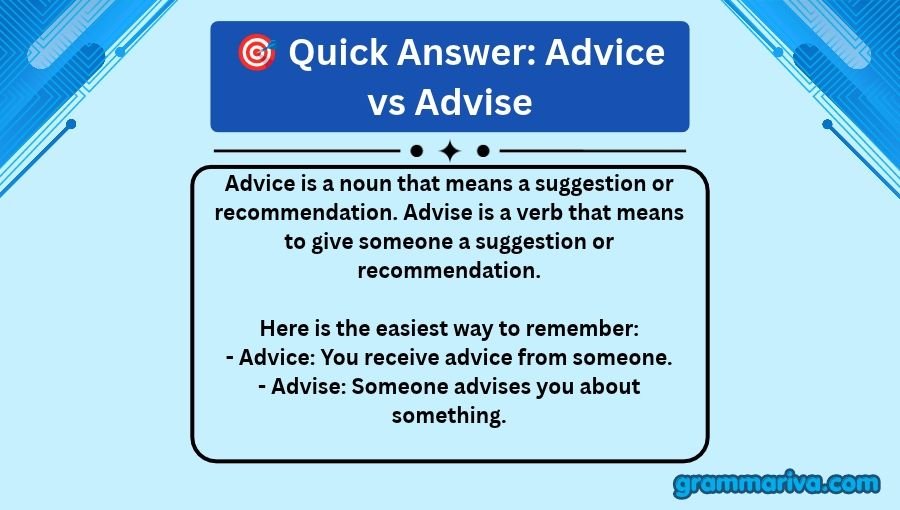
Advice is a noun that means a suggestion or recommendation. Advise is a verb that means to give someone a suggestion or recommendation.
Here is the easiest way to remember:
- Advice: You receive advice from someone.
- Advise: Someone advises you about something.
Examples:
- ✅ My teacher gave me useful advice.
- ✅ My teacher advised me to study harder.
Both sentences are correct because each word performs a different grammatical job.
Understanding the Basics of Advice vs Advise
The main difference between these words is their part of speech. One names a suggestion, while the other describes the action of giving that suggestion.
Although their meanings are connected, they cannot always replace each other.
Advice: Meaning and Correct Use
Advice is a noun. It refers to an opinion, suggestion, or recommendation that someone gives to help another person make a decision.
People often seek advice when they face a problem or need help with an important choice.
Examples:
- My father gave me excellent advice.
- I need your advice about my career.
- Her advice helped me avoid a mistake.
- The manager offered advice to the new employee.
- We followed the doctor’s advice.
In each sentence, advice names the suggestion or guidance being received.
Remember: You can give, receive, offer, share, or follow advice.
Advise: Meaning and Correct Use
Advise is a verb. It describes the action of giving someone advice or recommending a particular choice.
It tells readers what a person does rather than naming the suggestion itself.
Examples:
- I advise you to save money.
- My teacher advised me to practice daily.
- The doctor will advise the patient.
- She advised her friend to stay calm.
- We advise customers to read the instructions.
In these examples, advise describes an action.
Remember: You advise someone, but you give someone advice.
Main Comparison Table
| Form | Type | Meaning | Example | Correct/Incorrect |
|---|---|---|---|---|
| Advice | Noun | A suggestion | I need your advice. | ✅ Correct |
| Advise | Verb | To give a suggestion | I advise you to wait. | ✅ Correct |
| Advice | Used as a verb | Giving a suggestion | I advice you to wait. | ❌ Incorrect |
| Advise | Used as a noun | A suggestion | Thank you for your advise. | ❌ Incorrect |
Why Do People Confuse Advice and Advise?
People confuse these words because they have almost identical spellings and very similar meanings. Their different grammatical roles are easy to overlook, especially when typing quickly.
I once reviewed a student’s English assignment in which the sentence read, “My parents gave me good advise.” The student understood the meaning perfectly but had chosen the wrong word. Once I explained that advice names the suggestion, the student corrected the sentence immediately.
Here are three common reasons for this confusion:
- Similar spelling: Both words contain almost the same letters.
- Related meanings: Both are connected to suggestions and guidance.
- Similar sounds: Their pronunciation is close enough to cause confusion in everyday speech.
The best solution is to learn the noun-and-verb difference instead of relying only on spelling.
Is Advice a Noun or a Verb?
Advice is always used as a noun in standard English. It names a suggestion, recommendation, or piece of guidance.
A noun can be the subject or object of a sentence. Advice commonly appears after words such as some, good, helpful, and valuable.
Examples:
- Her advice was helpful.
- I received some advice.
- We appreciated his valuable advice.
- Your advice made a difference.
How Advice Works in Sentences
Consider this sentence:
“My brother gave me helpful advice.”
The sentence contains three important parts:
- My brother: The person giving the suggestion.
- Gave me: The action and recipient.
- Helpful advice: The suggestion being given.
The word advice acts as the object of the verb gave.
Why Is Advice an Uncountable Noun?
In standard English, advice is an uncountable noun. This means you generally do not add an s to make it plural.
You should not write advices when talking about multiple suggestions in ordinary standard English.
Instead, use expressions such as:
- A piece of advice.
- Two pieces of advice.
- Several suggestions.
- Some helpful advice.
- A few words of advice.
Examples:
- ✅ She gave me two pieces of advice.
- ❌ She gave me two advices.
- ✅ I received several useful suggestions.
- ❌ I received several useful advice.
Advice Usage Summary
| Meaning | Word Type | Example Sentence |
|---|---|---|
| A suggestion | Noun | I need your advice. |
| Helpful guidance | Noun | His advice was valuable. |
| A recommendation | Noun | We followed her advice. |
| An opinion intended to help | Noun | My friend offered some advice. |
Is Advise a Noun or a Verb?
Advise is a verb. It describes the action of recommending something or giving someone guidance.
It can appear in different tenses depending on when the action happens.
Examples:
- I advise my students to read daily.
- She advises people about their careers.
- The doctor advised him to rest.
- We will advise you after reviewing the details.
Present Tense
Use advise when talking about a current action or a general recommendation.
Examples:
- I advise you to be careful.
- Teachers advise students to complete their homework.
- The company advises customers to check their orders.
Past Tense
The past tense of advise is advised.
Examples:
- My father advised me to work hard.
- The lawyer advised her to review the contract.
- Our teacher advised us to prepare early.
Present Participle
The present participle is advising.
Examples:
- She is advising her younger brother.
- The manager is advising the new team.
- They are advising customers about the changes.
Advise Usage Summary
| Form | Word Type | Example |
|---|---|---|
| Advise | Base verb | I advise my friend. |
| Advises | Present-tense verb | She advises her students. |
| Advised | Past-tense verb | He advised me yesterday. |
| Advising | Present participle | They are advising us. |
💡 Test Tip: How to Remember the Difference
The easiest way to remember these words is to connect advice with a thing and advise with an action.
Try this simple test:
Ask yourself: Am I talking about a suggestion or giving a suggestion?
- If you’re talking about the suggestion itself, use advice.
- If you’re describing the action of giving a suggestion, use advise.
The Noun and Verb Memory Trick
Think of these two sentences:
- My friend gave me advice.
- My friend advised me.
Both communicate a similar idea, but their sentence structures are different.
Another helpful trick is to remember their final sounds:
- Advice ends with an /s/ sound.
- Advise ends with a /z/ sound.
This pronunciation difference can help you recognize the words when speaking.
Quick Memory Table
| Question | Correct Word |
|---|---|
| What did someone give you? | Advice |
| What did someone do? | Advise |
| What do you need? | Advice |
| What should someone do? | Advise |
| What did the teacher offer? | Advice |
| What did the teacher recommend? | Advise |
How to Use Advice and Advise in Everyday Sentences
Both words are useful in everyday English. You can use them when talking about school, work, relationships, money, health, or personal decisions.
The key is to choose the word that fits the sentence structure.
Examples With Advice
- My mother always gives me good advice.
- I asked my friend for advice.
- His advice helped me find a new job.
- She ignored the advice of her teacher.
- Thank you for your honest advice.
Examples With Advise
- I advise you to think carefully.
- My parents advise me to save money.
- The teacher advised us to study regularly.
- Experts advise people to plan ahead.
- I would advise against making a quick decision.
Sentence Comparison Table
| Advice Sentence | Advise Sentence |
|---|---|
| I need your advice. | I advise you to listen. |
| She gave me advice. | She advised me to wait. |
| His advice was useful. | He advised us to be careful. |
| We followed their advice. | They advised us to follow the rules. |
📝 Case Study: Advice vs Advise in a Professional Email
Imagine that a new employee wants help writing an email to a manager. The employee wants to ask for guidance about an upcoming project.
Here is an example of how both words can be used correctly.
Incorrect Email
Subject: Request for Advise
Hello Mr. Smith,
I need your advise about the new project. Could you advice me on how to manage the tasks?
Thank you for your help.
Correct Email
Subject: Request for Advice
Hello Mr. Smith,
I need your advice about the new project. Could you advise me on how to manage the tasks?
Thank you for your help.
What Changed?
There are two corrections:
- Request for Advice: The email asks for a suggestion, so the noun advice is correct.
- Could you Advise Me: The sentence asks the manager to perform an action, so the verb advise is correct.
Notice how changing just one letter makes a difference to the grammatical role of each word.
This is a useful example because professional emails often include requests for guidance.
⚖️ Grammar Rules Explanation: Advice vs Advise
The basic grammar rule is simple: advice is a noun, while advise is a verb.
Standard English grammar keeps these two forms separate because they perform different jobs in a sentence.
Rule 1: Use Advice After a Determiner or Adjective
Use advice when naming a suggestion.
Common expressions include:
- Some advice.
- Good advice.
- Helpful advice.
- Valuable advice.
- A piece of advice.
Examples:
- ✅ I received some helpful advice.
- ❌ I received some helpful advise.
- ✅ Her advice was excellent.
- ❌ Her advise was excellent.
Rule 2: Use Advise After a Subject
Use advise when describing what someone recommends.
Examples:
- ✅ I advise you to be patient.
- ❌ I advice you to be patient.
- ✅ The doctor advises regular exercise.
- ❌ The doctor advice regular exercise.
Rule 3: Use Advised for Past Actions
When describing something that happened in the past, use advised.
Examples:
- ✅ My teacher advised me to practice.
- ❌ My teacher advice me to practice.
- ✅ They advised us to leave early.
- ❌ They advice us to leave early.
Rule 4: Use Advice With Expressions of Quantity
Because advice is uncountable, use phrases such as a piece of advice rather than an advice.
Examples:
- ✅ She gave me a piece of advice.
- ❌ She gave me an advice.
- ✅ I need two pieces of advice.
- ❌ I need two advices.
Correct vs Incorrect at a Glance
| Sentence | Correct/Incorrect | Why |
|---|---|---|
| I need your advice. | ✅ Correct | Advice is a noun. |
| I advise you to wait. | ✅ Correct | Advise is a verb. |
| She gave me good advise. | ❌ Incorrect | The noun form is needed. |
| He advice me every day. | ❌ Incorrect | The verb form is needed. |
| My father advised me yesterday. | ✅ Correct | Advised is the past-tense verb. |
⚠️ Common Mistakes When Using Advice and Advise
The most common mistake is using one word in place of the other. This happens because both words are connected to recommendations and guidance.
Other mistakes involve plural forms, past tense, and sentence structure.
I once caught myself typing “Please advice me” in a quick work message. I noticed the mistake before sending it because I remembered that the sentence needed an action word. I changed it to “Please advise me.”
Similar Grammar Confusions
Advice and advise are not the only English words that cause spelling and grammar problems.
Here are some other common examples:
| Confusing Words | Difference | Correct Example |
|---|---|---|
| It’s / Its | Contraction / Possessive | It’s raining. |
| Your / You’re | Possessive / Contraction | You’re helpful. |
| There / Their | Place / Possession | Their house is large. |
| Affect / Effect | Usually verb / Usually noun | It affects me. |
| Then / Than | Time / Comparison | Better than before. |
| Loose / Lose | Not tight / Misplace | Don’t lose it. |
Common Wrong Spellings and Uses
| Wrong Form | What’s Wrong | Correct Form |
|---|---|---|
| I need your advise. | A noun is needed. | I need your advice. |
| Please advice me. | A verb is needed. | Please advise me. |
| She gave me an advice. | Advice is uncountable. | She gave me a piece of advice. |
| He gave me two advices. | Incorrect plural form. | He gave me two pieces of advice. |
| My teacher advice me. | Incorrect verb form. | My teacher advises me. |
| His advise was helpful. | Incorrect noun spelling. | His advice was helpful. |
Why These Mistakes Happen
Fast typing: People often type without checking the grammatical role of a word.
Autocorrect: Spell-check tools may accept both words because they are correctly spelled words in different contexts. They may not detect the wrong choice.
Lack of knowledge: Some writers know that both words relate to suggestions but do not understand the noun-and-verb difference.
Similar pronunciation: Their sounds are close, so it can be hard to notice the spelling difference during conversation.
The best way to avoid these errors is to read the full sentence and check whether you need a noun or a verb.
How to Use Advice and Advise in Different Contexts
Both words work in casual and formal English. However, the sentence structure determines which one you should choose.
Everyday Conversation
Use advice when talking about suggestions from friends or family.
Use advise when describing the act of recommending something.
Examples:
- My sister gave me great advice.
- I advise you to talk to your parents.
Professional Writing
These words are common in workplace communication.
Examples:
- We appreciate your advice.
- Our team advises clients on project planning.
Creative Writing
Writers can use both words in stories, dialogue, and character descriptions.
Examples:
- The old man offered the traveler some advice.
- The wise woman advised the young prince to remain patient.
Social Media and Texting
Both words appear in online messages, captions, and comments.
Examples:
- I need some advice about my new job.
- Can you advise me on which phone to buy?
Context Comparison Table
| Context | Which Term to Use | Example |
|---|---|---|
| Everyday conversation | Both | I need advice. / I advise you to wait. |
| Professional writing | Both | Thank you for your advice. |
| Creative writing | Both | She advised him to leave. |
| Social media/texting | Both | Please give me some advice. |
Common Phrases With Advice and Advise
Several everyday expressions use these words naturally. Learning them can help you remember the correct form.
Common Phrases With Advice
| Phrase | Meaning |
|---|---|
| A piece of advice | One helpful suggestion |
| Good advice | A useful recommendation |
| Sound advice | Wise or sensible guidance |
| Words of advice | Suggestions offered to someone |
| Seek advice | Ask someone for guidance |
| Follow someone’s advice | Act according to a recommendation |
Common Phrases With Advise
| Phrase | Meaning |
|---|---|
| I would advise | A polite way to recommend something |
| Strongly advise | Recommend something firmly |
| Advise against | Recommend not doing something |
| Advise someone to | Tell someone what action is recommended |
| Please be advised | A formal way to provide information |
| Advise on | Give guidance about a subject |
Examples:
- My father gave me a piece of advice.
- I would advise you to stay calm.
- Experts advise against risky decisions.
- Please be advised that the office will close early.
How to Remember the Difference Between Advice and Advise
Remembering the difference becomes easier when you use a short memory trick.
The S and Z Sound Trick
The final sound can help you recognize the words:
- Advice: Ends with an /s/ sound.
- Advise: Ends with a /z/ sound.
This is a helpful way to distinguish them when speaking.
The Noun and Verb Trick
Remember this simple pattern:
- Advice = Thing.
- Advise = Action.
For example:
“I received advice because my friend advised me.”
The first word names the suggestion. The second word describes the action.
The Replace-It Trick
You can also replace the word with another word to check whether it fits.
Try these substitutions:
- Advice → Suggestion.
- Advise → Recommend.
Examples:
- I need your suggestion. (Correct)
- I need your recommend. (Incorrect)
- I recommend you to wait. (The intended verb meaning is clear, although “I recommend that you wait” is more natural.)
- I need your recommendation. (Correct)
This test can help you identify the right grammatical form.
Synonyms and Alternatives for Advice and Advise
Sometimes you may want to use another word to make your writing more varied.
However, not every alternative works in every sentence. Choose a replacement that matches the meaning and grammatical role.
Alternatives for Advice
| Alternative | Works When | Does Not Work When |
|---|---|---|
| Suggestion | Talking about an idea or recommendation | Referring to the action of recommending |
| Guidance | Talking about help or direction | Referring to one specific command |
| Recommendation | Giving a formal or helpful suggestion | Describing the act of advising |
| Tip | Sharing a short, practical idea | Giving detailed professional guidance |
| Counsel | Discussing serious or professional guidance | Referring to casual everyday tips |
Alternatives for Advise
| Alternative | Works When | Does Not Work When |
|---|---|---|
| Recommend | Suggesting a choice or action | Naming a suggestion |
| Suggest | Offering an idea | Referring to advice as a noun |
| Guide | Helping someone choose a direction | Making a simple recommendation |
| Counsel | Giving careful guidance | Referring to casual suggestions |
| Encourage | Supporting someone to take action | Giving direct instructions |
Examples:
- My friend gave me a useful suggestion.
- I recommend that you read the instructions.
- The teacher guided us through the task.
- Her counselor offered helpful guidance.
Why Getting Advice and Advise Right Matters
Using the correct word helps your writing sound clear, professional, and easy to understand.
Although readers may understand what you mean when you make a small spelling mistake, repeated errors can affect the quality of your writing.
Clarity in Communication
Correct word choice helps readers understand your message without confusion.
For example:
- “I need your advice” asks for a suggestion.
- “I advise you” means you are giving a recommendation.
These sentences communicate different ideas.
Professionalism
Correct grammar creates a better impression in business emails, reports, job applications, and official documents.
It shows that you care about clear communication.
Digital Communication
Social media posts, online articles, and text messages are often read quickly. Correct spelling makes your content easier to understand.
A simple grammar check can prevent small mistakes from affecting your message.
A useful writing reminder:
“Clear words make clear messages.”
Why It Matters Table
| Situation | Why Getting It Right Matters |
|---|---|
| Resume | Shows attention to detail. |
| Client email | Creates a professional impression. |
| Published content | Improves writing quality. |
| Social post | Makes the message easier to understand. |
Quick Recap Checklist: Advice vs Advise
Use this checklist whenever you are unsure which word belongs in your sentence.
| Question | If Yes → Use |
|---|---|
| Are you talking about a suggestion? | Advice |
| Are you asking for guidance? | Advice |
| Are you describing the action of recommending? | Advise |
| Are you telling someone what they should do? | Advise |
| Are you talking about a past recommendation? | Advised |
| Are you describing an ongoing recommendation? | Advising |
Practice Examples
Try choosing the correct word in each sentence before checking the answers.
Example A: My teacher gave me helpful ______.
Answer: Advice.
Example B: I ______ you to read the book.
Answer: Advise.
Example C: My parents ______ me to work hard last year.
Answer: Advised.
More Practice
Choose the correct option:
- I need your (advice / advise).
- She will (advice / advise) her students.
- He gave me a useful piece of (advice / advise).
Correct Answers:
- Advice.
- Advise.
- Advice.
FAQs About Advice vs Advise
What Is the Main Difference Between Advice and Advise?
Advice is a noun that means a suggestion or recommendation. Advise is a verb that means to give someone a suggestion or recommendation.
Example: “She gave me advice” and “She advised me to study.”
Is Advice a Noun or a Verb?
Advice is a noun. It refers to helpful information, guidance, or a recommendation.
Example: “Thank you for your advice.”
Is Advise a Noun or a Verb?
Advise is a verb. It describes the action of recommending something or giving someone guidance.
Example: “I advise you to be careful.”
Can I Say a Piece of Advice?
Yes. “A piece of advice” is the correct expression when referring to one suggestion.
Example: “My teacher gave me a piece of advice.”
Is Advices Ever Correct?
In standard everyday English, advice is an uncountable noun and does not normally have a plural form. Use “pieces of advice” or “suggestions” instead.
What Is the Past Tense of Advise?
The past tense of advise is advised.
Example: “My father advised me to save money.”
Is It Please Advice Me or Please Advise Me?
“Please advise me” is correct because the sentence requires a verb.
“Advice” is a noun and cannot perform the same job in this sentence.
How Do You Pronounce Advice and Advise?
Advice ends with an /s/ sound, while advise ends with a /z/ sound. Their different final sounds help distinguish them in spoken English.
Can Advice and Advise Be Used in the Same Sentence?
Yes. Both words can appear in one sentence because they have different grammatical roles.
Example: “I advise you to follow your teacher’s advice.”
How Can I Remember Advice vs Advise Easily?
Remember that advice is a thing and advise is an action.
You receive advice, and someone advises you.
Conclusion
Understanding advice vs advise becomes simple when you remember one basic grammar rule: advice is a noun, and advise is a verb. Advice refers to a suggestion or helpful recommendation, while advise describes the action of giving that recommendation.
Whenever you write a sentence, ask yourself whether you are naming a suggestion or describing an action. If you’re talking about something someone gives or receives, choose advice. If you’re describing what someone recommends, choose advise. Also, remember that advice is uncountable, so expressions such as “a piece of advice” are correct.
I recommend practicing these words in everyday conversations, emails, and short writing exercises. The more you use them correctly, the easier the difference becomes.
You don’t need to memorize complicated grammar rules to master this topic. Just remember one simple idea: You give advice, but you advise someone. Keep that rule in mind, and you’ll rarely confuse these two words again! 🎯
Do you like this personality?

Hi, I’m Lucas Bennett. I’m a grammar content specialist at Grammariva. I work on articles covering everyday grammar questions, sentence usage, and writing tips that readers can apply with confidence.


[…] mistakes in simple language. By the end, you will know exactly which spelling to choose. 😊 Advice vs Advise | Loose vs Lose | Than vs […]
[…] to remember the rule. Let’s make this spelling choice easy! ✍️ Practice vs Practise | Advice vs Advise | Loose vs […]