
Have you ever wondered about license vs licence and which spelling is correct? These two spellings look almost the same, but their use depends on the type of English you are writing. Choosing the right one can make your writing clearer and more professional, especially in schoolwork, business emails, and official documents.
The good news is that the rule is simple once you understand it. In American English, license is the correct spelling for both the noun and the verb. In British English, the spelling changes depending on the word’s role in a sentence. This small difference often causes confusion for students, writers, and people who work with international readers.
As an editor, I always suggest checking the audience before choosing a spelling. 🇺🇸 A consistent spelling style makes your writing easier to read and more professional. In this guide, I will explain the difference, show clear examples, and share simple ways to remember the rule. Let’s make this spelling choice easy! ✍️ Practice vs Practise | Advice vs Advise | Loose vs Lose
🎯 Quick Answer: License vs Licence
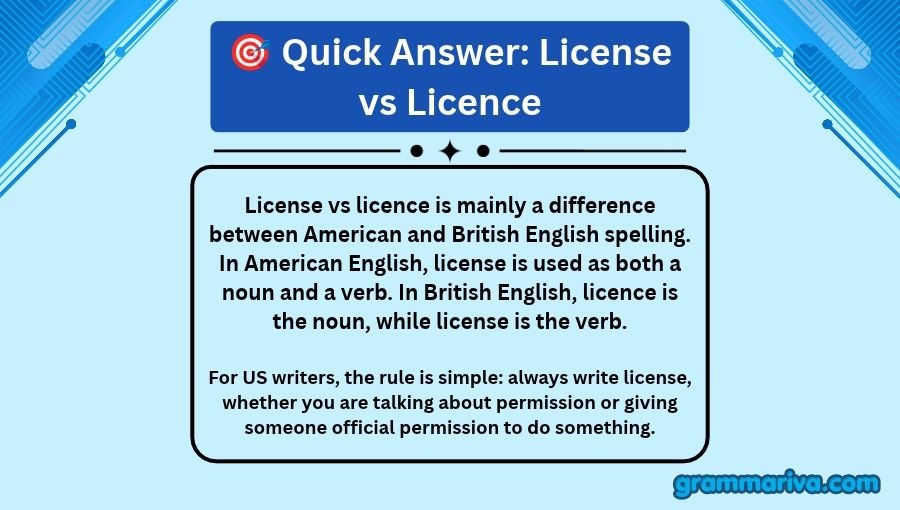
License vs licence is mainly a difference between American and British English spelling. In American English, license is used as both a noun and a verb. In British English, licence is the noun, while license is the verb.
For US writers, the rule is simple: always write license, whether you are talking about permission or giving someone official permission to do something.
- American English: License (noun and verb).
- British English: Licence (noun), license (verb).
- Canadian English: Licence is commonly used as the noun, while license is the verb.
Understanding the Basics of License vs Licence
The main difference between these spellings is the regional writing style. American English uses one spelling for both word forms. British English uses two spellings to show whether the word is a noun or a verb.
A noun names something. A verb describes an action. Understanding this basic grammar rule will help you choose the right spelling.
| Form | Type | Meaning | Example |
|---|---|---|---|
| License | American noun | Official permission | I renewed my driver’s license. |
| License | American verb | To give official permission | The state will license the business. |
| Licence | British noun | Official permission | She showed her driving licence. |
| License | British verb | To give official permission | The council will license the shop. |
What Does License Mean?
In American English, license is a noun when it refers to official permission, a legal document, or approval to do something.
Examples:
- I need a license to drive a car.
- Her business license expires next month.
- The restaurant received its license.
- He applied for a professional license.
In these examples, the word names a form of permission or proof of approval.
What Does Licence Mean?
In British English, licence is the noun form of the word. It has the same basic meaning as the American noun license.
Examples:
- He renewed his driving licence.
- The shop has a valid business licence.
- She keeps her fishing licence in her wallet.
However, American writers should use license in these sentences.
Is License a Noun or a Verb?
In American English, license can be both a noun and a verb. Its spelling does not change when its grammar role changes.
As a noun:
- She has a license to teach.
- My license is still valid.
As a verb:
- The state will license the new company.
- Local officials license food businesses.
In British English, the noun is licence, but the verb remains license.
License vs Licence: Key Differences in American and British English
The most useful way to understand these spellings is to compare their regional rules. American English keeps the spelling the same. British English uses c for the noun and s for the verb.
| Feature | American English | British English |
|---|---|---|
| Noun spelling | License | Licence |
| Verb spelling | License | License |
| Driver’s document | Driver’s license | Driving licence |
| Business permission | Business license | Business licence |
| Action of granting permission | License | License |
| Standard US usage | License | Not standard US spelling |
Why Does American English Use License for Both Forms?
American English follows a simpler spelling pattern for this word. The noun and verb share the same spelling, even though they perform different jobs in a sentence.
For example:
- The company needs a license. (Noun)
- The government will license the company. (Verb)
The spelling remains unchanged. You only need to understand how the word works in the sentence.
Why Does British English Use Licence for the Noun?
British English uses different endings to separate the noun and verb forms.
- Licence refers to permission or an official document.
- License describes the action of giving permission.
This pattern is similar to other British English word pairs, such as practice and practise.
Does the Spelling Change the Meaning?
No. The basic meaning remains the same. Both spellings refer to official permission or the act of granting it.
The difference is based on regional spelling rules and grammar. A British reader and an American reader will usually understand both forms, but each audience expects a different standard spelling.
Correct Meanings and Uses of License
The word license has several common uses in American English. It can describe legal permission, a document, or the act of allowing someone to do something.
License as a Noun for Official Permission
A license can give someone legal permission to perform an activity.
Examples:
- The company received a license to sell food.
- You need a license to operate a taxi.
- The city issued a license for the event.
Sentence breakdown:
In the sentence “You need a license to operate a taxi”:
- You = subject.
- Need = verb.
- A license = noun phrase.
- To operate a taxi = explains the activity.
The word license names the permission required for the activity.
License as a Noun for an Official Document
A license can also refer to a physical or digital document that proves someone has permission.
Examples:
- I left my driver’s license at home.
- Please bring your professional license.
- Her fishing license is in the car.
Here, the word refers to proof of permission rather than the permission itself.
License as a Verb for Granting Permission
As a verb, license means to officially allow a person or business to perform an activity.
Examples:
- The state will license the new company.
- Officials license qualified drivers.
- The agency can license private training centers.
Sentence breakdown:
In “The state will license the new company”:
- The state = subject.
- Will license = verb phrase.
- The new company = object.
The word describes an action performed by the state.
License as a Verb in Professional Settings
Businesses, government agencies, and professional groups often use license when discussing official approval.
Examples:
- The board will license qualified nurses.
- The agency licenses childcare centers.
- Local officials license commercial vehicles.
The word works as a verb because it describes the action of granting permission.
Summary of the Main Meanings
| Meaning | Word Type | Example Sentence |
|---|---|---|
| Official permission | Noun | I need a license to work. |
| Proof of permission | Noun | She showed her license. |
| Granting permission | Verb | The state will license the company. |
| Official approval of a business | Verb | The agency licenses restaurants. |
💡 Test Tip: How to Choose the Right Form
If you are writing in American English, use license for both nouns and verbs.
If you are checking British English, ask whether the word names permission or describes an action.
- If it names permission, use licence.
- If it describes granting permission, use license.
A simple question can help: “Is this word naming something or describing an action?”
Is License Correct in American English?
Yes. License is the standard American English spelling for both the noun and the verb. You should use it in school assignments, business documents, website content, and everyday writing intended for US readers.
Examples:
- My driver’s license needs to be renewed.
- The company received a business license.
- The state will license the new building.
- She has a license to practice law.
The spelling licence is not the standard American form.
American English Examples
| Sentence | Correct or Incorrect? | Explanation |
|---|---|---|
| I renewed my driver’s license. | ✅ Correct | American noun spelling. |
| She has a valid driving licence. | ❌ Incorrect | Use license in US English. |
| The state will license the company. | ✅ Correct | Correct American verb spelling. |
| He applied for a business licence. | ❌ Incorrect | Use business license in US English. |
| The agency licenses restaurants. | ✅ Correct | Correct verb form. |
Is Licence Correct in British English?
Yes. Licence is the standard British English spelling when the word is used as a noun. It refers to official permission or a document that proves permission.
However, British English uses license as a verb.
Examples:
- She renewed her driving licence.
- The shop has a valid licence.
- The council will license the business.
British English Examples
| Sentence | Correct or Incorrect? | Explanation |
|---|---|---|
| I need a driving licence. | ✅ Correct | British noun spelling. |
| She received a business license. | ❌ Incorrect | Use licence as a British noun. |
| The council will license the shop. | ✅ Correct | British verb spelling. |
| He showed his licence to the officer. | ✅ Correct | British noun spelling. |
📝 Case Study: License vs Licence in a Workplace Email
Imagine that a company in New York is preparing an email for a new employee. The employee must submit an official document before starting work.
A manager writes:
“Please send a copy of your professional licence before Monday.”
The message is easy to understand. However, the spelling does not follow standard American English.
The corrected sentence is:
“Please send a copy of your professional license before Monday.”
Why is this version better?
- The company is based in the United States.
- The word refers to an official document.
- American English uses license as a noun.
- The corrected sentence follows US spelling standards.
I once reviewed a workplace document that mixed British and American spellings on the same page. The meaning was clear, but the inconsistent style made the document look poorly edited. That is why I recommend choosing one English style before you begin writing.
Grammar Rules Explanation: When to Use License and Licence
The correct spelling depends on two things: your audience and the word’s role in the sentence. American English uses license for both nouns and verbs. British English uses licence for nouns and license for verbs.
Here are the main grammar rules.
Rule 1: Use License as a Noun in American English
A noun names a person, place, thing, or idea. When license refers to official permission or a document, it works as a noun.
Correct examples:
- My driver’s license expires in June.
- She needs a license for her new business.
- The company has a valid operating license.
Incorrect for American English:
- My driver’s licence expires in June.
- She needs a licence for her new business.
Both incorrect examples use British noun spelling. They should use license when following US English standards.
Rule 2: Use License as a Verb in American English
A verb describes an action. When someone officially grants permission, license works as a verb.
Correct examples:
- The government will license the new company.
- The board licenses qualified professionals.
- Officials licensed the restaurant last year.
The spelling stays the same in all these examples.
Rule 3: Follow the Noun and Verb Difference in British English
British English uses licence for the noun and license for the verb.
Examples:
- She has a driving licence. (Noun)
- The council will license the business. (Verb)
Do not apply this British rule to American writing.
Rule 4: Keep Your English Style Consistent
A document should follow one main spelling system. Avoid switching between American and British spellings without a clear reason.
For example, if your website targets American readers, write:
- Driver’s license
- Business license
- Professional license
- Licensed driver
Do not randomly replace these with British spellings.
Correct vs Incorrect at a Glance
| Sentence | Correct/Incorrect | Why |
|---|---|---|
| I need a license to drive. | ✅ Correct | Standard American noun spelling. |
| She received a new licence. | ❌ Incorrect in US English | British noun spelling. |
| The state will license the store. | ✅ Correct | Correct American verb spelling. |
| He showed his driver’s licence. | ❌ Incorrect in US English | Use driver’s license. |
| The agency licenses new businesses. | ✅ Correct | Correct American verb form. |
⚠️ Common Mistakes People Make With License and Licence
People often mix up these spellings because they look almost identical. The difference is only one letter, so it is easy to overlook.
Here are three common reasons for these errors.
Fast Typing
People often type quickly without checking each word. When writing an email or filling out a form, they may use whichever spelling comes to mind first.
For example:
- Incorrect for US English: Please attach your driving licence.
- Correct for US English: Please attach your driving license.
Autocorrect
Autocorrect can also cause problems. A device set to British English may suggest licence even when you are writing for an American audience.
Always check your keyboard’s language settings when preparing important documents.
Lack of Grammar Knowledge
Some writers know that the two spellings exist but do not know when to use each one. They may think one is outdated or that the two forms have completely different meanings.
The actual rule is based on regional spelling and grammar.
I once caught myself using licence while editing a US-focused article after working on several British English pages. It was a useful reminder that even experienced writers need to check their spelling style.
Similar Grammar Confusions
License and licence are not the only words that confuse writers. English has several word pairs that look or sound similar but follow different rules.
| Word Pair | Difference | Example |
|---|---|---|
| It’s / Its | Contraction / Possessive | It’s raining. / The dog wagged its tail. |
| Your / You’re | Possessive / Contraction | Your book is here. / You’re welcome. |
| There / Their | Place / Possessive | Go there. / Their house is large. |
| Advice / Advise | Noun / Verb | I need advice. / Please advise me. |
| Practice / Practise | British noun / verb | Practice is the US spelling for both. |
Common Wrong Spellings and Uses
The following table shows mistakes that American writers should avoid.
| Wrong Form | What’s Wrong | Correct Form |
|---|---|---|
| Driving licence | British noun spelling | Driving license |
| Business licence | British noun spelling | Business license |
| Professional licence | British noun spelling | Professional license |
| To licence a business | Incorrect American verb spelling | To license a business |
| The company was licenced | Incorrect US spelling | The company was licensed |
| Licence holder | British noun spelling | License holder |
How to Avoid These Mistakes
Use these simple habits:
- Set your spell-check language to US English.
- Check the target audience before writing.
- Use the same spelling throughout a document.
- Review official terms before publishing.
- Read your sentences aloud to catch other grammar errors.
How Is License Used in Different Contexts?
The word license appears in everyday conversations, professional documents, creative writing, and online communication. Its spelling stays the same across these settings when you follow American English.
Everyday Conversation
People often use license when talking about driving, work, or permission.
Examples:
- Do you have your driver’s license?
- I need to renew my license.
- He finally got his license.
Professional Writing
Businesses and government offices use the word when discussing legal approval and official documents.
Examples:
- Please submit a copy of your professional license.
- The company must obtain a business license.
- Our agency licenses qualified applicants.
Creative Writing
Writers can use license when describing permission, freedom, or an official document.
Examples:
- She kept her license in the small leather wallet.
- The artist received a license to display the work.
- He had the freedom to create without asking for a license.
Social Media and Texting
On social media, people usually write the word in its standard form.
Examples:
- Finally got my driver’s license! 🚗
- One step closer to my dream career. Professional license secured!
- No more asking for rides. I passed my driving test!
Usage by Context
| Context | Which Term to Use | Example |
|---|---|---|
| Everyday conversation | License (US) | I got my license yesterday. |
| Professional writing | License (US) | Submit your business license. |
| Creative writing | License (US) | She received a license to perform. |
| Social media/texting | License (US) | My driver’s license is finally here! |
Common Phrases and Expressions With License
Several common expressions use the word license. These phrases are useful in everyday speech and professional writing.
Here are some examples.
| Phrase | Meaning |
|---|---|
| Driver’s license | Official permission to drive |
| Business license | Permission to operate a business |
| Professional license | Approval to work in a regulated profession |
| Fishing license | Permission to fish under applicable rules |
| Marriage license | Legal document authorizing a marriage |
| Software license | Permission to use a software program under certain terms |
Examples in Sentences
- Driver’s license: I received my driver’s license last week.
- Business license: The owner applied for a business license.
- Professional license: She needs a professional license for her job.
- Fishing license: We bought a fishing license before the trip.
- Marriage license: The couple applied for a marriage license.
- Software license: The company purchased a software license for its employees.
These expressions are common in American English. Use license in each one.
Synonyms and Alternatives to License
Sometimes, you can replace license with another word or phrase. However, the best alternative depends on the sentence.
Not every alternative has exactly the same meaning. For example, permit and authorization can describe permission, but they may refer to different types of official approval.
| Alternative | Works When | Does Not Work When |
|---|---|---|
| Permit | Referring to official permission | Referring to a specific license document or system |
| Authorization | Describing approved access or action | Naming a particular legal license |
| Approval | Describing acceptance or permission | Referring to a formal license number |
| Certification | Describing proof of qualifications | Describing every type of legal permission |
| Permission | Talking about being allowed to do something | Referring to a formal document with legal requirements |
Examples of Alternative Words
License → Permit
- Original: I need a license to park here.
- Alternative: I need a permit to park here.
This works when the local authority uses permits for parking approval.
License → Authorization
- Original: The employee needs a license to access the system.
- Alternative: The employee needs authorization to access the system.
The second sentence focuses on approved access rather than a formal license.
License → Certification
- Original: She has a professional license.
- Alternative: She has professional certification.
These terms are not always interchangeable. A certification may show that someone has completed training, while a license may be legally required to perform certain work.
Why Does Correct License Spelling Matter?
Correct spelling helps readers understand your message. It also shows that you have paid attention to the writing style expected by your audience.
Even a small spelling difference can make a document look inconsistent.
Clarity in Communication
Correct spelling helps readers understand what you mean. It prevents unnecessary confusion, especially when discussing legal documents and official permission.
Professionalism
A well-edited email, report, or website creates a better impression. Consistent spelling shows care and attention to detail.
Accuracy in Digital Communication
Online content reaches readers from different countries. Using the correct regional spelling helps your content match its intended audience.
A Simple Thought to Remember
“Clear writing begins with choosing words that fit your reader.”
Why Getting the Spelling Right Matters
| Situation | Why Getting It Right Matters |
|---|---|
| Resume | Keeps professional writing consistent. |
| Client email | Creates a clear and polished message. |
| Published content | Matches the spelling style of the target audience. |
| Social media post | Makes your message look accurate and natural. |
How to Remember the Difference Between License and Licence
The easiest way to remember the rule is to connect the spelling with your target audience.
If you write for American readers, always use license. If you write for British readers, remember the noun and verb distinction.
Simple Memory Tricks
- US English: License for everything.
- British English: Licence is the noun.
- British English: License is the verb.
- Canadian English: Licence is commonly used as the noun, while license is the verb.
The Noun and Verb Test
Try replacing the word with another noun or verb.
Example:
“She has a valid license.”
You can replace license with document. This shows that it is a noun.
Example:
“The state will license the company.”
You can replace license with approve. This shows that it is a verb.
This test helps you understand the grammar role without memorizing a long list of rules.
Can You Use License and Licence in the Same Document?
You can use both spellings when you are discussing different regional English standards. However, you should not mix them randomly in a document written for one audience.
For example, a guide comparing American and British English may correctly include both forms:
- American English: driver’s license.
- British English: driving licence.
In this case, each spelling is used to explain a different regional rule.
However, a US business report should use license consistently.
When Is Mixing Both Forms Acceptable?
| Situation | Is Mixing Acceptable? | Reason |
|---|---|---|
| American business report | ❌ No | Use American spelling consistently. |
| British school assignment | ❌ No | Follow British spelling rules. |
| International grammar guide | ✅ Yes | Both forms may be needed for comparison. |
| Article about regional English | ✅ Yes | The article explains both standards. |
Quick Recap Checklist: License vs Licence
Use this checklist before publishing your writing. It will help you select the correct spelling without spending too much time checking grammar rules.
| Question | If Yes → Use |
|---|---|
| Are you writing for American readers? | License |
| Are you using American English for a noun? | License |
| Are you using American English for a verb? | License |
| Are you writing a British English noun? | Licence |
| Are you writing a British English verb? | License |
| Are you comparing both regional styles? | Both, where appropriate |
Practice Examples
Test your knowledge with these three examples.
Example A: I need a new driver’s ______.
Answer: License
This is an American English noun.
Example B: The government will ______ the new company.
Answer: License
This is a verb describing the action of granting permission.
Example C: She renewed her driving ______.
Answer: Licence in British English; License in American English
Both choices depend on the regional writing style.
FAQs About License vs Licence
Is license or licence correct in American English?
License is correct in American English for both the noun and the verb. For example, Americans write driver’s license and license a business.
What is the difference between license and licence?
The difference is mainly regional. American English uses license for nouns and verbs. British English uses licence as a noun and license as a verb.
Is licence ever correct?
Yes. Licence is the standard British English noun spelling. It is also commonly used as a noun in Canadian English.
Is driver’s license or driver’s licence correct?
In American English, driver’s license is correct. In British English, driving licence is the standard expression.
Is license a noun or a verb?
In American English, license can be both. It is a noun when it refers to official permission or a document. It is a verb when it means to grant official permission.
Why do British people spell license differently?
British English uses licence for the noun and license for the verb. This spelling difference helps show the grammatical role of the word.
Is licensed or licenced correct?
Licensed is the standard spelling in American and British English. For example, “She is a licensed driver.” The spelling licenced is not the standard form.
Is licensing or licencing correct?
Licensing is the standard spelling in both American and British English. For example, “The agency is responsible for licensing businesses.”
Is license the same as permit?
They have similar meanings, but they are not always interchangeable. Both can refer to official permission. However, the exact legal use depends on the activity and the rules of the issuing authority.
Which spelling should I use for an American audience?
Always use license. This applies to nouns, verbs, common expressions, and related forms such as licensed and licensing.
Conclusion
Understanding license vs licence is easy once you know the difference between American and British English. In the United States, license is the correct spelling for both nouns and verbs. You should write driver’s license, business license, and license a company when following American English rules.
British English follows a slightly different pattern. It uses licence as a noun and license as a verb. Both regional forms are correct within their own spelling systems.
As a writer and editor, I recommend choosing your target audience before starting an article, email, or professional document. This simple habit will help you avoid spelling mistakes and keep your writing consistent. 🇺🇸
Remember these three points:
- American English: License for nouns and verbs.
- British English: Licence for nouns.
- Both styles: License for verbs.
You do not need to memorize complicated grammar rules. Just remember your audience and apply the correct spelling every time.
One small spelling choice can make a big difference in clear, confident writing! ✍️

Hi, I’m Nathan Reed. I’m a grammar and writing specialist at Grammariva. I work on practical grammar content that helps readers understand sentence structure, punctuation, vocabulary, and better writing habits.


[…] easy memory tricks. By the end, you’ll know exactly which spelling fits your sentence. 🎯 License vs Licence | Practice vs Practise | Advice vs […]