Have you ever stopped while writing a sentence and wondered whether also has or has also is the correct word order? 🤔 You are not alone.
Both forms contain the same three words, but their position can change the rhythm and focus of a sentence. The good news is that both also has and has also can be grammatically correct. The right choice depends on what comes before them and how the sentence is structured.
I teach grammar by looking at patterns rather than asking students to memorize long lists of rules. That approach works well here. Once you understand where also normally sits with the verb has, the choice becomes much easier.
In this guide, I will explain the difference between the two forms, show you when to use each one, and give you plenty of clear examples. I will also cover common mistakes, professional writing, everyday speech, FAQs, and simple tests you can use when you are unsure. By the end, choosing between these forms should feel natural. ✨ Set vs Sit | Seen vs Scene | Family Was or Family Were
🎯 Quick Answer: Also Has or Has Also
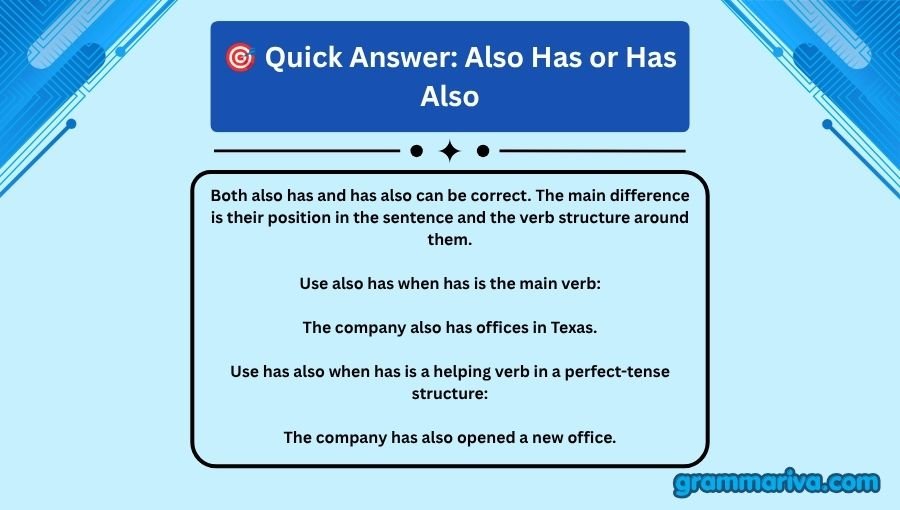
Both also has and has also can be correct. The main difference is their position in the sentence and the verb structure around them.
Use also has when has is the main verb:
The company also has offices in Texas.
Use has also when has is a helping verb in a perfect-tense structure:
The company has also opened a new office.
A simple rule is this: when has is the main verb meaning “possesses” or “contains,” also usually comes before it. When has helps form the present perfect, also usually comes after has and before the past participle.
📚 Understanding the Basics of Also Has or Has Also
The key difference is not simply style. It is often connected to the job that has performs in the sentence.
When has expresses possession, ownership, relationships, features, or characteristics, also commonly comes before it.
Sarah also has a new laptop.
Here, has means that Sarah possesses a laptop.
But when has works as a helping verb, also normally comes between has and the main verb.
Sarah has also bought a new laptop.
Here, has does not mean possession. It helps create the present perfect tense. The main action is bought.
Also Has vs Has Also at a Glance
| Form | Type | Meaning | Example | Correct/Incorrect |
|---|---|---|---|---|
| also has | also + main verb | Has something in addition | She also has a car. | ✅ Correct |
| has also + past participle | helping verb + also + main verb | Has done something in addition | She has also bought a car. | ✅ Correct |
| has also | has + also | Can show an additional action or fact | He has also agreed. | ✅ Correct |
| also has + noun | also + possession verb | Possesses something else | He also has a ticket. | ✅ Correct |
| has also + base verb | Incorrect tense pattern | Wrong after present-perfect has | He has also buy a ticket. | ❌ Incorrect |
The important point is that also does not randomly move around. Its position is affected by the role of has.
🔎 Is Also Has Correct?
Yes, also has is correct when has functions as the main verb.
For example:
Maria also has two brothers.
The sentence says that Maria has two brothers in addition to something already mentioned.
Another example:
This phone also has a better camera.
Here, has expresses a feature or quality of the phone.
When Also Has Comes Before a Noun
This is one of the most common patterns.
The house also has a large garage.
Breakdown:
- The house = subject
- also = adverb
- has = main verb
- a large garage = object
The word also tells the reader that the garage is an additional feature.
More Examples
The restaurant also has vegetarian options. ✅
My brother also has a passport. ✅
The school also has an evening program. ✅
This laptop also has a touch screen. ✅
The apartment also has a balcony. ✅
These sentences all use has as the main verb.
🔎 Is Has Also Correct?
Yes, has also is correct when has is functioning as a helping verb before another verb.
For example:
She has also completed the training.
Here, completed is the main verb. Has helps form the present perfect tense.
Another example:
The team has also won two other games.
The action is won, while has helps form the tense.
The Basic Pattern
The common structure is:
Subject + has + also + past participle
Examples include:
He has also visited Canada. ✅
She has also written a book. ✅
The company has also launched a new product. ✅
Daniel has also finished his report. ✅
This pattern is especially common in formal and professional writing.
🧩 Why Do People Confuse Also Has and Has Also?
People often confuse these forms because the words themselves are identical. Only their order changes.
The bigger issue is that has can play two different roles.
It can be a main verb:
She has a new job.
Or it can be a helping verb:
She has started a new job.
That small difference changes where also naturally appears.
I once reviewed a student’s essay where nearly every sentence used has also, even when the student meant possession. The student had learned that “also” often comes after “has” but had not learned why. Once we changed has from a helping verb to a main verb in the examples, the pattern became much easier to understand.
A Simple Comparison
| Sentence | Role of Has | Meaning |
|---|---|---|
| She also has a dog. | Main verb | She possesses a dog too. |
| She has also adopted a dog. | Helping verb | She has completed the action of adopting. |
| The store also has a website. | Main verb | The store possesses/maintains a website. |
| The store has also opened online. | Helping verb | The store has completed an action. |
| He also has a question. | Main verb | He possesses or has a question. |
🎯 How Does Also Has Work in a Sentence?
Also has usually appears when has means possession, ownership, inclusion, or a feature.
This makes the structure easy to spot:
Subject + also has + noun
For example:
The museum also has a gift shop.
The object after has is a gift shop, a noun phrase.
Another example:
Our office also has a meeting room.
Again, has is the main verb.
Common Uses of Also Has
You can use this form to talk about:
- possession
- features
- relationships
- available options
- physical parts
- qualities
- additional facts
For example:
The car also has heated seats.
Emma also has three cousins.
The package also has a tracking number.
This plan also has several benefits.
All four sentences use has as the main verb.
💡 How Does Has Also Work in a Sentence?
Has also commonly appears before a past participle when has is part of the present perfect tense.
The basic structure is:
Subject + has + also + past participle
For example:
The manager has also approved the request.
The word approved is the past participle.
Other examples include:
The company has also changed its policy.
She has also completed the course.
The team has also improved its performance.
He has also spoken with the client.
In each case, has is helping the main verb.
A Useful Pattern Table
| Pattern | Example | Correct? |
|---|---|---|
| Subject + also has + noun | She also has a car. | ✅ |
| Subject + has also + past participle | She has also bought a car. | ✅ |
| Subject + also has + past participle | She also has bought a car. | ⚠️ Possible but less natural in most contexts |
| Subject + has also + noun | She has also a car. | ❌ Usually unnatural in modern US English |
| Subject + has also + base verb | She has also buy a car. | ❌ |
📝 Correct Meanings and Uses
The two forms can communicate related ideas, but they are not always interchangeable.
1. Possession or Ownership
Use also has when has means possession.
The company also has a branch in Miami. ✅
The company has a branch in Miami in addition to something already mentioned.
2. Additional Features
Use also has for features or parts.
This model also has a larger screen. ✅
The larger screen is an additional feature.
3. Additional Completed Actions
Use has also when describing another completed action.
The company has also expanded into Europe. ✅
The word expanded gives us the main action.
4. Additional Experiences
Use has also when talking about something someone has experienced.
She has also worked abroad. ✅
Again, worked is the main verb.
Meaning Summary
| Meaning | Word Type | Example Sentence |
|---|---|---|
| Additional possession | Main verb | He also has a car. |
| Additional feature | Main verb | The phone also has a better camera. |
| Additional completed action | Helping verb | He has also traveled abroad. |
| Additional experience | Helping verb | She has also taught English. |
| Additional change | Helping verb | The company has also grown quickly. |
💡 Test Tip: Check What Comes After Has
Here is my favorite quick test.
Look at the word after has.
If it is a noun or noun phrase, also has will often be the natural choice.
She also has a job.
If it is a past participle, has also is often the natural choice.
She has also worked there.
Ask yourself:
Is “has” showing possession, or is “has” helping another verb?
If it shows possession, choose also has.
If it helps another verb, choose has also.
This test will solve many cases in seconds.
📝 Case Study: A Workplace Email
Imagine a manager writing an email about a new office.
The manager writes:
Our new office also has a larger conference room.
That is correct because has describes a feature of the office.
Later, the manager writes:
The company has also moved the support team to the new location.
That is also correct. Here, moved is the main verb and has helps form the present perfect.
The Email Pattern
| Sentence | Form | Why |
|---|---|---|
| The office also has a kitchen. | also has | Has describes possession/feature |
| It also has extra storage. | also has | Has describes a feature |
| The company has also renovated the lobby. | has also | Has helps “renovated” |
| We have also added new desks. | have also | Have helps “added” |
| The team has also moved upstairs. | has also | Has helps “moved” |
I once edited a workplace notice where the writer used has also before every noun. The message sounded awkward even though the meaning was easy to understand. Changing sentences such as “The office has also a kitchen” to “The office also has a kitchen” made the notice sound much more natural.
📖 Grammar Rules Explanation
The central grammar rule is based on the role of the verb has.
When has is a main verb, an adverb such as also commonly comes before it.
She also has a new computer.
When has is an auxiliary, or helping, verb in the present perfect, also normally comes after the auxiliary and before the main verb.
She has also purchased a new computer.
This is part of a broader English pattern. Short adverbs such as also, often, and usually can appear in different positions depending on the verb structure.
Most standard English references support these basic word-order patterns. The exact position can sometimes vary for emphasis or style, but the patterns above are the safest choices for normal US English writing.
Correct vs Incorrect at a Glance
| Sentence | Correct/Incorrect | Why |
|---|---|---|
| She also has a new car. | ✅ Correct | Has is the main verb. |
| She has also bought a new car. | ✅ Correct | Has is a helping verb. |
| The house also has three bedrooms. | ✅ Correct | Has describes possession/features. |
| The house has also three bedrooms. | ❌ Incorrect/unnatural | Modern US English normally uses “also has.” |
| He has also completed the task. | ✅ Correct | Has helps the verb “completed.” |
⚠️ Common Mistakes With Also Has and Has Also
These mistakes usually happen because writers remember the position of also but forget to check the verb structure.
Why Mistakes Happen
Three common causes are:
- Fast typing
People type the words in the order they hear them. - Autocorrect
Automatic suggestions can change word order or encourage a familiar pattern. - Lack of knowledge
Writers may know that both “has” and “also” are correct but may not know how their grammatical roles affect position.
Similar Grammar Confusions
| Confusion | Correct Form | Common Error |
|---|---|---|
| it’s / its | It’s raining. | Its raining. |
| your / you’re | You’re ready. | Your ready. |
| their / they’re | They’re here. | Their here. |
| affect / effect | It affected me. | It effected me. |
| has also / also has | She has also left. | She has left also. in every context |
Specific Wrong Forms
| Wrong Form | What’s Wrong | Correct Form |
|---|---|---|
| She has also a car. | Unnatural word order for possession | She also has a car. |
| He also has visited Paris. | Possible in special emphasis, but not the normal choice | He has also visited Paris. |
| She has also buy a ticket. | Base verb cannot follow present-perfect has | She has also bought a ticket. |
| The company has also a website. | Possession pattern is unnatural | The company also has a website. |
| He also has completed the work. | Less natural placement in ordinary US English | He has also completed the work. |
❓ Can Also Has and Has Also Ever Appear in the Same Sentence?
Yes, they can appear in the same sentence when they perform different grammatical jobs.
For example:
The company also has several offices and has also opened a new location.
The first has expresses possession.
The second has helps form the present perfect.
This is a useful example because it shows why memorizing one fixed rule is not enough. You need to look at what each has is doing.
Another Example
She also has a degree and has also worked in education.
The first phrase tells us what she possesses.
The second tells us about an experience.
Both forms are correct in the same sentence.
🌎 Usage in Different Contexts
The choice works across many types of writing. The grammar rule stays the same, but the context can affect which form you see more often.
Everyday Conversation
In conversation, also has is common for possession and features.
My phone also has that app.
Has also appears when people discuss experiences or completed actions.
He has also been there before.
Professional Writing
Professional writing often uses both forms.
The report also has several useful charts.
The research team has also completed the final review.
Creative Writing
Creative writing may use either form depending on the sentence.
The old house also has a hidden room.
She has also discovered something strange.
Social Media and Texting
Informal writing can be less strict, but standard word order is still best when clarity matters.
This jacket also has deep pockets.
She has also posted the photos.
Context Table
| Context | Which Term to Use | Example |
|---|---|---|
| Everyday conversation | Depends on verb role | My phone also has a new feature. |
| Professional writing | Depends on verb role | The company has also expanded. |
| Creative writing | Depends on meaning | The house also has a secret room. |
| Social media/texting | Depends on meaning | He has also shared the video. |
🧠 How To Remember the Difference
You do not need a complicated grammar formula.
Remember this:
HAS + THING = ALSO HAS
She also has a car.
HAS + ACTION = HAS ALSO + VERB
She has also bought a car.
This is not an absolute rule for every possible English sentence, but it is an excellent practical guide for standard US English.
A Memory Trick
Think of has as having two jobs.
Job 1: Possession
She also has a dog.
Job 2: Helping another verb
She has also adopted a dog.
When has owns the job by itself, also goes before it.
When has helps another verb, also usually sits between them.
✍️ Also Has or Has Also in Formal Writing
Both forms are appropriate in formal writing when used correctly.
Consider these examples:
The proposal also has several advantages.
This is clear and professional.
The proposal has also received approval from the board.
This is also clear and professional.
The main thing to avoid is forcing the same word order into every sentence.
Formal Writing Examples
| Purpose | Example |
|---|---|
| Describe a feature | The proposal also has several benefits. |
| Describe an action | The committee has also approved the proposal. |
| Describe possession | The organization also has several offices. |
| Describe progress | The organization has also expanded its services. |
🗣️ Can Also Be Placed at the End?
Sometimes also can appear later in a sentence, especially in informal speech or for emphasis.
For example:
She has a car also.
This can be understood, but it is less natural in standard US English than:
She also has a car.
For polished writing, placing also before the main verb is usually the safer choice when expressing an additional fact.
Similarly:
He has finished the work also.
is understandable, but:
He has also finished the work.
is smoother and more standard.
📌 Common Sentence Patterns
Learning patterns is often easier than learning isolated examples.
Pattern 1: Subject + Also Has + Noun
The school also has a library.
Pattern 2: Subject + Has Also + Past Participle
The school has also added a new library.
Pattern 3: Subject + Also Has + Adjective/Noun Phrase
The product also has a useful feature.
Pattern 4: Subject + Has Also + Completed Action
The company has also changed its policy.
Pattern Table
| Pattern | Example |
|---|---|
| Subject + also has + noun | He also has a ticket. |
| Subject + has also + past participle | He has also purchased a ticket. |
| Subject + also has + feature | The car also has heated seats. |
| Subject + has also + action | The company has also changed its policy. |
🔄 Alternatives to Also
Sometimes you can replace also with another word or phrase. However, the replacement may change the tone or sentence structure.
| Alternative | Works When | Does Not Work When |
|---|---|---|
| too | Adding a simple extra point | Formal writing needs a more neutral style |
| as well | Adding another fact | You need a very concise sentence |
| additionally | Formal or structured writing | Casual conversation sounds more natural |
| in addition | Adding a separate point | You need a short adverb |
| furthermore | Adding a related argument | Simple possession is being described |
For example:
She also has a car.
can become:
She has a car too.
Both express an additional fact.
But also is often the easiest choice because it fits naturally into many sentence structures.
💬 Why It Matters
Correct word order makes your writing easier to understand.
Clarity
Readers should not have to stop and work out what a sentence means.
The company also has a branch in Chicago.
is immediately clear.
Professionalism
Correct grammar creates a stronger impression in resumes, emails, reports, and business documents.
Digital Communication
Clear writing matters online too. A short sentence can be misunderstood when its word order feels unnatural.
A useful writing principle is:
Clear words become stronger when they appear in a clear order.
Why Accuracy Matters
| Situation | Why Getting It Right Matters |
|---|---|
| Resume | Makes your writing look polished |
| Client email | Builds trust and clarity |
| Published content | Improves readability |
| Social post | Helps readers understand your point quickly |
🧪 Practice Examples
Try choosing the natural form before checking the answers.
Example 1
The hotel ___ a swimming pool.
Answer:
The hotel also has a swimming pool. ✅
Why? Has expresses a feature or possession.
Example 2
The hotel ___ renovated its rooms.
Answer:
The hotel has also renovated its rooms. ✅
Why? Renovated is the main verb.
Example 3
My computer ___ a larger battery.
Answer:
My computer also has a larger battery. ✅
Example 4
My computer ___ received a software update.
Answer:
My computer has also received a software update. ✅
The same basic test works every time.
⚠️ Is Also Has Ever Incorrect?
The phrase also has is not inherently incorrect. It becomes incorrect only when it does not fit the sentence structure or intended meaning.
For example:
She also has a sister. ✅
This is perfectly natural.
But if you mean that she completed an action:
She also has visited Spain.
This is possible in certain contexts, but standard US English normally prefers:
She has also visited Spain. ✅
The second version clearly follows the normal present-perfect pattern.
So do not label also has as “wrong.” Instead, ask whether has is being used as the main verb.
⚠️ Is Has Also Ever Incorrect?
Likewise, has also is not inherently incorrect.
He has also finished the report. ✅
This is completely standard.
But:
He has also a report. ❌
is not the normal word order in modern US English.
The natural sentence is:
He also has a report. ✅
The problem is not the words themselves. The problem is the relationship between the words.
🎯 Quick Recap Checklist
Use this checklist whenever you are unsure.
| Question | If Yes → Use |
|---|---|
| Does “has” mean possession? | also has |
| Is “has” describing a feature? | also has |
| Does another verb follow “has”? | has also + verb |
| Is the sentence in the present perfect? | has also + past participle |
| Is a noun directly after “has”? | Usually also has + noun |
Three Final Practice Sentences
- The restaurant also has outdoor seating. ✅
- The restaurant has also added a new menu. ✅
- The restaurant has also a patio. ❌
The first sentence describes a feature.
The second describes an action.
The third uses the wrong normal word order for possession.
❓ FAQs About Also Has vs Has Also
Is “also has” grammatically correct?
Yes. Also has is grammatically correct when has functions as the main verb. For example, “The house also has a garage” is correct.
Is “has also” grammatically correct?
Yes. Has also is correct when has works as a helping verb before another verb. For example, “She has also completed the course” is correct.
What is the difference between also has and has also?
Also has usually appears when has expresses possession or a feature. Has also usually appears when has helps form the present perfect with another verb.
Should I say “she also has” or “she has also”?
Both can be correct, but the sentence structure matters. Say “She also has a car” for possession. Say “She has also bought a car” for a completed action.
Is “he has also a car” correct?
It is not the normal word order in standard modern US English. The natural form is “He also has a car.”
Is “she also has visited” correct?
It can occur in special contexts, especially for emphasis, but “She has also visited” is the normal and more natural choice in standard US English.
Where should “also” go with “has”?
When has is the main verb, also commonly comes before it: “She also has a dog.” When has is an auxiliary, also usually comes after it: “She has also adopted a dog.”
Can “also” come at the end of a sentence?
Yes, especially in informal speech, but it is often less natural. For polished US English, “She also has a car” is usually better than “She has a car also.”
Is “also has” more formal than “has also”?
Neither form is automatically more formal. The correct choice depends on the grammatical role of has. Both can appear in professional writing.
How can I quickly remember the difference?
Use this shortcut: also has + thing and has also + action. For example, “She also has a car” but “She has also bought a car.”
🏁 Conclusion
Also has or has also is not really a choice between a correct form and an incorrect form. Both can be correct, but they normally appear in different sentence structures.
Use also has when has is the main verb and expresses possession, a feature, or another similar relationship:
The phone also has a better camera.
Use has also when has is a helping verb followed by another verb:
The company has also launched a new service.
When you feel unsure, look at the word after has. If you are talking about a thing, feature, or possession, also has is usually the natural choice. If you are describing an action with a past participle, has also is usually the better choice.
Once you learn to identify the job of has, the word order becomes much easier. 🌟 Keep the simple pattern in mind, and your writing will sound clearer, smoother, and more natural every time.

Hi, I’m Lucas Bennett. I’m a grammar content specialist at Grammariva. I work on articles covering everyday grammar questions, sentence usage, and writing tips that readers can apply with confidence.
[…] situations. By the end, you should be able to choose the right word without stopping to guess. 🎯 Also Has or Has Also | Set vs Sit | Seen vs […]
[…] the basic idea, choosing the right phrase becomes almost automatic. 😊 Stint or Stent | Also Has or Has Also | Set vs […]