Have you ever stopped while writing and wondered whether further or furthermore is the better choice? 🤔 These two words look similar, and both can appear in formal writing. However, they do different jobs in a sentence. Choosing the wrong one can make your sentence sound awkward or change its meaning.
I see this confusion often when editing essays, emails, reports, and online articles. The good news is that the difference is easier to understand than it first seems.
Further can talk about greater distance, additional information, or going deeper into a subject. Furthermore is mainly used as a linking word that adds another supporting point.
In this guide, I will explain the difference in simple English. You will see clear examples, common mistakes, practical tests, and examples from everyday and professional writing. By the end, you should be able to choose the right word quickly and confidently. ✍️ OK vs Okay | Masters Student or MS Student | Putted or Put
🎯 Quick Answer: Further or Furthermore
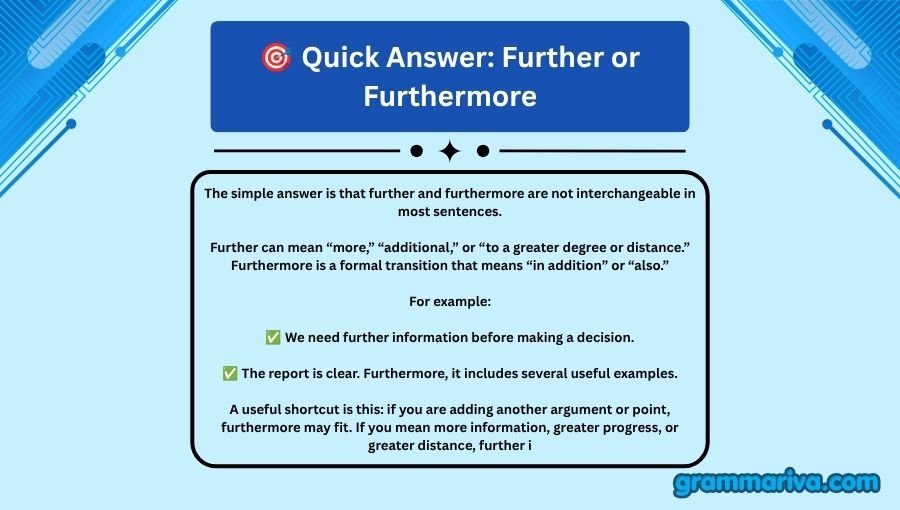
The simple answer is that further and furthermore are not interchangeable in most sentences.
Further can mean “more,” “additional,” or “to a greater degree or distance.” Furthermore is a formal transition that means “in addition” or “also.”
For example:
- ✅ We need further information before making a decision.
- ✅ The report is clear. Furthermore, it includes several useful examples.
A useful shortcut is this: if you are adding another argument or point, furthermore may fit. If you mean more information, greater progress, or greater distance, further is usually the better choice.
📚 Further or Furthermore: Understanding the Basics
The key difference between further or furthermore is their grammatical role.
Further can work as an adjective, adverb, or verb. It often means “more,” “additional,” or “to a greater extent.”
Furthermore is an adverb used mainly as a sentence connector. It introduces an additional point that supports or develops what came before.
| Form | Type | Meaning | Example | Correct/Incorrect |
|---|---|---|---|---|
| further | adjective | additional | We need further details. | ✅ Correct |
| further | adverb | to a greater degree or distance | Let’s discuss this further. | ✅ Correct |
| further | verb | to advance or promote | The program will further our goals. | ✅ Correct |
| furthermore | adverb | in addition | Furthermore, the plan is affordable. | ✅ Correct |
| furthermore | adjective | describes a noun | We need furthermore information. | ❌ Incorrect |
The last example shows an important rule. You cannot normally place furthermore directly before a noun to mean “additional.”
Say:
- ✅ We need further information.
- ❌ We need furthermore information.
🧠 Is Further the Same as Furthermore?
No. Further and furthermore have related ideas, but they serve different grammatical purposes.
Further usually modifies something or describes additional progress, information, distance, or degree. Furthermore connects one idea to another.
Compare these sentences:
- ✅ We need to investigate the matter further.
- ✅ The evidence is strong. Furthermore, two witnesses support the claim.
In the first sentence, further describes the degree of investigation. In the second, furthermore adds another point.
Further as “more”
One of the most common uses of further is to mean “additional.”
- ✅ Please send further information.
- ❌ Please send furthermore information.
Here, further describes the noun “information.”
Further as “to a greater extent”
Further can also describe an action that continues or goes deeper.
- ✅ We need to examine the issue further.
- ✅ She wanted to discuss the proposal further.
In these examples, further means something like “more deeply” or “more completely.”
Furthermore as “in addition”
Furthermore adds another statement.
- ✅ The hotel is affordable. Furthermore, it is close to the airport.
- ❌ The hotel is affordable. Further, it is close to the airport.
The second sentence is not always grammatically impossible because further has other uses. However, furthermore is the clearer choice when you mean “in addition.”
🔍 Key Differences Between Further and Furthermore
The easiest way to remember the difference is to look at the job each word performs.
| Feature | Further | Furthermore |
|---|---|---|
| Basic idea | more or additional | in addition |
| Common role | adjective/adverb/verb | adverb |
| Before a noun | Yes | No |
| Adds another argument | Sometimes, but less directly | Yes |
| Means “additional” | Yes | No, not directly before a noun |
| Common in formal writing | Yes | Yes |
| Works after a verb | Yes | Usually no |
| Example | further research | Furthermore, research shows… |
A simple rule I teach is:
Further modifies or extends an idea. Furthermore adds another idea.
That one sentence solves many usage problems.
✏️ When Should You Use Further?
Use further when you mean “more,” “additional,” “greater,” or “to a greater extent.”
Here are the most common uses.
Further Before a Noun
Use further before a noun when you mean “additional.”
- ✅ We need further evidence.
- ❌ We need furthermore evidence.
- ✅ The company requested further details.
- ❌ The company requested furthermore details.
- ✅ No further action is required.
- ❌ No furthermore action is required.
This is one of the clearest differences between the two words.
Further After a Verb
You can use further after many verbs to mean “more” or “to a greater degree.”
- ✅ We should discuss the matter further.
- ✅ The teacher explained the topic further.
- ✅ I would like to investigate this issue further.
You cannot replace further with furthermore in these sentences.
Further as a Verb
Further can also be a verb meaning to help something develop or progress.
- ✅ The course will further your career.
- ✅ The project may further our understanding of the problem.
This use is less common in casual speech but appears often in professional and academic writing.
| Meaning | Word Type | Example Sentence |
|---|---|---|
| additional | adjective | We need further information. |
| more deeply | adverb | Let’s examine the issue further. |
| greater distance | adverb/adjective | The store is further down the road. |
| promote progress | verb | The project will further our goals. |
➕ When Should You Use Furthermore?
Use furthermore when you want to add another point to an argument or explanation.
It is close in meaning to:
- in addition
- also
- moreover
- additionally
For example:
- ✅ The product is inexpensive. Furthermore, it is easy to use.
- ✅ The plan saves money. Furthermore, it reduces waste.
Furthermore is especially common in formal writing. It often appears at the beginning of a sentence, followed by a comma.
Furthermore at the Beginning of a Sentence
This is probably the most familiar structure.
- ✅ Furthermore, the results support our conclusion.
- ✅ Furthermore, the company plans to expand next year.
Furthermore in the Middle of a Sentence
It can also appear in other positions, although the beginning is often the clearest.
- ✅ The proposal is, furthermore, easy to implement.
This style is more formal. In everyday writing, “also” may sound more natural.
| Purpose | Example | Better Choice |
|---|---|---|
| Add information | We need more information. | further |
| Add an argument | The plan is cheap. Furthermore, it is effective. | furthermore |
| Continue research | We should investigate further. | further |
| Request extra details | Please provide further details. | further |
| Add a supporting point | Furthermore, the results were positive. | furthermore |
💡 Test Tip: How Can You Tell Which Word Is Correct?
Here is a quick test I use when checking sentences.
Replace the word with “in addition.”
If the sentence still makes sense, furthermore may be the correct choice.
For example:
The plan is affordable. Furthermore, it is simple.
Try:
The plan is affordable. In addition, it is simple.
The meaning works.
Now try:
We need further information.
Replace it:
We need in addition information.
That does not work.
So further is correct.
Another useful test is to ask whether the word describes a noun or an action.
If it means additional, use further.
If it means another supporting point, use furthermore.
📝 Case Study: Further or Furthermore in a Work Email
Imagine I am editing a workplace email from a manager.
The original message says:
We need furthermore information before we approve the proposal.
I would change it to:
We need further information before we approve the proposal.
Why? Because “information” is a noun, and the writer means “additional information.”
Later, the email says:
The proposal is affordable. Further, it could help reduce operating costs.
I would probably change this to:
The proposal is affordable. Furthermore, it could help reduce operating costs.
The second sentence adds another supporting point. That is exactly where furthermore works well.
I once edited a short business report with this same issue. The writer had used “furthermore” before several nouns. Once we changed those examples to “further,” the report sounded much more natural.
📖 Grammar Rules Explanation
The grammar behind further or furthermore becomes simple when you focus on function.
Further has several grammatical roles. It can describe a noun, modify an action, or function as a verb.
Furthermore is an adverb that acts mainly as a linking word. It connects a new statement with a previous statement.
Consider:
We need further research.
Here, further modifies “research.” It means additional research.
Now consider:
The research is useful. Furthermore, it is easy to understand.
Here, furthermore does not describe “research.” Instead, it connects the second statement to the first.
Standard English references and major dictionaries treat these as separate words with different uses. The safest approach is to focus on the meaning and grammatical role rather than assuming that their similar spelling makes them interchangeable.
Correct vs Incorrect at a Glance
| Sentence | Correct/Incorrect | Why |
|---|---|---|
| We need further information. | ✅ Correct | “Further” means additional. |
| We need furthermore information. | ❌ Incorrect | “Furthermore” does not modify the noun “information.” |
| Let’s discuss this further. | ✅ Correct | “Further” means more deeply. |
| Let’s discuss this furthermore. | ❌ Incorrect | The sentence needs the adverb “further.” |
| Furthermore, the results were positive. | ✅ Correct | “Furthermore” adds another point. |
The main lesson is not simply “one is right and one is wrong.” Both are correct words. The question is what job does the word need to perform?
⚠️ Common Mistakes With Further and Furthermore
People often confuse these words because they share the same beginning and have related meanings.
Here are three common reasons:
- Fast typing: Writers may choose the longer or more familiar word without checking the sentence.
- Autocorrect: Software can sometimes encourage a word that looks similar to the intended word.
- Lack of knowledge: Learners may assume that “furthermore” simply means a stronger version of “further.”
It does not.
I once caught myself typing “furthermore information” while reviewing a draft late at night. The mistake looked harmless at first. Then I read the sentence aloud and immediately noticed that “further information” sounded natural while “furthermore information” did not.
Similar Grammar Confusions
| Confusion | Correct Use | Main Difference |
|---|---|---|
| it’s / its | It’s cold. / Its color is blue. | contraction vs possession |
| your / you’re | Your book / You’re ready | possession vs “you are” |
| their / they’re | Their car / They’re coming | possession vs “they are” |
| affect / effect | affect behavior / the effect | verb vs noun in common uses |
| then / than | later then / better than | time vs comparison |
| further / furthermore | further details / furthermore, it works | additional vs added point |
Common Wrong Forms and Uses
| Wrong Form | What’s Wrong | Correct Form |
|---|---|---|
| furthermore information | “Furthermore” cannot normally modify the noun | further information |
| furthermore details | Same problem | further details |
| discuss furthermore | Wrong choice for “discuss more” | discuss further |
| go furthermore | Does not normally express greater distance | go further |
| furthermore research | “Furthermore” is not an adjective | further research |
| investigate furthermore | Use “further” to mean more deeply | investigate further |
❓ Why Do People Confuse Further and Furthermore?
People confuse these words because they share a common form and both can relate to the idea of adding or extending something.
The problem becomes worse in formal writing. Learners often see furthermore in essays and assume it can replace further whenever they want to sound more formal.
That is not the case.
For example:
We need further evidence.
This sentence is already formal and natural. Changing it to “furthermore evidence” does not make it more professional. It simply makes it incorrect.
A good writer does not choose the longer word just because it looks more academic. The right word is the one that performs the correct grammatical job.
🌎 Further or Furthermore in Different Contexts
The best choice can also depend on the context.
Everyday Conversation
Further is much more natural in everyday speech.
- “Can we talk about this further?”
- “Do you need further help?”
Furthermore sounds formal and may feel unusual in casual conversation.
Professional Writing
Both can be useful.
- “Please provide further information.”
- “Furthermore, the report confirms the findings.”
Creative Writing
Further is useful for movement, distance, and deeper thought.
- “She walked further into the forest.”
- “He wanted to explore the question further.”
Furthermore can appear in a narrator’s formal voice, but it may sound stiff in dialogue.
Social Media and Texting
“Further” may appear naturally, but “furthermore” is less common.
A social post might say:
I need further proof 😂
A formal post might say:
Furthermore, the results speak for themselves.
| Context | Which Term to Use | Example |
|---|---|---|
| Everyday conversation | further | Let’s discuss it further. |
| Professional writing | both | Further details are available. |
| Academic writing | both | Furthermore, the results support the claim. |
| Creative writing | further | He walked further into the woods. |
| Social media | usually further | I need further proof! |
🧩 How Further Works With Common Nouns
One of the most useful patterns is further + noun.
Common combinations include:
- further information
- further details
- further research
- further discussion
- further investigation
- further action
- further evidence
- further questions
- further development
- further assistance
These phrases are common because further means “additional.”
| Phrase | Meaning | Example |
|---|---|---|
| further information | additional information | Please provide further information. |
| further research | additional research | Further research is needed. |
| further discussion | more discussion | This needs further discussion. |
| further evidence | additional evidence | We need further evidence. |
| further questions | additional questions | Contact us with further questions. |
Notice that furthermore does not work in these noun phrases.
🔗 Common Phrases With Further
There are several natural expressions that use further.
| Phrase | Meaning |
|---|---|
| further information | additional information |
| further details | additional details |
| further discussion | more discussion |
| investigate further | investigate more deeply |
| discuss further | discuss in greater detail |
| go further | continue or move beyond a point |
These phrases are especially useful in professional and academic writing.
Furthermore does not have the same kind of noun-based phrase pattern. It works mainly as a connector.
🔄 Synonyms and Alternatives
Sometimes you can replace further or furthermore with another word. However, the replacement depends on the sentence.
For further, useful alternatives include:
- additional
- more
- extra
- deeper
- greater
For furthermore, useful alternatives include:
- additionally
- moreover
- also
- in addition
- besides
| Alternative | Works When | Does Not Work When |
|---|---|---|
| additional | Before a noun | Talking about moving farther |
| more | Casual situations | A formal transition is needed |
| moreover | Adding an argument | Describing additional information before a noun |
| additionally | Adding another point | Describing distance |
| in addition | Connecting ideas | Modifying a noun directly |
For example:
- Further information → Additional information
- Furthermore, the plan works → In addition, the plan works
- Let’s discuss it further → Let’s discuss it more
❓ Can Further Mean “In Addition”?
Yes, further can sometimes mean “additional,” but it does not always work exactly like the transition furthermore.
For example:
We need further evidence.
Here, “further” means “additional.”
But:
The evidence is strong. Furthermore, it is reliable.
Here, “furthermore” means “in addition.”
The two ideas are related, but their sentence roles are different.
❓ Can You Start a Sentence With Further?
Yes. You can start a sentence with further, depending on the meaning.
For example:
Further details will be provided tomorrow.
Here, “further” means “additional.”
You can also write:
Further, the report explains how the system works.
This use is possible, but it is less common and can sound formal. If your intended meaning is “in addition,” furthermore or additionally is often clearer.
❓ Can You Use Furthermore in Casual Writing?
Yes, but it may sound more formal than necessary.
For example:
I like the design. Furthermore, it is easy to use.
This is grammatically correct. But in a casual text, you might naturally say:
I like the design. Plus, it’s easy to use.
Or:
I like the design. It’s also easy to use.
The choice is not only about grammar. Good writing also considers tone.
🎯 How to Remember the Difference
Here is my favorite memory trick:
Further = more.
Furthermore = more information in the form of another point.
Think about these two examples:
I need further information.
You want more information.
Furthermore, I need a copy of the report.
You are adding another point.
Another shortcut is:
Further modifies. Furthermore connects.
That is not a complete description of every possible use, but it is an excellent practical rule for most writing.
❓ Is Further More Common Than Furthermore?
In general writing, further has a much wider range of uses because it can describe additional things, greater progress, distance, or deeper investigation.
Furthermore has a narrower job. It mainly introduces an additional point.
This is why you will see phrases such as:
- further information
- further research
- further questions
- discuss further
- investigate further
while furthermore is more often used as a sentence connector.
📌 Further or Furthermore in Academic Writing
Both words are useful in academic writing, but they serve different purposes.
Use further when discussing additional research or deeper investigation.
Further research is needed to understand the results.
Use furthermore when adding a supporting argument.
The method is inexpensive. Furthermore, it is easy to repeat.
Academic writing should not use furthermore simply to sound intelligent. If “also” or “in addition” communicates the idea more clearly, one of those alternatives may be better.
💼 Further or Furthermore in Professional Emails
Professional emails often use further because phrases such as “further information” and “further assistance” are common.
Examples:
- “Please contact me if you require further assistance.”
- “I would be happy to provide further details.”
- “We can discuss the matter further during the meeting.”
Furthermore can also be useful when presenting several reasons.
The proposal fits our budget. Furthermore, it can be completed within the required time.
| Email Purpose | Best Choice | Example |
|---|---|---|
| Ask for more information | further | Please provide further information. |
| Offer more help | further | Please contact us for further assistance. |
| Continue a discussion | further | We can discuss this further. |
| Add another reason | furthermore | Furthermore, the plan saves time. |
⚠️ Further vs Furthermore: What Sounds More Natural?
Grammar is only part of good writing. Natural style matters too.
Consider:
Furthermore, I also agree with your suggestion.
This is grammatically understandable, but it can be wordy because furthermore already signals addition, while also does the same job.
A cleaner version is:
Furthermore, I agree with your suggestion.
Or:
I also agree with your suggestion.
The goal is not to use as many formal words as possible. The goal is to communicate clearly.
🧪 Practice: Choose Further or Furthermore
Try these examples before looking at the answers.
- We need ___ information.
- The product is affordable. ___, it is reliable.
- Let’s discuss this ___.
- ___, the company plans to hire more employees.
- No ___ action is necessary.
Answers
| Sentence | Answer | Reason |
|---|---|---|
| We need ___ information. | further | It means additional information. |
| The product is affordable. ___, it is reliable. | furthermore | It adds another point. |
| Let’s discuss this ___. | further | It means discuss more. |
| ___, the company plans to hire more employees. | furthermore | It introduces another fact. |
| No ___ action is necessary. | further | It means no additional action. |
💬 Why It Matters in Clear Communication
Choosing between further or furthermore may seem like a tiny grammar issue. However, small word choices can affect how professional and clear your writing sounds.
If you write:
Please send furthermore details.
The reader can probably guess what you mean. But the sentence is not standard English.
A better version is:
Please send further details.
Clear grammar reduces distractions. The reader can focus on your message instead of stopping to wonder about your word choice.
Clear words make strong ideas easier to understand.
Why Getting It Right Matters
| Situation | Why Getting It Right Matters |
|---|---|
| Resume | Shows attention to language and detail |
| Client email | Creates a professional impression |
| Published article | Improves readability and trust |
| Social post | Keeps the message clear and natural |
🌟 Special Cases and Style Notes
There is no major spelling exception that changes the basic rule between further and furthermore.
One useful style point is that furthermore is more formal. In some situations, also, moreover, or in addition may sound more natural.
Also remember that further can relate to physical distance:
The school is further down the road.
It can also relate to an abstract idea:
We need to examine the issue further.
So further is much more flexible than furthermore.
🧭 Further or Furthermore: A Simple Decision Guide
When you are unsure, ask yourself three questions.
Question 1: Do I mean “additional”?
Use further.
Question 2: Do I mean “more deeply” or “to a greater extent”?
Use further.
Question 3: Am I introducing another supporting idea?
Use furthermore.
| Question | If Yes → Use |
|---|---|
| Do I mean additional? | further |
| Does the word describe a noun? | further |
| Do I mean more deeply? | further |
| Am I adding another argument? | furthermore |
| Can I replace the word with “in addition”? | furthermore |
📝 More Examples to Build Confidence
Further
- ✅ We need further evidence.
- ✅ She requested further details.
- ✅ I would like to discuss this further.
- ✅ The team investigated the problem further.
- ✅ No further action is required.
Furthermore
- ✅ The plan is practical. Furthermore, it is affordable.
- ✅ The course is useful. Furthermore, it is easy to access.
- ✅ The evidence is strong. Furthermore, it is supported by several sources.
The pattern becomes clear with practice.
❓ Which Is Better for “Additional Information”?
Further is the correct choice.
Say:
Please provide further information.
Do not write:
Please provide furthermore information.
This is one of the most common mistakes involving these words.
The same pattern applies to “details,” “research,” “assistance,” “questions,” and many other nouns.
❓ Which Is Better for Adding Another Argument?
Furthermore is usually the better choice.
For example:
The proposal would save money. Furthermore, it would reduce waste.
Here, the second sentence gives another reason to support the proposal.
You could also use:
The proposal would save money. In addition, it would reduce waste.
Both work because both introduce an additional point.
❓ Can Further and Furthermore Be Used Together?
They can appear in the same passage, but they usually do different jobs.
For example:
We need further research. Furthermore, the current evidence is limited.
The first further means “additional.” The second furthermore means “in addition.”
Using both correctly in nearby sentences is completely possible.
❓ Is “Further More” Correct?
No. Furthermore is normally written as one word.
Correct:
Furthermore, the results were positive.
Incorrect:
Further more, the results were positive.
This is a spelling mistake rather than a difference in meaning.
❓ Is “Further More Information” Correct?
No. If you mean additional information, say:
We need further information.
You do not need more after further because “further” already expresses the idea of additional or more.
You could also say:
We need more information.
Both are natural. The first sounds somewhat more formal.
❓ Can Further Be Used in Formal Writing?
Yes. Further is extremely useful in formal writing.
Common examples include:
- further information
- further research
- further analysis
- further discussion
- further investigation
- further consideration
- further assistance
It is not less formal than furthermore. They simply perform different jobs.
❓ Is Furthermore Too Formal for Everyday English?
Sometimes.
Furthermore is grammatically correct in everyday English, but it can sound formal or academic.
For casual conversation, people often prefer:
- also
- plus
- besides
- in addition
For formal reports and essays, furthermore can fit well when you want to add a supporting point.
❓ What Is the Easiest Way to Remember Further vs Furthermore?
Remember this short rule:
Further means more. Furthermore means in addition.
Then check the sentence.
- “I need more information.” → further information
- “I am adding another point.” → furthermore
If you remember those two patterns, you will get most everyday uses right.
❓ Can I Use “Moreover” Instead of “Furthermore”?
Usually, yes.
Both moreover and furthermore can introduce an additional supporting point.
For example:
The plan is affordable. Furthermore, it is easy to implement.
can become:
The plan is affordable. Moreover, it is easy to implement.
However, neither word should replace further in:
We need further information.
You cannot naturally say:
We need moreover information.
❓ What Is the Difference Between Further and Further More?
In standard modern writing, furthermore is the correct single-word form.
Further more is not the normal spelling of the connector.
Compare:
- ✅ Furthermore, the plan is practical.
- ❌ Further more, the plan is practical.
When you mean “additional,” however, use further:
- ✅ further information
- ✅ further details
- ✅ further research
❓ Which Word Should I Use in a Business Report?
Use further for additional things and furthermore for an added argument or point.
For example:
Further analysis is required.
But:
The results are promising. Furthermore, they support our original prediction.
Both are professional. The correct choice depends on the sentence’s function.
❓ Can “Further” Mean “Farther”?
Yes, further can refer to distance, and it is often used in both physical and abstract contexts.
For example:
We walked further down the road.
It can also mean going deeper into an idea:
Let’s examine the issue further.
In many modern contexts, further is widely used for both physical and figurative distance. The important point here is that furthermore does not serve this role.
❓ Is Further or Furthermore Better in an Essay?
Both can be correct, but they should be used for different purposes.
Use further for additional information or deeper discussion.
Further research may explain the results.
Use furthermore to add another argument.
The method is affordable. Furthermore, it produces reliable results.
Do not add furthermore simply because an essay is formal.
❓ What Is the Main Difference Between Further and Furthermore?
The main difference is grammatical function.
Further means “more,” “additional,” or “to a greater extent.” It can modify nouns and verbs and can also work as a verb.
Furthermore means “in addition.” It normally connects one statement to another.
If you remember that distinction, most examples become easy to solve.
❓ How Do I Choose Between Further and Furthermore Quickly?
Use this three-step check:
- Before a noun? Choose further.
- After a verb meaning “more”? Choose further.
- Adding another sentence or argument? Choose furthermore.
For example:
- further information ✅
- discuss further ✅
- furthermore, the results agree ✅
This quick test works especially well when editing emails, essays, and articles.
🔄 Quick Recap Checklist
| Question | If Yes → Use |
|---|---|
| Does it mean “additional”? | further |
| Does it describe a noun? | further |
| Does it mean “more deeply”? | further |
| Does it mean “in addition”? | furthermore |
| Does it introduce another argument? | furthermore |
| Does “furthermore information” sound wrong? | Use further information |
Practice Examples
1. We need ___ information before we decide.
Answer: further
2. The service is affordable. ___, it is easy to use.
Answer: furthermore
3. We should investigate the issue ___.
Answer: further
❓ Why Is Further or Furthermore Important in Grammar?
Using further or furthermore correctly helps you make a clear distinction between adding information and adding an argument.
Further commonly means “additional” or “more.”
Furthermore commonly means “in addition.”
This distinction matters most in formal writing, where precise word choice can make an article, report, email, or essay easier to read.
FAQs About Further vs Furthermore
❓ Is further information correct?
Yes. Further information is correct and means additional information.
❓ Is furthermore information correct?
No. Furthermore does not normally work as an adjective before “information.” Use further information instead.
❓ Does furthermore mean in addition?
Yes. Furthermore is commonly used to introduce another point or supporting idea.
❓ Can I say “discuss furthermore”?
No, not when you mean “discuss more” or “discuss in greater detail.” Say discuss further.
❓ Can I start a sentence with furthermore?
Yes. For example: “Furthermore, the results support the original conclusion.”
❓ Can further be used before a noun?
Yes. Examples include further information, further research, further details, and further questions.
❓ Is further more one word?
The connector is written as one word: furthermore.
❓ Is furthermore formal?
Yes. It is generally more formal than everyday choices such as “also” or “plus.” It is common in essays, reports, and professional writing.
❓ Can further mean more?
Yes. For example, “Let’s discuss the matter further” means “Let’s discuss the matter more.”
❓ What is the easiest way to remember the difference?
Remember: Further = more or additional. Furthermore = in addition.
🎯 Conclusion: Further or Furthermore Made Simple
Further or furthermore becomes easy once you understand the job each word performs. Further usually means “more,” “additional,” or “to a greater extent.” Use it in phrases such as “further information,” “further research,” and “discuss the issue further.”
Furthermore means “in addition” and is mainly used to introduce another supporting point. For example, “The plan is affordable. Furthermore, it is easy to implement.”
My simplest rule is this: further modifies or extends an idea, while furthermore connects an added idea. If you mean additional information, choose further. If you are adding another argument, choose furthermore.
Once you learn this small distinction, your writing becomes cleaner and more natural. ✨ You will also avoid one of the most common mistakes, such as writing “furthermore information” when you mean “further information.”
Keep the rule in mind: Further means more. Furthermore means in addition. Remember that, and you will rarely confuse these two words again. ✅

Hi, I’m Olivia Carter. I’m an English language editor at Grammariva, and I work on making grammar lessons clear, accurate, and easy to follow. I especially enjoy writing about common grammar mistakes and everyday English.
[…] and quick tests. By the end, you should be able to choose the correct form with confidence. Further or Furthermore | OK vs Okay | Masters Student or MS […]
[…] was the better choice. 😊So, which one should you use? Let’s make the answer clear. Is vs Are | Further or Furthermore | OK vs […]