Have you ever written a sentence such as “I will like to ask a question” and wondered if it sounds right? You are not alone. English learners often mix up i will like to vs i would like to because both forms contain like to, and both can appear when someone talks about a future action or a personal choice.
The key difference is simple: “I would like to” is the normal and polite way to say that you want to do something. “I will like to” is not normally used to express a present request or desire. It may work in a different meaning when will describes a future reaction or preference, but that use is much less common.
I teach this distinction by focusing on the meaning behind the sentence. If you are politely asking for something, would like to is usually the form you need. If you are talking about what you expect to enjoy in the future, will like can make sense. 😊
Let us look at the difference step by step so you can choose the right form with confidence. Anyplace vs Any Place | Plane vs Plain | Supercede vs Supersede
🎯 Quick Answer: I Will Like To vs I Would Like To
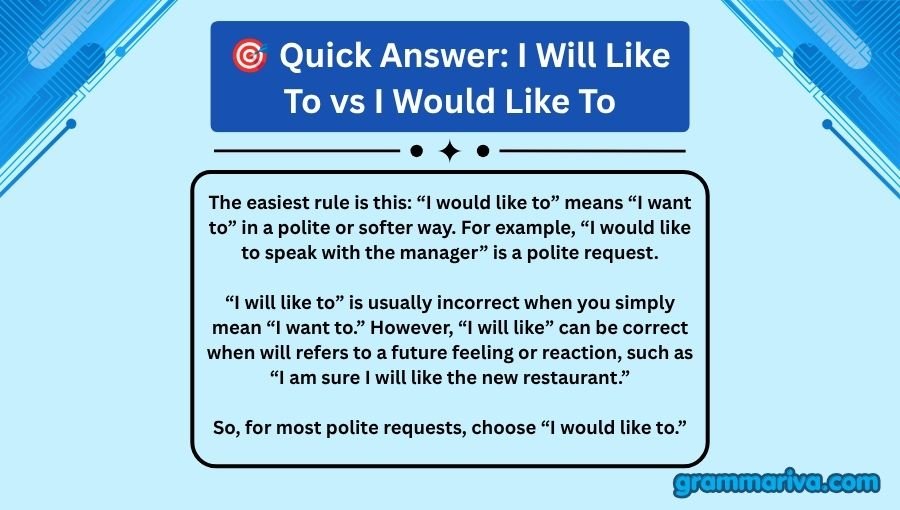
The easiest rule is this: “I would like to” means “I want to” in a polite or softer way. For example, “I would like to speak with the manager” is a polite request.
“I will like to” is usually incorrect when you simply mean “I want to.” However, “I will like” can be correct when will refers to a future feeling or reaction, such as “I am sure I will like the new restaurant.”
So, for most polite requests, choose “I would like to.”
🔤 Related Word Forms and Useful Variations
The main forms in this comparison are related to the verbs will and would. They are not simply spelling variations. Their meanings change because will and would serve different purposes.
| Form | Type | Example |
|---|---|---|
| will | Modal verb | I will call you tomorrow. |
| would | Modal verb | I would like to call you. |
| will like | Future preference/reaction | I think you will like it. |
| would like | Polite desire/request | I would like some coffee. |
| would like to | Polite desire to act | I would like to join the meeting. |
| won’t like | Negative future reaction | You won’t like the result. |
📚 Understanding the Basics of I Will Like To vs I Would Like To
The basic difference is about present desire versus future expectation.
When I say “I would like to,” I am usually saying that I want to do something. The phrase sounds polite and natural.
When I say “I will like,” I am usually making a prediction about a future feeling or reaction. It does not normally mean “I want to.”
I would like to express a desire
“I would like to” is common when someone wants to do something.
For example:
- ✅ I would like to ask a question.
- ❌ I will like to ask a question.
The first sentence means, “I want to ask a question,” but it sounds more polite.
The second sentence sounds unnatural if the speaker simply means that they want to ask a question.
I will like to talk about a future reaction
There are situations where will like is correct. In these cases, will points toward a future experience.
For example:
- ✅ You will like this movie.
- ❌ You would like this movie.
The first sentence can mean that I believe you are going to enjoy the movie. The second can also be grammatical in certain contexts, but it changes the meaning and often needs a condition or another context.
Here is the main difference at a glance:
| Form | Type | Meaning | Example | Correct/Incorrect |
|---|---|---|---|---|
| I would like to | Polite expression of desire | I want to | I would like to leave early. | ✅ Correct |
| I will like | Future preference/reaction | I am going to enjoy it | I will like the new design. | ✅ Correct |
| I will like to | Unnatural for ordinary requests | Usually intended as “I want to” | I will like to order lunch. | ❌ Usually incorrect |
| I would like | Polite preference | I want | I would like some tea. | ✅ Correct |
| I will | Future intention/action | I plan or promise | I will order lunch. | ✅ Correct |
❓ Is I Will Like To Correct English?
“I will like to” can be grammatical in unusual contexts, but it is not the normal way to express a present desire or polite request. If you mean “I want to,” use “I would like to.”
Consider these examples:
- ❌ I will like to meet you.
- ✅ I would like to meet you.
The second sentence is the natural choice.
Now compare that with:
- ✅ I think I will like the new job.
Here, will like works because the speaker is predicting a future feeling.
The problem is not the word will itself. The problem is using will like to as a direct replacement for would like to.
❓ Why Do People Confuse I Will Like To and I Would Like To?
People confuse these forms because will and would are closely related modal verbs. Learners also see would like used so often that they may assume will like is simply another version of the same expression.
Another reason is that will is strongly connected with the future. Someone may think, “I want to do this in the future, so I should say ‘I will like to.’” English does not work that way.
I once helped a student who wrote “I will like to apply for this position” in a practice job email. The student understood the message perfectly, but the phrase sounded unnatural. We changed it to “I would like to apply for this position,” and the sentence immediately sounded more professional.
The important lesson is that future time does not automatically require “will like to.”
🧠 I Would Like To: Meaning and Correct Use
“I would like to” is a polite way to express a wish, desire, or intention.
It often appears in:
- polite requests
- professional emails
- formal conversations
- customer service situations
- introductions
- invitations
- statements of personal preference
Polite requests
- ✅ I would like to make an appointment.
- ❌ I will like to make an appointment.
Professional communication
- ✅ I would like to discuss the proposal.
- ❌ I will like to discuss the proposal.
Personal intentions
- ✅ I would like to visit California someday.
- ❌ I will like to visit California someday.
The phrase does not necessarily mean that the action will happen. It tells the listener what the speaker wants or wishes to do.
| Meaning | Word Type | Example Sentence |
|---|---|---|
| Polite request | Modal expression | I would like to speak with you. |
| Personal desire | Modal expression | I would like to learn Spanish. |
| Preference | Modal expression | I would like to sit near the window. |
| Future wish | Modal expression | I would like to travel more next year. |
❓ When Should You Use I Would Like To?
Use “I would like to” when you want to say “I want to” politely. It is one of the most useful phrases for making requests without sounding too direct.
Examples:
- ✅ I would like to order a sandwich.
- ❌ I will like to order a sandwich.
- ✅ I would like to ask about the price.
- ❌ I will like to ask about the price.
- ✅ I would like to schedule a meeting.
- ❌ I will like to schedule a meeting.
The phrase is especially helpful when speaking to someone you do not know well.
A useful sentence pattern
You can remember this pattern:
I would like to + base verb
Examples:
- I would like to learn.
- I would like to visit.
- I would like to ask.
- I would like to apply.
- I would like to discuss.
Do not change the main verb into a past form after to.
💡 Test Tip: Replace “Would Like To” With “Want To”
Here is my favorite quick test.
If you can replace the phrase with “want to” and the meaning stays the same, “would like to” is probably the right choice.
For example:
“I would like to speak with you.”
Replace it:
“I want to speak with you.”
The meaning remains clear. So would like to works.
Now look at:
“I will like to speak with you.”
If you intended to mean “I want to speak with you,” will like to is not the natural choice.
This simple test works well in everyday writing.
📝 Case Study: A Professional Email
Imagine that I am writing to a company about a job opening.
A learner might write:
❌ I will like to apply for the marketing position.
The reader can understand the sentence, but the wording is not natural standard English for a polite expression of interest.
I would write:
✅ I would like to apply for the marketing position.
The difference is small, but the second sentence sounds much more polished.
I once edited a short application message where the writer used “I will like to” several times. We changed each request to “I would like to.” Nothing else in the message needed major changes. The result sounded much more natural.
| Situation | Less Natural | Better Choice |
|---|---|---|
| Job application | I will like to apply. | I would like to apply. |
| Restaurant | I will like to order. | I would like to order. |
| Meeting | I will like to discuss this. | I would like to discuss this. |
| Customer service | I will like to know more. | I would like to know more. |
📖 Grammar Rules Explanation
The grammar becomes easier when we separate the two modal verbs.
Will commonly expresses future actions, decisions, promises, or predictions.
Would has several uses. One very common use is to make a statement softer or more polite. The expression would like is a standard polite way to express a desire or preference.
In “I would like to leave,” the word would is not simply a past form of will. The complete expression would like has a polite meaning.
In “I will like the restaurant,” will points to a future reaction. The speaker expects to enjoy the restaurant.
This distinction explains why these sentences behave differently:
- ❌ I will like to speak with the manager.
- ✅ I would like to speak with the manager.
But:
- ✅ I think I will like the manager.
- ❌ I think I would like the manager.
The last sentence is not always wrong, but it can express a different idea depending on context. It may suggest a conditional or imagined situation.
Most standard English reference materials treat would like as a normal polite expression of desire.
Correct vs Incorrect at a Glance
| Sentence | Correct/Incorrect | Why |
|---|---|---|
| I would like to ask something. | ✅ Correct | Polite request |
| I will like to ask something. | ❌ Usually incorrect | Will like to is not the normal polite form |
| I think I will like the new café. | ✅ Correct | Future reaction |
| I would like to visit New York. | ✅ Correct | Future wish |
| I will like to visit New York someday. | ❌ Usually incorrect | Would like to is better for the wish |
❓ Can I Say I Will Like To in a Formal Email?
You should normally use “I would like to” instead of “I will like to” in a formal email when you are making a request or expressing a desire.
For example:
- ❌ I will like to request more information.
- ✅ I would like to request more information.
- ❌ I will like to confirm my appointment.
- ✅ I would like to confirm my appointment.
However, will like can appear naturally when discussing someone’s future reaction:
- ✅ I believe you will like the updated proposal.
The difference is based on meaning, not formality alone.
⚠️ Common Mistakes With These Forms
These mistakes happen for several simple reasons.
Fast typing
People often type the first phrase that comes to mind. If you regularly use will, you may accidentally write it where would is needed.
Autocorrect
Typing quickly can also lead to automatic corrections. A sentence may look correct at first glance even though the modal verb changed.
Lack of knowledge
Learners may know that will talks about the future. They then assume that a future wish must use will. But English uses would like for polite wishes.
Confusion with similar pairs
English has many small word pairs that cause similar problems.
| Confusion | Correct Forms | Main Difference |
|---|---|---|
| it’s / its | it’s, its | contraction vs possession |
| your / you’re | your, you’re | possession vs “you are” |
| their / they’re | their, they’re | possession vs “they are” |
| then / than | then, than | time/order vs comparison |
| will / would | will, would | different meanings and uses |
Specific Wrong Forms
| Wrong Form | What’s Wrong | Correct Form |
|---|---|---|
| I will like to ask | Wrong modal for a polite desire | I would like to ask |
| I will like to know | Unnatural request structure | I would like to know |
| I will like to apply | Unnatural expression of desire | I would like to apply |
| I will like to order | Not the normal polite ordering phrase | I would like to order |
| I would will like to go | Two modals are incorrectly combined | I would like to go |
| I would liked to go | Wrong verb form after would | I would like to go |
🕰️ Word History and Development
A detailed history is not necessary to understand this grammar point. The useful fact is that will and would are long-established English modal verbs with several meanings.
Over time, would like became a common polite expression for stating what someone wants or prefers.
| Period | Form | Note |
|---|---|---|
| Earlier English | will-related forms | Used to express ideas connected with desire or intention |
| Later English | would | Developed several uses beyond simple past reference |
| Modern English | would like | Common polite expression of desire |
| Modern English | will like | Commonly used for future reactions or preferences |
The important point for modern writers is how these forms function today.
🌎 Usage in Different Contexts
The best choice depends on what you mean.
Everyday conversation
In normal conversation, “I would like to” is polite and natural.
“I would like to get some coffee.”
You may also simply say:
“I want some coffee.”
Professional writing
In professional settings, would like to is especially useful because it sounds respectful.
“I would like to discuss the next steps.”
Creative writing
Creative writing gives authors more freedom. A character might say something unusual for a specific reason. Still, standard dialogue should use natural English unless the unusual form is intentional.
Social media and texting
Casual messages often use want to rather than would like to.
“I want to go!”
But would like to is still correct.
| Context | Which Term to Use | Example |
|---|---|---|
| Everyday conversation | I would like to / I want to | I would like to sit outside. |
| Professional writing | I would like to | I would like to discuss this matter. |
| Creative writing | Depends on character/context | I would like to see the place. |
| Social media/texting | I want to / I’d like to | I’d like to go with you. |
❓ Is I Would Like To More Polite Than I Want To?
Yes. “I would like to” is generally softer and more polite than “I want to.”
Compare:
- “I want to speak with the director.”
- “I would like to speak with the director.”
Both can express the speaker’s desire. The second sounds less direct.
This does not mean want is rude. It is perfectly normal in everyday English. The choice depends on the situation.
🗣️ Common Phrases With Would Like To
There are several useful patterns you can memorize.
| Phrase | Meaning |
|---|---|
| I would like to ask… | I politely want to ask |
| I would like to know… | I politely want information |
| I would like to confirm… | I want to confirm politely |
| I would like to discuss… | I want to discuss something |
| I would like to request… | I am making a polite request |
| I would like to thank you… | I want to express thanks politely |
These phrases are especially useful in emails and workplace communication.
❓ When Is Will Like Correct?
“Will like” is correct when you are talking about a future feeling, reaction, or preference.
For example:
- ✅ I think you will like this book.
- ✅ She will like the new office.
- ✅ They will like the food.
- ✅ I am sure he will like the gift.
In each case, will like means that someone is expected to enjoy something.
Compare:
“I would like the gift.”
This means the gift is something I want or prefer.
“I will like the gift.”
This predicts that I will enjoy the gift when I receive or experience it.
That is a meaningful difference.
🔍 I Will Like To vs I Would Like To in Future Situations
Future time can make this comparison confusing. Both forms can appear when discussing the future, but they do not express the same idea.
“I would like to travel next summer” expresses a wish or desire.
“I will like the trip” predicts a future reaction.
| Sentence | Meaning |
|---|---|
| I would like to travel next summer. | I want to travel next summer. |
| I will like the trip. | I expect to enjoy the trip. |
| I would like to meet her. | I want to meet her. |
| I will like her. | I expect to enjoy or appreciate her personality. |
🧩 Synonyms and Alternatives
You do not always need would like to. Several alternatives can work.
| Alternative | Works When | Does Not Work When |
|---|---|---|
| want to | Direct, everyday desire | You need a softer tone |
| hope to | Expressing a hope | You are making a simple direct request |
| plan to | Stating a plan | You only want something but have no plan |
| intend to | Formal statement of intention | Casual conversation needs a relaxed tone |
| wish to | Formal or literary desire | Very casual speech is preferred |
For example:
“I hope to visit Italy someday.”
This is not exactly the same as:
“I would like to visit Italy someday.”
Hope to emphasizes an expected or desired possibility. Would like to simply expresses the desire.
❓ Why Does Getting This Difference Right Matter?
Getting the distinction right helps your writing sound natural, especially when you are communicating with teachers, employers, customers, or clients.
A sentence can be grammatically understandable but still sound unusual. Choosing the right modal verb removes that awkwardness.
| Situation | Why Getting It Right Matters |
|---|---|
| Resume or application | Makes your writing sound polished |
| Client email | Creates a respectful tone |
| Published content | Improves grammar and readability |
| Social post | Keeps your wording natural and clear |
A useful rule I tell my students is:
“Choose the form that matches the meaning, not just the time.”
That rule is short, but it solves many modal-verb problems.
💭 How To Remember the Difference
Use this memory trick:
Would like = want.
Will like = expect to enjoy.
Think about these two sentences:
“I would like to eat.”
Meaning: I want to eat.
“I will like the meal.”
Meaning: I expect to enjoy the meal.
The word to also gives you a useful clue. When you are using the polite desire pattern, the normal structure is:
would + like + to + base verb
Examples:
- would like to go
- would like to learn
- would like to ask
- would like to visit
❓ Can I Use I’d Like To Instead?
Yes. “I’d like to” is the contraction of “I would like to,” and it is extremely common in everyday English.
For example:
- I’d like to ask a question.
- I’d like to order dinner.
- I’d like to speak with you.
- I’d like to learn more.
The contraction is often more conversational, while the full form can feel slightly more formal or deliberate.
Both are correct.
📝 Practice Examples
Try to choose the better form before looking at the explanation.
Example 1
“I ___ like to make a reservation.”
Answer: would
- ✅ I would like to make a reservation.
- ❌ I will like to make a reservation.
Example 2
“I think you ___ like this restaurant.”
Answer: will
- ✅ I think you will like this restaurant.
- ❌ I think you would like this restaurant.
The second sentence can be correct in a conditional context, but without that context, will like is the straightforward future prediction.
Example 3
“I ___ like to apply for the position.”
Answer: would
- ✅ I would like to apply for the position.
- ❌ I will like to apply for the position.
Example 4
“I am sure she ___ like your idea.”
Answer: will
- ✅ I am sure she will like your idea.
- ❌ I am sure she would like your idea.
Again, would can work in some special contexts, but will fits the simple prediction.
❓ What Is the Easiest Rule for I Will Like To vs I Would Like To?
The easiest rule is:
Use “would like to” when you mean “want to.” Use “will like” when you mean “expect to enjoy.”
That single rule handles most everyday cases.
Ask yourself:
- Am I expressing what I want?
- Am I making a polite request?
- Am I stating a preference?
If yes, choose would like.
If you are predicting someone’s future reaction, choose will like.
❓ Is I Will Like To Ever Acceptable?
It can occur in unusual or context-specific English, but it should not be your normal choice for a polite request or desire.
For standard everyday writing, replace:
❌ I will like to…
with:
✅ I would like to…
If you are talking about a future reaction, remove to and use:
✅ I will like…
For example:
“I think I will like my new teacher.”
This is natural because it predicts a future feeling.
❓ Should I Use Would Like To or Want To?
Use “would like to” when you want a softer or more polite tone. Use “want to” when a direct, casual statement is appropriate.
Compare:
- “I want to ask you something.”
- “I would like to ask you something.”
Both are correct. The second is more polite.
In a friendly conversation, want to may sound completely natural. In a formal email, would like to is often a better fit.
❓ Is I Would Like To Too Formal for Conversation?
No. “I would like to” is common in spoken English, especially when making polite requests.
For example:
“I would like to order the chicken, please.”
That sounds normal at a restaurant.
In casual speech, you may also hear:
“I’d like the chicken, please.”
The contraction I’d makes the sentence feel more relaxed.
❓ What Is the Difference Between I Will and I Would?
“I will” commonly expresses a future action, decision, promise, or prediction. “I would” has several uses, including polite requests, imagined situations, and preferences expressed with “would like.”
Examples:
- I will call you tomorrow.
- I would like to call you.
- I will enjoy the concert.
- I would like to attend the concert.
Notice that will and would are not interchangeable just because they look related.
❓ Which Form Is Better for Job Applications?
“I would like to” is normally the better choice when expressing interest or making a polite request in a job application.
For example:
✅ I would like to apply for the customer service position.
You can also use more direct wording:
“I am writing to apply for the customer service position.”
That second version is often even stronger because it clearly states the purpose of the message.
❓ Can I Say I Would Like To in a Formal Letter?
Yes. “I would like to” is completely suitable for formal letters and professional emails.
Examples include:
- I would like to request further information.
- I would like to confirm my appointment.
- I would like to discuss the matter.
- I would like to thank you for your response.
These forms are polite without being unnecessarily complicated.
❓ What Should I Say Instead of I Will Like To?
Use “I would like to” when you mean “I want to.”
For example:
- ❌ I will like to know more.
- ✅ I would like to know more.
- ❌ I will like to join the program.
- ✅ I would like to join the program.
- ❌ I will like to speak with you.
- ✅ I would like to speak with you.
If you mean that you expect to enjoy something later, use “I will like” without to:
- ✅ I will like the program.
- ✅ I will like speaking with her.
🧾 Quick Recap Checklist
Use this checklist whenever you are unsure.
| Question | If Yes → Use |
|---|---|
| Do you mean “I want to”? | I would like to |
| Are you making a polite request? | I would like to |
| Are you stating a polite preference? | I would like to |
| Are you predicting a future reaction? | I will like |
| Are you making a future promise or action? | I will |
| Are you speaking casually about a desire? | I want to |
Practice
- “I ___ like to ask about the course.”
Answer: would → “I would like to ask about the course.” - “I think you ___ like this book.”
Answer: will → “I think you will like this book.” - “I ___ like to schedule an appointment.”
Answer: would → “I would like to schedule an appointment.”
FAQs About I Will Like To vs I Would Like To
Is “I will like to” grammatically correct?
It can occur in special contexts, but it is not the normal expression for a present desire or polite request. Use “I would like to” when you mean “I want to.”
Is “I would like to” correct English?
Yes. “I would like to” is a standard and polite way to express a desire, preference, or request.
What is the difference between “I will like” and “I would like”?
“I will like” usually predicts a future feeling or reaction. “I would like” usually expresses a present desire or preference.
Should I say “I will like to apply” or “I would like to apply”?
Use “I would like to apply.” It is the natural form for expressing your desire to apply.
Should I say “I will like to know” or “I would like to know”?
Use “I would like to know.” It is the standard polite way to request information.
Is “I’d like to” the same as “I would like to”?
Yes. “I’d like to” is the contraction of “I would like to.” It is common in both speech and informal writing.
Can “I will like” be correct?
Yes. For example, “I think I will like the new restaurant” is correct because it predicts a future reaction.
Is “I would like to” more polite than “I want to”?
Generally, yes. “I would like to” sounds softer and more polite, while “I want to” is more direct.
Can I use “I would like to” in a job application?
Yes. It is a natural choice for politely expressing interest or making a request in professional writing.
What is the easiest way to remember the difference?
Remember: “Would like” means “want,” while “will like” often means “expect to enjoy.” This quick contrast works in most everyday situations.
Conclusion
I will like to vs i would like to becomes much easier once you focus on meaning rather than simply thinking about future time. Use “I would like to” when you mean “I want to” or when you are making a polite request. Use “I will like” when you are predicting a future feeling or reaction.
For example, “I would like to visit the museum” expresses a desire. “I think I will like the museum” predicts that you will enjoy it.
The good news is that you do not need to memorize a long grammar rule. Ask yourself one simple question: Am I saying what I want, or am I predicting what I will enjoy? If you are expressing a desire, would like to is usually your answer. If you are predicting a future reaction, will like may be the better choice. 😊
Once this distinction becomes familiar, your emails, conversations, applications, and everyday writing will sound more natural and confident. ✨
Remember: Would like means want; will like means expect to enjoy.
Have you ever written a sentence such as “I will like to ask a question” and wondered if it sounds right? You are not alone. English learners often mix up i will like to vs i would like to because both forms contain like to, and both can appear when someone talks about a future action or a personal choice.
The key difference is simple: “I would like to” is the normal and polite way to say that you want to do something. “I will like to” is not normally used to express a present request or desire. It may work in a different meaning when will describes a future reaction or preference, but that use is much less common.
I teach this distinction by focusing on the meaning behind the sentence. If you are politely asking for something, would like to is usually the form you need. If you are talking about what you expect to enjoy in the future, will like can make sense. 😊
Let us look at the difference step by step so you can choose the right form with confidence.
🎯 Quick Answer: I Will Like To vs I Would Like To
The easiest rule is this: “I would like to” means “I want to” in a polite or softer way. For example, “I would like to speak with the manager” is a polite request.
“I will like to” is usually incorrect when you simply mean “I want to.” However, “I will like” can be correct when will refers to a future feeling or reaction, such as “I am sure I will like the new restaurant.”
So, for most polite requests, choose “I would like to.”
🔤 Related Word Forms and Useful Variations
The main forms in this comparison are related to the verbs will and would. They are not simply spelling variations. Their meanings change because will and would serve different purposes.
| Form | Type | Example |
|---|---|---|
| will | Modal verb | I will call you tomorrow. |
| would | Modal verb | I would like to call you. |
| will like | Future preference/reaction | I think you will like it. |
| would like | Polite desire/request | I would like some coffee. |
| would like to | Polite desire to act | I would like to join the meeting. |
| won’t like | Negative future reaction | You won’t like the result. |
📚 Understanding the Basics of I Will Like To vs I Would Like To
The basic difference is about present desire versus future expectation.
When I say “I would like to,” I am usually saying that I want to do something. The phrase sounds polite and natural.
When I say “I will like,” I am usually making a prediction about a future feeling or reaction. It does not normally mean “I want to.”
I would like to express a desire
“I would like to” is common when someone wants to do something.
For example:
- ✅ I would like to ask a question.
- ❌ I will like to ask a question.
The first sentence means, “I want to ask a question,” but it sounds more polite.
The second sentence sounds unnatural if the speaker simply means that they want to ask a question.
I will like to talk about a future reaction
There are situations where will like is correct. In these cases, will points toward a future experience.
For example:
- ✅ You will like this movie.
- ❌ You would like this movie.
The first sentence can mean that I believe you are going to enjoy the movie. The second can also be grammatical in certain contexts, but it changes the meaning and often needs a condition or another context.
Here is the main difference at a glance:
| Form | Type | Meaning | Example | Correct/Incorrect |
|---|---|---|---|---|
| I would like to | Polite expression of desire | I want to | I would like to leave early. | ✅ Correct |
| I will like | Future preference/reaction | I am going to enjoy it | I will like the new design. | ✅ Correct |
| I will like to | Unnatural for ordinary requests | Usually intended as “I want to” | I will like to order lunch. | ❌ Usually incorrect |
| I would like | Polite preference | I want | I would like some tea. | ✅ Correct |
| I will | Future intention/action | I plan or promise | I will order lunch. | ✅ Correct |
❓ Is I Will Like To Correct English?
“I will like to” can be grammatical in unusual contexts, but it is not the normal way to express a present desire or polite request. If you mean “I want to,” use “I would like to.”
Consider these examples:
- ❌ I will like to meet you.
- ✅ I would like to meet you.
The second sentence is the natural choice.
Now compare that with:
- ✅ I think I will like the new job.
Here, will like works because the speaker is predicting a future feeling.
The problem is not the word will itself. The problem is using will like to as a direct replacement for would like to.
❓ Why Do People Confuse I Will Like To and I Would Like To?
People confuse these forms because will and would are closely related modal verbs. Learners also see would like used so often that they may assume will like is simply another version of the same expression.
Another reason is that will is strongly connected with the future. Someone may think, “I want to do this in the future, so I should say ‘I will like to.’” English does not work that way.
I once helped a student who wrote “I will like to apply for this position” in a practice job email. The student understood the message perfectly, but the phrase sounded unnatural. We changed it to “I would like to apply for this position,” and the sentence immediately sounded more professional.
The important lesson is that future time does not automatically require “will like to.”
🧠 I Would Like To: Meaning and Correct Use
“I would like to” is a polite way to express a wish, desire, or intention.
It often appears in:
- polite requests
- professional emails
- formal conversations
- customer service situations
- introductions
- invitations
- statements of personal preference
Polite requests
- ✅ I would like to make an appointment.
- ❌ I will like to make an appointment.
Professional communication
- ✅ I would like to discuss the proposal.
- ❌ I will like to discuss the proposal.
Personal intentions
- ✅ I would like to visit California someday.
- ❌ I will like to visit California someday.
The phrase does not necessarily mean that the action will happen. It tells the listener what the speaker wants or wishes to do.
| Meaning | Word Type | Example Sentence |
|---|---|---|
| Polite request | Modal expression | I would like to speak with you. |
| Personal desire | Modal expression | I would like to learn Spanish. |
| Preference | Modal expression | I would like to sit near the window. |
| Future wish | Modal expression | I would like to travel more next year. |
❓ When Should You Use I Would Like To?
Use “I would like to” when you want to say “I want to” politely. It is one of the most useful phrases for making requests without sounding too direct.
Examples:
- ✅ I would like to order a sandwich.
- ❌ I will like to order a sandwich.
- ✅ I would like to ask about the price.
- ❌ I will like to ask about the price.
- ✅ I would like to schedule a meeting.
- ❌ I will like to schedule a meeting.
The phrase is especially helpful when speaking to someone you do not know well.
A useful sentence pattern
You can remember this pattern:
I would like to + base verb
Examples:
- I would like to learn.
- I would like to visit.
- I would like to ask.
- I would like to apply.
- I would like to discuss.
Do not change the main verb into a past form after to.
💡 Test Tip: Replace “Would Like To” With “Want To”
Here is my favorite quick test.
If you can replace the phrase with “want to” and the meaning stays the same, “would like to” is probably the right choice.
For example:
“I would like to speak with you.”
Replace it:
“I want to speak with you.”
The meaning remains clear. So would like to works.
Now look at:
“I will like to speak with you.”
If you intended to mean “I want to speak with you,” will like to is not the natural choice.
This simple test works well in everyday writing.
📝 Case Study: A Professional Email
Imagine that I am writing to a company about a job opening.
A learner might write:
❌ I will like to apply for the marketing position.
The reader can understand the sentence, but the wording is not natural standard English for a polite expression of interest.
I would write:
✅ I would like to apply for the marketing position.
The difference is small, but the second sentence sounds much more polished.
I once edited a short application message where the writer used “I will like to” several times. We changed each request to “I would like to.” Nothing else in the message needed major changes. The result sounded much more natural.
| Situation | Less Natural | Better Choice |
|---|---|---|
| Job application | I will like to apply. | I would like to apply. |
| Restaurant | I will like to order. | I would like to order. |
| Meeting | I will like to discuss this. | I would like to discuss this. |
| Customer service | I will like to know more. | I would like to know more. |
📖 Grammar Rules Explanation
The grammar becomes easier when we separate the two modal verbs.
Will commonly expresses future actions, decisions, promises, or predictions.
Would has several uses. One very common use is to make a statement softer or more polite. The expression would like is a standard polite way to express a desire or preference.
In “I would like to leave,” the word would is not simply a past form of will. The complete expression would like has a polite meaning.
In “I will like the restaurant,” will points to a future reaction. The speaker expects to enjoy the restaurant.
This distinction explains why these sentences behave differently:
- ❌ I will like to speak with the manager.
- ✅ I would like to speak with the manager.
But:
- ✅ I think I will like the manager.
- ❌ I think I would like the manager.
The last sentence is not always wrong, but it can express a different idea depending on context. It may suggest a conditional or imagined situation.
Most standard English reference materials treat would like as a normal polite expression of desire.
Correct vs Incorrect at a Glance
| Sentence | Correct/Incorrect | Why |
|---|---|---|
| I would like to ask something. | ✅ Correct | Polite request |
| I will like to ask something. | ❌ Usually incorrect | Will like to is not the normal polite form |
| I think I will like the new café. | ✅ Correct | Future reaction |
| I would like to visit New York. | ✅ Correct | Future wish |
| I will like to visit New York someday. | ❌ Usually incorrect | Would like to is better for the wish |
❓ Can I Say I Will Like To in a Formal Email?
You should normally use “I would like to” instead of “I will like to” in a formal email when you are making a request or expressing a desire.
For example:
- ❌ I will like to request more information.
- ✅ I would like to request more information.
- ❌ I will like to confirm my appointment.
- ✅ I would like to confirm my appointment.
However, will like can appear naturally when discussing someone’s future reaction:
- ✅ I believe you will like the updated proposal.
The difference is based on meaning, not formality alone.
⚠️ Common Mistakes With These Forms
These mistakes happen for several simple reasons.
Fast typing
People often type the first phrase that comes to mind. If you regularly use will, you may accidentally write it where would is needed.
Autocorrect
Typing quickly can also lead to automatic corrections. A sentence may look correct at first glance even though the modal verb changed.
Lack of knowledge
Learners may know that will talks about the future. They then assume that a future wish must use will. But English uses would like for polite wishes.
Confusion with similar pairs
English has many small word pairs that cause similar problems.
| Confusion | Correct Forms | Main Difference |
|---|---|---|
| it’s / its | it’s, its | contraction vs possession |
| your / you’re | your, you’re | possession vs “you are” |
| their / they’re | their, they’re | possession vs “they are” |
| then / than | then, than | time/order vs comparison |
| will / would | will, would | different meanings and uses |
Specific Wrong Forms
| Wrong Form | What’s Wrong | Correct Form |
|---|---|---|
| I will like to ask | Wrong modal for a polite desire | I would like to ask |
| I will like to know | Unnatural request structure | I would like to know |
| I will like to apply | Unnatural expression of desire | I would like to apply |
| I will like to order | Not the normal polite ordering phrase | I would like to order |
| I would will like to go | Two modals are incorrectly combined | I would like to go |
| I would liked to go | Wrong verb form after would | I would like to go |
🕰️ Word History and Development
A detailed history is not necessary to understand this grammar point. The useful fact is that will and would are long-established English modal verbs with several meanings.
Over time, would like became a common polite expression for stating what someone wants or prefers.
| Period | Form | Note |
|---|---|---|
| Earlier English | will-related forms | Used to express ideas connected with desire or intention |
| Later English | would | Developed several uses beyond simple past reference |
| Modern English | would like | Common polite expression of desire |
| Modern English | will like | Commonly used for future reactions or preferences |
The important point for modern writers is how these forms function today.
🌎 Usage in Different Contexts
The best choice depends on what you mean.
Everyday conversation
In normal conversation, “I would like to” is polite and natural.
“I would like to get some coffee.”
You may also simply say:
“I want some coffee.”
Professional writing
In professional settings, would like to is especially useful because it sounds respectful.
“I would like to discuss the next steps.”
Creative writing
Creative writing gives authors more freedom. A character might say something unusual for a specific reason. Still, standard dialogue should use natural English unless the unusual form is intentional.
Social media and texting
Casual messages often use want to rather than would like to.
“I want to go!”
But would like to is still correct.
| Context | Which Term to Use | Example |
|---|---|---|
| Everyday conversation | I would like to / I want to | I would like to sit outside. |
| Professional writing | I would like to | I would like to discuss this matter. |
| Creative writing | Depends on character/context | I would like to see the place. |
| Social media/texting | I want to / I’d like to | I’d like to go with you. |
❓ Is I Would Like To More Polite Than I Want To?
Yes. “I would like to” is generally softer and more polite than “I want to.”
Compare:
- “I want to speak with the director.”
- “I would like to speak with the director.”
Both can express the speaker’s desire. The second sounds less direct.
This does not mean want is rude. It is perfectly normal in everyday English. The choice depends on the situation.
🗣️ Common Phrases With Would Like To
There are several useful patterns you can memorize.
| Phrase | Meaning |
|---|---|
| I would like to ask… | I politely want to ask |
| I would like to know… | I politely want information |
| I would like to confirm… | I want to confirm politely |
| I would like to discuss… | I want to discuss something |
| I would like to request… | I am making a polite request |
| I would like to thank you… | I want to express thanks politely |
These phrases are especially useful in emails and workplace communication.
❓ When Is Will Like Correct?
“Will like” is correct when you are talking about a future feeling, reaction, or preference.
For example:
- ✅ I think you will like this book.
- ✅ She will like the new office.
- ✅ They will like the food.
- ✅ I am sure he will like the gift.
In each case, will like means that someone is expected to enjoy something.
Compare:
“I would like the gift.”
This means the gift is something I want or prefer.
“I will like the gift.”
This predicts that I will enjoy the gift when I receive or experience it.
That is a meaningful difference.
🔍 I Will Like To vs I Would Like To in Future Situations
Future time can make this comparison confusing. Both forms can appear when discussing the future, but they do not express the same idea.
“I would like to travel next summer” expresses a wish or desire.
“I will like the trip” predicts a future reaction.
| Sentence | Meaning |
|---|---|
| I would like to travel next summer. | I want to travel next summer. |
| I will like the trip. | I expect to enjoy the trip. |
| I would like to meet her. | I want to meet her. |
| I will like her. | I expect to enjoy or appreciate her personality. |
🧩 Synonyms and Alternatives
You do not always need would like to. Several alternatives can work.
| Alternative | Works When | Does Not Work When |
|---|---|---|
| want to | Direct, everyday desire | You need a softer tone |
| hope to | Expressing a hope | You are making a simple direct request |
| plan to | Stating a plan | You only want something but have no plan |
| intend to | Formal statement of intention | Casual conversation needs a relaxed tone |
| wish to | Formal or literary desire | Very casual speech is preferred |
For example:
“I hope to visit Italy someday.”
This is not exactly the same as:
“I would like to visit Italy someday.”
Hope to emphasizes an expected or desired possibility. Would like to simply expresses the desire.
❓ Why Does Getting This Difference Right Matter?
Getting the distinction right helps your writing sound natural, especially when you are communicating with teachers, employers, customers, or clients.
A sentence can be grammatically understandable but still sound unusual. Choosing the right modal verb removes that awkwardness.
| Situation | Why Getting It Right Matters |
|---|---|
| Resume or application | Makes your writing sound polished |
| Client email | Creates a respectful tone |
| Published content | Improves grammar and readability |
| Social post | Keeps your wording natural and clear |
A useful rule I tell my students is:
“Choose the form that matches the meaning, not just the time.”
That rule is short, but it solves many modal-verb problems.
💭 How To Remember the Difference
Use this memory trick:
Would like = want.
Will like = expect to enjoy.
Think about these two sentences:
“I would like to eat.”
Meaning: I want to eat.
“I will like the meal.”
Meaning: I expect to enjoy the meal.
The word to also gives you a useful clue. When you are using the polite desire pattern, the normal structure is:
would + like + to + base verb
Examples:
- would like to go
- would like to learn
- would like to ask
- would like to visit
❓ Can I Use I’d Like To Instead?
Yes. “I’d like to” is the contraction of “I would like to,” and it is extremely common in everyday English.
For example:
- I’d like to ask a question.
- I’d like to order dinner.
- I’d like to speak with you.
- I’d like to learn more.
The contraction is often more conversational, while the full form can feel slightly more formal or deliberate.
Both are correct.
📝 Practice Examples
Try to choose the better form before looking at the explanation.
Example 1
“I ___ like to make a reservation.”
Answer: would
- ✅ I would like to make a reservation.
- ❌ I will like to make a reservation.
Example 2
“I think you ___ like this restaurant.”
Answer: will
- ✅ I think you will like this restaurant.
- ❌ I think you would like this restaurant.
The second sentence can be correct in a conditional context, but without that context, will like is the straightforward future prediction.
Example 3
“I ___ like to apply for the position.”
Answer: would
- ✅ I would like to apply for the position.
- ❌ I will like to apply for the position.
Example 4
“I am sure she ___ like your idea.”
Answer: will
- ✅ I am sure she will like your idea.
- ❌ I am sure she would like your idea.
Again, would can work in some special contexts, but will fits the simple prediction.
❓ What Is the Easiest Rule for I Will Like To vs I Would Like To?
The easiest rule is:
Use “would like to” when you mean “want to.” Use “will like” when you mean “expect to enjoy.”
That single rule handles most everyday cases.
Ask yourself:
- Am I expressing what I want?
- Am I making a polite request?
- Am I stating a preference?
If yes, choose would like.
If you are predicting someone’s future reaction, choose will like.
❓ Is I Will Like To Ever Acceptable?
It can occur in unusual or context-specific English, but it should not be your normal choice for a polite request or desire.
For standard everyday writing, replace:
❌ I will like to…
with:
✅ I would like to…
If you are talking about a future reaction, remove to and use:
✅ I will like…
For example:
“I think I will like my new teacher.”
This is natural because it predicts a future feeling.
❓ Should I Use Would Like To or Want To?
Use “would like to” when you want a softer or more polite tone. Use “want to” when a direct, casual statement is appropriate.
Compare:
- “I want to ask you something.”
- “I would like to ask you something.”
Both are correct. The second is more polite.
In a friendly conversation, want to may sound completely natural. In a formal email, would like to is often a better fit.
❓ Is I Would Like To Too Formal for Conversation?
No. “I would like to” is common in spoken English, especially when making polite requests.
For example:
“I would like to order the chicken, please.”
That sounds normal at a restaurant.
In casual speech, you may also hear:
“I’d like the chicken, please.”
The contraction I’d makes the sentence feel more relaxed.
❓ What Is the Difference Between I Will and I Would?
“I will” commonly expresses a future action, decision, promise, or prediction. “I would” has several uses, including polite requests, imagined situations, and preferences expressed with “would like.”
Examples:
- I will call you tomorrow.
- I would like to call you.
- I will enjoy the concert.
- I would like to attend the concert.
Notice that will and would are not interchangeable just because they look related.
❓ Which Form Is Better for Job Applications?
“I would like to” is normally the better choice when expressing interest or making a polite request in a job application.
For example:
✅ I would like to apply for the customer service position.
You can also use more direct wording:
“I am writing to apply for the customer service position.”
That second version is often even stronger because it clearly states the purpose of the message.
❓ Can I Say I Would Like To in a Formal Letter?
Yes. “I would like to” is completely suitable for formal letters and professional emails.
Examples include:
- I would like to request further information.
- I would like to confirm my appointment.
- I would like to discuss the matter.
- I would like to thank you for your response.
These forms are polite without being unnecessarily complicated.
❓ What Should I Say Instead of I Will Like To?
Use “I would like to” when you mean “I want to.”
For example:
- ❌ I will like to know more.
- ✅ I would like to know more.
- ❌ I will like to join the program.
- ✅ I would like to join the program.
- ❌ I will like to speak with you.
- ✅ I would like to speak with you.
If you mean that you expect to enjoy something later, use “I will like” without to:
- ✅ I will like the program.
- ✅ I will like speaking with her.
🧾 Quick Recap Checklist
Use this checklist whenever you are unsure.
| Question | If Yes → Use |
|---|---|
| Do you mean “I want to”? | I would like to |
| Are you making a polite request? | I would like to |
| Are you stating a polite preference? | I would like to |
| Are you predicting a future reaction? | I will like |
| Are you making a future promise or action? | I will |
| Are you speaking casually about a desire? | I want to |
Practice
- “I ___ like to ask about the course.”
Answer: would → “I would like to ask about the course.” - “I think you ___ like this book.”
Answer: will → “I think you will like this book.” - “I ___ like to schedule an appointment.”
Answer: would → “I would like to schedule an appointment.”
FAQs About I Will Like To vs I Would Like To
Is “I will like to” grammatically correct?
It can occur in special contexts, but it is not the normal expression for a present desire or polite request. Use “I would like to” when you mean “I want to.”
Is “I would like to” correct English?
Yes. “I would like to” is a standard and polite way to express a desire, preference, or request.
What is the difference between “I will like” and “I would like”?
“I will like” usually predicts a future feeling or reaction. “I would like” usually expresses a present desire or preference.
Should I say “I will like to apply” or “I would like to apply”?
Use “I would like to apply.” It is the natural form for expressing your desire to apply.
Should I say “I will like to know” or “I would like to know”?
Use “I would like to know.” It is the standard polite way to request information.
Is “I’d like to” the same as “I would like to”?
Yes. “I’d like to” is the contraction of “I would like to.” It is common in both speech and informal writing.
Can “I will like” be correct?
Yes. For example, “I think I will like the new restaurant” is correct because it predicts a future reaction.
Is “I would like to” more polite than “I want to”?
Generally, yes. “I would like to” sounds softer and more polite, while “I want to” is more direct.
Can I use “I would like to” in a job application?
Yes. It is a natural choice for politely expressing interest or making a request in professional writing.
What is the easiest way to remember the difference?
Remember: “Would like” means “want,” while “will like” often means “expect to enjoy.” This quick contrast works in most everyday situations.
Conclusion
I will like to vs i would like to becomes much easier once you focus on meaning rather than simply thinking about future time. Use “I would like to” when you mean “I want to” or when you are making a polite request. Use “I will like” when you are predicting a future feeling or reaction.
For example, “I would like to visit the museum” expresses a desire. “I think I will like the museum” predicts that you will enjoy it.
The good news is that you do not need to memorize a long grammar rule. Ask yourself one simple question: Am I saying what I want, or am I predicting what I will enjoy? If you are expressing a desire, would like to is usually your answer. If you are predicting a future reaction, will like may be the better choice. 😊
Once this distinction becomes familiar, your emails, conversations, applications, and everyday writing will sound more natural and confident. ✨
Remember: Would like means want; will like means expect to enjoy.

Hi, I’m Ethan Brooks. I’m an English grammar writer at Grammariva, where I work on clear explanations, practical examples, and useful writing tips. I enjoy making difficult grammar topics easier to understand.
[…] cover everyday and professional use, and give you simple tests you can use whenever you are unsure. I Will Like To vs I Would Like To | Anyplace vs Any Place | Plane vs […]