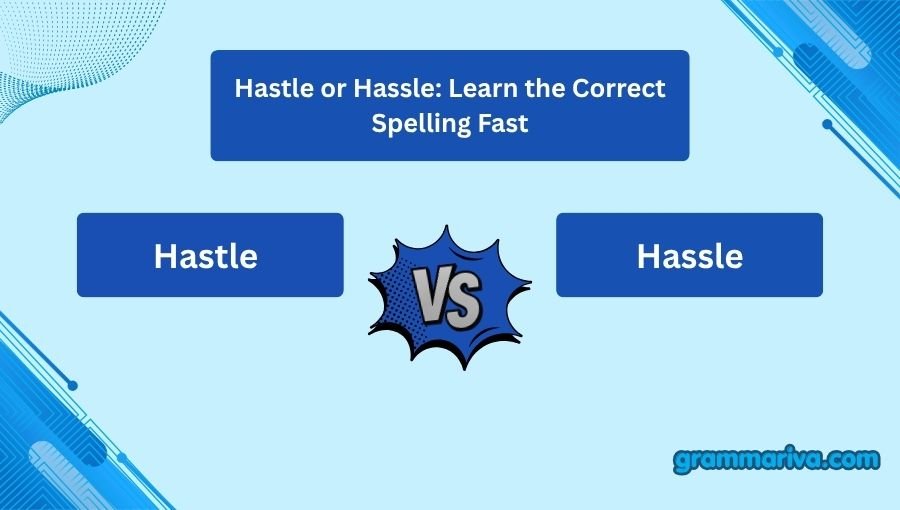
Have you ever typed hastle or hassle and stopped because one of them looked wrong? 😅 You are not alone. These two spellings look very close, but only one is the standard English word. The correct spelling is hassle.
The word hassle is common in everyday American English. You might use it when talking about a difficult task, an annoying problem, or something that causes trouble. For example, you might say, “Getting a refund was such a hassle.”
The confusion usually comes from the sound of the word. When we say hassle, the second syllable is soft and quick. That can make the spelling easy to forget. Fast typing can make the problem worse, too.
In this guide, I’ll explain the difference between hastle or hassle, show you the correct uses, and give you simple ways to remember the spelling. I’ll also cover common mistakes, examples, phrases, and FAQs so you can use the word with confidence. ✍️ Indolence vs Insolence | Alright vs Allright | Worn or Warn
🎯 Quick Answer: Hastle or Hassle?
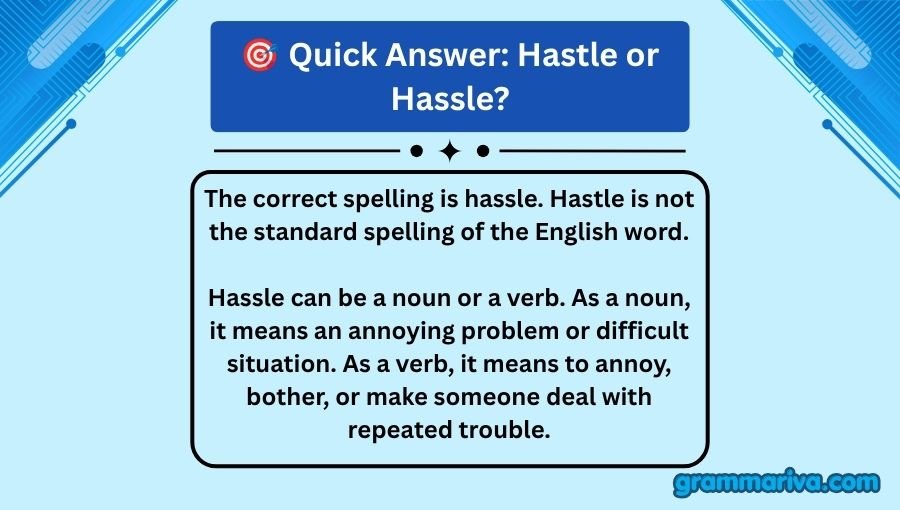
The correct spelling is hassle. Hastle is not the standard spelling of the English word.
Hassle can be a noun or a verb. As a noun, it means an annoying problem or difficult situation. As a verb, it means to annoy, bother, or make someone deal with repeated trouble.
- ✅ The paperwork was a hassle.
- ❌ The paperwork was a hastle.
If you are writing about an annoying task, problem, or inconvenience, choose hassle.
🔎 Is Hastle or Hassle the Correct Spelling?
Hassle is the correct spelling. The spelling hastle is a common mistake caused by the way the word sounds.
Here is the basic difference:
| Form | Type | Meaning | Example | Correct/Incorrect |
|---|---|---|---|---|
| hassle | Noun | An annoying problem or inconvenience | The delay was a hassle. | ✅ Correct |
| hassle | Verb | To bother or annoy someone | Stop hassling me. | ✅ Correct |
| hastle | Misspelling | Not the standard spelling | The delay was a hastle. | ❌ Incorrect |
The key point is simple: hassle has two s’s in the middle.
You should write:
hassle
Not:
hastle
🧠 Why Do People Confuse Hastle and Hassle?
People confuse these spellings because hassle is pronounced in a way that can make the second s easy to miss. Typing quickly also makes the mistake more likely.
I once edited a short workplace message that said, “Sorry for the hastle.” The writer knew exactly what they wanted to say. They had simply typed the word the way it sounded in their head. A quick spelling check fixed it.
Common reasons for the confusion include:
- The word is often spoken faster than it is spelled.
- The second s can be easy to overlook.
- People may write words based on sound.
- Autocorrect does not always catch every spelling error.
- Fast typing can cause letters to disappear.
- Some writers have seen the incorrect form online.
The mistake is understandable, but the solution is easy. Remember that hassle contains ss.
A Simple Memory Trick
Think:
HASSLE = annoying STRESS
Both words contain an S sound and relate to trouble or difficulty.
You can also break the spelling into:
H-A-S-S-L-E
Two S’s sit together in the middle.
📚 Hassle: Meaning and Correct Use
The word hassle has two main grammatical uses. It can work as a noun or a verb.
Hassle as a Noun
As a noun, hassle means an annoying problem, inconvenience, or difficult situation.
Examples:
- Getting through airport security was a hassle.
- Moving to a new apartment can be a hassle.
- The return process was more trouble than it was worth.
- I do not want the hassle of changing providers.
In these examples, hassle names the annoying situation.
Hassle as a Verb
As a verb, hassle means to bother, annoy, pressure, or trouble someone.
Examples:
- The salesperson kept hassling me.
- Please stop hassling your brother.
- The customers were hassled by repeated phone calls.
Notice the related form hassling. It keeps the double s:
hassle → hassling
The spelling changes slightly when the ending is added, but the main spelling pattern remains clear.
Meaning Summary
| Meaning | Word Type | Example Sentence |
|---|---|---|
| An annoying problem | Noun | The paperwork was a hassle. |
| An inconvenience | Noun | Parking downtown is a hassle. |
| To bother someone | Verb | They kept hassling him. |
| To pressure someone | Verb | The seller hassled us to buy it. |
✏️ How Is Hassle Used in a Sentence?
Hassle usually describes something that causes extra trouble, effort, or annoyance.
For example:
Booking the appointment online was a hassle.
Here, hassle is a noun. It describes the frustrating experience.
Another example is:
My neighbor keeps hassling me about the fence.
Here, hassling is a verb. It describes the action of repeatedly bothering someone.
Compare these examples:
- ✅ The long line was a hassle.
- ❌ The long line was a hastle.
- ✅ Stop hassling me about it.
- ❌ Stop hastling me about it.
The correct word family keeps the ss pattern.
💡 Test Tip
When you are unsure, write the word slowly:
has + sle
Then check the middle.
If you wrote hassle, you have the standard spelling.
If you wrote hastle, remove the t.
⚖️ Hastle or Hassle at a Glance
The fastest way to understand the difference is to compare actual sentences.
| Sentence | Correct/Incorrect | Why |
|---|---|---|
| The paperwork was a hassle. | ✅ Correct | Hassle is the correct noun. |
| The paperwork was a hastle. | ❌ Incorrect | Hastle is a misspelling. |
| I do not need this hassle. | ✅ Correct | The word describes an inconvenience. |
| I do not need this hastle. | ❌ Incorrect | The standard spelling uses ss. |
| Stop hassling me. | ✅ Correct | Hassling is the correct verb form. |
The pattern is easy once you see it several times.
📝 Case Study: Hassle in a Workplace Email
This workplace example shows how the hastle or hassle confusion can appear in a normal email.
A first draft might say:
❌ “Sorry for the hastle. The system is still not working.”
That spelling is incorrect.
A better version is:
✅ “Sorry for the hassle. The system is still not working.”
The second version looks polished and professional.
I once caught myself typing a similar spelling mistake in a quick message. I had written the word based on its sound. When I reread the sentence, the missing s stood out. That small pause reminded me why proofreading matters, even with simple words.
In professional writing, small spelling errors can distract readers from your main point. One wrong letter may not change the meaning, but it can make the writing look less careful.
📖 Grammar Rules Explanation
The standard spelling is hassle. The form hastle is not the standard spelling of this English word.
There is no grammar rule that makes hastle acceptable as an alternative spelling. Instead, this is mainly a spelling issue.
The word hassle can be used as both a noun and a verb.
As a noun:
The delay was a hassle.
As a verb:
They hassled me about the payment.
The spelling hassle should be learned as a whole word. Most standard English dictionaries list hassle, not hastle, as the normal spelling.
Correct vs Incorrect Examples
| Sentence | Correct/Incorrect | Why |
|---|---|---|
| This paperwork is a hassle. | ✅ Correct | Hassle is the correct noun. |
| This paperwork is a hastle. | ❌ Incorrect | Hastle is a misspelling. |
| I hate the hassle of parking. | ✅ Correct | The word describes an inconvenience. |
| I hate the hastle of parking. | ❌ Incorrect | The spelling should contain ss. |
| She kept hassling him. | ✅ Correct | Hassling is the correct verb form. |
A useful rule is:
If you mean an annoying problem or an act of bothering someone, spell it H-A-S-S-L-E.
⚠️ Common Mistakes With Hassle
Spelling errors often happen when people write quickly. They may hear a word clearly but not remember every letter.
Three common causes are:
- Fast typing
Fingers may skip a letter or insert the wrong one. - Autocorrect
Writers may trust a keyboard suggestion without checking it. - Lack of familiarity
If you rarely write a word, its spelling may not feel natural.
The biggest mistake with this word is replacing the second s with t.
Similar Spelling Confusions
| Confusion | Correct Form | Main Difference |
|---|---|---|
| it’s / its | it’s / its | Apostrophe changes the meaning. |
| your / you’re | your / you’re | Possession vs. “you are.” |
| they’re / their / there | they’re / their / there | Different meanings and functions. |
| affect / effect | affect / effect | Usually different grammatical roles. |
| loose / lose | loose / lose | Different meanings and sounds. |
These examples show why spelling and word choice both matter.
❌ Common Wrong Forms of Hassle
| Wrong Form | What’s Wrong | Correct Form |
|---|---|---|
| hastle | The t should not be there. | hassle |
| hassel | The final letters are reversed. | hassle |
| hasle | One s is missing. | hassle |
| hastel | The middle letters are incorrect. | hassle |
| hassel-ing | The base spelling is wrong. | hassling |
When in doubt, return to the basic form:
HASSLE
🕰️ What Is the History of the Word Hassle?
The exact history of many everyday English words can be complex, but you do not need a detailed history lesson to spell hassle correctly.
For modern writers, the useful fact is that hassle is the established standard spelling in English. The form hastle is not a standard alternative spelling.
Because uncertain word histories can easily lead to false claims, it is better to focus on the modern form you need for writing.
| Stage | Form | Practical Note |
|---|---|---|
| Earlier English usage | hassle | The word developed as an informal English term. |
| Modern English | hassle | The standard spelling became established. |
| Current US English | hassle | Common in speech and writing. |
The main lesson is simple: history does not make hastle an accepted spelling.
🌎 Hassle in Different Contexts
The word hassle works in many settings. It is especially common in casual and conversational American English.
Everyday Conversation
Use hassle when talking about annoying tasks or problems.
Finding parking was such a hassle.
Professional Writing
The word can appear in workplace writing, especially when the tone is not highly formal.
We want to make the return process as hassle-free as possible.
Creative Writing
Writers can use hassle to show frustration or everyday conflict.
She did not want another hassle after such a long day.
Social Media and Texting
It is very common in casual posts and messages.
Traveling with three bags is a whole hassle. 😩
| Context | Which Term to Use | Example |
|---|---|---|
| Everyday conversation | hassle | That was such a hassle. |
| Professional writing | hassle | We want to reduce the hassle. |
| Creative writing | hassle | He wanted to avoid another hassle. |
| Social media/texting | hassle | No more travel hassles! |
Across all four contexts, the correct spelling remains hassle.
💬 Common Phrases With Hassle
Several common expressions use hassle. These phrases can help you remember the correct spelling naturally.
Hassle-Free
Hassle-free means easy and without unnecessary trouble.
The online service offers a hassle-free checkout.
A Lot of Hassle
This phrase describes something that causes considerable trouble.
Moving all those boxes was a lot of hassle.
Avoid the Hassle
This means to avoid unnecessary difficulty.
I ordered online to avoid the hassle of waiting in line.
Worth the Hassle
This asks whether something is worth the effort or trouble.
The discount was not worth the hassle.
Hassle Someone
This means to bother, pressure, or annoy someone.
Please do not hassle me while I am working.
| Phrase | Meaning |
|---|---|
| hassle-free | Without unnecessary trouble |
| a lot of hassle | A great deal of trouble |
| avoid the hassle | Stay away from unnecessary difficulty |
| worth the hassle | Worth the effort or trouble |
| hassle someone | Bother or pressure someone |
🔄 Synonyms and Alternatives to Hassle
Sometimes another word may fit your sentence better. The best choice depends on what you mean.
Trouble
Use trouble for a broad idea of difficulty or inconvenience.
The repair caused a lot of trouble.
Problem
Use problem when you want to focus on something that needs to be solved.
We have a problem with the order.
Inconvenience
Use inconvenience when something creates extra effort or discomfort.
We apologize for the inconvenience.
Annoy
Use annoy when someone or something bothers you.
The repeated calls annoyed me.
Bother
Use bother for a general sense of disturbance or annoyance.
I do not want to bother you.
| Alternative | Works When | Does Not Work When |
|---|---|---|
| trouble | You mean difficulty or inconvenience | You need a stronger focus on annoyance |
| problem | You mean something that needs fixing | You only mean minor inconvenience |
| inconvenience | You mean extra effort or discomfort | You mean someone repeatedly bothers you |
| annoy | You mean emotional irritation | You mean a difficult task |
| bother | You mean disturbance or irritation | You need a noun for a difficult process |
🎯 Why Does Getting the Spelling Right Matter?
Correct spelling helps readers understand your message without distraction. Even a small spelling mistake can make a sentence look less polished.
This matters most when you are writing for other people.
Consider these situations:
| Situation | Why Getting It Right Matters |
|---|---|
| Resume | Shows attention to detail |
| Client email | Creates a professional impression |
| Published content | Builds reader trust |
| Social post | Keeps your writing clear and polished |
A useful writing principle is:
Clear words make clear messages.
You do not need complicated vocabulary to sound smart. You need the right word, spelled correctly, in the right place.
The difference between hassle and hastle is small on the screen. But choosing the standard spelling makes your writing look much more reliable.
💡 How To Remember the Difference
The easiest memory trick is to focus on the two s’s.
Write:
HAS + SLE = HASSLE
Do not insert a t.
You can also connect hassle with the idea of stress. Both words are associated with unpleasant situations.
Try this quick mental test:
“Was it a hassle?”
If yes, write:
H-A-S-S-L-E
You can practice the word in short sentences:
- The trip was a hassle.
- Parking is always a hassle.
- I want to avoid the hassle.
- Stop hassling me.
After seeing the correct pattern several times, it becomes much easier to remember.
🧩 Hastle or Hassle: Quick Recap Checklist
Use this checklist whenever you are unsure.
| Question | If Yes → Use |
|---|---|
| Do you mean an annoying problem? | hassle |
| Do you mean an inconvenience? | hassle |
| Do you mean to bother someone? | hassle |
| Are you writing “hassling”? | hassling |
| Did you spell it with a t? | Change it to hassle |
Practice Examples
- The airport check-in was a hassle. ✅
- I do not want the hassle of returning it. ✅
- Stop hassling your sister. ✅
Now try to remember the core pattern:
HASSLE = H-A-S-S-L-E
❓ FAQs About Hastle vs Hassle
Is “hastle” a correct English word?
No. Hastle is not the standard spelling of the common English word. If you mean an annoying problem, inconvenience, or act of bothering someone, use hassle.
Is it hassle or hastle?
The correct spelling is hassle. It contains two s’s and no t.
Correct: The process was a hassle.
Incorrect: The process was a hastle.
What does hassle mean?
Hassle means an annoying problem, inconvenience, or difficult situation. As a verb, it can mean to bother, annoy, or pressure someone.
How do you spell hassle?
Spell it H-A-S-S-L-E.
The easiest part to remember is the double s in the middle.
Is hassle a noun or a verb?
Hassle can be both a noun and a verb.
As a noun:
The delay was a hassle.
As a verb:
They kept hassling me.
What is the plural of hassle?
The plural is hassles.
Example:
Traveling can involve many small hassles.
The plural adds -s to the standard spelling.
What is the difference between hassle and bother?
Both words can describe annoyance. Hassle often focuses on trouble, inconvenience, or an annoying task. Bother can describe either annoying someone or causing inconvenience.
For example:
Parking downtown is a hassle.
But:
I do not want to bother you.
Is “hassle-free” correct?
Yes. Hassle-free is a common compound expression meaning free from unnecessary trouble or difficulty.
Example:
The service promises a hassle-free experience.
Why do people spell hassle as hastle?
People often make this mistake because they spell the word based on how it sounds. Fast typing and unfamiliarity with the word can also cause the error.
How can I remember the spelling of hassle?
Remember the double s:
HAS + SLE = HASSLE
Do not put a t in the middle. Writing the word a few times in short sentences can also help.
✅ Final Thoughts on Hastle or Hassle
Hastle or hassle is a simple spelling question with a simple answer: hassle is the correct standard form. Use it when you mean an annoying problem, inconvenience, or situation that causes extra trouble. You can also use it as a verb when you mean to bother or pressure someone.
The biggest spelling trap is the missing or replaced s. Remember the pattern H-A-S-S-L-E. The double s is the key.
When you see hastle, stop and check it. If the sentence is about trouble, inconvenience, or annoyance, change it to hassle. ✨
Good spelling does not require a perfect memory. It requires a few useful patterns and a quick habit of checking your work. Once you remember the two s’s, this common mistake becomes much easier to avoid.
When in doubt, remember: trouble is a hassle, never a “hastle.” ✅

Hi, I’m Nathan Reed. I’m a grammar and writing specialist at Grammariva. I work on practical grammar content that helps readers understand sentence structure, punctuation, vocabulary, and better writing habits.