Choosing between work experience or working experience can feel confusing, especially when you are writing a resume, cover letter, LinkedIn profile, or professional email. Both phrases can appear natural at first glance, but they do not always work in the same way.
When I edit resumes, this is one of those small language choices that can make a sentence sound more polished. The good news is that the rule is easier than it seems. 😊
In most professional situations, work experience is the standard and more natural choice when you mean the experience someone has gained from doing jobs or working in a field. Working experience is possible in some contexts, but it usually has a different structure and meaning.
I will explain the difference in simple terms. You will also see examples, common mistakes, workplace examples, resume tips, and a quick test you can use whenever you are unsure. By the end, choosing the right phrase should feel automatic. 👍 No Difference vs No Different | Copywritten vs Copyrighted | Anyone Else vs Someone Else vs Everyone Else
🎯 Quick Answer: Work Experience or Working Experience
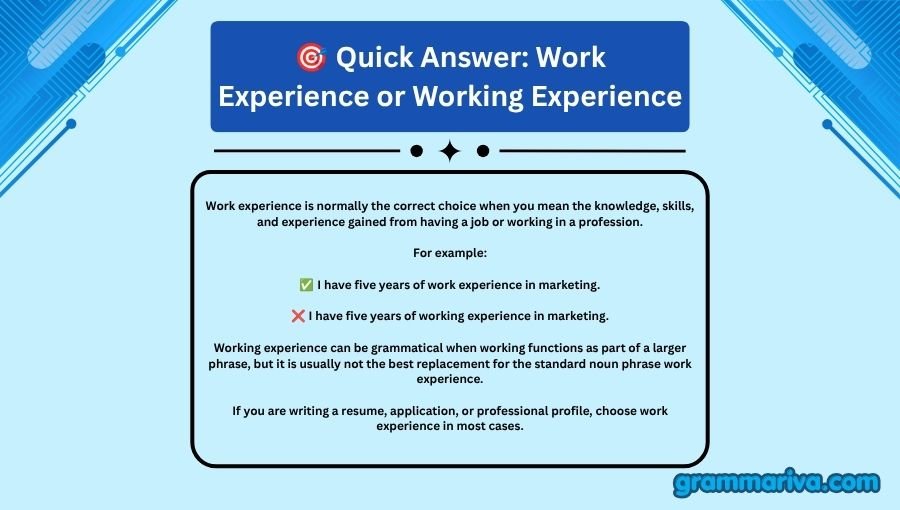
Work experience is normally the correct choice when you mean the knowledge, skills, and experience gained from having a job or working in a profession.
For example:
- ✅ I have five years of work experience in marketing.
- ❌ I have five years of working experience in marketing.
Working experience can be grammatical when working functions as part of a larger phrase, but it is usually not the best replacement for the standard noun phrase work experience.
If you are writing a resume, application, or professional profile, choose work experience in most cases.
Work Experience vs Working Experience at a Glance
The basic difference is simple: work experience is a common noun phrase for professional experience, while working experience usually describes an experience that happens while someone is working.
| Form | Type | Meaning | Example | Correct/Incorrect |
|---|---|---|---|---|
| work experience | Noun phrase | Experience gained through employment | I have three years of work experience. | ✅ Correct |
| working experience | Participial/adjectival phrase | Experience connected with the act of working | Working experience can teach you patience. | ✅ Context-dependent |
| work experiences | Plural noun phrase | Separate experiences gained through different jobs | My work experiences shaped my career. | ✅ Correct |
| working experiences | Plural phrase | Experiences occurring while working | Our working experiences were very different. | ✅ Correct, but less common |
The key point is that work experience is the established phrase for professional background.
Is Work Experience the Standard Professional Phrase?
Yes. Work experience is the usual phrase in resumes, job applications, interviews, and career discussions.
It normally refers to the skills and knowledge you gain through employment. It can include full-time jobs, part-time jobs, internships, freelance work, and other relevant professional activities.
Consider these examples:
- ✅ I have six years of work experience in finance.
- ❌ I have six years of working experience in finance.
- ✅ Please list your work experience on the application.
- ❌ Please list your working experience on the application.
The first version sounds natural because work experience acts as a standard noun phrase.
Why Work Experience Sounds Natural
In this phrase, work describes the type of experience.
You can think of it like this:
work + experience = experience gained from work
That structure is common in English.
| Expression | Meaning | Example |
|---|---|---|
| work experience | Professional experience | She has strong work experience. |
| work history | Record of previous employment | His work history is impressive. |
| work skills | Skills used at work | Communication is one of her work skills. |
| work environment | Place or conditions where people work | We have a friendly work environment. |
| work schedule | Planned working hours | My work schedule changes weekly. |
Why Do People Confuse Work Experience and Working Experience?
People often confuse these phrases because work and working are closely related. They come from the same basic idea, but they perform different jobs in a sentence.
I once edited a resume where the applicant had written “ten years of working experience” several times. The meaning was perfectly clear, but changing it to “ten years of work experience” made the resume sound much more natural.
The confusion is also common because some varieties of English use working experience more often than standard US professional English does.
Another reason is that English learners may think working is more precise because it clearly connects the experience to a job. However, English does not always form noun phrases that way.
A Simple Way to Think About It
Ask yourself what you mean.
If you mean:
“How much professional experience does this person have?”
Use work experience.
If you mean:
“What happened while someone was working?”
A phrase containing working may be appropriate.
| Meaning | Best Choice | Example |
|---|---|---|
| Professional background | work experience | I have five years of work experience. |
| Career experience | work experience | Her work experience helped her qualify. |
| Experience during the act of working | working experience | The working experience was challenging. |
| Experience gained from employment | work experience | His work experience includes teaching. |
💡 Test Tip: How Can You Remember the Difference?
Use this quick test:
Can you replace the phrase with “professional experience”?
If yes, use work experience.
For example:
I have seven years of professional experience.
That sounds natural.
So:
I have seven years of work experience.
also sounds natural.
But:
I have seven years of working experience.
is less natural in standard professional US English.
The One-Line Test
Professional background = work experience.
This small rule will solve most cases.
| Question | Answer |
|---|---|
| Am I talking about my career background? | Use work experience. |
| Am I describing skills gained from jobs? | Use work experience. |
| Am I writing a resume? | Use work experience. |
| Am I describing something that happened while working? | Working may fit. |
| Do I simply mean professional experience? | Use work experience. |
What Does Work Experience Mean?
Work experience means the knowledge, skills, and practical understanding a person gains through employment or professional activity.
It can refer to one job or several jobs. It can also include internships, volunteer positions, freelance projects, apprenticeships, and other activities when they provide useful professional experience.
For example:
- ✅ My work experience includes three years in customer service.
- ✅ She gained valuable work experience during her internship.
- ✅ The company requires two years of relevant work experience.
Here, work experience is treated as a noun phrase.
Work Experience Can Be General or Specific
You can use the phrase without a number:
I have relevant work experience.
You can also give a specific amount:
I have four years of work experience.
Or identify a field:
I have work experience in software development.
| Pattern | Example |
|---|---|
| work experience | I have relevant work experience. |
| years of work experience | She has eight years of work experience. |
| work experience in + field | He has work experience in accounting. |
| relevant work experience | Do you have relevant work experience? |
| previous work experience | My previous work experience was in sales. |
Is Working Experience Ever Correct?
Yes, but it is not normally the phrase you want when describing your professional background.
Working is the present participle of work. It can describe an activity that is happening or an experience connected to that activity.
For example:
- ✅ Working with children taught me patience.
- ✅ Working experience in a busy restaurant can be demanding.
- ✅ My experience working with international clients was valuable.
Notice that the structure changes.
Instead of using working experience as a direct substitute for work experience, English often uses experience working with…
For example:
I have experience working with children.
This is very natural.
Compare:
I have five years of work experience with children.
Both can work, depending on the intended meaning.
I have five years of working experience with children.
This is less natural in standard US professional writing.
Work Experience in Resumes and Job Applications
For resumes and applications, work experience is the safest and most natural choice.
A resume section is commonly labeled:
Work Experience
This heading tells the reader that the section contains your previous jobs and professional roles.
Examples:
- ✅ Work Experience
- ❌ Working Experience
If you are writing a resume for a US employer, I strongly recommend Work Experience as the heading.
Resume Examples
| Resume Element | Recommended Version |
|---|---|
| Section heading | Work Experience |
| Sentence | I have five years of work experience in sales. |
| Application question | Please describe your work experience. |
| Profile | Marketing professional with eight years of work experience. |
| Interview answer | My work experience includes customer service and management. |
A polished resume should remove unnecessary wording. Work experience is short, clear, and immediately understood.
How Should You Use Work Experience in a Sentence?
The phrase can appear in several common sentence patterns.
With Numbers
Use years of work experience when giving the length of your professional background.
- ✅ She has ten years of work experience.
- ✅ I have two years of work experience in education.
With a Field
Use work experience in when identifying an area of work.
- ✅ He has work experience in accounting.
- ✅ I have work experience in digital marketing.
With a Verb
Use verbs such as gain, have, develop, and build.
- ✅ I gained valuable work experience during college.
- ✅ She developed strong work experience in customer service.
- ✅ He has extensive work experience in engineering.
| Verb | Example |
|---|---|
| have | I have five years of work experience. |
| gain | She gained valuable work experience. |
| build | He built strong work experience in sales. |
| develop | They developed useful work experience. |
| require | The position requires relevant work experience. |
📝 Case Study: A Resume That Needed One Small Change
A recent graduate once showed me a resume that said:
“I have two years of working experience in retail.”
The sentence was understandable. There was no major communication problem. But for a US-focused resume, I would change it to:
“I have two years of work experience in retail.”
That version is more natural and fits standard professional usage.
The applicant did not need to rewrite the entire sentence. Only one word needed to change.
This is a useful lesson: grammar corrections do not always require major changes. Sometimes the best edit is simply choosing the phrase native speakers expect to see.
Grammar Rules Explanation
The grammar difference comes from how work and working function in the phrase.
In work experience, work functions as a noun modifier. It tells us what kind of experience we mean. The phrase refers to experience gained through employment or professional activity.
In working experience, working is the -ing form of the verb work. It can function as a participle and describe an experience related to working.
That is why the two phrases should not automatically be treated as interchangeable.
Standard English usage strongly favors work experience when discussing someone’s professional background.
A general reference check with well-known English dictionaries also supports the distinction between work as a noun and working as an -ing form used in different grammatical structures.
Correct vs Incorrect at a Glance
| Sentence | Correct/Incorrect | Why |
|---|---|---|
| I have five years of work experience. | ✅ Correct | Standard noun phrase for professional experience. |
| I have five years of working experience. | ⚠️ Less natural | Understandable, but not the preferred US form. |
| My work experience includes teaching. | ✅ Correct | Refers to professional background. |
| My working experience includes teaching. | ⚠️ Less natural | Working is unnecessary here. |
| I have experience working with children. | ✅ Correct | Working correctly introduces an activity. |
The key grammar rule is simple:
Use work experience for professional background. Use working when it functions naturally as an -ing form in a larger structure.
Correct vs Incorrect Examples You Should Know
Here are several practical examples.
Example 1
- ✅ I have three years of work experience in banking.
- ❌ I have three years of working experience in banking.
Example 2
- ✅ Please describe your work experience.
- ❌ Please describe your working experience.
Example 3
- ✅ My work experience prepared me for this position.
- ❌ My working experience prepared me for this position.
Example 4
- ✅ I have experience working with customers.
- ❌ I have experience work with customers.
Example 5
- ✅ Working with customers taught me patience.
- ❌ Work with customers taught me patience.
The last pair shows why working is not always wrong. It depends on its grammatical role.
⚠️ Common Mistakes With Work Experience and Working Experience
Most mistakes happen because the two forms look almost identical.
There are several reasons:
- Fast typing can cause people to choose the first form that comes to mind.
- Autocorrect may reinforce a phrase someone has already used.
- English learners may translate the structure directly from another language.
- People may see working experience online and assume it is always interchangeable with work experience.
- Writers may believe that adding -ing makes the phrase more grammatically complete.
I once caught myself typing “working experience” in a draft while editing a career guide. I stopped because I was using the phrase to mean professional background. Changing it to “work experience” made the sentence cleaner immediately.
Similar Grammar Confusions
| Confusion | Correct Form | Basic Rule |
|---|---|---|
| it’s / its | depends on meaning | It’s = it is; its = possession |
| your / you’re | depends on meaning | Your = possession; you’re = you are |
| their / they’re | depends on meaning | Their = possession; they’re = they are |
| affect / effect | depends on function | Usually verb vs. noun |
| work / working | depends on structure | Use work for professional experience |
Common Wrong Uses
| Wrong Form | What’s Wrong | Correct Form |
|---|---|---|
| working experience on my resume | Less natural professional phrase | work experience on my resume |
| five years working experience | Missing natural noun structure | five years of work experience |
| many working experiences | Usually unnecessary wording | many work experiences |
| professional working experience | Redundant in most cases | professional work experience |
| previous working experience | Unnatural in standard US usage | previous work experience |
| relevant working experience | Less natural | relevant work experience |
Does Work Experience Need to Be Plural?
Usually, work experience is treated as an uncountable noun when you mean someone’s overall professional background.
For example:
I have five years of work experience.
You do not normally need to say:
I have five years of work experiences.
However, work experiences can be correct when you mean separate or distinct experiences.
For example:
My work experiences at two different companies taught me different skills.
The plural form focuses on individual experiences rather than a general amount of professional experience.
| Form | Use | Example |
|---|---|---|
| work experience | General professional background | I have work experience in finance. |
| work experiences | Separate experiences | My work experiences shaped my career. |
| years of work experience | Amount of experience | She has ten years of work experience. |
| professional experience | Formal alternative | He has extensive professional experience. |
Usage in Different Contexts
The best choice can depend slightly on context, but work experience remains the standard option for professional writing.
| Context | Which Term to Use | Example |
|---|---|---|
| Everyday conversation | work experience | I need more work experience. |
| Professional writing | work experience | Please include your work experience. |
| Creative writing | Depends on sentence | Working all night was exhausting. |
| Social media/texting | Either can appear, but work experience is clearer | I finally got some work experience! |
Everyday Conversation
People commonly say:
I need more work experience.
or:
How much work experience do you have?
These are natural and clear.
Professional Writing
Professional writing strongly favors:
relevant work experience
and:
previous work experience
This includes resumes, cover letters, job applications, business websites, and workplace documents.
Creative Writing
Creative writing gives you more freedom.
For example:
Working experience in the field changed how she saw the job.
But even in creative writing, the sentence should match the intended meaning.
Social Media and Texting
Informal writing is more flexible. However, if you are posting professional information, work experience remains the better choice.
Common Phrases With Work Experience
There are several common combinations worth learning. These phrases appear often in job-related writing.
| Phrase | Meaning |
|---|---|
| work experience | Experience gained through employment |
| relevant work experience | Experience related to a specific position |
| previous work experience | Experience from earlier jobs |
| professional work experience | Experience in a professional setting |
| years of work experience | Amount of professional experience |
| work experience section | Resume section listing previous jobs |
Learning these combinations can make your writing sound more natural.
For example:
Please list your relevant work experience.
This sounds much more natural than:
Please list your relevant working experience.
What Alternatives Can You Use?
Sometimes you do not need either phrase. Several alternatives can express the same general idea.
| Alternative | Works When | Does Not Work When |
|---|---|---|
| professional experience | Discussing career background | Talking about a specific work activity |
| career experience | Discussing a person’s career broadly | Referring to one particular job task |
| employment history | Listing previous jobs | Describing skills gained from work |
| professional background | Giving an overview of someone’s career | Talking about a single work event |
| job experience | Informal contexts | Formal writing where professional experience is better |
For example:
She has extensive professional experience in marketing.
This means almost the same thing as:
She has extensive work experience in marketing.
But:
Her employment history includes three companies.
focuses more on the record of jobs themselves.
Work Experience vs Professional Experience
Professional experience is often a useful alternative to work experience.
Both can describe experience gained through employment, but they can have slightly different tones.
Work experience is simple and direct.
Professional experience sounds somewhat more formal and is common in resumes and business profiles.
| Phrase | Tone | Example |
|---|---|---|
| work experience | Simple and direct | I have five years of work experience. |
| professional experience | Formal | I have five years of professional experience. |
| employment history | Record-focused | My employment history includes three roles. |
| career background | Broad | Her career background is impressive. |
For most general questions, work experience is the easiest choice.
Why Does Getting the Phrase Right Matter?
Small language choices can affect how polished your writing sounds.
This is especially true when you are applying for a job. Recruiters may read dozens of resumes. Clear wording helps them understand your background quickly.
Clarity in Communication
The standard phrase reduces confusion.
I have seven years of work experience.
The reader immediately knows that you are talking about your professional background.
Professionalism
Using standard professional wording can make a resume or application sound more polished.
Digital Communication
The same principle applies to LinkedIn profiles, business emails, websites, and online portfolios.
A simple rule is worth remembering:
Clear words make professional writing easier to trust.
| Situation | Why Getting It Right Matters |
|---|---|
| Resume | Shows professional experience clearly |
| Job application | Makes your qualifications easy to understand |
| Client email | Keeps professional language polished |
| Published content | Improves clarity and credibility |
How To Remember the Difference
You do not need to memorize a complicated grammar rule.
Just remember this:
Work experience = professional background.
Then remember:
Experience working = experience doing a work activity.
Compare:
I have five years of work experience.
with:
I have experience working with children.
Both are correct because they use different structures.
A Memory Trick
Think of work experience as a label.
A resume section can simply say:
Work Experience
Think of working as an action.
Working with customers taught me patience.
This distinction makes the choice much easier.
| If You Mean… | Use |
|---|---|
| Your career background | work experience |
| Your job history | work experience |
| Skills gained from employment | work experience |
| An activity you perform | working |
| Something that happened while doing a job | working |
Can You Say “Years of Working Experience”?
You may see this phrase in English-language writing, especially from non-US sources. Readers can usually understand it.
However, for polished US English, I recommend:
years of work experience
instead of:
years of working experience
For example:
- ✅ She has ten years of work experience.
- ⚠️ She has ten years of working experience.
The second sentence is understandable. It is simply less natural for standard US professional writing.
This distinction matters when you are preparing a resume, cover letter, business profile, or formal application.
Work Experience in Questions and Answers
Questions about professional background normally use work experience.
Examples:
- ✅ How much work experience do you have?
- ✅ Do you have any work experience in sales?
- ✅ What kind of work experience do you have?
- ✅ Can you tell me about your work experience?
These questions are common in interviews and applications.
| Question | Natural Answer |
|---|---|
| How much work experience do you have? | I have four years of work experience. |
| Do you have work experience in sales? | Yes, I have three years of sales experience. |
| What is your work experience? | My work experience includes teaching and management. |
| Where did you gain your work experience? | I gained it at two different companies. |
Special Exception: Working Experience in a Different Structure
There is no major special exception that makes working experience a standard replacement for work experience in US professional writing.
However, working can be completely correct when it describes an activity.
For example:
Working from home has changed my routine.
Here, working is a verb form. It is not replacing work in the noun phrase work experience.
Another example:
My experience working remotely was positive.
This is also natural.
The important point is to look at the whole sentence rather than deciding that every use of working is wrong.
Quick Comparison: Which One Should You Choose?
| Sentence | Best Choice |
|---|---|
| I have five years of ___ experience. | work |
| Please describe your ___ experience. | work |
| My ___ experience is listed below. | work |
| I have experience ___ with customers. | working |
| ___ with customers improved my skills. | Working |
| My experience ___ remotely was useful. | working |
This table gives you the practical rule in one place.
🎯 Quick Recap Checklist
Use this checklist whenever you are unsure.
| Question | If Yes → Use |
|---|---|
| Are you talking about your professional background? | work experience |
| Are you writing a resume? | work experience |
| Are you describing years spent in a career? | work experience |
| Are you describing an action happening during work? | working |
| Does “experience working with…” fit the sentence? | working |
Practice Examples
1. I have six years of ___ experience in finance.
✅ work
2. I have experience ___ with international clients.
✅ working
3. Please add your ___ experience to your resume.
✅ work
The pattern becomes clear once you focus on the meaning.
FAQs About Work Experience vs Working Experience
Is work experience or working experience correct?
Work experience is the standard choice when you mean professional experience gained through employment. Working experience can be grammatical in other structures, but it is usually less natural as a direct replacement.
Is work experience correct on a resume?
Yes. Work Experience is the preferred heading for a resume section that lists previous jobs and professional roles.
Can I say “five years of working experience”?
You can, and most readers will understand it. However, five years of work experience is more natural and polished in standard US English.
What is the difference between work experience and working experience?
Work experience means professional experience gained through employment. Working experience uses working as an -ing form and can describe experience connected with the act of working.
Should I write “work experience” on a job application?
Yes. Work experience is the best choice for most job applications, especially when describing your previous employment or professional skills.
Is “working experience” grammatically wrong?
Not always. The phrase can be grammatical depending on the sentence. However, using working experience as a direct substitute for work experience is usually less natural in standard US professional English.
Should I say “years of work experience” or “years of working experience”?
Use years of work experience. It is the standard and more natural expression.
Can I say “experience working with customers”?
Yes. Experience working with customers is completely natural because working describes the activity you have experience doing.
Is “work experiences” correct?
Yes, when you mean separate or distinct experiences. For general professional background, however, work experience is usually treated as an uncountable noun.
What is another word for work experience?
Depending on the context, you can use professional experience, professional background, career experience, or employment history. Each has a slightly different focus.
Conclusion
Work experience or working experience is a much easier choice once you focus on what you mean. If you are talking about your professional background, skills gained from employment, or the number of years you have spent working in a field, work experience is the standard choice.
Use work experience on resumes, job applications, LinkedIn profiles, cover letters, and other professional documents. For example, “I have five years of work experience in marketing” is clear and natural.
Use working when it functions as an -ing form describing an action, as in “I have experience working with customers.” That structure is different and should not be confused with the standard noun phrase.
When in doubt, remember one simple rule: professional background = work experience. Keep that rule in mind, and you will avoid one of the most common wording problems in professional English. 😊
Choose the standard phrase, keep your sentence clear, and let your experience speak for itself.

Hi, I’m Lucas Bennett. I’m a grammar content specialist at Grammariva. I work on articles covering everyday grammar questions, sentence usage, and writing tips that readers can apply with confidence.
[…] By the end, you should be able to choose confidently without stopping to second-guess yourself. ✨ Work Experience or Working Experience | No Difference vs No Different | Copywritten vs […]