Have you ever wondered about anyone else vs someone else vs everyone else and which phrase is correct in a sentence? You are not alone. These three phrases look very similar, but they do not mean the same thing.
The difference is mainly about who you mean. “Anyone else” points to any other person. “Someone else” points to one other person, but that person is not named. “Everyone else” points to all the other people in a group. 😊
I teach grammar by focusing on meaning first. Once you understand the meaning, the grammar becomes much easier. I also find that short examples work better than long rules.
In this guide, I’ll explain anyone else vs someone else vs everyone else with simple rules, examples, tables, common mistakes, and practical tips. By the end, you should be able to choose the right phrase without stopping to think twice. ✨ Substantive or Substantial | Trawling vs Trolling | Hail vs Hale
Quick Answer :Anyone Else vs Someone Else vs Everyone Else🎯
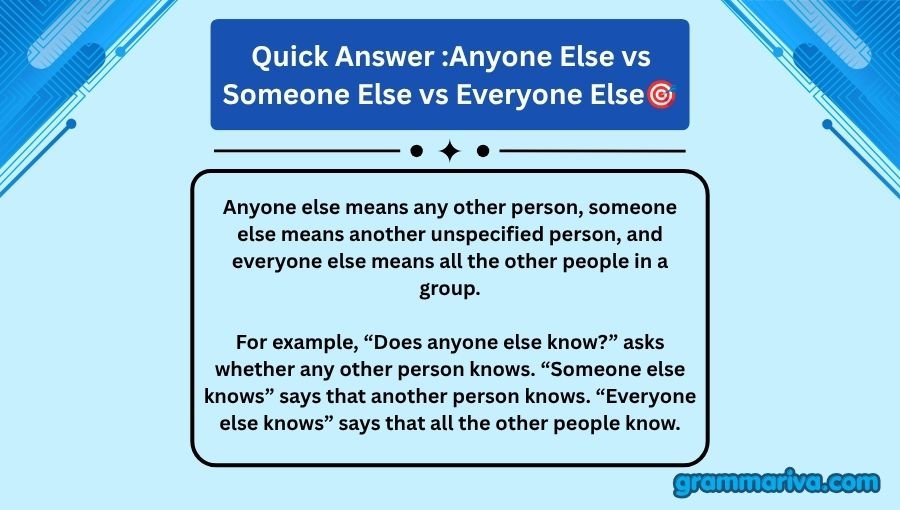
Anyone else means any other person, someone else means another unspecified person, and everyone else means all the other people in a group.
For example, “Does anyone else know?” asks whether any other person knows. “Someone else knows” says that another person knows. “Everyone else knows” says that all the other people know.
| Phrase | Basic Meaning | Example |
|---|---|---|
| Anyone else | Any other person | Does anyone else want coffee? |
| Someone else | Another person | Someone else took my seat. |
| Everyone else | All other people | Everyone else arrived early. |
| No one else | Nobody other than the person or people mentioned | No one else knew the answer. |
Is Anyone Else the Same as Someone Else?
No. Anyone else and someone else are not interchangeable in every sentence. The main difference is whether you mean any possible person or one particular but unnamed person.
Think of the question:
“Is there another person who can help?”
You could ask:
Can anyone else help me?
This does not identify a particular helper. You are asking whether at least one other person can help.
Now compare it with:
Someone else can help me.
This makes a statement about another person. You believe that another person can help, even though you do not name that person.
Anyone Else
“Anyone” usually refers to any person in a group or any person at all, depending on context.
The word “else” adds the meaning of “other” or “in addition to the person already mentioned or understood.”
Examples:
- Does anyone else need a copy?
- Has anyone else seen my keys?
- Can anyone else answer this question?
Someone Else
“Someone” refers to one person whose identity is not stated.
“Else” means that the person is another person.
Examples:
- Someone else answered the phone.
- I think someone else owns this bag.
- Ask someone else for help.
The easiest way to remember the difference is this:
Anyone else = any other person.
Someone else = one other person.
What Does Everyone Else Mean?
Everyone else means all the other people in a group except the person or people already being discussed.
It is broader than “someone else.”
Consider this sentence:
Everyone else went home.
This means all the other people went home.
Now compare:
Someone else went home.
This means another person went home, but it does not say that all the other people went home.
| Phrase | Number of People Intended | Example | Meaning |
|---|---|---|---|
| Anyone else | One or more possible people | Did anyone else call? | Did any other person call? |
| Someone else | One unspecified person | Someone else called. | Another person called. |
| Everyone else | All other people | Everyone else called. | All the other people called. |
| No one else | Zero other people | No one else called. | Nobody other than those mentioned called. |
Anyone Else vs Someone Else vs Everyone Else at a Glance
The easiest way to compare the three phrases is to focus on question, statement, and whole group.
| Form | Type | Meaning | Example | Correct/Incorrect |
|---|---|---|---|---|
| Anyone else | Indefinite pronoun phrase | Any other person | Does anyone else agree? | ✅ Correct |
| Someone else | Indefinite pronoun phrase | One other person | Someone else agreed. | ✅ Correct |
| Everyone else | Indefinite pronoun phrase | All other people | Everyone else agreed. | ✅ Correct |
| Anyone else in a statement | Context-dependent | Any other person | Anyone else can join. | ✅ Correct |
| Everyone else for one person | Wrong meaning | One other person | Everyone else called me. | ❌ Incorrect if only one caller is meant |
A useful pattern is:
- Anyone asks about possibilities.
- Someone identifies one unknown person.
- Everyone includes the whole group.
- Else means another or other.
How Does Anyone Else Work in Questions?
Anyone else is very common in questions. It asks whether another person or any other people fit the situation.
For example:
Does anyone else want pizza?
The speaker is not asking about one known person. The speaker wants to know if there is at least one other person who wants pizza.
Common Uses of Anyone Else
You can use it when asking about:
- opinions
- actions
- experiences
- choices
- knowledge
- preferences
- abilities
Examples:
Has anyone else finished the assignment?
The speaker asks whether another person has finished it.
Does anyone else feel tired?
The speaker asks whether other people have the same feeling.
Can anyone else drive?
The speaker asks whether another person has the ability to drive.
Test Tip 💡
When you see a question, replace anyone else with any other person.
If the sentence still makes sense, “anyone else” is probably the right choice.
Does anyone else know?
becomes:
Does any other person know?
The meaning stays almost the same.
When Should You Use Someone Else?
Use someone else when you mean another person, but you do not say who that person is.
It often appears in statements and requests.
For example:
Someone else left this umbrella here.
You know that another person left it. You simply do not know or do not say who.
You can also use “someone else” when asking a person to find another person.
Ask someone else.
This means ask another person.
Examples
I think someone else took my notebook.
The speaker believes another person took it.
Someone else will handle the meeting.
Another person will handle it.
Could someone else explain this?
The speaker wants another person to explain it.
Notice that “someone else” does not mean everybody.
If three people are available, “someone else” can refer to one of those people without identifying which one.
Can Everyone Else Refer to a Group?
Yes. Everyone else refers to all the other people in a group.
This is the phrase to choose when the whole remaining group is included.
For example:
Everyone else stayed after class.
This means all the other people stayed.
It does not mean only one person stayed.
More Examples
Everyone else has already left.
All the other people have left.
Everyone else agreed with the plan.
All the other people agreed.
Everyone else was wearing a jacket.
All the other people were wearing jackets.
The phrase can also contrast one person with a group.
I stayed home, but everyone else went out.
Here, “I” is separated from the group. “Everyone else” means all the other people.
Why Do People Confuse Anyone Else and Someone Else?
People confuse these phrases because both contain “one” ideas and both can refer to an unknown person. The difference becomes clear when you look at the speaker’s purpose.
I once marked a student’s sentence that said, “Someone else want to join us?” The student knew the intended meaning, but the question needed Does anyone else want to join us? The student had chosen “someone” because the question involved another person. The missing piece was the question pattern.
Here is the key:
Anyone else often asks whether another person exists or qualifies.
Someone else usually states that another person exists or asks for another person.
Compare:
Does anyone else want to come?
You are asking about possibilities.
Someone else wants to come.
You are saying that another person wants to come.
This small difference solves many common errors.
What Is the Grammar Rule Behind These Phrases?
The grammar behind anyone else vs someone else vs everyone else is simple once you understand what “any,” “some,” and “every” tell us about the people being discussed. The grammar is based on indefinite pronouns and the meaning they carry.
“Anyone,” “someone,” and “everyone” are pronouns that refer to people without naming them. Adding “else” changes the reference to another person or other people.
The important difference is not the word else. The main difference is the first word.
- Any suggests an open choice or possibility.
- Some usually points to an unspecified person or thing.
- Every includes all members of a group.
This gives us a simple pattern:
any + one + else → any other person
some + one + else → another person
every + one + else → all other people
Correct vs Incorrect at a Glance
| Sentence | Correct/Incorrect | Why |
|---|---|---|
| Does anyone else want to join? | ✅ Correct | It asks whether any other person wants to join. |
| Someone else wants to join. | ✅ Correct | It identifies another unnamed person. |
| Everyone else wants to join. | ✅ Correct | It includes all the other people. |
| Does someone else want to join? | ✅ Correct | It can ask whether another particular but unnamed person wants to join. |
| Everyone else want to join. | ❌ Incorrect | “Everyone” takes a singular verb: “wants.” |
Most standard English references treat these forms as normal indefinite-pronoun constructions. The best choice depends on the meaning you want, not simply on which phrase sounds familiar.
How Does Verb Agreement Work With Everyone Else?
Everyone else takes a singular verb because “everyone” is grammatically singular.
This rule often surprises learners because “everyone” refers to many people.
Correct:
Everyone else is ready.
Incorrect:
Everyone else are ready.
Even though many people are included, the grammar treats “everyone” as singular.
Compare the Forms
| Subject | Correct Verb | Example |
|---|---|---|
| Anyone else | Singular | Does anyone else know? |
| Someone else | Singular | Someone else knows. |
| Everyone else | Singular | Everyone else knows. |
| No one else | Singular | No one else knows. |
Remember that the verb changes based on the pronoun, not the number of real people you imagine.
Case Study: A Workplace Conversation 📝
Imagine a team of six people working on a presentation.
The manager asks:
“Does anyone else need more time?”
This asks whether any other team member needs more time.
One employee replies:
“Someone else may need another hour.”
That employee believes another team member needs more time, but does not name the person.
Later, the manager says:
“Everyone else can submit the slides by noon.”
Now the manager is talking about the entire remaining group.
The three phrases perform three different jobs:
| Workplace Sentence | Meaning |
|---|---|
| Does anyone else need help? | Is there another person who needs help? |
| Someone else needs help. | Another unnamed person needs help. |
| Everyone else needs help. | All the other people need help. |
| No one else needs help. | Nobody else needs help. |
This is why choosing the right phrase matters in emails and meetings. A small word can change the size of the group you mean.
Common Mistakes With These Phrases ⚠️
Understanding anyone else vs someone else vs everyone else can help you avoid small word-choice mistakes that change the meaning of a sentence. The most common mistakes happen when writers focus on the words rather than the intended meaning.
Mistake 1: Using Everyone Else for One Person
Incorrect:
Everyone else called me yesterday.
This is correct only if all the other people called you.
If one other person called you, use:
Someone else called me yesterday.
Mistake 2: Using Someone Else for the Whole Group
If you mean all the other people, “someone else” is too narrow.
Incorrect for a whole group:
Someone else in the class passed the test.
This means at least one other person passed. It does not say the whole class passed.
For the whole group:
Everyone else in the class passed the test.
Mistake 3: Forgetting the Auxiliary Verb
In many questions, “anyone else” appears with does, did, has, can, or another helping verb.
Incorrect:
Anyone else wants coffee?
Better in standard written English:
Does anyone else want coffee?
Why These Errors Happen
Three simple causes are common:
- Fast typing: People write before checking the sentence.
- Autocorrect: Phones can change words or suggest a different form.
- Lack of knowledge: Learners may know each word but not the difference in meaning.
I once caught myself typing “everyone else are” in a quick message after thinking about a large group. I stopped because the number of people distracted me from the grammar. The correct form was “everyone else is.” That quick check saved me from sending the wrong sentence.
Similar Grammar Confusions
| Confusion | Correct Form | Main Difference |
|---|---|---|
| It’s / its | It’s / its | “It’s” means “it is”; “its” shows possession. |
| Your / you’re | Your / you’re | “Your” shows possession; “you’re” means “you are.” |
| Their / there / they’re | Their / there / they’re | Possession, place, and “they are.” |
| Then / than | Then / than | Time/order versus comparison. |
| Who’s / whose | Who’s / whose | “Who is” versus possession. |
Specific Wrong Forms and Uses
| Wrong Form | What’s Wrong | Correct Form |
|---|---|---|
| Everyone else are ready. | Wrong verb agreement | Everyone else is ready. |
| Someone else are coming. | Singular subject needs singular verb | Someone else is coming. |
| Anyone else wants coffee? | Missing auxiliary in standard question form | Does anyone else want coffee? |
| Everyone else want to leave. | Singular “everyone” needs “wants” | Everyone else wants to leave. |
| Someone else people came. | “Someone” already refers to a person | Some other people came. |
| Anyone else’s is here. | Unnecessary and unclear possessive construction | Someone else’s is here. |
Is “Someone Else’s” Correct?
Yes. Someone else’s is the possessive form of “someone else.”
It means something belongs to another person.
Examples:
This phone is someone else’s.
The phone belongs to another person.
I accidentally took someone else’s jacket.
The jacket belongs to another person.
The apostrophe belongs at the end of else because the full phrase acts as the possessive expression.
Compare:
| Form | Meaning | Example |
|---|---|---|
| Someone else | Another person | Someone else called. |
| Someone else’s | Belonging to another person | Someone else’s phone rang. |
| Anyone else | Any other person | Does anyone else know? |
| Everyone else | All other people | Everyone else left. |
This is one place where the apostrophe matters.
How Are These Phrases Used in Different Contexts?
The same grammar works in conversation, professional writing, creative writing, and online messages. The level of formality may change, but the meanings stay stable.
| Context | Which Term to Use | Example |
|---|---|---|
| Everyday conversation | Anyone else | Does anyone else want lunch? |
| Professional writing | Someone else | Someone else will review the file. |
| Creative writing | Everyone else | Everyone else had already gone. |
| Social media/texting | Anyone else | Anyone else obsessed with this song? |
| Workplace discussion | Someone else | Someone else can lead the call. |
| Group announcements | Everyone else | Everyone else should remain seated. |
Everyday Conversation
You will often hear:
“Anyone else hungry?”
This is casual and common in speech.
Professional Writing
A workplace email might say:
“Someone else from the finance team will contact you.”
This clearly says another person will make contact.
Creative Writing
A story might say:
“Everyone else ran toward the door.”
This shows that the whole remaining group moved.
Social Media and Texting
Social media often uses “anyone else” to invite people with the same experience to respond.
“Anyone else stay up way too late watching old movies?”
The phrase creates a sense of shared experience.
Which Common Phrases Use Anyone Else, Someone Else, or Everyone Else?
These expressions appear in many natural sentences.
| Phrase | Meaning |
|---|---|
| Anyone else? | Is there another person? |
| Anyone else want some? | Does another person want some? |
| Someone else will do it. | Another person will do it. |
| Ask someone else. | Ask another person. |
| Someone else’s idea | An idea belonging to another person |
| Everyone else knows. | All the other people know. |
These are not special idioms. They are common sentence patterns that follow the normal meanings of the pronouns.
How Can You Replace These Phrases?
Sometimes another expression can replace one of these phrases. However, the replacement must keep the same meaning.
| Alternative | Works When | Does Not Work When |
|---|---|---|
| Any other person | You mean any possible person | You mean the entire group |
| Another person | You mean one other person | You mean all other people |
| All the other people | You mean the entire remaining group | You mean just one person |
| Other people | You mean more than one person in a general way | You need to emphasize every person |
| Somebody different | You mean another person | You mean any person in a question |
For example:
Can anyone else help?
can become:
Can any other person help?
The meaning stays close.
But:
Everyone else helped.
should not normally become:
Someone else helped.
The second sentence changes the meaning from the whole group to one unspecified person.
Why Does Getting These Words Right Matter?
Knowing anyone else vs someone else vs everyone else helps you make your meaning clear, especially when you are talking about one person compared with a larger group. Choosing between anyone else, someone else, and everyone else affects clarity. It tells the reader how many people you mean and what you are asking or stating.
This matters in:
- work emails
- school assignments
- instructions
- published articles
- social media posts
- everyday conversations
A simple sentence can become unclear if the wrong pronoun is used.
| Situation | Why Getting It Right Matters |
|---|---|
| Resume or application | Clear grammar creates a polished impression. |
| Client email | The reader needs to understand exactly who is responsible. |
| Published content | Accurate wording improves trust and readability. |
| Social post | The right phrase makes the intended audience clear. |
A useful writing principle is:
Clear words make clear thoughts easier to share.
You do not need fancy grammar to sound professional. You need the right words for the meaning.
How Can You Remember the Difference?
When learning anyone else vs someone else vs everyone else, the best approach is to focus on whether you mean any person, one person, or the whole group. Use the Any-Some-Every test.
Ask yourself what you mean.
1. Do you mean any possible other person?
Use:
Anyone else
Example:
Does anyone else have a question?
2. Do you mean one other person?
Use:
Someone else
Example:
Someone else has my book.
3. Do you mean all the other people?
Use:
Everyone else
Example:
Everyone else has finished.
Here is the memory trick:
ANY = any possibility
SOME = one unknown person
EVERY = the whole group
The word else adds the idea of “other.”
Quick Recap Checklist ✅
Use these questions whenever you are unsure.
| Question | If Yes → Use |
|---|---|
| Am I asking whether any other person fits? | Anyone else |
| Am I talking about one unnamed other person? | Someone else |
| Am I talking about all the other people? | Everyone else |
| Am I saying nobody other than the people mentioned? | No one else |
| Am I showing ownership by another person? | Someone else’s |
Practice Examples
1. ______ want to come with us?
Answer: Does anyone else want to come with us?
Why? You are asking whether any other person wants to come.
2. ______ took my seat.
Answer: Someone else took my seat.
Why? One other person took it.
3. ______ finished the project.
Answer: Everyone else finished the project.
Why? All the other people finished it.
FAQs About Anyone Else vs Someone Else
What is the difference between anyone else and someone else?
“Anyone else” means any other person and is common in questions. “Someone else” means another unspecified person and is common in statements and requests.
Is anyone else grammatically correct?
Yes. “Anyone else” is grammatically correct and very common.
Example:
Does anyone else know the answer?
It asks whether another person knows.
Is someone else grammatically correct?
Yes. “Someone else” is standard English.
Example:
Someone else left this bag here.
It means another person left the bag.
What does everyone else mean?
“Everyone else” means all the other people in a group.
Example:
Everyone else went home.
This means all the other people went home.
Should I say anyone else or someone else in a question?
Both can be correct, depending on the meaning. “Anyone else” is often used when asking whether any other person qualifies. “Someone else” can suggest another particular but unnamed person.
Compare:
Does anyone else need help?
Did someone else call?
The first is an open question about any other person. The second asks whether another person called.
Does everyone else take a singular verb?
Yes. “Everyone” is grammatically singular.
Correct:
Everyone else is ready.
Incorrect:
Everyone else are ready.
What does someone else’s mean?
“Someone else’s” is the possessive form of “someone else.” It means something belongs to another person.
Example:
That laptop is someone else’s.
Can anyone else and everyone else mean the same thing?
No. “Anyone else” means any other person or people who meet the condition. “Everyone else” means all the other people in the group.
What is the difference between someone else and another person?
They are often very close in meaning. “Someone else” means another unspecified person. “Another person” can also mean one additional person, but it may sound slightly more neutral or formal depending on the sentence.
What is the easiest way to remember anyone else, someone else, and everyone else?
Remember:
Anyone = any possibility.
Someone = one unknown person.
Everyone = the whole group.
Then add else to mean “other.”
Conclusion
Anyone else vs someone else vs everyone else becomes much easier once you focus on the size of the group you mean. Anyone else refers to any other person and is especially common in questions. Someone else means one other person whose identity is not stated. Everyone else means all the other people in a group.
I recommend using the simple Any-Some-Every test. Ask yourself whether you mean any person, one person, or all people. That quick check can prevent most mistakes.
Also remember that “everyone” takes a singular verb. So write “everyone else is,” not “everyone else are.”
Grammar does not have to feel complicated. When you connect each word to its meaning, the correct choice becomes much more natural. 😊
Keep this rule in mind: anyone is any, someone is one, and everyone is all. Once that sticks, these three phrases become easy to use with confidence. ✨

Hi, I’m Nathan Reed. I’m a grammar and writing specialist at Grammariva. I work on practical grammar content that helps readers understand sentence structure, punctuation, vocabulary, and better writing habits.


[…] and everyday writing. By the end, you should be able to choose the right word with confidence. Anyone Else vs Someone Else vs Everyone Else | Substantive or Substantial | Trawling vs […]