Have you ever stopped while writing and wondered whether you should say substantive or substantial? You are not alone. These words look and sound similar, and both can describe something important, serious, or meaningful.
Yet they do not always work in the same sentence. Choosing the wrong one can make your writing sound unclear or change the meaning you want to express.
The confusion often comes from their shared idea of “having substance.” But English gives each word its own job. Substantive or substantial can be a tricky choice when you are writing an email, report, essay, article, or professional document. ✍️
In this guide, I will explain the difference in simple US English. You will learn what each word means, when to use it, common mistakes to avoid, and easy ways to remember the rule. I will also give you practical examples you can use in real writing. By the end, choosing between these two words should feel much easier. 😊 Trawling vs Trolling | Hail vs Hale | Cuss Words or Curse Words
🎯 Quick Answer: What Is the Difference Between Substantive and Substantial?
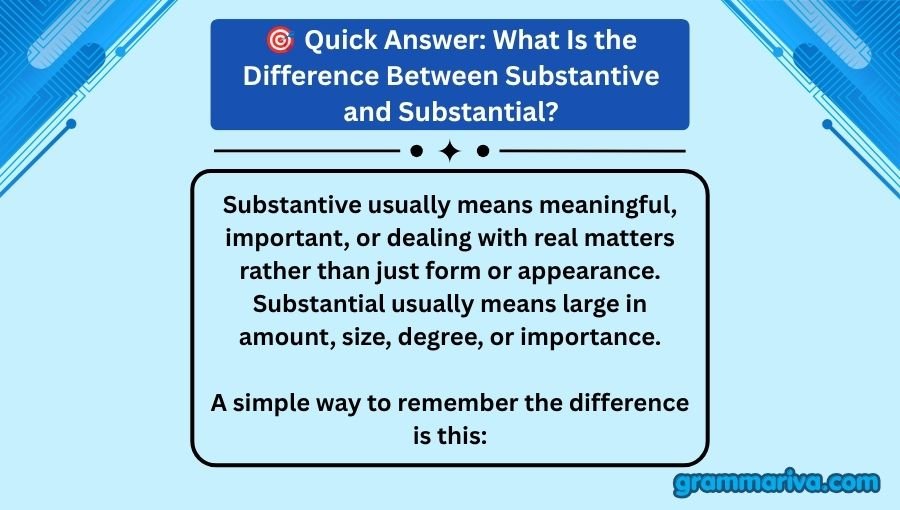
Substantive usually means meaningful, important, or dealing with real matters rather than just form or appearance. Substantial usually means large in amount, size, degree, or importance.
A simple way to remember the difference is this:
- Substantive = meaningful or dealing with the real substance of something
- Substantial = large, considerable, or significant in amount or degree
For example:
- The meeting produced substantive changes to the policy. ✅
- The company received a substantial increase in revenue. ✅
The first sentence focuses on the importance and real content of the changes. The second focuses on the large size of the increase.
Is Substantive or Substantial the Correct Choice? 🤔
Both words are correct. The right choice depends on what you want to say.
If you mean meaningful, serious, or related to the actual subject matter, choose substantive. If you mean large, considerable, or significant in amount, choose substantial.
Compare these examples
| Sentence | Correct/Incorrect | Reason |
|---|---|---|
| The committee had a substantive discussion. | ✅ Correct | The discussion dealt with real and important issues. |
| The committee had a substantial discussion. | ✅ Correct | The discussion was considerable or extensive. |
| She made a substantive argument. | ✅ Correct | Her argument had meaningful content. |
| She received a substantive salary. | ❌ Usually incorrect | “Substantial salary” is the natural choice for a large salary. |
| The report contains substantial evidence. | ✅ Correct | There is a large or significant amount of evidence. |
The key is to ask what kind of meaning you need.
Substantive: Meaning and Correct Use 📚
Substantive describes something that has real meaning, importance, or content. It often appears when we want to contrast serious content with surface details, procedure, or form.
You may see it in phrases such as:
- substantive discussion
- substantive issue
- substantive change
- substantive argument
- substantive evidence
- substantive work
Substantive for meaningful content
Use substantive when something deals with the actual matter being discussed.
For example:
The two teams held a substantive discussion about the contract.
This means the discussion was not just small talk. They dealt with real parts of the contract.
Substantive for important changes
You can also use substantive when a change affects the actual content or meaning of something.
The editor made substantive changes to the article.
This suggests that the editor changed important ideas, information, or content.
Substantive in professional and legal writing
The word is common in formal writing. It can describe issues, rights, arguments, rules, or changes that involve the actual subject matter.
| Meaning | Word Type | Example Sentence |
|---|---|---|
| Meaningful | Adjective | We had a substantive conversation. |
| Related to real content | Adjective | The proposal requires substantive changes. |
| Important in nature | Adjective | The report raises substantive concerns. |
| Focused on the main matter | Adjective | The team discussed substantive issues. |
💡 Test Tip
Try replacing substantive with meaningful.
If the sentence still makes sense, substantive may be the better choice.
For example:
We need a substantive response.
Try:
We need a meaningful response.
The meaning stays close, so substantive works well.
Substantial: Meaning and Correct Use 📈
Substantial usually means large, considerable, or significant. It can describe an amount, size, degree, effect, or change.
Common phrases include:
- substantial amount
- substantial increase
- substantial difference
- substantial evidence
- substantial cost
- substantial improvement
- substantial benefit
Substantial for a large amount
Use substantial when something is large or considerable in quantity.
The project requires a substantial amount of money.
The focus is on the size of the amount.
Substantial for a major degree
It can also describe something that is significant rather than merely small.
The new system led to a substantial improvement.
The improvement was large or important.
Substantial for something solid or strong
The word can sometimes describe something that has a strong, solid, or considerable quality.
The table was made from substantial wood.
Here, the idea is physical strength or solidity.
| Meaning | Word Type | Example Sentence |
|---|---|---|
| Large in amount | Adjective | We spent a substantial amount. |
| Considerable | Adjective | The company made substantial progress. |
| Significant | Adjective | The decision had a substantial effect. |
| Solid or strong | Adjective | The building has a substantial structure. |
What Does Substantive Mean in a Sentence? 📝
Substantive usually points to the quality or content of something, especially when the content is meaningful or important.
Consider:
The manager gave a substantive answer.
This means the answer contained useful information. It was not empty, vague, or merely polite.
Now compare:
The manager gave a substantial answer.
This can suggest that the answer was considerable in size or extent, but it sounds less natural in many everyday situations.
Sentence breakdown
The manager gave a substantive answer.
- The manager = subject
- gave = verb
- a substantive answer = object phrase
- substantive = describes the meaningful content of the answer
The word tells us about the quality and substance of the answer.
What Does Substantial Mean in a Sentence? 🔎
Substantial usually points to size, amount, degree, or significance.
Consider:
The business made a substantial profit.
The word tells us that the profit was large or considerable.
Sentence breakdown
The business made a substantial profit.
- The business = subject
- made = verb
- a substantial profit = object phrase
- substantial = describes the size or importance of the profit
The focus is not on whether the profit contains meaningful ideas. The focus is on its amount or significance.
Substantive or Substantial at a Glance 📊
The fastest way to understand the difference is to compare their main jobs.
| Form | Main Idea | Common Use | Example |
|---|---|---|---|
| Substantive | Meaningful or content-based | discussion, issue, change | We need a substantive discussion. |
| Substantial | Large or considerable | amount, increase, cost | We need a substantial investment. |
| Substantive | Real and important | argument, response | She gave a substantive response. |
| Substantial | Significant in degree | effect, improvement | The treatment produced substantial improvement. |
| Substantive | Related to actual substance | policy, rights, issues | The law created substantive rights. |
A useful shortcut is:
Substantive asks, “Does this have real meaning or content?”
Substantial asks, “Is this large, considerable, or significant?”
Why Do People Confuse Substantive and Substantial? 🧠
People confuse these words because they share the same basic idea of substance. They also look almost identical when written.
The endings can make the distinction harder:
- substantive
- substantial
Both can also appear with words like change, issue, difference, and discussion. That creates overlap.
I once reviewed a short business report where the writer used substantial several times when they really meant meaningful. The sentences were grammatically possible, but the meaning was not quite right. We changed several examples to substantive, and the report became much clearer.
Common reasons for confusion
| Reason | What Happens |
|---|---|
| Similar spelling | Writers treat the words as interchangeable. |
| Similar meaning | Both can suggest importance. |
| Similar sentence patterns | Both can modify words like “change.” |
| Fast typing | Writers choose the first familiar word. |
| Autocorrect | Technology may not detect a meaning problem. |
| Limited vocabulary knowledge | The subtle difference may be missed. |
Key Differences Between Substantive and Substantial ✨
The biggest difference is what each word measures or describes.
Substantive focuses on content
The lawyer raised a substantive issue.
The issue concerns a real part of the matter.
Substantial focuses on degree or amount
The lawyer requested a substantial payment.
The payment is large or considerable.
Side-by-side examples
| Substantive | Substantial |
|---|---|
| substantive discussion | substantial investment |
| substantive argument | substantial profit |
| substantive issue | substantial amount |
| substantive change | substantial increase |
| substantive response | substantial cost |
Both words can sometimes describe the same noun, but the meaning can shift.
For example:
We made a substantive change.
This suggests the content or nature of something changed.
We made a substantial change.
This suggests the change was large or significant.
Can Substantive and Substantial Be Used With “Change”? 🔄
Yes. Both can be used with change, but they emphasize different ideas.
Substantive change means a meaningful change to the actual content, structure, or substance of something.
Substantial change means a large, considerable, or significant change.
Examples
The new law introduced substantive changes to the rules. ✅
The rules themselves changed in meaningful ways.
The new law introduced substantial changes to the rules. ✅
The changes were large or significant.
The new law introduced a substantive amount of change. ❌
This wording is unnatural.
The new law introduced a substantial amount of change. ✅
Here, substantial describes the amount.
Easy rule
When you care about what changed, think substantive.
When you care about how much changed, think substantial.
How Do You Use Substantive in Professional Writing? 💼
Substantive works especially well in professional writing when you need to describe meaningful content or serious discussion.
You might write:
We need substantive feedback before the final draft.
This means you want useful comments about the actual work.
You might also write:
The meeting focused on substantive issues.
This means the team focused on real matters rather than minor details.
Professional examples
| Situation | Natural Example |
|---|---|
| Business meeting | We had a substantive discussion about the budget. |
| Report | The report includes substantive recommendations. |
| Legal writing | The case raises substantive questions. |
| Academic writing | The study provides substantive evidence. |
| Editing | The article needs substantive revisions. |
How Do You Use Substantial in Professional Writing? 💼
Substantial is useful when you want to describe a large amount, major effect, or considerable improvement.
For example:
The company experienced a substantial increase in sales.
The increase was large.
Another example:
The project requires substantial funding.
The project needs a large amount of money.
Professional examples
| Situation | Natural Example |
|---|---|
| Finance | The company reported substantial losses. |
| Business | We made substantial progress. |
| Budget | The project needs substantial funding. |
| Results | The update produced substantial benefits. |
| Research | The study found a substantial difference. |
Case Study: A Workplace Email 📧
Imagine that a manager sends this message:
“Please review the proposal and provide substantive feedback.”
The manager wants feedback about the actual content of the proposal. They want useful comments about the ideas, structure, facts, or recommendations.
Now imagine the manager writes:
“Please review the proposal and provide substantial feedback.”
This could suggest a large amount of feedback. It does not clearly express the same idea as the first sentence.
I once caught a similar issue while editing a workplace email. The writer wanted colleagues to give useful comments, not simply a lot of comments. Changing substantial feedback to substantive feedback made the request much more precise.
| Email Phrase | Intended Meaning | Best Choice |
|---|---|---|
| meaningful feedback | Useful comments | Substantive feedback |
| large amount of feedback | A lot of comments | Substantial feedback |
| meaningful discussion | Serious discussion | Substantive discussion |
| large discussion | Considerable in size | Usually reword the sentence |
| meaningful changes | Changes to actual content | Substantive changes |
Grammar Rules Explanation
Substantive and substantial are both adjectives. They can both describe nouns, but they usually highlight different qualities.
Substantive focuses on substance, meaning, content, or real importance.
Substantial focuses on size, amount, degree, strength, or considerable importance.
Neither word is automatically “more correct.” The noun and intended meaning determine the better choice.
For example:
The committee made a substantive change.
This suggests the committee changed something meaningful or central.
The committee made a substantial change.
This suggests the change was large or significant.
Both can be grammatically correct. The difference is one of meaning.
Most standard English reference sources treat these as separate words with overlapping but distinct uses. Good writing depends on choosing the word that matches the idea you want to express.
Correct vs Incorrect at a Glance
| Sentence | Correct/Incorrect | Why |
|---|---|---|
| We need a substantive answer. | ✅ Correct | The answer should contain meaningful information. |
| We need a substantial amount of money. | ✅ Correct | The amount is large. |
| She made a substantive argument. | ✅ Correct | The argument has meaningful content. |
| She made a substantial argument. | ⚠️ Less natural | “Substantive argument” is clearer when meaning content. |
| The company made a substantial profit. | ✅ Correct | The profit was considerable. |
⚠️ Common Mistakes With These Words
Most mistakes happen because writers remember that both words can mean important. They then use them without checking the exact meaning.
Similar grammar confusions
| Confusion | Correct Choice | Basic Rule |
|---|---|---|
| substantive / substantial | Depends on meaning | Content vs. amount or degree |
| affect / effect | Depends on grammar | Verb vs. noun in many uses |
| advice / advise | Depends on word type | Noun vs. verb |
| accept / except | Depends on meaning | Receive vs. exclude |
| your / you’re | Depends on meaning | Possession vs. “you are” |
| its / it’s | Depends on meaning | Possession vs. “it is” |
Why these mistakes happen
Fast typing: You may type the familiar-looking word without thinking.
Autocorrect: Spell-check tools often catch spelling errors, but they may not catch a word that is grammatically correct yet wrong for the intended meaning.
Lack of knowledge: If you have not learned the difference, both words can seem interchangeable.
Specific mistakes to avoid
| Wrong Form or Use | What’s Wrong | Better Form |
|---|---|---|
| substantive amount of money | The focus is quantity | substantial amount of money |
| substantial discussion about the issue | Can be unclear when meaning serious content | substantive discussion |
| substantive profit | Usually unnatural for amount | substantial profit |
| substantial response | Can be vague when meaning useful content | substantive response |
| substantive increase | Usually focuses on size | substantial increase |
| substantial argument | May sound unclear | substantive argument when meaning content |
How Can You Remember the Difference? 💡
Use a simple two-word test.
Think “substance” for substantive
If you mean real content, meaningful ideas, or the actual matter, choose substantive.
substantive argument
substantive issue
substantive discussion
Think “size” for substantial
If you mean large, considerable, or significant in amount, choose substantial.
substantial amount
substantial increase
substantial cost
Here is my favorite memory trick:
Substantive = substance of the idea.
Substantial = size or degree of the thing.
This is not a rule for every possible use, but it works well for most common writing situations.
Usage in Different Contexts 🌎
The best word can change depending on the context.
| Context | Which Term to Use | Example |
|---|---|---|
| Everyday conversation | Either, depending on meaning | We had a substantive talk. |
| Professional writing | Often substantive for content | The report needs substantive changes. |
| Creative writing | Either | The character faced a substantial loss. |
| Social media/texting | Either, though both are formal | She made substantial progress. |
Everyday conversation
You may use substantive when talking about a serious conversation.
We finally had a substantive talk.
Use substantial for a large amount or major result.
We made substantial progress.
Professional writing
Both are useful, but precision matters more.
The team needs substantive feedback.
The project requires substantial funding.
Creative writing
Writers can use both words when the meaning fits.
She faced a substantial loss.
The story raises substantive questions about trust.
Social media and texting
These words are more formal than many casual alternatives. Still, they can work when the subject is serious.
Common Phrases With Substantive and Substantial 🗣️
Neither word has many traditional idioms, but both appear in common fixed or repeated phrases.
| Phrase | Meaning |
|---|---|
| substantive discussion | A serious discussion about real issues |
| substantive change | A meaningful change to actual content |
| substantive issue | A real or important issue |
| substantive argument | An argument with meaningful content |
| substantial amount | A large amount |
| substantial increase | A considerable increase |
These phrases are useful because they show the normal patterns of each word.
Substantive or Substantial in Academic Writing 🎓
Academic writing often uses both terms, but for different purposes.
Use substantive when discussing ideas, arguments, evidence, or issues.
The paper presents a substantive argument.
Use substantial when discussing quantity, size, degree, or results.
The researchers collected a substantial amount of data.
Academic examples
| Intended Meaning | Best Word | Example |
|---|---|---|
| Meaningful argument | Substantive | The article presents a substantive argument. |
| Large amount of data | Substantial | The researchers collected substantial data. |
| Meaningful criticism | Substantive | The review offers substantive criticism. |
| Large improvement | Substantial | The method produced substantial improvement. |
| Real issue | Substantive | The paper addresses a substantive issue. |
Synonyms and Alternatives 🔤
Sometimes you can replace these words with simpler terms.
For substantive, useful alternatives include:
- meaningful
- important
- serious
- content-based
- significant
For substantial, alternatives include:
- large
- considerable
- significant
- major
- sizeable
But these words are not always exact replacements.
| Alternative | Works When | Does Not Work When |
|---|---|---|
| meaningful | You mean useful or important content | You mean a large quantity |
| considerable | You mean a large amount or degree | You need to stress actual content |
| significant | You mean important or noticeable | You need a precise content-based meaning |
| large | You mean physical or numerical size | You mean meaningful discussion |
| serious | You mean importance or gravity | You mean quantity |
For example, meaningful discussion can often replace substantive discussion.
But large discussion does not naturally replace it.
Why Does Getting the Difference Right Matter? 🎯
Choosing the right word improves clarity. It tells your reader exactly what you mean.
In professional writing, small word choices can make a message sound more polished. In academic writing, they can help you separate the quality of an idea from the size of a result.
A simple writing principle is:
“Choose the word that describes the idea you actually mean.”
Why it matters in real situations
| Situation | Why Getting It Right Matters |
|---|---|
| Resume | Clear wording makes your achievements easier to understand. |
| Client email | Precise language prevents confusion. |
| Published content | Correct word choice improves trust and readability. |
| Social post | Clear language helps readers understand your message quickly. |
For example:
I made substantial improvements to the report.
This usually means the improvements were large or significant.
I made substantive improvements to the report.
This suggests the improvements affected the actual content or quality of the report.
Both may be correct. The intended meaning decides the choice.
Can Both Words Be Correct in the Same Sentence? 🔄
Yes. Sometimes both words can appear in one sentence because they describe different things.
For example:
The team made substantive changes after receiving substantial feedback.
Here, substantive changes means the changes affected the real content.
Substantial feedback means there was a considerable amount of feedback.
This sentence is a useful reminder that the two words are not simply right versus wrong.
More examples
The company made substantive improvements after a substantial investment. ✅
The committee held a substantive discussion after receiving a substantial number of complaints. ✅
In both cases, each adjective has a different job.
Special Exception: When “Substantial” Means More Than Size ⚠️
Substantial does not always mean physical size or a simple number. It can also mean considerable, important, or significant.
For example:
The evidence showed a substantial difference.
The difference does not need to be physically large. It can be large in degree or importance.
Likewise:
She made a substantial contribution.
This can mean her contribution was significant or considerable.
That is why replacing substantial with “large” will not always produce a natural sentence.
Quick Recap Checklist ✅
Use this checklist whenever you are unsure.
| Question | If Yes → Use |
|---|---|
| Am I talking about meaningful content? | Substantive |
| Am I talking about the real subject matter? | Substantive |
| Am I describing a serious discussion? | Substantive |
| Am I describing a large amount? | Substantial |
| Am I describing a considerable increase? | Substantial |
| Am I describing a major effect or result? | Substantial |
Practice Examples
1. We need a ______ discussion about the contract.
Answer: substantive ✅
The goal is a meaningful discussion about the actual contract.
2. The company made a ______ investment in the project.
Answer: substantial ✅
The investment was large or considerable.
3. The editor suggested ______ changes to the article.
Answer: substantive if the changes affect the actual content. ✅
4. The new plan created a ______ improvement in performance.
Answer: substantial when the improvement was considerable. ✅
FAQs About Substantive vs Substantial
What is the simple difference between substantive and substantial?
Substantive usually means meaningful, content-based, or related to the actual matter being discussed. Substantial usually means large, considerable, or significant in amount or degree.
Is “substantive change” correct?
Yes. Substantive change is correct when you mean a meaningful change to the actual content, structure, or substance of something.
Is “substantial change” correct?
Yes. Substantial change is correct when you mean a large, considerable, or significant change.
Is substantive or substantial better for “amount”?
Substantial is the natural choice. Say “a substantial amount of money” or “a substantial amount of work.”
Should I say “substantive discussion” or “substantial discussion”?
Both can be grammatical, but they emphasize different ideas. Substantive discussion means a meaningful discussion about real issues. Substantial discussion suggests a considerable or extensive discussion.
Is “substantive evidence” correct?
Yes. Substantive evidence can describe evidence that has meaningful or important content. However, substantial evidence is also possible when you mean a significant or considerable body of evidence.
Can substantive and substantial mean the same thing?
They can overlap when both suggest importance or significance. However, they are not always interchangeable. Substantive tends to focus on content or substance, while substantial tends to focus on amount, degree, or significance.
What is a good synonym for substantive?
Depending on context, useful alternatives include meaningful, important, serious, or content-based. The best choice depends on the exact sentence.
What is a good synonym for substantial?
Useful alternatives include considerable, large, significant, or major. Choose the one that best matches whether you mean amount, degree, size, or importance.
How can I quickly remember substantive vs substantial?
Think substantive = substance. If you are talking about meaningful content or the actual matter, choose substantive. Think substantial = size or degree when you mean something large, considerable, or significant.
Conclusion
Substantive or substantial becomes much easier to choose once you focus on the meaning behind the sentence. Substantive usually describes meaningful content, serious discussion, real issues, or changes to the actual substance of something. Substantial usually describes something large, considerable, significant, or strong in degree.
My simplest rule is this: substantive focuses on substance, while substantial focuses on size, amount, or degree. ✨
So, write “substantive feedback” when you want useful comments about the actual work. Write “substantial feedback” when you mean a considerable amount of feedback. Write “substantive changes” when the content itself changed. Write “substantial changes” when the changes were large or significant.
When you pause over these two words, do not ask which one sounds more formal. Ask what you really mean. That small habit will make your writing clearer, sharper, and more professional. 📝
Remember: choose “substantive” for substance and “substantial” for something considerable. Get the meaning right, and the word choice follows naturally.

Hi, I’m Madison Hayes. I’m an English learning writer at Grammariva, where I work on simple lessons and examples for people who want to improve their grammar and writing. I love turning confusing rules into easy-to-follow explanations.

[…] By the end, you should be able to choose the right phrase without stopping to think twice. ✨ Substantive or Substantial | Trawling vs Trolling | Hail vs […]