Have you ever used concurrent vs simultaneous and wondered whether these words mean exactly the same thing? You are not alone.
The two words are close in meaning, and in many everyday sentences, they can both describe events that happen at about the same time. However, there is a small but useful difference in how they are normally used.
I teach and edit English for clarity, and I often see writers treat these words as perfect replacements for each other. That can make a sentence sound less precise than it could be. The key is to ask whether you are talking about events that overlap in time or events that happen at exactly the same moment. 🧠
Once you understand that difference, choosing the right word becomes much easier. In this guide, I will explain the meanings, grammar, common uses, examples, mistakes, and practical differences between these two words. By the end, you should be able to choose confidently without stopping to second-guess yourself. ✨ Work Experience or Working Experience | No Difference vs No Different | Copywritten vs Copyrighted
🎯 Quick Answer: Concurrent vs Simultaneous
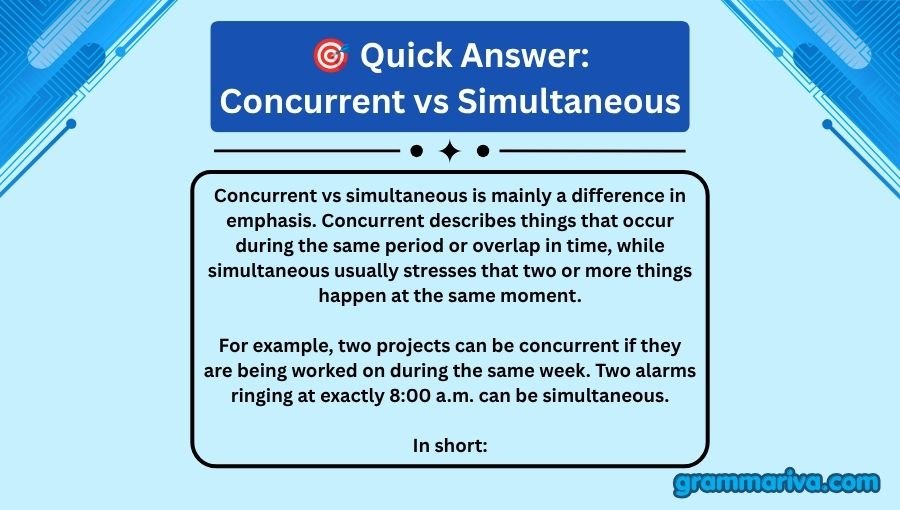
Concurrent vs simultaneous is mainly a difference in emphasis. Concurrent describes things that occur during the same period or overlap in time, while simultaneous usually stresses that two or more things happen at the same moment.
For example, two projects can be concurrent if they are being worked on during the same week. Two alarms ringing at exactly 8:00 a.m. can be simultaneous.
In short:
- Concurrent = happening during the same period, often with overlap.
- Simultaneous = happening at the same time or moment.
- The words can overlap in meaning, but simultaneous is usually more exact when exact timing matters.
Is Concurrent the Same as Simultaneous?
Concurrent and simultaneous are closely related, but they are not always identical. Concurrent focuses more on events existing or happening during the same period, while simultaneous places stronger emphasis on the same point in time.
Consider these examples:
| Word | Main idea | Example |
|---|---|---|
| Concurrent | Events overlap in time | We are managing two concurrent projects. |
| Simultaneous | Events happen at the same moment | The two lights turned on simultaneously. |
A concurrent event does not necessarily have to begin and end at exactly the same time.
For example:
The company ran two concurrent training programs.
The programs may have started on different days. They simply took place during an overlapping period.
Now consider:
The two players scored simultaneous goals.
This sentence suggests that the goals happened at essentially the same moment.
That distinction is useful in professional writing, science, technology, sports, and everyday speech.
Concurrent vs Simultaneous at a Glance
The easiest way to understand the difference is to compare the focus of each word.
| Form | Type | Meaning | Example | Correct/Incorrect |
|---|---|---|---|---|
| Concurrent | Adjective | Happening during the same period | She has two concurrent assignments. | ✅ Correct |
| Simultaneous | Adjective | Happening at the same time or moment | Both phones rang simultaneously. | ✅ Correct |
| Concurrent | Adjective | Overlapping in time | The teams held concurrent meetings. | ✅ Correct |
| Simultaneous | Adjective | Occurring together at the same moment | The doors opened simultaneously. | ✅ Correct |
| Concurrent | Adjective | Exact same instant | The two flashes were concurrent. | ⚠️ Possible, but less precise |
| Simultaneous | Adjective | Broad overlapping period | She completed simultaneous projects over several months. | ⚠️ Possible, but concurrent may be clearer |
The words often overlap, so there is no simple rule saying that one is always right and the other is always wrong.
The important difference is degree of timing precision.
What Does Concurrent Mean?
Concurrent means happening during the same period, especially when two or more activities overlap in time.
It is often used when separate events, tasks, conditions, or processes are taking place at once or during overlapping periods.
For example:
The manager is handling three concurrent projects.
This does not necessarily mean that the manager works on all three projects at the exact same second. It means all three projects are active during the same general period.
Concurrent in Everyday Use
You might use concurrent when discussing:
- projects
- activities
- events
- responsibilities
- processes
- courses
- meetings
- legal matters
- work tasks
Here are some examples:
She took two concurrent courses. ✅
The company launched concurrent marketing campaigns. ✅
He has concurrent responsibilities in both departments. ✅
The two meetings were concurrent. ✅
The word often sounds more formal than simultaneous, so it is especially common in professional or academic writing.
What Does Simultaneous Mean?
Simultaneous means happening at the same time, especially at the same moment.
It is useful when the timing of two or more actions is very close or exactly matched.
For example:
The two doors opened simultaneously.
The sentence strongly suggests that both doors opened at the same time.
Other examples include:
The audience gave a simultaneous reaction. ✅
Both alarms sounded simultaneously. ✅
The machines stopped simultaneously. ✅
The word is particularly useful when exact timing matters.
💡 Test Tip: How Can You Tell Which Word to Use?
Here is a simple test I use when editing.
Ask yourself:
“Do I mean overlapping time, or exactly the same moment?”
If you mean overlapping time, choose concurrent.
If you mean the same moment, choose simultaneous.
| What You Mean | Better Choice | Example |
|---|---|---|
| Same general period | Concurrent | We have concurrent projects. |
| Overlapping activities | Concurrent | The courses run concurrently. |
| Same exact moment | Simultaneous | The bells rang simultaneously. |
| Events occurring together | Simultaneous | The players made simultaneous moves. |
This is not an absolute grammar law. Context still matters. But it is a very useful guide.
How Is Concurrent Used in a Sentence?
Concurrent is an adjective. It normally comes before a noun or after a linking verb.
Before a Noun
We have concurrent deadlines.
Here, concurrent describes the deadlines.
After a Linking Verb
The two programs are concurrent.
Here, concurrent comes after the verb are and describes the programs.
Concurrent can also appear in the adverb form concurrently.
The teams worked concurrently.
That means the teams worked during overlapping periods.
| Form | Word Class | Example |
|---|---|---|
| Concurrent | Adjective | We have concurrent projects. |
| Concurrently | Adverb | The projects were completed concurrently. |
| Concurrence | Noun | The decision required concurrence. |
| Concur | Verb | I concur with your conclusion. |
Not every related form has exactly the same meaning in every context. In particular, concur often means to agree, so it should not automatically be treated as a timing word.
How Is Simultaneous Used in a Sentence?
Simultaneous is also an adjective.
It usually describes actions, events, movements, reactions, or processes that happen at the same time.
Examples:
The two cameras captured simultaneous images. ✅
The students gave simultaneous answers. ✅
The system received simultaneous requests. ✅
The related adverb is simultaneously.
Both teams scored simultaneously. ✅
This form is often helpful because it clearly shows that you are describing how something happened.
| Form | Word Class | Example |
|---|---|---|
| Simultaneous | Adjective | They made simultaneous changes. |
| Simultaneously | Adverb | The systems restarted simultaneously. |
Concurrent vs Simultaneous: The Core Grammar Difference
The grammar of these words is simple. Both concurrent and simultaneous are adjectives.
The main difference is not their grammatical category. It is the timing idea they communicate.
Concurrent commonly describes activities that exist or happen during an overlapping period.
Simultaneous commonly describes activities that occur at the same time.
Think about a school day.
Suppose Math class runs from 9:00 to 10:00 and Science class runs from 9:30 to 10:30. These classes are concurrent for 30 minutes because their time periods overlap.
If two students answer a question at exactly 9:45, their answers are simultaneous.
| Situation | Natural Word | Reason |
|---|---|---|
| Two projects active all week | Concurrent | Their periods overlap. |
| Two alarms ring at 7:00 | Simultaneous | They happen at the same moment. |
| Two courses run during one semester | Concurrent | Their time periods overlap. |
| Two players move at exactly the same time | Simultaneous | The timing is matched. |
| Two business operations run during the same month | Concurrent | They share a time period. |
📝 Case Study: A Workplace Example
I once edited a project update in which a manager wrote, “The team completed simultaneous projects during the quarter.”
The manager was not trying to say that the projects were completed at the exact same moment. The projects were simply active during the same quarter.
I changed the wording to:
“The team managed concurrent projects during the quarter.”
That version was more precise.
Imagine a company working on a website redesign while also developing a mobile app. The two projects may share team members and may run from March through June. They are concurrent projects.
But imagine that two departments receive the same emergency alert at exactly 2:15 p.m. Those departments received the alert simultaneously.
The context tells you which word gives the reader the clearest picture.
Why Do People Confuse Concurrent and Simultaneous?
People confuse these words because both describe events connected by time. In ordinary conversation, the difference may not matter much.
Another reason is that dictionaries and common usage allow some overlap between their meanings. Both words can describe things happening together.
I once heard a student say, “The two classes are simultaneous because they happen in the same semester.” The sentence was understandable, but concurrent was the better choice because the student meant that the courses occupied an overlapping period, not that they happened at one exact moment.
Common causes of confusion include:
- similar meanings
- overlapping usage
- formal vocabulary
- fast writing
- unfamiliarity with the timing distinction
- assuming synonyms are always interchangeable
Similar Word Confusions
| Confusion | Main Difference |
|---|---|
| Concurrent vs simultaneous | Overlapping period vs same moment |
| It’s vs its | Contraction vs possessive form |
| Your vs you’re | Possessive vs “you are” |
| Affect vs effect | Usually verb vs noun |
| Then vs than | Time/order vs comparison |
| Advice vs advise | Noun vs verb |
The best solution is to focus on meaning instead of memorizing isolated rules.
⚠️ Common Mistakes With Concurrent and Simultaneous
Mistakes usually happen because writers focus on the general idea of “at the same time” without asking how exact the timing is.
Why These Mistakes Happen
Fast typing: When people type quickly, they often choose the first similar word that comes to mind.
Autocorrect: Spell-check tools may correct spelling but do not always understand the intended meaning.
Lack of knowledge: Writers may know that both words relate to time but not know the difference in emphasis.
Overuse of synonyms: Writers sometimes replace one word with another simply to avoid repetition.
I once caught myself changing concurrent to simultaneous in a report just to vary the wording. When I reread the sentence, I realized the change had made the meaning less accurate. The activities overlapped for several weeks. They did not happen at one moment.
Common Wrong Forms and Uses
| Wrong Form or Use | What’s Wrong | Correct Form |
|---|---|---|
| Concurrent at exactly 5:00 | May not express exact timing clearly | Simultaneous |
| Simultaneous projects over six months | Can suggest exact matching rather than overlap | Concurrent |
| Concurrently happened at one exact moment | Possible but often less direct | Happened simultaneously |
| Simultanious | Misspelled | Simultaneous |
| Concurent | Misspelled | Concurrent |
| Simultaneously together | Redundant in many sentences | Simultaneously |
Can Concurrent and Simultaneous Be Interchanged?
Sometimes they can. However, replacing one with the other can slightly change the meaning.
For example:
The two events occurred concurrently.
This tells us that the events occurred during an overlapping period.
The two events occurred simultaneously.
This gives a stronger sense that the events happened at the same moment.
Both sentences can be correct. The second is more precise about exact timing.
| Sentence | Meaning | Natural? |
|---|---|---|
| The programs ran concurrently. | They ran during overlapping periods. | ✅ |
| The programs ran simultaneously. | They ran at the same time. | ✅ |
| The bells rang concurrently. | They rang during an overlapping period. | ⚠️ Less natural |
| The bells rang simultaneously. | They rang at the same moment. | ✅ |
The noun you are describing also matters.
Concurrent projects is very natural.
Simultaneous projects is possible, but it may sound as though the projects happened at exactly the same time.
Usage in Different Contexts
The best choice can depend on the setting.
| Context | Which Term to Use | Example |
|---|---|---|
| Everyday conversation | Simultaneous is often more natural | The two phones rang simultaneously. |
| Professional writing | Concurrent is useful for overlapping work | We are managing concurrent projects. |
| Creative writing | Either, depending on the image | Their movements were simultaneous. |
| Social media/texting | Simultaneous is often simpler | We all laughed simultaneously. |
In casual speech, people often use simpler expressions such as at the same time.
In formal writing, concurrent can be useful when you need to describe overlapping processes or responsibilities.
Concurrent in Business and Professional Writing
Concurrent is especially useful when discussing work that happens during the same period.
Common examples include:
- concurrent projects
- concurrent tasks
- concurrent deadlines
- concurrent investigations
- concurrent sessions
- concurrent processes
- concurrent responsibilities
For example:
Our team is handling three concurrent projects.
This does not mean everyone is doing all three projects at the exact same moment. It means the projects are active during the same general period.
Another example:
The company offered concurrent training sessions.
This means the sessions took place during overlapping times. Depending on context, they may even have occurred at exactly the same time.
Simultaneous in Everyday and Technical Writing
Simultaneous is useful when the timing itself is important.
You may see it in descriptions of:
- movements
- sounds
- reactions
- signals
- events
- commands
- actions
- system responses
For example:
The system received simultaneous requests from several users.
Here, the writer wants to emphasize that the requests arrived at roughly the same time.
In technology, simultaneous can sometimes describe events that occur together from the system’s point of view, even when the underlying processes are extremely fast rather than perfectly synchronized.
How To Remember The Difference
Use this memory trick: Understanding concurrent vs simultaneous becomes much easier when you focus on whether the events overlap over a period or happen at the exact same moment.
Concurrent = same time period.
Simultaneous = same moment.
Imagine two trains.
If two trains are traveling on nearby tracks during the same hour, their journeys are concurrent.
If two trains leave their stations at exactly 10:00, their departures are simultaneous.
| Memory Question | Answer |
|---|---|
| Do the periods overlap? | Concurrent |
| Do the events happen at the same moment? | Simultaneous |
| Am I discussing several ongoing tasks? | Usually concurrent |
| Am I emphasizing exact timing? | Usually simultaneous |
This simple test works in most ordinary writing situations.
Common Phrases With Concurrent
Concurrent appears naturally in several common expressions.
| Phrase | Meaning |
|---|---|
| Concurrent projects | Projects active during the same period |
| Concurrent sessions | Sessions taking place during overlapping times |
| Concurrent processes | Processes running during the same period |
| Concurrent responsibilities | Responsibilities held at the same time |
| Concurrent events | Events occurring during an overlapping period |
| Concurrent activities | Activities happening during the same general period |
For example:
Managing concurrent projects requires good planning.
The phrase is especially natural in workplace and academic settings.
Common Phrases With Simultaneous
Simultaneous also appears in many natural combinations.
| Phrase | Meaning |
|---|---|
| Simultaneous action | Action occurring at the same time |
| Simultaneous movement | Movement happening together |
| Simultaneous events | Events happening at the same moment |
| Simultaneous reaction | Reactions occurring together |
| Simultaneous response | Responses given at the same time |
| Simultaneous change | Changes occurring together |
For example:
The players made simultaneous movements.
This stresses that their movements occurred together.
Alternatives to Concurrent and Simultaneous
You do not always need either word. Sometimes a simpler phrase is clearer.
| Alternative | Works When | Does Not Work When |
|---|---|---|
| At the same time | You want simple everyday English | Exact technical precision is needed |
| At once | Events happen immediately or together | You mean a long overlapping period |
| Together | Actions happen as a group | Timing needs special emphasis |
| Overlapping | Time periods share some duration | Events happen at exactly one moment |
| In parallel | Separate activities proceed alongside each other | You specifically mean an exact shared moment |
For general readers, at the same time is often the easiest choice.
For professional writing, however, concurrent can be more precise when describing overlapping work.
Grammar Rules Explanation
Both concurrent and simultaneous are adjectives. They modify nouns or appear after linking verbs.
The main grammar issue is not whether either word is grammatically valid. Both are standard English words. The issue is whether the word matches the intended timing.
Use concurrent when separate activities, conditions, or events occur during an overlapping period.
Use simultaneous when you want to emphasize that events occur at the same time or moment.
Most standard English reference sources treat these words as related in meaning, but context determines which one is the better choice.
Correct vs Incorrect at a Glance
| Sentence | Correct/Incorrect | Why |
|---|---|---|
| We are managing concurrent projects. | ✅ Correct | The projects can overlap over a period. |
| The alarms went off simultaneously. | ✅ Correct | The alarms went off at the same moment. |
| We completed concurrent tasks at exactly 2:00. | ⚠️ Less precise | Simultaneous may better stress the exact moment. |
| The two meetings were concurrent during the afternoon. | ✅ Correct | Their time periods overlapped. |
| The two lights switched on concurrently at exactly the same instant. | ⚠️ Possible | Simultaneously is more direct for exact timing. |
The word incorrect should be used carefully here. Many sentences involving these words are grammatically possible but less precise rather than completely ungrammatical.
That distinction matters because good editing is about meaning, not simply labeling sentences right or wrong.
Why Does Precision Matter in Professional Writing?
Precision helps readers understand exactly what happened.
Suppose a manager writes:
The teams worked on simultaneous projects.
A reader might imagine that the projects happened at exactly the same time.
But if the projects lasted several months and simply overlapped, this is clearer:
The teams worked on concurrent projects.
The second sentence gives the reader a better picture.
Why Getting It Right Matters
| Situation | Why Getting It Right Matters |
|---|---|
| Resume | Shows careful control of professional language |
| Client email | Prevents confusion about schedules |
| Published content | Makes explanations more precise |
| Social post | Helps readers understand the intended timing |
A useful rule is:
Clear writing does not just tell readers what happened. It helps them understand when it happened.
Can You Say “Concurrent Events”?
Yes. Concurrent events is a natural phrase when several events occur during the same period.
For example:
The city hosted several concurrent events during the festival.
The events may have started and ended at different times, but their schedules overlapped.
Compare that with:
The city hosted several simultaneous events.
This can suggest that the events were taking place at the same time.
Both may be correct. The intended timing decides which is clearer.
Can You Say “Simultaneous Events”?
Yes. Simultaneous events is also correct.
It is especially useful when two or more events happen at the same moment.
For example:
The stadium witnessed simultaneous celebrations after the final score.
The wording creates a picture of celebrations happening together.
If the celebrations simply happened during the same evening but at different times, concurrent events might be more accurate.
Concurrent vs Simultaneous in Technology
Technology gives us a useful example because timing can become more complex.
A system may handle several concurrent processes. This means the processes are active during overlapping periods.
That does not always mean the computer performs every operation at exactly the same instant.
By contrast, simultaneous is often used when multiple events are described as occurring at the same time from the user’s perspective.
| Technology Situation | Better Term | Why |
|---|---|---|
| Several tasks active during one period | Concurrent | Activities overlap |
| Two signals arrive together | Simultaneous | Timing is emphasized |
| Multiple users access a service | Concurrent | Requests overlap in activity |
| Two alerts appear at once | Simultaneous | Same moment is emphasized |
This distinction is one reason the two words should not always be treated as exact synonyms.
Concurrent vs Simultaneous in Everyday Conversation
In casual conversation, you can often avoid the issue by saying at the same time.
For example:
We both spoke at the same time.
That is simple and natural.
You could also say:
We spoke simultaneously.
This is grammatically correct but sounds more formal.
You could say:
We had concurrent conversations.
That would mean the conversations overlapped. It does not necessarily mean that everyone was speaking at exactly the same moment.
So, in everyday English, context and natural tone matter just as much as strict precision.
A Simple Decision Guide
When you are unsure, follow these steps.
Step 1: Identify the time relationship
Ask whether the activities simply overlap or occur at one shared moment.
Step 2: Think about duration
If each activity lasts for minutes, hours, days, or weeks and their periods overlap, concurrent is often a good choice.
Step 3: Look for exact timing
If the sentence emphasizes one instant, simultaneous is usually better.
Step 4: Consider the audience
For everyday readers, at the same time may be simpler.
For formal writing, choose the more precise word.
| Question | If Yes → Use |
|---|---|
| Do the activities overlap for a period? | Concurrent |
| Do they happen at one moment? | Simultaneous |
| Are you describing ongoing projects? | Concurrent |
| Are you describing matching actions? | Simultaneous |
| Would “at the same time” sound clearer? | Use that phrase |
Practice Examples
Try these examples before checking the answers.
Example 1
The company has three ______ projects.
Answer: concurrent. ✅
The projects are active during the same general period.
Example 2
The two bells rang ______.
Answer: simultaneously. ✅
The sentence focuses on the same moment.
Example 3
The university offered four ______ courses during the semester.
Answer: concurrent. ✅
The courses took place during an overlapping period.
Example 4
The dancers made a ______ movement.
Answer: simultaneous. ✅
The movement happened together.
Example 5
Several ______ investigations were underway.
Answer: concurrent. ✅
The investigations were active during the same period.
⚠️ A Final Look at Common Errors
Here are some patterns worth avoiding.
| Less Clear or Wrong | Better | Reason |
|---|---|---|
| The projects happened simultaneously for three months. | The projects ran concurrently for three months. | Three months suggests an overlapping period. |
| The alarms were concurrent at exactly 8:00. | The alarms were simultaneous at exactly 8:00. | Exact timing favors simultaneous. |
| We have simultaneous responsibilities this year. | We have concurrent responsibilities this year. | Responsibilities overlap over a longer period. |
| The two lights came on concurrently at the same instant. | The two lights came on simultaneously. | Simultaneously is more direct. |
Remember that some of these are not strict grammar errors. They are cases where one word communicates the intended timing more clearly.
Quick Recap Checklist
Use this checklist whenever you are deciding between the two words.
| Question | If Yes → Use |
|---|---|
| Are two activities active during the same period? | Concurrent |
| Do two time periods overlap? | Concurrent |
| Are two events happening at exactly the same moment? | Simultaneous |
| Are two actions matched in timing? | Simultaneous |
| Are you discussing ongoing work or projects? | Concurrent |
| Are you emphasizing an instant or exact timing? | Simultaneous |
Three Quick Practice Questions
- We are working on two ______ projects.
Answer: concurrent ✅ - The two doors opened ______.
Answer: simultaneously ✅ - Several ______ sessions were available throughout the morning.
Answer: concurrent ✅
The fastest memory trick is:
Concurrent = overlapping time.
Simultaneous = same moment.
FAQs About Concurrent vs Simultaneous
Is concurrent the same as simultaneous?
Not always. Concurrent usually means happening during the same or overlapping period, while simultaneous more strongly means happening at the same moment.
What is the difference between concurrent and simultaneous?
The main difference is timing. Concurrent focuses on overlapping periods, while simultaneous focuses on events occurring at the same time or moment.
Is “concurrent projects” correct?
Yes. Concurrent projects is a natural phrase for projects that are active during the same period.
Is “simultaneous projects” correct?
Yes, but the meaning can be slightly different. It may suggest that the projects are happening at the same time. If you mean that they simply overlap over a longer period, concurrent projects is usually clearer.
Which word should I use for events happening at exactly the same time?
Use simultaneous when exact or nearly exact timing is the main idea.
Which word should I use for overlapping activities?
Use concurrent when separate activities take place during overlapping periods.
Can concurrent and simultaneous be used interchangeably?
Sometimes, especially when the context does not depend on precise timing. However, they are not perfect synonyms in every sentence.
Is “simultaneously” the adverb of simultaneous?
Yes. Simultaneously is the adverb form of simultaneous.
For example:
The machines stopped simultaneously. ✅
Is “concurrently” the adverb of concurrent?
Yes. Concurrently is the adverb form of concurrent.
For example:
The teams worked concurrently. ✅
What is an easy way to remember concurrent vs simultaneous?
Remember this:
Concurrent = same time period.
Simultaneous = same moment.
If the activities overlap for a while, think concurrent. If they happen together at one moment, think simultaneous.
Conclusion
Concurrent vs simultaneous becomes much easier once you focus on the timing you want to describe. Concurrent is generally the better choice for activities, projects, events, or processes that take place during the same or overlapping period. Simultaneous is usually the better choice when two or more things happen at the same moment.
I recommend asking yourself one simple question before choosing: “Do I mean overlapping time, or the exact same moment?” That question will solve most usage problems quickly. 👍
Remember that neither word is automatically better. Good writing depends on matching the word to the meaning. Use concurrent for overlapping activities and simultaneous when exact shared timing matters. When a simpler phrase such as at the same time works better for your audience, there is nothing wrong with using it.
Once you make this small distinction part of your editing habit, your sentences become clearer and more precise. ✨
Concurrent means overlapping in time. Simultaneous means happening at the same moment. Choose the word that tells your reader exactly what you mean.

Hi, I’m Madison Hayes. I’m an English learning writer at Grammariva, where I work on simple lessons and examples for people who want to improve their grammar and writing. I love turning confusing rules into easy-to-follow explanations.
[…] the end, you should be able to choose the right form without stopping to think twice. ✨ Concurrent vs Simultaneous | Work Experience or Working Experience | No Difference vs No […]