
Have you ever typed a word, looked at it twice, and wondered if the spelling suddenly looks wrong? 🤔 reinforce vs reenforce is one of those spelling questions that can make even careful writers pause. The two forms look almost identical, and both seem to make sense at first glance. However, standard modern English has a clear answer.
The correct spelling is reinforce. It means to make something stronger, support an idea, or add strength to something. Reenforce is generally treated as a misspelling or a nonstandard variant, so it is best avoided in normal English writing.
I have seen this mistake in school assignments, emails, and online posts. It often happens because the sound of the word makes the extra e seem reasonable. Once you learn the simple rule, though, the difference becomes much easier to remember. ✍️ Targetted or Targeted | Openned or Opened | Thank You Both or Thanks to Both of You
🎯 Quick Answer: Reinforce vs Reenforce
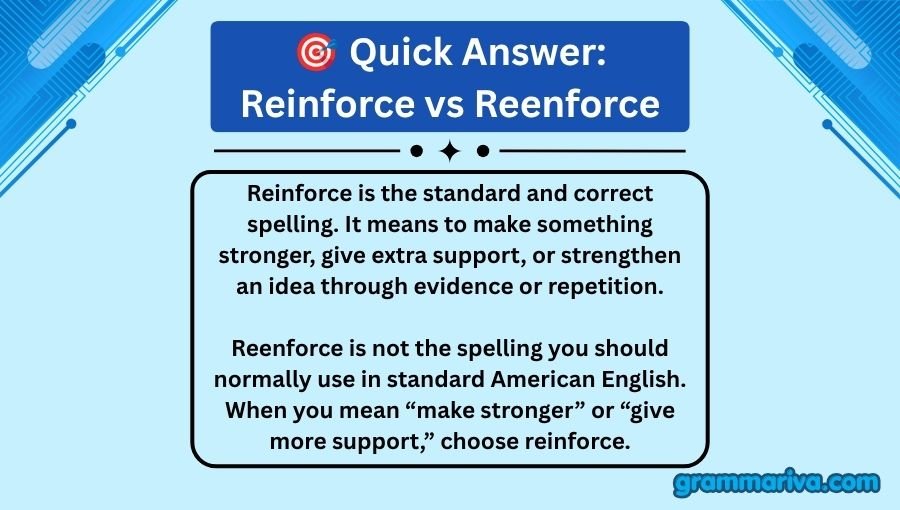
Reinforce is the standard and correct spelling. It means to make something stronger, give extra support, or strengthen an idea through evidence or repetition.
Reenforce is not the spelling you should normally use in standard American English. When you mean “make stronger” or “give more support,” choose reinforce.
| Word | Standard Spelling? | Meaning | Example |
|---|---|---|---|
| Reinforce | ✅ Yes | Make stronger or support | The teacher used examples to reinforce the lesson. |
| Reenforce | ❌ No in standard usage | Usually intended to mean reinforce | Please use evidence to reinforce your point. |
The easiest rule is simple: When you mean “make stronger,” spell it reinforce.
🧩 Related Word Forms of Reinforce
The word reinforce has several useful forms. These forms are correctly built from the same base word.
| Form | Type | Example |
|---|---|---|
| Reinforce | Verb | We need to reinforce the wall. |
| Reinforces | Verb, third-person singular | This example reinforces the rule. |
| Reinforced | Past tense/past participle | The bridge was reinforced with steel. |
| Reinforcing | Present participle/gerund | They are reinforcing the structure. |
| Reinforcement | Noun | The team received reinforcement. |
These forms keep the same reinforc- spelling pattern. Notice that none of them changes the word into reenforce.
🔎 Understanding the Basics of Reinforce vs Reenforce
The core difference is spelling and standard usage. Reinforce is the accepted spelling for the verb meaning “to make stronger” or “to support.” Reenforce should generally be corrected to reinforce.
The word can describe physical strength, mental support, stronger arguments, better habits, or added support in a structure.
| Form | Type | Meaning | Example | Correct/Incorrect |
|---|---|---|---|---|
| Reinforce | Verb | Make stronger | Workers reinforced the bridge. | ✅ Correct |
| Reenforce | Verb-like spelling | Intended to mean make stronger | Workers reenforced the bridge. | ❌ Incorrect |
| Reinforced | Past form | Made stronger | The door was reinforced. | ✅ Correct |
| Reinforcing | -ing form | Making stronger | They are reinforcing the wall. | ✅ Correct |
Why Is Reinforce the Correct Spelling?
Reinforce is formed with the spelling rein- followed by force. The word is pronounced in a way that can make writers think another e belongs between the parts.
It does not.
Think of the word as:
rein + force = reinforce
Do not turn it into:
re + en + force = reenforce
The spelling stays reinforce when the word changes tense or form.
What Does Reinforce Mean?
To reinforce something means to make it stronger or provide extra support.
For example:
The builders reinforced the roof before winter.
The roof receives extra support. The action makes it stronger.
The word can also describe ideas.
The new evidence reinforced her argument.
Here, the evidence does not physically strengthen anything. Instead, it makes the argument more convincing.
Reinforce Can Describe Ideas and Habits
The word is not limited to buildings or physical objects. It is common when talking about learning, behavior, opinions, and communication.
For example:
The teacher repeated the rule to reinforce the lesson.
The repetition helps make the lesson stronger in the student’s mind.
Positive feedback can reinforce good habits.
The feedback gives extra support to the behavior.
| Meaning | Word Type | Example Sentence |
|---|---|---|
| Make physically stronger | Verb | Steel bars reinforced the concrete. |
| Support an argument | Verb | The facts reinforce her claim. |
| Strengthen learning | Verb | Practice reinforces new skills. |
| Encourage behavior | Verb | Praise can reinforce good habits. |
💡 Test Tip: How Can You Check the Spelling?
Try replacing the word with strengthen.
If strengthen fits the sentence, you probably need reinforce.
For example:
The facts reinforce the conclusion.
You can say:
The facts strengthen the conclusion.
The meaning remains close.
Now remember the spelling:
reinforce = strengthen
That simple connection can help you avoid reenforce.
❓ Is Reinforce the Same as Reenforce?
No. In standard English writing, reinforce is the spelling you should use. Reenforce is generally considered a misspelling when it is intended to mean “make stronger” or “support.”
This distinction matters most in formal writing. A school paper, business email, report, article, or resume should use reinforce.
| Sentence | Status | Explanation |
|---|---|---|
| The facts reinforce my argument. | ✅ Correct | The facts strengthen the argument. |
| The facts reenforce my argument. | ❌ Incorrect | Use the standard spelling reinforce. |
| The walls were reinforced. | ✅ Correct | The walls were made stronger. |
| The walls were reenforced. | ❌ Incorrect | The extra “e” is unnecessary. |
💬 Why Do People Confuse Reinforce and Reenforce?
People often confuse these spellings because English does not always spell words exactly as they sound. The beginning of reinforce can sound as though it contains another vowel sound.
Understanding reinforce vs reenforce starts with one simple rule: use reinforce when you mean to make something stronger.
There is also a visual problem. Writers may see re- and assume that another e should follow it.
I once edited a short workplace report where the writer used reenforce several times. The writer knew exactly what the word meant. The problem was simply the spelling. After changing each instance to reinforce, the report looked much more polished.
The mistake can happen for several reasons:
- The word sounds like it contains an extra vowel.
- People type quickly.
- Spell-check tools do not always catch every unusual spelling.
- Writers may remember the sound but not the spelling.
- The word can be confused with other re- words.
- People may assume that reenforce follows a simple spelling pattern.
The good news is that this is an easy mistake to fix once you remember the correct form.
📝 Case Study: Reinforce in a Workplace Email
Imagine a manager writing an email to a team after a safety meeting.
An employee writes:
We should reenforce the safety rules during every shift.
The meaning is clear, but the spelling is not standard.
A polished version would be:
We should reinforce the safety rules during every shift.
Here, reinforce means to strengthen or support the importance of the safety rules through reminders.
I once caught a similar spelling issue while reviewing a document before it was sent to clients. The word looked familiar enough that it had survived several quick edits. A final spelling check caught it. That small correction made the document feel much more professional.
| Situation | Less Suitable Version | Better Version |
|---|---|---|
| Team email | reenforce the policy | reinforce the policy |
| School paper | reenforce the argument | reinforce the argument |
| Work report | reenforced the structure | reinforced the structure |
| Training guide | reenforcing the lesson | reinforcing the lesson |
📚 Grammar Rules Explanation
The standard verb is reinforce. It is used when something becomes stronger because extra support, evidence, material, repetition, or encouragement is added.
The spelling does not become reenforce when you use the verb in a sentence.
The main forms are:
- reinforce
- reinforces
- reinforced
- reinforcing
- reinforcement
The key spelling pattern is reinforce.
Standard English reference sources agree on the common spelling reinforce. When writing for school, work, publication, or a general audience, this is the safe form to choose.
The grammar is also important. Reinforce is a verb, so it needs to work as an action in a sentence.
The coach reinforced the team’s confidence.
Here, reinforced is the verb.
The coach’s speech was a reinforcement of the team’s confidence.
Here, reinforcement is a noun.
The two forms have related meanings but different jobs in a sentence.
✅ Correct vs Incorrect at a Glance
| Sentence | Correct/Incorrect | Why |
|---|---|---|
| The facts reinforce the main idea. | ✅ Correct | Reinforce means strengthen. |
| The facts reenforce the main idea. | ❌ Incorrect | Use the standard spelling reinforce. |
| The workers reinforced the bridge. | ✅ Correct | Reinforced is the correct past form. |
| The workers reenforced the bridge. | ❌ Incorrect | The extra “e” is not needed. |
| Repetition reinforces good habits. | ✅ Correct | Reinforces is the correct third-person form. |
⚠️ Common Mistakes With Reinforce and Reenforce
This spelling mistake often comes from speed rather than poor writing skills. A person may know the correct word but type the wrong version without noticing.
Three common causes are:
- Fast typing: Your fingers may follow the sound instead of the correct spelling.
- Autocorrect: Technology can sometimes fail to flag a nonstandard form.
- Lack of knowledge: If you have never learned the correct spelling, both forms may look possible.
Similar Spelling Confusions
English has many pairs that cause similar problems.
| Confusion | Correct Form | Basic Rule |
|---|---|---|
| it’s / its | Depends on meaning | “It’s” means it is; “its” shows possession. |
| your / you’re | Depends on meaning | “Your” shows possession; “you’re” means you are. |
| their / they’re | Depends on meaning | “Their” shows possession; “they’re” means they are. |
| affect / effect | Depends on use | They have different grammatical roles and meanings. |
| then / than | Depends on meaning | “Then” relates to time; “than” is used for comparison. |
Common Wrong Spellings of Reinforce
| Wrong Form | What’s Wrong | Correct Form |
|---|---|---|
| Reenforce | Extra “e” | Reinforce |
| Re-enforce | Unnecessary hyphen | Reinforce |
| Reenforced | Wrong past spelling | Reinforced |
| Reenforcing | Wrong spelling of -ing form | Reinforcing |
| Reenforces | Wrong spelling of third-person form | Reinforces |
A useful habit is to learn the complete word family. If you remember reinforce, you can build the other forms correctly.
❓ How Do You Use Reinforce in a Sentence?
Use reinforce when something strengthens an object, idea, message, belief, skill, habit, or argument.
Examples:
The teacher used a quiz to reinforce the lesson. ✅
Extra beams reinforced the roof. ✅
The data reinforce the report’s conclusion. ✅
The coach’s advice reinforced my confidence. ✅
The word can work with both physical and abstract things.
| Use | Example |
|---|---|
| Physical support | Workers reinforced the bridge. |
| Evidence | New facts reinforce the claim. |
| Learning | Practice reinforces the skill. |
| Behavior | Rewards can reinforce good behavior. |
❓ Can Reinforce Be Used for Ideas?
Yes. Reinforce is commonly used for ideas, opinions, arguments, lessons, and beliefs.
For example:
The results reinforce the need for better planning.
The results give stronger support to the idea.
Another example:
Her story reinforced my belief that preparation matters.
The story strengthens the speaker’s belief.
This use is especially common in academic, business, and professional writing.
🏗️ Reinforce in Physical Contexts
In physical contexts, reinforce means to make something stronger by adding support.
You may see it used with:
- walls
- bridges
- roofs
- concrete
- buildings
- doors
- structures
- materials
For example:
Engineers reinforced the damaged section of the bridge.
The added support helps the structure become stronger.
| Physical Object | Example |
|---|---|
| Wall | Workers reinforced the wall. |
| Bridge | Engineers reinforced the bridge. |
| Roof | The team reinforced the roof. |
| Concrete | Steel was used to reinforce the concrete. |
🧠 Reinforce in Learning and Behavior
The word also appears often in education and psychology-related writing. It can describe something that strengthens learning or encourages a behavior.
For example:
Practice reinforces new vocabulary.
The practice helps the learner remember the words.
Praise can reinforce helpful behavior.
The praise encourages the behavior to continue.
| Area | Example |
|---|---|
| Learning | Practice reinforces new skills. |
| Training | Repetition reinforces instructions. |
| Behavior | Praise reinforces positive actions. |
| Memory | Review reinforces what students learned. |
❓ Why Is Reenforce Usually Considered Wrong?
Reenforce is usually considered wrong because it is not the standard spelling used for the common verb reinforce.
The extra e does not add meaning. It is simply an unnecessary spelling change.
Compare:
reinforce ✅
with:
reenforce ❌
If you are writing for a professional or academic audience, there is little reason to choose the nonstandard spelling. Using reinforce avoids confusion and makes your writing look polished.
🗣️ Reinforce in Different Contexts
The word reinforce works across many kinds of communication. Its meaning stays related to making something stronger or giving it support.
Knowing reinforce vs reenforce can help you avoid spelling mistakes in both casual and professional writing.
| Context | Which Term to Use | Example |
|---|---|---|
| Everyday conversation | Reinforce | That reminder reinforced what I already knew. |
| Professional writing | Reinforce | The data reinforce our recommendation. |
| Creative writing | Reinforce | The storm reinforced the character’s fear. |
| Social media/texting | Reinforce | This photo really reinforces the message. |
In casual texting, people may make spelling mistakes without caring much. In published or professional content, however, the standard spelling is the better choice.
❓ What Are Common Phrases With Reinforce?
There are many natural phrases using reinforce. They usually describe strengthening an idea, structure, message, habit, or argument.
| Phrase | Meaning |
|---|---|
| Reinforce an idea | Make an idea stronger |
| Reinforce an argument | Add support to an argument |
| Reinforce a message | Make a message clearer or stronger |
| Reinforce a habit | Encourage a habit to continue |
| Reinforce a structure | Add physical support |
| Reinforce learning | Help knowledge become stronger or easier to remember |
These phrases can help you recognize the word in real writing.
🔄 Synonyms and Alternatives to Reinforce
Sometimes another word can replace reinforce, but the best choice depends on the sentence.
| Alternative | Works When | Does Not Work When |
|---|---|---|
| Strengthen | You mean make something stronger | You need a specific technical meaning |
| Support | You mean provide evidence or help | You mean physically strengthen in a detailed sense |
| Confirm | You mean show that something is true | You mean add physical strength |
| Boost | You mean increase something informally | You need formal or technical wording |
| Encourage | You mean support behavior or effort | You mean strengthen a physical structure |
For example, strengthen is a close replacement:
The evidence reinforces the argument.
The evidence strengthens the argument.
Both sentences work.
But encourage would not normally replace reinforce when talking about a bridge.
Workers reinforced the bridge. ✅
Workers encouraged the bridge. ❌
The meaning changes completely.
❓ Can Reinforce Mean Support?
Yes. Reinforce can mean to support something by making it stronger or adding evidence, help, or encouragement.
For example:
The new evidence reinforces her position.
The evidence supports her position.
In a physical context:
Steel beams reinforce the structure.
The beams provide physical support.
The exact meaning depends on the context.
✍️ How Reinforce Works in Professional Writing
Professional writing often depends on small spelling choices. A single unusual spelling can distract readers from an otherwise strong message.
Consider these examples:
The survey results reenforce our recommendation. ❌
The survey results reinforce our recommendation. ✅
The second version is standard and clear.
This matters in:
- business reports
- client emails
- resumes
- presentations
- research papers
- training materials
- website content
A good editor checks not only grammar but also standard spelling.
🎯 Why Getting Reinforce Right Matters
Correct spelling improves clarity. It also helps your writing look careful and professional.
A reader may understand reenforce, but that does not make it the best choice. Standard spelling reduces distractions.
Clear writing makes the message easier to trust.
That simple principle applies to schoolwork, business writing, and online content.
| Situation | Why Getting It Right Matters |
|---|---|
| Resume | Shows attention to detail |
| Client email | Creates a professional impression |
| Published content | Keeps spelling consistent |
| Social post | Makes the message easier to read |
❓ Does Reinforce Have a Special Exception?
There is no common spelling exception that makes reenforce the preferred form in standard American English.
For ordinary writing, the rule is straightforward:
Use reinforce.
If you encounter reenforce somewhere, context may explain why the writer used it, but you should not copy the spelling into normal professional or academic writing.
🧠 How to Remember the Difference
The easiest memory trick is to connect reinforce with force.
Think:
rein + force → reinforce
The word contains force, which can remind you of strength.
You can also remember:
Reinforce = make stronger.
If you see reenforce, pause and ask:
“Do I mean make stronger?”
If the answer is yes, write reinforce.
A Simple Memory Sentence
I use reinforce when I want to make something stronger.
Repeat that sentence a few times. It creates a clear link between meaning and spelling.
| Memory Trick | What to Remember |
|---|---|
| Word parts | rein + force |
| Meaning | Make stronger |
| Correct spelling | reinforce |
| Wrong spelling to avoid | reenforce |
| Past form | reinforced |
❓ How Can You Avoid the Reinforce Spelling Mistake?
Use a short proofreading routine.
First, look at the whole sentence. Then ask whether the word means strengthen or support. If it does, check the spelling.
You can also search your document for reenforce before publishing it.
A quick editing routine can be:
- Search for reenforce.
- Replace it with reinforce.
- Search for reenforced.
- Replace it with reinforced.
- Search for reenforcing.
- Replace it with reinforcing.
This takes only a few seconds.
❓ Is Reinforce a Verb or a Noun?
Reinforce is a verb. It describes an action.
The workers reinforce the wall.
The related noun is reinforcement.
The wall needs reinforcement.
The difference is easy to see:
| Word | Part of Speech | Example |
|---|---|---|
| Reinforce | Verb | They reinforce the wall. |
| Reinforced | Verb form | They reinforced the wall. |
| Reinforcing | Verb form | They are reinforcing the wall. |
| Reinforcement | Noun | The wall needs reinforcement. |
Knowing the word forms makes it easier to use the word correctly.
❓ What Is the Past Tense of Reinforce?
The past tense is reinforced.
The workers reinforced the bridge yesterday.
Not:
The workers reenforced the bridge yesterday. ❌
The same spelling rule applies. The base word is reinforce, so the past form is reinforced.
❓ What Is the -ing Form of Reinforce?
The -ing form is reinforcing.
The team is reinforcing the damaged wall.
The spelling keeps the reinforc- pattern.
Do not write reenforcing in standard English.
| Base Form | Past Form | -ing Form |
|---|---|---|
| Reinforce | Reinforced | Reinforcing |
🔍 Reinforce vs Reenforce at a Glance
If you remember only one table from this guide, remember this one. Knowing reinforce vs reenforce can help you avoid spelling mistakes in both casual and professional writing.
| Feature | Reinforce | Reenforce |
|---|---|---|
| Standard spelling | ✅ Yes | ❌ No |
| Means “make stronger” | ✅ Yes | Usually intended to mean this |
| Good for formal writing | ✅ Yes | ❌ No |
| Past form | Reinforced | Avoid |
| -ing form | Reinforcing | Avoid |
| Best choice | ✅ Use it | ❌ Replace it |
The decision is simple. When you mean make stronger, use reinforce.
✅ Quick Recap Checklist
Use this checklist before you finish your sentence or document.
| Question | If Yes → Use |
|---|---|
| Do you mean “make stronger”? | Reinforce |
| Do you mean “support an idea”? | Reinforce |
| Are you writing formally? | Reinforce |
| Are you writing the past tense? | Reinforced |
| Are you writing the -ing form? | Reinforcing |
| Did you type “reenforce”? | Change it to reinforce |
Practice Examples
- The evidence reinforces the main point. ✅
- The builders reinforced the damaged wall. ✅
- Repetition is reinforcing the lesson. ✅
Try making your own sentence with reinforce. Then replace it with strengthen. If the sentence still makes sense, you have probably chosen the right word.
❓ Is Reinforce the Correct Spelling in American English?
Yes. Reinforce is the standard spelling to use in American English when you mean “make stronger” or “support.”
For school, work, websites, reports, and other formal writing, choose reinforce.
❓ Should I Use Reenforce in a Formal Email?
No. Use reinforce instead.
For example:
We want to reinforce the importance of the deadline. ✅
This is clear and professional.
Avoid:
We want to reenforce the importance of the deadline. ❌
The second sentence uses a nonstandard spelling.
❓ What Is the Difference Between Reinforce and Strengthen?
Both words can mean to make something stronger, but reinforce can suggest adding support or evidence.
For example:
New beams reinforced the building.
You could also say:
New beams strengthened the building.
Both work, but reinforce often fits especially well when something is strengthened by added support.
❓ Can Reinforce Be Used for Arguments?
Yes. Reinforce is often used for arguments, opinions, claims, and conclusions.
The statistics reinforce the author’s argument.
The statistics provide stronger support for the argument.
This use is common in essays, reports, research, and professional communication.
❓ Is Reenforce Ever Better Than Reinforce?
For ordinary standard English, no. Reinforce is the safer and accepted choice.
If you are editing a document, replacing reenforce with reinforce is normally the right correction when the intended meaning is “make stronger.”
❓ How Do You Spell Reinforce Correctly?
Spell it:
R-E-I-N-F-O-R-C-E
A useful way to remember it is:
REIN + FORCE = REINFORCE
The word ends with force, which connects naturally with its meaning of making something stronger.
❓ What Are the Correct Forms of Reinforce?
The main forms are reinforce, reinforces, reinforced, reinforcing, and reinforcement.
Examples include:
- We reinforce the lesson.
- The example reinforces the point.
- The wall was reinforced.
- They are reinforcing the structure.
- Extra support provided reinforcement.
These forms are all built around the correct spelling.
❓ Why Does Reenforce Look Correct?
It looks possible because English has many words beginning with re-, and writers may naturally add another e when they hear the word.
Fast typing can also cause the mistake. If you have never stopped to learn the spelling, reenforce can look perfectly reasonable.
But standard spelling uses reinforce.
❓ What Is an Easy Way to Remember Reinforce?
Connect the word to force.
Think:
Reinforce means to add force or strength.
Then remember the spelling:
rein + force = reinforce
This simple visual trick is often enough to stop the spelling mistake.
❓ Can I Use Reinforce in Casual Writing?
Yes. Reinforce works in casual conversation, texts, social posts, emails, and formal writing.
For example:
That reminder really reinforced what I was thinking.
The word is natural in everyday English.
You do not need to save it only for formal writing.
🏁 Conclusion
Reinforce vs Reenforce becomes easy once you remember that reinforce is the standard spelling for “make stronger” or “provide support.” The extra e in reenforce is not needed in normal standard English.
Use reinforce for physical objects, arguments, lessons, habits, messages, and ideas. Use reinforced for the past form and reinforcing for the -ing form. When you see reenforce, stop and check whether you really mean reinforce.
I recommend remembering the word as rein + force. That small trick can save you from a common spelling error. ✍️ I recommend remembering the word as rein + force. That small trick can save you from a common spelling error. ✍️
Good spelling does not have to be hard. Once the correct form becomes familiar, you will spot the wrong version much faster. Keep this rule in mind, and your writing will be clearer, cleaner, and more professional. 🌟
When something becomes stronger, choose reinforce, not reenforce.

Hi, I’m Nathan Reed. I’m a grammar and writing specialist at Grammariva. I work on practical grammar content that helps readers understand sentence structure, punctuation, vocabulary, and better writing habits.


[…] you simple tricks to remember the right spelling. By the end, you should never need to guess again. Reinforce vs Reenforce | Targetted or Targeted | Openned or […]
[…] memory tricks. By the end, you should know exactly which word to choose. ✨ Messege vs Message | Reinforce vs Reenforce | Targetted or […]