
Have you ever typed a word and stopped because it suddenly looked wrong? Openned or opened is one of those spelling questions that can make even a confident writer pause. The two forms look almost the same, but only one is standard English. ✍️
The correct spelling is opened. The form openned is incorrect in standard English. This mistake happens because English has many words that double their final consonant when we add -ed, such as planned and stopped. It is easy to think open follows the same rule.
I have seen this mistake in school assignments, emails, and quick online messages. The good news is that the rule is simple once you know why the extra n is not needed. In this guide, I will explain the difference, show clear examples, cover common mistakes, and give you an easy trick to remember the correct spelling. 😊 Thank You Both or Thanks to Both of You | Herself vs Herselfs vs Her Self | Hearty or Hardy
🎯 Quick Answer: Openned or Opened?
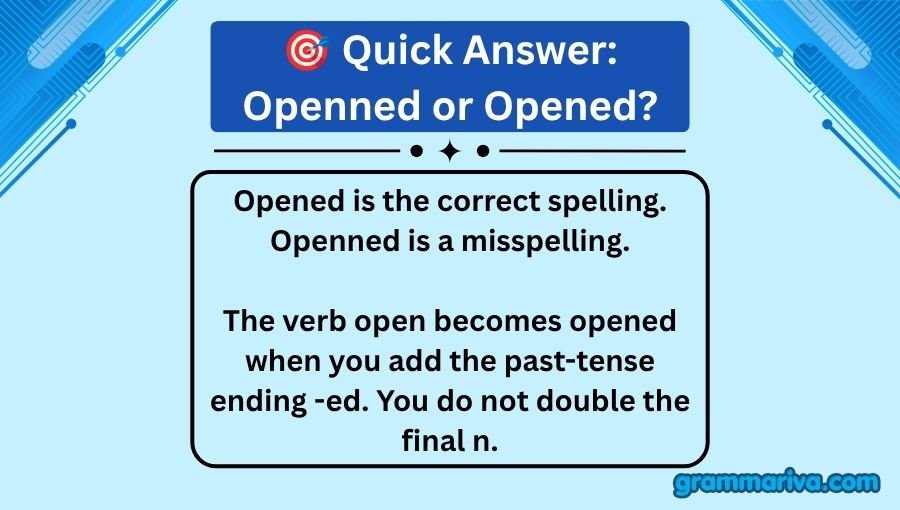
Opened is the correct spelling. Openned is a misspelling.
The verb open becomes opened when you add the past-tense ending -ed. You do not double the final n.
- ✅ Correct: She opened the door.
- ❌ Incorrect: She openned the door.
So, when you are deciding between openned or opened, choose opened every time in standard English.
🔍 Is Openned the Same as Opened?
No. Opened is the standard English word, while openned is an incorrect spelling.
The word opened is the past tense and past participle of open. It can describe an action that happened in the past or an action that has been completed.
For example:
- I opened the window.
- The store opened at nine.
- She has opened the package.
The spelling stays opened in each case.
Why Does “Openned” Look Possible?
English spelling rules can make this mistake seem reasonable. Some verbs double their final consonant before -ed.
Compare these words:
- stop → stopped
- plan → planned
- shop → shopped
- drop → dropped
Because these words double their final consonant, writers sometimes assume that open should become openned.
It does not.
The correct form is:
open → opened
There is only one n before the -ed ending.
📚 Opened: Meaning and Correct Use
Opened is the past tense and past participle of open. It can mean that someone moved something from a closed position, made something accessible, or started an activity or event.
Here are some common uses.
Opened as the Past Tense
When someone performs an action in the past, opened can describe what happened.
- ✅ Maria opened the book.
- ❌ Maria openned the book.
The action happened in the past, so opened is correct.
Opened for Something That Became Accessible
We can also use opened when a place, object, or service became available.
- ✅ The new library opened last Monday.
- ❌ The new library openned last Monday.
Here, opened tells us that the library began operating or became available.
Opened as a Past Participle
Opened can also appear with helping verbs such as has, have, and had.
- ✅ He has opened the email.
- ❌ He has openned the email.
The spelling does not change just because the word is used with a helping verb.
Meaning Summary
| Meaning | Word Type | Example Sentence |
|---|---|---|
| Moved something from closed to open | Verb | She opened the door. |
| Made something accessible | Verb | He opened the box. |
| Started operating | Verb | The shop opened early. |
| Past participle with a helping verb | Verb | They have opened the file. |
⚖️ Openned or Opened at a Glance
The easiest way to understand the difference is to compare the forms directly. Opened follows the normal spelling of the verb open when -ed is added.
| Form | Type | Meaning | Example | Correct/Incorrect |
|---|---|---|---|---|
| open | Base verb | To make something not closed | Please open the door. | ✅ Correct |
| opened | Past tense | Made something open in the past | She opened the door. | ✅ Correct |
| opened | Past participle | Used with helping verbs | He has opened the door. | ✅ Correct |
| openned | Misspelling | Not standard English | She openned the door. | ❌ Incorrect |
🤔 Why Do People Confuse Openned and Opened?
People often confuse these spellings because they remember the consonant-doubling rule but apply it too broadly.
A common pattern in English is:
stop → stopped
plan → planned
shop → shopped
That pattern can make open → openned look logical at first glance. But spelling rules depend on the structure of the original word.
I once reviewed a short student paragraph that used openned twice. The student had correctly spelled planned and stopped elsewhere, so the problem was not a lack of effort. The student had simply extended one spelling pattern to a word where it did not apply.
That is a useful lesson: do not double a consonant just because another verb does.
🧠 Why Does Open Become Opened?
The word open already has the final letter n it needs before the -ed ending.
The standard form is:
open + ed = opened
It is not:
open + ned = openned
The spelling rule does not call for another n.
When you write the word, think of it as two simple parts:
open + ed
That makes the correct spelling easier to see.
✏️ When Should You Use Opened?
Use opened when you need the past tense or past participle of open.
You may use it when talking about:
- doors
- windows
- books
- boxes
- emails
- accounts
- stores
- websites
- events
- conversations
- opportunities
Examples:
- ✅ I opened the window because the room was warm.
- ❌ I openned the window because the room was warm.
- ✅ She opened the package carefully.
- ❌ She openned the package carefully.
- ✅ The manager opened the meeting with a short speech.
- ❌ The manager openned the meeting with a short speech.
A Simple Test Tip 💡
If you are unsure, remove -ed.
Ask yourself:
What is the base verb?
If the base verb is open, the past form is opened.
Do not add another n.
open → opened
This quick test works well when you are writing quickly.
📝 Case Study: A Workplace Email
Imagine that an employee wants to tell a manager that a shared document is ready.
The employee writes:
“I openned the file and checked the final page.”
The meaning is clear, but the spelling is wrong. A polished version would be:
“I opened the file and checked the final page.”
I once caught myself typing openned while editing a short work message. I had just written several words with doubled consonants, so my fingers followed the wrong pattern. I deleted the extra n and moved on.
This shows why even experienced writers can make small spelling errors. The key is knowing what to check.
| Situation | Incorrect Version | Correct Version |
|---|---|---|
| I openned the file. | I opened the file. | |
| Meeting | She openned the discussion. | She opened the discussion. |
| Store | The shop openned at eight. | The shop opened at eight. |
| Personal message | I openned your message. | I opened your message. |
📖 Grammar Rules for Opened
The spelling opened comes from adding the regular past-tense ending -ed to open.
The basic pattern is:
open + ed = opened
The final n is not doubled.
This is different from some short verbs that double their final consonant before adding -ed. For example:
plan → planned
stop → stopped
drop → dropped
But:
open → opened
The spelling rule depends on the word. You cannot assume that every verb ending in a consonant will double that consonant.
Standard English reference works agree on the spelling opened. If you are writing for school, work, or publication, use opened.
Correct vs Incorrect at a Glance
| Sentence | Correct/Incorrect | Why |
|---|---|---|
| She opened the door. | ✅ Correct | The past form of open is opened. |
| She openned the door. | ❌ Incorrect | The final n should not be doubled. |
| We opened the store early. | ✅ Correct | Opened correctly shows the past action. |
| He openned the email. | ❌ Incorrect | Openned is a misspelling. |
| They have opened the box. | ✅ Correct | Opened works as a past participle. |
⚠️ Common Mistakes With Openned and Opened
The biggest mistake is adding an extra n.
People may also confuse opened with other forms of the word, especially when writing quickly.
Here are some related spelling problems:
| Common Confusion | Correct Form | Why People Confuse Them |
|---|---|---|
| it’s / its | it’s / its | Both sound alike in many sentences. |
| your / you’re | your / you’re | They have similar sounds. |
| their / there | their / there | They sound alike in standard speech. |
| planned / planed | planned / planed | The meanings and spelling rules differ. |
| opened / openned | opened | Writers may overapply consonant doubling. |
Why These Mistakes Happen
Fast Typing
When people type quickly, their fingers may add letters automatically. A familiar spelling pattern can take over before the writer checks the word.
Autocorrect
Autocorrect can sometimes change a word, but it cannot catch every mistake. A misspelling may also survive if the software does not recognize what you intended.
Lack of Knowledge
If someone has never learned why opened has one n, the spelling can be hard to remember.
Pattern Matching
This is a major reason for openned. Writers know words such as planned and stopped, so they may copy the same pattern.
Specific Wrong Forms to Avoid
| Wrong Form | What’s Wrong | Correct Form |
|---|---|---|
| openned | Extra n | opened |
| openning | Extra n before -ing | opening |
| openninged | Incorrect combination | opened |
| openn | Extra n | open |
| openning the door | Wrong spelling of present participle | opening the door |
| openned it | Past form is misspelled | opened it |
🕰️ Opened: Word Form and History
The spelling of opened is easiest to understand by looking at the modern base verb open and its regular past form.
English uses -ed to form the past tense of many regular verbs. For open, the result is opened.
There is no need to add a second n.
| Stage | Form | Note |
|---|---|---|
| Base form | open | Present/base verb |
| Past form | opened | Standard past-tense form |
| Past participle | opened | Used with helping verbs |
| Present participle | opening | Uses -ing without doubling the n |
The spelling pattern is useful because it helps explain both opened and opening.
🌎 How Is Opened Used in Different Contexts?
Opened works in many kinds of writing. The meaning depends on the situation, but the spelling remains the same.
Everyday Conversation
In daily speech, you might say:
“I opened the fridge.”
“She opened the window.”
“He opened the gift.”
Professional Writing
In professional writing, opened can describe documents, accounts, meetings, or businesses.
“The team opened the file and reviewed the data.”
Creative Writing
Writers often use opened to describe actions in a story.
“He opened the old wooden door and stepped inside.”
Social Media and Texting
The same spelling applies in casual messages.
“Finally opened that package 😂”
Casual writing can be short, but standard spelling is still opened.
| Context | Which Term to Use | Example |
|---|---|---|
| Everyday conversation | opened | I opened the window. |
| Professional writing | opened | We opened the account. |
| Creative writing | opened | She opened the mysterious box. |
| Social media/texting | opened | I finally opened it! |
💬 Common Phrases With Opened
Opened appears in many normal English phrases. These phrases can help you remember the correct spelling.
| Phrase | Meaning |
|---|---|
| opened the door | moved a door into an open position |
| opened the window | moved a window open |
| opened an account | created or started an account |
| opened a business | started operating a business |
| opened the meeting | started a meeting |
| opened the package | removed or broke the package’s closed state |
Notice that each phrase uses opened, never openned.
🔄 Synonyms and Alternatives for Opened
Sometimes another word can replace opened, depending on the exact meaning.
For example, unlocked can work when something was locked. Started can work when an event began. But these words are not always interchangeable.
| Alternative | Works When | Does Not Work When |
|---|---|---|
| unlocked | Something was locked | A simple physical opening is meant |
| started | An event or activity began | A door or box was physically opened |
| revealed | Something hidden became visible | You simply moved a door |
| unsealed | A seal was removed | No seal was involved |
| began | An activity or period started | You mean opening a physical object |
For example:
“She opened the door.”
You cannot always replace opened with started.
“The meeting opened at noon.”
In some contexts, began may sound more natural.
Choosing a synonym depends on meaning, not just spelling.
🎯 Why Does Correct Spelling Matter?
Correct spelling makes your meaning easier to understand. It also makes your writing look careful and professional.
A spelling error such as openned usually does not make the sentence impossible to understand. However, repeated errors can make a reader question the quality of the rest of the writing.
I once edited a short online article where the writer used openned several times. The ideas were good, but the repeated spelling error distracted from the message. One small correction improved the whole piece.
As I often tell students:
“Clear writing starts with small, correct choices.”
| Situation | Why Getting It Right Matters |
|---|---|
| Resume | Shows attention to detail |
| Client email | Creates a professional impression |
| Published content | Builds reader trust |
| Social post | Keeps writing clean and easy to read |
🧩 How To Remember the Difference
The easiest memory trick is very short:
Open has one N. Opened keeps one N.
Think:
OPEN + ED = OPENED
Do not think:
OPEN + NED = OPENNED
Another useful trick is to compare it with planned.
- plan → planned
- open → opened
The two words follow different spelling patterns.
Memory Trick Table
| Base Word | Past Form | What Happens |
|---|---|---|
| open | opened | No doubled n |
| plan | planned | Final n doubles |
| stop | stopped | Final p doubles |
| shop | shopped | Final p doubles |
| call | called | No doubled l in standard US spelling |
The goal is not to memorize every spelling rule at once. Just remember the word pair:
open → opened
📱 Opened in Digital Communication
Digital writing creates many quick spelling mistakes. People often type messages while moving between apps, answering emails, or posting online.
You might see:
❌ I openned your message.
The corrected version is:
✅ I opened your message.
You might also see:
❌ I openned the link.
The corrected version is:
✅ I opened the link.
Even when a message is casual, the standard spelling is still opened.
🧠 Practice: Can You Choose the Correct Form?
Try these examples before looking at the answers.
- She ___ the door slowly.
- We ___ the new account yesterday.
- He ___ the package this morning.
- They ___ the store at nine.
- I have ___ your email.
The answer for all five is opened.
That is not because opened is always the right word in every sentence. It is because each sentence needs the past form of open.
| Sentence | Answer |
|---|---|
| She ___ the door slowly. | opened |
| We ___ the new account yesterday. | opened |
| He ___ the package this morning. | opened |
| They ___ the store at nine. | opened |
| I have ___ your email. | opened |
📋 Quick Recap Checklist
Use this checklist whenever you are unsure about the spelling.
| Question | If Yes → Use |
|---|---|
| Is the base verb open? | opened for the past |
| Are you talking about a past action? | opened |
| Are you using has, have, or had? | opened |
| Are you tempted to add another n? | Do not add it |
| Are you writing the standard past form? | opened |
Practice Examples
- ✅ She opened the book.
- ❌ She openned the book.
- ✅ We opened the store early.
- ❌ We openned the store early.
- ✅ He has opened the package.
- ❌ He has openned the package.
❓ FAQs About Openned vs Opened
Is “openned” a correct English word?
No. Openned is a misspelling. The correct past-tense and past-participle form of open is opened.
Is it opened or openned?
The correct form is opened. It has one n before -ed.
Why is opened spelled with one n?
The base word is open. Adding the regular past-tense ending -ed gives opened. English does not require the final n to be doubled here.
What is the past tense of open?
The past tense of open is opened.
Example:
She opened the door.
Is “openning” correct?
No. The correct present-participle form is opening.
Example:
She is opening the door.
Why do people spell opened as openned?
People often overapply the consonant-doubling pattern found in words such as planned and stopped. Fast typing and habit can also cause the error.
What is the difference between open and opened?
Open is the base form, while opened is the past tense and past participle.
Example:
- Please open the box.
- She opened the box.
Can I use opened with “has” or “have”?
Yes. Opened can be used as a past participle.
Example:
They have opened the new store.
Is opened correct in formal writing?
Yes. Opened is the standard spelling and is appropriate for formal, academic, business, and casual writing.
How can I remember the spelling of opened?
Remember this simple formula:
open + ed = opened
Keep the single n.
🔑 Final Takeaway
Openned or opened has a very simple answer: opened is the correct spelling, while openned is incorrect in standard English. The past form of open is made by adding -ed without doubling the final n.
Remember the basic pattern:
open → opened
If you are writing an email, school assignment, article, resume, or social media post, use opened. Do not let words such as planned or stopped trick you into adding another consonant.
When I am proofreading, I use one quick check: look at the base word first. If the base is open, the past form is opened. That small habit catches the error almost instantly. ✨
So the next time you pause over the spelling, keep it simple. One n, then -ed. Opened is the form to remember, and openned is the form to avoid. Keep your spelling clean, keep your message clear, and let every word do its job. ✅

Hi, I’m Lucas Bennett. I’m a grammar content specialist at Grammariva. I work on articles covering everyday grammar questions, sentence usage, and writing tips that readers can apply with confidence.


[…] asked questions. By the end, you should feel confident choosing the correct form every time. 😊 Openned or Opened | Thank You Both or Thanks to Both of You | Herself vs Herselfs vs Her […]
[…] simple rule, though, the difference becomes much easier to remember. ✍️ Targetted or Targeted | Openned or Opened | Thank You Both or Thanks to Both of […]