Have you ever typed a word that looks right, only to wonder if one small letter changes the whole meaning? That happens often with emersion vs immersion. These two words look almost identical, but they describe opposite ideas in many contexts. One is linked to coming out or appearing, while the other is linked to going into or being deeply surrounded by something. 🤔
I have seen this mix-up in student writing, emails, and even polished website content. The problem is easy to understand. Both words contain the same basic letters, and both can describe movement or a state of being surrounded by something. The extra im- in immersion can make the distinction hard to spot.
The good news is that the difference is simple once you connect each word with its main idea. In this guide, I will explain emersion vs immersion with clear examples, practical rules, comparison tables, common mistakes, and memory tricks. By the end, you should know exactly which word to choose. ✨ Messege vs Message | Reinforce vs Reenforce | Targetted or Targeted
🎯 Quick Answer: Emersion vs Immersion
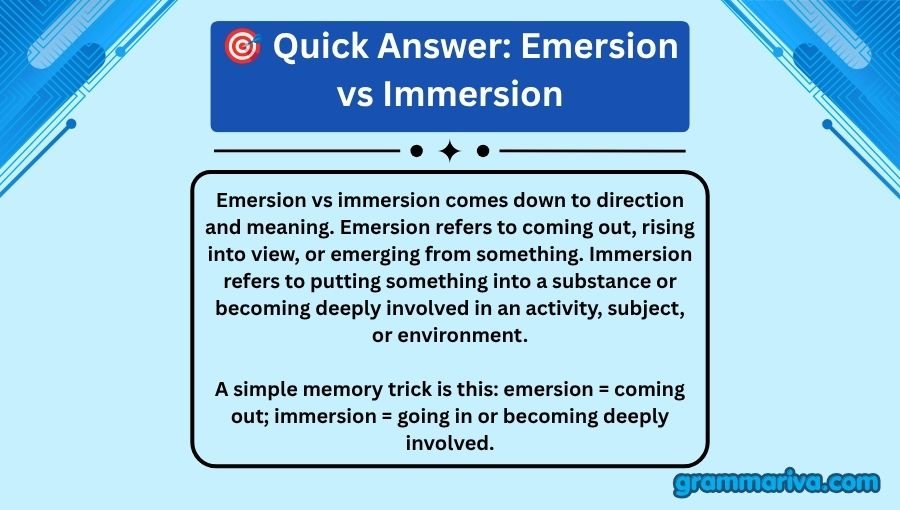
Emersion vs immersion comes down to direction and meaning. Emersion refers to coming out, rising into view, or emerging from something. Immersion refers to putting something into a substance or becoming deeply involved in an activity, subject, or environment.
A simple memory trick is this: emersion = coming out; immersion = going in or becoming deeply involved.
| Word | Main Idea | Simple Meaning | Example |
|---|---|---|---|
| Emersion | Coming out | Appearing or rising from something | The moon’s emersion was visible after the eclipse. |
| Immersion | Going in | Being placed in or deeply involved | Language immersion helped her learn Spanish. |
🔎 Is Emersion the Same as Immersion?
No, emersion and immersion are not the same. They point in different directions and are used in different situations.
Emersion describes something coming out of, rising from, or becoming visible after being hidden or covered. It is a less common word, so many readers may not see it often.
Immersion is much more common. It can describe physically putting something into liquid or becoming deeply involved in an experience.
Think of the difference like this:
- Emersion: out or into view.
- Immersion: in or deeply involved.
| Word | Direction or Idea | Common Use | Example |
|---|---|---|---|
| Emersion | Outward | Something becomes visible | The star’s emersion was observed. |
| Immersion | Inward | Something enters a liquid | The immersion of the object took seconds. |
| Immersion | Deep involvement | Learning or experience | She learned through language immersion. |
📚 Emersion: Meaning and Correct Use
Emersion means the act or process of coming out, rising into view, or becoming visible after being hidden or covered.
The word is real, but it is relatively uncommon in everyday English. You are more likely to see it in technical, scientific, astronomical, or specialized writing.
For example:
The telescope recorded the emersion of the star.
Here, the star was previously hidden from view and then became visible.
Another example is:
The emersion of the moon marked the end of the observed event.
The word works because the moon is described as becoming visible again.
When Should You Use Emersion?
Use emersion when the main idea is coming out or becoming visible.
| Meaning | Word Type | Example Sentence |
|---|---|---|
| Coming out | Noun | The emersion of the object was gradual. |
| Becoming visible | Noun | Observers recorded the emersion of the star. |
| Emerging from something | Noun | The emersion happened after the obstruction moved. |
Sentence Breakdown
Consider this sentence:
The emersion of the satellite was visible through the telescope.
- Emersion is the noun.
- Satellite is what becomes visible.
- Through the telescope explains how it was observed.
The key idea is that something was hidden and then came out of view or into view.
💡 Test Tip
Ask yourself:
Is something coming out or becoming visible?
If yes, emersion may be the correct word.
If the idea is going into something or becoming deeply involved, you probably need immersion instead.
🌊 Immersion: Meaning and Correct Use
Immersion means placing something into a liquid or another substance. It can also mean becoming deeply involved in an activity, environment, language, culture, or subject. Understanding emersion vs immersion starts with knowing that emersion describes coming out or becoming visible.
This is the word most people use in everyday writing.
For example:
The immersion of the tool in water cleaned the surface.
Here, the tool is physically placed into water.
But immersion does not always involve liquid.
Consider:
The student improved her French through language immersion.
She is not being placed inside a liquid. Instead, she is surrounded by the language and uses it deeply.
Understanding emersion vs immersion starts with knowing that emersion describes coming out or becoming visible.
| Meaning | Word Type | Example Sentence |
|---|---|---|
| Placing into liquid | Noun | The immersion of the device lasted five minutes. |
| Deep involvement | Noun | Cultural immersion changed his view of the country. |
| Full attention | Noun | Her immersion in the book made her lose track of time. |
⚖️ Emersion vs Immersion at a Glance
The fastest way to understand emersion vs immersion is to compare their central ideas.
| Form | Type | Meaning | Example | Correct/Incorrect |
|---|---|---|---|---|
| Emersion | Noun | Coming out or becoming visible | The emersion of the star was recorded. | ✅ Correct |
| Immersion | Noun | Going into or being deeply involved | The immersion program helped students learn. | ✅ Correct |
| Emersion | Noun | Deep involvement in a subject | Her emersion in French was excellent. | ❌ Incorrect |
| Immersion | Noun | Coming out into view | The immersion of the moon became visible. | ❌ Incorrect |
The central contrast is simple:
Emersion = emergence or coming into view.
Immersion = entering deeply or becoming surrounded.
❓ Why Do People Confuse Emersion and Immersion?
People confuse these words because their spelling is nearly identical. Both contain mersion, and the first letters are easy to overlook when reading quickly.
Another reason is that immersion is much more common. Writers may know the word immersion but accidentally use it when they actually mean something coming out or becoming visible.
I once edited a short science article where the writer used immersion for an object becoming visible after being hidden. The sentence looked fine at first glance. Once I checked the direction of the action, the error became obvious. The object was coming out, so emersion was the better choice.
| Reason | How It Causes Confusion | Helpful Fix |
|---|---|---|
| Similar spelling | The words look almost identical | Check the first letters |
| Rare use of emersion | Writers may not recognize it | Learn its basic meaning |
| Fast reading | Small spelling differences are missed | Read the whole sentence |
| Autocorrect | Software may prefer a common word | Check meaning manually |
| Limited vocabulary | One word may be used for both ideas | Learn the contrast |
🧭 How Can You Remember the Difference?
Use the first part of each word as a memory clue.
Emersion starts with e, which you can connect with exit or emerge.
Immersion starts with im, which you can connect with in.
This is not a rule about how the words were formed. It is simply a useful memory trick.
| Word | Memory Clue | Meaning |
|---|---|---|
| Emersion | E = exit | Coming out |
| Immersion | Im = in | Going in |
| Emersion | E = emerge | Becoming visible |
| Immersion | Involvement | Becoming deeply involved |
Try these questions:
- Is the thing coming out? → Emersion
- Is the thing going in? → Immersion
- Is someone becoming deeply involved? → Immersion
- Is something becoming visible after being hidden? → Emersion
That quick test can prevent most mistakes.
✍️ Correct Meanings and Uses
The two words work best when you focus on the action being described.
Emersion in Technical or Scientific Writing
Emersion can describe something becoming visible after being hidden. It may appear in specialized descriptions of observations or events.
The emersion of the object was observed through the instrument.
The important idea is reappearance.
Immersion in Education
Immersion is common when discussing language learning.
The child learned Japanese through immersion.
This means the learner was surrounded by the language and had frequent exposure to it.
Immersion in Culture
The word also works when someone becomes deeply involved in another culture.
Her cultural immersion gave her a better understanding of local customs.
Immersion in Everyday Activities
Immersion can describe deep focus.
His immersion in the novel lasted all afternoon.
| Situation | Best Word | Why |
|---|---|---|
| Something becomes visible | Emersion | It comes into view |
| Something enters water | Immersion | It goes into a substance |
| Deep language learning | Immersion | The learner is surrounded by language |
| Cultural experience | Immersion | The person becomes deeply involved |
| Deep focus on a book | Immersion | The person gives full attention |
📝 Case Study: A Workplace Email
Imagine a workplace team testing equipment.
A manager writes:
“The emersion of the device in cleaning fluid should last ten minutes.”
That sentence creates a problem. If the writer means that the device is being placed into the fluid, the correct word is immersion.
The revised sentence is:
“The immersion of the device in cleaning fluid should last ten minutes.”
Here, immersion clearly shows that the device goes into the fluid.
I once caught myself making a similar mistake while proofreading a technical note. I had read the sentence several times because the spelling looked familiar. Then I asked one simple question: “Is this going in or coming out?” That immediately showed me which word the sentence needed.
| Original Idea | Wrong Choice | Better Choice | Reason |
|---|---|---|---|
| Device goes into fluid | Emersion | Immersion | It enters the fluid |
| Object becomes visible | Immersion | Emersion | It comes into view |
| Student learns through full exposure | Emersion | Immersion | The learner is deeply involved |
| Hidden object becomes visible | Immersion | Emersion | It emerges from being hidden |
📖 Grammar Rules Explanation
The main grammar rule is straightforward: both emersion and immersion are nouns, but their meanings differ.
Emersion refers to coming out, emerging, or becoming visible.
Immersion refers to going into something or becoming deeply involved in something.
The difference is semantic. In other words, the sentence must match the intended meaning.
Standard English reference sources recognize immersion as a normal word in many everyday contexts. Emersion is also an established word, but it is much less common and often appears in specialized contexts.
Do not choose based only on which word looks more familiar. Choose based on what the sentence actually means.
Correct vs Incorrect at a Glance
| Sentence | Correct/Incorrect | Why |
|---|---|---|
| The immersion of the object in water was brief. | ✅ Correct | The object goes into water. |
| The emersion of the star was observed. | ✅ Correct | The star becomes visible. |
| Her emersion in Spanish helped her speak fluently. | ❌ Incorrect | Deep language involvement is immersion. |
| The immersion of the hidden star marked its return to view. | ❌ Incorrect | Coming into view is emersion. |
| The student’s immersion in the subject was impressive. | ✅ Correct | The student was deeply involved. |
⚠️ Common Mistakes With These Words
Most mistakes happen because writers focus on spelling instead of meaning.
The key to avoiding emersion vs immersion mistakes is to check the meaning before choosing the spelling.
Three common causes are especially worth watching:
- Fast typing: Your fingers may choose the familiar word.
- Autocorrect: Software may favor the more common spelling.
- Lack of knowledge: If you have rarely seen emersion, you may assume immersion works everywhere.
Another common problem is using immersion for every situation involving movement. That does not work.
| Confusion | Correct Choice | Basic Rule |
|---|---|---|
| It’s / its | Depends on meaning | Contraction vs possession |
| Your / you’re | Depends on meaning | Possession vs “you are” |
| Affect / effect | Depends on use | Verb vs noun in many cases |
| Then / than | Depends on meaning | Time vs comparison |
| Emersion / immersion | Depends on direction | Out vs in/deep involvement |
Specific Wrong Forms to Avoid
| Wrong Form or Use | What’s Wrong | Correct Form |
|---|---|---|
| Emersion in a language | Deep involvement needs immersion | Immersion |
| Immersion from behind an object | Coming into view needs emersion | Emersion |
| Emmersion | Extra “m” creates a misspelling | Immersion |
| Immerssion | Extra “s” creates a misspelling | Immersion |
| Emmersion from view | Misspelling plus wrong form | Emersion |
| Emersion program | Usually wrong if referring to deep learning | Immersion program |
🕰️ Emersion and Immersion: Word History
The history of these words is related to the broader idea of movement into or out of something. Their modern meanings preserve a useful contrast between entering and emerging.
Because specialized word history can be complex, it is best not to rely on invented dates or overly precise origin claims. For everyday writing, the practical distinction matters much more than memorizing a timeline.
| Stage | Form | General Note |
|---|---|---|
| Earlier English use | Related forms | Ideas of entering or emerging were expressed through related word families |
| Later development | Emersion | The word came to describe coming out or becoming visible |
| Later development | Immersion | The word developed around being put into or deeply involved |
| Modern English | Both | Immersion is common; emersion is more specialized |
🌎 Usage in Different Contexts
The correct choice can become easier when you know where each word is normally used.
The difference between emersion vs immersion becomes clearer when you look at how each word works in real situations.
Everyday Conversation
Immersion is much more likely in everyday speech.
“I love total immersion when I learn something new.”
Emersion is less common in casual conversation.
Professional Writing
Both can appear in professional writing, but the meaning must be exact.
Technical writing may use emersion when something comes into view. Training, education, and business writing often use immersion for deep involvement.
Creative Writing
Writers can use immersion to describe a powerful experience.
“The story pulled me into complete immersion.”
Emersion can work when describing something rising into view, especially in a poetic or technical setting.
Social Media and Texting
Most casual posts will use immersion.
For example:
“Total immersion in my new hobby today!”
Emersion is uncommon unless the post is discussing a specialized subject.
| Context | Which Term to Use | Example |
|---|---|---|
| Everyday conversation | Usually immersion | I enjoy language immersion. |
| Professional writing | Either, based on meaning | The device underwent immersion. |
| Creative writing | Usually immersion | She found herself in total immersion. |
| Social media/texting | Usually immersion | Weekend immersion in nature! |
💬 Common Phrases With Immersion
Because immersion is common, it appears in several natural phrases. These expressions usually describe deep involvement or being placed into something.
| Phrase | Meaning |
|---|---|
| Language immersion | Learning by being surrounded by a language |
| Cultural immersion | Deep involvement in a culture |
| Total immersion | Complete involvement |
| Immersion program | A program built around intensive exposure |
| Immersion experience | An experience that surrounds or deeply involves someone |
| Full immersion | Complete involvement in an activity or setting |
There are fewer common fixed expressions with emersion. That is another clue that you should not treat the two words as interchangeable.
🔄 Synonyms and Alternatives
Sometimes you can replace one of these words with a simpler phrase. This can make your writing clearer, especially when your audience may not know the less common term emersion.
| Alternative | Works When | Does Not Work When |
|---|---|---|
| Emergence | Something appears or comes out | You mean deep involvement |
| Appearance | Something becomes visible | You need the specialized idea of emersion |
| Reappearance | Something becomes visible again | Something is being placed into liquid |
| Submersion | Something goes below a surface | You mean learning or general involvement |
| Deep involvement | Someone becomes strongly engaged | You mean physical placement in liquid |
For example, instead of:
The emersion of the object was noticeable.
You could write:
The emergence of the object was noticeable.
Depending on the exact context, emergence may be easier for a general audience.
🎯 Why Getting Emersion vs Immersion Right Matters
Correct word choice makes your meaning clear. A single letter can change the direction of an action.
In professional writing, that difference can matter even more. A technical instruction about putting something into liquid should not accidentally suggest that the object is coming out.
The same principle applies to education. A language immersion program means students are surrounded by the language. Calling it an emersion program changes the meaning and may confuse readers.
“Good word choice removes doubt before the reader has to ask a question.”
| Situation | Why Getting It Right Matters |
|---|---|
| Resume | Shows careful language skills |
| Client email | Prevents confusing instructions |
| Published content | Builds trust and clarity |
| Social post | Helps readers understand your message |
🧠 How to Remember Emersion vs Immersion
Here is my favorite memory trick:
E = Exit.
Think of emersion as something coming out or becoming visible.
IM = In.
Think of immersion as going in or becoming deeply involved.
Try this mini test:
The swimmer went into the pool.
That is immersion.
The hidden object became visible.
That is emersion.
The student spent six months surrounded by French.
That is immersion.
The object appeared after being hidden.
That is emersion.
This simple out-versus-in trick makes emersion vs immersion much easier to remember.
| If the sentence describes… | Choose |
|---|---|
| Coming out | Emersion |
| Appearing | Emersion |
| Becoming visible | Emersion |
| Going into liquid | Immersion |
| Being surrounded by something | Immersion |
| Deep involvement | Immersion |
❓ Is Immersion More Common Than Emersion?
Yes, immersion is much more common in general English.
You will see it in education, technology, travel, entertainment, hobbies, science, and everyday conversation.
Emersion is less common. It is most useful when you specifically need to describe something coming out, emerging, or becoming visible.
This difference in frequency is one reason writers may know immersion well but hesitate when they actually need emersion.
❓ Can Emersion Be Used for Learning?
Usually, no. If you mean learning by being deeply surrounded by a language, culture, or subject, use immersion.
For example:
She studied French through immersion.
Not:
She studied French through emersion.
The first sentence clearly describes deep exposure and involvement.
❓ Is Emersion a Real English Word?
Yes. Emersion is a real English word. It is simply much less common than immersion.
It can describe something coming out or becoming visible after being hidden or covered.
If you need a simpler word for a general audience, emergence or appearance may sometimes be clearer, depending on the sentence.
❓ What Is the Difference Between Emersion and Immersion?
The basic difference is direction.
Emersion describes coming out or becoming visible. Immersion describes going into something or becoming deeply involved in it.
A useful memory rule is:
Emersion = out.
Immersion = in.
❓ Should I Say Language Emersion or Language Immersion?
Say language immersion.
Language immersion means learning through strong and repeated exposure to the language. Students may hear, read, speak, and use the language throughout much of their learning experience.
Language emersion is not the standard choice for this meaning.
❓ Is It Immersion in Water or Emersion in Water?
Usually, immersion in water is correct when you mean putting something into water or being surrounded by water.
For example:
The immersion of the device in water caused damage.
If you mean the device later comes out of the water, you could describe that event as an emersion.
❓ Can Immersion Mean Deep Focus?
Yes. Immersion can describe deep involvement in an activity, subject, story, culture, or environment.
For example:
Her immersion in the novel made her forget the time.
The sentence does not describe physical water. It describes deep mental involvement.
❓ What Is an Easy Way to Remember These Words?
Connect emersion with exit and emerge.
Connect immersion with in.
If something comes out, think emersion. If something goes in or becomes deeply involved, think immersion.
❓ Is Emersion Common in Everyday English?
No. Emersion is relatively uncommon in everyday English.
Most people encounter immersion much more often. You may see emersion in specialized writing, especially when a precise term is needed for something becoming visible or emerging from an obscured position.
❓ Can I Use Emergence Instead of Emersion?
Sometimes, yes.
Emergence is often easier for general readers and can describe something appearing, developing, or coming into view.
However, the words are not always perfect replacements. If your context requires the specific idea expressed by emersion, keep emersion.
❓ What Is the Opposite of Immersion?
There is no single opposite that works in every context, but emersion can describe the act of coming out after being immersed.
For example, something may first undergo immersion in water and later undergo emersion as it comes back into view or out of the water.
✅ Quick Recap Checklist
Use this checklist whenever you are unsure.
| Question | If Yes → Use |
|---|---|
| Is something coming out? | Emersion |
| Is something becoming visible? | Emersion |
| Is something emerging from being hidden? | Emersion |
| Is something going into liquid? | Immersion |
| Is someone deeply involved in a subject? | Immersion |
| Is someone learning through strong exposure? | Immersion |
| Is the sentence about culture or language exposure? | Immersion |
Practice Examples
- The student learned Spanish through immersion. ✅
- The telescope recorded the emersion of the object. ✅
- Her emersion in the subject lasted all semester. ❌
- Correct: Her immersion in the subject lasted all semester.
- Understanding emersion vs immersion is easier when you focus on whether something is coming out, going in, or becoming deeply involved. This simple distinction can help you choose the right word with confidence.
🏁 Conclusion
Emersion vs immersion becomes much easier once you focus on direction and meaning. Emersion describes coming out, emerging, or becoming visible. Immersion describes going into something or becoming deeply involved in it.
If an object comes into view after being hidden, emersion may be the right noun. If an object goes into water, immersion is the better choice. The same rule applies to abstract ideas. A student can experience language immersion. A traveler can enjoy cultural immersion. A reader can become immersed in a story.
I recommend using the simple out vs in test whenever you are unsure. Ask what the sentence is really describing before you worry about spelling. That one step can prevent most errors.
You do not need a complicated grammar rule. You just need to remember the direction. Keep emersion connected with coming out and immersion connected with going in or becoming deeply involved. Once that distinction becomes familiar, this confusing word pair becomes easy. Keep your word choice clear, and your writing will stay strong. ✨📚

Hi, I’m Ethan Brooks. I’m an English grammar writer at Grammariva, where I work on clear explanations, practical examples, and useful writing tips. I enjoy making difficult grammar topics easier to understand.


[…] writing needs the full form, and why speakers sometimes choose one expression over the other. 😊 Emersion vs Immersion | Messege vs Message | Reinforce vs […]
[…] By the end, you should feel confident choosing the right word every time. ✨ Do Not or Don’t | Emersion vs Immersion | Messege vs […]