When you are unsure about giving or given, the problem usually comes down to one simple question: How is the word working in the sentence? 🤔 Both words come from the verb give, but they do not play the same grammatical role. One is an -ing form, while the other is a past participle. That small difference can change the whole sentence.
I have seen this confusion in school assignments, emails, resumes, and everyday messages. The good news is that you do not need to memorize a long list of rules. You only need to look at the words around the verb. Once you know what those words are doing, choosing the right form becomes much easier. ✨
This guide explains the difference in plain US English. You will see simple rules, examples, tables, common mistakes, practical tests, and FAQs so you can use both forms with confidence. My Father and I or My Father and Me | Cartel vs Mafia | Leapt or Leaped
🎯 Quick Answer: Giving or Given
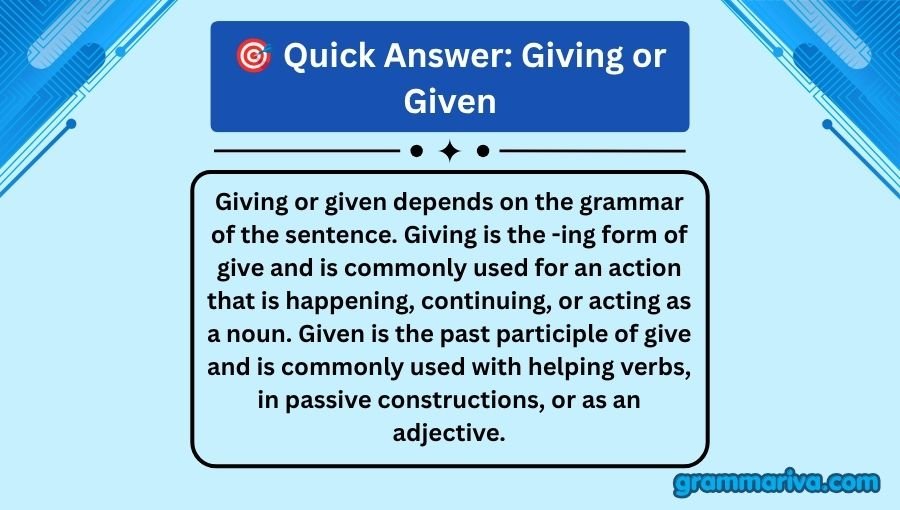
Giving or given depends on the grammar of the sentence. Giving is the -ing form of give and is commonly used for an action that is happening, continuing, or acting as a noun. Given is the past participle of give and is commonly used with helping verbs, in passive constructions, or as an adjective.
Compare these examples:
- ✅ She is giving me a book.
- ❌ She is given me a book.
Here, giving follows is as part of the present progressive tense.
But:
- ✅ She was given a book.
- ❌ She was giving a book.
Here, given works in a passive construction. The sentence means that someone gave a book to her.
The easiest rule is this: Use giving for an ongoing action or a gerund. Use given when grammar calls for the past participle, especially after forms of have or in passive sentences.
📚 Understanding the Basics of Giving or Given
The core difference between giving or given is their form and grammatical job. Giving shows the -ing form of give, while given is its past participle.
The verb give has several important forms:
| Form | Type | Meaning | Example | Correct/Incorrect |
|---|---|---|---|---|
| give | Base verb | Perform the action | I give her advice. | ✅ Correct |
| gives | Third-person singular | Performs the action | He gives good advice. | ✅ Correct |
| gave | Simple past | Performed the action before now | She gave me a gift. | ✅ Correct |
| giving | -ing form | Performing or continuing the action | She is giving a speech. | ✅ Correct |
| given | Past participle | Used with helping verbs or passively | He has given me advice. | ✅ Correct |
This table shows why you cannot simply swap the two words.
What Does Giving Mean?
Giving is the present participle or gerund form of give. It can describe an action in progress or function as a noun.
For example:
The teacher is giving us homework.
Here, giving is part of the present progressive verb phrase is giving. The action is happening now.
It can also act as a noun:
Giving to others can make people feel happy.
In that sentence, giving is the subject. It names the act of giving.
What Does Given Mean?
Given is the past participle of give. It is often used with helping verbs such as has, have, and had.
For example:
She has given me excellent advice.
The word has combines with given to form the present perfect tense.
Given is also common in passive sentences:
He was given a second chance.
The person receiving the action is the subject of the sentence.
Giving or Given: The Main Difference
| Word | Main Grammar Role | Common Pattern | Example |
|---|---|---|---|
| giving | -ing form | am/is/are + giving | She is giving a presentation. |
| giving | Gerund | giving + noun/phrase | Giving advice can be difficult. |
| given | Past participle | has/have/had + given | They have given their answer. |
| given | Passive | was/were + given | She was given a prize. |
| given | Adjective-like use | given + noun | At a given time, we can meet. |
The key is to check the helper verb and the role of the word.
❓ Is Giving the Same as Given?
No. Giving and given come from the same verb, but they serve different grammatical purposes.
Think of the verb give as having a small family of forms. Each member has its own job.
- give → base form
- gave → simple past
- giving → -ing form
- given → past participle
Consider these sentences:
- ✅ I am giving him the documents.
- ❌ I am given him the documents.
The first sentence describes an action in progress.
Now look at:
- ✅ I have given him the documents.
- ❌ I have giving him the documents.
The second sentence is wrong because have needs the past participle given, not the -ing form.
I once reviewed a short workplace message that said, “We are given the client an update.” The writer clearly knew the intended meaning, but the helper verb made giving the correct choice. Changing one word fixed the whole sentence.
🔍 When Should You Use Giving?
Use giving when the sentence needs the -ing form of give. This happens in several common situations.
1. Giving With the Present Progressive
Use giving after am, is, or are when an action is happening now or around the present time.
- ✅ I am giving a presentation today.
- ❌ I am given a presentation today.
- ✅ They are giving free samples.
- ❌ They are given free samples.
The pattern is:
am/is/are + giving
This is one of the easiest patterns to recognize.
2. Giving as a Gerund
Giving can act like a noun.
- ✅ Giving is better than taking in this situation.
- ❌ Given is better than taking in this situation.
Here, giving names an activity.
Other examples include:
- Giving advice requires care.
- Giving someone a second chance can be difficult.
- Giving gifts is common during the holidays.
3. Giving After Certain Verbs
Some verbs naturally take an -ing form after them.
For example:
- She enjoys giving advice.
- He avoids giving personal information.
- They discussed giving employees more time.
In each case, giving follows another verb and describes an activity.
Test Tip 💡
Try replacing giving with another -ing verb such as helping or working.
If the structure still sounds natural, giving may be the right form.
She is giving a speech.
She is working on a speech.
Both structures work.
🎁 When Should You Use Given?
Use given when the sentence needs the past participle of give.
1. Given After Have, Has, or Had
This is one of the strongest clues.
- ✅ She has given me her answer.
- ❌ She has giving me her answer.
- ✅ They had given us enough time.
- ❌ They had giving us enough time.
The pattern is:
have/has/had + given
2. Given in Passive Sentences
Use given when someone receives something and the sentence uses a passive structure.
- ✅ The student was given extra time.
- ❌ The student was giving extra time.
The meaning is that someone gave extra time to the student.
More examples:
- She was given a promotion.
- We were given clear instructions.
- He was given permission to leave.
3. Given as an Adjective
Given can also describe something that has been specified or established.
For example:
At a given time, only one person may enter.
Here, given does not mean that someone is actively giving something. It means a particular or specified time.
Another example:
For a given situation, this rule works well.
This use is different from the verb form, so context matters.
Meaning Summary
| Meaning | Word Type | Example Sentence |
|---|---|---|
| Action in progress | Present participle | She is giving a speech. |
| Activity used as a noun | Gerund | Giving can be rewarding. |
| Perfect-tense verb | Past participle | He has given his answer. |
| Passive verb | Past participle | She was given a ticket. |
| Specified or particular | Adjective-like use | At a given time, call me. |
❓ Why Do People Confuse Giving and Given?
People confuse these forms because both come from give, and both can appear near helping verbs.
The biggest problem is that English does not use one fixed pattern for every verb form. The helper verb tells you what comes next.
For example:
- is giving
- was given
- has given
- had given
A learner may remember that is and has are both helping verbs and then choose the wrong form. But they follow different patterns.
I once caught myself typing “has giving” in a quick note while editing a paragraph. I knew the rule, but I was typing too fast. That small mistake reminded me that even experienced writers benefit from checking the helper verb.
Common reasons for confusion include:
- fast typing
- autocorrect
- weak knowledge of verb forms
- translating directly from another language
- remembering the meaning but forgetting the grammar
- seeing both forms used correctly in different sentences
The solution is not to guess. Look at the structure.
📝 Case Study: Giving or Given in a Workplace Email
Imagine that a manager wants to tell an employee that the employee received extra time.
The manager writes:
❌ You are giving an extra week to finish the project.
That sentence sounds as if the employee is actively giving an extra week to someone else.
The intended meaning is that the employee received the extra week.
The better sentence is:
✅ You are given an extra week to finish the project.
However, in natural workplace English, an even clearer option would often be:
✅ You have been given an extra week to finish the project.
Why?
Because have been given clearly shows a passive action that has happened.
Now imagine a different message:
✅ We are giving you an extra week to finish the project.
This time, giving is correct because we are performing the action.
That contrast is useful:
We are giving you time.
You have been given time.
Same basic event. Different grammatical viewpoint.
⚙️ Grammar Rules Explanation
The rule becomes simple when you focus on verb forms.
Giving is the -ing form of give. It commonly follows forms of be when forming progressive tenses. It can also function as a gerund.
Given is the past participle of give. It commonly follows have, has, or had. It also appears in passive constructions after forms of be.
These patterns are especially useful:
| Grammar Pattern | Correct Form | Example |
|---|---|---|
| am/is/are + ___ | giving | She is giving a lesson. |
| was/were + ___ in passive | given | She was given a lesson plan. |
| has/have + ___ | given | She has given a lesson. |
| had + ___ | given | She had given the lesson already. |
| enjoy + ___ | giving | She enjoys giving lessons. |
Standard English grammar references and major dictionaries agree on the basic distinction between these verb forms.
Correct vs. Incorrect at a Glance
| Sentence | Correct/Incorrect | Why |
|---|---|---|
| She is giving me directions. | ✅ Correct | Is + giving forms a progressive verb. |
| She is given me directions. | ❌ Incorrect | Is given does not fit this active meaning. |
| He has given me the report. | ✅ Correct | Has + given uses the past participle. |
| He has giving me the report. | ❌ Incorrect | Has requires the past participle here. |
| They were given new instructions. | ✅ Correct | Were given forms a passive construction. |
The important point is that given is not simply a more formal version of giving. They have different grammatical jobs.
⚠️ Common Mistakes With Giving and Given
Most mistakes happen because writers focus on the meaning instead of the grammar around the word.
Someone may think, “The sentence is about giving, so I should use giving.” That is not enough.
The helper verb matters.
Common Grammar Confusions
| Confusion | Correct Choice | Why |
|---|---|---|
| it’s / its | Depends on meaning | It’s means it is; its shows possession. |
| your / you’re | Depends on meaning | Your shows possession; you’re means you are. |
| their / they’re | Depends on meaning | Their shows possession; they’re means they are. |
| affect / effect | Depends on function | They have different common grammar roles. |
| giving / given | Depends on verb structure | The forms have different grammatical jobs. |
Specific Wrong Uses
| Wrong Form | What’s Wrong | Correct Form |
|---|---|---|
| I am given him advice. | Progressive active structure needs -ing. | I am giving him advice. |
| She has giving me a gift. | Has needs the past participle. | She has given me a gift. |
| They are given the presentation. | Wrong form for active ongoing action. | They are giving the presentation. |
| He had giving his answer. | Had needs the past participle. | He had given his answer. |
| We was giving them help. | Wrong subject-verb agreement. | We were giving them help. |
| She was giving a prize. | Wrong if the intended meaning is that she received it. | She was given a prize. |
Fast typing is a major cause. Autocorrect can also make things worse because it may change a word without understanding the intended grammar.
A student once sent me a draft that repeatedly used has giving. The student understood the idea perfectly but had memorized the wrong pattern. After learning “have/has/had + past participle,” the problem disappeared.
🧠 How To Remember the Difference
A simple memory trick can help.
Think:
Giving = doing
Given = received or completed
This is not a complete grammar rule, but it is a useful first check.
For example:
I am giving her a gift.
I am doing the action.
She was given a gift.
She received the action.
Another useful test is to look at the word immediately before the verb.
If You See These Patterns
am/is/are + giving
She is giving advice.
was/were + given
She was given advice.
has/have/had + given
She has given advice.
This quick pattern check solves many cases.
🌎 Giving or Given in Different Contexts
The correct choice does not change just because you are writing in a different setting. However, some patterns appear more often in certain contexts.
| Context | Which Term to Use | Example |
|---|---|---|
| Everyday conversation | Giving or given, based on structure | I am giving him a call. |
| Professional writing | Giving or given, based on structure | The team has given its approval. |
| Creative writing | Either, based on meaning | She was given one final chance. |
| Social media/texting | Either, based on grammar | Giving myself a fresh start. |
Everyday Conversation
You will often hear giving in active sentences:
I’m giving you five minutes.
You may also hear given in passive sentences:
He was given five minutes.
Professional Writing
Both forms are common.
The company has given employees new guidelines.
Employees were given new guidelines.
The first sentence focuses on the company. The second focuses on employees.
Creative Writing
Writers use both forms to control focus and rhythm.
She kept giving him reasons to stay.
He was given one final chance.
Social Media and Texting
Informal writing often uses short phrases:
Giving myself permission to rest. ✨
Given another chance, I would do it differently.
Even in casual writing, the grammar still matters.
❓ Can Giving Come After “Is”?
Yes. Giving can correctly come after is when the sentence uses the present progressive.
For example:
She is giving a speech.
The pattern is:
is + giving
But is + given can also be correct when the sentence is passive:
She is given a speech every Monday.
This sentence has a different meaning. It says someone gives her a speech every Monday.
So do not assume that is always requires giving. Ask whether the sentence is active or passive.
Compare:
- The teacher is giving the students a test.
- The students are given a test by the teacher.
Both are grammatical. They simply present the action from different viewpoints.
❓ Can Given Come After “Have”?
Yes. In fact, given is the normal past participle after have, has, and had.
Examples:
- I have given my answer.
- She has given us permission.
- They had given him enough time.
Do not use giving in these perfect-tense patterns.
- ❌ I have giving my answer.
- ❌ She has giving us permission.
- ❌ They had giving him enough time.
The formula is:
have/has/had + given
❓ Can Given Be Used With “Was” or “Were”?
Yes. Given can follow was or were in passive sentences.
Examples:
- He was given a warning.
- She was given a chance.
- They were given clear instructions.
The subject receives the action.
But was/were + giving can also be correct in a different structure:
He was giving a speech.
That sentence is active and progressive.
Compare:
| Sentence | Meaning |
|---|---|
| He was giving a speech. | He was performing the action. |
| He was given a speech. | Someone gave a speech to him. |
The difference is significant.
❓ Is “Giving” a Verb or a Noun?
Giving can be a verb form or a noun-like gerund, depending on how it is used.
As a verb:
She is giving me advice.
As a gerund:
Giving is a generous act.
In the first sentence, giving is part of the verb phrase. In the second, it functions as the subject.
This flexible use is one reason learners may find the word confusing.
❓ Is “Given” Always a Verb?
No. Given can function as a past participle and can also have adjective-like uses.
For example:
He has given his answer.
Here, it is part of the verb phrase.
But:
At a given time, the room must be empty.
Here, given means a particular or specified time.
Context tells you which role it has.
❓ Why Is “I Am Given” Different From “I Am Giving”?
The two structures have different meanings.
I am giving means I am performing the action.
I am given means someone is giving something to me, usually in a passive structure.
Compare:
- I am giving the students books.
- I am given books by the teacher.
The first sentence makes I the giver. The second makes I the receiver.
This active/passive difference is one of the most useful things to understand when choosing between the forms.
❓ What Is the Past Participle of Give?
The past participle of give is given.
The main forms are:
| Tense/Form | Verb |
|---|---|
| Base | give |
| Third-person singular | gives |
| Simple past | gave |
| Present participle | giving |
| Past participle | given |
Examples:
- I give advice.
- She gives advice.
- She gave advice yesterday.
- She is giving advice now.
- She has given advice before.
Learning all five forms together makes the pattern much easier to remember.
💬 Common Phrases With Giving
There are many everyday phrases that naturally use giving.
| Phrase | Meaning |
|---|---|
| giving advice | offering advice |
| giving a speech | speaking formally to an audience |
| giving a hand | helping someone |
| giving it a try | attempting something |
| giving someone a chance | allowing someone an opportunity |
| giving an answer | providing a response |
Examples:
She is giving a speech tonight.
Thanks for giving me a hand.
I am giving it a try.
These phrases show how naturally the -ing form can appear in everyday English.
🔄 Synonyms and Alternatives
Sometimes you can replace giving or given with another phrase. However, the replacement must still fit the meaning.
| Alternative | Works When | Does Not Work When |
|---|---|---|
| offering | Someone presents something for acceptance | The meaning is not about an offer |
| providing | Someone supplies something | The sentence needs a more personal sense of giving |
| handing | Something is physically passed to someone | The item is abstract |
| granting | Someone officially allows something | The situation is casual or physical |
| receiving | You want to focus on the person getting something | You need to describe the giver’s action |
For example:
She is giving me advice.
could become:
She is offering me advice.
But you cannot replace every instance of given with received without changing the sentence structure.
🎯 Why Getting Giving or Given Right Matters
Using the correct form improves clarity. It tells your reader whether someone is doing an action, receiving an action, or referring to a completed action.
It also makes professional writing sound more polished.
| Situation | Why Getting It Right Matters |
|---|---|
| Resume | Shows strong command of English. |
| Client email | Prevents confusion about actions and responsibilities. |
| Published content | Builds trust with readers. |
| Social post | Keeps casual writing clear and natural. |
A simple grammar choice can change who appears to be responsible for an action.
Consider:
We are giving customers refunds.
versus:
Customers are given refunds.
Both may describe the same event. But the focus is different.
A useful writing principle is:
Clear grammar makes the intended action easier to see.
That is especially true when several people are involved in the sentence.
❓ Does the Meaning Change Between Giving and Given?
Yes. The meaning can change because the grammatical viewpoint changes.
Compare:
The manager is giving Sarah a new role.
Sarah receives the role.
Now:
Sarah is given a new role by the manager.
The same basic event is described, but Sarah is now the subject of the passive sentence.
This is why giving or given is not simply a spelling choice. It can affect who appears to perform the action and who receives it.
🧩 How To Choose the Right Form Quickly
When you are stuck, follow these steps.
Step 1: Find the Main Verb
Look at the sentence and find the verb related to give.
Step 2: Check the Helper Verb
Look for:
- am
- is
- are
- was
- were
- has
- have
- had
Step 3: Identify the Pattern
If you see:
am/is/are + action happening now
use giving.
If you see:
has/have/had + completed action
use given.
If you see a passive structure such as:
was/were + something received
use given.
Step 4: Ask Who Does the Action
If the subject performs the action:
She is giving him a book.
If the subject receives the action:
She is given a book.
This four-step check works in most everyday cases.
📝 Practice Examples for Giving or Given
Try choosing the correct form before checking the answers.
Example 1
The company is ___ employees more training.
Answer: giving
✅ The company is giving employees more training.
Why? Is + giving forms a progressive active verb.
Example 2
The employees have ___ their approval.
Answer: given
✅ The employees have given their approval.
Why? Have + given forms the present perfect.
Example 3
The winner was ___ a trophy.
Answer: given
✅ The winner was given a trophy.
Why? The winner receives the trophy in a passive construction.
Example 4
She enjoys ___ helpful advice.
Answer: giving
✅ She enjoys giving helpful advice.
Why? The verb enjoys is followed by an -ing form.
✅ Quick Recap Checklist
Use this checklist whenever you are unsure.
| Question | If Yes → Use |
|---|---|
| Is the action happening now? | giving |
| Does the word follow enjoy, avoid, or similar verbs? | giving |
| Is the word acting as a noun for an activity? | giving |
| Does it follow has, have, or had? | given |
| Is the sentence passive and does someone receive the action? | given |
| Does it mean “specified” or “particular”? | given |
Remember these three examples:
- ✅ She is giving me advice.
- ✅ She has given me advice.
- ✅ She was given advice.
They all use forms of give, but their grammar is different.
❓ Can I Say “She Has Giving Me a Gift”?
No. The correct sentence is:
✅ She has given me a gift.
After has, you need the past participle given.
The same rule applies to have and had:
✅ They have given us permission.
✅ They had given us permission.
Do not use giving after these perfect-tense helping verbs.
❓ Can I Say “She Is Given Me a Gift”?
Usually, no, if you mean that she is actively giving you a gift.
The correct sentence is:
✅ She is giving me a gift.
However, is given can be grammatical in a passive sentence with a different meaning:
She is given a gift every year.
Here, she receives a gift.
❓ Which Is Correct: “I Am Giving” or “I Am Given”?
Both can be correct, but they mean different things.
I am giving means that you perform the action.
I am giving my friend a gift.
I am given means that someone gives something to you.
I am given a gift every year.
Choose based on who performs the action.
❓ Which Is Correct: “Have Giving” or “Have Given”?
Have given is correct.
✅ We have given the customer an answer.
❌ We have giving the customer an answer.
The pattern is:
have + past participle = have given
The same applies to has given and had given.
❓ Is “Given” More Formal Than “Giving”?
No. The difference is grammatical, not simply formal.
Giving and given have different functions.
She is giving a presentation.
She has given a presentation.
The first describes an ongoing action. The second describes an action viewed as completed or connected to the present.
You should not choose one simply because it sounds more formal.
❓ How Can I Remember Giving vs Given?
Remember two basic patterns:
Giving = -ing action
Given = past participle
Then memorize these examples:
I am giving.
I have given.
I was given.
If you remember those three patterns, many difficult sentences become much easier.
❓ What Is the Difference Between Gave, Giving, and Given?
They are three different forms of the same verb.
Gave is the simple past:
She gave me a gift yesterday.
Giving is the -ing form:
She is giving me a gift now.
Given is the past participle:
She has given me a gift.
| Form | Typical Pattern | Example |
|---|---|---|
| gave | Simple past | She gave me a gift. |
| giving | am/is/are + -ing | She is giving me a gift. |
| given | have/has/had + participle | She has given me a gift. |
Knowing these forms together prevents many mistakes.
❓ What Is the Easiest Test for Giving or Given?
Look at the helper verb.
If you see am, is, or are and the sentence describes an action in progress, choose giving.
If you see has, have, or had, choose given.
If the sentence is passive and describes something received, given is often correct.
For example:
They are giving us instructions.
They have given us instructions.
We were given instructions.
These three patterns cover a large share of everyday examples.
❓ Can Giving Be Used Without a Helping Verb?
Yes. Giving can act as a gerund.
For example:
Giving is an important part of friendship.
It can also appear after another verb:
She enjoys giving advice.
So giving does not always need is, am, or are before it.
❓ Can Given Be Used Without Have, Has, or Had?
Yes. Given can appear in passive constructions and in adjective-like uses.
For example:
She was given a chance.
Here, was creates a passive construction.
Another example:
At a given time, the doors will close.
Here, given describes a particular time.
So while have/has/had + given is a major pattern, it is not the only use of given.
🌟 Conclusion
Giving or given becomes much easier once you look at the grammar around the word. Giving is the -ing form of give. It is common in progressive tenses, after certain verbs, and when the activity itself acts like a noun. Given is the past participle. It is common after has, have, and had, and it appears often in passive sentences.
When you are unsure, check the structure first. Ask whether the subject is doing the action or receiving it. Then check the helping verb. Am/is/are + giving often shows an action in progress. Has/have/had + given shows a perfect construction. Was/were + given often shows a passive construction.
With a little practice, you will stop guessing and start recognizing the pattern automatically. 😊 The best rule to remember is simple: giving shows the -ing action, while given is the past participle. Once that pattern sticks, choosing the right form becomes almost automatic.

Hi, I’m Madison Hayes. I’m an English learning writer at Grammariva, where I work on simple lessons and examples for people who want to improve their grammar and writing. I love turning confusing rules into easy-to-follow explanations.

[…] and quick tests. By the end, you should feel comfortable choosing the right form. ✍️ Giving or Given | My Father and I or My Father and Me | Cartel vs […]
[…] should feel confident choosing the right word every time. ✨ Who to Contact or Whom to Contact | Giving or Given | My Father and I or My Father and […]