Have you ever wondered whether to use learn or teach when talking about gaining knowledge or sharing information? These two words are closely related, but they describe different actions. Understanding learn vs teach can help you speak and write more clearly. Both words are common in schools, workplaces, homes, and everyday conversations. However, mixing them up can change the meaning of a sentence.
Think about a classroom. A student learns a new lesson, while a teacher teaches that lesson. The same idea applies outside school. You learn a new skill from a friend, and you teach someone how to use it. Simple, right? 😊
As an English writing guide, I find that understanding who receives knowledge and who shares it is the easiest way to remember these words. In this guide, I will explain their meanings, grammar rules, common mistakes, and practical examples. You will also find useful tables, practice sentences, and answers to common questions. By the end, you will know exactly when to use each word. Flaunt vs Flout | Imply vs Infer | Disinterested vs Uninterested
🎯 Quick Answer: Learn vs Teach
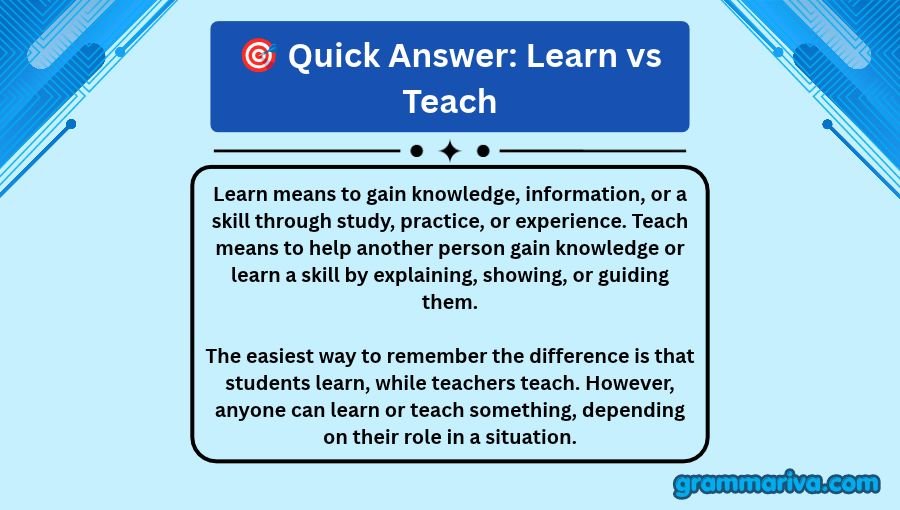
Learn means to gain knowledge, information, or a skill through study, practice, or experience. Teach means to help another person gain knowledge or learn a skill by explaining, showing, or guiding them.
The easiest way to remember the difference is that students learn, while teachers teach. However, anyone can learn or teach something, depending on their role in a situation.
- Learn = Receive or gain knowledge.
- Teach = Give or share knowledge.
For example:
- I learn English every day.
- I teach English to young students.
Both sentences are correct because the person in each sentence is doing a different action.
📚 Understanding the Basics of Learn vs Teach
The main difference between learn and teach is the direction in which knowledge moves. When you learn, you receive information or develop a skill. When you teach, you share information or help another person develop a skill.
These words are often used together because one person’s teaching can help another person learn.
| Form | Type | Meaning | Example |
|---|---|---|---|
| Learn | Verb | Gain knowledge | I learn new words. |
| Learns | Verb | Gains knowledge | She learns quickly. |
| Learned | Past tense | Gained knowledge | I learned French. |
| Learning | Present participle | Gaining knowledge | He is learning math. |
| Teach | Verb | Give knowledge | I teach science. |
| Teaches | Verb | Gives knowledge | She teaches children. |
| Taught | Past tense | Gave knowledge | He taught me English. |
| Teaching | Present participle | Giving knowledge | They are teaching art. |
Learn: The Meaning and Correct Use
Learn is a verb that describes gaining knowledge, facts, or skills. You can learn by reading books, listening to someone, watching videos, asking questions, or practicing something.
You do not always need a teacher to learn. People can also learn from their mistakes, experiences, and daily activities.
Examples:
- I want to learn Spanish.
- She learns new things every week.
- We learned an important lesson yesterday.
- He is learning how to drive.
- Children learn through play.
Sentence breakdown:
In the sentence “I want to learn Spanish”:
- I = The person gaining knowledge.
- Want = Shows a desire.
- To learn = The action of gaining knowledge.
- Spanish = The subject being studied.
The sentence is correct because the speaker wants to gain a new language skill.
Teach: The Meaning and Correct Use
Teach is a verb that describes helping someone gain knowledge or develop a skill. A person can teach by explaining an idea, giving instructions, showing an example, or guiding someone through a task.
Teachers, parents, coaches, friends, and skilled workers can all teach others.
Examples:
- I teach English at school.
- My father teaches me how to cook.
- She taught us a useful lesson.
- They are teaching children to swim.
- Can you teach me how to play chess?
Sentence breakdown:
In the sentence “My father teaches me how to cook”:
- My father = The person sharing knowledge.
- Teaches = The action of giving instruction.
- Me = The person receiving instruction.
- How to cook = The skill being explained.
The sentence is correct because the father is helping someone gain a cooking skill.
Learn vs Teach Comparison Table
| Feature | Learn | Teach |
|---|---|---|
| Main action | Gaining knowledge | Sharing knowledge |
| Direction | Receiving information | Giving information |
| Person | Learner | Teacher |
| Common setting | School or self-study | Classroom or training |
| Example | I learn math. | I teach math. |
| Past tense | Learned | Taught |
| Main purpose | Understand something | Help someone understand |
🤔 What Is the Main Difference Between Learn and Teach?
The main difference is that learn focuses on the person receiving knowledge, while teach focuses on the person sharing knowledge.
For example, imagine a mother showing her daughter how to bake a cake. The mother teaches the recipe, and the daughter learns how to make the cake.
Both actions happen in the same situation, but they describe different roles.
Consider these examples:
- The coach teaches the team new skills.
- The players learn new skills from the coach.
- My brother taught me how to ride a bicycle.
- I learned how to ride a bicycle from my brother.
Notice how the subject changes depending on who performs the action.
A Simple Way to Remember the Difference
Ask yourself one question: Is the person gaining knowledge or giving it?
- If the person is gaining knowledge, use learn.
- If the person is giving knowledge, use teach.
This simple test works in most everyday situations.
💡 Why Do People Confuse Learn and Teach?
People confuse these words because both are connected to education, knowledge, and skills. They often appear in the same sentence or conversation.
However, their meanings are not interchangeable.
I once noticed a learner writing, “My teacher learned me English.” The learner wanted to say that the teacher helped them study English. The correct sentence was “My teacher taught me English.”
The mistake happened because the learner understood the general idea but mixed up the two actions.
Here are some reasons people confuse them:
- Both words relate to gaining knowledge.
- Both are common in schools and workplaces.
- People sometimes translate them directly from another language.
- Their sentence patterns are different.
- Fast typing can lead to choosing the wrong word.
Correct vs incorrect examples:
- ❌ My mother learned me how to cook.
- ✅ My mother taught me how to cook.
- ❌ I taught English from my online course.
- ✅ I learned English from my online course.
- ❌ My teacher learns us grammar.
- ✅ My teacher teaches us grammar.
- ❌ She taught how to swim from her coach.
- ✅ She learned how to swim from her coach.
🧠 Learn: Different Meanings and Uses
Learn has several common uses. It can describe gaining information, developing a skill, discovering a fact, or remembering something through experience.
Learn Through Study
Use learn when someone gains knowledge by reading, studying, attending classes, or listening to lessons.
Examples:
- I learn English from books.
- She learned about American history.
- They are learning new grammar rules.
The person is gaining information through study.
Learn Through Practice
Use learn when someone develops an ability by doing something repeatedly.
Examples:
- He learned to play the guitar.
- I am learning how to drive.
- My sister learned to swim last summer.
These sentences describe skills that improve with practice.
Learn Through Experience
Learn can also describe gaining knowledge from something that happens in life.
Examples:
- I learned from my mistakes.
- We learned a valuable lesson during the trip.
- She learned to be more patient.
In these examples, the person gains understanding through real situations.
Learn About Something
Use learn about when you gain information about a subject, person, event, or topic.
Examples:
- I want to learn about science.
- We learned about the new project.
- He learned about healthy eating.
Summary of Learn’s Uses
| Meaning | Word Type | Example Sentence |
|---|---|---|
| Gain information | Verb | I learn history. |
| Develop a skill | Verb | She learned to dance. |
| Gain experience | Verb | We learned from our mistakes. |
| Discover information | Verb | I learned about the meeting. |
📖 Teach: Different Meanings and Uses
Teach also has several common uses. It can describe giving lessons, showing someone how to do something, explaining an idea, or helping someone develop good habits.
Teach a Subject
Use teach when someone gives lessons in a particular subject.
Examples:
- My mother teaches mathematics.
- He teaches English at a college.
- They teach science to children.
Teach a Skill
Use teach when someone shows another person how to perform an activity.
Examples:
- My uncle taught me how to drive.
- She teaches children to swim.
- Can you teach me to play the piano?
Teach a Lesson
Teach can describe helping someone understand an idea through an experience or explanation.
Examples:
- The experience taught me patience.
- This mistake taught us an important lesson.
- Her story teaches people to be kind.
Teach Someone About Something
Use teach about when someone provides information or instruction on a subject.
Examples:
- Our teacher taught us about planets.
- The course teaches students about business.
- My father taught me about saving money.
Summary of Teach’s Uses
| Meaning | Word Type | Example Sentence |
|---|---|---|
| Give lessons | Verb | She teaches English. |
| Show a skill | Verb | He taught me to cook. |
| Share an important lesson | Verb | Life taught me patience. |
| Explain a subject | Verb | They teach us about history. |
✍️ What Are the Correct Verb Forms of Learn and Teach?
Learn and teach have different verb forms. Learning these forms helps you make correct sentences in the present, past, and future.
Learn is usually treated as a regular verb in American English. Its past tense and past participle are learned. Learnt is also used in some varieties of English, especially British English.
Teach is an irregular verb. Its past tense and past participle are both taught.
| Verb Form | Learn | Teach |
|---|---|---|
| Base form | Learn | Teach |
| Third-person singular | Learns | Teaches |
| Simple past | Learned | Taught |
| Past participle | Learned | Taught |
| Present participle | Learning | Teaching |
| Infinitive | To learn | To teach |
Examples:
- I learn something new every day.
- She learns quickly.
- I learned a new skill yesterday.
- He has learned a lot this year.
- My father teaches me English.
- She taught me yesterday.
- They have taught many students.
- We are teaching a new lesson.
Is Learned or Learnt Correct?
Both learned and learnt are accepted forms of the past tense and past participle of learn.
In American English, learned is the standard and more common choice. Learnt is more common in British English.
For example:
- American English: I learned something new.
- British English: I learnt something new.
If you are writing for a US audience, choose learned for consistency.
📝 Real-Life Case Study: Learn and Teach at Work
Imagine that a company hires a new employee named Daniel. His manager, Sarah, needs to explain how the company software works.
Sarah spends an hour showing Daniel how to use the system. She explains each step and answers his questions.
At the end of the training session, Daniel can complete basic tasks without help.
Here is how we describe the situation:
- Sarah teaches Daniel how to use the software.
- Daniel learns how to use the software.
- Sarah taught him the basic steps.
- Daniel learned the process during training.
Now imagine Daniel becomes an experienced employee. A new worker joins the company, and Daniel shows that person how to use the same software.
The roles change:
- Daniel teaches the new employee.
- The new employee learns from Daniel.
This example shows that someone can be both a learner and a teacher. The correct word depends on the action happening at that moment.
Workplace Example Table
| Situation | Correct Term | Example |
|---|---|---|
| Manager explains a process | Teach | Sarah teaches Daniel. |
| Employee gains a skill | Learn | Daniel learns the system. |
| Employee explains a task | Teach | Daniel teaches his coworker. |
| New worker gains knowledge | Learn | The new worker learns quickly. |
⚖️ Grammar Rules Explanation: Learn vs Teach
Learn and teach are both verbs, but they follow different sentence patterns.
Understanding their grammar rules helps you avoid common errors.
Rule A: Learn + Something
Use learn when the subject gains knowledge or information.
Correct examples:
- I learn English.
- She learns new skills.
- They learned the rules.
The person or subject is receiving knowledge.
Rule B: Teach + Someone + Something
Use teach when someone gives information or instruction to another person.
Correct examples:
- I teach children English.
- She teaches students mathematics.
- My father taught me a useful skill.
The person or subject is sharing knowledge.
Rule C: Learn From Someone
Use learn from when you want to identify the person who gives you knowledge or experience.
Examples:
- I learned English from my teacher.
- She learns a lot from her mother.
- We learned valuable lessons from our coach.
Rule D: Teach Someone How to Do Something
Use teach someone how to when a person explains the steps needed to complete an activity.
Examples:
- My brother taught me how to swim.
- She teaches children how to read.
- Can you teach me how to use this computer?
Rule E: Learn to Do Something
Use learn to when someone develops the ability to perform an action.
Examples:
- I learned to drive.
- She wants to learn to cook.
- They are learning to speak English.
Rule F: Teach Someone to Do Something
Use teach someone to when a person helps another person develop a particular skill.
Examples:
- My father taught me to ride a bike.
- The coach teaches players to work together.
- She taught her son to read.
Correct vs Incorrect at a Glance
| Sentence | Correct/Incorrect | Why |
|---|---|---|
| I learned English from my teacher. | ✅ Correct | I gained knowledge from someone. |
| My teacher learned me English. | ❌ Incorrect | Use taught me instead. |
| She teaches children mathematics. | ✅ Correct | She shares knowledge. |
| He taught how to drive me. | ❌ Incorrect | The correct order is taught me how to drive. |
| I am learning a new language. | ✅ Correct | I am gaining a skill. |
Test Tip
When you are unsure, look at the person doing the action.
Ask:
- Is this person gaining knowledge? Use learn.
- Is this person giving knowledge? Use teach.
- Does the sentence identify the source of knowledge? Consider learn from.
- Does the sentence describe instruction given to someone? Consider teach someone.
This quick test can help you choose the right word without memorizing long grammar rules.
⚠️ Common Mistakes When Using Learn and Teach
Most mistakes happen when people focus on the topic instead of the action. Since both words are connected to education, it is easy to choose the wrong one.
Other mistakes happen because people type quickly, depend too much on autocorrect, or do not know the correct sentence pattern.
I once caught myself writing “I teach from experience” when I meant “I learn from experience.” Both sentences can be grammatical in different contexts, but they express different ideas. That small change reminded me to check the meaning before choosing a verb.
Similar Grammar Confusions
| Word Pair | Main Difference | Example |
|---|---|---|
| It’s / Its | Contraction / Possession | It’s cold. / Its color is blue. |
| Your / You’re | Possession / You are | Your book. / You’re kind. |
| There / Their | Place / Possession | There it is. / Their house. |
| Affect / Effect | Usually verb / Usually noun | It affects me. / It has an effect. |
| Then / Than | Time / Comparison | Eat then leave. / Bigger than mine. |
Why These Mistakes Happen
Fast typing: People sometimes choose the first word that comes to mind. They may not stop to check whether the sentence describes receiving or sharing knowledge.
Autocorrect: Some writing tools suggest words based on spelling and sentence patterns. However, they may not understand the exact meaning you want.
Lack of knowledge: A person who has not learned the difference between these verbs may use them interchangeably.
Translation habits: Direct translation from another language can also create confusion because sentence structures are not always the same.
Common Wrong Spellings and Uses
| Wrong Form | What’s Wrong | Correct Form |
|---|---|---|
| Teached | Incorrect past tense | Taught |
| Taughted | Extra ending added | Taught |
| Learnd | Missing correct spelling pattern | Learned |
| Learnning | Extra letter | Learning |
| Teach me English yesterday | Wrong tense | Taught me English yesterday |
| My teacher learned me | Wrong verb choice | My teacher taught me |
🌎 Learn vs Teach in Different Contexts
Both verbs appear in everyday conversation, professional writing, creative work, and social media. The correct choice depends on whether someone is gaining or sharing knowledge.
Everyday Conversation
People use learn and teach when talking about daily activities, personal skills, and new experiences.
Examples:
- I want to learn how to bake.
- Can you teach me this game?
- We learned something interesting today.
Professional Writing
In professional writing, learn often describes training, development, and gaining experience. Teach describes providing instruction, training, or guidance.
Examples:
- Employees can learn new skills through training.
- The company teaches workers how to follow safety rules.
- I learned valuable skills during my internship.
Creative Writing
Writers use these words to describe character growth, life lessons, and personal change.
Examples:
- She learned to trust herself.
- His father taught him the value of honesty.
- Every journey teaches us something new.
Social Media and Texting
On social media, both words are useful when sharing experiences or offering advice.
Examples:
- Still learning, still growing. 🌱
- Teach me something I don’t know.
- I learned a lot this year.
- We teach each other something new every day.
Usage Comparison Table
| Context | Which Term to Use | Example |
|---|---|---|
| Everyday conversation | Both | I learned to cook, and now I teach my brother. |
| Professional writing | Both | Employees learn skills, and managers teach them. |
| Creative writing | Both | Life teaches lessons, and people learn from them. |
| Social media/texting | Both | Learning every day and teaching what I know. |
💬 Common Phrases With Learn and Teach
Certain phrases appear frequently in everyday English. Learning these expressions can make your writing sound more natural.
Common Phrases With Learn
| Phrase | Meaning |
|---|---|
| Learn by doing | Gain knowledge through practice |
| Learn from mistakes | Gain knowledge from errors |
| Learn by heart | Memorize something |
| Learn the ropes | Understand how a job or activity works |
| Learn a lesson | Gain understanding from an experience |
| Learn something new | Gain fresh information or skills |
Common Phrases With Teach
| Phrase | Meaning |
|---|---|
| Teach a lesson | Help someone understand something |
| Teach by example | Show the right behavior through actions |
| Teach someone a skill | Help someone develop an ability |
| Teach a class | Give lessons to students |
| Teach the basics | Explain the main starting ideas |
| Teach someone a thing or two | Show someone useful knowledge or skills |
Examples in Sentences
- You can learn by doing instead of only reading.
- I learned the ropes during my first week.
- My mistakes taught me a valuable lesson.
- Good leaders teach by example.
- She teaches a class every Monday.
- My grandfather taught me a useful skill.
🔍 Synonyms and Alternatives for Learn and Teach
Learn and teach have several related words, but these alternatives do not always have exactly the same meaning.
Choose a replacement based on the action and the context.
| Alternative | Works When | Does Not Work When |
|---|---|---|
| Study | Someone is working to gain knowledge | You mean someone is giving instruction |
| Understand | Someone gains a clear idea | You mean the entire learning process |
| Discover | Someone finds new information | You mean receiving formal lessons |
| Instruct | Someone gives directions or training | You mean personally gaining knowledge |
| Educate | Someone provides broader knowledge | You mean a small, informal demonstration |
Examples of Alternatives
Study: I study English every evening.
This works because the person spends time gaining knowledge.
Understand: I understand the lesson now.
This focuses on having a clear idea rather than the full process of learning.
Discover: We discovered a new way to solve the problem.
This works when someone finds something new.
Instruct: The manager instructed the staff on the new rules.
This describes giving guidance or directions.
Educate: Parents educate their children about healthy habits.
This describes helping someone gain knowledge.
⭐ Why Does Getting Learn and Teach Right Matter?
Using learn and teach correctly makes your message clear. It helps readers understand who is receiving knowledge and who is sharing it.
The difference may seem small, but choosing the wrong verb can change the meaning of an entire sentence.
A simple writing principle is worth remembering:
“Clear words make clear messages.”
Clarity in Communication
Correct verb choice helps people understand your meaning without guessing.
For example, “I learned English from my teacher” clearly explains that you received instruction.
Professionalism
Correct grammar makes emails, reports, resumes, and other work documents easier to trust and understand.
Digital Communication
People read short messages quickly. A wrong verb can confuse readers, especially when the sentence does not provide much context.
Why Accuracy Matters in Different Situations
| Situation | Why Getting It Right Matters |
|---|---|
| Resume | Clearly describes skills you gained or training you provided |
| Client email | Prevents confusion about instructions and responsibilities |
| Published content | Improves grammar, clarity, and reader trust |
| Social media post | Helps followers understand your message |
For example, if your resume says, “I taught advanced computer skills during training,” it shows that you provided instruction.
If it says, “I learned advanced computer skills during training,” it shows that you gained those skills.
Both statements can be useful, but they describe different experiences.
🧩 How to Remember the Difference Between Learn and Teach
The best way to remember these words is to connect them with two simple roles: the learner and the teacher.
A learner receives knowledge. A teacher shares knowledge.
Try these easy memory tips:
- Learn = Get knowledge.
- Teach = Give knowledge.
- Learn from = Identify the source of knowledge.
- Teach someone = Identify the person receiving instruction.
You can also remember this short sentence:
Teachers teach, and students learn.
This sentence connects both verbs and makes their difference easy to understand.
Quick Memory Practice
| Situation | Correct Word | Example |
|---|---|---|
| You gain a new skill | Learn | I want to learn coding. |
| You explain a skill | Teach | I teach coding. |
| Your friend helps you | Learn | I learn from my friend. |
| You help your friend | Teach | I teach my friend. |
✅ Quick Recap Checklist
Use this checklist whenever you are unsure which verb belongs in your sentence.
| Question | If Yes → Use |
|---|---|
| Are you gaining knowledge? | Learn |
| Are you developing a new skill? | Learn |
| Are you receiving information from someone? | Learn from |
| Are you sharing information with someone? | Teach |
| Are you giving someone instructions? | Teach |
| Are you helping someone develop a skill? | Teach |
Practice Examples
Choose the correct word in each sentence.
Example A: My father wants to (learn / teach) me how to drive.
Correct answer: Teach
Why? My father is sharing a skill with me.
Example B: I want to (learn / teach) Spanish before my trip.
Correct answer: Learn
Why? I want to gain knowledge of a new language.
Example C: She (learned / taught) a valuable lesson from her mistakes.
Correct answer: Learned
Why? She gained knowledge through experience.
Example D: Our coach (learns / teaches) us how to work as a team.
Correct answer: Teaches
Why? The coach gives instruction to the players.
❓ FAQs About Learn vs Teach
What is the main difference between learn and teach?
Learn means to gain knowledge or develop a skill. Teach means to share knowledge or help another person develop a skill. Students learn, while teachers teach.
Can learn and teach be used in the same sentence?
Yes. These words can appear together when one person shares knowledge and another person receives it.
Example: My mother teaches me how to cook, and I learn a new recipe every week.
Is it correct to say I learned from my teacher?
Yes. This sentence is grammatically correct. It means your teacher helped you gain knowledge or develop a skill.
Is it correct to say my teacher taught me English?
Yes. This is a correct sentence. It means your teacher gave you lessons or helped you understand English.
What is the past tense of learn?
The past tense of learn is learned in standard American English. Learnt is also accepted, especially in British English.
Example: I learned a new word yesterday.
What is the past tense of teach?
The past tense of teach is taught. It is an irregular verb, so you should not write teached.
Example: My father taught me how to ride a bicycle.
Should I use learn or teach when talking about a new skill?
Use learn when you are gaining the skill. Use teach when you are helping another person gain that skill.
Example: I learned to swim, and now I teach children to swim.
Is teach me English correct?
Yes. “Teach me English” is correct because the person is asking someone to provide instruction.
Example: Can you teach me English?
What is the difference between learn from and teach to?
Learn from identifies the person or source providing knowledge. Teach identifies the person receiving instruction. You can say, “I learn from my teacher” and “My teacher teaches me.”
How can I remember when to use learn or teach?
Remember that learn means receiving knowledge, while teach means sharing knowledge. Ask yourself whether the person is gaining information or giving it. This simple question usually helps you choose correctly.
🎯 Conclusion
Understanding learn vs teach becomes easy when you remember one basic rule: learn means gaining knowledge, while teach means sharing knowledge. These verbs are connected, but they describe two different actions. A student learns from a teacher, and a teacher teaches a student. The same rule applies to parents, friends, coaches, coworkers, and anyone who shares or receives information.
Use learn when you study a subject, develop a skill, or gain knowledge through experience. Use teach when you explain something, give instructions, or help another person improve a skill.
Remember their past forms, too. Learned is the standard American English past tense of learn, while taught is the correct past tense of teach.
You do not need complicated grammar rules to get these words right. Just think about the direction of knowledge before choosing your verb.
Keep practicing, read your sentences carefully, and use these words in everyday conversations. Every new skill begins when you learn something, and every good lesson grows when you teach it to someone else. 🌟
Learn something valuable today, and teach something useful tomorrow!

Hi, I’m Madison Hayes. I’m an English learning writer at Grammariva, where I work on simple lessons and examples for people who want to improve their grammar and writing. I love turning confusing rules into easy-to-follow explanations.

[…] the rules, examples, and everyday situations that make these verbs easier to understand. 🎯 Learn vs Teach | Flaunt vs Flout | Imply vs […]