Have you ever used the word imply when you really meant infer? You are not alone. These two words are easy to mix up because both relate to meaning, messages, and understanding. However, they describe two different actions. One person suggests something, while another person figures out what that suggestion means.Understanding imply vs infer can make your writing clearer and help you avoid common grammar mistakes.
If you are writing an email, talking with friends, working on a school assignment, or creating online content, choosing the right word matters. 😊
As an English grammar writer, I often explain this difference with one simple idea: the speaker implies, and the listener infers. Once you understand who does what, the confusion becomes much easier to solve.
In this guide, I will explain both words using simple definitions, everyday examples, comparison tables, practical writing tips, and common mistakes. By the end, you will know exactly when to use each word. Let’s make this grammar rule easy to remember! 🎯 Disinterested vs Uninterested | Nauseous vs Nauseated | Literally vs Figuratively
🎯 Quick Answer: Imply vs Infer
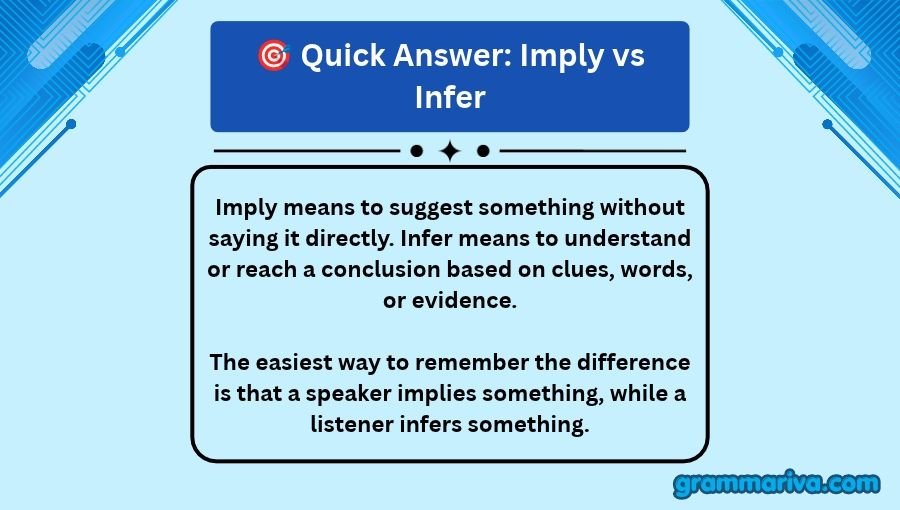
Imply means to suggest something without saying it directly. Infer means to understand or reach a conclusion based on clues, words, or evidence.
The easiest way to remember the difference is that a speaker implies something, while a listener infers something.
For example:
- Correct: Sarah implied that she was unhappy with the decision.
- Correct: I inferred from Sarah’s words that she was unhappy.
The first sentence describes what Sarah suggested. The second explains what another person understood from her words.
📚 Understanding the Basics of Imply vs Infer
The main difference between these words is the direction of communication. One word describes sending an indirect message. The other describes receiving and understanding that message.
When someone implies something, they give clues or hints. They may choose not to express their thoughts openly.
When someone infers something, they use those clues to reach a conclusion. They think about the information and decide what it probably means.
Imply: Meaning and Correct Use
Imply is a verb that means to suggest, hint at, or express an idea indirectly.
A person does not always need to say something directly to communicate a message. Sometimes, their words, actions, or tone suggest what they really mean.
Examples:
- The manager implied that some employees needed better training.
- Her smile implied that she already knew the secret.
- His comments implied that he did not support the plan.
- The teacher implied that the answer was hidden in the passage.
Sentence breakdown:
The manager implied that some employees needed better training.
- Subject: The manager
- Verb: Implied
- Message: Some employees needed better training.
The manager did not directly say that the employees were unskilled. Instead, the manager suggested the idea through indirect language.
Infer: Meaning and Correct Use
Infer is a verb that means to reach a conclusion based on information, clues, facts, or evidence.
People infer things when they notice details and use their thinking skills to understand what those details suggest.
Examples:
- I inferred from his expression that he was worried.
- The students inferred the answer from the story.
- We can infer that the road is closed from the warning signs.
- She inferred that her friend needed help.
Sentence breakdown:
I inferred from his expression that he was worried.
- Subject: I
- Verb: Inferred
- Evidence: His expression
- Conclusion: He was worried.
The speaker studied the person’s expression and reached a conclusion.
Imply vs Infer Comparison Table
| Form | Type | Meaning | Example | Correct/Incorrect |
|---|---|---|---|---|
| Imply | Verb | Suggest indirectly | She implied that she was tired. | Correct |
| Infer | Verb | Reach a conclusion | I inferred that she was tired. | Correct |
| Implied | Past-tense verb | Suggested indirectly | He implied that he disagreed. | Correct |
| Inferred | Past-tense verb | Reached a conclusion | We inferred the answer. | Correct |
| Implying | Present participle | Suggesting indirectly | She is implying something. | Correct |
| Inferring | Present participle | Drawing a conclusion | I am inferring from the clues. | Correct |
🔍 What Is the Main Difference Between Imply and Infer?
The main difference is that imply describes the person giving an indirect message, while infer describes the person understanding that message.
Think about a normal conversation.
A friend says, “Some people never arrive on time.”
Your friend does not directly mention your name. However, you remember arriving late that morning.
Your friend may be implying that you are often late. You may infer that the comment is about you.
Here is another simple comparison:
| Word | Main Action | Person Involved | Direction |
|---|---|---|---|
| Imply | Suggesting | Speaker or writer | Sending a message |
| Infer | Understanding | Listener or reader | Receiving a message |
A Simple Real-Life Example
Imagine your boss says:
“Some team members could improve their communication skills.”
Your boss is implying that certain employees need to communicate better.
You hear this comment and remember that your manager recently discussed your emails. You infer that your communication may need improvement.
The words work together, but they describe different actions.
💡 Why Do People Confuse Imply and Infer?
People confuse these words because both deal with information that is not always stated directly. They also often appear in the same conversation.
However, the person suggesting something and the person understanding it are performing different actions.
I once reviewed a student’s essay in which the sentence read, “The author inferred that the main character was dishonest.” The paragraph actually explained how the author suggested dishonesty through the character’s actions. The better word was “implied.” The student understood the meaning but had switched the roles of the two words.
Here are some common reasons for the confusion:
- Similar meanings: Both words relate to indirect communication.
- Same situations: They can appear in the same discussion.
- Unclear roles: Writers sometimes forget who is giving the message and who is receiving it.
- Fast writing: People may choose the first word that comes to mind.
- Limited practice: Some learners understand the definitions but struggle to apply them.
More Examples of the Difference
❌ Incorrect: The teacher inferred that the students should study harder by saying the exam would be difficult.
✅ Correct: The teacher implied that the students should study harder by saying the exam would be difficult.
Why? The teacher suggested an idea. The teacher was not drawing a conclusion from evidence.
❌ Incorrect: I implied from her silence that she was upset.
✅ Correct: I inferred from her silence that she was upset.
Why? You used her silence as a clue and reached a conclusion.
📝 Correct Meanings and Uses of Imply
The word imply has several closely related uses. In each case, the basic idea is that someone or something suggests a meaning without expressing it directly.
Suggesting an Idea Indirectly
Use imply when someone communicates an idea without stating it clearly.
Examples:
- His words implied that he wanted a new job.
- The email implied that the meeting might be canceled.
- Her answer implied that she was not interested.
The message is suggested rather than openly stated.
Showing a Hidden Meaning
Use imply when words, expressions, or actions point toward an unstated idea.
Examples:
- Her cold response implied disappointment.
- The advertisement implied that the product was better than others.
- His silence implied that he disagreed.
Indicating Something Through Evidence
Sometimes, facts or events can imply something even when there is no speaker.
Examples:
- The dark clouds imply that rain may be coming.
- The damage to the door implies that someone tried to enter.
- The report implies that sales may decline.
In these examples, the available information suggests a possible meaning.
Table: Different Uses of Imply
| Meaning | Word Type | Example Sentence |
|---|---|---|
| Suggest indirectly | Verb | He implied that he was unhappy. |
| Communicate a hidden idea | Verb | Her tone implied anger. |
| Indicate a possible result | Verb | The results imply a problem. |
🧠 Correct Meanings and Uses of Infer
Infer describes the mental process of understanding something from available information. It is often used when a person studies clues, facts, or statements.
Reaching a Conclusion From Clues
Use infer when you notice details and decide what they probably mean.
Examples:
- I inferred that the store was closed from its dark windows.
- We inferred that the child was tired from his behavior.
- She inferred that the answer was incorrect from the teacher’s expression.
Understanding an Unspoken Message
Use infer when you understand something that another person has not directly said.
Examples:
- I inferred from his tone that he was annoyed.
- She inferred that her friend wanted to leave.
- They inferred that the manager was unhappy with the results.
Drawing a Conclusion From Facts
Infer is also common in education, research, reading, and professional discussions.
Examples:
- Scientists inferred that the sample had been damaged.
- Readers can infer the character’s feelings from the dialogue.
- The team inferred that the new system was working well.
Table: Different Uses of Infer
| Meaning | Word Type | Example Sentence |
|---|---|---|
| Reach a conclusion | Verb | I inferred that he was upset. |
| Understand an indirect message | Verb | She inferred his real intention. |
| Draw a conclusion from evidence | Verb | Researchers inferred a possible cause. |
🎯 How to Remember the Difference Between Imply and Infer
The simplest memory trick is to remember two roles: the sender and the receiver.
- Imply = Send a hint.
- Infer = Understand a hint.
Imagine two people talking.
Person A: “It is getting late.”
Person B thinks: “Maybe she wants me to leave.”
Person A may be implying that the visit should end. Person B may infer that it is time to go.
The Speaker and Listener Test
Ask yourself these questions before choosing a word:
- Is someone suggesting an idea? Use imply.
- Is someone reaching a conclusion? Use infer.
- Is a writer giving an indirect message? Use imply.
- Is a reader understanding a hidden message? Use infer.
Test Tip
Try replacing the word with a simple phrase.
If you can replace it with “suggests indirectly,” use imply.
If you can replace it with “figures out from clues,” use infer.
For example:
“Her words ______ that she was disappointed.”
The phrase “suggested indirectly” fits. Therefore, use implied.
“I ______ that she was disappointed from her words.”
The phrase “figured out from clues” fits. Therefore, use inferred.
⚖️ Grammar Rules Explanation for Imply and Infer
Both imply and infer are standard verbs. They are grammatically correct, but they have different meanings and sentence roles.
The correct choice depends on the action being described.
Rule: Use Imply for the Person or Thing Giving a Hint
The subject of the sentence performs the action of suggesting something.
Examples:
- The writer implies that the ending is tragic.
- Her words imply that she is worried.
- The results imply that the plan needs changes.
In these sentences, the subject provides information that points toward an idea.
Rule: Use Infer for the Person Drawing a Conclusion
The subject of the sentence studies available information and reaches a conclusion.
Examples:
- Readers infer that the ending is tragic.
- I infer from her words that she is worried.
- We inferred from the results that the plan needed changes.
The subject is the one understanding the information.
Rule: Use the Correct Past Forms
The past form of imply is implied.
The past form of infer is inferred.
Examples:
- She implied that she was ready.
- He inferred that she was ready.
Both sentences are correct, but the actions are different.
Rule: Do Not Switch the Roles
A common grammar error occurs when writers use infer for the person giving a message or imply for the person receiving it.
❌ Incorrect: The speaker inferred that the audience should leave.
✅ Correct: The speaker implied that the audience should leave.
❌ Incorrect: The audience implied that the speaker was angry.
✅ Correct: The audience inferred that the speaker was angry.
Correct vs Incorrect at a Glance
| Sentence | Correct/Incorrect | Why |
|---|---|---|
| The teacher implied that the test would be hard. | Correct | The teacher suggested an idea. |
| I inferred that the test would be hard. | Correct | I reached a conclusion. |
| She inferred that she was unhappy by saying so indirectly. | Incorrect | She was expressing a suggestion. |
| His expression implied that he was nervous. | Correct | His expression suggested a feeling. |
| We implied from the evidence that the plan failed. | Incorrect | We drew a conclusion from evidence. |
⚠️ Common Mistakes With Imply and Infer
These mistakes happen because writers focus on the meaning of a conversation instead of identifying who performs the action.
The words are connected, but they cannot always replace each other.
Common Grammar Confusions
| Confused Words | Correct Difference | Example |
|---|---|---|
| Imply vs Infer | Suggest vs conclude | She implied it; I inferred it. |
| It’s vs Its | It is vs possession | It’s cold. Its color is blue. |
| Your vs You’re | Belonging vs you are | Your book; you’re ready. |
| Affect vs Effect | Usually influence vs result | It affects me. The effect is clear. |
| Accept vs Except | Receive vs excluding | I accept all except one. |
Why These Mistakes Happen
Fast typing: People often write quickly and select the wrong word without thinking about its meaning.
Autocorrect: Some writing tools suggest words based on spelling or context. They may not understand the exact message the writer wants to express.
Lack of knowledge: A person may know both words but not understand the difference between suggesting something and reaching a conclusion.
I once caught myself typing, “The results inferred a serious problem” while editing a work report. The results were providing evidence, so the correct word was “implied.” It was a small mistake, but it changed the meaning of the sentence.
Common Wrong Spellings and Uses
| Wrong Form | What’s Wrong | Correct Form |
|---|---|---|
| Implyed | Incorrect past-tense spelling | Implied |
| Infered | Missing an extra r | Inferred |
| Infering | Missing an extra r | Inferring |
| Implier | Usually not the intended word for a person suggesting something | Person who implied it |
| I implied from the clues | Wrong verb for drawing a conclusion | I inferred from the clues |
| The reader inferred the message by writing it | Wrong role in the sentence | The writer implied the message |
💬 Usage of Imply and Infer in Different Contexts
Both words appear in everyday speech, professional writing, creative work, and online conversations. The right choice depends on what the person is doing.
Everyday Conversation
People use imply when they want to suggest something without saying it openly.
They use infer when they understand what someone else means.
Examples:
- Are you implying that I made a mistake?
- I inferred from your expression that you were upset.
- His comment implied that he wanted to go home.
Professional Writing
In business communication, imply is useful when discussing the meaning of a statement or report.
Infer is useful when explaining conclusions drawn from facts or information.
Examples:
- The report implies that the company needs a new strategy.
- We inferred from the survey that customers prefer simpler products.
- Her email implied that the deadline might change.
Creative Writing
Writers often imply feelings through dialogue, body language, and descriptions.
Readers then infer the characters’ emotions and intentions.
Examples:
- The author’s description implied that the character felt lonely.
- I inferred that the character was hiding something.
- The final scene implies that a new conflict is coming.
Social Media and Texting
These words can also make online conversations clearer.
Examples:
- Are you implying that my post was about you?
- I inferred from your reply that you did not agree.
- That caption implies a deeper meaning.
Context Comparison Table
| Context | Which Term to Use | Example |
|---|---|---|
| Everyday conversation | Both | She implied it, and I inferred the meaning. |
| Professional writing | Both | The report implies a risk; managers infer its impact. |
| Creative writing | Both | The author implies a feeling; readers infer it. |
| Social media/texting | Both | Your message implies something I can infer. |
📧 Real-Life Case Study: Imply vs Infer at Work
Imagine that a company manager sends an email to the entire team.
The email says:
“Some project updates have not been completed on time. We need everyone to pay closer attention to deadlines.”
The manager does not mention any employee by name.
However, one team member recently submitted a report late. That employee reads the email and thinks the manager is referring to their work.
Let’s understand the two actions.
What the manager did:
The manager implied that some employees were not meeting deadlines.
What the employee did:
The employee inferred that the message might be about their late report.
Both words are correct because they describe different actions.
Practical Email Example
❌ Incorrect: The manager inferred that the team needed to improve its time management through the email.
✅ Correct: The manager implied that the team needed to improve its time management through the email.
❌ Incorrect: I implied from the email that my work was late.
✅ Correct: I inferred from the email that my work might be late.
What Can We Learn?
This example shows why the difference matters in professional communication.
A writer should use imply when describing an indirect message. A reader should use infer when explaining a conclusion drawn from that message.
🗣️ Common Phrases With Imply and Infer
There are no special idioms that you must memorize to understand these words. However, several natural word combinations appear often in everyday and professional English.
Common Phrases With Imply
- Imply that something is true
- Strongly imply
- Seem to imply
- Imply a connection
- Imply responsibility
Common Phrases With Infer
- Infer from the evidence
- Infer from context
- Draw an inference
- Reasonably infer
- Infer that something happened
Phrase Comparison Table
| Phrase | Meaning |
|---|---|
| Imply that something is true | Suggest that an idea may be true |
| Strongly imply | Give a clear indirect suggestion |
| Seem to imply | Appear to suggest something |
| Infer from the evidence | Reach a conclusion using facts |
| Infer from context | Understand something using surrounding details |
| Draw an inference | Form a conclusion from available information |
✍️ Synonyms and Alternatives for Imply and Infer
Some words can replace imply or infer in certain sentences. However, they do not always carry exactly the same meaning.
Choosing the right alternative depends on the context.
Alternatives for Imply
Suggest: Use this when someone presents an idea without stating it directly.
Example: Her words suggest that she is unhappy.
Hint: Use this when someone gives a small clue about something.
Example: He hinted that he had a surprise.
Indicate: Use this when something points toward a possible fact or result.
Example: The report indicates a decline in sales.
Alternatives for Infer
Conclude: Use this when someone reaches a decision after thinking about information.
Example: We concluded that the plan was too expensive.
Deduce: Use this when someone reaches a logical conclusion from facts.
Example: The detective deduced who had entered the room.
Understand: Use this when someone grasps the meaning of a message or situation.
Example: I understood from her tone that she was upset.
Alternatives Comparison Table
| Alternative | Works When | Does Not Work When |
|---|---|---|
| Suggest | Someone gives an indirect idea | A person is drawing a conclusion |
| Hint | Someone gives a clue | A detailed logical conclusion is needed |
| Indicate | Something points toward a fact | A person is describing a complete reasoning process |
| Conclude | Someone reaches a decision | Someone is only suggesting an idea |
| Deduce | A conclusion comes from logical evidence | A person is giving an indirect message |
🌟 Why Getting Imply and Infer Right Matters
Choosing the correct word helps readers understand who is communicating an idea and who is interpreting it.
A small word choice can change the meaning of an entire sentence. This is especially important in professional writing, education, and online communication.
Clarity in Communication
Using the correct word helps readers follow your message.
If you say that a writer inferred something, readers may think the writer reached a conclusion. If you mean that the writer suggested an idea, imply is the better choice.
Professionalism
Correct grammar shows care and attention to detail.
In emails, reports, and presentations, using the right verb can make your message sound more accurate and professional.
Better Digital Writing
Online readers often scan content quickly. Clear word choices help them understand your meaning without stopping to guess.
A Simple Writing Reminder
“Clear words make clear thoughts easier to share.”
Why It Matters Table
| Situation | Why Getting It Right Matters |
|---|---|
| Resume | Helps describe ideas and conclusions accurately. |
| Client email | Prevents confusion about indirect messages. |
| Published content | Improves clarity and reader trust. |
| Social post | Helps followers understand your intended meaning. |
🧩 How to Use Imply and Infer in One Sentence
You can use both words in the same sentence when one person suggests something and another person understands it.
This is a useful way to remember the difference.
Examples:
- The teacher implied that the answer was incorrect, and the student inferred that they needed to try again.
- His message implied that he was leaving, so I inferred that the meeting was over.
- The report implied that sales were falling, and the managers inferred that the marketing plan needed changes.
Combined Usage Table
| Person or Source | Action | Example |
|---|---|---|
| Teacher | Implies | The teacher implied that the answer was wrong. |
| Student | Infers | The student inferred that another answer was needed. |
| Writer | Implies | The writer implied that the ending was sad. |
| Reader | Infers | The reader inferred that the character was lonely. |
🧠 Quick Recap Checklist: Imply vs Infer
Before using either word, ask yourself what action is happening.
| Question | If Yes → Use |
|---|---|
| Is someone suggesting something indirectly? | Imply |
| Is a writer giving readers a hidden message? | Imply |
| Is a person giving a hint? | Imply |
| Is someone reaching a conclusion from clues? | Infer |
| Is a reader understanding an unstated idea? | Infer |
| Is someone using evidence to make a judgment? | Infer |
Practice Examples
Try these sentences before checking the answers.
Example A: The coach ______ that the players needed more practice.
Answer: Implied. The coach suggested an idea indirectly.
Example B: I ______ from his expression that he was nervous.
Answer: Inferred. I reached a conclusion from his expression.
Example C: The article ______ that the new policy could create problems.
Answer: Implies. The article suggests a possible result.
Remember This Simple Rule
- The person giving the hint implies.
- The person understanding the hint infers.
- The speaker implies.
- The listener infers.
FAQs About Imply vs Infer
What is the difference between imply and infer?
Imply means to suggest something indirectly, while infer means to reach a conclusion based on clues or information. A speaker implies a message, and a listener infers its meaning.
Is imply the same as infer?
No, imply and infer are not the same. They are related words, but they describe opposite sides of communication. One involves suggesting an idea, while the other involves understanding it.
How do you use imply in a sentence?
Use imply when someone or something suggests an idea without stating it directly.
Example: Her comments implied that she was unhappy with the decision.
How do you use infer in a sentence?
Use infer when someone reaches a conclusion from available information.
Example: I inferred from his silence that he did not agree.
Does the speaker imply or infer?
The speaker usually implies because they are the person giving the message or suggestion. The listener usually infers because they interpret the speaker’s words.
Does the reader infer or imply?
The reader usually infers. Readers use words, context, and details to understand ideas that the writer may not state directly.
What is the past tense of imply and infer?
The past tense of imply is implied. The past tense of infer is inferred.
Examples:
- She implied that she was ready.
- I inferred that she was ready.
Can you use imply and infer in the same sentence?
Yes. You can use both words when one person suggests something and another person reaches a conclusion from that suggestion.
Example: The manager implied that the deadline would change, and the team inferred that the project needed more time.
What is an easy trick to remember imply vs infer?
Remember this simple rule: imply means to send a hint, while infer means to understand a hint. The speaker implies, and the listener infers.
Is it correct to say infer from the evidence?
Yes. This is a correct and common expression. It means reaching a conclusion by studying facts or clues.
Example: Scientists inferred from the evidence that the sample had been damaged.
Conclusion
Understanding imply vs infer becomes easy when you remember who is giving the message and who is interpreting it. Imply means to suggest something indirectly, while infer means to reach a conclusion from words, actions, or evidence.
As a simple rule, the speaker implies and the listener infers. The writer suggests an idea, and the reader works out what it means. Both words are useful in everyday conversations, school assignments, business emails, and professional writing.
I recommend using the speaker-and-listener test whenever you are unsure. Ask yourself whether someone is giving a hint or understanding one. That small check can prevent many common grammar mistakes.
Keep practicing with real sentences. Pay attention to how people use these words in conversations and written content. Before long, choosing the right word will feel natural. 😊
Remember: People imply messages, but they infer meanings. Master this simple difference, and your English will become clearer, stronger, and more confident!

Hi, I’m Ethan Brooks. I’m an English grammar writer at Grammariva, where I work on clear explanations, practical examples, and useful writing tips. I enjoy making difficult grammar topics easier to understand.

[…] useful tables, and practical tips. By the end, you will know exactly when to use each one. Imply vs Infer | Disinterested vs Uninterested | Nauseous vs […]
[…] to common questions. By the end, you will know exactly when to use each word. Flaunt vs Flout | Imply vs Infer | Disinterested vs […]