Whose vs whos is a common English grammar confusion that can make even simple sentences difficult to write correctly. Although these two words sound alike, they have different meanings and uses.
The easiest way to understand whose vs who’s is to remember that whose shows ownership, while who’s is a contraction of who is or who has. Both forms are correct, but they cannot be used in the same way. One small apostrophe can change the meaning of your sentence.
As an English grammar writer, I often see this mistake in both casual and professional writing. The good news is that the rule is simple once you learn a few easy tests. In this guide, I’ll explain both words with clear definitions, practical examples, comparison tables, common mistakes, and short practice questions. 😊 Their vs There vs They’re | Your vs You’re | Its vs It’s
🎯 Quick Answer: Whose vs Who’s
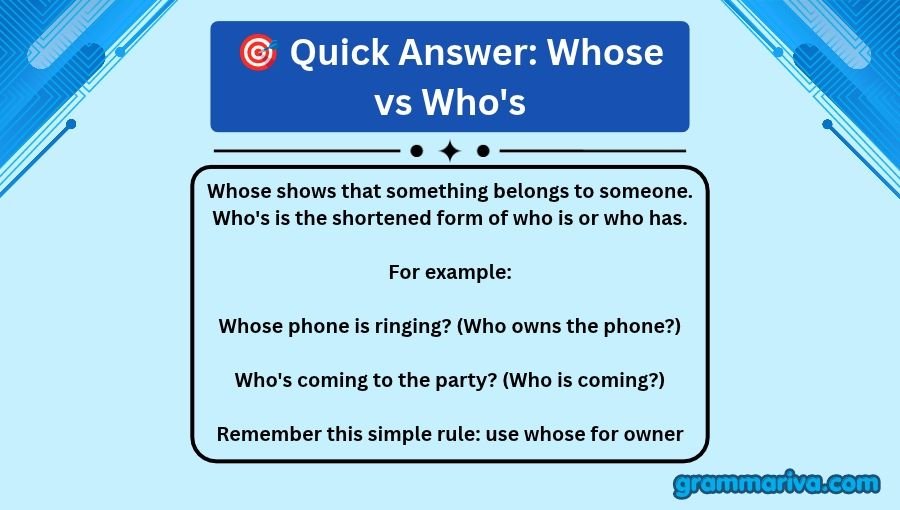
Whose shows that something belongs to someone. Who’s is the shortened form of who is or who has.
For example:
- Whose phone is ringing? (Who owns the phone?)
- Who’s coming to the party? (Who is coming?)
Remember this simple rule: use whose for ownership and who’s when you can replace it with who is or who has.
Understanding the Basics of Whose vs Who’s
The main difference between these words is their grammatical purpose. Although they sound alike, they perform different jobs in a sentence.
Whose is a possessive word. It asks about or describes ownership. Who’s is a contraction that combines two words into one.
Let’s look at their differences:
| Form | Type | Meaning | Example |
|---|---|---|---|
| Whose | Possessive pronoun or determiner | Belonging to whom | Whose jacket is this? |
| Who’s | Contraction | Who is or who has | Who’s at the door? |
| Whose | Relative possessive word | Belonging to a person | I met a girl whose brother is a doctor. |
| Who’s | Contraction | Who is | Who’s your favorite singer? |
Both words are grammatically correct. However, choosing the wrong one can make your sentence confusing.
What Does Whose Mean?
Whose is a word used to ask who owns something or to show that something belongs to a person.
It is the possessive form of who. You can use it in questions and statements.
Examples:
- Whose shoes are near the door?
- I know a boy whose father is a pilot.
- Whose notebook did you borrow?
- She is the student whose project won first place.
In each example, whose connects a person with something that belongs to them or is related to them.
What Does Who’s Mean?
Who’s is a contraction of two possible word combinations:
- Who is
- Who has
The apostrophe replaces the missing letters.
Examples:
- Who’s your new teacher? (Who is your new teacher?)
- Who’s going to the store? (Who is going to the store?)
- Who’s finished the assignment? (Who has finished the assignment?)
- Who’s been calling me? (Who has been calling me?)
The correct meaning depends on the rest of the sentence.
💡 Why Do People Confuse Whose and Who’s?
People confuse these words because they sound exactly alike in standard spoken English. Their spelling is also very similar. The only visible difference is the apostrophe in who’s.
When people speak, they cannot hear the apostrophe. They must understand the sentence to know which word fits.
I once reviewed a student’s school essay that included the sentence, “Who’s backpack is lying on the floor?” The student understood that the sentence asked about ownership but used the contraction by mistake. Changing who’s to whose fixed the problem immediately.
Here are the main reasons behind this confusion:
- Similar pronunciation: Both words sound the same.
- Apostrophe confusion: Writers may think every possessive word needs an apostrophe.
- Fast typing: People often choose the first spelling that comes to mind.
- Limited grammar knowledge: Some writers do not know that who’s means who is or who has.
- Autocorrect: A keyboard may suggest the wrong form.
The best way to avoid this mistake is to understand the purpose of each word instead of relying on how it sounds.
Whose: Meaning and Correct Use
Whose is used to ask about ownership or describe a person connected to something. It can appear at the beginning of a question or inside a statement.
Using Whose in Questions
Use whose when you want to know who owns an object.
Examples:
- Whose car is parked outside?
- Whose keys are these?
- Whose house are we visiting?
- Whose idea was this?
- Whose shoes did you find?
Sentence breakdown:
“Whose laptop is on the table?”
- Whose = asks about ownership.
- Laptop = the object.
- Is on the table = describes its location.
The question asks who owns the laptop.
Using Whose in Statements
You can also use whose to connect a person with something related to them.
Examples:
- I have a friend whose mother is a nurse.
- She hired a writer whose articles are easy to read.
- We visited a family whose home was beautiful.
- He knows a student whose grades are excellent.
In these sentences, whose introduces information about a person.
Using Whose With People and Animals
Whose can refer to people and animals.
Examples:
- I met a dog whose tail was very long.
- She adopted a cat whose eyes were bright blue.
- We helped a farmer whose animals needed food.
It can also refer to organizations in some contexts when describing something associated with them.
Test Tip for Whose
Here is an easy trick I recommend to students.
Ask yourself:
Does the sentence ask about ownership or show a relationship?
If the answer is yes, use whose.
For example:
- Whose jacket is this?
- I know a man whose car is red.
Both sentences describe ownership or a relationship.
Who’s: Meaning and Correct Use
Who’s is a contraction of who is or who has. It makes sentences shorter and more natural.
You can use it in questions, statements, and everyday conversations.
Using Who’s to Mean Who Is
Use who’s when the full phrase is who is.
Examples:
- Who’s your best friend?
- Who’s waiting outside?
- Who’s responsible for this task?
- Who’s ready for dinner?
- Who’s your favorite actor?
Sentence breakdown:
“Who’s calling me?”
- Who’s = who is.
- Calling = the action.
- Me = the person receiving the call.
The complete sentence is “Who is calling me?”
Using Who’s to Mean Who Has
You can also use who’s when it means who has.
Examples:
- Who’s completed the homework?
- Who’s taken my notebook?
- Who’s seen this movie?
- Who’s been working all morning?
- Who’s already eaten lunch?
Sentence breakdown:
“Who’s finished the project?”
- Who’s = who has.
- Finished = past participle.
- The project = the completed task.
The complete sentence is “Who has finished the project?”
How to Identify the Correct Meaning
Look at the words that follow who’s.
If the sentence uses a form of be, such as an adjective or an -ing verb, it may mean who is.
If it uses a past participle, it may mean who has.
Examples:
| Sentence | Full Form | Meaning |
|---|---|---|
| Who’s happy? | Who is happy? | Asking about a person |
| Who’s running? | Who is running? | Asking about an action |
| Who’s arrived? | Who has arrived? | Asking about completion |
| Who’s called you? | Who has called you? | Asking about an action |
🔍 How to Tell the Difference Between Whose and Who’s
The simplest way to choose the correct spelling is to replace who’s with who is or who has.
If the sentence still makes sense, who’s is correct. If it does not, you probably need whose.
Consider these examples:
- Whose book is this?
- Who’s reading the book?
- Whose phone is ringing?
- Who’s calling your phone?
Try the replacement test:
“Who’s reading the book?”
Replace who’s with who is:
“Who is reading the book?”
The sentence makes sense, so who’s is correct.
Now try:
“Whose book is this?”
Replace whose with who is:
“Who is book is this?”
The result is incorrect. Therefore, whose is the right choice.
Easy Memory Trick
Remember these two simple rules:
- Whose = Ownership
- Who’s = Who is or who has
You can also remember that the apostrophe in who’s signals missing letters. It does not show ownership.
📝 Case Study: Whose vs Who’s in Everyday Writing
Imagine that a manager sends a message to a group of employees:
“Who’s laptop is connected to the meeting screen?”
The manager wants to know who owns the laptop. However, the sentence uses the wrong word.
The correct version is:
“Whose laptop is connected to the meeting screen?”
Now imagine another message:
“Whose joining the meeting tomorrow?”
This sentence is also incorrect because the writer wants to ask who is joining.
The correct version is:
“Who’s joining the meeting tomorrow?”
I once edited a workplace message where a writer used whose before an -ing verb. The intended meaning was who is. A quick replacement test revealed the error.
These examples show why checking the meaning is more useful than simply looking for an apostrophe.
Grammar Rules Explanation: Whose vs Who’s
The grammar rules for these words are simple once you understand their different roles.
Whose functions as a possessive word. Who’s functions as a contraction. They are not interchangeable.
The Possessive Rule
Use whose when asking about ownership or describing a person associated with something.
Examples:
- Whose coat is hanging there?
- I met a woman whose son is a teacher.
- Whose birthday is next week?
In each sentence, the word connects a person to something that belongs to or is associated with them.
The Contraction Rule
Use who’s when you mean who is or who has.
Examples:
- Who’s your new neighbor?
- Who’s working today?
- Who’s already completed the test?
The apostrophe takes the place of missing letters in the contraction.
Why Who’s Is Not Possessive
A common mistake is thinking that the apostrophe in who’s shows ownership.
However, this is not how the word works.
Compare:
- Who’s car is outside? ❌
- Whose car is outside? ✅
The first sentence is incorrect because who is car does not make sense.
The second sentence is correct because it asks who owns the car.
Correct vs Incorrect at a Glance
| Sentence | Correct/Incorrect | Why |
|---|---|---|
| Whose phone is this? | ✅ Correct | Asks about ownership |
| Who’s your brother? | ✅ Correct | Means who is |
| Who’s book is missing? | ❌ Incorrect | Needs the possessive form |
| Whose coming to dinner? | ❌ Incorrect | Needs who is |
| Who’s finished the work? | ✅ Correct | Means who has |
⚠️ Common Mistakes With Whose and Who’s
The most common mistake is using who’s whenever a sentence refers to something owned by a person.
Another mistake is avoiding who’s because the writer believes contractions are always incorrect in formal English.
Both ideas are wrong.
Here are some common grammar pairs that create similar confusion:
| Confusing Words | Correct Difference | Example |
|---|---|---|
| It’s / Its | It’s means it is or it has; its shows possession | Its color is blue. |
| Your / You’re | Your shows possession; you’re means you are | You’re very kind. |
| Their / They’re | Their shows possession; they’re means they are | They’re coming. |
| Whose / Who’s | Whose shows possession; who’s means who is or who has | Whose bag is this? |
| There / Their | There refers to a place or introduces a statement; their shows possession | Their house is there. |
Common Wrong Forms and Their Corrections
| Wrong Form | What’s Wrong | Correct Form |
|---|---|---|
| Who’s bag is this? | Uses a contraction for ownership | Whose bag is this? |
| Whose going home? | Uses a possessive word instead of a contraction | Who’s going home? |
| Who’s mother called? | Incorrectly asks about ownership | Whose mother called? |
| Whose been here? | Cannot mean who has | Who’s been here? |
| Who’s birthday is today? | Uses the wrong possessive form | Whose birthday is today? |
| Whose your teacher? | Cannot replace who is | Who’s your teacher? |
Why These Errors Happen
There are three common reasons:
- Fast typing: Writers may not stop to check which word they need.
- Autocorrect: A keyboard may replace the intended spelling with another form.
- Lack of knowledge: Some people do not understand the difference between possessive words and contractions.
To prevent these errors, read the complete sentence and check its meaning before publishing.
How to Remember the Difference Easily
You do not need to memorize complicated grammar rules to use these words correctly. A simple replacement trick is enough for most sentences.
Try these memory tips:
- If the sentence asks who owns something, use whose.
- If you can say who is, use who’s.
- If you can say who has, use who’s.
- Never use the apostrophe in who’s to show ownership.
A Simple Three-Step Test
Step A: Read the sentence.
Example: “Who’s jacket is this?”
Step B: Replace who’s with who is.
“Who is jacket is this?”
Step C: Check the meaning.
The sentence does not make sense. Therefore, change who’s to whose.
Correct sentence: “Whose jacket is this?”
Usage of Whose and Who’s in Different Contexts
Both forms appear in everyday speech and writing. The correct choice depends on what you want to say.
| Context | Which Term to Use | Example |
|---|---|---|
| Everyday conversation | Both | Whose keys are these? Who’s coming? |
| Professional writing | Both | Whose report is ready? Who’s managing the project? |
| Creative writing | Both | Who’s at the window? The girl whose name was Lily smiled. |
| Social media and texting | Both | Whose dog is this? Who’s online? |
Everyday Conversation
People use both words in daily conversations.
Examples:
- Whose turn is it?
- Who’s picking up the children?
- Whose drink is on the counter?
- Who’s coming with us?
Professional Writing
Both forms are acceptable in professional communication.
Examples:
- Whose approval is required?
- Who’s responsible for the final report?
- Whose signature is missing?
- Who’s leading the new team?
For very formal writing, you can replace contractions with their full forms when appropriate.
Creative Writing
Writers use whose to add details about characters and who’s to create natural dialogue.
Examples:
- The woman whose voice filled the room was a famous singer.
- “Who’s there?” the old man asked.
- I met a traveler whose stories were fascinating.
Social Media and Texting
Both forms are common in online communication.
Examples:
- Whose birthday is today?
- Who’s ready for the weekend?
- Whose puppy is this?
- Who’s watching the game tonight?
Even in casual messages, correct spelling makes your meaning clear.
Common Phrases With Whose and Who’s
There are no special idioms that you must memorize to understand these words. However, several everyday question patterns use them naturally.
| Phrase | Meaning |
|---|---|
| Whose turn is it? | Asking who should act next |
| Whose fault is it? | Asking who is responsible |
| Whose idea was this? | Asking who suggested something |
| Who’s there? | Asking who is present |
| Who’s next? | Asking who comes after the current person |
| Who’s in charge? | Asking who has responsibility |
These phrases are useful in conversations, workplace messages, and everyday writing.
Synonyms and Alternatives for Whose and Who’s
Sometimes, you can rewrite a sentence using other words. However, these alternatives do not always preserve the exact meaning.
| Alternative | Works When | Does Not Work When |
|---|---|---|
| Belonging to whom | Asking about ownership | Asking who is performing an action |
| Which person’s | Identifying an owner’s object | Introducing a contraction |
| Who is | Expanding who’s | Asking about ownership |
| Who has | Expanding who’s in a present-perfect sentence | Describing possession |
| Owned by whom | Asking about an object’s owner | Referring to a person’s identity or action |
For example:
- Whose car is this? = Which person’s car is this?
- Who’s waiting? = Who is waiting?
These alternatives help explain the meaning, but they should not replace the original words in every sentence.
Why Getting Whose and Who’s Right Matters
Correct grammar helps readers understand your message without stopping to guess what you mean.
A small spelling mistake may not change the meaning in every conversation. However, repeated errors can make professional and academic writing look careless.
Here are three reasons to learn the difference.
Clarity in Communication
Using the right word helps readers understand your question.
Compare:
- Whose bag is missing?
- Who’s missing?
These sentences ask completely different questions.
Professionalism
Correct grammar makes emails, reports, and other work messages easier to read.
A simple spelling check can improve the quality of your writing.
Better Digital Communication
Social media posts, online comments, and text messages are easier to understand when the right words are used.
As a simple writing principle:
“Clear words make clear messages.”
| Situation | Why Getting It Right Matters |
|---|---|
| Resume | Shows attention to detail |
| Client email | Creates a professional impression |
| Published content | Improves reading quality |
| Social media post | Makes the message clear |
🎯 Quick Recap Checklist
Use this checklist whenever you are unsure which word belongs in your sentence.
| Question | If Yes → Use |
|---|---|
| Are you asking who owns something? | Whose |
| Are you describing something belonging to a person? | Whose |
| Can you replace the word with who is? | Who’s |
| Can you replace the word with who has? | Who’s |
| Does the sentence need a possessive word? | Whose |
Practice Examples
Test your understanding with these sentences.
Choose the correct word in each sentence:
- ______ shoes are these?
- ______ coming to the office today?
- Do you know the person ______ dog went missing?
Answers:
- Whose shoes are these?
- Who’s coming to the office today?
- Do you know the person whose dog went missing?
Bonus Practice
Try these examples without looking at the answers.
- ______ been using my computer?
- ______ house are we visiting?
- ______ your favorite singer?
Answers:
- Who’s been using my computer?
- Whose house are we visiting?
- Who’s your favorite singer?
FAQs About Whose vs Who’s
What Is the Main Difference Between Whose and Who’s?
Whose shows ownership or asks who something belongs to. Who’s is a contraction of who is or who has. Their meanings are different even though they sound alike.
Is Whose or Who’s Correct for Ownership?
Whose is correct when asking about ownership. For example, “Whose phone is on the desk?” asks who owns the phone.
Is Who’s Short for Who Is or Who Has?
Who’s can mean both who is and who has. The surrounding words help you identify the intended meaning.
Can Whose Be Used for People and Things?
Yes. Whose can refer to people, animals, and sometimes organizations. It shows ownership or a relationship.
For example: “I know a girl whose brother lives in Texas.”
Why Does Who’s Have an Apostrophe?
The apostrophe shows that letters have been removed from the original words. In who’s, it replaces letters in who is or who has.
Is Whose a Possessive Pronoun?
Whose is a possessive form of who. It can function as a possessive determiner before a noun or as a possessive pronoun in some constructions.
For example:
- Whose jacket is this?
- Whose is this?
Is Who’s Ever Used to Show Possession?
No. Who’s does not show ownership. It only represents who is or who has. Use whose when you need to ask about possession.
Can I Use Who’s in Formal Writing?
Yes. Who’s is grammatically correct in formal writing when a contraction is suitable. However, some formal styles prefer writing who is or who has in full.
How Can I Remember Whose vs Who’s Easily?
Remember that whose means belonging to whom, while who’s means who is or who has. Try replacing who’s with either full phrase. If the sentence makes sense, the contraction is correct.
Which Is Correct: Whose Birthday or Who’s Birthday?
“Whose birthday” is correct because the question asks who owns or is associated with the birthday.
Example: “Whose birthday is tomorrow?”
“Who’s birthday” is incorrect because who’s cannot show ownership.
Conclusion
Understanding whose vs who’s is easier when you remember one simple grammar rule: whose shows ownership, while who’s means who is or who has. Both words are correct, but they have different jobs in a sentence. Use whose when asking who owns something or describing a relationship. Use who’s when you can replace it with who is or who has without changing the sentence’s meaning.
I recommend using the replacement test whenever you feel unsure. Read your sentence, expand the contraction, and check whether it still makes sense. This small habit can help you avoid common spelling mistakes in emails, schoolwork, articles, and everyday messages.
You do not need complicated grammar lessons to master these words. Just remember their meanings and practice with a few examples. Keep learning, keep writing, and pay attention to small details. ✨ The right word makes every sentence clearer!
Do you like this personality?

Hi, I’m Nathan Reed. I’m a grammar and writing specialist at Grammariva. I work on practical grammar content that helps readers understand sentence structure, punctuation, vocabulary, and better writing habits.


[…] examples. You will also find helpful tables and practice questions to test your knowledge. Whose vs Whos | Their vs There vs They’re | Your vs […]