Have you ever written a sentence and stopped because you were unsure whether to say based on vs based off of? You are not alone. Both expressions appear in everyday English, and both can sound natural in conversation. However, they do not have the same status in standard formal English.
I have seen this confusion in emails, school papers, articles, and even polished business documents. The problem is easy to understand. English speakers often say “based off of” because it feels like a natural extension of “based on.” Over time, that phrase has become common in informal speech and writing.
Still, when you want the safest and clearest choice, based on is the standard expression. It works well in academic writing, professional communication, journalism, and everyday English. “Based off of” is widely used, but many editors consider it informal or nonstandard.
In this guide, I will explain the difference in simple terms. You will learn when to use each phrase, why people confuse them, and how to choose the best form without second-guessing yourself. ✍️😊 Entitled vs Titled | Crumby or Crummy | Wait or Weight
🎯 Quick Answer: Based on vs Based Off Of
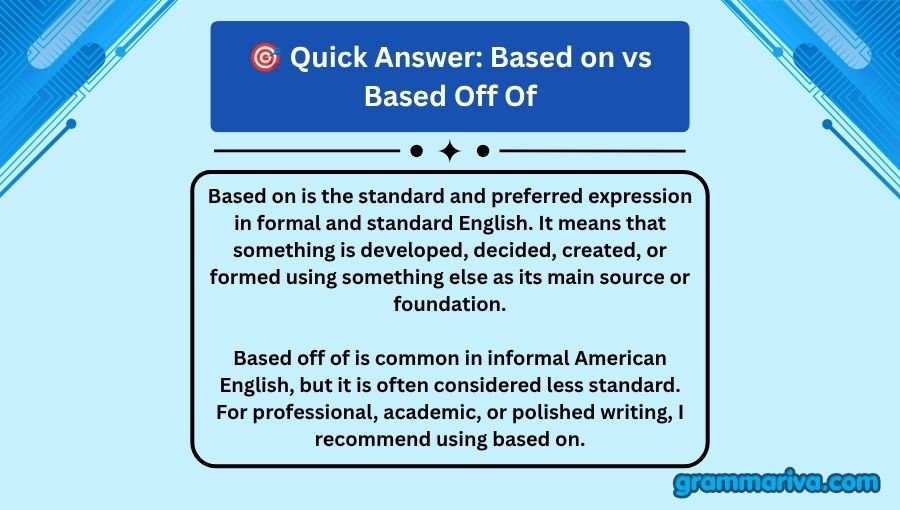
Based on is the standard and preferred expression in formal and standard English. It means that something is developed, decided, created, or formed using something else as its main source or foundation.
Based off of is common in informal American English, but it is often considered less standard. For professional, academic, or polished writing, I recommend using based on.
Best choice: The movie is based on a true story.
Less formal: The movie is based off of a true story.
Based on vs Based Off Of: The Basic Difference
The main difference is one of standard usage and formality. Based on is the established standard form, while based off of is a newer and more informal variation used by many speakers.
| Form | Type | Meaning | Example | Correct/Incorrect |
|---|---|---|---|---|
| based on | Standard phrase | Built or formed from something | The film is based on a novel. | ✅ Correct |
| based off of | Informal variation | Built or formed from something | The film is based off of a novel. | ⚠️ Informal |
| based off | Informal variation | Formed using something as a source | The design is based off the original. | ⚠️ Informal |
| base on | Verb phrase | To form something using a source | We base our decision on facts. | ✅ Correct |
| based upon | Formal variation | Based on something | The policy is based upon evidence. | ✅ Correct |
The safest rule is simple: use “based on” when you want standard English.
“Based upon” is also correct, but it can sound more formal than necessary. In most situations, “based on” is shorter and more natural.
Is Based On the Standard Expression?
Yes. Based on is the standard expression used when something is developed, created, judged, or decided using another thing as its foundation.
For example:
- The movie is based on a true story. ✅
- The report is based on recent data. ✅
- Her decision was based on experience. ✅
- The character is based on a real person. ✅
The word “on” connects the idea to its source or foundation.
How “Based On” Works in a Sentence
Consider this sentence:
The book is based on historical events.
Here, “the book” is the thing being created or discussed. “Historical events” provide the foundation.
Another example:
Our decision was based on the available evidence.
The decision depends on the evidence. The evidence is the basis for the decision.
| Meaning | Word Type | Example Sentence |
|---|---|---|
| Using a source | Phrase | The movie is based on a novel. |
| Using evidence | Phrase | The decision was based on facts. |
| Using experience | Phrase | Her advice is based on experience. |
| Using research | Phrase | The article is based on new research. |
💡 Test Tip
When you are unsure, replace the phrase with “using as a foundation.”
If the sentence still makes sense, based on will usually be the right choice.
The article is based on research.
The article uses research as its foundation.
That meaning is clear, so “based on” works perfectly.
Is Based Off Of the Same as Based On?
In everyday speech, based off of is often used with the same meaning as based on. However, the two expressions are not equally preferred in standard English.
“Based off of” can be understood easily by most American English speakers. The issue is not usually meaning. The issue is standard usage and style.
| Sentence | Meaning | Style |
|---|---|---|
| The movie is based on the book. | The book provides the source. | ✅ Standard |
| The movie is based off of the book. | The book provides the source. | ⚠️ Informal |
| The plan is based on customer feedback. | Feedback provides the foundation. | ✅ Standard |
| The plan is based off of customer feedback. | Feedback provides the foundation. | ⚠️ Informal |
| The character is based on my friend. | Friend inspired the character. | ✅ Standard |
I would not call every use of “based off of” a communication failure. People use it often, and the meaning is usually obvious. But if you are writing a résumé, research paper, business email, article, or formal report, based on is the better choice.
Why Do People Confuse Based On and Based Off Of?
People confuse these expressions because based off of sounds logical in casual speech. English speakers often use “off” to mean that something comes from a source.
For example:
- The idea came off the original design.
- He worked off the information he received.
- She made a copy off the original.
Because “off” can suggest a source or starting point, “based off of” can feel natural.
I once edited a short business article in which the writer used “based off of” several times. The writer was surprised when I changed each one to “based on.” He told me he had heard “based off of” all his life and thought it was the formal version. That is exactly why this confusion is so common.
The important thing is to separate what people commonly say from what is safest in formal writing.
Based On: Meaning and Correct Use
Based on means that something is formed, created, judged, or developed from a particular source, fact, idea, experience, or example.
It can describe many kinds of relationships.
Based on a Source
The television series is based on a novel.
The novel provides the source for the series.
Based on Evidence
The conclusion was based on strong evidence.
The evidence supports the conclusion.
Based on Experience
Her advice is based on years of experience.
Her experience is the foundation of her advice.
Based on an Idea
The design is based on a simple idea.
The idea provides the starting point for the design.
| Use | Example |
|---|---|
| Source | The film is based on a book. |
| Evidence | The decision is based on evidence. |
| Experience | His opinion is based on experience. |
| Data | The forecast is based on current data. |
| Idea | The project is based on a simple concept. |
Can You Use Based On in Formal Writing?
Yes. Based on is an excellent choice for formal writing because it is standard, clear, concise, and widely accepted. When comparing based on vs based off of, formal writing usually favors “based on” because it is the more standard and widely accepted choice.
You can safely use it in:
- Academic papers
- Business reports
- Professional emails
- Résumés
- News articles
- Research summaries
- Website content
- School assignments
- Technical documents
Examples:
The findings are based on three years of research. ✅
The recommendation was based on customer feedback. ✅
The report is based on verified information. ✅
There is no need to replace “based on” with a more complicated phrase just to sound professional.
Can You Use Based Off Of in Formal Writing?
You can find based off of in real writing, especially informal American English, but I would avoid it in formal writing.
The reason is simple. Some readers, teachers, editors, and style guides may consider it nonstandard or unnecessarily informal.
Compare:
The study is based on recent data. ✅
The study is based off of recent data. ⚠️
The second sentence is understandable. It does not create a major meaning problem. However, the first sentence is cleaner and more widely accepted.
When a standard alternative is short and natural, there is little reason to take the risk.
📝 Case Study: A Workplace Email
Imagine that a manager needs to explain how a new schedule was created.
An employee writes:
The new schedule was based off of the team’s availability.
The meaning is clear. However, if this is a formal workplace email, I would edit it to:
The new schedule was based on the team’s availability.
The second version sounds polished without being stiff.
Now imagine a casual conversation:
“How did you make this schedule?”
“I based it off of everyone’s availability.”
In casual speech, this may sound completely normal to many American English speakers.
| Situation | Recommended Form | Example |
|---|---|---|
| Academic paper | based on | The study is based on survey data. |
| Business email | based on | The plan is based on client feedback. |
| Casual conversation | based on / based off of | I based it on your idea. |
| Social media | Either may appear | The post is based on a real event. |
| Formal report | based on | The conclusion is based on the findings. |
The lesson is not that people never say “based off of.” They clearly do. The lesson is that context matters, and “based on” is the safest choice across contexts.
Grammar Rules Explanation
The phrase based on follows the standard pattern in English. “Based” is the past participle of “base,” and “on” introduces the source, foundation, or thing that supports the idea.
For example:
The article is based on research.
The research provides the foundation for the article.
The expression can appear after forms of “be”:
The story is based on a real event.
It can also appear as a participial phrase:
Based on the available evidence, we changed our decision.
The key grammar point is that on is the standard preposition used with “based” when identifying the foundation of something.
“Based upon” is also standard:
The decision was based upon the available evidence.
However, “based upon” is usually more formal than “based on.”
“Based off of” uses “off” where standard formal English normally uses “on.” The expression has become common in informal speech, but it is not the best choice when you want a broadly accepted standard form.
A general reference source such as a major English dictionary will recognize “based” in this sense and the established use of “based on.” The safest editorial choice remains straightforward: choose based on for standard writing.
Correct vs Incorrect at a Glance
| Sentence | Correct/Incorrect | Why |
|---|---|---|
| The film is based on a true story. | ✅ Correct | Standard expression. |
| The film is based off of a true story. | ⚠️ Informal | Common variation, but less standard. |
| Her answer was based on the evidence. | ✅ Correct | “On” correctly introduces the basis. |
| Her answer was based off of the evidence. | ⚠️ Informal | Understandable but less formal. |
| The plan was based upon research. | ✅ Correct | “Based upon” is a formal alternative. |
What Is the Difference Between Based On and Based Upon?
Based on and based upon have essentially the same meaning. The main difference is style.
“Based on” is more common and usually sounds more natural.
“Based upon” can sound more formal or traditional.
| Expression | Meaning | Tone |
|---|---|---|
| based on | Using something as a foundation | Neutral |
| based upon | Using something as a foundation | Formal |
| based off of | Using something as a foundation | Informal |
For most writing, I recommend “based on.”
There is no need to choose “based upon” simply because you want your writing to sound sophisticated.
How Does Based Off Differ From Based Off Of?
“Based off” and “based off of” are both informal variations of the standard expression based on.
You may hear:
The design is based off the original.
Or:
The design is based off of the original.
Both can be understood, but neither is the safest choice for formal writing.
The word “of” does not make the phrase more formal. If anything, it makes the expression longer.
A simple editing rule works well:
based off / based off of → based on
This quick substitution can improve many sentences immediately.
Common Mistakes With Based On and Based Off Of
People make this mistake for several reasons.
Fast Typing
When people type quickly, they often write the phrase they hear in conversation. If “based off of” is common in their speech, it may appear automatically in their writing.
Autocorrect
Autocorrect and predictive text can reinforce familiar phrases. Your phone may not warn you that a phrase is informal.
Lack of Knowledge
Some writers simply have never been taught that “based on” is the standard choice. They may assume that “based off of” is equally formal because they hear it often.
I once caught myself typing “based off of” in a casual draft after hearing the phrase repeatedly during a conversation. I changed it immediately because the final document was intended for a professional audience. The mistake was not caused by a lack of English knowledge. It was caused by writing the way I had just heard people speak.
Similar Grammar Confusions
| Confusion | Correct Form | Common Problem |
|---|---|---|
| it’s / its | it’s / its | Apostrophe confusion |
| your / you’re | your / you’re | Sounding alike |
| their / there / they’re | their / there / they’re | Similar pronunciation |
| then / than | then / than | Similar spelling |
| based on / based off of | based on | Formality and usage confusion |
Specific Wrong Forms
| Wrong Form | What’s Wrong | Correct Form |
|---|---|---|
| based off of | Informal variation | based on |
| based off | Informal variation | based on |
| base on | Wrong tense in some contexts | based on |
| based at | Wrong preposition for this meaning | based on |
| based from | Usually unnecessary for this meaning | based on |
| based with | Incorrect preposition | based on |
How To Remember the Difference
The easiest memory trick is this: Remembering the difference between based on vs based off of is easy when you think of “on” as the word that connects an idea to its foundation.
A foundation is something you build “on.”
You build a house on a foundation. In the same way, an idea can be based on information.
Think of these examples:
- based on facts
- based on evidence
- based on research
- based on experience
- based on a book
When you see “based,” ask yourself:
What is the foundation?
Then use on.
Memory Table
| Question | Best Choice |
|---|---|
| Is this formal writing? | based on |
| Is this academic writing? | based on |
| Is this professional writing? | based on |
| Is this casual conversation? | based on is still safest |
| Did I write “based off of”? | Consider changing it to based on |
Usage in Different Contexts
The phrase appears in many forms of communication. The safest choice remains consistent across most settings. The choice between based on vs based off of can depend on the setting, but “based on” remains the safest option across most types of writing.
| Context | Which Term to Use | Example |
|---|---|---|
| Everyday conversation | based on | The story is based on something that happened. |
| Professional writing | based on | The report is based on client data. |
| Creative writing | based on | The character is based on her sister. |
| Social media/texting | based on | This post is based on a real conversation. |
Social media is more flexible because people often write exactly as they speak. Even there, “based on” is short and natural, so it remains a strong choice.
Common Phrases With Based On
“Based on” appears in many useful expressions.
| Phrase | Meaning |
|---|---|
| based on evidence | Supported by evidence |
| based on facts | Supported by facts |
| based on experience | Developed from experience |
| based on research | Developed using research |
| based on a true story | Inspired by real events |
| based on available information | Using the information currently known |
These phrases are common because they clearly show the source of an idea or decision.
Alternatives to Based On
Sometimes you can replace “based on” with another expression. The best choice depends on the sentence.
| Alternative | Works When | Does Not Work When |
|---|---|---|
| founded on | Something has a strong foundation | The meaning is purely casual |
| built on | An idea or system develops from something | You need a formal factual statement |
| derived from | Something comes from a source | The sentence needs very simple wording |
| informed by | Information influences a decision | Something is directly adapted from a source |
| inspired by | Something gets an idea from another source | The source is the direct foundation |
For example:
The decision was based on customer feedback.
You could say:
The decision was informed by customer feedback.
But the meanings are not always identical. “Informed by” suggests influence. “Based on” more strongly suggests that the information forms the foundation.
Why Based On Matters in Professional Writing
Choosing the standard expression helps your writing stay clear and polished.
A grammar choice may seem small, but repeated small choices shape how readers see a document.
Clarity
“Based on” is immediately familiar to readers.
Professionalism
Standard expressions reduce the chance that an editor will flag your writing.
Digital Communication
Emails, websites, reports, and online articles can reach many types of readers. A standard phrase works well across audiences.
A useful writing principle is:
When two expressions communicate the same idea, choose the one that is clear, standard, and widely accepted.
| Situation | Why Getting It Right Matters |
|---|---|
| Résumé | Shows careful writing |
| Client email | Creates a polished impression |
| Published content | Supports consistent editorial style |
| Social post | Makes the sentence easy to understand |
You do not need complicated vocabulary to sound professional. Often, the simplest standard phrase is the strongest one.
Is Based Off Of Always Wrong?
No. It is better to describe based off of as informal or nonstandard in formal usage rather than pretending that nobody uses it.
Millions of English speakers understand and use the expression. It appears especially often in casual American speech and online writing.
The practical question is not simply:
“Can people understand this?”
They usually can.
The better question is:
“Is this the best form for my audience and purpose?”
For formal writing, the answer is usually based on.
For casual conversation, you may hear both.
Can Based Off Of Be Used in American English?
Yes, you can encounter based off of in American English, particularly in informal communication. It is not an expression that causes confusion for most speakers.
However, its widespread use does not automatically make it the preferred formal expression.
This distinction is useful:
- Common in speech does not always mean best in formal writing.
- Understandable does not always mean preferred by editors.
- Informal does not always mean meaningless or impossible to understand.
That is why I recommend keeping the two ideas separate.
Based On vs Based Off Of in Real Sentences
Here are several pairs you can use as models.
| Based On | Based Off Of |
|---|---|
| The movie is based on a novel. | The movie is based off of a novel. |
| The decision is based on facts. | The decision is based off of facts. |
| The design is based on an old model. | The design is based off of an old model. |
| Her opinion is based on experience. | Her opinion is based off of experience. |
| The report is based on new data. | The report is based off of new data. |
In each pair, the intended meaning is almost the same. The key difference is standardness and style.
When Should You Use Based On?
Use based on when you want the most broadly accepted form.
It is especially useful when:
- You are writing for school.
- You are writing for work.
- You are preparing a résumé.
- You are writing an article.
- You are publishing online.
- You are communicating with clients.
- You are writing a formal report.
- You want to avoid an editor questioning your wording.
A simple sentence such as “The report is based on verified data” is clear and professional.
There is no advantage in replacing it with “based off of” in these situations.
When Might You Hear Based Off Of?
You are most likely to hear based off of in:
- Casual conversation
- Informal messages
- Social media
- Podcasts
- Interviews
- Everyday American speech
That does not mean you must use it. It simply explains why the expression may sound completely normal to you.
Language changes through everyday use. Expressions can become common before they become fully accepted in every style of writing.
🎯 Quick Recap Checklist
Use this checklist whenever you are unsure.
| Question | If Yes → Use |
|---|---|
| Are you writing formally? | based on |
| Are you writing academically? | based on |
| Are you writing a professional email? | based on |
| Are you writing a report? | based on |
| Are you unsure which phrase is safest? | based on |
| Are you quoting casual speech? | based off of may appear |
Practice Examples
- The article is ___ recent research.
Answer: based on ✅ - The character was ___ a real person.
Answer: based on ✅ - The decision was ___ the available evidence.
Answer: based on ✅
Why Do Editors Usually Prefer Based On?
Editors prefer based on because it is concise, familiar, and standard. Understanding based on vs based off of helps writers choose wording that sounds clear and professional.
When editing a sentence, I usually ask three questions:
- Is the meaning clear?
- Is the phrase standard?
- Is there a simpler option?
“Based on” passes all three tests.
“Based off of” may communicate the intended meaning, but it adds an informal feel. If the goal is polished writing, changing it to “based on” is usually an easy improvement.
Is Based On More Formal Than Based Off Of?
Yes. In practical writing, based on is the more formal and standard choice. The difference between based on vs based off of is mainly about standard usage and formality, rather than meaning.
“Based off of” sounds more conversational.
| Phrase | Formality | Recommendation |
|---|---|---|
| based on | Standard/neutral | ⭐ Best overall |
| based upon | Formal | Good when appropriate |
| based off of | Informal | Avoid in formal writing |
| based off | Informal | Avoid in formal writing |
FAQs About Based On vs Based Off Of
Is “based on” correct?
Yes. Based on is the standard expression used when something is formed, created, decided, or developed using something else as its foundation.
Is “based off of” grammatically correct?
“Based off of” is widely used and easily understood, especially in informal American English. However, it is generally less preferred than “based on” in formal and edited writing.
Which is better, based on or based off of?
Based on is the better choice for standard English. It works in formal, professional, academic, and casual writing.
Can I use “based off of” in a professional email?
You can, but based on is a safer choice. Using “based on” keeps the email polished and avoids unnecessary informal wording.
Is “based off” correct?
“Based off” is a common informal variation. For standard formal English, use based on instead.
Is “based upon” correct?
Yes. Based upon is correct and has the same basic meaning as “based on.” It is simply more formal in tone.
Why do people say “based off of”?
People use “based off of” because it has become common in everyday speech. The expression likely feels natural because “off” can sometimes suggest a source or starting point.
Should I use “based on” in academic writing?
Yes. Based on is the preferred choice for academic writing because it is standard, clear, and concise.
Is “based off of” an American expression?
It is commonly heard in American English, especially in informal speech and online communication. However, its use does not make it the preferred expression for formal writing.
How can I remember the correct phrase?
Remember that something can be built on a foundation. Therefore, when something is formed from a source or foundation, based on is the safest phrase.
Conclusion
Based on vs based off of can be confusing because both expressions are heard in everyday English, but the safest standard choice is based on. Use it when you mean that something is formed, created, decided, or developed from a particular source, idea, fact, or experience.
“Based off of” is common enough to sound natural to many American English speakers. Still, it carries a more informal feel and may be rejected or edited in formal writing. If you are writing an academic paper, professional email, report, résumé, or polished article, there is little reason to choose the less standard option.
I use a simple rule when editing: if “based on” fits the meaning, use it. It is short, clear, familiar, and widely accepted. ✅
You do not need to memorize a complicated grammar rule. Just think of a foundation. You build on a foundation, and ideas can be based on information.
When in doubt, keep your writing simple: based on is the safe choice. ✨

Hi, I’m Lucas Bennett. I’m a grammar content specialist at Grammariva. I work on articles covering everyday grammar questions, sentence usage, and writing tips that readers can apply with confidence.

[…] tips. By the end, you should be able to choose the right word without stopping to think twice. 😊 Based on vs Based Off Of | Entitled vs Titled | Crumby or […]