Have you ever written a sentence and stopped because you could not decide between leave it as it is or leave it as is? 🤔 Both expressions are common in English, and both can sound natural. The real question is whether there is a meaningful difference between them and whether one is more correct in certain situations.
The good news is that you do not need a complicated grammar rule to make the right choice. Both phrases can tell someone not to change something. However, they have slightly different structures and can create a different tone.
“Leave it as it is” is a little more complete and explicit. “Leave it as is” is shorter and very common, especially in instructions, workplace communication, and everyday speech.
As an editor, I often see writers hesitate over this choice because they assume one phrase must be wrong. That is not the case. In this guide, I will explain how both expressions work, when to use each one, and how to avoid common mistakes. ✍️ Ahead vs A Head | Concurrent vs Simultaneous | Work Experience or Working Experience
🎯 Quick Answer: Leave It as It Is or Leave It as Is
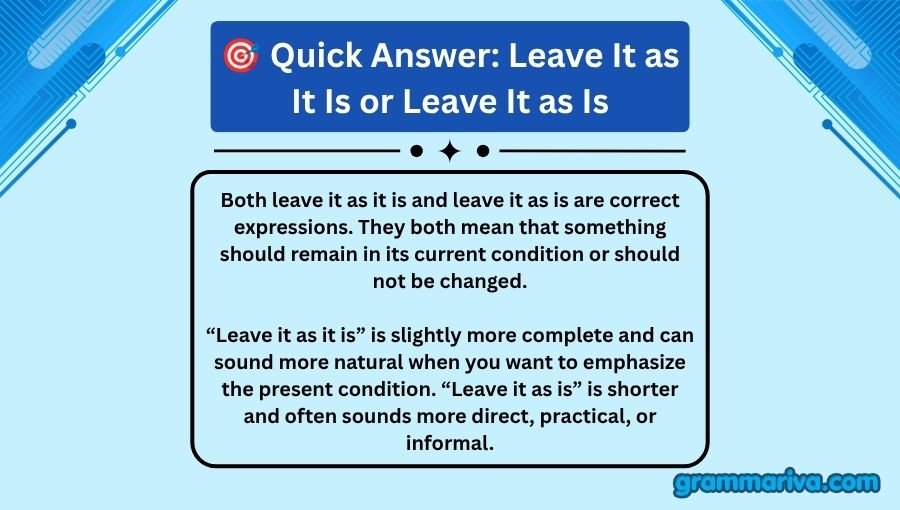
Both leave it as it is and leave it as is are correct expressions. They both mean that something should remain in its current condition or should not be changed.
“Leave it as it is” is slightly more complete and can sound more natural when you want to emphasize the present condition. “Leave it as is” is shorter and often sounds more direct, practical, or informal.
Quick comparison
| Expression | Correct? | Main idea | Typical tone |
|---|---|---|---|
| Leave it as it is | ✅ Yes | Keep it in its current condition | Neutral |
| Leave it as is | ✅ Yes | Do not change it | Direct and concise |
| Leave it as its | ❌ No | Incorrect structure | — |
| Leave it is | ❌ No | Missing “as” | — |
Understanding the Difference Between Leave It as It Is or Leave It as Is
The key difference is structural rather than one of basic meaning. “Leave it as it is” contains a full clause after “as,” while “leave it as is” uses a shorter fixed expression.
Both tell the listener to avoid making a change.
Consider these examples:
- Leave the picture as it is. ✅
- Leave the picture as is. ✅
Both sentences mean that the picture should remain unchanged.
The first version sounds slightly more complete because “it is” clearly refers to the current condition. The second version is more compact.
| Form | Type | Meaning | Example | Correct/Incorrect |
|---|---|---|---|---|
| Leave it as it is | Verb phrase + clause | Keep something unchanged | Leave the design as it is. | ✅ Correct |
| Leave it as is | Verb phrase + fixed expression | Keep something unchanged | Leave the design as is. | ✅ Correct |
| Leave it as its | Incorrect phrase | No standard meaning here | Leave it as its. | ❌ Incorrect |
| Leave it is | Incomplete expression | Does not form the intended phrase | Leave it is. | ❌ Incorrect |
The important point is that you do not need to treat one correct expression as a grammatical error.
Is Leave It as It Is More Formal Than Leave It as Is?
Yes, “leave it as it is” can sound slightly more formal or more complete, although both expressions are acceptable in standard English.
The difference is mainly one of style. In careful writing, you may prefer the fuller version when you want the sentence to sound especially clear.
For example:
- Please leave the document as it is. ✅
- Please leave the document as is. ✅
Both work in a professional email. The first feels a little more traditional. The second is shorter and more direct.
| Situation | Preferred Form | Why |
|---|---|---|
| Formal explanation | Leave it as it is | Full and clear |
| Workplace instruction | Leave it as is | Short and direct |
| Casual conversation | Either | Both sound natural |
| Editing instructions | Leave it as is | Efficient |
| Strong emphasis on current condition | Leave it as it is | Makes the current state clear |
Neither version automatically makes your writing formal or informal. The surrounding sentence matters too.
Why Do People Confuse Leave It as It Is and Leave It as Is?
People often confuse these expressions because their meanings are almost identical. The words also appear in nearly the same order, so writers may wonder whether one contains an unnecessary word.
The word “it” in the longer version can make the structure easier to understand:
Leave it as it is.
Here, “it” is the subject of “is.”
In the shorter version:
Leave it as is.
The final “is” remains part of the established expression even though the structure is more compact.
I once edited a short workplace guide where the writer had changed every instance of “leave it as is” to “leave it as it is” because they thought the shorter form was incorrect. I restored several of the shorter examples. The original wording was already grammatical, and the concise style actually suited the instructions better.
This is a useful lesson: shorter does not always mean incorrect.
Leave It as It Is: Meaning and Correct Use
“Leave it as it is” means to keep something in its current condition without changing it.
The phrase is useful when the current state is already known or visible.
Example 1
The room looks fine, so leave it as it is. ✅
This means nobody should rearrange, clean, repaint, or otherwise change the room.
Example 2
I like the paragraph this way. Leave it as it is. ✅
The speaker wants the paragraph to remain unchanged.
Example 3
The machine is working now, so leave it as it is. ✅
The instruction is to avoid making further changes.
Meaning table
| Meaning | Word Type | Example Sentence |
|---|---|---|
| Keep something unchanged | Verb phrase | Leave the painting as it is. |
| Avoid making repairs or changes | Verb phrase | It works well, so leave it as it is. |
| Keep the current appearance | Verb phrase | Leave the room as it is. |
The phrase can refer to physical objects, documents, plans, situations, designs, and many other things.
Leave It as Is: Meaning and Correct Use
“Leave it as is” also means to keep something unchanged.
It is especially useful when giving a short instruction. You will often see it in editing, design, business, technical, and everyday contexts.
Examples:
- The layout looks good. Leave it as is. ✅
- Don’t adjust the settings. Leave them as is. ✅
- The contract is ready. Leave it as is. ✅
The shorter form can make an instruction sound firm and efficient.
| Expression | Meaning | Example |
|---|---|---|
| Leave it as is | Do not change it | Leave the photo as is. |
| Leave them as is | Do not change multiple things | Leave the files as is. |
| Leave everything as is | Keep everything unchanged | Leave everything as is until Monday. |
Notice that the pronoun can change. You are not required to use “it.”
Can You Use Leave It as It Is and Leave It as Is in the Same Way?
In most situations, yes. The two expressions can replace each other without changing the basic meaning.
For example:
- Leave the schedule as it is. ✅
- Leave the schedule as is. ✅
Both tell someone not to change the schedule.
However, style can influence your choice. The longer expression may sound more natural when you are explaining a condition. The shorter version can work better when you are giving a quick instruction.
Test Tip 💡
Try replacing the expression with “do not change it.”
If the sentence still makes sense, either expression will usually work.
Leave the design as it is.
→ Do not change the design.
Leave the design as is.
→ Do not change the design.
If that substitution preserves the intended meaning, you are probably using the expression correctly.
Case Study: Choosing the Better Phrase at Work
Imagine that a designer sends a company logo to a manager. The manager likes the design and does not want any more changes.
The manager could write:
Please leave the logo as it is.
This sounds clear and slightly more complete.
The manager could also write:
Please leave the logo as is.
This is shorter and perfectly suitable for a workplace message.
If I were editing the email, I would not mark either sentence as grammatically wrong. I would choose based on the tone of the entire message.
| Workplace Message | Best Choice | Reason |
|---|---|---|
| Please leave the logo as it is. | Either | Clear and neutral |
| Please leave the logo as is. | Either | Concise and direct |
| The logo should remain unchanged. | Alternative | More formal |
| Do not make further changes to the logo. | Alternative | Very explicit |
The lesson is simple: correctness and style are not always the same thing.
Grammar Rules Explanation
The grammar becomes easier when you look at the structure.
In “leave it as it is,” the verb “leave” tells someone not to change something. The pronoun “it” identifies the thing being left unchanged. The phrase “as it is” describes its current state.
In “leave it as is,” the same basic idea is expressed in a shorter form. The expression “as is” is widely used to mean that something is in its current condition and should remain that way.
Standard English references and major dictionaries recognize both patterns as established English usage. The important distinction is therefore not “correct versus incorrect.” It is mainly fuller wording versus shorter wording.
Correct vs Incorrect at a Glance
| Sentence | Correct/Incorrect | Why |
|---|---|---|
| Leave the document as it is. | ✅ Correct | Uses the full expression correctly. |
| Leave the document as is. | ✅ Correct | Uses the shorter expression correctly. |
| Leave the document as its. | ❌ Incorrect | “Its” is the wrong word. |
| Leave the document it is. | ❌ Incorrect | The required “as” is missing. |
| Leave as it is the document. | ⚠️ Awkward | The word order is unnatural. |
A useful rule is this:
Use “as it is” when you want the fuller expression. Use “as is” when you want a shorter, direct expression.
Neither choice changes the basic instruction.
Why Leave It as Is Works Without the Second It
One common question is why “leave it as is” can work when “leave it as it is” appears to have a clearer subject.
The short answer is that “as is” functions as an established expression meaning “in its current condition.”
Compare:
Leave the package as it is.
The package should remain in its present state.
Leave the package as is.
The package should remain in its present state.
The second version does not need another “it” because the expression already works naturally without it.
This is similar to many common English expressions where a shorter form has become standard in ordinary use.
Common Mistakes With Leave It as It Is or Leave It as Is
Mistakes happen for several simple reasons:
- Fast typing: Writers may leave out small words.
- Autocorrect: Software can sometimes change a phrase unexpectedly.
- Lack of knowledge: Learners may think one version must be wrong.
- Overthinking: Writers may try to “fix” a phrase that is already correct.
A student once showed me a sentence that said, “Please leave it as its.” She knew that the sentence needed something after “as,” but she had confused “is” with “its.” We fixed it by remembering that “is” is a verb, while “its” shows possession.
Similar Grammar Confusions
| Confusion | Correct Form | Common Error |
|---|---|---|
| it’s / its | It’s ready. / Its color is bright. | Mixing possession and contraction |
| your / you’re | Your book / You’re ready | Mixing possessive and contraction |
| their / they’re | Their house / They’re home | Mixing possessive and contraction |
| then / than | Better than before | Using “then” for comparison |
| affect / effect | It affected me. / The effect was clear. | Mixing related forms |
Specific Wrong Forms
| Wrong Form | What’s Wrong | Correct Form |
|---|---|---|
| Leave it as its | “Its” is not the verb needed here | Leave it as it is |
| Leave it is | “As” is missing | Leave it as is |
| Leave as it is | The object may be missing when one is needed | Leave it as it is |
| Leave it as its is | Combines incorrect forms | Leave it as it is |
| Leave it as-is it | Unnatural structure | Leave it as is |
| Leave it as it | Incomplete expression | Leave it as it is |
How to Remember the Difference
The easiest way to remember the expressions is to focus on the meaning rather than counting words.
Ask yourself:
Do I mean “do not change it”?
If yes, “leave it as it is” and “leave it as is” are both possible.
A simple memory trick is:
As it is = current condition.
As is = current condition, shorter form.
You can also remember that “its” is different from “it is.”
- It is = a pronoun + verb.
- Its = a possessive word.
For example:
- Leave it as it is. ✅
- The dog wagged its tail. ✅
They look similar, but they do different jobs.
Usage in Different Contexts
Both expressions work in many settings. Your choice mainly depends on tone, length, and context.
| Context | Which Term to Use | Example |
|---|---|---|
| Everyday conversation | Either | Leave it as it is. |
| Professional writing | Either | Please leave the file as is. |
| Creative writing | Either | He decided to leave the old house as it was. |
| Social media/texting | Leave it as is | Just leave it as is 😂 |
| Editing instructions | Leave it as is | Leave the heading as is. |
In texting, the shorter version may feel more natural because people often prefer brief wording.
In formal writing, the longer version can sometimes sound smoother. Still, “as is” is not automatically too informal for professional communication.
Leave It as It Is or Leave It as Is in Professional Writing
For business emails, reports, editing notes, and workplace instructions, either expression can be correct.
Consider:
Please leave the final paragraph as it is. ✅
This sounds polished and neutral.
Please leave the final paragraph as is. ✅
This sounds concise and practical.
If you are writing for a client, both can work. Your overall writing style should guide the choice.
| Professional Situation | Natural Choice |
|---|---|
| Client email | Either |
| Editing note | As is |
| Formal report | As it is |
| Design instruction | As is |
| Policy explanation | As it is |
Common Phrases With As Is and As It Is
The expressions appear in several useful patterns.
| Phrase | Meaning |
|---|---|
| Leave it as is | Do not change it |
| Leave it as it is | Keep its current condition |
| Sold as is | Sold in its current condition |
| Take it as it is | Accept the situation without demanding changes |
| As it is | In the current condition or situation |
| As is | In the current condition |
Be careful with “as it is” because it can have uses beyond the specific instruction to leave something unchanged.
For example:
The room is small as it is.
Here, “as it is” means that the room is already small. It is not an instruction to leave the room alone.
Is As Is Always Informal?
No. “As is” is not automatically informal.
It appears in ordinary conversation, workplace writing, technical instructions, and other forms of communication. Its short structure makes it efficient.
For example:
Please use the template as is. ✅
That sentence can be perfectly appropriate in a professional setting.
The important thing is whether the phrase fits the tone of the surrounding text.
If your document uses short, direct instructions, “as is” may be the better choice. If your writing is more explanatory, “as it is” may flow more naturally.
Alternatives to Leave It as It Is or Leave It as Is
Sometimes you may want to avoid both expressions. Several alternatives are available.
| Alternative | Works When | Does Not Work When |
|---|---|---|
| Keep it unchanged | You want maximum clarity | You want a casual tone |
| Do not change it | Giving a direct instruction | You want a softer style |
| Keep it the same | Everyday conversation | Very formal technical writing |
| Keep the current version | Documents or drafts | Referring to a physical object |
| Let it remain as it is | Formal or literary writing | Very short instructions |
For example:
Please keep the document unchanged.
This is very clear.
Please do not change the document.
This is direct and leaves little room for confusion.
Please keep the current version.
This works especially well when discussing files, drafts, or software.
Why It Matters: Clarity and Professionalism
Choosing between these expressions rarely changes the meaning. Still, accurate wording helps your writing sound confident.
Clear writing tells the reader exactly what you want.
A client should not have to wonder whether “leave it as is” is a typo. A student should not lose confidence because they think the phrase is grammatically wrong. A published article should not treat a standard expression as an error.
Good writing makes the intended meaning easy to see.
| Situation | Why Getting It Right Matters |
|---|---|
| Resume | Shows attention to language |
| Client email | Prevents confusion |
| Published content | Builds reader trust |
| Social post | Keeps the message natural |
The difference between these two expressions is small, but understanding it gives you more control over your writing.
Can You Say Leave Them as Is?
Yes. You can use “leave them as is” when referring to more than one thing.
Examples:
- Leave the files as is. ✅
- Leave the documents as they are. ✅
- Leave the settings as they are. ✅
Notice the natural plural form:
Singular: Leave it as it is.
Plural: Leave them as they are.
You can also use the shorter version:
Singular: Leave it as is.
Plural: Leave them as is.
| Number | Full Form | Short Form |
|---|---|---|
| Singular | Leave it as it is. | Leave it as is. |
| Plural | Leave them as they are. | Leave them as is. |
This shows that the choice is not limited to one exact sentence.
Can You Say Leave It as They Are?
Usually, no, if “it” refers to one singular thing.
The pronoun and the later verb should match.
- Leave it as it is. ✅
- Leave them as they are. ✅
- Leave it as they are. ❌
If you are talking about one object, use it is.
If you are talking about multiple objects, use they are in the fuller construction.
This agreement rule makes the longer version especially easy to understand.
How the Meaning Changes With Different Verbs
The same pattern can appear with other verbs.
For example:
- Keep it as it is. ✅
- Accept it as it is. ✅
- Take it as it is. ✅
These sentences all relate to accepting or maintaining the current condition, but the main verb changes the exact meaning.
| Verb | Example | Basic Meaning |
|---|---|---|
| Leave | Leave it as it is. | Do not change it |
| Keep | Keep it as it is. | Maintain its condition |
| Accept | Accept it as it is. | Do not demand changes |
| Take | Take it as it is. | Accept it without changes |
This helps show why “leave” is not the only verb that can appear with this pattern.
Practice Examples
Try choosing the better expression in each sentence. Remember that in many cases, both versions are correct.
Example 1
The painting already looks good. ______.
Answer: Leave it as it is. ✅
Also correct: Leave it as is. ✅
Example 2
The client approved the design. Please ______.
Answer: Leave it as is. ✅
Also correct: Leave it as it is. ✅
Example 3
The computer is working normally. Don’t change anything.
Answer: Leave it as it is. ✅
Example 4
The files are ready. ______ until tomorrow.
Answer: Leave them as is. ✅
| Practice | Correct Answer |
|---|---|
| Keep the photo unchanged. | Leave it as is. |
| Keep the room in its current condition. | Leave it as it is. |
| Do not change the files. | Leave them as is. |
🎯 Leave It as It Is or Leave It as Is at a Glance
The simplest conclusion is that both expressions are standard and useful.
“Leave it as it is” is the fuller version. It clearly points to the current state of something.
“Leave it as is” is the shorter version. It gives the same basic instruction with fewer words.
Neither should be treated as a spelling mistake or grammar error.
| Feature | Leave It as It Is | Leave It as Is |
|---|---|---|
| Correct | ✅ | ✅ |
| Meaning | Keep unchanged | Keep unchanged |
| Length | Longer | Shorter |
| Tone | Neutral/full | Concise/direct |
| Professional use | Yes | Yes |
| Casual use | Yes | Yes |
| Main advantage | Explicit | Efficient |
⚠️ Common Mistakes to Avoid
Before publishing or sending your sentence, check these points:
- Do not write “as its” when you mean “as it is.”
- Do not remove “as” from the expression.
- Do not assume that “as is” is incorrect simply because it is shorter.
- Do not change a correct phrase just because it looks unusual.
- Match singular and plural pronouns when using the longer form.
I once caught myself typing “leave it as its” in a quick editing note. I was moving too fast and had simply typed the possessive form by accident. A quick reread caught it before I sent the message. Fast typing can trip up even experienced writers.
How To Remember Leave It as It Is or Leave It as Is
Use this three-step test:
- Ask what you mean.
Do you mean “do not change it”? - Choose your style.
Want a fuller expression? Use “as it is.”
Want a shorter expression? Use “as is.” - Check the pronoun.
Singular: it is
Plural: they are
That is enough for most situations.
Quick Recap Checklist
| Question | If Yes → Use |
|---|---|
| Do you mean “do not change it”? | Either expression |
| Do you want the fuller form? | Leave it as it is |
| Do you want a shorter instruction? | Leave it as is |
| Are you talking about multiple things? | Leave them as they are / as is |
| Did you accidentally write “its”? | Change it to “it is” |
Practice
- The draft is fine. Leave it as is. ✅
- The room looks good. Leave it as it is. ✅
- The files are ready. Leave them as is. ✅
FAQs About Leave It as It Is vs Leave It as Is
Is “leave it as it is” grammatically correct?
Yes. “Leave it as it is” is grammatically correct and means to keep something in its current condition.
Is “leave it as is” grammatically correct?
Yes. “Leave it as is” is also correct. It is a shorter way to tell someone not to change something.
Is “leave it as it is” better than “leave it as is”?
Not necessarily. Both are correct. “Leave it as it is” is fuller, while “leave it as is” is more concise.
Which is more formal, leave it as it is or leave it as is?
“Leave it as it is” can sound slightly more formal or complete, but “leave it as is” is also acceptable in professional writing.
Can I use “leave it as is” in a professional email?
Yes. “Leave it as is” is appropriate in many professional emails, especially when giving a short and clear instruction.
What does “leave it as it is” mean?
It means do not change something from its current condition. For example, “Leave the report as it is” means that no further changes should be made.
What does “leave it as is” mean?
It means keep something in its current condition without changing it. It has essentially the same meaning as “leave it as it is.”
Is “leave it as its” correct?
No. “Leave it as its” is incorrect when you mean “leave it unchanged.” The correct form is “leave it as it is” or “leave it as is.”
Can I say “leave them as is”?
Yes. “Leave them as is” is correct when referring to multiple things. You can also say “leave them as they are.”
Is “leave it as it is” the same as “do not change it”?
In most situations, yes. Both tell someone to keep something in its current condition.
Conclusion
Leave it as it is or leave it as is is not a choice between correct and incorrect English. Both expressions are correct and communicate the idea that something should remain unchanged. The main difference is style and structure.
“Leave it as it is” gives you the fuller expression. It can feel clear, neutral, and slightly more formal. “Leave it as is” gives you a shorter and more direct version. It works especially well for instructions, editing notes, workplace messages, and casual communication.
The most important mistake to avoid is confusing “is” with “its.” Remember that “it is” contains a verb, while “its” shows possession.
When you mean “do not change it,” you can confidently use either form. Choose the one that best matches your sentence and tone. ✨ Once you understand that both are valid, this common grammar question becomes much easier.
When the meaning is clear, choose the form that makes your writing sound natural, precise, and confident.

Hi, I’m Olivia Carter. I’m an English language editor at Grammariva, and I work on making grammar lessons clear, accurate, and easy to follow. I especially enjoy writing about common grammar mistakes and everyday English.
[…] and how to remember the difference. By the end, you should be able to choose confidently. 👍 Leave It as It Is or Leave It as Is | Ahead vs A Head | Concurrent vs […]
[…] step by step so you can choose the right word with confidence. Independent From or Independent Of | Leave It as It Is or Leave It as Is | Ahead vs A […]