If you have ever stopped while writing and wondered whether lite vs light is the right spelling, you are not alone. These two words look almost the same, but they do not always work in the same places. One is a standard English word with many meanings. The other is mainly used in special contexts, especially for products, brands, food, drinks, software, and informal writing. ✍️
I teach and edit English for a living, and I often see this pair cause small but avoidable mistakes. The tricky part is that light can mean many things. It can describe weight, brightness, color, food, or even the way something feels. Lite, however, is much more limited.
The good news is that the difference is easy to remember once you understand the basic rule. In standard writing, light is usually the correct choice. Lite is generally used in names, labels, marketing, and informal contexts where it suggests a reduced or simpler version of something. 😊
Let us look at the difference step by step so you can choose the right word with confidence. Independent From or Independent Of | Leave It as It Is or Leave It as Is | Ahead vs A Head
🎯 Quick Answer: What Is the Difference Between Lite vs Light?
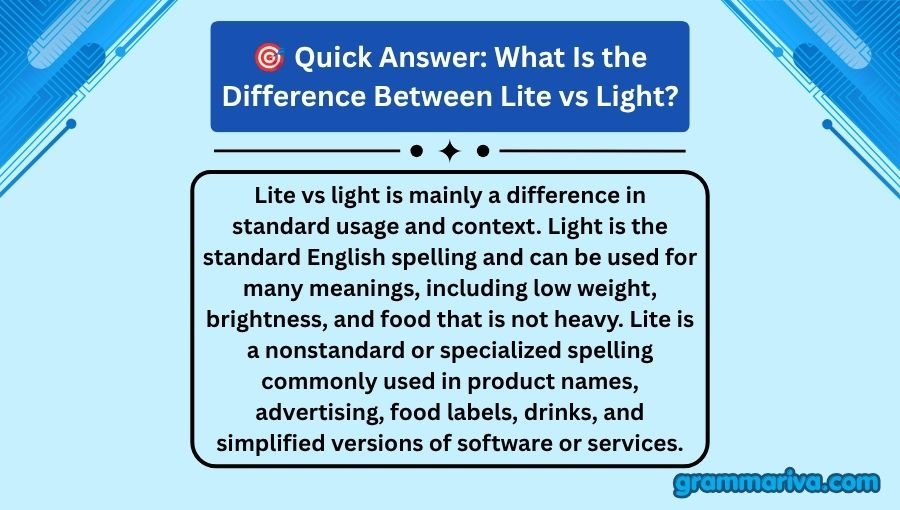
Lite vs light is mainly a difference in standard usage and context. Light is the standard English spelling and can be used for many meanings, including low weight, brightness, and food that is not heavy. Lite is a nonstandard or specialized spelling commonly used in product names, advertising, food labels, drinks, and simplified versions of software or services.
| Word | Main Use | Standard English? | Example |
|---|---|---|---|
| light | Weight, brightness, color, food, and more | Yes | This bag is light. |
| lite | Reduced, simpler, or branded version | Limited/specialized | I downloaded the lite version. |
Simple rule: When you are writing normal English, choose light unless lite is part of an established name, label, product description, or informal expression.
Is Lite the Same as Light?
No, lite and light are not fully interchangeable. Light is the normal English word, while lite is a specialized spelling used in certain contexts.
For example, you can say that a suitcase is light because it does not weigh much. You would not normally write that the suitcase is lite in standard prose.
However, a company might call a product a Lite version to show that it has fewer features, less content, or a reduced version of the original product.
Examples
Correct:
✅ This laptop is very light.
Incorrect in standard prose:
❌ This laptop is very lite.
Correct in a product context:
✅ The company released a Lite version of the app.
Incorrect as a general replacement:
❌ The company released a Light version of the app.
The second sentence is not automatically grammatically wrong, but if the official product name is Lite, changing the spelling would make the name inaccurate.
Lite vs Light at a Glance
The easiest way to understand the pair is to compare their jobs in a sentence.
| Form | Type | Meaning | Example | Correct/Incorrect |
|---|---|---|---|---|
| light | Adjective | Not heavy | The box is light. | ✅ Correct |
| light | Noun | Brightness or a lamp | Turn on the light. | ✅ Correct |
| light | Verb | To make something burn or become lit | Please light the candle. | ✅ Correct |
| light | Adjective | Not strong or heavy | We had a light meal. | ✅ Correct |
| lite | Specialized spelling | Reduced or simpler version | I use the Lite app. | ✅ Correct in context |
| lite | General adjective | Replacement for standard “light” | The box is lite. | ❌ Usually incorrect |
The key idea is simple: light has a broad role in English, while lite has a narrow role.
Why Do People Confuse Lite and Light?
People confuse these words because they look and sound similar. The final -e in lite makes it look like a modern spelling of light, even though the two forms have different uses.
I once edited a short product description where a writer used lite several times to mean “not heavy.” The writer knew exactly what the product meant but had copied the spelling from marketing language. Once we changed the general uses to light, the description sounded much more natural.
There are several common reasons for this confusion:
- Lite appears often in product names.
- Advertising uses lite to make products sound modern or simple.
- Some food and drink labels use lite.
- Software may have a Lite version.
- Fast typing makes similar words easy to mix up.
- People may assume lite is simply a shorter spelling of light.
| Reason | How It Causes Confusion | Better Approach |
|---|---|---|
| Product names | Brands often use “Lite” | Check whether it is an official name |
| Advertising | Marketing favors short spellings | Use standard English outside the brand name |
| Food labels | “Lite” can appear on packaging | Follow the product’s established label |
| Software | Reduced versions may be called “Lite” | Keep the official product spelling |
| Fast typing | Similar words are easy to mistype | Proofread the sentence |
| Lack of knowledge | Writers may treat them as equal | Remember that “light” is standard |
What Does Light Mean?
Light is a standard English word with several common meanings. It can describe something that weighs little, produces brightness, has a pale color, or is not heavy or intense.
Because it has many meanings, light appears in everyday speech, school writing, professional documents, books, emails, and conversations.
Light Meaning “Not Heavy”
This is one of the most common uses.
Example:
✅ This suitcase is light enough to carry with one hand.
Here, light describes the weight of the suitcase.
You could also say:
- a light bag
- a light jacket
- a light chair
- a light package
- a light laptop
You would normally not replace light with lite in these sentences.
Light Meaning “Not Heavy or Strong”
Light can also describe food, activity, rain, sleep, or other things that are mild or not intense.
Examples:
✅ I had a light breakfast.
✅ We had light rain in the morning.
✅ She did some light exercise.
✅ I am a light sleeper.
These are normal English expressions.
Light Meaning “Brightness”
Light can refer to brightness or something that produces brightness.
Examples:
✅ The room needs more light.
✅ Please turn off the light.
✅ Sunlight filled the room.
Here, lite cannot normally replace light.
| Meaning of Light | Word Type | Example Sentence |
|---|---|---|
| Not heavy | Adjective | This box is light. |
| Not intense | Adjective | We had a light workout. |
| Mild food | Adjective | I ordered a light meal. |
| Brightness | Noun | The light is too bright. |
| Lamp or source | Noun | Turn off the light. |
| Make something burn | Verb | Light the candle. |
When Should You Use Lite?
Lite is mainly used in specialized or informal contexts. It often suggests a reduced, simpler, lower-feature, or lighter version of something.
It is especially common in:
- Product names
- Food and drink labels
- Software
- Apps
- Services
- Marketing
- Informal digital communication
For example:
The company released a Lite version of its application.
Here, Lite suggests that the version may have fewer features or a simpler design.
The word can also appear as part of an established product or brand name. In that case, you should preserve the official spelling.
| Context | Why “Lite” May Appear | Example |
|---|---|---|
| Software | Fewer features | Download the Lite version. |
| Apps | Simpler version | The Lite app uses less storage. |
| Food | Reduced amount of something | The label says Lite. |
| Drinks | Marketing or product labeling | I bought the Lite version. |
| Services | Lower-cost or limited plan | They offer a Lite package. |
| Brand names | Official spelling | The product is called ___ Lite. |
Is Light the Correct Word in Standard English?
Yes. In standard English writing, light is the normal spelling for the broad meanings associated with weight, brightness, intensity, and similar ideas.
If you are writing an essay, report, email, article, resume, or formal document, light is usually the safe choice unless you are referring to a specific name or product.
For example:
✅ The material is light and easy to carry.
❌ The material is lite and easy to carry.
The first sentence follows standard English spelling. The second may look like advertising language rather than ordinary prose.
A Useful Test Tip 💡
Ask yourself:
“Am I describing something in normal English, or am I naming a special product or reduced version?”
- Normal description → light
- Official product or special label → lite may be correct
This simple question solves most cases.
How Can You Tell Which Word to Use?
A quick substitution test can help.
If you mean not heavy, use light.
If you mean brightness, use light.
If you mean a lamp or source of brightness, use light.
If you mean to ignite something, use light.
If you are referring to a special reduced version or established product name, check whether the name uses Lite.
| What You Mean | Best Choice | Example |
|---|---|---|
| Not heavy | light | The package is light. |
| Brightness | light | The light is bright. |
| Lamp | light | Turn on the light. |
| Mild meal | light | We had a light dinner. |
| Reduced product version | lite | Try the Lite plan. |
| Official product name | lite/Lite | Keep the brand’s spelling. |
📝 Case Study: Lite vs Light in a Workplace Email
Imagine that a company employee is writing an email about a new software package.
The employee writes:
“The lite version is easier to install and uses fewer features.”
The meaning is understandable. But if Lite is the official name of the software version, the employee should capitalize and preserve the official name:
“The Lite version is easier to install and uses fewer features.”
Now imagine the employee is talking about the physical weight of the installation equipment:
“The equipment is light enough for one person to carry.”
Here, light is clearly the correct choice.
I once caught a similar issue while reviewing workplace copy. The writer used a special product spelling in a general sentence. The fix took only a few seconds, but it made the document look much more polished.
The lesson is useful: do not let a product spelling replace a standard English word when you are writing a normal description.
Lite vs Light in Grammar and Sentence Structure
The main difference is not simply spelling. It is also about how each word functions in English.
Light can serve as an adjective, noun, and verb. Its grammatical uses are broad.
Lite is much more restricted. It is generally used as a special spelling rather than as a general replacement for all the grammatical uses of light.
For example:
- The bag is light. → adjective
- Turn on the light. → noun
- Light the candle. → verb
You cannot freely change each of these to lite.
The distinction becomes especially important in formal writing. Standard English depends on choosing the established form that fits the meaning and context.
Correct vs Incorrect at a Glance
| Sentence | Correct/Incorrect | Why |
|---|---|---|
| The package is light. | ✅ Correct | “Light” means not heavy. |
| The package is lite. | ❌ Usually incorrect | “Lite” is not the normal spelling for weight. |
| Turn on the light. | ✅ Correct | “Light” is a noun here. |
| Turn on the lite. | ❌ Incorrect | “Lite” does not normally mean a lamp. |
| We had a light lunch. | ✅ Correct | “Light” can describe a meal. |
| We had a lite lunch. | ❌ Usually incorrect | “Light” is standard in ordinary prose. |
| Download the Lite version. | ✅ Correct | “Lite” identifies a reduced version. |
| Please lite the candle. | ❌ Incorrect | The verb is spelled “light.” |
⚠️ Common Mistakes With Lite and Light
Most mistakes happen because writers see lite in advertising and assume it can replace light everywhere.
It cannot.
Another problem is autocorrect. A person may type quickly and choose the wrong form without noticing.
Common causes include:
- Fast typing
- Autocorrect
- Texting habits
- Product advertising
- Lack of knowledge
- Confusing brand names with standard vocabulary
Here are some other word pairs that create similar problems:
| Confusing Pair | Correct Distinction |
|---|---|
| it’s / its | “It’s” = it is; “its” = possessive |
| your / you’re | “Your” = possessive; “you’re” = you are |
| their / they’re | “Their” = possessive; “they’re” = they are |
| there / their | “There” = place; “their” = possessive |
| then / than | “Then” = time; “than” = comparison |
| affect / effect | Usually verb vs. noun, depending on context |
The same lesson applies to lite and light: similar-looking words may have very different jobs.
Specific Wrong Forms to Avoid
| Wrong Form or Use | What’s Wrong | Correct Form |
|---|---|---|
| The box is lite. | Not standard for weight | The box is light. |
| Turn on the lite. | Wrong word for a lamp | Turn on the light. |
| Lite the candle. | Incorrect verb spelling | Light the candle. |
| A lite jacket | Usually unnecessary in standard prose | A light jacket |
| The room needs more lite. | Incorrect noun spelling | The room needs more light. |
| Lite rain | Not standard general English | Light rain |
Why Is Light Used More Often Than Lite?
Light has been a normal English word for a very long time and serves many grammatical roles. Lite, by contrast, developed as a specialized spelling used in particular settings.
You do not need to memorize a complicated history to use the words correctly.
Think of light as the standard word in the English language.
Think of lite as a special label that appears in certain products, names, and informal contexts.
That distinction explains why you might see Lite on a package or app but still write light in an ordinary sentence.
| Situation | Natural Choice |
|---|---|
| School essay | light |
| Formal report | light |
| Business email | light |
| Normal conversation | light |
| Product name | Follow official spelling |
| App version | Lite may be correct |
| Marketing label | Lite may be used |
| Food packaging | Follow the label |
How Do Lite and Light Work in Different Contexts?
The context often determines the correct choice. Understanding lite vs light in different contexts makes it much easier to choose the correct spelling in everyday, professional, and digital writing.
Everyday Conversation
Use light for normal descriptions.
This backpack is light.
Professional Writing
Use light unless you are using an official product or service name.
The equipment is light enough for one employee to move.
Creative Writing
Use light for ordinary descriptions, such as light rain, light clothing, or light footsteps.
Social Media and Texting
You may see lite more often because informal digital writing often borrows marketing language.
That does not mean lite is always the correct standard spelling.
| Context | Which Term to Use | Example |
|---|---|---|
| Everyday conversation | light | This bag is light. |
| Professional writing | light | The material is light. |
| Creative writing | light | Light rain fell outside. |
| Social media | Depends on context | Try the Lite version. |
Are There Common Phrases With Light?
Yes. Light appears in many common phrases and expressions because it has several meanings.
| Phrase | Meaning |
|---|---|
| light rain | Rain that is not heavy |
| light meal | A meal that is not heavy |
| light sleeper | A person who wakes easily |
| light weight | Low weight |
| light at the end of the tunnel | Hope after a difficult period |
| shed light on | Help explain something |
These phrases normally use light, not lite.
For example:
✅ The report helped shed light on the problem.
You should not replace light with lite simply because the two words look similar.
What Are Good Alternatives to Light?
Sometimes you can replace light with another word, but the best alternative depends on the meaning.
For physical weight, lightweight may work.
For brightness, bright may work.
For food, small, mild, or not heavy may fit in some situations.
Do not treat these alternatives as exact replacements in every sentence.
| Alternative | Works When | Does Not Work When |
|---|---|---|
| lightweight | Talking about physical weight | Talking about a lamp |
| bright | Talking about strong light | Talking about weight |
| mild | Talking about intensity or flavor | Talking about physical weight |
| small | Talking about amount or size | Talking about brightness |
| simple | Talking about reduced complexity | Talking about physical weight |
The important point is that light has several meanings, so no single synonym replaces it everywhere.
Why Does Choosing the Right Word Matter?
Choosing the correct spelling improves clarity. It also makes your writing look more professional.
In a casual text, a reader may understand what you mean even if you type lite instead of light. In a business document, however, that choice can make the writing appear careless.
Consider these situations:
| Situation | Why Getting It Right Matters |
|---|---|
| Resume | Shows attention to language |
| Client email | Creates a professional impression |
| Published content | Improves accuracy and trust |
| Social post | Makes the message easier to read |
A useful writing principle is:
Clear words make clear messages.
You do not need fancy vocabulary to sound professional. You need the right word in the right place.
Is Lite Ever Correct?
Yes. Lite can be correct when it is an established spelling for a product, service, label, or reduced version.
For example, a company might offer:
- a Lite plan
- a Lite app
- a Lite version
- a Lite package
In these cases, the spelling may be part of the name or marketing identity.
The important point is that this does not make lite a universal replacement for light.
If you are describing weight, brightness, or an ordinary situation, use light.
If you are copying an official name, use the spelling that the name officially uses.
| Example | Best Choice | Reason |
|---|---|---|
| A light suitcase | light | Describes weight |
| A light room | light | Describes brightness |
| A light meal | light | Describes food |
| A Lite app | Lite | Special product version |
| A Lite plan | Lite | Special service name |
| Light the fire | light | Verb meaning ignite |
💡 How To Remember the Difference
I recommend using a two-question memory trick:
1. Am I using the ordinary English word?
Use light.
2. Am I referring to a special product or reduced version?
Check whether Lite is the established spelling.
Another helpful reminder is:
Light is the language word. Lite is usually the label word.
This is not a rule that covers every possible brand or product. It is simply a practical memory tool.
Quick Memory Table
| If You Mean… | Remember |
|---|---|
| Not heavy | light |
| Brightness | light |
| Lamp | light |
| Mild food | light |
| Ignite | light |
| Reduced product | lite may be used |
| Official brand name | Follow the official spelling |
Which One Should You Use in Formal Writing?
In formal writing, light should be your default choice.
Use it in:
- Academic writing
- Reports
- Business emails
- Resumes
- Articles
- Instructions
- Professional communication
Use Lite only when you are referring to a specific name, label, or established term that uses that spelling.
For example:
✅ The device is light enough to carry.
But:
✅ The company offers a Lite version of the device.
The first sentence describes the device. The second identifies a special version.
Can Lite Be Used for Food and Drinks?
Yes, but this depends on the product and label.
Food and drink companies sometimes use lite as a marketing or labeling form. It can suggest that a product has a reduced amount of something or is intended to seem lighter.
However, in ordinary prose, light remains the standard word.
Compare:
I had a light dinner.
This is a normal English sentence.
If you are naming a specific product that uses Lite, preserve the product’s spelling.
I bought the Lite version of the product.
The context makes the difference.
Can Lite Be Used for Software and Apps?
Yes. This is one of the most common specialized uses of Lite.
A software company may create a reduced version of a program with fewer features, lower storage needs, or a simpler design. The company may call that version Lite.
For example:
The Lite version has fewer features than the full version.
Here, Lite identifies the type of software.
However, if you simply mean that the software itself is not heavy in terms of file size or resource use, the sentence may require light, small, or another more precise word depending on the meaning.
| Meaning | Example |
|---|---|
| Official reduced version | The Lite app is available now. |
| Physical weight | The device is light. |
| Brightness | The screen gives off bright light. |
| Simple design | The interface is simple. |
| Small file size | The file is small. |
How Do I Know If Lite Is a Brand Name?
Look at how the company presents the name.
If the company consistently writes the product as Lite, do not change it to Light when referring to that product.
For example, if a service officially calls one plan its Lite Plan, writing Light Plan would change the name.
When editing professional content, I always check this before correcting the spelling. A word that looks unusual may be unusual on purpose because it is part of a brand.
What Is the Easiest Rule for Lite vs Light?
The easiest rule is this:
Use light for normal English meanings. Use lite only when a special context, product, label, or established name calls for it.
That rule handles most everyday cases.
You do not need to worry about the difference every time you see the words. First identify what the word means. Then decide whether you are using a standard English word or referring to a specialized name.
✅ Quick Recap Checklist
Use this checklist whenever you are unsure.
| Question | If Yes → Use |
|---|---|
| Does the word mean “not heavy”? | light |
| Does it mean brightness or a lamp? | light |
| Does it mean mild or not intense? | light |
| Is it the verb meaning “ignite”? | light |
| Is it an official reduced product version? | Lite, if officially spelled that way |
| Is it a special brand or service name? | Follow the official spelling |
Practice Examples
1. This suitcase is very ___.
Answer: light ✅
2. The company launched a ___ version of its app.
Answer: Lite if that is the official product name. ✅
3. Please ___ the candle.
Answer: light ✅
These three examples cover the most important difference.
Practice: Choose Lite or Light
Try these sentences before checking the answers.
- The jacket is very ___.
- Please turn off the ___.
- The company released a ___ version of the program.
- We had a ___ lunch.
- Please ___ the fire.
- This bag is surprisingly ___.
- The service has a basic ___ plan.
- There was ___ rain overnight.
Answers
| No. | Answer | Reason |
|---|---|---|
| 1 | light | Describes weight |
| 2 | light | Refers to a lamp/source |
| 3 | Lite | Refers to a reduced version |
| 4 | light | Describes a meal |
| 5 | light | Verb meaning ignite |
| 6 | light | Describes weight |
| 7 | Lite | Specialized plan name if officially named that way |
| 8 | light | Describes rain intensity |
FAQs About Lite vs Light
Is light the standard spelling?
Yes. Light is the standard spelling used for the common meanings of the word, including low weight, brightness, mild intensity, and the verb meaning to ignite.
Is lite a real English word?
Yes, lite is used in English, but its use is limited compared with light. It commonly appears in product names, food labels, advertising, software, apps, and reduced versions of services.
Should I write light or lite for something that is not heavy?
Use light. For example, “This bag is light” is the standard form.
Is it correct to say “a lite bag”?
Usually not in standard English if you simply mean that the bag is not heavy. Write “a light bag” instead.
Is Lite correct for software?
Yes, if the software company uses Lite to identify a reduced or simpler version. For example, “Lite version” can be correct when it is part of the product’s established naming.
Is “light lunch” correct?
Yes. Light lunch is a standard expression for a meal that is not large or heavy.
Is “lite lunch” correct?
It can appear in marketing or product labeling, but light lunch is the normal choice in standard English prose.
Is “light the candle” correct?
Yes. Light is the correct verb when you mean to make a candle or fire burn.
Can I use lite instead of light in formal writing?
Usually no. In formal writing, use light for standard meanings. Use Lite only when it is part of an established name, product, label, or special term.
How can I quickly remember lite vs light?
Remember: light is the normal English word, while lite is usually a special spelling used for products, labels, or reduced versions.
Conclusion: Lite vs Light Made Simple
Lite vs light becomes much easier once you focus on meaning and context. Light is the standard English word for things that are not heavy, brightness, lamps, mild meals, light rain, and the verb meaning to ignite. Lite has a much narrower role and is commonly found in product names, marketing, food labels, apps, software, and reduced versions of services.
When you are writing an ordinary sentence, light should almost always be your first choice. When you see Lite, ask whether it is part of a product name or a special label.
I use one simple rule when editing: if the sentence describes something in normal English, choose light. If the spelling belongs to a specific product or reduced version, keep Lite when that is the established form. ✨
Once you learn that distinction, this spelling pair stops being confusing.
Use light for standard English. Use lite when the context specifically calls for it.

Hi, I’m Lucas Bennett. I’m a grammar content specialist at Grammariva. I work on articles covering everyday grammar questions, sentence usage, and writing tips that readers can apply with confidence.
[…] sizeable, show you when to use each form, and give you easy ways to remember the correct spelling. Lite vs Light | Independent From or Independent Of | Leave It as It Is or Leave It as […]
[…] the end, you should be able to choose the right word quickly and confidently. Sizable or Sizeable | Lite vs Light | Independent From or Independent […]