Have you ever typed a sentence and stopped because you could not decide between jibe vs jive? You are not alone. These two words look and sound close, but they do not always mean the same thing. That small spelling difference can change the meaning of a sentence.
The confusion becomes even greater because both words can appear in informal conversation. One can describe something that agrees or fits, while the other can relate to a style of speech, music, dancing, or playful talk. In some uses, the words have also overlapped in everyday English.
As an editor, I often see this mix-up in emails, articles, and social posts. Learning the difference does not require memorizing a long list of rules.
You mainly need to connect each spelling with its most common meaning. Once you know that connection, choosing the right word becomes much easier. 🧠✨ Recurring vs Reoccurring | Take a Rest vs Have a Rest | Creek or Crick
🎯 Quick Answer: Jibe vs Jive
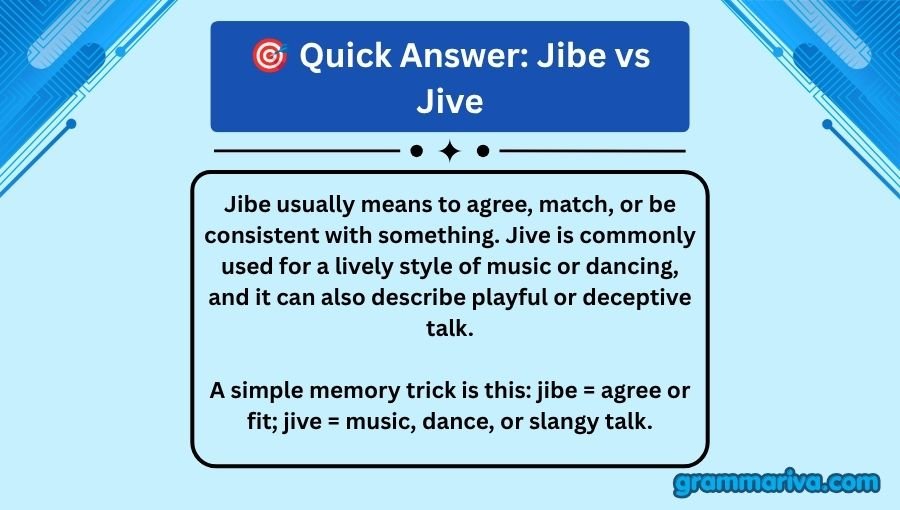
Jibe usually means to agree, match, or be consistent with something. Jive is commonly used for a lively style of music or dancing, and it can also describe playful or deceptive talk.
A simple memory trick is this: jibe = agree or fit; jive = music, dance, or slangy talk.
Jibe vs Jive: Meaning and Correct Use
The clearest way to understand jibe vs jive is to separate their main meanings.
Jibe is commonly used as a verb when two things agree or fit together. It can also be used as a noun in the expression “jibe with,” although the verb use is especially common.
Jive has several established uses. It can refer to a lively form of music and dance. It can also describe informal, playful, or misleading speech.
Here is the basic difference:
| Form | Type | Meaning | Example | Correct/Incorrect |
|---|---|---|---|---|
| Jibe | Verb | Agree or be consistent | Her story doesn’t jibe with the facts. | ✅ Correct |
| Jive | Noun | A lively style of music or dance | They danced the jive all night. | ✅ Correct |
| Jive | Verb | Talk or behave in a playful or misleading way | He was just jiving with us. | ✅ Correct |
| Jive | Verb | Mean “agree” in some informal usage | The details jive with the report. | ⚠️ Informal/less preferred |
| Jibe | Noun | A specific sailing maneuver | The sailor performed a jibe. | ✅ Correct |
The key point is that jibe is the safer choice when you mean “agree,” “match,” or “fit.”
Is Jibe the Same as Jive?
No. Jibe and jive have different main meanings, even though their uses can overlap in informal English.
If you want to say that one fact agrees with another, jibe is the standard choice.
✅ The witness’s statement jibes with the evidence.
❌ The witness’s statement jives with the evidence.
In casual speech, you may sometimes hear “jive” used to mean “agree.” That usage exists, but many editors prefer jibe for this meaning because it keeps the distinction clear.
For music and dance, however, jive is the natural word.
✅ They learned how to dance the jive.
❌ They learned how to dance the jibe.
So, while the words can occasionally overlap, they should not be treated as complete synonyms.
Key Differences Between Jibe and Jive
The biggest difference is meaning. Jibe is strongly connected with agreement or consistency, while jive has strong connections to music, dancing, and informal speech.
| Feature | Jibe | Jive |
|---|---|---|
| Main use | Agree or fit | Music, dance, or informal talk |
| Common phrase | Jibe with | Jive music |
| Can be a verb? | Yes | Yes |
| Can be a noun? | Yes | Yes |
| Used for agreement? | Standard | Informal in some usage |
| Used for dance? | Yes, in a separate sailing sense | Yes |
| Best memory clue | Agreement | Music and movement |
Think of the sentence you are trying to write. If the subject is facts, statements, evidence, numbers, or explanations, jibe will often be the right choice.
If the subject is dancing, music, playful language, or a certain kind of informal behavior, jive may be the better choice.
Why Do People Confuse Jibe and Jive?
People confuse these words because they are pronounced similarly in many varieties of English and have been used in overlapping ways.
Another reason is that both words can function as verbs. That makes the distinction less obvious when you are typing quickly.
I once edited a short business report in which the writer used “jive” several times to mean “agree.” The meaning was easy to understand, but I changed the formal uses to “jibe.” The writer later told me that the two words had always looked interchangeable to him.
That experience is common. The problem is usually not grammar knowledge. It is the close sound and spelling.
A simple way to separate them
Use this mental pair:
- Jibe → agreement
- Jive → music and dance
- Jive → playful or misleading talk
This is not an absolute rule for every historical or informal use. It is a practical guide for modern writing.
Jibe: Meaning and Correct Uses
The most common meaning of jibe is to agree or be consistent with something.
1. Jibe means “agree”
When one fact, statement, or explanation agrees with another, you can use jibe with.
✅ Her explanation jibes with what I heard.
❌ Her explanation jives with what I heard.
Here, “jibes with” means that her explanation is consistent with the other information.
2. Jibe can describe a good match
You can also use jibe when two ideas or details fit together.
✅ The numbers do not jibe with the final report.
❌ The numbers do not jive with the final report.
The first sentence says that the numbers and report do not agree.
3. Jibe has a sailing meaning
There is also a separate noun and verb use of jibe in sailing. It refers to changing the position of a sailing boat by bringing the stern through the wind.
This meaning is less common in everyday writing, but it is a legitimate use.
| Meaning | Word Type | Example Sentence |
|---|---|---|
| Agree or be consistent | Verb | Her account jibes with the evidence. |
| Match or fit | Verb | His actions do not jibe with his promises. |
| Sailing maneuver | Noun/Verb | The crew prepared for a jibe. |
💡 Test Tip
Replace jibe with agree. If the sentence still makes sense, jibe is probably the correct choice.
For example:
“The details jibe with her story.”
Try:
“The details agree with her story.”
The meaning works, so jibe is a good choice.
Jive: Meaning and Correct Uses
Jive has several established meanings, but they are different from the main meaning of jibe.
1. Jive can refer to music and dance
The word jive is strongly associated with a lively style of music and dance.
✅ The dancers performed a fast jive.
❌ The dancers performed a fast jibe.
Here, jive is clearly the correct word.
2. Jive can describe playful talk
In informal English, jive can describe playful, exaggerated, or sometimes misleading talk.
✅ Stop jiving around and tell me what happened.
The exact meaning depends on context. It can suggest joking, fooling around, or speaking in a way that is not completely serious.
3. Jive can work as an adjective in informal expressions
You may encounter expressions such as “jive talk” or descriptions of something as “jive.” These uses are informal and depend heavily on context.
Because jive has several slang-related meanings, it is usually not the best replacement for jibe in formal writing.
Jibe vs Jive in Real Sentences
Seeing the words in complete sentences makes the difference easier to remember.
| Sentence | Word | Meaning |
|---|---|---|
| The evidence does not jibe with his claim. | Jibe | Agree |
| She loves learning the jive. | Jive | Dance |
| His story doesn’t jibe with the facts. | Jibe | Match |
| They spent the evening dancing the jive. | Jive | Dance |
| He was jiving around instead of working. | Jive | Fooling around |
A useful question is: Am I talking about agreement, or am I talking about music, dancing, or informal behavior?
That question solves most everyday cases.
📝 Case Study: A Confusing Workplace Email
Imagine that a manager sends this email:
“The sales figures don’t jive with the numbers in the monthly report.”
The reader understands the meaning. The writer wants to say that the numbers do not agree.
For a polished professional email, I would write:
“The sales figures don’t jibe with the numbers in the monthly report.”
The change is small, but the wording is clearer and more conventional for formal writing.
The same principle applies to reports, academic work, business communication, and published articles. If you mean “agree” or “match,” jibe is the safer choice.
Grammar Rules Explanation
The main distinction is based on meaning and established usage.
Jibe functions as a verb meaning to agree, correspond, or be consistent. It is commonly followed by “with” when it describes agreement between two things.
Examples:
Her explanation jibes with the evidence.
The facts do not jibe with his claim.
Jive has separate established meanings. It can function as a noun or verb related to music and dance. It can also function as an informal verb connected with joking, fooling around, or misleading talk.
The difference matters because replacing one word with the other can make a sentence less precise.
In informal English, jive is sometimes used where jibe would traditionally be expected to mean “agree.” This overlap explains why you may encounter both forms in edited and unedited writing. However, for clear formal writing, using jibe for agreement is the better choice.
Standard English reference works generally recognize these words as distinct terms with overlapping pronunciation but different primary meanings.
Correct vs Incorrect at a Glance
| Sentence | Correct/Incorrect | Why |
|---|---|---|
| The facts jibe with her statement. | ✅ Correct | “Jibe” means agree or match. |
| The facts jive with her statement. | ⚠️ Informal | “Jive” is sometimes used this way, but “jibe” is clearer in formal writing. |
| He performed a lively jive. | ✅ Correct | “Jive” refers to the dance. |
| He performed a lively jibe. | ❌ Incorrect | “Jibe” does not mean this dance. |
| Her story doesn’t jibe with the evidence. | ✅ Correct | The ideas do not agree. |
⚠️ Common Mistakes With Jibe and Jive
The biggest mistake is choosing the spelling based only on sound.
Both words can sound alike or nearly alike in ordinary speech. That means listening alone may not help.
Why these mistakes happen
Fast typing: You may type the first spelling that comes to mind.
Autocorrect: Your device may accept the wrong word because both spellings are legitimate English words.
Lack of knowledge: If you have never learned the difference, the two forms naturally look interchangeable.
Informal exposure: You may see “jive” used to mean “agree” in casual writing, which makes the distinction harder to learn.
| Confusing Pair | Correct Distinction |
|---|---|
| Its / It’s | Possession vs. “it is” or “it has” |
| Your / You’re | Possession vs. “you are” |
| Their / They’re | Possession vs. “they are” |
| Then / Than | Time/order vs. comparison |
| Jibe / Jive | Agree/match vs. dance/music/informal talk |
Specific wrong forms and uses
| Wrong Form | What’s Wrong | Correct Form |
|---|---|---|
| The facts jive with the report. | Too informal for a formal agreement meaning | The facts jibe with the report. |
| They danced the jibe. | Wrong spelling for the dance | They danced the jive. |
| Her story doesn’t jive with the evidence. | “Jive” is less precise for formal agreement | Her story doesn’t jibe with the evidence. |
| He learned the jibe yesterday. | The dance is “jive” | He learned the jive yesterday. |
| The numbers jive with the records. | Agreement meaning is better expressed with “jibe” | The numbers jibe with the records. |
I once caught myself typing “jive” in a sentence about two sets of data agreeing. I stopped because the context was a formal report. Changing it to “jibe” made the intended meaning much clearer.
How To Remember the Difference
A memory trick can make jibe vs jive much easier.
Think of the letter B in jibe as standing for balance.
If two facts balance or agree, they jibe.
Think of the letter V in jive as pointing toward vibes.
Music, dancing, and lively movement can have a certain vibe. That connection can help you remember jive.
This is just a memory aid, not the history of the words.
The three-second test
Before choosing a spelling, ask:
- Does the sentence mean “agree”?
- Does it involve music or dancing?
- Does it describe playful or misleading talk?
If the answer to the first question is yes, choose jibe in formal writing.
If the answer involves dancing or music, choose jive.
Usage in Different Contexts
The right word can depend on what you are writing.
| Context | Which Term to Use | Example |
|---|---|---|
| Everyday conversation | Jibe for agreement; jive for dance or informal talk | Your story doesn’t jibe with mine. |
| Professional writing | Jibe for agreement | The figures do not jibe with the report. |
| Creative writing | Either, depending on meaning | The band played a lively jive. |
| Social media/texting | Either, depending on context | Those details don’t jibe at all. |
In professional writing, I recommend being especially careful. A reader may understand an informal use of jive, but a precise word choice makes your writing look more polished.
Can You Use Jive to Mean Agree?
Yes, you may encounter jive used informally to mean “agree” or “fit,” but jibe is the clearer choice for formal writing.
For example:
✅ The evidence doesn’t jibe with his claim.
⚠️ The evidence doesn’t jive with his claim.
The second sentence is understandable, but the first is the better editorial choice when you mean that two things are consistent.
This distinction is especially useful in business writing, school assignments, journalism, and other settings where word choice matters.
Common Phrases With Jibe and Jive
There are several useful expressions that can help you remember the words.
| Phrase | Meaning |
|---|---|
| Jibe with | Agree or be consistent with |
| Not jibe with | Conflict with or fail to match |
| Jive music | A style of lively music |
| Dance the jive | Perform the jive dance |
| Jive around | Fool around or act unseriously |
| Jive talk | Informal or misleading talk |
The phrase jibe with is especially important because it is one of the most common contexts in which learners need to choose between the two spellings.
Is “Jibe With” the Correct Expression?
Yes. Jibe with is the standard expression when you mean that one thing agrees with or matches another.
For example:
✅ The witness’s account jibes with the video.
The sentence means that the account is consistent with what the video shows.
You can also use the negative form:
✅ His explanation does not jibe with the available evidence.
Here, the explanation conflicts with the evidence.
A useful substitution test is to replace “jibe with” with “agree with.”
“The results jibe with the prediction.”
“The results agree with the prediction.”
Both sentences express the same basic idea.
Jibe vs Jive in Professional Writing
Professional writing rewards precision. When you are discussing facts, reports, data, statements, or evidence, jibe is usually the best choice when you mean “agree.”
Consider these examples:
✅ The audit results jibe with the original records.
❌ The audit results jive with the original records.
The first version is more appropriate for a formal report.
In a business email, you could write:
“The updated figures do not jibe with the previous report. Could you please review the totals?”
That wording is clear and professional.
Jibe vs Jive in Everyday Conversation
Everyday speech is more flexible. People may use jive in places where formal editors would prefer jibe.
That does not mean every informal use is wrong. Language changes through common use, and context matters.
Still, if you are unsure, the safest rule is simple:
Use jibe for agreement and jive for music, dancing, or informal behavior.
This rule will serve you well in most modern writing situations.
Synonyms and Alternatives
Sometimes you can avoid the confusion entirely by choosing a different word.
| Alternative | Works When | Does Not Work When |
|---|---|---|
| Agree | Two ideas or facts match | You mean a dance |
| Match | Two things correspond | You mean informal talk |
| Fit | Details work together | You mean a music style |
| Consistent with | Formal writing about agreement | You want a casual dance reference |
| Correspond | Facts or details align | You mean playful speech |
For example:
“The figures jibe with the report.”
could become:
“The figures agree with the report.”
or:
“The figures are consistent with the report.”
These alternatives are especially useful if you are writing for an audience that may not know the distinction.
Why Getting Jibe and Jive Right Matters
Correct word choice improves clarity. It also shows that you understand the meaning behind the words you use.
A reader may not consciously notice that you chose jibe instead of jive, but accurate word choice makes the sentence feel natural.
Clear writing begins with choosing the word that carries the meaning you actually intend.
| Situation | Why Getting It Right Matters |
|---|---|
| Resume | Shows careful writing skills |
| Client email | Keeps professional communication precise |
| Published content | Builds reader confidence |
| Social post | Prevents avoidable confusion |
The difference may seem tiny, but small word choices add up. A polished piece of writing is usually made from many small decisions.
Does Jibe Have Any Other Meaning?
Yes. Jibe also has a sailing-related meaning.
In sailing, a jibe is a maneuver in which a boat changes direction with the stern passing through the wind. The word can function as a noun or verb in this context.
For example:
“The crew prepared for a jibe.”
This meaning is separate from the common “agree” meaning.
That creates an interesting contrast:
- Jibe can mean agree.
- Jibe can also refer to a sailing maneuver.
- Jive can refer to music or dance.
- Jive can describe informal or playful behavior.
Context tells you which meaning is intended.
Jibe vs Jive: A Simple Decision Guide
When you are unsure, use this quick guide.
| Ask Yourself | If Yes → Use |
|---|---|
| Do I mean “agree”? | Jibe |
| Do I mean “match”? | Jibe |
| Am I discussing facts that are consistent? | Jibe |
| Am I talking about a dance? | Jive |
| Am I talking about a style of music? | Jive |
| Am I describing playful or misleading talk? | Jive |
| Am I writing formally about agreement? | Jibe |
This guide covers most situations you are likely to encounter.
🧠 A Fast Memory Trick for Jibe vs Jive
Remember this short sentence:
“Facts jibe. Dancers jive.”
It is short enough to remember and gives you a useful mental shortcut.
Here are a few practice examples:
- The numbers ___ with the report.
- Answer: jibe ✅
- They performed the ___ at the dance competition.
- Answer: jive ✅
- Her explanation does not ___ with the evidence.
- Answer: jibe ✅
- The performers practiced the ___ for weeks.
- Answer: jive ✅
If you can answer these quickly, you have probably mastered the basic distinction.
📝 Practice: Choose the Correct Word
Try these before looking at the answers.
Example 1
“The two accounts do not ___ with each other.”
Answer: jibe ✅
The accounts do not agree.
Example 2
“She learned how to ___ during the class.”
Answer: jive ✅
The sentence refers to dancing.
Example 3
“His explanation doesn’t ___ with the available evidence.”
Answer: jibe ✅
The explanation does not match the evidence.
Example 4
“The band played music for a lively ___.”
Answer: jive ✅
The sentence refers to music and dance.
Example 5
“The new data ___ with our earlier findings.”
Answer: jibe ✅
The data agree with the earlier findings.
Common Sentence Patterns to Learn
Learning common patterns is often easier than memorizing isolated definitions.
Pattern 1: Jibe with + noun
“The facts jibe with the evidence.”
Pattern 2: Do not jibe with + noun
“His actions do not jibe with his promises.”
Pattern 3: Dance the jive
“They danced the jive at the event.”
Pattern 4: Jive around
“Stop jiving around and finish the task.”
| Pattern | Meaning | Example |
|---|---|---|
| Jibe with | Agree with | The facts jibe with the report. |
| Does not jibe with | Does not agree with | Her story does not jibe with the evidence. |
| Dance the jive | Perform the dance | They danced the jive. |
| Jive around | Fool around | He kept jiving around. |
These patterns make the distinction easier to apply naturally.
How Jibe and Jive Work in Digital Communication
Text messages and social media often make spelling confusion worse because people type quickly and rarely stop to check individual words.
You might see:
“That doesn’t jive with what you said.”
The meaning is clear. The writer means that the two statements do not agree.
In a casual message, readers will usually understand it. In a formal article, report, or email, however, jibe is the better choice for this meaning.
Digital writing has made word accuracy more visible because short messages are often shared, quoted, or published without editing.
Quick Recap Checklist
Use this checklist whenever you are unsure.
| Question | If Yes → Use |
|---|---|
| Does the sentence mean “agree”? | Jibe |
| Does it mean “be consistent with”? | Jibe |
| Does it describe a dance? | Jive |
| Does it refer to music? | Jive |
| Does it describe playful or misleading talk? | Jive |
| Is the sentence a formal statement about agreement? | Jibe |
Practice examples
1. The witness’s account ___ with the evidence.
Answer: jibes ✅
2. They performed the ___ at the festival.
Answer: jive ✅
3. The new figures do not ___ with the old report.
Answer: jibe ✅
A final memory line:
Jibe means agreement. Jive brings music, dance, or informal talk.
FAQs About Jibe vs Jive
What is the difference between jibe and jive?
Jibe usually means to agree, match, or be consistent with something. Jive commonly refers to music, dancing, or informal and playful speech.
Is “jibe with” or “jive with” correct?
Jibe with is the standard choice when you mean “agree with” or “be consistent with.” For formal writing, use “jibe with.”
Is jive ever used to mean agree?
Yes. Jive is sometimes used informally to mean “agree” or “fit,” especially in casual speech and writing. However, jibe is the clearer and more traditional choice for formal writing when you mean agreement.
Which is correct: “the facts jibe” or “the facts jive”?
When you mean that the facts agree or are consistent, the facts jibe is the preferred form.
Is the dance called a jibe or a jive?
The dance is called the jive. For example: “They performed the jive.”
What does “jibe with” mean?
“Jibe with” means to agree with, match, or be consistent with something.
Example: “Her explanation jibes with the evidence.”
Can jibe be a noun?
Yes. Jibe can be a noun in several contexts, including a sailing maneuver. It can also appear in the expression “in jibe” in specialized usage, although the agreement use is more commonly encountered as a verb.
Can jive be a verb?
Yes. Jive can be used as a verb for dancing or for informal behavior such as fooling around. It can also appear in informal expressions involving talk or interaction.
Which word should I use in a formal email: jibe or jive?
Use jibe when you mean that information, facts, numbers, or statements agree. For example: “The figures do not jibe with the previous report.”
How can I remember jibe vs jive?
Remember: “Facts jibe. Dancers jive.” Use jibe for agreement and jive for music, dancing, or informal behavior.
Conclusion
Jibe vs jive becomes much easier once you connect each spelling with its main meaning. Use jibe when you mean that something agrees, matches, or is consistent with something else. Use jive when you are talking about a style of music or dance, or about certain kinds of informal and playful speech.
The phrase jibe with is especially useful to remember. If you can replace the phrase with “agree with,” jibe is usually the word you want. If the sentence involves dancing or music, jive is the natural choice. 🎯
Do not let the similar spelling trick you. You do not need to memorize dozens of rules. Just stop for a second and ask what the sentence means. That small check can prevent an easy spelling mistake.
The simplest rule is worth remembering: facts jibe, dancers jive. Keep that line in mind, and choosing between these two words will become almost automatic. ✨

Hi, I’m Nathan Reed. I’m a grammar and writing specialist at Grammariva. I work on practical grammar content that helps readers understand sentence structure, punctuation, vocabulary, and better writing habits.
[…] need to know where each spelling is preferred and how to keep your writing consistent. ✍️ Jibe vs Jive | Recurring vs Reoccurring | Take a Rest vs Have a […]
[…] By the end, choosing between these words should feel natural. 😊 Specialty vs Speciality | Jibe vs Jive | Recurring vs […]