Have you ever typed roofs vs rooves and stopped because you were not sure which spelling looked right? You are not alone. English has many plural words that do not follow simple rules. That can make a common word like roof surprisingly confusing. 🧐
The good news is that the rule here is much easier than it seems. In standard modern American English, roofs is the normal plural form of roof. You will see it in everyday writing, professional documents, news articles, textbooks, and most edited content.
But what about rooves? You may have seen it before, especially in older writing or some varieties of British English. It is a real historical or regional spelling, but it is not the usual choice in modern American English.
In this guide, I will explain the difference between roofs vs rooves, show you which form to use, explain why the confusion exists, and give you simple tests you can use whenever you are unsure. By the end, the choice should feel easy. 🏡 Dieing vs Dying | Is It to or Too Early | Mom vs Mum
🎯 Quick Answer: Roofs vs Rooves
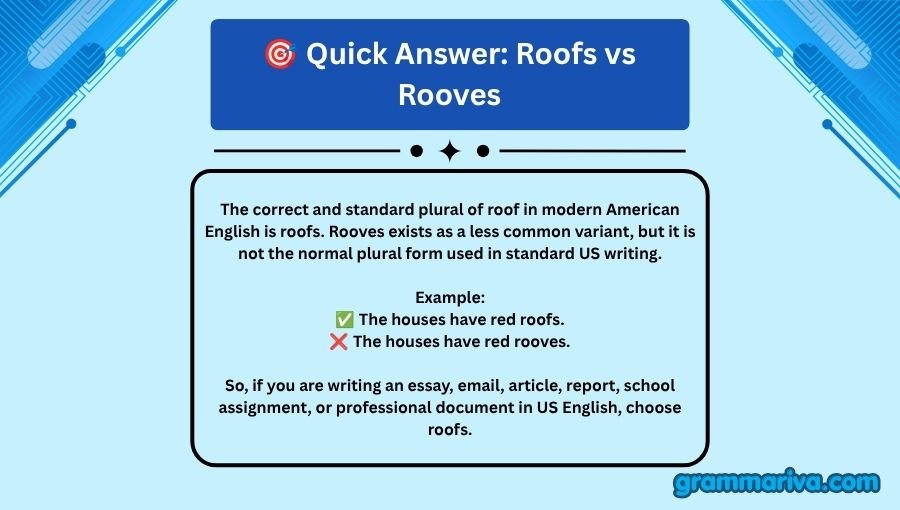
The correct and standard plural of roof in modern American English is roofs. Rooves exists as a less common variant, but it is not the normal plural form used in standard US writing.
Example:
✅ The houses have red roofs.
❌ The houses have red rooves.
So, if you are writing an essay, email, article, report, school assignment, or professional document in US English, choose roofs.
🏠 Related Word Forms of Roof
The word roof has several useful forms, but the plural form is the one that causes the most confusion. The basic noun is roof, while roofs is its regular plural. Roof’s is possessive, so it has a different job.
| Form | Type | Example |
|---|---|---|
| roof | Singular noun | The roof needs repair. |
| roofs | Plural noun | The roofs need repair. |
| roof’s | Singular possessive | The roof’s color is gray. |
| roofs’ | Plural possessive | The roofs’ surfaces were damaged. |
| roofing | Related noun/participle | The roofing needs replacement. |
| roofed | Past tense/past participle | The workers roofed the building. |
The apostrophe changes the meaning. Roofs simply means more than one roof. Roof’s means something belongs to one roof or is connected to one roof. Roofs’ shows possession involving multiple roofs.
🔎 Understanding Roofs vs Rooves
The main difference is simple: roofs is the standard modern plural form, while rooves is a less common variant. For most American English writing, roofs is the clear choice.
| Form | Type | Meaning | Example | Correct/Incorrect |
|---|---|---|---|---|
| roof | Singular noun | One covering of a building | The roof is leaking. | Correct |
| roofs | Plural noun | More than one roof | The roofs are leaking. | Correct |
| rooves | Variant plural | Alternative plural spelling | The old rooves were repaired. | Usually avoid in US English |
| roof’s | Singular possessive | Belonging to one roof | The roof’s edge is damaged. | Correct |
| roofs’ | Plural possessive | Belonging to several roofs | The roofs’ colors matched. | Correct |
The key point is that roof does not need an unusual plural ending in modern standard English. The regular plural -s works perfectly.
Why Is Roof Pluralized as Roofs?
Roofs follows the regular English plural pattern. Add -s to the singular noun roof, and you get roofs.
This is similar to many other common nouns:
- book → books
- chair → chairs
- house → houses
- wall → walls
- roof → roofs
The spelling may look unusual because some English nouns ending in certain sounds take -es. But roof does not need that ending.
Does the Sound Change?
The plural roofs is normally pronounced with an s sound at the end. You do not need to change the spelling to make the plural work.
For writing purposes, the important point is simple: the plural spelling is roofs.
❓ Is Roofs the Correct Plural of Roof?
Yes. Roofs is the standard plural of roof in modern American English. It means two or more roofs.
For example:
The storm damaged several roofs across the neighborhood.
Here, roofs refers to multiple building roofs.
Another example:
Workers inspected the roofs before winter.
Again, the word refers to more than one roof.
The spelling rooves may appear in some sources, but it is much less common. If your goal is clear, standard US English, roofs is the safest choice.
❓ Why Do People Confuse Roofs and Rooves?
People often confuse these spellings because English has several plural patterns, and some words do use unusual plural forms. A writer may expect roof to behave like another word that changes its spelling when pluralized.
For example:
- hoof → hooves
- leaf → leaves
- knife → knives
- wolf → wolves
That pattern can make rooves look logical.
I once edited a short school handout where a student had written rooves several times. The student knew the rule for hooves and assumed roof followed the same pattern. Once we compared the words, the difference became much easier to remember.
The problem is not that the writer does not understand English. The problem is that English has many exceptions and competing patterns.
The Hoof Comparison
The word hoof is one reason people may expect roof to become rooves.
| Singular | Common Plural | Pattern |
|---|---|---|
| roof | roofs | Regular plural |
| hoof | hooves | Irregular spelling change |
| leaf | leaves | Irregular spelling change |
| wolf | wolves | Irregular spelling change |
| belief | beliefs | Regular plural |
| chief | chiefs | Regular plural |
The important lesson is this: words that look similar do not always form their plurals in the same way.
📝 Roofs vs Rooves in Real Sentences
Seeing the words in complete sentences makes the rule easier to apply.
Example 1: Homes
✅ Several homes have solar panels on their roofs.
❌ Several homes have solar panels on their rooves.
The first sentence uses the standard plural.
Example 2: Construction
✅ The company repairs damaged roofs.
❌ The company repairs damaged rooves.
Professional writing should normally use roofs.
Example 3: Weather
✅ Heavy snow can damage roofs.
❌ Heavy snow can damage rooves.
Again, roofs is the normal modern spelling.
Example 4: Architecture
✅ The buildings have steep roofs.
❌ The buildings have steep rooves.
The plural noun is simply roofs.
💡 Test Tip: Use the Simple Singular-to-Plural Test
When I teach this point, I recommend one quick test: say the singular word first, then add -s.
roof → roofs
If the sentence means more than one roof, roofs is the normal answer.
You can also replace the word with another regular plural noun.
The houses have large roofs.
Think:
The houses have large windows.
Both roofs and windows simply refer to multiple objects.
Do not automatically copy the pattern from hoof → hooves. English spelling patterns do not always transfer from one word to another.
📚 Correct Meanings and Uses of Roof
The word roof has several related uses. Knowing these uses helps you understand why the plural form stays the same.
Roof as the Top of a Building
The most common meaning is the structure that covers the top of a building.
The roof protects the house from rain.
When talking about several buildings, use roofs.
The roofs protected the houses from the storm.
Roof as the Upper Covering of Something
Roof can also describe the upper covering of certain structures.
The car has a roof.
With more than one vehicle:
The cars have different roofs.
Roof in Figurative Language
The word can also appear in expressions with a figurative meaning.
The crowd raised the roof.
This does not mean people physically lifted a roof. It means they made a lot of noise or excitement.
| Meaning | Word Type | Example Sentence |
|---|---|---|
| Covering of a building | Noun | The roof is new. |
| Upper covering of a structure | Noun | The stadium roof opened. |
| Figurative upper limit or covering | Noun | The noise nearly raised the roof. |
🏢 Case Study: A Workplace Email
Imagine a property manager needs to email a contractor about several buildings.
A weak version might say:
The inspection found damage on three rooves.
A better version is:
The inspection found damage on three roofs.
The second sentence is the better choice for standard US professional writing.
The reason is not complicated. The writer is referring to three separate roof structures, so the regular plural roofs is appropriate.
I once caught myself typing a strange plural while editing a construction report. I paused, checked the singular form, and changed it to roofs. That small check took only a few seconds.
This is a useful lesson for everyone. Even experienced writers can hesitate over unusual spelling patterns.
📖 Grammar Rules Explanation
The grammar rule is straightforward: roof normally forms its plural by adding -s, producing roofs.
There is no grammatical need to change f to v.
In standard English, some nouns ending in -f or -fe do change spelling in the plural. Examples include leaf → leaves and knife → knives. But this is not a universal rule.
Other words keep their final f:
- belief → beliefs
- chef → chefs
- chief → chiefs
- cliff → cliffs
- proof → proofs
- roof → roofs
That means you cannot determine the plural simply by looking at the final letter.
Most standard reference sources agree that roofs is the normal modern plural. Rooves can be found as a variant, but it is not the form most writers should choose in ordinary American English.
Correct vs Incorrect at a Glance
| Sentence | Correct/Incorrect | Why |
|---|---|---|
| The roofs need repair. | ✅ Correct | Roofs is the standard plural. |
| The rooves need repair. | ❌ Usually incorrect for standard US use | Rooves is an uncommon variant. |
| We inspected five roofs. | ✅ Correct | The sentence needs a plural noun. |
| The house’s roof is old. | ✅ Correct | Roof is singular and possessive. |
| The roofs’ surfaces were damaged. | ✅ Correct | Roofs’ is plural possessive. |
The distinction between roofs and roofs’ is also worth remembering. The apostrophe in roofs’ does not create the plural. The plural is already roofs.
⚠️ Common Mistakes With Roofs
The most common mistake is replacing roofs with rooves because the writer remembers other words that change f to v.
Mistakes can happen for several reasons:
- Fast typing
- Autocorrect
- Lack of knowledge
- Copying an older spelling
- Confusing roof with hoof
- Assuming every -f word has the same plural rule
Autocorrect can also make things worse. A writer may type quickly, see that a word looks familiar, and move on without checking it.
Similar Grammar Confusions
| Confusion | Correct Form | Main Difference |
|---|---|---|
| it’s / its | Both can be correct | It’s = it is; its = possessive |
| your / you’re | Both can be correct | Your = possessive; you’re = you are |
| their / they’re | Both can be correct | Their = possessive; they’re = they are |
| then / than | Depends on meaning | Time/order vs comparison |
| affect / effect | Depends on use | Different grammatical roles and meanings |
| roof / roofs | Both can be correct | Singular vs plural |
The last pair is especially easy when the writer forgets that roofs already contains the plural ending.
Specific Wrong Forms to Avoid
| Wrong Form | What’s Wrong | Correct Form |
|---|---|---|
| rooves | Uncommon variant in standard US writing | roofs |
| roofes | Incorrect extra ending | roofs |
| roof’s | Incorrect if you only mean more than one roof | roofs |
| roofs’s | Incorrect plural possessive construction | roofs’ |
| roofes’ | Incorrect plural and possessive spelling | roofs’ |
Remember that roof’s can be correct when it is possessive.
The roof’s edge is damaged.
Here, the edge belongs to one roof.
But:
The roofs are damaged.
Here, you are simply talking about several roofs.
❓ When Should You Use Roofs in Professional Writing?
Use roofs in professional writing whenever you mean more than one roof. This includes reports, business emails, construction documents, news writing, school work, and technical material.
For example:
Our team inspected the roofs of all six buildings.
That sentence is clear and standard.
Professional readers should not have to stop and wonder whether an unusual spelling is intentional. Choosing the common form keeps the message smooth.
| Professional Situation | Recommended Form | Example |
|---|---|---|
| Inspection report | roofs | The roofs require inspection. |
| Contractor email | roofs | We repaired two roofs. |
| School assignment | roofs | The roofs were damaged. |
| News article | roofs | Storm winds damaged roofs. |
| Business proposal | roofs | The plan covers all roofs. |
❓ Is Rooves Ever Correct?
Rooves is a real variant spelling, but it is uncommon in modern standard US English. For most readers, roofs will look more natural and familiar.
This distinction matters because a word can exist without being the best choice for everyday writing.
You may encounter rooves in older material, historical texts, regional usage, or sources influenced by older spelling traditions. Seeing it does not mean that every writer should use it.
A good rule is:
If you are writing modern American English, choose roofs.
If you are quoting an old text or discussing historical spelling, you may need to preserve rooves exactly as it appears in the original.
🌎 Roofs vs Rooves Across Different Contexts
The preferred form remains roofs in ordinary modern US English. Context can affect how unusual rooves feels, but it does not change the main recommendation.
| Context | Which Term to Use | Example |
|---|---|---|
| Everyday conversation | roofs | Those roofs look new. |
| Professional writing | roofs | The roofs require repairs. |
| Creative writing | Usually roofs | Snow covered the roofs. |
| Social media/texting | roofs | Look at those colorful roofs! |
Creative writing may allow unusual word choices for style. Even so, rooves should not be inserted simply because it sounds more poetic.
The same applies to social media. Informal writing has fewer editing rules, but roofs is still the natural standard form.
✍️ How to Remember the Difference
A simple memory trick can save you from this mistake.
Think: Roof + S = Roofs
Do not make the word more complicated than it needs to be.
ROOF + S = ROOFS
You can also remember this sentence:
Many roofs, one roof.
One building has a roof.
Several buildings have roofs.
Another useful trick is to group roof with other words that keep f in the plural:
- roof → roofs
- proof → proofs
- belief → beliefs
- chief → chiefs
- chef → chefs
This does not mean every -f word follows the same rule. It simply gives you a useful memory group.
🧠 Roofs vs Rooves: A Memory Chart
Use this chart when you need a quick review.
| Singular | Standard Plural | Remember |
|---|---|---|
| roof | roofs | Add -s |
| proof | proofs | Add -s |
| chief | chiefs | Add -s |
| chef | chefs | Add -s |
| belief | beliefs | Add -s |
| hoof | hooves | Different pattern |
| leaf | leaves | Different pattern |
| knife | knives | Different pattern |
The biggest lesson is that English plural spelling must often be learned word by word.
❓ Why Doesn’t Roof Become Rooves Like Hoof Becomes Hooves?
Because English does not apply one universal spelling rule to every noun ending in f. Some words change the ending when pluralized, while others simply add -s.
Compare:
hoof → hooves
with:
roof → roofs
Both words end in a similar letter pattern. Yet their standard plural spellings differ.
This is common in English. Similar-looking words can have different plural forms.
The safest approach is not to guess from one word. Learn the accepted plural for the specific noun you are using.
💬 Common Phrases With Roofs
There are several everyday expressions and phrases that use roof or roofs. Most are straightforward.
| Phrase | Meaning |
|---|---|
| under one roof | In the same home or building |
| raise the roof | Make a lot of noise or excitement |
| hit the roof | Become very angry |
| roof over one’s head | A place to live |
| from roof to floor | From the top to the bottom |
| on the roof | Located on top of a building |
Notice that fixed expressions often use the singular roof because they refer to the concept of a roof rather than multiple physical roofs.
For example:
We all live under one roof.
You would not normally change that expression to under one roofs.
🔄 Synonyms and Alternatives for Roof
Sometimes you can replace roof with another phrase, but the replacement depends on the meaning.
| Alternative | Works When | Does Not Work When |
|---|---|---|
| covering | Referring to a top layer | You specifically mean a building roof |
| rooftop | Referring to the top surface | You mean the complete roof structure |
| canopy | Referring to a covering overhead | You mean a normal house roof |
| shelter | Referring to protection or a place to stay | You need a precise construction term |
| top | Informal or broad description | Technical precision matters |
For most sentences about buildings, roof remains the clearest word.
For example:
Workers repaired the roofs.
Replacing roofs with tops would make the sentence less precise.
❓ Does Roofs Mean More Than One Roof?
Yes. Roofs is the plural noun meaning two or more roofs.
For example:
The neighborhood has hundreds of roofs.
The sentence refers to many separate roof structures.
The singular form is:
The neighborhood has one roof.
The plural form is:
The neighborhood has many roofs.
This singular-versus-plural test works in almost every basic sentence.
🏗️ Roofs in Construction and Real Estate
Construction and real estate are two areas where the word roofs appears often. Reports may discuss the condition, material, shape, age, or repair needs of several roofs.
Examples include:
- metal roofs
- flat roofs
- green roofs
- tile roofs
- residential roofs
- commercial roofs
- damaged roofs
- new roofs
All of these use roofs as the normal plural.
| Phrase | Meaning |
|---|---|
| metal roofs | Roofs made with metal materials |
| flat roofs | Roofs with little slope |
| tile roofs | Roofs covered with tiles |
| commercial roofs | Roofs on commercial buildings |
| damaged roofs | Roofs that need repair |
If you work in construction, property management, architecture, or real estate, using the standard spelling helps your documents look polished.
❓ Are Roofs and Rooves Pronounced Differently?
The main issue is spelling, not a need for a different plural meaning. In ordinary modern English, roofs is the standard written plural form.
If you encounter rooves, pronunciation may vary by speaker or region, but there is no reason for a modern American writer to choose that spelling simply because of pronunciation.
When writing, focus on the standard form:
roof → roofs
That is enough for most situations.
📱 Roofs in Social Media and Texting
Informal writing gives people more freedom, but roofs remains the natural standard spelling.
For example:
These colorful roofs are giving vacation vibes. 🌈
Or:
I could stare at these old roofs all day.
Using rooves may make the caption look like a spelling error to many readers.
That can matter if you are posting professional content, running a business account, or publishing educational material.
A casual post does not need perfect formal grammar in every sentence, but common words should still be spelled clearly when possible.
⚠️ Why Getting Roofs Right Matters
A single spelling mistake may seem tiny. Yet repeated mistakes can affect how readers view your writing.
Clear spelling helps with:
- Clarity: Readers understand your meaning quickly.
- Professionalism: Your writing looks carefully edited.
- Digital communication: Emails and posts are easier to read.
- Trust: Accurate writing can make information feel more reliable.
A reader should focus on your message, not wonder whether an unusual spelling was intentional.
A Simple Writing Principle
Good word choice should make reading easier, not make readers stop and guess.
That is especially true in professional writing.
| Situation | Why Getting It Right Matters |
|---|---|
| Resume | Shows attention to detail |
| Client email | Keeps communication professional |
| Published content | Builds reader confidence |
| Social post | Prevents avoidable spelling confusion |
🧩 Special Exception: Historical or Regional Usage
The main exception is when you are dealing with a source or style that deliberately uses rooves.
You might see the spelling in older writing or in some regional varieties of English. In that situation, rooves may be preserved because the writer is quoting or studying that specific form.
However, this does not change the practical rule for modern US English.
If you are writing your own sentence today, use roofs.
If you are reproducing an older sentence exactly, keep the original spelling when accuracy requires it.
This is a useful distinction between writing correctly for modern readers and preserving historical wording.
❓ Should You Use Roofs or Rooves in American English?
Use roofs in American English. It is the standard modern plural form and the best choice for most writing.
Choose rooves only when there is a specific reason to preserve or discuss that variant.
For normal American English:
The roofs were damaged by the storm.
That is the version you should use.
📊 Roofs vs Rooves Quick Comparison
| Feature | Roofs | Rooves |
|---|---|---|
| Standard modern US plural | Yes | No |
| Refers to multiple roofs | Yes | Yes, as a variant |
| Common in everyday writing | Yes | No |
| Recommended for school work | Yes | Usually no |
| Recommended for business writing | Yes | Usually no |
| Can appear in older or regional usage | Yes | Yes |
| Best choice for modern US English | Yes | No |
The table makes the main point clear: roofs is the practical choice for modern American English.
📝 Practice Examples
Try these examples yourself before checking the answers.
Practice 1
The storm damaged several ________.
Answer: roofs
Practice 2
The contractor inspected the ________ of three buildings.
Answer: roofs
Practice 3
The ________ edge needs to be repaired.
Answer: roof’s
Notice that this last example is different. It refers to one roof and uses the possessive form.
Practice 4
The ________ surfaces were covered with snow.
Answer: roofs’
Here, the sentence refers to surfaces belonging to multiple roofs.
❓ How Can You Tell Whether Roofs Is Plural or Possessive?
Look for an apostrophe.
Roofs = plural.
The roofs are old.
Roof’s = singular possessive.
The roof’s tiles are old.
Roofs’ = plural possessive.
The roofs’ tiles are old.
| Form | Meaning | Example |
|---|---|---|
| roof | One roof | The roof is green. |
| roofs | More than one | The roofs are green. |
| roof’s | Belonging to one | The roof’s color is green. |
| roofs’ | Belonging to several | The roofs’ colors are different. |
This is a small punctuation rule, but it can completely change the meaning of a sentence.
❓ Is Rooves a Spelling Mistake?
Not always. Rooves is a recognized variant spelling, but it is uncommon and generally not the preferred form in modern American English.
That distinction matters.
Calling every occurrence of rooves an absolute spelling error would be too strong because the form has appeared in real English usage. However, telling a modern US writer to use rooves as the normal plural would also be misleading.
For practical writing, the answer is simple:
Use roofs.
🔍 How Editors Handle Roofs vs Rooves
Editors usually consider the audience, style guide, and type of publication. For standard US content, the regular plural roofs is the natural choice.
If I were editing a blog post, business report, school paper, or website written in American English, I would normally change rooves to roofs unless the context gave me a clear reason to preserve the variant.
This approach keeps the writing familiar and easy to read.
An editor’s goal is not simply to change unusual words. The goal is to make the text clear, correct, and appropriate for its audience.
🧠 How To Remember Roofs vs Rooves
Here is the shortest rule to memorize:
One roof. Two roofs. Many roofs.
Do not let hoof → hooves trick you into changing roof.
Think of roof as part of the regular -s group:
- roof → roofs
- proof → proofs
- chief → chiefs
- chef → chefs
- belief → beliefs
When you see rooves, pause and ask:
Am I writing modern American English?
If the answer is yes, choose roofs.
✅ Quick Recap Checklist
Use this checklist whenever you are unsure.
| Question | If Yes → Use |
|---|---|
| Do I mean more than one roof? | roofs |
| Am I writing standard US English? | roofs |
| Am I writing a professional document? | roofs |
| Am I describing several buildings? | roofs |
| Am I preserving an older quotation? | Keep the original if needed |
| Am I showing possession by one roof? | roof’s |
| Am I showing possession by several roofs? | roofs’ |
Three Quick Practice Sentences
- The houses have new roofs.
- The roof’s surface is wet.
- The roofs’ colors are different.
If you can tell these three forms apart, you have mastered the main rule.
❓ Why Do English Words Ending in F Have Different Plurals?
English has more than one plural pattern for nouns ending in f or fe. Some words change their ending, while others simply add -s.
Examples include:
- leaf → leaves
- knife → knives
- wolf → wolves
- roof → roofs
- belief → beliefs
- chief → chiefs
There is no single rule that correctly changes every word ending in f.
That is why memorizing the standard form of common words is useful.
FAQs About Roofs vs Rooves
❓ What is the correct plural of roof?
The standard plural of roof is roofs. This is the form normally used in modern American English.
❓ Is rooves grammatically correct?
Rooves exists as a less common variant plural of roof. However, it is not the normal choice for modern standard US English. In most writing, use roofs.
❓ Why is it roofs instead of rooves?
English plural rules are not completely uniform. Some nouns ending in f change to ves, but others keep the f and add -s. Roof belongs to the second group in standard modern usage.
❓ Is roofs correct in American English?
Yes. Roofs is the standard plural form in American English and is the recommended choice for school, business, professional, and general writing.
❓ Is rooves British English?
Rooves can occur in British and other varieties of English, but it is not simply a standard British-only spelling. It is better understood as a less common variant rather than the normal plural form everywhere outside the United States.
❓ Is roof’s the plural of roof?
No. Roof’s is usually a singular possessive form. For example, “The roof’s edge is damaged” means the edge belongs to one roof. The normal plural is roofs.
❓ What is the plural possessive of roof?
The plural possessive is roofs’. For example: “The roofs’ surfaces were damaged.” The apostrophe comes after the s because the noun is already plural.
❓ Why do people write rooves?
People may write rooves because they know plural forms such as hooves, leaves, and wolves. They may assume that every noun ending in f follows the same pattern. That assumption is incorrect for roof in standard modern usage.
❓ Should I use roofs or rooves in an essay?
Use roofs. It is the standard and familiar plural form in modern American English. It is the safest choice for essays, assignments, reports, and other formal writing.
❓ How do I remember the correct spelling?
Use this simple memory line: one roof, two roofs, many roofs. Think of roof as a noun that simply takes -s in the plural.
🎯 Final Conclusion: Roofs vs Rooves Made Simple
Roofs vs rooves becomes much easier once you remember one basic rule: roofs is the standard plural form in modern American English.
One building has a roof. Two buildings have roofs. That is the form you should normally use in essays, emails, reports, articles, websites, and everyday writing. 🏠
Rooves is not a completely invented spelling. It has appeared as a less common variant in English. You may encounter it in older, regional, or specialized contexts. Still, that does not make it the best choice for modern US writing.
I recommend keeping the rule simple. Do not assume that every word ending in f changes to ves. Compare hoof → hooves with roof → roofs, and you will see why guessing can lead you astray.
The easiest memory trick is also the best one: one roof, two roofs, many roofs.
When in doubt, choose the familiar standard form. Write roofs, keep your meaning clear, and let your writing stand strong. ✨

Hi, I’m Lucas Bennett. I’m a grammar content specialist at Grammariva. I work on articles covering everyday grammar questions, sentence usage, and writing tips that readers can apply with confidence.



[…] phrase, why people confuse them, how to remember the difference, and how to avoid common mistakes. Roofs vs Rooves | Dieing vs Dying | For Who or For […]
[…] whenever you face the it is must vs it is a must question. ✨Piece of Mine or Peace of Mind | Roofs vs Rooves | Dieing vs […]