Have you ever written “it is must” and wondered if you should add an a? You are not alone. The difference between it is must vs it is a must looks tiny, but that one small word changes whether the sentence follows standard English grammar. 😊
I have seen this mistake in emails, school assignments, website copy, and casual messages. The good news is that the rule is simple. “It is a must” is the standard correct form when you mean that something is necessary, required, or highly recommended. “It is must” does not work as a normal English sentence.
In this guide, I will explain why the article a matters, how to use the correct expression, and what alternatives you can choose. We will also look at real examples, common mistakes, workplace writing, texting, and useful memory tricks.
By the end, you should feel confident whenever you face the it is must vs it is a must question. ✨Piece of Mine or Peace of Mind | Roofs vs Rooves | Dieing vs Dying
🎯 Quick Answer: Is “It Is Must” or “It Is a Must” Correct?
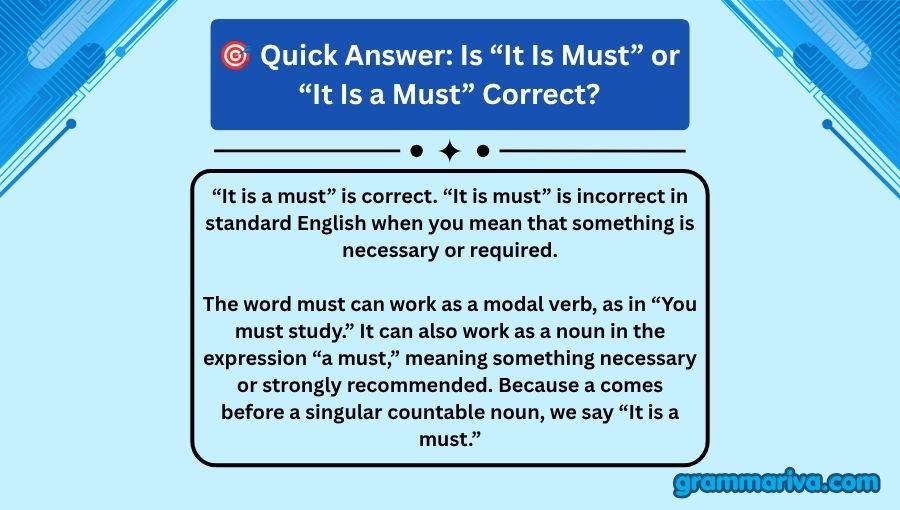
“It is a must” is correct. “It is must” is incorrect in standard English when you mean that something is necessary or required.
The word must can work as a modal verb, as in “You must study.” It can also work as a noun in the expression “a must,” meaning something necessary or strongly recommended. Because a comes before a singular countable noun, we say “It is a must.”
❓ Is “It Is Must” Correct English?
No. “It is must” is not standard English when must is being used as a noun meaning something necessary.
The problem is that must is being treated like a noun in this sentence, but a singular countable noun normally needs a determiner such as a, an, the, this, or that.
Compare these examples:
- ❌ It is must to carry your ID.
- ✅ It is a must to carry your ID.
However, the second sentence is not always the most natural choice. In formal writing, you might write:
- ✅ You must carry your ID.
- ✅ Carrying your ID is required.
- ✅ You are required to carry your ID.
This gives us an easy rule:
Use “a must” when must is a noun. Do not use “must” as a noun without a suitable determiner.
❓ Is “It Is a Must” Correct?
Yes. “It is a must” is a standard English expression meaning that something is necessary, essential, or strongly recommended.
For example:
- ✅ A passport is a must for international travel.
- ✅ Good communication is a must in this job.
- ✅ This book is a must for beginners.
Here, must acts as a noun. The phrase a must refers to something that is considered necessary or very desirable.
I often tell students to think of “a must” as meaning “a necessary thing.” That simple substitution makes the grammar much easier.
For example:
A good dictionary is a must.
Think:
A good dictionary is a necessary thing.
That makes the structure clear.
📚 It Is Must vs It Is a Must at a Glance
The main difference is grammatical. Must can be a modal verb, while a must uses must as a noun.
| Form | Type | Meaning | Example | Correct/Incorrect |
|---|---|---|---|---|
| must | Modal verb | Something is required | You must leave now. | ✅ Correct |
| a must | Noun phrase | Something necessary | A helmet is a must. | ✅ Correct |
| it is must | Incorrect noun structure | Intended to mean something is necessary | It is must for drivers. | ❌ Incorrect |
| it is a must | Noun phrase | Something is necessary | It is a must for drivers. | ✅ Correct |
| must be | Modal + verb | Something is required or certain | It must be ready. | ✅ Correct |
The key point is that “must” and “a must” do different grammatical jobs.
🔍 Why Do People Confuse “It Is Must” and “It Is a Must”?
People often confuse these expressions because must is usually learned as a verb. When learners later see “a must,” the change can feel strange.
There is also a strong influence from short phrases such as:
- “You must go.”
- “You must try it.”
- “It must work.”
- “This is a must.”
These sentences use must in different ways.
I once reviewed a short business email where the writer had typed, “This feature is must for every user.” The writer clearly knew that must meant “necessary.” The problem was the sentence structure. Changing it to “This feature is a must for every user” fixed the grammar immediately.
Another reason for the confusion is that some languages do not use articles in the same way English does. A speaker may understand the meaning perfectly but leave out a because their first language does not require the same structure.
The mistake is easy to fix once you know the role of must in the sentence.
🧩 “Must” as a Modal Verb
When must is a modal verb, it comes before a base verb.
Examples include:
- You must study.
- You must listen.
- We must leave.
- She must finish the report.
In these sentences, must expresses necessity, duty, or a strong requirement.
The basic pattern is:
Subject + must + base verb
For example:
You + must + wear + a seat belt.
You do not add a before must in this structure.
- ✅ You must wear a seat belt.
- ❌ You a must wear a seat belt.
This is completely different from the noun expression “a must.”
📝 “A Must” as a Noun
When must acts as a noun, it means something that is necessary or highly desirable.
The structure is:
a + must
Examples:
- A good attitude is a must.
- A backup plan is a must.
- This jacket is a must for winter.
- Patience is a must when teaching children.
Here, must is not telling someone what to do. It names something that is viewed as necessary.
That is why a is needed.
Consider this sentence:
A backup plan is a must.
The noun phrase a backup plan is the subject. The word must is the noun after is.
The same idea appears in:
A backup plan is a necessity.
Because necessity is a singular countable noun in this use, it has a determiner. The expression a must follows the same basic idea.
💡 Test Tip: Replace “A Must” With “A Necessity”
Here is one of my favorite quick tests.
If you mean “a necessity” or “something necessary,” you can often use “a must.”
Try this:
Good planning is a must.
Replace the phrase:
Good planning is a necessity.
The meaning still works.
Now try:
Good planning is must.
That structure does not work.
This test is useful because it helps you focus on meaning rather than spelling.
Meaning Test Table
| Meaning | Word Type | Example Sentence |
|---|---|---|
| Requirement | Modal verb | You must wear a helmet. |
| Necessary thing | Noun | A helmet is a must. |
| Strong recommendation | Noun | This movie is a must. |
| Certain conclusion | Modal verb | He must be tired. |
🏢 Case Study: A Workplace Email
Imagine a manager sends this message:
“Team, it is must to submit the report before Friday.”
The intended meaning is clear, but the grammar is wrong.
A natural correction would be:
“Team, it is a must to submit the report before Friday.”
However, for professional writing, I would make it even clearer:
“Team, you must submit the report before Friday.”
Why?
Because “you must submit” directly tells the team what is required. It is shorter and stronger.
Here are three possible versions:
| Version | Grammar | Style |
|---|---|---|
| It is must to submit the report. | ❌ Incorrect | Avoid |
| It is a must to submit the report. | ✅ Grammatically possible | Less direct |
| You must submit the report. | ✅ Correct | Clear and professional |
This shows an important writing lesson: correct grammar does not always mean the sentence is the best possible sentence.
⚙️ Grammar Rules Explanation
The key to understanding it is must vs it is a must is knowing whether “must” is acting as a modal verb or a noun. The difference comes from the grammatical role of must.
When must is a modal verb, it normally appears before a base verb:
must + verb
Examples:
- must go
- must study
- must finish
- must attend
When must is a noun, it can refer to something considered necessary:
a + must
Examples:
- a must for students
- a must for travelers
- a must for beginners
- a must for every team
The expression “it is a must” uses the second pattern.
The word a is an indefinite article. It is used before a singular countable noun when referring to one item or thing in a general way.
So:
It is a must.
works because must is functioning as a noun.
But:
It is must.
does not provide the normal grammatical structure needed for the noun use.
Most standard English reference sources recognize must as having more than one grammatical use. The important lesson for learners is to identify the job the word is doing in the sentence.
Correct vs Incorrect at a Glance
| Sentence | Correct/Incorrect | Why |
|---|---|---|
| It is must for new employees. | ❌ Incorrect | Must is being used as a noun but lacks a determiner. |
| It is a must for new employees. | ✅ Correct | “A must” is a noun phrase. |
| New employees must attend training. | ✅ Correct | Must is a modal verb before a base verb. |
| This training is a must. | ✅ Correct | Must functions as a noun. |
| This training must be completed. | ✅ Correct | Must is a modal verb followed by “be.” |
❓ Can You Say “It Must Be”?
Yes. “It must be” is correct, but it has a different grammatical structure from “it is a must.”
Examples:
- ✅ It must be true.
- ✅ It must be difficult.
- ✅ It must be ready by noon.
Here, must is a modal verb.
The structure is:
It + must + be + complement
Compare that with:
It + is + a + must
These sentences look similar, but they are built differently.
| Sentence | Role of Must | Meaning |
|---|---|---|
| It must be expensive. | Modal verb | The speaker strongly believes it is expensive. |
| It is a must. | Noun | It is necessary or highly recommended. |
| It must be completed. | Modal verb | Completion is required. |
| It is a must for the job. | Noun | It is necessary for the job. |
❓ Can “A Must” Be Used Without “It Is”?
Absolutely. “A must” can appear in many sentence structures.
For example:
- A passport is a must.
- This guide is a must for beginners.
- A helmet is a must when cycling.
- Regular practice is a must.
- This feature is a must-have for professionals.
You do not need to use the exact structure “it is a must.”
In fact, many writers prefer more specific sentences because they tell the reader exactly what is necessary.
For example:
A backup copy is a must.
is clear.
But:
It is a must.
can sound vague if the reader does not know what it refers to.
⚠️ Common Mistakes With Must
Several factors can lead to mistakes with this expression.
1. Fast typing
People often leave out small words when typing quickly.
- ❌ It is must for safety.
- ✅ It is a must for safety.
The missing a may be a simple typing error.
2. Autocorrect
Autocorrect can change words or fail to suggest the structure you actually need. A quick message may go out before you notice the problem.
3. Lack of knowledge
Some learners know the meaning of must but do not know that must can also function as a noun.
4. Direct translation
A sentence may be translated from another language word for word. That can produce a structure that sounds logical but is not standard English.
I once caught myself typing a similar article phrase without the article while working quickly. I reread the sentence, saw that must was acting as a noun, and added a. That tiny edit made the structure correct.
Common Grammar Confusions
| Confusion | Correct Form | Common Wrong Form |
|---|---|---|
| its / it’s | It’s cold. | Its cold. |
| your / you’re | You’re ready. | Your ready. |
| their / they’re | They’re here. | Their here. |
| then / than | Better than before. | Better then before. |
| a must / must | It is a must. | It is must. |
Specific Wrong Forms
| Wrong Form | What’s Wrong | Correct Form |
|---|---|---|
| It is must. | Missing article before noun | It is a must. |
| It is must for me. | Noun use lacks determiner | It is a must for me. |
| This is must. | Incorrect noun structure | This is a must. |
| That book is must. | Must needs noun structure here | That book is a must. |
| A must is needed. | Awkward and repetitive | It is a must. |
| It a must. | Missing verb | It is a must. |
🌎 How Is “It Is a Must” Used in Different Contexts?
Understanding it is must vs it is a must can help you choose the right expression in everyday, professional, and online writing.
The expression works in casual, professional, and creative settings. Still, the best wording depends on your audience.
Everyday conversation: “That restaurant is a must.”
Professional writing: “Strong communication skills are a must for this role.”
Creative writing: “A quiet walk was a must after the long day.”
Social media: “This sunset spot is a must! 🌅”
Context Table
| Context | Which Term to Use | Example |
|---|---|---|
| Everyday conversation | a must | This café is a must. |
| Professional writing | must / required / a must | Clear records are a must. |
| Creative writing | a must | A quiet moment was a must. |
| Social media/texting | a must | This place is a must! |
For formal documents, I often prefer required, necessary, or a direct must sentence. These choices can sound sharper.
✍️ Professional Alternatives to “It Is a Must”
Although “a must” is correct, you have several alternatives.
Required
Use required when something is an official rule or condition.
A valid ID is required.
Necessary
Use necessary when something is needed.
A valid ID is necessary.
Essential
Use essential when something is extremely important.
A valid ID is essential for registration.
Must
Use must as a modal verb when you want a direct instruction.
You must bring a valid ID.
Alternatives Table
| Alternative | Works When | Does Not Work When |
|---|---|---|
| required | There is an official rule | You only mean “nice to have” |
| necessary | Something is needed | You want a very casual tone |
| essential | Something is extremely important | The need is minor |
| must | Giving a direct requirement | You are trying to use must as a noun |
| a must | Something is necessary or strongly recommended | A very formal legal tone is needed |
❓ Is “It Is a Must” Too Informal?
Not necessarily. “It is a must” is grammatically correct, but it can sound more conversational than “it is required” or “it is necessary.”
For example:
This book is a must for new teachers.
This sounds natural and friendly.
For a formal policy, you might write:
Completion of this course is required for all employees.
The choice depends on tone.
| Sentence | Tone |
|---|---|
| This course is a must. | Friendly |
| This course is necessary. | Neutral |
| This course is essential. | Strong |
| This course is required. | Formal |
| You must complete this course. | Direct |
❓ Can “A Must” Mean “Highly Recommended”?
Yes. “A must” can mean something that is not merely required but is strongly recommended or considered especially valuable.
For example:
This museum is a must for art lovers.
The speaker may not mean that visitors are legally required to visit the museum. The phrase means the museum is considered so good or important that visitors should not miss it.
That is why context matters.
Compare:
- A passport is a must for this trip. → Necessary.
- This restaurant is a must for food lovers. → Strongly recommended.
The phrase can therefore express different levels of importance.
🗣️ Common Phrases With “A Must”
The noun expression “a must” appears in several natural patterns.
| Phrase | Meaning |
|---|---|
| a must for beginners | Very useful or necessary for beginners |
| a must-have | Something considered highly desirable or necessary |
| a must for travelers | Something travelers should have or experience |
| an absolute must | Something viewed as completely necessary |
| a must-see | Something worth seeing |
| a must-read | Something worth reading |
These phrases are common because they make recommendations short and strong.
For example:
This guide is a must-read for new writers.
Here, must-read works differently from the simple phrase a must, but the basic idea of strong recommendation is related.
❓ Is “Must-Have” the Same as “A Must”?
They are closely related, but they are not always interchangeable. “A must” is a noun phrase, while “must-have” can work as a noun or adjective depending on the sentence.
Examples:
- This jacket is a must.
- This jacket is a must-have.
- This is a must-have jacket.
All three can express strong approval or recommendation.
However, must-have often has a stronger “highly desirable” or “essential item” feeling.
Compare the Structures
| Expression | Example | Main Idea |
|---|---|---|
| a must | This book is a must. | Necessary or strongly recommended |
| a must-have | This tool is a must-have. | Highly desirable or useful |
| must-have + noun | It is a must-have tool. | Describes the noun |
| must + verb | You must read it. | Requirement |
🧠 How to Remember the Difference
A simple way to remember it is must vs it is a must is to focus on what comes after “must.”
Use this simple three-step trick.
Step 1: Look after “must”
If a base verb follows must, it is probably the modal verb.
You must study.
Step 2: Look before “must”
If you see a must, must is functioning as a noun.
This course is a must.
Step 3: Ask what you mean
If you mean “something necessary,” use a must.
If you mean “is required to do something,” use must + verb.
Memory Formula
Must + verb = requirement
A + must = necessary thing
That one formula solves most cases.
❓ Why Does the Article “A” Matter?
The article a matters because it helps show that must is being used as a singular noun.
Consider:
This tool is a must.
The word must names the thing that is considered necessary.
Without a, the sentence loses the normal noun structure:
This tool is must. ❌
This is similar to other noun patterns:
- It is a necessity.
- It is an advantage.
- It is a benefit.
- It is a must.
The article belongs to the noun phrase.
🎯 How to Choose the Best Sentence
If you are unsure, do not force the phrase “it is a must.” Pick the structure that expresses your meaning most clearly.
Use must + verb for direct requirements:
You must wear safety glasses.
Use a must for a necessary or strongly recommended thing:
Safety glasses are a must.
Use required for formal rules:
Safety glasses are required.
Use necessary for a neutral explanation:
Safety glasses are necessary.
Quick Choice Table
| What You Mean | Best Choice |
|---|---|
| Direct command | You must do it. |
| Necessary thing | It is a must. |
| Official rule | It is required. |
| Neutral need | It is necessary. |
| Strong importance | It is essential. |
| Strong recommendation | It is a must-have. |
❓ Is “It Is a Must to…” Natural?
It can be understood, but “it is a must to…” is often less natural than a direct sentence with must.
For example:
It is a must to wear a helmet.
is understandable.
But:
You must wear a helmet.
is cleaner and more direct.
Another good option is:
Wearing a helmet is a must.
So, when editing your writing, ask whether you can make the sentence shorter.
Examples
- ❌ It is must to follow the rules.
- ⚠️ It is a must to follow the rules.
- ✅ You must follow the rules.
- ✅ Following the rules is a must.
The last two are usually better choices.
📱 “It Is a Must” in Social Media and Texting
Social media often uses “a must” in recommendation posts.
Examples:
- This beach is a must! 🏖️
- That café is a must for coffee fans. ☕
- This skincare step is a must. ✨
- The sunset view is a must-see. 🌇
In casual posts, the expression feels natural because it is short and energetic.
Still, avoid dropping the article a just because the sentence is informal.
- ❌ This place is must.
- ✅ This place is a must.
Informal English can be flexible, but standard grammar still helps your writing look polished.
🧾 Why Getting This Right Matters
Correct grammar improves clarity. A missing article may seem like a tiny issue, but repeated small errors can make professional writing look rushed.
Clear English helps in:
- resumes
- client emails
- reports
- school assignments
- blog posts
- product descriptions
- social media captions
As an editor, I see this often: the writer knows the idea but loses clarity because of one missing word.
Why Accuracy Matters
| Situation | Why Getting It Right Matters |
|---|---|
| Resume | Shows careful writing |
| Client email | Builds trust |
| Published content | Protects credibility |
| Social post | Makes the message polished |
A useful rule is:
Small grammar choices can make a big difference in how clear your writing feels.
❓ What Should You Use in Formal Writing?
In formal writing, choose must, required, necessary, or essential based on your meaning.
For example:
Employees must submit the form by Friday.
This is direct and professional.
Or:
Submission of the form is required by Friday.
This sounds more formal.
You can also write:
The form is necessary for registration.
These options are often better than repeating “it is a must” in formal documents.
🔄 Better Rewrites for Common Sentences
Sometimes the easiest way to understand a grammar rule is to rewrite weak sentences.
| Less Effective or Wrong | Better Version |
|---|---|
| It is must for safety. | Safety is essential. |
| It is must to register. | You must register. |
| This is must for students. | This is a must for students. |
| It is a must to read the instructions. | You must read the instructions. |
| This book is must. | This book is a must. |
The goal is not only to fix grammar. The goal is to choose the clearest sentence.
❓ What Is the Easiest Rule for Remembering “It Is Must vs It Is a Must”?
The easiest rule is this:
If “must” means a necessary thing, use “a must.” If “must” comes before a verb to express a requirement, do not add “a.”
Examples:
This guide is a must.
Here, must is a noun.
You must read this guide.
Here, must is a modal verb.
Never think of must as having only one grammatical job. Its role changes with the sentence.
✅ Quick Recap Checklist
Use this checklist whenever you are unsure.
| Question | If Yes → Use |
|---|---|
| Is must followed by a base verb? | must + verb |
| Does must mean “a necessary thing”? | a must |
| Are you describing an official requirement? | required |
| Are you giving a direct instruction? | must + verb |
| Are you making a strong recommendation? | a must or a must-have |
Practice Examples
- You ___ submit the form today.
✅ must - This form is ___ for registration.
✅ a must / required, depending on the intended tone - This museum is ___ for first-time visitors.
✅ a must
❓ FAQs About It Is Must vs It Is a Must
❓ Is “it is must” grammatically correct?
No. “It is must” is incorrect in standard English when must is being used as a noun. Use “it is a must” or choose a clearer alternative such as “it is necessary” or “it is required.”
❓ Is “it is a must” correct English?
Yes. “It is a must” is grammatically correct when must functions as a noun meaning something necessary, essential, or strongly recommended.
❓ What is the difference between “must” and “a must”?
Must is often a modal verb followed by a base verb, as in “You must leave.” A must is a noun phrase meaning something necessary or strongly recommended, as in “This book is a must.”
❓ Can I say “you must”?
Yes. “You must” is completely correct when followed by a base verb.
Example:
You must complete the form.
Do not add a:
You a must complete the form. ❌
❓ Can I say “this is a must”?
Yes. “This is a must” is a natural and correct expression. It means that the thing being discussed is necessary or strongly recommended.
❓ Is “it is a must to” grammatically correct?
It can be grammatical, but it is often less natural than a direct construction. Instead of “It is a must to wear a helmet,” most speakers would usually prefer “You must wear a helmet” or “Wearing a helmet is a must.”
❓ Is “must-have” the same as “a must”?
They are similar but not always identical. “A must” means something necessary or strongly recommended. “Must-have” often describes something considered essential or highly desirable.
Example:
This book is a must.
This book is a must-have for students.
❓ Which is better: “it is a must” or “it is necessary”?
Both are correct, but they have different tones. “It is necessary” is neutral and often better for formal writing. “It is a must” is more conversational and can also express strong recommendation.
❓ Can “must” be a noun?
Yes. In expressions such as “a must,” “a must-have,” “a must-see,” and “a must-read,” the word functions as part of a noun expression.
❓ How can I avoid the “it is must” mistake?
Remember the simple pattern:
Must + verb = requirement
A + must = necessary thing
For example:
You must study. ✅
This course is a must. ✅
🏁 Conclusion: It Is Must vs It Is a Must Made Simple
It is must vs it is a must becomes easy once you identify the role of must in the sentence. If must works as a modal verb, place it before a base verb: “You must study.” If must works as a noun meaning something necessary or strongly recommended, use “a must”: “This course is a must.”
The most important point is simple: “It is must” is not the standard form for this meaning. “It is a must” is correct. However, you should also think about style. In many formal sentences, “required,” “necessary,” or a direct “must + verb” construction will sound clearer.
I recommend using the quick test: if you can replace “a must” with “a necessity,” the noun structure is probably what you need. 👍
Once you remember “must + verb” and “a + must,” this small grammar problem becomes much easier. Keep the rule simple, choose the clearest sentence, and your writing will sound more natural every time. ✍️

Hi, I’m Nathan Reed. I’m a grammar and writing specialist at Grammariva. I work on practical grammar content that helps readers understand sentence structure, punctuation, vocabulary, and better writing habits.
[…] and memory tricks. By the end, you should be able to choose the right word with confidence. 😊 It Is Must vs It Is a Must| Piece of Mine or Peace of Mind | Roofs vs […]