Have you ever typed targetted or targeted and stopped because both spellings looked right? You are not alone. This is a common spelling question, especially when adding -ed to the verb target. The extra t can feel natural because some English verbs double their final consonant before adding a suffix. But English spelling rules do not treat every word the same way.
The correct spelling in standard American English is targeted. The spelling targetted is incorrect. Once you understand why the final t does not double, the difference becomes much easier to remember. I have seen this mistake in emails, school assignments, blog posts, and even quick notes. ✍️
In this guide, I will explain the rule in simple terms. We will look at meanings, examples, common mistakes, professional usage, memory tricks, and frequently asked questions. By the end, you should feel confident choosing the correct form every time. 😊 Openned or Opened | Thank You Both or Thanks to Both of You | Herself vs Herselfs vs Her Self
🎯 Quick Answer: Targetted or Targeted
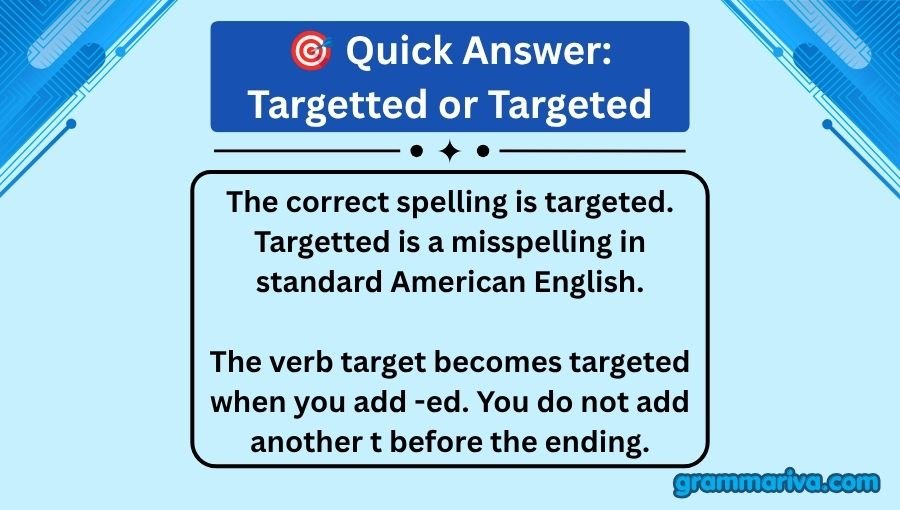
The correct spelling is targeted. Targetted is a misspelling in standard American English.
The verb target becomes targeted when you add -ed. You do not add another t before the ending.
- ✅ The campaign targeted young adults.
- ❌ The campaign targetted young adults.
A simple rule helps: target + ed = targeted.
📚 Related Word Forms of Target
The word target has several useful forms. The spelling changes in some forms, but the base word stays easy to recognize.
| Form | Type | Example |
|---|---|---|
| target | Verb / noun | We need to target the right audience. |
| targets | Verb / plural noun | The ad targets new customers. |
| targeted | Past tense / past participle | The company targeted local buyers. |
| targeting | Present participle | The company is targeting local buyers. |
| targetable | Adjective | The group is targetable through this campaign. |
The key form in this article is targeted. It is the standard past-tense and past-participle form of target.
🔍 Understanding Targetted or Targeted
The difference is simple: targeted is correct, while targetted contains one extra t.
The confusion happens because English has a consonant-doubling rule. Words such as stop become stopped, and plan becomes planned. However, that rule does not mean every verb ending in a consonant should double its final letter.
The word target already has two syllables. Its final syllable is not stressed in the way required for the usual doubling rule. Therefore, the final t stays single.
| Form | Type | Meaning | Example | Correct/Incorrect |
|---|---|---|---|---|
| target | Base verb | Aim at or select | We target new customers. | ✅ Correct |
| targeted | Past tense | Aimed at or selected | We targeted new customers. | ✅ Correct |
| targeting | Present participle | Aiming at or selecting | We are targeting new customers. | ✅ Correct |
| targetted | Claimed past tense | Intended to mean aimed at | We targetted new customers. | ❌ Incorrect |
| targets | Third-person verb | Aims at or selects | The ad targets students. | ✅ Correct |
Why Is Targeted Correct?
Targeted follows the standard spelling pattern for this verb. Add -ed directly to target.
target + ed = targeted
The final t does not become tt.
This is one of those cases where a spelling rule must be applied carefully. You cannot simply look at the final letter and decide to double it.
What Does Targeted Mean?
Targeted means directed toward a particular person, group, place, goal, or result.
For example:
- ✅ The company targeted small businesses.
- ❌ The company targetted small businesses.
Here, targeted tells us that the company directed its effort toward small businesses.
The word can describe marketing, advertising, criticism, support, attacks, research, services, and many other actions.
Targeted as a Past-Tense Verb
When target describes something that happened in the past, use targeted.
Examples:
- ✅ The teacher targeted the student’s main writing problem.
- ✅ The campaign targeted local voters.
- ✅ The program targeted families with young children.
In each sentence, the action happened in the past.
Targeted as a Past Participle
Targeted can also work as a past participle.
Examples:
- The campaign was targeted at new customers.
- The message was targeted toward a specific group.
- The ads have been targeted to different audiences.
The exact grammar depends on the sentence, but the spelling remains targeted.
🧠 Test Tip
When you are unsure, remove the ending.
Ask yourself:
What is the base verb?
The base verb is target.
Now add -ed:
target + ed = targeted
Do not insert another t.
| Meaning | Word Type | Example Sentence |
|---|---|---|
| Aim at a group | Verb | The ad targets parents. |
| Aimed at a group in the past | Past-tense verb | The ad targeted parents. |
| Directed toward a group | Past participle | The ad was targeted at parents. |
❓ Is Targetted the Same as Targeted?
No. Targetted and targeted are not equal spellings in standard American English. Targeted is the correct form.
The extra t in targetted is the problem. It usually appears because writers expect the final consonant to double before -ed.
Compare these examples:
- ✅ The message targeted new customers.
- ❌ The message targetted new customers.
The meaning is clear in both sentences, but only the first spelling is standard.
❓ Why Do People Confuse Targetted and Targeted?
People often confuse these forms because English has many words that double their final consonant before -ed.
For example:
- stop → stopped
- plan → planned
- shop → shopped
That pattern can make targetted look reasonable.
I once caught myself typing an extra t in a work document because I was thinking about words such as planned and stopped. I paused, checked the base word, and corrected it to targeted. The mistake was easy to make because the wrong form looked familiar.
The lesson is simple: do not double a consonant just because another English verb does.
📝 Targeted or Targetted in Real-Life Writing
Imagine that you are writing an email about a marketing campaign.
You write:
We targetted customers between the ages of 25 and 40.
The reader will probably understand your meaning. However, the spelling can make the sentence look careless.
A better version is:
We targeted customers between the ages of 25 and 40.
That small correction makes the sentence look polished and professional.
Case Study: A Workplace Email
I once edited a short business report that used targetted several times. The writer had strong ideas and clear data, but the repeated spelling error distracted from the message.
We changed every instance to targeted.
The final report looked much cleaner.
This shows why spelling matters even when the meaning is obvious. A reader should focus on your message, not stop at an avoidable spelling error.
| Situation | Example | Better Choice |
|---|---|---|
| Marketing report | The campaign targeted parents. | ✅ Targeted |
| School essay | The study targeted teens. | ✅ Targeted |
| Business email | We targeted local buyers. | ✅ Targeted |
| Social post | This ad targeted gamers. | ✅ Targeted |
| Formal report | The program targeted rural areas. | ✅ Targeted |
📖 Grammar Rules Explanation
The spelling rule is based on how English forms past-tense verbs. Some short verbs ending in one consonant double that consonant before -ed when the needed stress pattern is present.
For example:
- stop → stopped
- plan → planned
But target does not follow that doubling pattern.
Its standard form is:
target + ed → targeted
The final t remains single.
This is why targetted is not the standard spelling.
Most standard English reference sources and dictionaries list targeted as the normal past-tense and past-participle form. The important point is not to memorize a complicated rule. Simply remember the standard spelling of this common verb.
Correct vs Incorrect at a Glance
| Sentence | Correct/Incorrect | Why |
|---|---|---|
| The company targeted new customers. | ✅ Correct | Targeted is the standard past form. |
| The company targetted new customers. | ❌ Incorrect | The extra t should not be added. |
| The ad was targeted at students. | ✅ Correct | Targeted is correctly used as a participle. |
| The program targetted young families. | ❌ Incorrect | The spelling contains an unnecessary t. |
| We targeted the right audience. | ✅ Correct | The base verb takes -ed directly. |
⚠️ Common Mistakes With Targeted
The most common mistake is adding an extra t.
Why does this happen?
There are several reasons:
- Fast typing can cause spelling errors.
- Autocorrect may not always catch unusual misspellings.
- Writers may remember the consonant-doubling rule incorrectly.
- Some people learn English spelling patterns from similar words.
- The wrong form can look familiar because it resembles words such as stopped.
I once saw targetted in a draft that had been written very quickly. The writer knew exactly what the sentence meant. The problem was simply that the spelling had been typed from memory without a final check.
Similar Grammar Confusions
Spelling and grammar errors often happen because two forms look or sound close.
| Confusion | Correct Form | Common Error | Reason for Confusion |
|---|---|---|---|
| target / targeted | targeted | targetted | Consonant doubling |
| it’s / its | it’s / its | mixing them | Similar appearance |
| your / you’re | your / you’re | mixing them | Similar sound |
| their / there / they’re | depends on meaning | mixing them | Similar sound |
| affect / effect | depends on use | mixing them | Similar meaning and sound |
These errors are different from one another, but the lesson is similar: slow down when two forms look almost identical.
Common Wrong Spellings of Targeted
| Wrong Form | What’s Wrong | Correct Form |
|---|---|---|
| targetted | Extra t | targeted |
| targgeted | Extra g | targeted |
| targetd | Missing e | targeted |
| targetted | Incorrect consonant doubling | targeted |
| targetted at | Misspelled verb | targeted at |
| targetting | Incorrect doubling in this standard form | targeting |
The most important correction is targetted → targeted.
❓ When Should You Use Targeted?
Use targeted when you mean that something was directed toward a specific person, group, place, or goal.
It works in many areas of life.
For example:
Marketing
The company targeted college students.
Education
The lesson targeted weak reading skills.
Health campaigns
The campaign targeted young adults.
Technology
The update targeted a common security problem.
Workplace communication
The training targeted new employees.
In every example, the action is directed toward a particular target.
| Context | Which Term to Use | Example |
|---|---|---|
| Everyday conversation | targeted | The ad targeted me. |
| Professional writing | targeted | The campaign targeted small firms. |
| Creative writing | targeted | The criticism targeted his actions. |
| Social media/texting | targeted | That post was clearly targeted at me. |
💬 Targeted in Everyday Conversation
In normal conversation, people often use targeted to explain who or what an action was aimed at.
Examples include:
- The ad targeted people like me.
- The campaign targeted local families.
- That comment felt targeted.
- The message was targeted at a small group.
The word can be neutral or emotional depending on context.
For example, a marketing team may proudly say:
Our campaign targeted young professionals.
A person receiving criticism may say:
That comment felt targeted.
The spelling does not change in either case.
💼 Targeted in Professional Writing
Professional writing often uses targeted because businesses need to describe specific audiences and goals.
Common combinations include:
- targeted advertising
- targeted campaign
- targeted audience
- targeted message
- targeted approach
- targeted support
- targeted research
- targeted content
These phrases are common because they show that an action was designed for a particular purpose or group.
For example:
We created a targeted email campaign for existing customers.
That sentence is clear and professional.
📱 Targeted in Social Media and Texting
Informal writing still benefits from correct spelling.
You may see sentences such as:
That post was so targeted. 😂
Or:
Why did that feel targeted at me?
Short messages may be casual, but targeted remains the standard spelling.
Even when people type quickly, adding an extra t does not become correct simply because the message is informal.
❓ Does Targeted Always Need a Preposition?
No. The sentence determines which preposition, if any, you need.
You can say:
The campaign targeted students.
You can also say:
The campaign was targeted at students.
You may see targeted toward in some contexts as well.
The important point is that the spelling of the word remains targeted.
| Pattern | Example |
|---|---|
| target + object | The company targeted students. |
| be targeted at + group | The ad was targeted at students. |
| be targeted toward + group | The campaign was targeted toward new users. |
| targeted content | We created targeted content. |
🧩 Common Phrases With Targeted
Targeted appears in many common phrases. These combinations are useful in business, education, marketing, and everyday writing.
| Phrase | Meaning |
|---|---|
| targeted advertising | Advertising aimed at a chosen audience |
| targeted audience | A specific group a message is meant for |
| targeted campaign | A campaign designed for a specific group or goal |
| targeted approach | A focused method |
| targeted support | Help given to a particular group |
| targeted message | A message designed for a specific audience |
Learning these phrases can make the correct spelling easier to remember.
❓ Can Targeted Be Replaced With Other Words?
Sometimes. The best alternative depends on the sentence.
Possible alternatives include aimed, directed, focused, intended, and designed.
However, these words are not always perfect replacements.
For example:
The campaign targeted young adults.
You could write:
The campaign was aimed at young adults.
The meaning is close.
But in some technical or business contexts, targeted may be the most natural choice.
| Alternative | Works When | Does Not Work When |
|---|---|---|
| aimed | Something is directed toward a group or goal | The sentence needs a more specific business term |
| directed | An action is sent toward something | The meaning is about a carefully selected audience |
| focused | Attention is concentrated on something | You mean direct selection of a target |
| intended | You mean planned for someone or something | You need to describe an actual action |
| designed | Something was created for a purpose | You mean the act of directing an existing action |
❓ Why Does Getting the Spelling Right Matter?
Correct spelling helps readers trust your writing. One small mistake usually will not change the meaning, but repeated errors can make a document look rushed.
This matters most in places where your writing represents you or your business.
A simple rule I use when editing is:
Clear writing makes the message easier to trust.
You do not need perfect spelling to have good ideas. But correct spelling helps those ideas come across with less distraction.
| Situation | Why Getting It Right Matters |
|---|---|
| Resume | Shows attention to detail |
| Client email | Builds a professional impression |
| Published content | Improves readability and trust |
| Social post | Makes the message look polished |
🎯 How To Remember the Difference
The easiest memory trick is very short:
Target + ed = targeted.
Do not think of it as target + t + ed.
Think of the word in two parts:
target + ed
That gives you:
targeted
You can also compare it with targeting:
- target → targeted
- target → targeting
Neither form needs an extra t.
Another useful trick is to remember the phrase targeted audience. You will see this phrase often in marketing and business writing.
If you remember targeted audience, you can carry the spelling into other sentences.
❓ Is Targetted Ever Correct?
In standard American English, targetted is not the standard spelling of the past tense or past participle of target.
Use targeted instead.
For formal writing, schoolwork, business documents, websites, and professional communication, targeted is the safe and correct choice.
📋 Targeted or Targetted Quick Recap Checklist
Use this checklist whenever you are unsure.
| Question | If Yes → Use |
|---|---|
| Are you using the past form of target? | targeted |
| Are you describing something aimed at a group? | targeted |
| Are you writing a professional document? | targeted |
| Are you tempted to add another t? | Do not add it |
| Does your sentence contain targetted? | Change it to targeted |
Practice Examples
- The company targeted new customers. ✅
- The advertisement was targeted at parents. ✅
- The campaign targetted young adults. ❌ → The campaign targeted young adults.
- The teacher targeted the student’s main weakness. ✅
The pattern is consistent: targeted is the correct form.
❓ Why Do People Add an Extra T to Targeted?
People often add the extra t because they remember English verbs such as stop → stopped and plan → planned.
However, those examples do not mean every verb ending in a consonant should double its final letter.
For target, the standard form is simply targeted.
❓ Is Targeted the Past Tense of Target?
Yes. Targeted is the regular past-tense form of target.
For example:
The company targeted younger customers last year.
The base verb is target. The past-tense form is targeted.
❓ Is Targetted a Word?
You may encounter targetted in user-generated writing, older material, or spelling mistakes. However, it is not the standard spelling you should use in normal American English.
Choose targeted for clear and correct writing.
❓ How Do You Spell Targeted Correctly?
Spell it:
T-A-R-G-E-T-E-D
There is only one t before -ed.
A useful formula is:
target + ed = targeted
❓ Should You Write Targetted in Formal Writing?
No. Use targeted in formal writing.
This includes:
- essays
- reports
- resumes
- business emails
- websites
- academic work
- professional presentations
Using the standard spelling keeps your writing polished.
❓ What Is the Difference Between Target and Targeted?
Target is the base verb. Targeted is its past-tense or past-participle form.
Compare:
We target new customers.
This describes a present or general action.
We targeted new customers.
This describes an action that happened in the past.
| Word | Function | Example |
|---|---|---|
| target | Base verb | We target new customers. |
| targeted | Past tense | We targeted new customers. |
| targeting | -ing form | We are targeting new customers. |
| targets | Present third-person form | The ad targets new customers. |
❓ Is Targeted Used as an Adjective?
Yes. Targeted can describe something designed for a particular group, purpose, or goal.
For example:
We created a targeted campaign.
Here, targeted describes the campaign.
Other examples include:
- targeted advertising
- targeted support
- targeted content
- targeted treatment
- targeted research
The spelling remains targeted.
❓ What Is the Easiest Way To Remember Targeted?
Remember this simple equation:
TARGET + ED = TARGETED
There is no extra T.
If you see targetted, stop and remove one t.
That quick check can prevent the most common spelling mistake with this word.
❓ What Is the Correct Spelling: Targetted or Targeted?
The correct spelling is targeted.
Use targeted whenever you need the past tense, past participle, or adjective form of target.
Targetted is not the standard spelling.
❓ How Can I Avoid This Spelling Mistake?
Use three quick steps:
- Find the base word: target.
- Add -ed.
- Check that you have only one t before the ending.
So:
target + ed = targeted
This method is faster than trying to remember a long spelling rule.
🧠 Final Takeaway
The answer is clear: targeted is correct, while targetted is incorrect in standard American English.
Remember that the base verb is target. When you make it past tense, simply add -ed:
target + ed = targeted
The final t does not double.
This is a small spelling difference, but it is worth learning because targeted appears often in business writing, marketing, education, social media, and everyday communication. Once you stop applying the doubling rule automatically, the correct form becomes much easier to spot.
I recommend using the simple memory trick “target + ed = targeted.” If you ever see targetted, check it before you publish, submit, or send your writing. ✍️
Good spelling does not have to be hard. Learn the pattern once, use it with confidence, and you will rarely hesitate between targetted or targeted again. 🎯
Remember: one target, one T, one correct spelling: targeted.

Hi, I’m Madison Hayes. I’m an English learning writer at Grammariva, where I work on simple lessons and examples for people who want to improve their grammar and writing. I love turning confusing rules into easy-to-follow explanations.


[…] Once you learn the simple rule, though, the difference becomes much easier to remember. ✍️ Targetted or Targeted | Openned or Opened | Thank You Both or Thanks to Both of […]
[…] the right spelling. By the end, you should never need to guess again. Reinforce vs Reenforce | Targetted or Targeted | Openned or […]