Have you ever written a sentence like “I was busy whole day” and then stopped to wonder if whole day or all day is the better choice? You are not alone. These two phrases look very similar, and both talk about a complete period of time. Yet they do not always work in the same places.
As an English teacher and editor, I see this small difference cause big confusion. The good news is that the rule is easier than it first appears. All day is usually the natural choice when you mean something happens throughout the entire day. The whole day focuses on the day as one complete period.
For example, “I studied all day” sounds natural. “I spent the whole day studying” also sounds natural. But “I studied whole day” is not standard English. ❌
In this guide, I will explain the difference in simple terms. You will see clear examples, useful tables, common mistakes, workplace examples, and quick tests. By the end, choosing between these phrases should feel easy. 😊 Pajamas vs Pyjamas | Elegy vs Eulogy | Gases or Gasses
🎯 Quick Answer: Whole Day or All Day
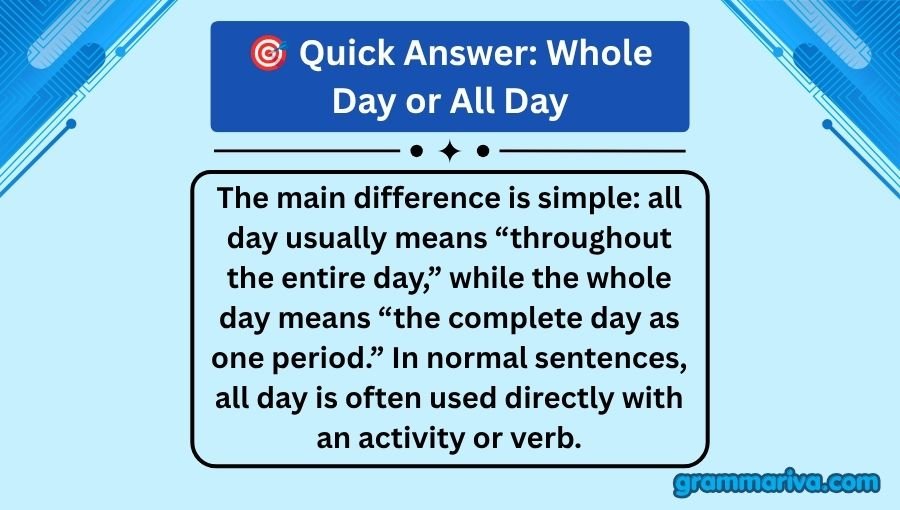
The main difference is simple: all day usually means “throughout the entire day,” while the whole day means “the complete day as one period.” In normal sentences, all day is often used directly with an activity or verb.
| Phrase | Main Use | Example |
|---|---|---|
| all day | Something continues throughout the day | I worked all day. |
| the whole day | The complete day viewed as one period | I spent the whole day at home. |
| a whole day | One complete day | We waited a whole day. |
| whole day | Usually needs a determiner | I stayed there the whole day. |
A key point is that whole day normally needs a word such as the, a, my, your, or another determiner.
So:
- ✅ I worked all day.
- ✅ I worked the whole day.
- ❌ I worked whole day.
Is Whole Day the Same as All Day? 🤔
No. Whole day and all day can express a similar idea, but their grammar and focus are different. All day works naturally as a time expression, while whole day normally needs a determiner.
Compare these sentences:
- ✅ She waited all day.
- ✅ She waited the whole day.
- ❌ She waited whole day.
The first sentence simply tells us how long she waited. The second treats the day as one complete unit.
I often tell students to think about the difference this way:
All day = throughout the day.
The whole day = the complete day.
Both can describe the same real event. The sentence structure changes the feel.
The Role of “The”
The word the is especially important with this construction.
We say:
- the whole day
- the whole week
- the whole month
- the whole year
We do not normally say:
- ❌ whole day
- ❌ whole week
- ❌ whole month
unless another determiner or special structure supplies the needed grammar.
For example:
- ✅ I spent my whole day working.
- ✅ We waited for a whole day.
- ✅ She stayed there for the whole day.
This is one of the easiest rules to remember.
What Does All Day Mean? ⏰
All day means during the entire day or throughout most or all of the day. It usually works as a time expression after a verb.
Examples include:
- I studied all day.
- She worked all day.
- They played outside all day.
- We talked all day.
- He slept all day.
The phrase tells us about the duration of an activity.
All Day With Action Verbs
All day is especially common with verbs that describe activities.
| Verb | Example With All Day | Meaning |
|---|---|---|
| work | I worked all day. | I worked throughout the day. |
| study | She studied all day. | She spent the day studying. |
| wait | We waited all day. | Our waiting lasted throughout the day. |
| rain | It rained all day. | Rain continued throughout the day. |
| travel | They traveled all day. | Their travel lasted throughout the day. |
Notice how natural these sentences sound.
You can usually replace all day with throughout the day.
“I worked all day” means roughly the same as “I worked throughout the day.”
That replacement is a useful test.
💡 Test Tip
If you can replace the phrase with throughout the day and the sentence still makes sense, all day is often a strong choice.
For example:
I practiced all day.
Becomes:
I practiced throughout the day.
The meaning remains clear.
What Does The Whole Day Mean? 📅
The whole day means the complete day considered as one period. It often appears after verbs such as spend, waste, enjoy, take, or stay.
Examples:
- I spent the whole day reading.
- She stayed home the whole day.
- We enjoyed the whole day together.
- He wasted the whole day.
- They were there the whole day.
The phrase can sound slightly more focused or emphatic than all day.
Consider:
I worked all day.
This focuses on the activity and its duration.
I spent the whole day working.
This focuses on the entire day as the time I gave to that activity.
Both are correct. The focus changes.
Meaning Summary
| Meaning | Word Type | Example Sentence |
|---|---|---|
| Throughout the day | Time expression | I studied all day. |
| The complete day | Noun phrase | I spent the whole day studying. |
| One complete day | Noun phrase with “a” | We waited a whole day. |
📝 Whole Day vs All Day at a Glance
The easiest way to understand whole day vs all day is to compare how each phrase fits into a sentence.
| Form | Type | Meaning | Example | Correct/Incorrect |
|---|---|---|---|---|
| all day | Time expression | Throughout the day | I worked all day. | ✅ Correct |
| the whole day | Noun phrase | The complete day | I spent the whole day working. | ✅ Correct |
| my whole day | Noun phrase | My complete day | My whole day was busy. | ✅ Correct |
| a whole day | Noun phrase | One complete day | We waited a whole day. | ✅ Correct |
| whole day | Bare noun phrase | Missing determiner | I worked whole day. | ❌ Incorrect |
The important lesson is not that one phrase is always right and the other is always wrong. Both are useful. Their grammar simply differs.
Why Do People Confuse Whole Day and All Day? 🧠
People confuse these phrases because both can describe an activity that lasts for an entire day. The meaning can overlap even though the sentence structure is different.
For example:
I studied all day.
and
I spent the whole day studying.
Both tell us that studying took up the day.
The difference becomes clearer when you look at the grammar around the phrase.
I once worked with a student who wrote, “I was at the library whole day.” She understood the intended meaning perfectly. The problem was simply the missing determiner. I changed it to “I was at the library all day,” and the sentence immediately sounded natural.
This is a common pattern. Learners often translate directly from another language. They know the idea of “whole day,” but English usually requires a different structure.
Common Reasons for the Confusion
- The meanings overlap.
- Both refer to a complete day.
- Other languages may build the phrase differently.
- Fast writing can remove small words.
- Learners may not know that “whole” often needs a determiner.
| Confusion | What the Writer Means | Better Choice |
|---|---|---|
| I worked whole day. | I worked throughout the day. | I worked all day. |
| I stayed whole day. | I stayed for the complete day. | I stayed the whole day. |
| She studied whole day. | She studied throughout the day. | She studied all day. |
| We spent all the day there. | We spent the complete day there. | We spent the whole day there. |
How Do You Use All Day in a Sentence? ✍️
Use all day when you want to show that an action, condition, or event continues throughout the day.
It commonly appears after the verb or near the end of the sentence.
Examples:
- I waited all day.
- She worked all day.
- We talked all day.
- The baby cried all day.
- It snowed all day.
You can also place it earlier when the sentence structure allows it:
All day, we waited for the bus.
This version gives stronger emphasis to the time period.
All Day in Questions
The phrase is also natural in questions.
- Did you work all day?
- Were you there all day?
- Has it been raining all day?
- Have you been studying all day?
It can also appear in negative sentences:
- I did not sleep all day.
- She was not busy all day.
- We were not there all day.
The exact meaning depends on the verb and context.
How Do You Use the Whole Day in a Sentence? 📝
Use the whole day when you want to treat the day as a complete unit.
It often works especially well with spend.
I spent the whole day cleaning my room.
The structure is:
spend + the whole day + activity
Other examples include:
- We spent the whole day at the beach.
- She spent the whole day preparing for the test.
- He spent the whole day fixing the car.
- They spent the whole day together.
You can also use it with other verbs:
The meeting took the whole day.
We stayed there the whole day.
She enjoyed the whole day.
The phrase often adds a sense that the complete period matters.
Correct Meanings and Uses ✅
Both expressions have several useful patterns. Learning these patterns is more helpful than memorizing one rigid rule.
1. Activities That Continue
Use all day for an activity that continues throughout the day.
I worked all day.
This is direct and natural.
2. A Day Viewed as One Complete Period
Use the whole day when the day itself is the focus.
I spent the whole day at home.
Here, the speaker emphasizes the complete period spent at home.
3. Strong Emphasis With “Whole”
Whole can add emphasis.
Compare:
I waited all day.
with:
I waited a whole day.
The second sentence can emphasize how long the wait felt.
The article a also changes the structure.
4. Possessive Forms
You can use a possessive before whole day:
- my whole day
- your whole day
- his whole day
- her whole day
- our whole day
- their whole day
For example:
My whole day was packed with meetings.
This means the complete day was filled with meetings.
| Pattern | Example | Use |
|---|---|---|
| all day | I worked all day. | Duration |
| the whole day | I worked the whole day. | Complete period |
| a whole day | We waited a whole day. | One complete day |
| my whole day | My whole day was busy. | Complete personal day |
| the whole day long | She sang the whole day long. | Strong duration emphasis |
Can You Say “All the Day”? 🚫
In modern standard American English, all day is the normal expression for this meaning. All the day is possible in some older, literary, or special styles, but it is not the usual choice in everyday American English.
For normal writing, use:
I worked all day.
rather than:
I worked all the day.
The first sentence is simpler and more natural.
This is useful for learners because direct translations can sometimes lead to longer forms that native speakers rarely use.
Can You Say “Whole Day” Without “The”? ⚠️
Usually, no. When whole day means a complete day as a noun phrase, it normally needs a determiner.
Correct examples include:
- the whole day
- a whole day
- my whole day
- your whole day
- one whole day
Incorrect in standard usage:
❌ I waited whole day.
Better:
✅ I waited all day.
Or:
✅ I waited the whole day.
The small word before whole matters.
| Missing Element | Incorrect | Correct |
|---|---|---|
| the | ❌ whole day | ✅ the whole day |
| a | ❌ I waited whole day. | ✅ I waited a whole day. |
| possessive | ❌ whole day was busy | ✅ My whole day was busy. |
| number | ❌ whole day later | ✅ one whole day later |
Case Study: A Workplace Email 💼
Imagine an employee writing to a manager:
“I was working whole day on the report.”
The intended meaning is clear. However, the sentence needs correction.
A natural version would be:
“I was working all day on the report.”
Another option is:
“I spent the whole day working on the report.”
The first version focuses on the length of the work. The second highlights the complete day spent on the report.
I once edited a short workplace report with almost this exact issue. The writer had excellent ideas, but several small time phrases sounded translated. Fixing them made the whole document sound much more natural without changing the meaning.
Before and After
| Original | Improved | Reason |
|---|---|---|
| I worked whole day. | I worked all day. | “All day” naturally follows the verb. |
| I spent all the day there. | I spent the whole day there. | “The whole day” fits after “spent.” |
| My whole day was busy. | My whole day was busy. | Already correct. |
| We waited a whole day. | We waited a whole day. | “A” correctly introduces the noun phrase. |
Grammar Rules Explanation
The difference comes from how all and whole work in these expressions.
All day functions as a time expression. It tells us that something happens throughout the day.
The whole day is a noun phrase. Whole describes the noun day, and the noun phrase normally needs a determiner.
That is why we say:
I studied all day.
But:
I studied the whole day.
The first phrase works directly as a time expression. The second contains the noun day, modified by whole, with the acting as the determiner.
The same basic pattern appears with other time nouns:
- all week
- the whole week
- all month
- the whole month
- all year
- the whole year
Standard English reference works agree with this general distinction between all and whole in these structures.
Correct vs Incorrect at a Glance
| Sentence | Correct/Incorrect | Why |
|---|---|---|
| I worked all day. | ✅ Correct | “All day” works as a time expression. |
| I worked whole day. | ❌ Incorrect | “Whole day” lacks a determiner. |
| I spent the whole day working. | ✅ Correct | “The whole day” is a complete noun phrase. |
| We waited a whole day. | ✅ Correct | “A” is the determiner before “whole day.” |
| She studied all the day. | ❌ Usually unnatural | “All day” is the normal modern form. |
What Is the Difference Between All Day and The Whole Day? 🎯
The simplest difference is focus.
All day focuses on duration.
The whole day focuses on the complete period.
Compare:
I watched TV all day.
This tells us how long I watched TV.
I spent the whole day watching TV.
This emphasizes that the entire day was devoted to watching TV.
The meanings are close. The sentence structure and focus are different.
| Feature | All Day | The Whole Day |
|---|---|---|
| Main focus | Duration | Complete period |
| Grammar | Time expression | Noun phrase |
| Determiner needed | No | Yes |
| Common pattern | verb + all day | spend + the whole day |
| Example | We talked all day. | We spent the whole day talking. |
How Does Whole Day or All Day Work in Different Contexts? 🌎
The choice can depend on the setting, although the basic grammar stays the same.
| Context | Which Term to Use | Example |
|---|---|---|
| Everyday conversation | all day | I was tired all day. |
| Professional writing | all day / the whole day | I worked all day on the report. |
| Creative writing | Either, based on focus | The rain fell all day. |
| Social media/texting | all day | I could sleep all day. |
Everyday Conversation
All day is extremely natural in casual speech.
I have been thinking about it all day.
Professional Writing
Both forms can work.
The training lasted all day.
or:
The training took the whole day.
The first is usually more direct.
Creative Writing
Writers can choose either form depending on rhythm and emphasis.
She walked all day.
She spent the whole day walking through the quiet streets.
Social Media and Texting
Short forms are usually best:
Could sleep all day 😴
Been working all day.
The phrase is clear and natural.
Common Phrases With All Day and Whole Day 💬
Some combinations appear very often in natural English.
| Phrase | Meaning |
|---|---|
| all day | Throughout the day |
| all day long | Throughout the entire day, with emphasis |
| the whole day | The complete day |
| a whole day | One complete day |
| my whole day | My complete day |
| the whole day through | During the complete day; less common and more literary |
All day long is especially common when the speaker wants extra emphasis.
The children played all day long.
This sounds more expressive than simply:
The children played all day.
All Day Long vs The Whole Day 🔍
All day long and the whole day can have similar meanings, but they are built differently.
We talked all day long.
We spent the whole day talking.
Both suggest that talking continued for the entire day.
The first emphasizes duration. The second presents the day as a complete block of time.
| Expression | Main Idea | Example |
|---|---|---|
| all day | Throughout the day | I worked all day. |
| all day long | Throughout the day with emphasis | I waited all day long. |
| the whole day | The complete day | I spent the whole day there. |
| a whole day | One complete day | It took a whole day. |
Synonyms and Alternatives 🔄
Sometimes you can replace these expressions with another phrase. The best choice depends on the sentence.
| Alternative | Works When | Does Not Work When |
|---|---|---|
| throughout the day | You mean during the day | You need a noun phrase after “spend” |
| the entire day | You want strong emphasis | A very casual phrase is preferred |
| during the day | You mean at some point in the daytime | You mean the activity lasted continuously |
| for the entire day | You want to stress duration | The sentence needs a shorter, casual style |
| from morning to night | You mean a long span across the day | The activity did not cover that broad period |
For example:
I worked all day.
can become:
I worked throughout the day.
But:
I spent the whole day at home.
does not always sound as natural if changed to:
I spent throughout the day at home.
That structure does not work.
So never replace phrases mechanically. Look at the grammar around them.
Why Does Getting Whole Day or All Day Right Matter? ⭐
Correct word choice makes your writing easier to understand. It also helps your English sound natural.
A reader may understand “I worked whole day,” but the sentence still sounds incomplete. A small grammar error can make a sentence feel translated or rushed.
Clarity
Correct time expressions show exactly how long something happened.
Professionalism
Small grammar details matter in emails, reports, applications, and business writing.
Digital Communication
Even short social posts look cleaner when common phrases are used correctly.
“I studied all day” sounds natural.
“I studied whole day” sounds like a learner sentence.
A useful writing principle is:
Clear words make clear thoughts easier to share.
| Situation | Why Getting It Right Matters |
|---|---|
| Resume | Shows attention to language |
| Client email | Creates a polished impression |
| Published content | Improves readability |
| Social post | Makes short writing sound natural |
Why Do Small Grammar Words Matter? 🧩
Words like the, a, my, and your may look small, but they can completely change whether a noun phrase is grammatical.
Compare:
whole day
with:
the whole day
The second one is complete.
This is not unique to day.
We also say:
- the whole week
- the whole month
- the whole story
- the whole book
- the whole house
The pattern is easy to remember:
determiner + whole + noun
Examples:
the whole day
my whole week
a whole month
her whole life
This pattern can help you avoid similar errors elsewhere.
⚠️ Common Mistakes With Whole Day or All Day
Most mistakes happen because writers focus on meaning instead of sentence structure. Fast typing, autocorrect, translation habits, and limited grammar knowledge can all play a role.
I once caught myself typing “I was there whole day” in a quick message. I knew the rule, but I was typing too fast. I changed it to “I was there all day” before sending it. Even experienced writers can make small slips when they rush.
Similar Grammar Confusions
| Confusion | Correct Form | Basic Rule |
|---|---|---|
| it’s / its | It’s raining. / The dog wagged its tail. | Contraction vs possession |
| your / you’re | Your book is here. / You’re ready. | Possessive vs “you are” |
| their / they’re | Their car is new. / They’re here. | Possessive vs “they are” |
| then / than | First this, then that. / Taller than me. | Time vs comparison |
| all day / whole day | I worked all day. | Time expression vs noun phrase |
Specific Wrong Forms
| Wrong Form | What’s Wrong | Correct Form |
|---|---|---|
| I worked whole day. | Missing determiner | I worked all day. |
| I spent all the day there. | Unnatural standard phrasing | I spent the whole day there. |
| She studied whole day. | Missing determiner | She studied all day. |
| We waited whole day. | Missing determiner | We waited a whole day. |
| My all day was busy. | Wrong structure | My whole day was busy. |
| I stayed all the whole day. | Unnecessary combination | I stayed all day. |
Fast Typing and Autocorrect Can Cause Problems 📱
Small grammar errors often appear when people type quickly.
A writer may know that the whole day is correct but accidentally leave out the.
Autocorrect can also make things worse. It may suggest a word that looks close to what you want but does not fit the sentence.
Before sending an important message, read the sentence once from start to finish.
Ask:
Am I describing duration, or am I treating the day as one complete unit?
That question solves many cases.
How Can You Remember the Difference? 💡
Use this simple memory trick:
Think “throughout”
If your meaning is throughout the day, use all day.
I practiced all day.
Think “complete”
If you are talking about the complete day, use the whole day.
I spent the whole day practicing.
Think “determiner”
If you use whole + day, check whether a determiner comes before whole.
the whole day
my whole day
a whole day
This three-part test is quick and reliable.
| Question | If Yes → Use |
|---|---|
| Do I mean “throughout the day”? | all day |
| Am I treating the day as one complete period? | the whole day |
| Does “whole” come directly before “day”? | Add a determiner |
| Am I using “spend”? | the whole day is often natural |
| Do I want a short time expression? | all day |
Quick Recap Checklist ✅
Here is the rule in its shortest form.
| Question | If Yes → Use |
|---|---|
| Do you mean throughout the day? | all day |
| Do you mean the complete day? | the whole day |
| Does “whole” modify “day”? | Use a determiner |
| Are you saying “I worked ___”? | all day is usually best |
| Are you saying “I spent ___”? | the whole day is often natural |
Practice Examples
1. I was busy ___.
Answer: all day
I was busy all day.
2. I spent ___ cleaning the house.
Answer: the whole day
I spent the whole day cleaning the house.
3. We waited for ___.
Answer: a whole day
We waited for a whole day.
FAQs About Whole Day vs All Day ❓
Is “all day” grammatically correct?
Yes. All day is a standard time expression meaning throughout the day or during the entire day.
Is “whole day” grammatically correct by itself?
Usually, no. When whole day functions as a noun phrase, it normally needs a determiner, such as the, a, my, or your.
Should I say “I worked all day” or “I worked the whole day”?
Both can be correct. I worked all day is generally more natural and direct. I worked the whole day puts more focus on the complete period.
Can I say “I spent all day”?
Yes. For example:
I spent all day studying.
This is completely natural.
You can also say:
I spent the whole day studying.
Both are correct.
Is “I spent the whole day” correct?
Yes. It is a standard construction. You can add a place or activity:
I spent the whole day at home.
I spent the whole day studying.
Can I say “all the day”?
It is not the normal choice in modern everyday American English. All day is the preferred form in most ordinary sentences.
What is the difference between “all day” and “all day long”?
Both describe something lasting throughout the day. All day long adds extra emphasis.
She worked all day.
She worked all day long.
The second sentence sounds more emphatic.
Why is “I worked whole day” wrong?
The problem is the noun phrase whole day. It normally needs a determiner. You can say I worked all day or I worked the whole day.
Is “my whole day” correct?
Yes. My whole day means the complete day belonging to or experienced by the speaker.
My whole day was busy.
Which is better for American English, “all day” or “the whole day”?
Both are correct, but all day is often the simpler and more natural choice when describing duration. Use the whole day when you want to focus on the complete period.
Conclusion 🌟
Whole day or all day becomes much easier once you understand the difference between duration and a complete time period. Use all day when you mean that something happens throughout the day. Use the whole day when you want to treat the day as one complete period. When you use whole day, remember that a determiner is normally needed: the whole day, a whole day, or my whole day.
I recommend using the simple “throughout” test when you are unsure. If you can naturally say “throughout the day,” all day will often be the right choice. If you are talking about the complete day as a unit, the whole day may fit better.
Once this pattern becomes familiar, sentences like “I worked all day” and “I spent the whole day working” will feel automatic. Keep your sentences simple, check the small words, and trust the structure. ✨
Remember: all day describes the span, while the whole day highlights the complete day.

Hi, I’m Olivia Carter. I’m an English language editor at Grammariva, and I work on making grammar lessons clear, accurate, and easy to follow. I especially enjoy writing about common grammar mistakes and everyday English.

[…] edited articles. The good news is that you only need a few clear rules to master these words. 😊 Whole Day or All Day | Pajamas vs Pyjamas | Elegy vs […]
[…] end, you should be able to spot the correct form almost instantly. 🧠 Prescribe vs Proscribe | Whole Day or All Day | Pajamas vs […]