Have you ever typed pajamas vs pyjamas and wondered which spelling is actually correct? You are not alone. Both forms look familiar, both are used by native English speakers, and both refer to the same type of sleepwear. The difference is mainly about where the spelling is used, not what the word means. 🛏️
If you write for an American audience, you will usually want pajamas. If you write for a British audience, pyjamas is the standard spelling. Canadian, Australian, and other English-speaking communities may also use pyjamas, although usage can vary by region and style.
I teach English writing with one simple goal: make confusing choices easy. In this guide, I will explain the difference, show you real examples, cover common mistakes, and give you quick tests you can use when you are unsure. Elegy vs Eulogy | Gases or Gasses | Take It or Leave It
🎯 Quick Answer: Pajamas vs Pyjamas
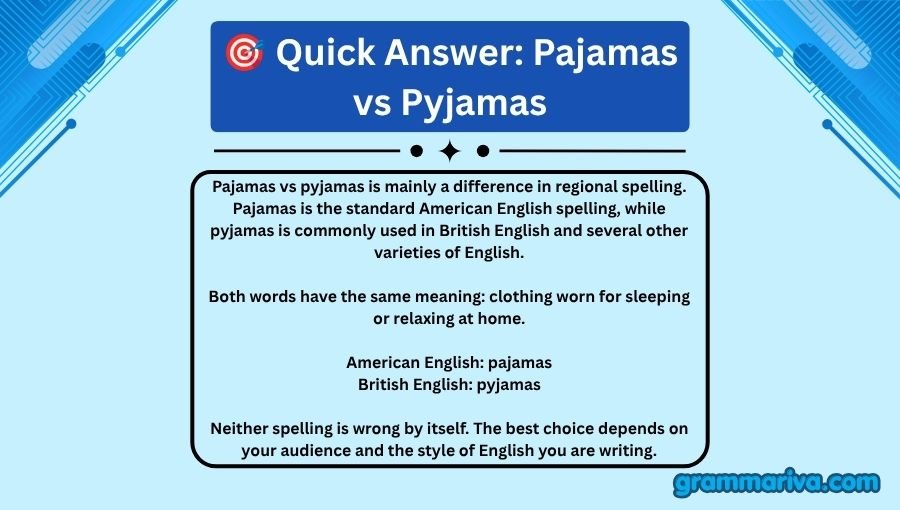
Pajamas vs pyjamas is mainly a difference in regional spelling. Pajamas is the standard American English spelling, while pyjamas is commonly used in British English and several other varieties of English.
Both words have the same meaning: clothing worn for sleeping or relaxing at home.
American English: pajamas
British English: pyjamas
Neither spelling is wrong by itself. The best choice depends on your audience and the style of English you are writing.
Is Pajamas the Same as Pyjamas? 🛏️
Yes. Pajamas and pyjamas mean the same thing. The spelling changes by region, but the basic meaning does not.
For example:
- I bought new pajamas for winter. ✅
- I bought new pyjamas for winter. ✅
Both sentences are correct. The first fits American English better. The second fits British English better.
Here is the key idea:
Pajamas = American English
Pyjamas = British English and other varieties
This is similar to other regional spelling differences. American English often uses forms such as color, while British English uses colour. The same basic idea applies here.
A simple comparison
| Form | Type | Meaning | Example | Correct/Incorrect |
|---|---|---|---|---|
| pajamas | American spelling | Sleepwear | I need new pajamas. | ✅ Correct |
| pyjamas | British spelling | Sleepwear | I need new pyjamas. | ✅ Correct |
| pajama | Singular form | One item or sleepwear as a category | This pajama top is soft. | ✅ Correct |
| pyjama | British singular form | One item or sleepwear as a category | This pyjama top is soft. | ✅ Correct |
| pajamass | Misspelling | No standard meaning | I bought pajamass. | ❌ Incorrect |
The spelling difference is easy once you connect pajamas with American English and pyjamas with British English.
What Is the Difference Between Pajamas and Pyjamas? 🌙
The main difference between pajamas and pyjamas is regional spelling. The words describe the same type of clothing. The pajamas vs pyjamas question often comes up when writers switch between American and British English.
In American English, the usual spelling is pajamas. In British English, the usual spelling is pyjamas.
Pajamas in American English
American writers normally spell the word with an a after the initial p:
pajamas
Examples:
- I left my pajamas on the bed. ✅
- My pajamas are still in the dryer. ✅
- She bought cute pajamas for her daughter. ✅
For a US blog, school paper, product description, or email, this is usually the spelling you should choose.
Pyjamas in British English
British writers normally use:
pyjamas
Examples:
- I left my pyjamas on the bed. ✅
- My pyjamas are still in the dryer. ✅
- She bought new pyjamas for her daughter. ✅
This spelling is also common in other places where British English conventions are followed.
The difference at a glance
| Feature | Pajamas | Pyjamas |
|---|---|---|
| Main variety | American English | British English |
| Meaning | Sleepwear | Sleepwear |
| Singular | pajama | pyjama |
| Plural | pajamas | pyjamas |
| US writing | Preferred | Less common |
| UK writing | Less common | Preferred |
| Meaning changes? | No | No |
So, if you are asking whether one word means something different, the answer is no.
Why Do People Confuse Pajamas and Pyjamas? 🤔
People confuse these spellings because English has different regional standards. A word can be perfectly correct in one variety of English and less common in another.
The letter a in pajamas and the letter y in pyjamas are enough to make the two forms look like different words. They are not different in meaning.
I once reviewed a short travel article written for US readers. The writer used pyjamas several times because that was the spelling they had learned at school. The spelling itself was not bad. The problem was that the article used American spelling everywhere else. I changed the word to pajamas so the style stayed consistent.
That is the real lesson: consistency matters.
Why regional spelling causes problems
You may see different versions because of:
- where the writer lives
- which English variety they learned
- the target audience
- school or workplace style rules
- books and websites they read
- autocorrect settings
- keyboard language settings
A useful rule
Ask yourself:
Who am I writing for?
If your readers are mainly in the United States, choose pajamas.
If your readers are mainly in the United Kingdom, choose pyjamas.
Pajamas: Meaning and Correct Use 💤
Pajamas is the standard American English spelling for clothing worn while sleeping or relaxing.
The word can refer to a matching set, such as a shirt and pants, or to sleepwear more generally.
Examples:
- I packed three pairs of pajamas for the trip. ✅
- These pajamas are very comfortable. ✅
- My son wears pajamas with stars on them. ✅
- She changed into her pajamas after dinner. ✅
Sentence breakdown
Consider this sentence:
I changed into my pajamas before bed.
- I = subject
- changed = verb
- into = preposition
- my pajamas = the clothing being worn
The word pajamas works naturally as a plural noun.
Why do we often say “pajamas” in the plural?
In everyday English, sleepwear is commonly discussed as a set of clothing. That is why phrases such as these sound natural:
- a pair of pajamas
- my pajamas
- new pajamas
- two pairs of pajamas
You may also see pajama before another noun:
- pajama pants
- pajama shirt
- pajama set
- pajama party
Meaning summary
| Meaning | Word Type | Example Sentence |
|---|---|---|
| Clothing worn for sleeping | Noun | I bought new pajamas. |
| A sleepwear set | Noun | This pajama set is soft. |
| Used before another noun | Modifier | She wore pajama pants. |
💡 Test Tip
If you are writing for Americans, look at the word pajamas and ask:
“Am I using American English?”
If yes, pajamas is normally your best choice.
Pyjamas: Meaning and Correct Use 🇬🇧
Pyjamas is the common British English spelling for sleepwear.
It has the same basic meaning as pajamas.
Examples:
- I need to wash my pyjamas. ✅
- She bought a new pair of pyjamas. ✅
- The children put on their pyjamas. ✅
- These pyjamas are warm enough for winter. ✅
For British English content, pyjamas is normally the natural choice.
British spelling in context
Imagine a UK children’s clothing website. A product might be described as:
“Soft cotton pyjamas for kids.”
That spelling matches the site’s likely audience.
An American website would normally write:
“Soft cotton pajamas for kids.”
The product has not changed. Only the spelling has.
Regional spelling table
| Audience | Preferred Form | Example |
|---|---|---|
| United States | pajamas | These pajamas are soft. |
| United Kingdom | pyjamas | These pyjamas are soft. |
| American-style publication | pajamas | Find the best pajamas for winter. |
| British-style publication | pyjamas | Find the best pyjamas for winter. |
How Do You Use Pajamas and Pyjamas in a Sentence? ✍️
Both forms can be used in ordinary sentences about sleeping, relaxing, shopping, children, clothing, travel, and bedtime.
Here are several examples.
I put on my pajamas at ten. ✅
I put on my pyjamas at ten. ✅
She bought blue pajamas for the baby. ✅
She bought blue pyjamas for the baby. ✅
Where are my pajamas? ✅
Where are my pyjamas? ✅
These pajamas are too small. ✅
These pyjamas are too small. ✅
The correct choice depends on the English variety you are using.
Context examples
| Context | Which Term to Use | Example |
|---|---|---|
| US conversation | pajamas | I need new pajamas. |
| UK conversation | pyjamas | I need new pyjamas. |
| US professional writing | pajamas | Our store sells children’s pajamas. |
| UK professional writing | pyjamas | Our store sells children’s pyjamas. |
| US social media | pajamas | Cozy pajamas and movie night! |
| UK social media | pyjamas | Cozy pyjamas and movie night! |
What Does the Grammar Rule Say? 📚
The grammar rule is simple: both spellings are accepted, but they belong to different regional varieties of English.
This is a spelling issue, not a difference in grammar or meaning.
Most standard English references recognize regional spelling differences of this kind. The important point is to follow the spelling system that matches your intended audience.
You do not need to treat pyjamas as a grammar mistake when reading British English. Likewise, you should not assume pajamas is wrong simply because you normally see pyjamas.
Correct vs Incorrect at a Glance
| Sentence | Correct/Incorrect | Why |
|---|---|---|
| I bought new pajamas. | ✅ Correct | Standard American spelling |
| I bought new pyjamas. | ✅ Correct | Standard British spelling |
| I bought new pajamass. | ❌ Incorrect | Extra “s” is not standard |
| I bought new pyjammas. | ❌ Incorrect | Misspelled form |
| I bought new pajamas for my trip. | ✅ Correct | Correct American usage |
There is one useful distinction: With pajamas vs pyjamas, the key rule is to match your spelling with your target variety of English.
Regional spelling is not the same as incorrect spelling.
If you are writing a British article, changing every pyjamas to pajamas would not necessarily improve it. It could actually make the article less consistent with the intended style.
Pajamas vs Pyjamas in Different Types of Writing 📝
Your choice should match the audience and publication style. The choice between pajamas vs pyjamas should match the English style used throughout your writing.
Everyday conversation
Use the form that matches the English variety you normally speak or write.
An American might say:
“I need to put on my pajamas.”
A British speaker might write:
“I need to put on my pyjamas.”
Professional writing
Consistency becomes more important in business writing.
If your company targets US customers, use pajamas across product pages, ads, emails, and articles.
If your company targets UK customers, use pyjamas.
Creative writing
Writers should consider the character and setting.
A US-based character would naturally fit pajamas in an American English story. A UK-based setting may call for pyjamas.
Social media and texting
Either form can work. Social media is often casual, but your audience still matters.
| Writing Type | US English | British English |
|---|---|---|
| Everyday conversation | pajamas | pyjamas |
| Professional writing | pajamas | pyjamas |
| Creative writing | pajamas | pyjamas |
| Social media | pajamas | pyjamas |
Can You Use Pajama as a Singular Word? 🔎
Yes. Pajama is used in American English as a singular form and also before other nouns.
For example:
- This pajama top is too big. ✅
- I bought a pajama set. ✅
- She needs a pajama shirt. ✅
In British English, the matching form is pyjama:
- This pyjama top is too big. ✅
- I bought a pyjama set. ✅
- She needs a pyjama shirt. ✅
The singular and plural forms follow the same regional spelling pattern.
| American English | British English | Example |
|---|---|---|
| pajama | pyjama | a pajama set / a pyjama set |
| pajamas | pyjamas | new pajamas / new pyjamas |
| pajama pants | pyjama trousers | sleepwear clothing |
| pajama party | pyjama party | a sleepwear-themed party |
One detail varies by region: some clothing names themselves may differ. For example, American English often uses pants, while British English can use trousers. That is a separate regional difference. Understanding pajamas vs pyjamas also helps you use the singular and plural forms correctly.
A Real-Life Case Study: Choosing the Right Spelling 💼
A small online clothing store is preparing two versions of its website.
The US page says:
“Shop soft cotton pajamas for women, men, and kids.”
The UK page says:
“Shop soft cotton pyjamas for women, men, and children.”
Both pages describe the same products. The spelling changes because the target customers are different.
I once caught a similar issue while editing a product description. The page was written for American shoppers, but the copy used pyjamas because the writer had copied wording from a British supplier. Nothing was unclear, but the page felt inconsistent. We changed the spelling throughout the US version.
That small edit made the page fit its audience better.
What this case teaches
When writing for a specific market:
- Identify your audience.
- Choose one English variety.
- Check regional spellings.
- Keep the same style throughout the page.
- Do not mix forms without a reason.
What Are the Common Mistakes With Pajamas and Pyjamas? ⚠️
Most mistakes happen because writers see both forms online. Understanding pajamas vs pyjamas can help you avoid mixing American and British spelling in the same article.
A person may also type quickly and let autocorrect change the spelling. Someone who learned British English may use pyjamas without realizing that a US publication prefers pajamas.
I once caught myself typing pyjamas in an American-style article after reading several British websites earlier that day. My brain had simply carried the spelling over. A quick style check fixed it.
Why mistakes happen
Common reasons include:
- fast typing
- autocorrect
- keyboard language settings
- lack of knowledge about regional spelling
- reading content from different countries
- copying text from another website
- mixing US and UK English
Similar English confusions
| Confusion | US Form | UK Form |
|---|---|---|
| color / colour | color | colour |
| center / centre | center | centre |
| organize / organise | organize | organise |
| traveled / travelled | traveled | travelled |
| pajamas / pyjamas | pajamas | pyjamas |
These examples show why context matters. A spelling can be correct without being the best choice for every audience.
Specific spelling mistakes
| Wrong Form | What’s Wrong | Correct Form |
|---|---|---|
| pajamass | Extra letter | pajamas |
| pajamaas | Extra “a” | pajamas |
| pyjammas | Extra “m” | pyjamas |
| pyjamasz | Extra letter | pyjamas |
| payjamas | Wrong spelling pattern | pajamas / pyjamas |
| pajama’s | Incorrect apostrophe for a simple plural | pajamas |
That final mistake deserves attention.
Pajamas is already plural. You do not need an apostrophe.
- I bought new pajamas. ✅
- I bought new pajama’s. ❌
An apostrophe usually shows possession or contraction. It does not normally create an ordinary plural.
Does the Word Have a Special History? 📖
The word has a long history connected with clothing and sleepwear, and its spelling differs across modern English varieties. The American and British forms developed into the spellings commonly used today.
For practical writing, you do not need to memorize a long history lesson. The useful point is that pajamas and pyjamas are established regional spellings of the same word.
The spelling you choose today should mainly depend on your audience and your chosen English style.
A simple historical view
| Period | Form | General Note |
|---|---|---|
| Earlier English usage | Regional forms varied | The word entered English through contact with other languages and cultures. |
| Later English development | pajama / pyjama forms | Different English varieties developed preferred spellings. |
| Modern American English | pajamas | Common US spelling |
| Modern British English | pyjamas | Common UK spelling |
| Modern global English | both forms | Regional usage continues |
The safest lesson is simple: you do not need to call one form wrong just because another form is more familiar to you.
Common Phrases With Pajamas and Pyjamas 🌙
There are many everyday phrases built around sleepwear. The noun itself stays the same, while the regional spelling changes.
| Phrase | Meaning |
|---|---|
| pajama set | A matching sleepwear set |
| pajamas for kids | Sleepwear designed for children |
| pajama party | A casual gathering where people wear sleepwear |
| pajama pants | Pants designed for sleeping or relaxing |
| put on pajamas | Change into sleepwear |
| stay in pajamas | Remain in sleepwear instead of getting dressed |
In British English, these can become:
- pyjama set
- pyjamas for kids
- pyjama party
- pyjama trousers
- put on pyjamas
- stay in pyjamas
The same regional rule applies.
What Alternatives Can You Use Instead? 👕
Sometimes you may want a different word. This can help when you are writing for a broad international audience.
However, alternatives are not always exact replacements.
| Alternative | Works When | Does Not Work When |
|---|---|---|
| sleepwear | You mean clothing worn for sleep | You need the casual everyday word |
| nightwear | You are using British-style wording | You specifically want American casual wording |
| bedtime clothes | You want very simple language | You need a standard clothing term |
| sleep clothes | You want an informal phrase | You are writing polished product copy |
| loungewear | The clothing is designed for relaxing too | You specifically mean traditional sleepwear |
Sleepwear is the broadest useful alternative. It can include pajamas, nightgowns, robes, and other clothing worn for sleeping.
Loungewear is different. It usually refers to comfortable clothing worn at home, but it is not always intended for sleep. Knowing the difference between pajamas vs pyjamas makes it easier to choose the right alternative for your audience.
Why Does the Correct Spelling Matter? 🎯
Choosing between pajamas and pyjamas matters because spelling helps show who your writing is for. The pajamas vs pyjamas distinction may be small, but consistent regional spelling can make your content look more polished.
The difference usually does not stop readers from understanding you. Still, consistent spelling makes content look more polished.
A US reader will recognize pyjamas, but pajamas will usually fit an American publication better. A UK reader will understand pajamas, but pyjamas normally fits British style better.
A useful writing principle is:
Clear writing respects both the word and the reader.
Why consistency matters
| Situation | Why Getting It Right Matters |
|---|---|
| Resume or application | Shows attention to writing style |
| Client email | Makes communication look polished |
| Published content | Keeps regional style consistent |
| Social post | Helps content match the intended audience |
This is not about judging one spelling as smarter or better. It is about choosing the form that fits your writing situation.
How Can You Remember the Difference? 💡
The easiest memory trick is to connect each spelling with its English variety. The easiest way to remember pajamas vs pyjamas is to connect each spelling with its regional English style.
For American English
Think:
Pajamas = America
The spelling has a after the first consonant:
p-a-j-a-m-a-s
For British English
Think:
Pyjamas = British English
The spelling has y:
p-y-j-a-m-a-s
You can also remember the matching forms:
American: pajama → pajamas
British: pyjama → pyjamas
A quick memory chart
| If Your Audience Is… | Remember |
|---|---|
| American | pajamas |
| British | pyjamas |
| US-based website | pajamas |
| UK-based website | pyjamas |
| Mixed international audience | Pick a style and stay consistent |
If you are still unsure, check the spelling style used by the rest of your document.
Quick Recap Checklist ✅
Use this checklist before publishing.
| Question | If Yes → Use |
|---|---|
| Are you writing for US readers? | pajamas |
| Are you writing for UK readers? | pyjamas |
| Does your document already use American spelling? | pajamas |
| Does your document already use British spelling? | pyjamas |
| Are you writing a US product description? | pajamas |
| Are you writing a UK product description? | pyjamas |
Practice Examples
1. US audience:
“I bought warm ___ for winter.”
Answer: pajamas ✅
2. UK audience:
“I bought warm ___ for winter.”
Answer: pyjamas ✅
3. US blog:
“Our guide covers the best pajamas for kids.”Once you understand pajamas vs pyjamas, choosing the right spelling becomes much easier.
Correct: pajamas ✅
FAQs About Pajamas vs Pyjamas
Is pajamas American or British English?
Pajamas is the standard spelling used in American English. British English generally uses pyjamas.
Is pyjamas American or British English?
Pyjamas is the standard spelling commonly associated with British English. It is also used in several other English-speaking regions.
Are pajamas and pyjamas the same thing?
Yes. They have the same basic meaning. Both refer to clothing worn for sleeping or relaxing. The main difference is regional spelling.
Which is correct, pajamas or pyjamas?
Both are correct. Use pajamas for American English and pyjamas for British English.
How do Americans spell pajamas?
Americans normally spell the word pajamas, with an a after the initial p.
How do British people spell pajamas?
British English normally spells the word pyjamas, with a y after the initial p.
Should I use pajamas or pyjamas for a US website?
Use pajamas for a US website. It matches standard American English spelling and keeps the site’s regional style consistent.
Should I use pajamas or pyjamas for a UK website?
Use pyjamas for a UK website. This matches the spelling normally expected in British English.
Is pajama singular or plural?
Pajama is the singular form used in American English, especially before another noun, as in pajama set. Pajamas is the common plural form.
Is there an apostrophe in pajamas?
No. The ordinary plural is pajamas, without an apostrophe. Pajama’s is not the standard plural spelling.
Pajamas vs Pyjamas: Final Takeaway 😴
Pajamas vs pyjamas comes down to regional English spelling. Pajamas is the standard American form, while pyjamas is the standard British form. Both refer to the same kind of sleepwear.
If you write for Americans, choose pajamas. If you write for British readers, choose pyjamas. If you write for an international audience, pick the spelling style that matches the rest of your content and use it consistently. 😊
The biggest mistake is not choosing the “wrong” regional form. The bigger problem is mixing styles without a reason. Consistent spelling makes your writing cleaner and easier to trust.
So, the next time you pause over the spelling, ask one quick question: Who am I writing for? Once you know that, the choice becomes easy.
Pajamas for American English. Pyjamas for British English. Same meaning, different regional spelling. ✨

Hi, I’m Nathan Reed. I’m a grammar and writing specialist at Grammariva. I work on practical grammar content that helps readers understand sentence structure, punctuation, vocabulary, and better writing habits.
[…] examples, and quick tests. By the end, choosing between these phrases should feel easy. 😊 Pajamas vs Pyjamas | Elegy vs Eulogy | Gases or […]
[…] news is that you only need a few clear rules to master these words. 😊 Whole Day or All Day | Pajamas vs Pyjamas | Elegy vs […]