Have you ever typed to many or too many and stopped because both versions looked almost right? You are not alone. This is a small spelling and grammar choice, but it can change the meaning of a sentence. The good news is that the rule is simple once you understand what to and too do.
I have seen this mistake in emails, school assignments, social posts, and even polished business writing. The problem usually happens because to and too sound alike in everyday speech. When we type quickly, it is easy to choose the wrong one. 😅
The correct form in sentences about an excessive number is too many. For example, “There are too many people in this room” means there are more people than needed or wanted. The form to many is usually incorrect when you mean “more than needed.”
In this guide, I will explain the difference, show clear examples, cover common mistakes, and give you easy tests you can use whenever you are unsure. By the end, choosing the right form should feel automatic. 👍 Help or Help To | Baptised vs Baptized | Reply Me vs Reply to Me
🎯 Quick Answer: To Many or Too Many?
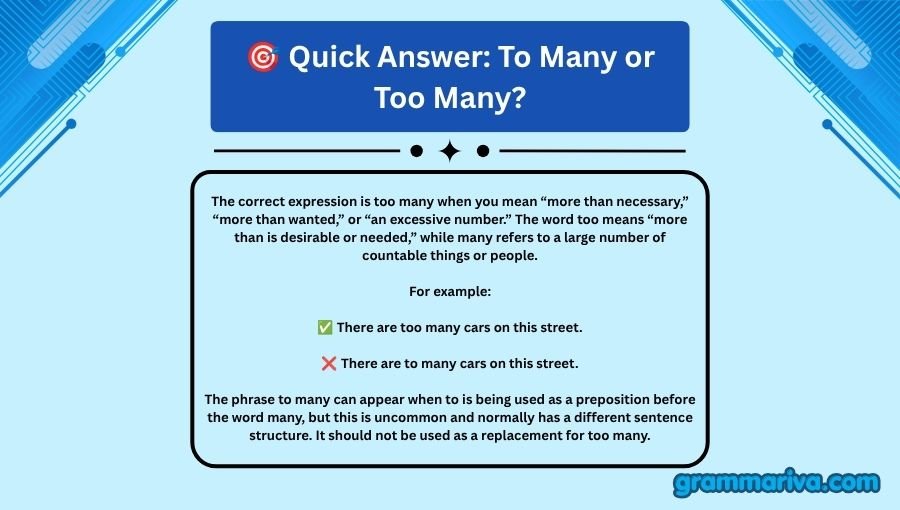
The correct expression is too many when you mean “more than necessary,” “more than wanted,” or “an excessive number.” The word too means “more than is desirable or needed,” while many refers to a large number of countable things or people.
For example:
- ✅ There are too many cars on this street.
- ❌ There are to many cars on this street.
The phrase to many can appear when to is being used as a preposition before the word many, but this is uncommon and normally has a different sentence structure. It should not be used as a replacement for too many.
| Expression | Type | Meaning | Example |
|---|---|---|---|
| too many | Adverb + determiner | More than needed or wanted | We have too many boxes. |
| to many | Preposition + determiner | Usually part of a different grammatical structure | The message was sent to many people. |
| many | Determiner/pronoun | A large number | Many people agreed. |
| too much | Adverb + determiner | More than needed of an uncountable thing | There is too much noise. |
Is To Many the Same as Too Many?
No. To many and too many are not normally interchangeable. Too many expresses an excessive number, while to usually shows direction, connection, or the person or group receiving something.
Consider these examples:
- ✅ There are too many advertisements on this page.
- ❌ There are to many advertisements on this page.
But:
- ✅ I sent the invitation to many friends.
- ❌ I sent the invitation too many friends.
The first sentence uses to correctly because it shows who received the invitation. The second needs to, not too, because the meaning is not “an excessive number.”
This distinction is the heart of the entire topic.
To Many vs Too Many at a Glance
The easiest way to understand the difference is to look at the job each word performs.
| Form | Word Function | Basic Idea | Example |
|---|---|---|---|
| to | Preposition | Direction, connection, or recipient | I spoke to many students. |
| too | Adverb | More than needed or also | Too many students arrived. |
| many | Determiner | A large number | Many students arrived. |
| too many | Phrase | An excessive number | Too many students arrived late. |
A useful question is: Am I saying “more than needed”?
If the answer is yes, use too many.
If you are showing that something is directed toward or given to a group, to many may be correct.
What Does Too Many Mean? 📚
Too many means that the number of people or things is greater than what is wanted, needed, expected, or reasonable in a particular situation.
The word many is used with countable nouns. The word too adds the idea of excess.
For example:
- There are too many chairs in this room.
- She bought too many dresses.
- We received too many emails.
- There are too many questions on this test.
In each case, the speaker is not simply saying that the number is large. The speaker is saying that the number has gone beyond a useful or acceptable amount.
Too Many With People
Use too many when a group contains more people than the situation can comfortably or reasonably handle.
- ✅ There are too many people in the elevator.
- ❌ There are to many people in the elevator.
- ✅ Too many workers arrived at the same time.
- ❌ To many workers arrived at the same time.
Too Many With Things
You can also use too many with countable objects.
- ✅ I have too many books on my desk.
- ✅ She bought too many shoes.
- ✅ We made too many copies.
- ✅ There are too many tabs open on my computer.
The noun after many should normally be countable and plural.
| Meaning | Word Type | Example Sentence |
|---|---|---|
| Excessive number of people | Phrase | Too many people complained. |
| Excessive number of objects | Phrase | Too many boxes are here. |
| Excessive number of tasks | Phrase | I have too many tasks today. |
| Excessive number of messages | Phrase | She received too many messages. |
💡 Test Tip
Try replacing too many with more than needed.
If the sentence still makes sense, too many is probably correct.
There are too many people here.
becomes:
There are more people here than needed.
That meaning works, so too many is correct.
When Is To Many Correct?
The expression to many can be correct when to functions as a preposition and many refers to a group of people or things.
For example:
The teacher spoke to many students.
Here, to connects the verb spoke with the people receiving the action.
Another example is:
This policy applies to many businesses.
Again, to is not expressing excess. It shows the relationship between the action or idea and the group.
| Sentence | Correct? | Reason |
|---|---|---|
| I spoke to many people. | ✅ | To shows who received the communication. |
| There were too many people. | ✅ | Too shows excess. |
| We sent emails to many customers. | ✅ | To identifies the recipients. |
| We received too many emails. | ✅ | Too shows an excessive number. |
| There are to many customers here. | ❌ | The intended meaning is excessive number. |
The key is not the sound. The key is the meaning.
Why Do People Confuse To Many and Too Many?
People confuse these expressions mainly because to and too sound alike in normal speech. When we hear a sentence, we cannot always tell which spelling the speaker would use.
Typing quickly makes the problem worse.
I once caught myself typing “too” when I meant “to” in a short message. I knew the rule, but I was writing quickly and relying on sound instead of meaning. That is exactly how this mistake happens.
Other common reasons include:
- fast typing
- autocorrect
- texting habits
- weak knowledge of homophones
- writing based on pronunciation
- skipping proofreading
- confusion about the word too
The mistake is especially common because both forms can appear before many, but they perform completely different jobs.
How Can You Tell Which Form to Use?
Use a meaning test rather than a sound test.
Ask yourself these questions:
- Does the sentence mean more than needed or wanted?
- Is the number excessive?
- Could I replace the phrase with more than necessary?
If yes, use too many.
If to is showing direction, a recipient, or a relationship, use to many.
| Question | If Yes | Example |
|---|---|---|
| Does it mean more than needed? | Use too many | Too many people complained. |
| Does it show a recipient? | Use to many | I spoke to many people. |
| Does it describe excess? | Use too many | We have too many files. |
| Does it show connection or direction? | Use to many | This applies to many users. |
📝 Case Study: A Workplace Email
Imagine a manager is reviewing a project report.
An employee writes:
❌ We have to many tasks remaining before Friday.
The sentence should be:
✅ We have too many tasks remaining before Friday.
Why?
The employee means the number of tasks is excessive. The sentence does not show direction or a recipient.
Now consider a different sentence:
We assigned the tasks to many team members.
Here, to many is correct because the tasks were assigned to a group of people.
The meaning changes completely depending on the role of to.
I once edited a short workplace note that said, “There are to many steps in this process.” The writer knew the intended meaning but had typed the words according to how they sounded. A quick replacement test fixed the sentence immediately.
Grammar Rules Explanation
The basic rule is straightforward.
To is commonly used as a preposition. It can show direction, movement, connection, or the person who receives an action.
Examples include:
- Send the report to Maria.
- I spoke to my manager.
- Give the file to the editor.
- This rule applies to many users.
Too is an adverb. In the expression too many, it adds the idea of excess.
Examples include:
- We have too many files.
- There are too many people here.
- She asked too many questions.
- They made too many changes.
Standard English usage treats these as separate words with different functions. Most major English reference sources make the same basic distinction.
Correct vs Incorrect at a Glance
| Sentence | Correct/Incorrect | Why |
|---|---|---|
| There are too many cars outside. | ✅ Correct | The number is excessive. |
| There are to many cars outside. | ❌ Incorrect | To does not express excess here. |
| I talked to many customers. | ✅ Correct | To identifies the people receiving the communication. |
| I talked too many customers. | ❌ Incorrect | The preposition to is required after “talked.” |
| We received too many applications. | ✅ Correct | The number of applications is excessive. |
Too Many and Countable Nouns
One important rule is that many normally works with countable nouns.
Countable nouns are things you can count individually:
- one book, two books
- one person, many people
- one chair, many chairs
- one email, many emails
Therefore, you can say:
- too many books
- too many people
- too many emails
- too many questions
For uncountable nouns, use too much instead.
| Countable Noun | Correct Expression | Uncountable Noun | Correct Expression |
|---|---|---|---|
| books | too many books | water | too much water |
| people | too many people | time | too much time |
| emails | too many emails | information | too much information |
| mistakes | too many mistakes | noise | too much noise |
| questions | too many questions | work | too much work |
This is a useful rule because it helps you choose between too many and too much.
Can You Use Too Many in Questions?
Yes. Too many can appear in questions when you want to ask whether the number is excessive.
Examples:
- Are there too many people here?
- Did I ask too many questions?
- Have we ordered too many pizzas?
- Are there too many rules?
The phrase does not automatically mean that there really are too many. A question simply asks whether the number has become excessive.
For example:
Did I send too many emails?
The speaker is asking whether the number of emails was more than appropriate.
Can Too Many Appear Before a Verb?
Yes, but its position depends on the sentence structure.
You can say:
Too many people arrived late.
Here, too many people is the subject.
You can also say:
We invited too many people.
Here, too many people is the object.
The phrase itself stays together even though its grammatical role can change.
| Position | Example | Role |
|---|---|---|
| Subject | Too many people complained. | Subject |
| Object | We invited too many people. | Object |
| After a verb | She bought too many gifts. | Object |
| After a linking structure | There are too many errors. | Noun phrase |
Common Mistakes With To Many and Too Many ⚠️
These errors often happen because the two words sound the same.
Mistake 1: Writing To Many for Excess
❌ There are to many people here.
✅ There are too many people here.
The intended meaning is excessive number, so too is required.
Mistake 2: Writing Too Many After Certain Verbs
❌ I spoke too many people.
✅ I spoke to many people.
The verb spoke needs the preposition to when identifying the people being addressed.
Mistake 3: Trusting Sound Alone
Both words are pronounced similarly in ordinary speech. That means listening is not enough.
Instead, ask what the word is doing in the sentence.
| Confusion | Example | Correct Form |
|---|---|---|
| to/too | I have ___ many books. | too |
| to/too | I spoke ___ many people. | to |
| your/you’re | ___ very helpful. | you’re |
| its/it’s | ___ raining outside. | it’s |
| their/there | Put it over ___. | there |
| then/than | Better ___ before. | than |
Why These Mistakes Happen
Fast typing: People often type what they hear.
Autocorrect: A phone or browser may not always understand the intended meaning.
Lack of knowledge: Some writers have never learned the difference between the two forms.
Habit: Frequent texting can encourage sound-based spelling.
Specific Wrong Forms to Avoid
| Wrong Form or Use | What’s Wrong | Correct Form |
|---|---|---|
| to many people are here | Wrong when meaning excessive number | too many people are here |
| there are to many | To does not show excess | there are too many |
| I talked too many people | Missing preposition | I talked to many people |
| too many of information | Information is uncountable | too much information |
| to many emails received | Wrong if meaning excessive emails | too many emails received |
| we have to many options | Wrong spelling for excess | we have too many options |
Why Too Many Is Different From Many
The word many means a large number. It does not always mean that the number is a problem.
Compare:
Many people attended the event.
This simply tells us that a large number attended.
Now compare:
Too many people attended the event.
This suggests that the number was higher than desired, expected, or manageable.
| Expression | Meaning | Example |
|---|---|---|
| many | A large number | Many people attended. |
| too many | More than desired or needed | Too many people attended. |
| so many | A very large number, often with emotion | So many people attended! |
| how many | Asking about number | How many people attended? |
This distinction is useful because too many carries an extra idea: excess.
How To Remember the Difference 🧠
Here is the memory trick I recommend to students:
Too = more than enough.
Think of the extra o in too as an extra amount.
too many = more than needed
For example:
I have too many bags.
There are more bags than I need.
By contrast:
I gave the bags to many people.
Here, to shows where the action goes.
Another quick trick is to replace too many with more than necessary.
If that replacement works, choose too many.
Usage in Different Contexts
The correct choice stays based on meaning, but you may see these expressions in different types of writing.
| Context | Which Term to Use | Example |
|---|---|---|
| Everyday conversation | Either, depending on meaning | There are too many people here. |
| Professional writing | Either, depending on meaning | The report was sent to many clients. |
| Creative writing | Either, depending on meaning | Too many stars filled the sky. |
| Social media/texting | Either, depending on meaning | Too many notifications 😂 |
In professional writing, the distinction matters because a typo can make a sentence look careless.
On social media, people may ignore the mistake, but correct spelling still makes posts easier to understand.
Common Phrases With Too Many
There are many natural phrases built around too many.
| Phrase | Meaning |
|---|---|
| too many people | An excessive number of people |
| too many choices | More choices than useful or manageable |
| too many questions | An excessive number of questions |
| too many problems | More problems than can be easily handled |
| too many times | More occasions than appropriate or wanted |
| too many things | An excessive number of objects, tasks, or concerns |
Examples:
- I have too many things to do.
- There are too many choices on the menu.
- She asked too many questions.
- We have discussed this too many times.
Synonyms and Alternatives
Sometimes you can replace too many with another phrase. However, the replacement may change the exact tone.
| Alternative | Works When | Does Not Work When |
|---|---|---|
| more than enough | You mean excess | You need a short phrase |
| an excessive number | Formal writing | Casual conversation |
| a large number | You only mean many | You specifically mean excess |
| more than necessary | You want a clear explanation | The context is informal and quick |
| an overwhelming number | The amount feels difficult to handle | The amount is only slightly high |
For example:
There are too many emails.
could become:
There are more emails than necessary.
But a large number of emails is not always the same. A large number may be perfectly acceptable.
Why It Matters in Professional Writing 💼
Small grammar choices can affect how polished your writing looks.
A client may understand:
There are to many delays.
But the mistake still makes the sentence look careless.
The corrected version is:
There are too many delays.
Professional writing often depends on small details. A correct sentence is easier to trust and easier to read.
Clear writing removes small obstacles between your idea and your reader.
| Situation | Why Getting It Right Matters |
|---|---|
| Resume | Shows attention to detail |
| Client email | Builds a professional impression |
| Published content | Improves readability and trust |
| Social post | Makes the message look polished |
Does Autocorrect Fix To Many and Too Many?
Not always. Spell-check tools can recognize that both to and too are valid English words. Because of this, a basic spelling checker may not flag the wrong choice.
For example:
There are to many problems.
Every word is spelled correctly from a dictionary point of view. The problem is grammatical context.
This is why proofreading should involve meaning, not just spelling.
When you check a sentence, ask:
Does this word express direction, or does it express excess?
That question can catch errors that spell-check tools miss.
How To Use Too Many in Negative Sentences
You can use too many in negative sentences, but the meaning should be clear.
For example:
We do not have too many chairs.
This usually means the number of chairs is not excessive.
Another example:
She did not make too many mistakes.
This means her number of mistakes was not excessive.
You can also use not too many as a softer way to say that the number is small or manageable.
- There are not too many people here.
- We have not received too many complaints.
- There are not too many steps.
Too Many vs So Many
These phrases are related but not identical.
Too many means more than desired, needed, or appropriate.
So many emphasizes a large number and often expresses surprise, excitement, frustration, or emotion.
Compare:
There are too many people here.
The speaker thinks the number is a problem.
There are so many people here!
The speaker is emphasizing the large number. The speaker may or may not think it is a problem.
| Expression | Main Idea | Example |
|---|---|---|
| too many | Excess | There are too many cars. |
| so many | Strong emphasis on number | There are so many cars! |
| many | Large number | Many cars are parked outside. |
| how many | Question about number | How many cars are there? |
Can Too Many Be Used With Times?
Yes. Too many times is common when something has happened more often than acceptable or desirable.
Examples:
- I have told you too many times.
- We have discussed this too many times.
- He made the same mistake too many times.
- That alarm has gone off too many times.
Here, times is countable, so many is appropriate.
Can You Say Too Many Much?
No. Too many much is incorrect.
Use too many with countable nouns.
Use too much with uncountable nouns.
- ✅ too many books
- ✅ too much water
- ❌ too many water
- ❌ too much books
This rule is separate from the to/too spelling issue, but learning it at the same time can prevent another common error.
A Simple Editing Method for Writers ✍️
When proofreading your work, do not simply search for the word to. Instead, look for sentences where to or too appears before many.
Then ask:
Does the sentence mean “more than needed”?
If yes:
too many
If not, check whether to is connecting an action to a person or group.
For example:
I gave the documents to many employees.
The documents were given to employees.
But:
I printed too many documents.
The number of documents was excessive.
The same two words can therefore appear with many in different sentences because their grammatical jobs are different.
Why Do People Type To Many Instead of Too Many?
The main reason is sound. To and too are homophones in standard English. That means they sound alike but have different spellings and meanings.
This creates a special problem in informal writing.
People often type:
There are to many options.
because they are thinking about the sound rather than the function.
The solution is simple: do not choose the spelling based only on pronunciation.
Instead, think about the meaning.
If you mean more than necessary, choose too.
Special Exception: To Many Is Sometimes Correct
There is a genuine exception worth remembering.
To many is correct when to functions normally as a preposition.
For example:
This advice is useful to many readers.
Here, to many readers does not mean “more than needed readers.” It identifies the group to whom the advice is useful.
Other examples include:
- This rule applies to many cases.
- She spoke to many guests.
- The offer was available to many customers.
- The change was helpful to many workers.
So it would be wrong to say that to many is always incorrect.
The correct rule is more precise:
Use too many for excess. Use to many when to is functioning as a preposition.
Quick Recap Checklist ✅
Use this checklist whenever you are unsure.
| Question | If Yes → Use |
|---|---|
| Do you mean more than needed? | too many |
| Do you mean an excessive number? | too many |
| Are you showing who receives an action? | to many |
| Are you showing a relationship with a group? | to many |
| Can you replace the phrase with “more than necessary”? | too many |
| Can you replace it with “toward many” or a recipient idea? | to many |
Practice Examples
1. There are ___ people in this room.
Answer: too many
2. I sent the invitations ___ people.
Answer: to many
3. We have ___ tasks to finish today.
Answer: too many
These examples show why context matters.
How To Remember To Many or Too Many
My favorite memory rule is very short:
Too has an extra O because it means extra.
If something is too many, there is an extra amount.
- too many emails
- too many people
- too many questions
- too many mistakes
When to is used to connect an action with a person or group, it does not express excess.
- speak to many people
- send to many customers
- give to many students
- explain to many readers
This simple trick will solve most cases.
FAQs About To Many vs Too Many
What is the correct form, to many or too many?
Too many is correct when you mean an excessive number. To many is correct when to works as a preposition, such as in “I spoke to many people.”
Is “to many people” grammatically correct?
Yes. “To many people” is grammatically correct when to shows the people receiving an action or the group connected to an idea.
Example:
She spoke to many people.
Is “too many people” grammatically correct?
Yes. Too many people means that the number of people is greater than desired, needed, expected, or manageable.
Example:
There are too many people in the room.
Why do people confuse to and too?
They are commonly pronounced the same, so writers can choose the wrong spelling when typing quickly. Autocorrect and weak proofreading can make the problem worse.
Should I write “there are to many”?
No, not when you mean that there is an excessive number. The correct sentence is:
There are too many.
When should I use “to many”?
Use to many when to functions as a preposition.
Example:
I sent the message to many customers.
When should I use “too many”?
Use too many when the number is more than necessary, wanted, expected, or appropriate.
Example:
We received too many applications.
Is “too many” the same as “so many”?
No. Too many usually suggests excess or a problem. So many emphasizes a large number and can express surprise, excitement, or emotion.
Is “too many” used with countable nouns?
Yes. Many is used with countable nouns.
Examples include:
- too many books
- too many people
- too many emails
- too many questions
For uncountable nouns, use too much.
What is the easiest way to remember the difference?
Remember this:
Too = extra.
If you mean “more than needed,” use too many. If to shows direction, connection, or a recipient, use to many.
Conclusion
To many or too many becomes easy once you focus on meaning instead of sound. Use too many when you mean that the number is excessive, such as “There are too many people here.” Use to many when to acts as a preposition, as in “I spoke to many people.”
The extra o in too can help you remember the idea of an extra amount. If something is more than needed, wanted, or reasonable, too many is usually the form you need. If you are showing who receives an action or which group something relates to, to many may be correct.
I recommend using the replacement test whenever you hesitate. If more than necessary fits the sentence, choose too many. If the sentence needs a preposition showing a recipient or connection, choose to many. 🧠
Once you practice this small distinction, the correct choice becomes almost automatic. Clear writing often comes down to small choices like this, and mastering them makes every sentence stronger. ✨

Hi, I’m Olivia Carter. I’m an English language editor at Grammariva, and I work on making grammar lessons clear, accurate, and easy to follow. I especially enjoy writing about common grammar mistakes and everyday English.
[…] By the end, you should be able to choose the right form without stopping to think twice. ✈️ To Many or Too Many | Help or Help To | Baptised vs […]