Have you ever typed a sentence with baptised vs baptized and stopped because one spelling looked wrong? You are not alone. These two words have the same meaning, the same pronunciation in ordinary speech, and the same basic grammatical role. The difference is mainly a matter of English spelling style. 🇺🇸🇬🇧
If you write in American English, you will usually want baptized. If you follow British English spelling, baptised is common. The choice becomes especially important when you are writing for a school, workplace, website, church publication, or audience that follows a particular form of English.
I work with English writing often, and I find this type of spelling difference much easier once you stop treating one form as automatically wrong. The real question is not simply, “Which word is correct?” It is, “Which spelling matches the English variety I am using?”
In this guide, I will explain the difference in simple terms. We will look at meanings, grammar, examples, regional usage, common mistakes, writing contexts, and easy ways to remember the rule. Reply Me vs Reply to Me | Curious of or Curious About | Postfix vs Suffix
🎯 Quick Answer: Baptised vs Baptized
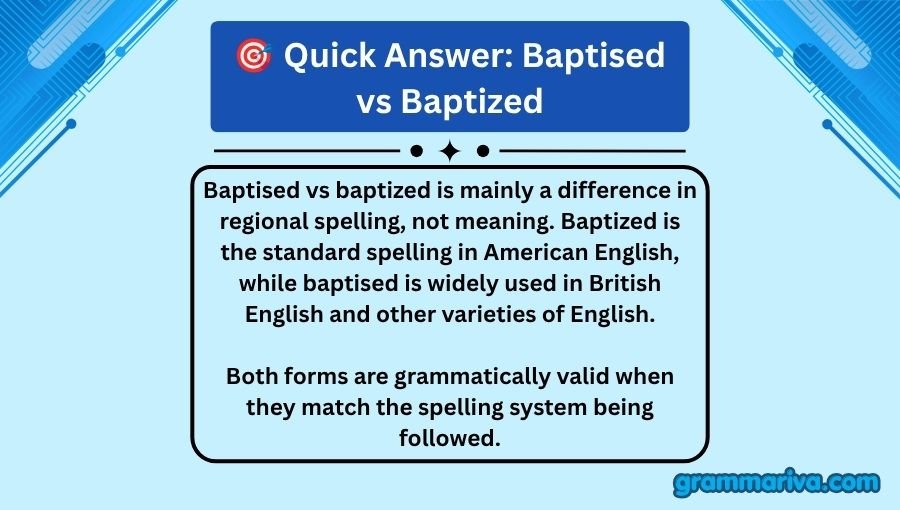
Baptised vs baptized is mainly a difference in regional spelling, not meaning. Baptized is the standard spelling in American English, while baptised is widely used in British English and other varieties of English.
Both forms are grammatically valid when they match the spelling system being followed.
| Spelling | Common English Variety | Meaning | Example |
|---|---|---|---|
| baptized | American English | Received baptism | She was baptized as a child. |
| baptised | British English | Received baptism | She was baptised as a child. |
| baptize | American English verb | To perform baptism | The church will baptize the baby. |
| baptise | British English verb | To perform baptism | The church will baptise the baby. |
🔤 Related Word Forms
The two spellings belong to the same word family. The main difference is the use of -ize in American English and -ise in British English.
| Form | Type | Example |
|---|---|---|
| baptize | American English verb | They plan to baptize the child. |
| baptise | British English verb | They plan to baptise the child. |
| baptized | American English past tense/past participle | The child was baptized last Sunday. |
| baptised | British English past tense/past participle | The child was baptised last Sunday. |
| baptizing | American English present participle | The minister is baptizing the child. |
| baptising | British English present participle | The minister is baptising the child. |
| baptism | Noun | The family attended the baptism. |
The spelling changes across the word family, but the basic meaning remains the same.
🎯 What Is the Difference Between Baptised and Baptized?
The difference between baptised and baptized is spelling rather than meaning. American English normally uses baptized, while British English commonly uses baptised.
For example:
- ✅ American English: The baby was baptized on Sunday.
- ✅ British English: The baby was baptised on Sunday.
Neither sentence has a grammar error. Each follows a different spelling convention.
Baptized in American English
In US English, baptized is the normal spelling.
Example:
The family said their son was baptized at the local church.
Here, baptized is a past-tense or past-participle form of baptize.
Baptised in British English
In British English, baptised is a common spelling.
Example:
The family said their son was baptised at the local church.
The meaning is the same. Only the spelling pattern changes.
A Simple Comparison
| Form | Region | Status | Example |
|---|---|---|---|
| baptized | US English | Standard | He was baptized last year. |
| baptised | UK English | Standard | He was baptised last year. |
| baptize | US English | Standard verb | They will baptize her. |
| baptise | UK English | Standard verb | They will baptise her. |
❓ Is Baptised the Same as Baptized?
Yes. Baptised and baptized have the same basic meaning. The spelling usually tells you which regional form of English the writer is following.
This is similar to other differences such as:
- color / colour
- organize / organise
- realize / realise
- recognize / recognise
The difference does not automatically mean that one form is incorrect.
| American English | British English |
|---|---|
| baptized | baptised |
| organized | organised |
| realized | realised |
| recognized | recognised |
| apologized | apologised |
There can be style differences between countries, but these pairs show the same general spelling pattern.
📝 Baptized: Meaning and Correct Use
Baptized is the American English spelling of the past-tense and past-participle form of baptize.
It can describe someone who has received baptism or an action in which someone is baptized.
Consider this sentence:
Maria was baptized when she was six months old.
The structure is simple:
- Maria = subject
- was = helping verb
- baptized = past participle
- when she was six months old = time information
Another example:
- ✅ The child was baptized in June.
- ❌ The child was baptised in June.
The second sentence is not necessarily wrong English. It simply follows British spelling rather than standard American spelling.
When American English Is Expected
Use baptized when your writing follows US English.
This includes many situations such as:
- American school assignments
- US business writing
- American websites
- US-focused blogs
- American publications
- Formal documents written in American English
🇬🇧 Baptised: Meaning and Correct Use
Baptised is the common British English spelling of the same word.
For example:
The child was baptised at the family church.
The meaning does not change because the spelling uses -ise instead of -ize.
If you are writing for a British audience, keeping the spelling consistent can make your work look more polished.
| Sentence | English Variety | Result |
|---|---|---|
| She was baptized last month. | American | Correct |
| She was baptised last month. | British | Correct |
| They baptized their son. | American | Correct |
| They baptised their son. | British | Correct |
💡 Test Tip: How Can You Choose the Right Spelling?
Ask yourself one question:
Which English spelling system am I using?
If the answer is American English, choose baptized.
If the answer is British English, choose baptised.
A second useful test is to check nearby spelling choices. If your article already uses color, favorite, and organize, then baptized will usually fit better.
If your article uses colour, favourite, and organise, then baptised will usually fit better.
| Your Existing Style | Better Match |
|---|---|
| color | baptized |
| favorite | baptized |
| organize | baptized |
| colour | baptised |
| favourite | baptised |
| organise | baptised |
This consistency test is one of the easiest ways to avoid accidental spelling changes.
❓ Why Do People Confuse Baptised and Baptized?
People confuse these spellings because they look almost identical and sound the same in normal speech. The final spelling difference is easy to miss when typing quickly.
I once edited a document that used organize in one paragraph and organise in the next. The writer had not made a serious grammar mistake. They had simply mixed two spelling systems. The same thing can happen with baptized and baptised.
Other reasons include:
- American and British English are both widely used.
- Spell-checkers may follow different language settings.
- Autocorrect can change spelling automatically.
- Writers may read sources from different countries.
- People may learn English from teachers using different regional standards.
- The words have the same meaning and sound, so the difference is easy to overlook.
The best solution is not to memorize which one is “always correct.” Instead, identify your target English variety and stay consistent.
📊 Baptised vs Baptized at a Glance
| Form | Spelling System | Meaning | Example | Correct? |
|---|---|---|---|---|
| baptized | American English | Received baptism | He was baptized yesterday. | ✅ Yes |
| baptised | British English | Received baptism | He was baptised yesterday. | ✅ Yes |
| baptize | American English | Perform baptism | They will baptize the baby. | ✅ Yes |
| baptise | British English | Perform baptism | They will baptise the baby. | ✅ Yes |
| baptize in a British-style document | Mixed style | Perform baptism | They will baptize the baby. | ⚠️ Usually change for consistency |
The last row is not grammatically wrong by itself. The concern is style consistency.
🧠 Grammar Rules Explanation
The grammar rule is straightforward: baptized and baptised are spelling variants of the same verb form.
In American English, the verb is generally written baptize, so its past form is baptized.
In British English, the verb is commonly written baptise, so its past form is baptised.
The spelling difference does not create a different tense, meaning, or grammatical function.
For example:
- baptize → baptized
- baptise → baptised
Both forms can function as past-tense or past-participle forms depending on the sentence.
Most standard English references recognize regional spelling differences of this kind. The important writing principle is consistency.
Correct vs Incorrect at a Glance
| Sentence | Correct/Incorrect | Why |
|---|---|---|
| The baby was baptized on Sunday. | ✅ Correct | Standard American spelling |
| The baby was baptised on Sunday. | ✅ Correct | Standard British spelling |
| The church will baptized the baby. | ❌ Incorrect | The base verb is needed after “will” |
| The church will baptize the baby. | ✅ Correct | Correct American base form |
| She has been baptized. | ✅ Correct | Correct past participle |
| She has been baptise. | ❌ Incorrect | The participle form is missing the final “d” |
Notice that the actual grammar error in some examples has nothing to do with the -ize/-ise difference. This is why context matters.
❓ When Should You Use Baptized in American English?
Use baptized when writing in standard American English. It is the expected spelling in US-focused formal and informal writing.
For example:
My nephew was baptized last spring.
You might also see:
The church baptized three children that morning.
And:
She had already been baptized before moving to the city.
The spelling remains baptized regardless of whether the word appears in a simple past construction or a perfect/passive construction.
| Sentence Pattern | Example |
|---|---|
| Simple past | The church baptized him. |
| Passive | He was baptized. |
| Present perfect | He has been baptized. |
| Past perfect | He had been baptized. |
| Future | They will baptize the child. |
The important point is that baptized is not used after every helping verb. The base form baptize is needed after words such as will and can.
❓ When Should You Use Baptised in British English?
Use baptised when your writing follows British English spelling.
For example:
My nephew was baptised last spring.
A British English sentence may also say:
The church baptised three children that morning.
The grammar is the same. The spelling convention changes.
| British Pattern | Example |
|---|---|
| Simple past | The church baptised him. |
| Passive | He was baptised. |
| Present perfect | He has been baptised. |
| Past perfect | He had been baptised. |
| Future | They will baptise the child. |
Again, the base form baptise follows helping verbs such as will.
📝 Case Study: Choosing the Right Form in a Real Document
When comparing baptised vs baptized in a real document, the best spelling depends on the English variety used by the writer. Imagine that I am editing a church newsletter for an American audience. The draft says:
“Our youngest members were baptised during a special Sunday service.”
The sentence is clear, but the newsletter uses American spelling everywhere else. Earlier paragraphs contain words such as favorite, honored, and organize.
I would change the sentence to:
“Our youngest members were baptized during a special Sunday service.”
Why? Not because baptised is meaningless or universally wrong. I would change it to maintain the newsletter’s American English style.
Now imagine the same newsletter is published by a church in the United Kingdom. In that case, baptised would fit naturally with British spelling.
| Document | Preferred Form |
|---|---|
| US church newsletter | baptized |
| UK church newsletter | baptised |
| US school essay | baptized |
| UK school essay | baptised |
| International audience | Follow the chosen house style |
⚠️ Common Mistakes With Baptised and Baptized
Common mistakes with baptised vs baptized often happen when writers mix American and British spelling styles. Most mistakes happen because writers mix regional spelling systems or select the wrong grammatical form.
A writer may know that baptized and baptised are related but still write will baptized, which is incorrect because will requires the base form.
Another common problem is switching between American and British spelling in the same article.
Common Spelling Confusions
| Confusion | Correct Forms | Main Issue |
|---|---|---|
| its / it’s | its, it’s | Possession vs contraction |
| your / you’re | your, you’re | Possession vs “you are” |
| their / there / they’re | their, there, they’re | Different meanings |
| color / colour | Both | Regional spelling |
| organize / organise | Both | Regional spelling |
| baptized / baptised | Both | Regional spelling |
These examples show why context matters. Some pairs involve different meanings. Others involve different regional spellings.
Why These Mistakes Happen
Fast typing: Writers often type based on sound rather than spelling.
Autocorrect: A device may use a US or UK dictionary without the writer noticing.
Lack of knowledge: Some writers do not realize that English has regional spelling systems.
Mixed reading habits: Someone may read American websites and British books every day.
I once caught myself changing a British-style spelling to an American one while editing a document. The surrounding text made it clear that the original spelling was intentional. That reminded me to check the whole document before changing a word that merely looked unfamiliar.
Specific Wrong Forms to Avoid
| Wrong Form | What’s Wrong | Correct Form |
|---|---|---|
| baptizd | Missing “e” | baptized |
| baptiseded | Extra ending | baptised |
| baptizied | Incorrect spelling pattern | baptized |
| baptised | Not wrong, but may conflict with US style | baptized in US English |
| baptized | Not wrong, but may conflict with UK style | baptised in UK English |
| will baptized | Wrong verb form after “will” | will baptize |
The key is to separate spelling preference from actual grammar errors.
❓ Is Baptized More Correct Than Baptised?
Not in every form of English. Baptized is the standard choice for American English, while baptised is a standard choice in British English.
Calling one spelling universally correct would miss the regional nature of the difference.
For a US audience, use baptized.
For a UK audience, use baptised.
For a document with an established style guide, follow that guide.
📚 Word History and Spelling Development
The difference between -ize and -ise is part of a wider pattern in English spelling. English has developed through contact with several languages and has maintained different spelling traditions across regions.
Over time, American English developed its own preferred spelling conventions. British English also retained or developed spelling patterns that differ from common US usage.
The important point for modern writers is not to memorize a complicated history. It is to recognize that baptized and baptised represent regional spelling choices for the same word.
| Stage | Form | General Note |
|---|---|---|
| Earlier English usage | baptize/baptise-type forms | Spelling was not always fully standardized |
| Later English | -ize and -ise patterns | Both spelling patterns continued |
| British usage | baptised | Common British spelling |
| American usage | baptized | Standard US spelling |
| Modern English | Both forms | Choice depends largely on regional style |
Because historical spelling was not always fixed, it is better to focus on the modern usage rule than on trying to attach one spelling to a single exact historical point.
🌎 Usage in Different Contexts
The choice between baptised vs baptized can also depend on the audience and the type of writing. The choice between baptised vs baptized depends on the audience and the English style used in the writing.
The right choice depends on the audience and style of the writing.
Everyday Conversation
In everyday speech, you cannot hear the spelling difference. Both words normally sound the same.
The spelling matters when the words are written down.
Professional Writing
Professional writing should follow a consistent English variety. If the document uses US spelling, baptized is the natural choice.
Creative Writing
Authors can choose a spelling based on the setting, narrator, publication style, or intended audience.
Social Media and Texting
Informal writing may be less strict, but standard spelling still makes your message easier to understand.
| Context | Which Term to Use | Example |
|---|---|---|
| US school paper | baptized | He was baptized as a baby. |
| UK school paper | baptised | He was baptised as a baby. |
| US professional article | baptized | The child was baptized last year. |
| UK professional article | baptised | The child was baptised last year. |
| Casual US text | baptized | She was baptized yesterday. |
| Casual UK text | baptised | She was baptised yesterday. |
💬 Common Phrases With Baptized and Baptised
The word appears in several ordinary phrases connected with baptism.
The spelling should match the regional English style of the surrounding text.
| Phrase | Meaning |
|---|---|
| was baptized | Received baptism |
| was baptised | British spelling of the same expression |
| baptized as a child | Received baptism during childhood |
| baptized as an adult | Received baptism during adulthood |
| baptized into the faith | Describes baptism within a religious context |
| baptized at the church | Identifies the place connected with the baptism |
The exact phrase can vary according to religious tradition and context. The spelling rule itself remains the same.
❓ Can You Use Baptized and Baptised in the Same Article?
You technically can encounter both forms in the same article, especially when quoting sources from different regions. However, ordinary original writing should usually use one spelling system consistently.
For example, an American article would normally use:
The child was baptized at the local church.
It would be unusual to write:
The child was baptized at the local church, but her sister was baptised there the following year.
Unless there is a specific reason for the change, the mixed spelling looks accidental.
| Writing Situation | Best Approach |
|---|---|
| One US article | Use baptized consistently |
| One UK article | Use baptised consistently |
| Quoting a British source in US article | Preserve the original quote if needed |
| Comparing English varieties | Show both forms |
| Editing a mixed document | Choose one style and make it consistent |
🔄 Synonyms and Alternatives
When deciding whether to use baptised vs baptized, you can sometimes choose a neutral phrase instead. There are situations where you may replace baptized or baptised with another phrase. However, alternatives do not always have exactly the same meaning.
For example, received baptism can be useful when you want to avoid regional spelling.
| Alternative | Works When | Does Not Work When |
|---|---|---|
| received baptism | You want a neutral phrase | A specific verb form is required |
| underwent baptism | A formal description is appropriate | You want a simple conversational style |
| took part in a baptism | Describing participation | You mean the person personally received baptism |
| had a baptism | Very general description | Precise religious wording is needed |
| was welcomed through baptism | Context supports this meaning | You need a direct equivalent |
These alternatives should not be treated as perfect replacements in every sentence.
🎯 How to Remember the Difference
Remembering baptised vs baptized is easy when you connect each spelling with its regional English style. The easiest memory trick is to connect the spelling to the larger regional spelling pattern.
US English → -ize → baptized
British English → -ise → baptised
You can remember it with this simple chain:
organize → organized → baptized
and:
organise → organised → baptised
If your writing uses -ize, choose baptized.
If your writing uses -ise, choose baptised.
| Memory Pattern | Example |
|---|---|
| US: -ize | organize |
| US: -ized | organized |
| US: -ize | baptize |
| US: -ized | baptized |
| UK: -ise | organise |
| UK: -ised | organised |
| UK: -ise | baptise |
| UK: -ised | baptised |
This is not a perfect rule for every English word, but it works well for this particular pair.
❓ Does the Meaning Change Between Baptised and Baptized?
No. The basic meaning does not change simply because the spelling changes.
Compare:
The child was baptized in the United States.
and:
The child was baptised in the United Kingdom.
The spelling differs, but the word describes the same basic religious action.
| Feature | Baptized | Baptised |
|---|---|---|
| Basic meaning | Same | Same |
| Grammar | Same | Same |
| Pronunciation | Generally the same | Generally the same |
| Main difference | US spelling | UK spelling |
| Typical audience | American English | British English |
❓ Which Spelling Should American Writers Use?
American writers should normally use baptized.
This applies whether you are writing an essay, blog post, email, report, article, or social media caption for a US audience.
Examples:
- ✅ The child was baptized last Sunday.
- ✅ Her parents chose to have her baptized.
- ✅ He was baptized as an infant.
- ❌ The church will baptized the child.
The last example is wrong because will must be followed by the base verb baptize, not the past form baptized.
❓ Which Spelling Should British Writers Use?
British writers commonly use baptised.
Examples include:
- The child was baptised last Sunday.
- Her parents chose to have her baptised.
- He was baptised as an infant.
The spelling fits the broader British -ise/-ised pattern.
📌 Why Does Getting the Spelling Right Matter?
The difference may seem small, but consistent spelling helps readers understand your writing style.
It matters for three main reasons.
Clarity
Consistent spelling tells readers which English variety you are using.
Professionalism
A document with mixed spelling can look poorly edited even when every individual word is understandable.
Digital Communication
Websites, blogs, and online publications often target specific countries. Consistent spelling helps content match its intended audience.
| Situation | Why Getting It Right Matters |
|---|---|
| Resume or application | Shows careful editing |
| Client email | Creates a polished impression |
| Published article | Maintains style consistency |
| Social post | Makes regional wording clear |
A useful rule is simple:
Good spelling is not only about knowing a word. It is also about knowing your audience.
🌟 Special Exception: Quotes and Original Names
There is one practical situation where you may intentionally see both forms in the same document: direct quotations or original titles.
Suppose an American writer quotes a British publication that uses baptised. The writer may preserve the original spelling inside the quotation rather than changing it.
Likewise, if a title, organization name, or historical text uses a particular spelling, changing it may alter the original wording.
Outside such cases, consistency is usually the better choice.
❓ How Do You Know Which Form to Choose?
Look at the rest of your document.
If you use:
- color
- favorite
- organize
- recognize
then baptized is likely the right fit.
If you use:
- colour
- favourite
- organise
- recognise
then baptised is likely the right fit.
| If Your Article Uses | Choose |
|---|---|
| color | baptized |
| favorite | baptized |
| organize | baptized |
| recognize | baptized |
| colour | baptised |
| favourite | baptised |
| organise | baptised |
| recognise | baptised |
This approach is much easier than trying to remember every regional spelling difference separately.
🧪 Practice Examples
Try choosing the correct form for the intended English variety.
Example 1
US English: The baby was ______ last Sunday.
Answer: baptized
Example 2
British English: The baby was ______ last Sunday.
Answer: baptised
Example 3
US English: The minister will ______ the child.
Answer: baptize
Example 4
British English: The minister will ______ the child.
Answer: baptise
These examples show an important grammar point: after will, use the base form, not baptized or baptised.
✅ Quick Recap Checklist
Use this checklist whenever you are unsure.
| Question | If Yes → Use |
|---|---|
| Am I writing standard American English? | baptized |
| Am I writing standard British English? | baptised |
| Does the sentence use “will”? | baptize/baptise |
| Does the sentence use “was” with the past participle? | baptized/baptised |
| Am I mixing US and UK spellings? | Choose one style and stay consistent |
| Am I preserving a direct quotation? | Keep the original spelling when appropriate |
Practice
- US: The child was baptized last summer.
- UK: The child was baptised last summer.
- US: The church will baptize the child next week.
The biggest lesson is that baptised is not simply a misspelling of baptized. It is a legitimate regional spelling.
❓ Why Do American and British English Spell This Word Differently?
American and British English developed different spelling preferences over time. One visible difference is the use of -ize in many American spellings and -ise in many British spellings.
That is why American English generally uses baptized, while British English commonly uses baptised.
The difference is a spelling convention rather than a difference in the basic meaning of the word.
❓ Is Baptised Wrong in American English?
When deciding between baptised vs baptized, American writers should normally follow the spelling style used throughout their document. Not necessarily. An American reader will understand baptised, and the spelling is valid in British English. However, if you are specifically writing in standard American English, baptized is the more consistent choice.
This distinction is useful:
- Wrong everywhere: incorrect grammar or spelling
- Different regional spelling: a valid form used in another English variety
- Style mismatch: a valid word that does not match the document’s chosen variety
Baptised generally falls into the second category when used in British English.
❓ Is Baptized Wrong in British English?
No. Baptized is the standard American spelling and is easily understood in British English. However, a British publication may prefer baptised to maintain its house style.
The issue is usually consistency, not basic comprehension.
❓ How Do You Spell Baptized in American English?
Knowing the difference between baptised vs baptized makes it easier to choose the correct spelling for American English writing. The American English spelling is baptized, with -ized at the end.
Example:
She was baptized when she was young.
The base verb is baptize.
Its main forms include:
| Form | American English |
|---|---|
| Base verb | baptize |
| Third-person singular | baptizes |
| Past tense | baptized |
| Past participle | baptized |
| Present participle | baptizing |
❓ How Do You Spell Baptised in British English?
The British English spelling is baptised, with -ised at the end.
Example:
She was baptised when she was young.
The base verb is baptise.
| Form | British English |
|---|---|
| Base verb | baptise |
| Third-person singular | baptises |
| Past tense | baptised |
| Past participle | baptised |
| Present participle | baptising |
❓ What Is the Easiest Way to Remember Baptised vs Baptized?
Remember one simple association:
American = -ize = baptized
British = -ise = baptised
Then check the rest of your document for similar spellings.
If you already wrote organize, recognize, and realize, then baptized will usually keep the style consistent.
If you wrote organise, recognise, and realise, then baptised will usually fit better.
FAQs About Baptised vs Baptized
What is the difference between baptised and baptized?
The main difference is spelling. Baptized is the standard American English spelling, while baptised is commonly used in British English. Both have the same basic meaning.
Is baptized American or British spelling?
Baptized is the standard American English spelling. British English commonly uses baptised.
Is baptised correct English?
Yes. Baptised is a standard spelling in British English and other varieties that follow that spelling pattern.
Should I use baptized in a US essay?
Yes. If your essay follows American English, baptized is normally the appropriate spelling.
Should I use baptised in British English?
Yes. Baptised is commonly used in British English and fits the British -ise/-ised spelling pattern.
Are baptized and baptised pronounced differently?
They are generally pronounced the same in ordinary English speech. The main difference is written spelling.
Is “was baptized” grammatically correct?
Yes. Was baptized is a correct passive construction in American English. In British English, the equivalent is was baptised.
Is “will baptized” correct?
No. After will, use the base verb. In American English, write will baptize. In British English, write will baptise.
Can I use baptized and baptised in the same article?
You can see both forms when quoting sources or discussing regional English. However, in your own writing, it is usually better to choose one spelling system and use it consistently.
Which is better for an American audience, baptised or baptized?
For standard American English, baptized is the natural choice. It matches the common US -ize/-ized spelling pattern.
🎯 Conclusion
Baptised vs baptized is mainly a regional spelling difference, not a difference in meaning. In standard American English, use baptized. In British English, baptised is commonly used. 🇺🇸🇬🇧
The easiest way to remember the rule is to look at the rest of your writing. If you use color, favorite, organize, and recognize, choose baptized. If you use colour, favourite, organise, and recognise, choose baptised.
Also remember the grammar rule behind the word forms. After will, use the base verb: will baptize or will baptise. With a passive structure such as “was,” use was baptized or was baptised.
When you are editing an article, essay, email, or website, consistency matters more than treating one regional form as universally correct. Once you know your audience, the choice becomes easy.
Choose the spelling that matches your English variety, keep it consistent, and you will never need to second-guess this pair again. ✨

Hi, I’m Madison Hayes. I’m an English learning writer at Grammariva, where I work on simple lessons and examples for people who want to improve their grammar and writing. I love turning confusing rules into easy-to-follow explanations.


[…] fixed expressions, and practical tests. By the end, you will know when each form works. 😊 Baptised vs Baptized | Reply Me vs Reply to Me | Curious of or Curious […]