Have you ever typed a sentence like “That is to bad” and then stopped because something looked wrong? You are not alone. The phrase sounds simple, but the difference between to bad or too bad can cause a quick grammar mistake. The correct form in standard English is too bad. The word too can mean “more than needed” or “to an excessive degree.” It can also express disappointment, sympathy, or regret. The word to, on the other hand, is usually used before a verb or to show direction or connection.
I teach grammar by looking at what a word does in a sentence, not just how it sounds. That method makes this pair much easier to remember. 😊 Once you know the job each word performs, you can spot the right choice in seconds.
In this guide, I will explain the difference in plain US English. You will see clear examples, common mistakes, practical tips, tables, FAQs, and real-life situations. By the end, you should feel confident whenever you need to choose between to bad or too bad. Homophone vs Homograph vs Homonym | Sell vs Sale | Sweeped vs Swept
Quick Answer: To Bad or Too Bad? 🎯
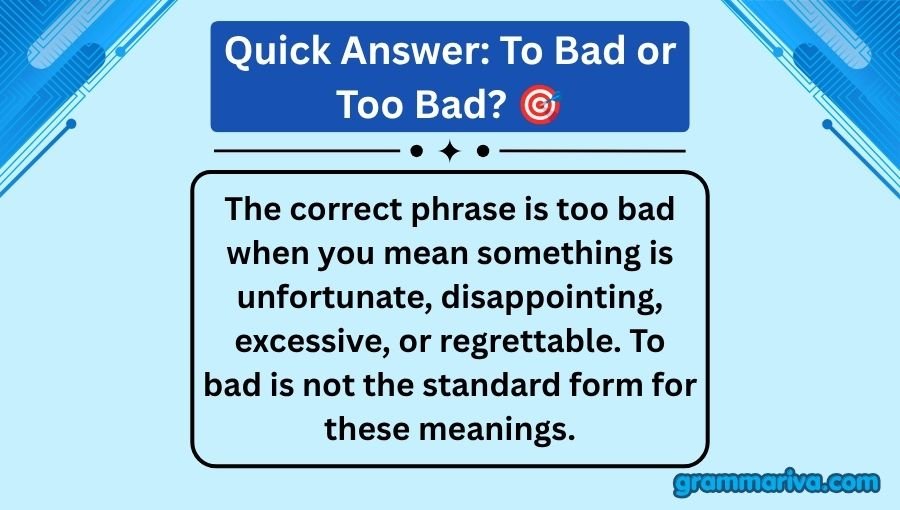
The correct phrase is too bad when you mean something is unfortunate, disappointing, excessive, or regrettable. To bad is not the standard form for these meanings.
For example:
- ✅ It is too bad that you missed the concert.
- ❌ It is to bad that you missed the concert.
A simple rule helps: too belongs in the expression too bad, while to normally connects to another word, often a verb.
What Is the Difference Between To Bad and Too Bad? 💡
The core difference is grammatical. Too is an adverb, while to is most often a preposition or part of an infinitive verb form. The phrase too bad is a standard expression. The phrase to bad is normally incorrect when someone means “unfortunate” or “unpleasant.”
| Form | Type | Meaning | Example | Correct/Incorrect |
|---|---|---|---|---|
| too bad | Adverb + adjective | Unfortunate, disappointing, or excessive | It is too bad you cannot come. | ✅ Correct |
| to bad | Preposition + adjective | Does not normally express this idea | It is to bad you cannot come. | ❌ Incorrect |
| too | Adverb | Excessively or also | The coffee is too hot. | ✅ Correct |
| to | Preposition/infinitive marker | Direction, purpose, or verb form | I want to go to school. | ✅ Correct |
The easiest point to remember is this: bad is an adjective, and too bad is the normal phrase when you describe something as unfortunate or disappointing.
Is Too Bad the Correct Expression? ✅
Yes. Too bad is the standard expression when you want to say that something is unfortunate, disappointing, or regrettable.
Consider these examples:
- ✅ Too bad you cannot stay longer.
- ❌ To bad you cannot stay longer.
Here, too bad works as an expression of disappointment.
It can also appear inside a longer sentence:
- ✅ It is too bad that the game was canceled.
- ❌ It is to bad that the game was canceled.
The word too changes the meaning of bad by showing a strong degree or reaction. In informal conversation, too bad can also stand alone.
“I missed the bus.”
“Too bad!”
That short response usually means “That is unfortunate.”
When Should You Use Too Bad? 📝
You should use too bad when you are describing something as unfortunate, disappointing, or excessive. The exact meaning depends on the sentence.
Too Bad Can Express Disappointment
This is one of the most common uses.
- ✅ It is too bad that Sarah could not join us.
- ❌ It is to bad that Sarah could not join us.
The speaker feels that Sarah’s absence is unfortunate.
Too Bad Can Mean Excessively Bad
Sometimes too has its normal meaning of “more than acceptable” or “more than desired.”
- ✅ The weather is too bad for a picnic.
- ❌ The weather is to bad for a picnic.
Here, too bad means the weather is bad to an extent that prevents the picnic.
Too Bad Can Show Sympathy
You can use too bad as a short response to someone else’s problem.
- “My flight was canceled.”
- “Oh, that’s too bad.”
This use is common in everyday speech.
Too Bad Can Sound Casual
The phrase often appears in friendly conversations and informal writing.
For example:
- Too bad we missed the last train.
- That is too bad.
- It’s too bad you have to leave early.
| Meaning | Word Type | Example Sentence |
|---|---|---|
| Unfortunate | Adverb + adjective | It is too bad that he missed the event. |
| Excessively bad | Adverb + adjective | The road conditions are too bad to drive safely. |
| Sympathy | Fixed expression | That’s too bad. |
| Disappointment | Fixed expression | Too bad we arrived late. |
💡 Test Tip: Replace Too With Very
A useful test is to ask whether the sentence is talking about degree or disappointment.
For example:
The weather is too bad for a picnic.
The word too tells us that the weather is bad beyond what is acceptable for the activity.
Another useful test is to ask whether you mean “unfortunate.” If yes, too bad is usually the right phrase.
Why Do People Confuse To Bad and Too Bad? 🤔
People confuse these words because to and too sound alike in many forms of spoken English. When we hear a sentence, the extra o in too is invisible. That makes the mistake easy to make when typing quickly.
The problem becomes clearer when we look at their jobs. To and too may sound similar, but they do very different work.
I once reviewed a student’s short story where the phrase “to bad” appeared three times. The student knew exactly what the sentence meant. The problem was simply that they were choosing the word by sound. Once I showed them the “extra o” rule, they corrected every example.
Other reasons include:
- Fast typing
- Autocorrect
- Spell-check habits
- Limited grammar practice
- Confusion between homophones
- Writing the way a word sounds
| Confusing Pair | Correct Meaning | Common Mistake |
|---|---|---|
| to / too | Direction vs. excessive degree | I am going too school. |
| your / you’re | Possession vs. you are | Your very kind. |
| its / it’s | Possession vs. it is | Its raining. |
| there / their / they’re | Place, possession, they are | Their going there. |
| two / to / too | Number, direction, excessive degree | I have too books. |
The key is not to memorize every sentence. Learn the role of each word.
To Bad or Too Bad at a Glance 📊
The difference becomes much easier when you compare complete sentences.
| Sentence | Correct/Incorrect | Why |
|---|---|---|
| It is too bad that you missed it. | ✅ Correct | Too bad expresses disappointment. |
| It is to bad that you missed it. | ❌ Incorrect | To bad is not the standard phrase. |
| The weather is too bad for hiking. | ✅ Correct | Too shows excessive degree. |
| The weather is to bad for hiking. | ❌ Incorrect | To does not fit before bad here. |
| That’s too bad. | ✅ Correct | This is a common expression of sympathy or regret. |
Notice that to is not a “bad version” of too in every sentence. Both words are correct English. They simply have different jobs.
For example:
- I want to go to the store. ✅
- The soup is too hot. ✅
The problem appears when to is used where too is needed.
How Does Too Work in English? 🔎
Too has several common uses. Understanding them helps you recognize why it belongs in too bad.
First, too can show an excessive amount or degree.
- The box is too heavy.
- The room is too cold.
- The music is too loud.
Second, too can mean “also.”
- I want to come too.
- She likes pizza too.
Third, too bad is a common expression. It can mean that something is unfortunate or disappointing.
- It is too bad you cannot stay.
These meanings are different, but they all use the spelling too.
| Use of “Too” | Meaning | Example |
|---|---|---|
| Degree | More than needed | The coffee is too hot. |
| Also | In addition | I want one too. |
| Expression | Unfortunate or disappointing | That is too bad. |
| Degree with adjective | Excessively | The test was too difficult. |
How Does To Work in English? 📚
To is a very common English word, but it does not replace too.
One major use is showing direction.
- We walked to school.
- She drove to work.
- He went to the store.
Another major use is marking an infinitive.
- I want to sleep.
- They need to study.
- She hopes to win.
The word to can also connect nouns or show relationships.
- The key belongs to John.
- This letter is addressed to my manager.
| Use of “To” | Meaning | Example |
|---|---|---|
| Direction | Moving toward a place | We went to school. |
| Infinitive | Before a base verb | I want to learn. |
| Relationship | Connection or belonging | This gift is to my sister. |
| Destination | Where something goes | Send it to my office. |
This is why to bad does not work as a replacement for too bad. In the phrase too bad, the word before bad needs to show degree or form the common expression.
Case Study: A Mistake in a Work Email 💼
Imagine that a coworker sends this message:
“It is to bad that the meeting was canceled.”
The meaning is clear, but the spelling is wrong.
A cleaner version is:
“It is too bad that the meeting was canceled.”
Now imagine a professional client email:
Incorrect:
“It is to bad that we could not complete the order today.”
Correct:
“It is too bad that we could not complete the order today.”
I once caught myself typing to bad in a quick message. I was moving fast and writing by sound. I deleted the phrase, typed too bad, and moved on. Even experienced writers can make small errors when they type quickly.
The lesson is simple: when the phrase means “unfortunate,” stop and choose too.
Why Is To Bad Incorrect in This Phrase? 🧠
The phrase too bad combines too, an adverb, with bad, an adjective. The adverb modifies the adjective by showing degree.
In too bad, the word too can communicate that something is unfortunate or bad to an excessive degree.
By contrast, to does not normally modify an adjective in this way. It commonly works as a preposition or as a marker before a base verb.
So:
- too bad = standard phrase
- to bad = incorrect when intended to mean “unfortunate”
This rule is not based on which spelling looks better. It is based on grammar and meaning.
Standard English reference sources agree on the basic distinction between to and too. You do not need a complicated rule. You only need to identify the job of the word.
Common Mistakes With To Bad and Too Bad ⚠️
The most common mistake is writing to bad when the intended phrase is too bad.
Here are several examples:
- ❌ To bad we missed the train.
- ✅ Too bad we missed the train.
- ❌ It is to bad that she left.
- ✅ It is too bad that she left.
- ❌ That’s to bad.
- ✅ That’s too bad.
- ❌ The weather is to bad for the trip.
- ✅ The weather is too bad for the trip.
- ❌ To bad you cannot come.
- ✅ Too bad you cannot come.
Why These Errors Happen
Fast Typing
When people type quickly, they often choose a word based on sound. Since to and too sound alike, the mistake can slip through.
Autocorrect
Autocorrect can sometimes change words in ways writers do not notice. A quick message may be sent before the writer reviews it.
Lack of Knowledge
Some learners know that both to and too are English words but have not learned the difference in their functions.
Sound-Based Writing
English contains many words that sound alike but have different meanings and spellings. To, too, and two are classic examples.
| Mistake | Why It Happens | Better Habit |
|---|---|---|
| Writing to bad | The words sound alike | Learn the fixed phrase too bad |
| Writing your instead of you’re | Fast typing | Expand the contraction |
| Writing its instead of it’s | Missing apostrophe awareness | Test “it is” |
| Writing there instead of their | Sound confusion | Check the meaning |
| Writing two instead of too | Homophone confusion | Check whether a number is intended |
Specific Wrong Forms
| Wrong Form | What’s Wrong | Correct Form |
|---|---|---|
| to bad | Wrong word for the expression | too bad |
| To bad | Capitalization does not fix the word choice | Too bad |
| tooo bad | Extra letter | too bad |
| tooo bad | Extra “o” | too bad |
| two bad | Usually changes the meaning | too bad |
| to badly | Wrong construction when expressing disappointment | too bad |
Is Too Bad Formal or Informal? 🗣️
Too bad works well in everyday conversation and informal writing. It is natural and widely understood.
For example:
- That’s too bad.
- Too bad you missed the show.
- It is too bad that the store is closed.
In a formal document, you may choose a more precise phrase depending on your purpose.
Instead of:
That’s too bad.
A formal report might say:
This is unfortunate.
Both can be correct. The best choice depends on the setting.
| Context | Which Term to Use | Example |
|---|---|---|
| Everyday conversation | too bad | That’s too bad. |
| Professional writing | too bad or unfortunate | It is too bad that the deadline changed. |
| Creative writing | too bad | Too bad, she thought. |
| Social media/texting | too bad | Too bad we missed it! |
The important point is that changing the tone does not change the spelling. If you use the phrase, it remains too bad.
How Is Too Bad Used in Everyday Conversation? 💬
Conversation is where you will hear this expression most often.
Someone might say:
“I forgot my umbrella.”
You might answer:
“Oh, that’s too bad.”
Here, the phrase shows sympathy.
Another example:
“We got there five minutes after the doors closed.”
“Too bad!”
Here, the speaker expresses disappointment.
The phrase can also describe a difficult situation:
“The weather is too bad to go outside.”
Now the meaning is stronger. The weather is bad beyond the level that makes going outside practical.
So the same two words can work in different ways depending on the sentence.
How Is Too Bad Used in Professional Writing? 💼
Professional writing often needs a careful tone. Too bad is grammatically correct, but it can sound casual in some business situations.
Compare:
- It is too bad that the shipment was delayed.
- Unfortunately, the shipment was delayed.
The first sentence is correct but conversational. The second sounds more formal.
For a workplace email, you can use too bad when writing to someone you know well. For a formal client message, unfortunately or regrettably may sound better.
| Situation | Example | Tone |
|---|---|---|
| Friendly coworker | That’s too bad. | Casual |
| Team email | It is too bad that we missed the deadline. | Neutral |
| Client email | Unfortunately, the delivery was delayed. | Formal |
| Report | The delay affected the schedule. | Professional |
Grammar tells you whether the phrase is correct. Context tells you whether it is the best style.
How Is Too Bad Used in Creative Writing? ✍️
Creative writers can use too bad to show character voice, emotion, or dialogue.
For example:
“Too bad,” Mia said, looking at the empty chair.
The phrase can make dialogue sound natural.
It can also show a character’s reaction:
It was too bad that the rain arrived before the outdoor party began.
The phrase is flexible. It can sound sad, casual, sarcastic, or sympathetic depending on the surrounding words.
That is one reason writers should learn both the grammar and the tone.
Common Phrases With Too Bad 🔤
Too bad appears in several natural expressions.
| Phrase | Meaning |
|---|---|
| That’s too bad. | That is unfortunate. |
| It’s too bad that… | Something unfortunate happened. |
| Too bad! | A short reaction to disappointment. |
| Too bad you can’t… | Expresses regret about someone’s inability to do something. |
| It’s too bad to see… | Shows sadness or regret about a situation. |
Examples:
- That’s too bad.
- It’s too bad that you have to leave.
- Too bad we missed the show.
- It’s too bad you cannot stay for dinner.
These phrases are natural because too bad is an established English expression.
What Can You Say Instead of Too Bad? 🔄
Sometimes another phrase may fit better. The best alternative depends on the tone you want.
| Alternative | Works When | Does Not Work When |
|---|---|---|
| unfortunate | You want a neutral or formal tone | You want a very casual reaction |
| regrettable | You want a formal tone | You are having a relaxed chat |
| sadly | You want to show sadness | You mean excessive degree |
| unfortunately | You want to introduce bad news | You mean “more than acceptable” |
| disappointing | You want to focus on unmet expectations | You are simply showing sympathy |
For example:
Too bad you missed the event.
can become:
Unfortunately, you missed the event.
But the tone changes slightly.
Similarly:
The weather is too bad for a picnic.
cannot always be replaced naturally with unfortunately because too is showing degree.
This distinction matters. A synonym may match the emotion but not the grammar.
Why Does Getting To Bad or Too Bad Right Matter? 🎯
A small spelling difference can change how polished your writing looks.
Clarity in Communication
Correct word choice makes your meaning easier to understand.
Professionalism
Small errors can affect how readers view an email, article, report, or application.
Digital Communication
Texts and social posts are often written quickly. That makes homophone mistakes common. A quick review can prevent them.
| Situation | Why Getting It Right Matters |
|---|---|
| Resume | Shows attention to detail |
| Client email | Supports a professional image |
| Published content | Builds reader trust |
| Social post | Makes the writing look polished |
I use a simple rule when editing: If a word sounds right but looks uncertain, check its job in the sentence. That habit catches many errors before publication.
Clear writing is often built from small choices made carefully.
How Can You Remember the Difference? 🧩
Try these simple memory tricks.
Trick 1: Too Has an Extra O
Think:
Too = extra
The extra o can remind you that too often relates to “extra” or “more than needed.”
- too hot
- too loud
- too expensive
- too bad
Trick 2: Two O’s Mean “More”
This is not a complete grammar rule, but it is a useful memory aid.
too = extra
to = direction or infinitive
Trick 3: Memorize the Whole Phrase
Do not memorize only the individual words. Memorize:
That’s too bad.
When you see the phrase as one unit, the correct spelling becomes automatic.
Trick 4: Ask What You Mean
If you mean:
- unfortunate
- disappointing
- regrettable
- excessively bad
then too bad is usually the right choice.
| Memory Question | Answer |
|---|---|
| Do I mean unfortunate? | Use too bad |
| Do I mean excessively bad? | Use too bad |
| Am I showing direction? | Consider to |
| Am I using an infinitive verb? | Consider to |
| Am I talking about the number 2? | Use two |
To Bad or Too Bad in Text Messages and Social Media 📱
Digital writing is where this mistake can happen most often. People type quickly. They may skip proofreading. They may also rely heavily on sound.
Still, the standard spelling remains too bad.
Examples:
- ✅ Too bad you couldn’t make it!
- ❌ To bad you couldn’t make it!
- ✅ That’s too bad 😔
- ❌ That’s to bad 😔
- ✅ Too bad we missed the sunset!
- ❌ To bad we missed the sunset!
A typo in a casual text is not a major problem. But if you are creating public content, a business post, or a professional message, correct spelling is worth the extra second.
Is To Bad Ever Correct? ⚠️
The exact sequence to bad can theoretically appear when to belongs to a larger grammatical structure and bad is being used independently in an unusual construction. However, this is not the normal phrase people mean when they write to bad.
For standard expressions such as:
- It is too bad.
- That’s too bad.
- Too bad we missed it.
- The weather is too bad.
use too bad.
Do not treat to bad as an alternative spelling. It is not.
This is why the safest practical rule is simple: when you mean “unfortunate” or “excessively bad,” write too bad.
Quick Recap Checklist ✅
Use this checklist whenever you are unsure.
| Question | If Yes → Use |
|---|---|
| Do I mean “unfortunate”? | too bad |
| Do I mean “disappointing”? | too bad |
| Do I mean “excessively bad”? | too bad |
| Am I showing direction? | to |
| Am I putting a marker before a base verb? | to |
| Am I talking about the number 2? | two |
Practice Examples
- It is ___ bad that you missed the party.
Answer: too ✅ - I need ___ go home.
Answer: to ✅ - That’s ___ bad.
Answer: too ✅
The more you practice by meaning, the faster the correct choice becomes.
FAQs About To vs Too 🧠
Is “to bad” or “too bad” correct?
Too bad is correct when you mean that something is unfortunate, disappointing, or excessively bad. To bad is not the standard phrase for these meanings.
Why do people write “to bad” instead of “too bad”?
People often confuse them because to and too sound alike. Fast typing, autocorrect, and choosing words by sound can also cause the mistake.
Is “too bad” grammatically correct?
Yes. Too bad is grammatically correct. Too can modify the adjective bad by showing degree. The phrase can also function as an expression of disappointment or sympathy.
Can “too bad” mean “unfortunate”?
Yes. In sentences such as “It is too bad that she missed the train,” the phrase means that the situation is unfortunate or disappointing.
Can “too bad” mean “very bad”?
Sometimes, but too usually adds the idea of excess or an undesirable degree. For example, “The weather is too bad for a picnic” means the weather is bad enough to prevent the planned activity.
Is “to bad” ever used correctly?
Not as the normal expression meaning “unfortunate” or “excessively bad.” If you intend the common phrase, use too bad.
What is an easy way to remember “too bad”?
Remember that too has an extra o and often relates to something extra or excessive. Since too bad expresses disappointment or excessive badness, the spelling with two o’s is the one to remember.
Should I use “too bad” in formal writing?
You can, but tone matters. In very formal writing, words such as unfortunately, regrettably, or unfortunate may sound more professional. Too bad is especially natural in conversation and informal writing.
Is “that’s too bad” polite?
It can be polite when you genuinely express sympathy. However, tone matters. Depending on how it is said, “Too bad” can sometimes sound dismissive or sarcastic.
What is the difference between “to,” “too,” and “two”?
To commonly shows direction or introduces an infinitive verb. Too can mean “also” or show excessive degree. Two is the number 2. Their sounds may be similar, but their meanings and uses are different.
Final Takeaway: To Bad or Too Bad Made Simple 🌟
To bad or too bad is an easy choice once you focus on meaning. Use too bad when you mean something is unfortunate, disappointing, or bad to an excessive degree. Use to for its normal jobs, such as showing direction or introducing an infinitive verb.
The most useful sentence to remember is:
“That’s too bad.”
The extra o in too can remind you that the phrase often deals with something extra, excessive, or unfortunate.
When I edit English writing, I do not rely only on how a word sounds. I check what job the word is doing in the sentence. That small habit can prevent many common mistakes. 👍
So the next time you wonder which form belongs in your sentence, pause for one second. Ask yourself what you mean. If you are expressing regret or describing something as excessively bad, choose too bad.
Remember the meaning, choose the right word, and make your English clearer every time. ✨

Hi, I’m Ethan Brooks. I’m an English grammar writer at Grammariva, where I work on clear explanations, practical examples, and useful writing tips. I enjoy making difficult grammar topics easier to understand.


[…] Once you understand the pattern, though, choosing the right form becomes much easier. 🎯 To Bad or Too Bad | Homophone vs Homograph vs Homonym | Sell vs […]
[…] the end, you should feel confident about choosing the correct form every time. Shown vs Showed | To Bad or Too Bad | Homophone vs Homograph vs […]