Sweeped vs swept is a common grammar question because the verb sweep does not follow the regular pattern we use with many English verbs. If you know that words like clean become cleaned and wash becomes washed, you may naturally think sweeped should be the past tense of sweep. However, standard English uses swept as the past tense and past participle of sweep. 🧹
This small spelling difference can cause trouble in schoolwork, emails, reports, captions, and everyday messages. The good news is that the rule is simple once you learn it. I teach students to focus on the base verb first, then remember its special past form. That makes the choice much easier.
In this guide, I will explain sweeped vs swept with simple examples, grammar rules, common mistakes, tables, practice sentences, and quick memory tips. By the end, you will know exactly when to use sweep, swept, and sweeping. Time Slot or Timeslot | At the House or In the House | By Which or In Which
Quick Answer: Sweeped vs Swept 🎯
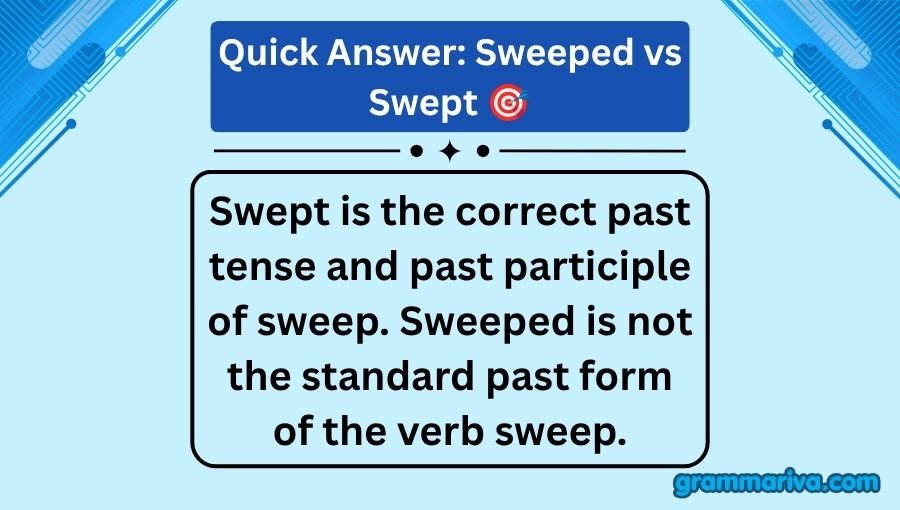
Swept is the correct past tense and past participle of sweep. Sweeped is not the standard past form of the verb sweep.
- Present: sweep
- Past: swept
- Past participle: swept
- Present participle: sweeping
For example:
- ✅ I swept the floor yesterday.
- ❌ I sweeped the floor yesterday.
The correct choice is swept when you are talking about an action that happened in the past.
Is Sweeped the Same as Swept? 🤔
No. Sweeped and swept are not interchangeable in standard English. Swept is the accepted past form of sweep, while sweeped is a nonstandard form that learners may create by applying a regular verb pattern.
English has many irregular verbs. Their past forms do not always end in -ed. For example:
| Base Verb | Past Form | Example |
|---|---|---|
| sweep | swept | She swept the kitchen. |
| keep | kept | He kept the door open. |
| sleep | slept | I slept early. |
| feel | felt | She felt better. |
| leave | left | They left at noon. |
This is why you should not assume that every past-tense verb needs -ed.
Sweep vs Swept: Key Difference Explained 📝
The main difference is grammatical tense. Sweep is the base form, while swept is the past tense and past participle. Understanding sweeped vs swept becomes easier when you remember that English has both regular and irregular verbs.
| Form | Type | Meaning | Example | Correct/Incorrect |
|---|---|---|---|---|
| sweep | Base verb | Clean with a broom or similar tool | I sweep the floor daily. | ✅ Correct |
| swept | Past tense | Swept at an earlier time | I swept the floor yesterday. | ✅ Correct |
| swept | Past participle | Used with helping verbs | She has swept the room. | ✅ Correct |
| sweeping | Present participle | Happening now or used as a modifier | He is sweeping the porch. | ✅ Correct |
| sweeped | Nonstandard past form | Incorrect standard past form | I sweeped the room. | ❌ Incorrect |
The easiest rule is this:
Use sweep for the present and swept for the past.
What Does Sweep Mean in the Present Tense? 🧹
Sweep is the base form of the verb. It means to clean a surface by moving dirt, dust, or other material with a broom or similar tool.
We use sweep for present actions, habits, commands, and after certain helping verbs.
Examples of Sweep
- ✅ I sweep the kitchen every morning.
- ❌ I swept the kitchen every morning.
The second sentence can be correct in a different context if the habit happened in the past, but the first sentence clearly describes a current habit.
More examples:
- Please sweep the hallway.
- I usually sweep after dinner.
- We need to sweep the garage.
- They sweep the classroom every afternoon.
Sweep in Different Present-Tense Structures
| Structure | Example |
|---|---|
| Simple present | I sweep the floor. |
| After “to” | I need to sweep the floor. |
| After a modal | You should sweep the floor. |
| Command | Sweep the floor, please. |
| Habit | We sweep every Saturday. |
Test Tip 💡
Ask yourself whether the action happens now, regularly, or as a command. If yes, sweep may be the right form.
If the action already happened, you usually need swept.
What Does Swept Mean in the Past Tense? ⏰
Swept is the simple past form of sweep. Use it when the sweeping action happened before now.
For example:
- ✅ Maria swept the kitchen this morning.
- ❌ Maria sweeped the kitchen this morning.
The time phrase this morning can refer to a completed past action, so swept is appropriate.
More Past-Tense Examples
- I swept the porch yesterday.
- He swept the classroom before lunch.
- We swept the garage last weekend.
- She swept the leaves from the sidewalk.
- They swept the floor after the party.
Sentence Breakdown
Consider this sentence:
Tom swept the kitchen after breakfast.
- Tom = subject
- swept = past-tense verb
- the kitchen = object
- after breakfast = time phrase
The word swept tells us that the action is complete.
When Should You Use Swept as a Past Participle? 📚
Swept also works as the past participle of sweep. A past participle often appears with helping verbs such as has, have, had, or forms of be.
Examples include:
- She has swept the room.
- We have swept the floor.
- He had swept the porch before the guests arrived.
- The leaves were swept away by the wind.
Notice that swept stays the same. Unlike some verbs, it does not change into a separate past participle form.
Forms of Sweep
| Tense or Form | Verb | Example |
|---|---|---|
| Base | sweep | I sweep the floor. |
| Simple past | swept | I swept the floor. |
| Past participle | swept | I have swept the floor. |
| Present participle | sweeping | I am sweeping the floor. |
| Third-person singular | sweeps | She sweeps the floor. |
This table is useful because it shows why sweeped does not belong in the standard verb pattern.
Why Do People Confuse Sweeped and Swept? 🧠
People often confuse these forms because -ed is the most familiar way to make a past-tense verb. Regular verbs follow patterns such as:
- walk → walked
- clean → cleaned
- jump → jumped
- wash → washed
So it is natural for someone to think:
sweep → sweeped
But sweep is an irregular verb. Its past form is swept.
I once helped a student who had written, “Yesterday, I sweeped my room.” She knew exactly what she wanted to say. Her mistake came from applying the regular -ed rule. Once we compared sweep → swept with sleep → slept, the pattern became much easier for her.
The mistake is understandable. The important part is learning the correct form and using it consistently.
Sweeped vs Swept in Everyday Sentences 🗣️
The fastest way to understand the difference is to see the words in real sentences.
| Meaning | Correct Sentence | Incorrect Sentence |
|---|---|---|
| Past cleaning action | I swept the floor. | I sweeped the floor. |
| Past action yesterday | She swept the porch yesterday. | She sweeped the porch yesterday. |
| Present habit | I sweep every morning. | I swept every morning. |
| Present action | I am sweeping now. | I am swept now. |
| Completed action | He has swept the room. | He has sweeped the room. |
The key is not just spelling. You also need to consider when the action happens.
Can You Say I Sweeped the Floor? ⚠️
No, not in standard English. The correct sentence is “I swept the floor.”
The reason is simple. Sweep is an irregular verb. Its past form is swept, not sweeped.
Compare these examples:
- ✅ I swept the floor before dinner.
- ❌ I sweeped the floor before dinner.
- ✅ She swept the hallway.
- ❌ She sweeped the hallway.
- ✅ We swept the leaves away.
- ❌ We sweeped the leaves away.
If you are writing for school, work, or a public audience, use swept.
Sweeped vs Swept Grammar Rules Explained
The verb sweep is irregular. Its simple past form is swept, and its past participle is also swept.
Standard English does not form the past tense of sweep by simply adding -ed. Therefore, sweeped is not the standard past-tense form.
The same pattern appears in several common verbs:
- sleep → slept
- keep → kept
- feel → felt
- sweep → swept
This does not mean that every verb ending in a similar sound follows exactly the same rule. English verbs must be learned according to their established forms.
Most standard dictionaries and grammar references list swept as the past form of sweep. For normal English writing, speaking, and editing, swept is the safe and correct choice.
Correct vs Incorrect at a Glance
| Sentence | Correct/Incorrect | Why |
|---|---|---|
| I swept the floor. | ✅ Correct | Swept is the past form of sweep. |
| I sweeped the floor. | ❌ Incorrect | Sweeped is not the standard past form. |
| She has swept the room. | ✅ Correct | Swept is also the past participle. |
| He is sweeping the porch. | ✅ Correct | Sweeping is the present participle. |
| We sweep the kitchen daily. | ✅ Correct | Sweep is correct for a present habit. |
The rule is short:
Sweep → swept → swept.
That three-word pattern is worth memorizing.
How Is Sweep Used in Different Contexts? 🎯
The word sweep can appear in many settings. Its basic meaning stays the same, but the sentence structure can change.
Everyday Conversation
People often use sweep when talking about household chores.
I need to sweep the kitchen.
Professional Writing
In workplace writing, sweep or swept can describe cleaning duties or completed tasks.
The staff swept the entrance before opening.
Creative Writing
Writers may use sweep in a broader sense. It can describe something moving across an area.
Dark clouds swept across the sky.
Social Media and Texting
Informal posts can also use swept naturally.
Finally swept the whole room. Time to relax! 😌
| Context | Which Term to Use | Example |
|---|---|---|
| Everyday conversation | sweep / swept | I swept the kitchen. |
| Professional writing | sweep / swept | The crew swept the entrance. |
| Creative writing | sweep / swept | Wind swept across the field. |
| Social media/texting | sweep / swept | I finally swept my room! |
What Are the Different Meanings of Sweep? 🌟
The verb sweep can have more than one meaning. The exact meaning depends on the sentence.
| Meaning | Word Type | Example Sentence |
|---|---|---|
| Clean with a broom | Verb | She swept the floor. |
| Move across an area | Verb | Wind swept across the valley. |
| Win completely in a series | Verb | The team swept the series. |
| Move quickly across something | Verb | His eyes swept the room. |
Cleaning
She swept the kitchen floor.
Here, swept means she cleaned the floor with a broom or similar tool.
Moving Across an Area
A strong wind swept through the town.
Here, swept does not mean cleaning. It means the wind moved strongly across the area.
Winning a Series
The team swept the championship series.
Here, swept means the team won every game in the series.
This wider use shows why context matters.
What Are Common Phrases With Swept? 💬
Swept appears in several common expressions. These phrases can have literal or figurative meanings.
| Phrase | Meaning |
|---|---|
| swept away | Carried away or strongly affected |
| swept aside | Ignored or pushed away |
| swept through | Moved quickly across an area |
| swept up | Gathered or caught up in something |
| swept the series | Won every game in a series |
| swept under the rug | Hidden or ignored |
For example:
The storm swept through the region.
And:
She was swept away by the beauty of the view.
These expressions are useful because they show that swept is not limited to cleaning.
What Are the Most Common Mistakes With Sweeped and Swept? ⚠️
The biggest mistake is adding -ed to sweep. People may write sweeped because that pattern works with many regular verbs.
Other mistakes can happen because of fast typing, autocorrect, or limited exposure to irregular verbs.
| Common Confusion | Correct Form | Why People Confuse Them |
|---|---|---|
| sweep / swept | Use according to tense | Both are forms of the same verb |
| sleep / slept | slept for the past | Learners may expect sleeped |
| keep / kept | kept for the past | Irregular pattern |
| feel / felt | felt for the past | The vowel changes |
| leave / left | left for the past | Past form changes fully |
| write / wrote | wrote for the past | Irregular verb pattern |
Why These Errors Happen
Fast typing: When people type quickly, they may use the first form that feels natural.
Autocorrect: A phone or browser may sometimes suggest a word that looks familiar but does not fit the intended grammar.
Lack of knowledge: If someone has not learned the irregular form, adding -ed feels logical.
I once caught myself typing an -ed form of an irregular verb in a quick work note. I noticed it during proofreading. That reminded me why a final read-through matters, even when a sentence looks simple.
Common Wrong Forms
| Wrong Form | What’s Wrong | Correct Form |
|---|---|---|
| sweeped | Incorrect past form | swept |
| sweepeded | Adds unnecessary letters | swept |
| sweep’t | Incorrect contraction-style spelling | swept |
| sweapt | Misspelling of the past form | swept |
| sweeped up | Incorrect past form | swept up |
| has sweeped | Incorrect past participle | has swept |
The correct form remains swept.
How Can You Remember Sweep vs Swept? 🧩
A simple memory trick is to connect sweep with sleep.
Both words have similar patterns:
sweep → swept
sleep → slept
You can also memorize the full verb chain:
sweep → swept → swept
Say it aloud several times. Then make one sentence with each form:
- I sweep the floor every day.
- I swept the floor yesterday.
- I have swept the floor already.
Another useful trick is to remember that sweeped sounds regular, but swept is the established form.
A Quick Memory Test
Fill in the blank:
Yesterday, I ___ the kitchen.
If you choose sweeped, stop and check the verb. Because yesterday signals the past, you need swept.
Can Swept Have a Figurative Meaning? 🌬️
Yes. Swept can describe movement or a strong emotional effect, not just cleaning.
For example:
The wind swept across the field.
Here, the wind moves quickly across the field.
Another example:
She was swept away by the music.
Here, swept away means she was deeply affected by the music.
The same past form appears in both cases.
| Literal or Figurative Use | Example |
|---|---|
| Literal cleaning | He swept the floor. |
| Wind movement | The storm swept across the coast. |
| Emotional effect | She was swept away by the story. |
| Complete victory | The team swept the competition. |
This is why learning the whole verb is more useful than memorizing only one definition.
What Is the Case Study for Sweeped vs Swept? 📝
Imagine a workplace email from a building manager:
“The cleaning team sweeped the lobby before the meeting.”
The meaning is clear, but the grammar is not standard. The corrected sentence is:
“The cleaning team swept the lobby before the meeting.”
Now imagine the same message in a maintenance report:
“The team has swept the lobby and cleaned the entrance.”
This version uses swept as a past participle after has.
A small grammar change makes the report look more polished.
This is a practical example of why sweeped vs swept matters in everyday and professional writing.
Before and After
| Situation | Original | Corrected |
|---|---|---|
| Workplace email | The team sweeped the lobby. | The team swept the lobby. |
| Maintenance report | The crew has sweeped the hall. | The crew has swept the hall. |
| Daily routine | We swept the hall every morning. | We sweep the hall every morning. |
| Finished task | I sweep the room yesterday. | I swept the room yesterday. |
The lesson is simple: check both the verb form and the time of the action.
What Are Good Synonyms for Swept? 🔄
Sometimes you can replace swept with another word. The best choice depends on the meaning.
| Alternative | Works When | Does Not Work When |
|---|---|---|
| cleaned | You mean making an area clean | You mean wind moving across an area |
| brushed | You mean moving something lightly with a brush | You mean a full sweeping action |
| cleared | You mean removing objects or material | You specifically mean using a broom |
| moved across | You describe movement | You specifically mean cleaning |
| won every game | You mean a sports series victory | You mean physical sweeping |
For example:
I swept the floor.
can become:
I cleaned the floor.
But:
The wind swept across the field.
cannot always be replaced naturally with cleaned.
Choose synonyms based on meaning, not just grammar.
Why Does Correct Usage Matter? ✍️
Using swept instead of sweeped may seem like a tiny detail. However, small grammar choices affect how polished your writing looks.
Correct verb forms help with:
- Clarity: Readers understand when an action happened.
- Professionalism: Correct grammar creates a stronger impression.
- Accuracy: The sentence follows standard English rules.
- Digital communication: Clean writing looks better in emails, posts, and messages.
| Situation | Why Getting It Right Matters |
|---|---|
| Resume | Shows attention to language details |
| Client email | Creates a professional impression |
| Published content | Helps maintain language accuracy |
| Social post | Makes the message easier to read |
A useful writing principle is:
Clear words make simple ideas easier to trust.
You do not need fancy grammar to sound smart. You need the right grammar in the right place.
Is There a Special Exception to the Rule? 🔎
For standard English, there is no normal grammar exception that makes sweeped the correct past tense of sweep. The standard forms remain sweep, swept, swept.
You may occasionally see sweeped in learner writing, informal errors, or unusual contexts. Seeing the form does not make it the standard past tense.
If you are writing an essay, article, email, report, school assignment, or professional message, use swept.
How Does Sweep Work With Helping Verbs? 🧠
Helping verbs make it easier to choose the correct form.
After will, use the base form:
I will sweep the floor.
After to, use the base form:
I want to sweep the floor.
After has, have, or had, use the past participle:
I have swept the floor.
With am, is, or are for an action happening now, use sweeping:
She is sweeping the floor.
| Helping Word | Correct Form | Example |
|---|---|---|
| will | sweep | I will sweep the room. |
| to | sweep | I need to sweep the room. |
| has | swept | She has swept the room. |
| have | swept | We have swept the room. |
| had | swept | He had swept the room. |
| is | sweeping | He is sweeping the room. |
| are | sweeping | They are sweeping the room. |
This is a powerful way to avoid the sweeped mistake.
How Can You Test Your Sentence? 💡
Use a three-step check.
Step 1: Find the Main Verb
Look for the word that shows the action.
I swept the floor.
The action is swept.
Step 2: Find the Time
Ask when the action happens.
- Every day → present
- Yesterday → past
- Right now → present progressive
- Already completed with has/have → past participle
Step 3: Choose the Form
| Time or Structure | Form |
|---|---|
| Present | sweep |
| Past | swept |
| Perfect | swept |
| Happening now | sweeping |
This test works quickly.
Sweeped vs Swept Practice Examples ✏️
Try these examples before looking at the answers.
Practice Set
- Yesterday, I ___ the garage.
- I usually ___ the kitchen after dinner.
- She has ___ the porch.
- They are ___ the classroom now.
- We ___ the leaves last Saturday.
Answers
- Yesterday, I swept the garage. ✅
- I usually sweep the kitchen after dinner. ✅
- She has swept the porch. ✅
- They are sweeping the classroom now. ✅
- We swept the leaves last Saturday. ✅
Remember:
Yesterday = swept.
Usually = sweep.
Has/have/had = swept.
Now with be = sweeping.
Quick Recap Checklist ✅
Use this checklist whenever you are unsure.
| Question | If Yes → Use |
|---|---|
| Is the action happening as a present habit? | sweep |
| Did the action happen in the past? | swept |
| Does the sentence use has, have, or had? | swept |
| Is the action happening right now with is/are/am? | sweeping |
| Are you thinking about “sweeped” as the past form? | Replace it with swept |
Three Final Practice Examples
- I sweep my room every Saturday. ✅
- I swept my room last Saturday. ✅
- I have swept my room already. ✅
The form changes because the grammar changes.
FAQs About Sweeped vs Swept
Is swept the past tense of sweep?
Yes. Swept is the standard simple past form of sweep. For example, “She swept the floor yesterday” is correct.
Is sweeped a word?
Sweeped may appear as a nonstandard form in learner writing, but it is not the standard past tense of sweep. In normal English, use swept.
Is it correct to say I sweeped the floor?
No. The standard sentence is “I swept the floor.” The verb sweep is irregular, so its past form is swept, not sweeped.
What is the past participle of sweep?
The past participle is swept. You can use it with has, have, or had, as in “They have swept the room.”
What is the difference between sweep and swept?
Sweep is the base form and is used for present actions, habits, commands, and after certain helping verbs. Swept is the past tense and past participle.
What is the correct form: sweeped or swept?
The correct standard form is swept. The basic verb pattern is sweep → swept → swept.
Can I say she has sweeped the floor?
No. Say “She has swept the floor.” After has, you need the past participle, which is swept.
Is swept only used for cleaning?
No. Swept can also describe movement, strong effects, or complete victories. For example, “The wind swept across the field” and “The team swept the series.”
How do you remember swept?
Remember the simple chain sweep → swept → swept. You can also connect it with sleep → slept, another common irregular verb.
Why do people say sweeped?
People often say or write sweeped because they apply the regular -ed pattern. Since many English verbs form the past with -ed, the mistake feels natural. However, sweep is irregular, so the standard past form is swept.
Conclusion
Sweeped vs swept becomes easy once you remember one simple rule: swept is the standard past tense and past participle of sweep. The base form is sweep, the past form is swept, and the present participle is sweeping. 🧹
Use sweep for present habits and actions, such as “I sweep the kitchen every day.” Use swept for completed past actions, such as “I swept the kitchen yesterday.” Use swept after has, have, and had, as in “She has swept the room.”
Do not let the regular -ed pattern trick you into writing sweeped. English has many irregular verbs, and sweep is one of them.
I recommend remembering the three-part pattern:
sweep → swept → swept
Once that pattern sticks, this grammar problem becomes much easier. Keep your writing clear, choose the right verb form, and let swept do the past-tense work. ✨
When in doubt, remember: sweep today, swept yesterday, swept already.

Hi, I’m Madison Hayes. I’m an English learning writer at Grammariva, where I work on simple lessons and examples for people who want to improve their grammar and writing. I love turning confusing rules into easy-to-follow explanations.


[…] and quick tests. By the end, you should be able to choose the right word with confidence. ✨ Sweeped vs Swept | Time Slot or Timeslot | At the House or In the […]
[…] By the end, you should be able to tell these terms apart with confidence. 😊Sell vs Sale | Sweeped vs Swept | Time Slot or […]