Choosing between she has or she have can feel confusing, especially when you are writing quickly. Both words come from the verb have, so it is easy to wonder why one works after “she” while the other does not. The good news is that the rule is simple once you understand subject-verb agreement. 😊
In standard English, she has is the correct form when “she” is the subject of a sentence. We use she have only in certain structures where another verb or helping word controls the form of have. This small difference matters in school writing, emails, reports, conversations, and online posts.
I have taught this rule many times, and I find that learners often understand it after seeing a few clear examples. In this guide, I will explain the rule in plain English, show common mistakes, and give you easy tests to remember the correct choice. ✨ Spatter or Splatter | Eaten or Ate | Comma Before or After For Example
Quick Answer: She Has or She Have? 🎯
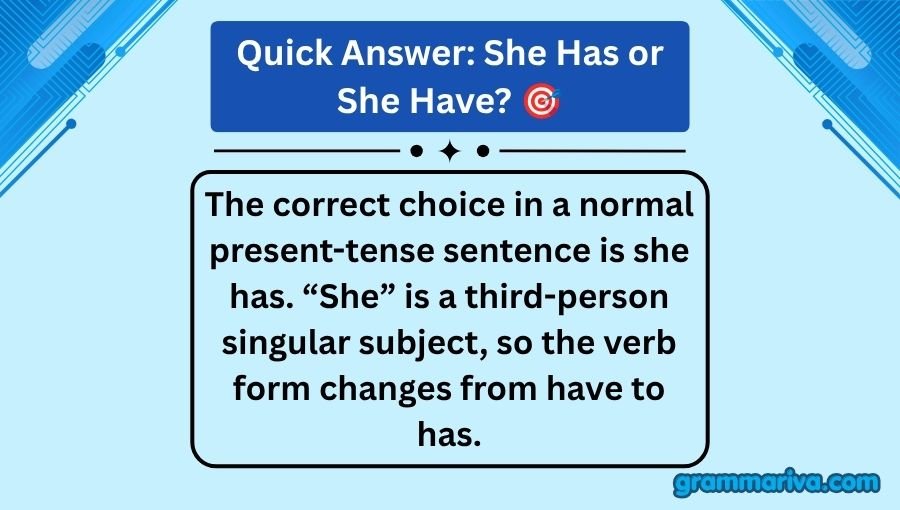
The correct choice in a normal present-tense sentence is she has. “She” is a third-person singular subject, so the verb form changes from have to has.
For example:
- ✅ She has a new phone.
- ❌ She have a new phone.
However, she have can appear after certain helping verbs or in special sentence structures. For example, “Does she have a car?” is correct because does already carries the present-tense agreement.
Related Forms of Have and Has 📝
The words have and has are forms of the same verb. They can also appear in contractions and questions.
| Form | Type | Example |
|---|---|---|
| have | Base/present form | They have a plan. |
| has | Third-person singular present form | She has a plan. |
| had | Past form | She had a plan. |
| having | -ing form | She is having lunch. |
| she’s | Contraction of she is or she has | She’s ready. / She’s finished. |
| doesn’t have | Negative form | She doesn’t have time. |
| does she have | Question form | Does she have time? |
The key point is that has normally follows he, she, and it when the sentence is in the simple present.
Understanding She Has or She Have at a Glance 📚
The basic difference is subject-verb agreement. She has is normally used when “she” directly controls the verb in a simple present statement. She have is normally incorrect in that structure.
| Form | Type | Meaning | Example | Correct/Incorrect |
|---|---|---|---|---|
| she has | Present verb form | She possesses or experiences something | She has a car. | ✅ Correct |
| she have | Base verb after she | Attempts to express present possession | She have a car. | ❌ Incorrect |
| she had | Past verb form | She possessed or experienced something before | She had a car. | ✅ Correct |
| she does have | Emphatic form | Strongly states possession or action | She does have a car. | ✅ Correct |
| she will have | Future form | She will possess or experience something | She will have a car. | ✅ Correct |
| does she have | Question structure | Asks about possession or experience | Does she have a car? | ✅ Correct |
A useful rule is this:
She + has in a normal present-tense statement.
But when another helping verb comes before have, use have, not has.
Is She Has the Correct Form? 🔎
Yes. She has is the standard form in a simple present statement when “she” is the subject.
Consider these examples:
- ✅ She has two brothers.
- ❌ She have two brothers.
Here, “she” is singular. The verb must agree with that singular subject. The form has does that job.
She Has for Possession
We use she has when someone owns, holds, or possesses something.
Examples:
- ✅ She has a new laptop.
- ✅ She has three books.
- ✅ She has a beautiful house.
- ✅ She has enough money.
- ❌ She have a new laptop.
- ❌ She have three books.
The meaning can be physical possession or something more abstract.
For example:
- ✅ She has a great idea.
- ✅ She has a lot of patience.
- ✅ She has an appointment today.
The subject is still “she,” so has is the correct simple present form.
She Has for Experiences and Conditions
Has is not limited to ownership. It can describe experiences, conditions, events, and relationships.
Examples:
- ✅ She has a headache.
- ✅ She has a meeting at noon.
- ✅ She has two children.
- ✅ She has a good relationship with her team.
In each sentence, “she” is singular, so has fits the simple present structure.
She Has in Perfect Tenses
The word has also works as a helping verb.
Examples:
- ✅ She has finished her homework.
- ✅ She has already left.
- ✅ She has seen that movie.
Here, has helps form the present perfect tense.
| Use | Example | Meaning |
|---|---|---|
| Possession | She has a bike. | She owns a bike. |
| Experience | She has a cold. | She is experiencing a condition. |
| Event | She has a meeting. | A meeting is scheduled for her. |
| Relationship | She has two sisters. | She has two sisters in her family. |
| Perfect tense | She has finished. | The action is complete. |
Test Tip 💡
Replace she with they and look at the verb.
- She has a dog.
- They have a dog.
If the sentence is a normal present-tense statement, she usually takes has, while they take have.
This simple subject swap is one of the fastest ways to check your sentence.
When Is She Have Actually Correct? 🤔
She have can be correct when another word or structure requires the base form have.
This is where many learners get confused. They learn that “she has” is correct and then assume “she have” can never appear. That is not true.
Consider this question:
- ✅ Does she have a car?
- ❌ Does she has a car?
Why is have correct here? Because does is the helping verb. The main verb stays in its base form.
The same pattern appears with other modal verbs:
- ✅ She might have time.
- ✅ She could have a chance.
- ✅ She will have dinner later.
- ✅ She should have more information.
In these sentences, the word after the helping verb stays in the base form.
| Structure | Correct Example | Why |
|---|---|---|
| She has | She has a car. | Has agrees with she. |
| Does she have | Does she have a car? | Does carries the tense. |
| She does have | She does have a car. | Does carries the tense. |
| She will have | She will have a car. | Will requires the base form. |
| She might have | She might have a car. | Might requires the base form. |
| She should have | She should have a car. | Should requires the base form. |
So the real rule is not simply “never use she have.” The better rule is:
Use “has” when she directly takes the present-tense verb. Use “have” after helping verbs such as does, will, can, could, should, and might.
Why Do People Confuse She Has and She Have? 🧠
People often confuse these forms because have is the base form of the verb. It appears with many subjects.
For example:
- I have
- you have
- we have
- they have
But third-person singular subjects use has in simple present statements:
- he has
- she has
- it has
A student once wrote, “She have a lot of experience” in a short essay I was reviewing. The student knew the verb was have, but had not yet learned that the form changes after a third-person singular subject. Once we changed the sentence to “She has a lot of experience,” the pattern became clear.
The Main Reason
The confusion often comes from memorizing vocabulary instead of sentence patterns. If you only remember that have means possession, you may use the same form everywhere.
Grammar works differently. The subject can change the verb form.
| Subject | Correct Form | Example |
|---|---|---|
| I | have | I have a question. |
| You | have | You have a question. |
| We | have | We have a question. |
| They | have | They have a question. |
| He | has | He has a question. |
| She | has | She has a question. |
| It | has | It has a problem. |
What Is the Rule for She Has in Present Tense? 📖
The rule is simple: in the simple present tense, a third-person singular subject such as she takes has when have is the main verb.
Examples:
- ✅ She has a new job.
- ❌ She have a new job.
- ✅ She has enough time.
- ❌ She have enough time.
This is an example of subject-verb agreement.
The same pattern applies to he and it:
- He has a car.
- She has a car.
- It has four wheels.
But plural subjects use have:
- They have a car.
- We have a car.
Correct Meanings and Uses of Has ✅
The word has can serve several common roles. Learning these uses makes the grammar easier.
1. Possession
- She has a blue bag.
- She has a new job.
2. Family or Relationships
- She has two sisters.
- She has many close friends.
3. Experiences
- She has a headache.
- She has trouble sleeping.
4. Scheduled Events
- She has a meeting tomorrow.
- She has an appointment at three.
5. Present Perfect
- She has finished the report.
- She has visited New York.
| Meaning | Word Type | Example Sentence |
|---|---|---|
| Possession | Main verb | She has a laptop. |
| Family | Main verb | She has one brother. |
| Experience | Main verb | She has a headache. |
| Scheduled event | Main verb | She has a meeting. |
| Completed action | Helping verb | She has finished the task. |
Case Study: A Workplace Email 💼
Imagine a manager sends this email:
“Maria has a meeting with the client at 2 p.m. She has all the documents ready.”
Both uses are correct because Maria and she are singular subjects.
Now imagine someone writes:
“Maria have a meeting with the client.”
That sentence has a subject-verb agreement problem.
I once edited a short workplace report where the writer used have after “she” several times. The writer was not making a spelling mistake. The issue was that the writer had copied the base verb pattern from sentences beginning with “they.” A quick subject check fixed every example.
The lesson is useful beyond grammar exercises. In workplace writing, small agreement errors can make otherwise strong writing look rushed.
Grammar Rules Explanation 📘
The grammar rule comes from subject-verb agreement. In the simple present tense, English changes certain verbs when the subject is third-person singular.
For the verb have, the special form is has.
The pattern is:
I/you/we/they + have
he/she/it + has
This applies when have is the main present-tense verb.
However, after a modal or another auxiliary verb, the main verb normally appears in its base form. That is why we say:
- She has a car.
- Does she have a car?
- She will have a car.
- She might have a car.
The helping verb already carries the tense or grammatical information, so have does not change to has.
Standard grammar references and major dictionaries support the distinction between have and has based on sentence structure and subject agreement.
Correct vs Incorrect at a Glance
| Sentence | Correct/Incorrect | Why |
|---|---|---|
| She has a new job. | ✅ Correct | Has agrees with she. |
| She have a new job. | ❌ Incorrect | Have does not agree directly with she here. |
| Does she have a new job? | ✅ Correct | Does carries the tense. |
| Does she has a new job? | ❌ Incorrect | The main verb stays in the base form after does. |
| She will have a new job. | ✅ Correct | Will takes the base form have. |
Common Mistakes With She Has and She Have ⚠️
These errors usually happen for simple reasons. Fast typing is one. Autocorrect can play a role too. A lack of grammar knowledge is another common cause.
Why These Errors Happen
- Fast typing: People often write what sounds natural without checking the subject.
- Autocorrect: A keyboard may suggest a form that looks familiar.
- Lack of knowledge: Learners may know the word have but not its changing form.
- Speech habits: Some forms can sound less obvious in fast speech.
- Pattern confusion: Learners may copy “they have” into a “she” sentence.
Similar Grammar Confusions
| Confusion | Correct Choice | Example |
|---|---|---|
| it’s / its | Depends on meaning | It’s cold. / The dog wagged its tail. |
| your / you’re | Depends on meaning | Your book. / You’re ready. |
| their / they’re | Depends on meaning | Their car. / They’re here. |
| there / their | Depends on meaning | Put it there. / Their house. |
| has / have | Depends on subject and structure | She has it. / They have it. |
Specific Wrong Forms to Avoid
| Wrong Form | What’s Wrong | Correct Form |
|---|---|---|
| She have a car. | Simple present agreement is wrong. | She has a car. |
| She has went home. | Incorrect past participle after has. | She has gone home. |
| Does she has a car? | Does requires the base form. | Does she have a car? |
| She don’t have time. | The negative auxiliary does not agree with she. | She doesn’t have time. |
| She doesn’t has time. | Doesn’t requires the base form. | She doesn’t have time. |
| She have finished it. | Have does not agree directly with she here. | She has finished it. |
Is She Has Used in Questions? ❓
Usually, she has is not the normal order for a simple present question. English generally uses does to form questions with have.
Compare:
- ✅ Does she have a car?
- ❌ Does she has a car?
The statement is:
- She has a car.
When we turn it into a question, does takes the present-tense job. The verb returns to have.
The same pattern works with negatives:
- She doesn’t have a car.
- She doesn’t have enough time.
- She doesn’t have the answer.
This is one of the most useful patterns to memorize.
How Do You Remember She Has or She Have? 💡
I recommend using a two-step test.
Step 1: Find the subject
Ask: Who has the thing or experience?
If the answer is she, check the sentence structure.
Step 2: Look for a helping verb
If there is no helping verb before have, use has in a normal present statement.
If a helping verb such as does, will, can, could, should, or might comes first, use have.
| Question | If Yes → Use |
|---|---|
| Is “she” the subject? | Check for a helping verb. |
| Is it a simple present statement? | Has |
| Does come before the verb? | Have |
| Will come before the verb? | Have |
| Can come before the verb? | Have |
| Might come before the verb? | Have |
Practice Examples
- She ___ a new dress. → has
- Does she ___ a new dress? → have
- She will ___ a new dress. → have
Usage in Different Contexts 🌎
The same basic grammar rule works in everyday speech, professional writing, creative writing, and digital communication.
| Context | Which Term to Use | Example |
|---|---|---|
| Everyday conversation | She has | She has a new phone. |
| Professional writing | She has | She has several years of experience. |
| Creative writing | Depends on structure | She has a secret. |
| Social media/texting | She has in standard writing | She has the best style. |
Informal texting may contain grammar mistakes, but informal writing does not change the standard rule.
Common Phrases With Has 🗣️
There are many everyday expressions using has.
| Phrase | Meaning |
|---|---|
| She has to go | She needs to leave. |
| She has got it | She understands or possesses it. |
| She has no idea | She does not know. |
| She has a point | Her idea has merit. |
| She has time | She is not short on time. |
| She has a chance | She has an opportunity. |
Notice that has remains correct when “she” is directly followed by the verb in these statements.
Does She Have or Does She Has? 🔍
The correct question is “Does she have…?”
This is one of the most common searches related to this grammar point.
- ✅ Does she have a ticket?
- ❌ Does she has a ticket?
The reason is simple. Does is already the present-tense auxiliary. The main verb uses its base form, have.
The same rule applies to other verbs:
- Does she work here?
- Does she like coffee?
- Does she know him?
- Does she have a car?
You would not say “Does she works,” “Does she likes,” or “Does she knows” in standard English.
She Has vs She Have in Negative Sentences 🚫
Negative sentences often cause another mistake.
The correct form is:
She doesn’t have…
Not:
She doesn’t has…
Examples:
- ✅ She doesn’t have a car.
- ❌ She doesn’t has a car.
- ✅ She doesn’t have enough money.
- ❌ She doesn’t has enough money.
Again, doesn’t carries the present-tense agreement. The main verb stays as have.
| Statement | Negative | Question |
|---|---|---|
| She has a car. | She doesn’t have a car. | Does she have a car? |
| She has time. | She doesn’t have time. | Does she have time? |
| She has a ticket. | She doesn’t have a ticket. | Does she have a ticket? |
| She has a plan. | She doesn’t have a plan. | Does she have a plan? |
Synonyms and Alternatives 🔄
Sometimes you can rewrite a sentence to avoid using has, but the replacement must preserve the meaning.
| Alternative | Works When | Does Not Work When |
|---|---|---|
| owns | Talking about ownership | Talking about headaches or events |
| possesses | Formal ownership contexts | Casual everyday speech |
| holds | Referring to something physically held | Most abstract forms of possession |
| experiences | Talking about an event or condition | Simple ownership |
| contains | Talking about what is inside something | Talking about a person having an item |
For example, “She has a car” can become “She owns a car.” But “She has a headache” cannot naturally become “She owns a headache.”
Why Does Getting the Form Right Matter? 🎯
Using the correct form improves clarity and makes your writing sound polished.
A small grammar error may not change the meaning, but it can affect how readers judge the writing.
| Situation | Why Getting It Right Matters |
|---|---|
| Resume | Shows attention to detail. |
| Client email | Creates a professional impression. |
| Published content | Makes the writing easier to trust. |
| Social post | Keeps the message clear and polished. |
A simple sentence can be enough to show the difference:
- ❌ She have five years of experience.
- ✅ She has five years of experience.
The second sentence sounds natural and professional.
A useful reminder is:
Clear grammar makes simple ideas easier to trust.
What About She Has to and She Have to? 🧩
The phrase she has to is correct in a normal present-tense statement.
For example:
- ✅ She has to leave early.
- ❌ She have to leave early.
Here, has to means that she must do something.
But questions and negatives change the structure:
- ✅ Does she have to leave?
- ✅ She doesn’t have to leave.
- ❌ Does she has to leave?
- ❌ She doesn’t has to leave.
This is another excellent example of how does controls the verb form.
| Sentence Type | Correct Example |
|---|---|
| Statement | She has to work. |
| Question | Does she have to work? |
| Negative | She doesn’t have to work. |
| Future | She will have to work. |
| Modal | She may have to work. |
Special Exception and Edge Cases 🧠
There is no special exception that makes she have correct as the ordinary main verb in a simple present statement.
However, have is correct after helping verbs.
For example:
- She can have dessert.
- She may have another chance.
- She will have more time.
- Does she have enough money?
- She doesn’t have a ticket.
So instead of memorizing “she have is always wrong,” memorize the more accurate rule:
She has is correct when have directly follows “she” in a normal present-tense statement.
She have is correct when a grammatical structure requires the base form, especially after auxiliaries and modal verbs.
Quick Recap Checklist ✅
Use this checklist whenever you are unsure.
| Question | If Yes → Use |
|---|---|
| Is “she” the subject? | Check the next verb structure. |
| Is this a simple present statement? | Has |
| Is “does” before the verb? | Have |
| Is “doesn’t” before the verb? | Have |
| Is “will” before the verb? | Have |
| Is a modal such as “can” or “might” before the verb? | Have |
| Is “has” being used as a perfect-tense helper? | Has |
Final Practice
1. She ___ a new apartment.
Answer: has
2. Does she ___ a new apartment?
Answer: have
3. She will ___ a new apartment next year.
Answer: have
These three examples cover the core rule.
FAQs About She Has vs She Have ❓
Is “she has” grammatically correct?
Yes. She has is grammatically correct in a normal simple present statement when “she” is the subject.
Example: She has a new computer.
Is “she have” grammatically correct?
It can be correct after a helping verb or modal, but it is not correct as the main verb in an ordinary simple present statement.
Correct: Does she have a car?
Incorrect: She have a car.
Which is correct, she has or she have?
She has is correct when “she” directly takes the present-tense verb.
Example: She has a dog.
Use have after structures such as does, will, can, could, should, and might.
Do we say “Does she have” or “Does she has”?
The correct form is does she have.
Example: Does she have a ticket?
Because does already carries the present-tense agreement, the main verb stays in its base form.
Do we say “She has” or “She have” in a sentence?
Use she has in a normal present-tense statement.
Example: She has enough time.
Use she have only when another helping structure requires the base verb.
Is “she has a car” correct?
Yes. She has a car is completely correct.
“She” is a third-person singular subject, so the present form of have becomes has.
Is “she doesn’t have” correct?
Yes. She doesn’t have is correct.
Example: She doesn’t have a car.
Do not write “She doesn’t has,” because doesn’t requires the base form have.
Is “does she has” ever correct?
Not in standard English when has is intended as the main verb after does.
Use:
Does she have a car?
Not:
Does she has a car?
Why does she take “has” instead of “have”?
Because she is a third-person singular subject. In the simple present tense, the verb have changes to has after third-person singular subjects.
What is an easy way to remember the rule?
Remember this pattern:
She has.
But:
Does she have?
And:
She will have.
The helping verb controls the form when one is present.
Conclusion: She Has or She Have Made Simple
The key rule is easy: she has or she have depends on the sentence structure. In a normal simple present statement, she has is correct because “she” is a third-person singular subject. For example, “She has a new job” is correct.
But have returns after helping verbs and modal verbs. That is why we say “Does she have a job?” and “She will have a job.” We also say “She doesn’t have a job.”
When I teach this rule, I encourage learners to look for the subject first and then check whether a helping verb appears before the main verb. That small habit prevents most mistakes. 👍
If you remember only three patterns, remember these: She has, Does she have?, and She will have. Once those patterns become familiar, this common grammar question becomes much easier.
Master the pattern, check the helper, and your grammar will stay on track. ✨

Hi, I’m Nathan Reed. I’m a grammar and writing specialist at Grammariva. I work on practical grammar content that helps readers understand sentence structure, punctuation, vocabulary, and better writing habits.


[…] examples, cover common mistakes, and give you simple tests you can use whenever you are unsure. ✨ She Has or She Have | Spatter or Splatter | Eaten or […]
[…] the difference. By the end, choosing the right term should feel much easier. 🧠 Leapt or Leaped | She Has or She Have | Spatter or […]