Sending an email sounds simple, but choosing the right verb tense can be surprisingly tricky. I sent vs I have sent vs I had sent an email is a common grammar question because all three forms describe an email that was sent, but each one shows a different relationship with time. 📧 Sending an email sounds simple, but choosing the right verb tense can be surprisingly tricky.
“Understanding i sent vs i have sent can make email writing much easier.”You may know exactly what happened, yet still wonder whether to write, “I sent an email,” “I have sent an email,” or “I had sent an email.
” The confusion becomes even stronger when you are writing to a boss, teacher, client, or coworker. 📧
I have taught and edited English sentences for years, and I often see this problem in short workplace messages. The good news is that the rule is much easier once you think about the timeline. Eventhough or Even Though | Afflict vs Inflict | Behaviour or Behavior
🎯 Quick Answer: I Sent vs I Have Sent vs I Had Sent an Email
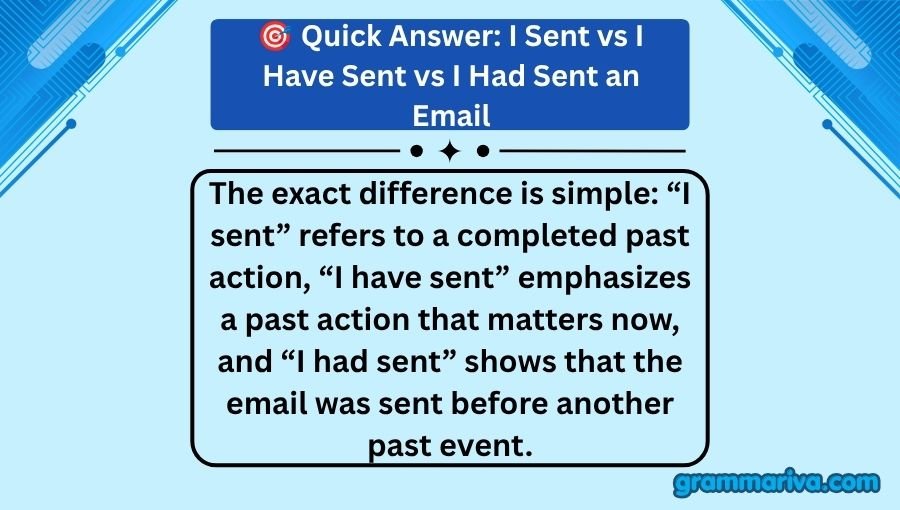
The exact difference is simple: “I sent” refers to a completed past action, “I have sent” emphasizes a past action that matters now, and “I had sent” shows that the email was sent before another past event.
| Form | Basic Time | Main Idea | Example |
|---|---|---|---|
| I sent | Simple past | Completed past action | I sent an email yesterday. |
| I have sent | Present perfect | Past action connected to now | I have sent the email. |
| I had sent | Past perfect | Earlier past action | I had sent the email before the meeting started. |
A quick rule helps:
- Use I sent when you are talking about a finished past time.
- Use I have sent when the result or action is relevant now.
- Use I had sent when another past event gives you a second point in time.
Is “I Sent” Correct for an Email?
Yes, “I sent” is correct when you are describing an email that you sent at a completed time in the past.
The simple past is often the best choice when the time is clear. Words such as yesterday, last night, this morning, two hours ago, on Monday, and last week commonly work with this form.
Examples
✅ I sent the email yesterday.
❌ I have sent the email yesterday.
The first sentence works because yesterday is a finished past time. The second sentence combines a finished past-time expression with the present perfect, which is normally not the natural choice in standard American English.
Another example:
✅ I sent the documents to the client on Monday.
❌ I have sent the documents to the client on Monday.
The specific past time makes sent the natural choice.
When “I sent” works best
Use I sent when:
- The action happened at a definite past time.
- You are telling a story about something that happened.
- The email is simply one completed event in the past.
- You want to focus on when the action happened.
| Time Expression | Natural Form | Example |
|---|---|---|
| Yesterday | I sent | I sent the email yesterday. |
| Last night | I sent | I sent the report last night. |
| Two hours ago | I sent | I sent it two hours ago. |
| On Monday | I sent | I sent the file on Monday. |
| Last week | I sent | I sent three emails last week. |
When Should You Say “I Have Sent an Email”?
“I have sent an email” is correct when the past action has a clear connection to the present. The speaker is usually interested in the current result rather than the exact past time.
For example, imagine your coworker asks:
“Did you contact the client?”
You can answer:
✅ I have sent an email to the client.
This tells your coworker that the email has been sent and that fact matters now.
You could also say:
✅ I have sent the requested documents.
The important point is not exactly when you sent them. The important point is that they are now sent.
Present relevance matters
Compare these two sentences:
✅ I sent the email at 9:00 a.m.
✅ I have sent the email.
The first focuses on when the action happened.
The second focuses on the current status. The email has now been sent.
| Sentence | Main Focus | Meaning |
|---|---|---|
| I sent the email yesterday. | Past time | The action happened yesterday. |
| I have sent the email. | Present result | The email is now sent. |
| I had sent the email before lunch. | Earlier past | The email was sent before another past time. |
| I sent the email at 10:30. | Exact past event | The action happened at 10:30. |
Is “I Had Sent” Correct for an Email?
Yes. “I had sent” is correct when the email was sent before another event or point in the past.
The past perfect shows the order of two past actions.
Consider this sentence:
✅ I had sent the email before the meeting started.
There are two past actions:
- I sent the email.
- The meeting started.
The email was sent first. The meeting started later.
That earlier action uses had sent.
Timeline
Email sent → Meeting started → Speaker talks about both events
This is why the past perfect is useful. It makes the order clear.
Another example:
✅ I had sent the email before my manager called me.
The email came first. The phone call happened later.
Without had, you might still understand the sentence from context, but the past perfect makes the time relationship especially clear.
I Sent vs I Have Sent vs I Had Sent: The Core Difference
Knowing the difference between i sent vs i have sent helps you choose the tense that matches your meaning.The easiest way to understand i sent vs i have sent is to look at whether you are focusing on a finished past time or the present result.
The three forms describe different relationships with time.
| Form | Grammar Name | Time Relationship | Example |
|---|---|---|---|
| I sent | Simple past | Completed past | I sent the email yesterday. |
| I have sent | Present perfect | Past action linked to now | I have sent the email. |
| I had sent | Past perfect | Past action before another past event | I had sent the email before she arrived. |
Think of them as three different viewpoints.
I sent looks backward at a completed event.
I have sent looks from the present toward a completed action whose result matters now.
I had sent looks backward from a past point to an even earlier action.
Why Do People Confuse “I Sent,” “I Have Sent,” and “I Had Sent”?
“The confusion around i sent vs i have sent usually comes from the difference between past time and present relevance.” People confuse these forms because all three can describe the same basic action: an email was sent.
The difference is not the basic action. The difference is the time relationship.
I once edited a short workplace message that said, “I have sent the proposal yesterday.” The writer knew exactly what they meant. They simply chose the present perfect because the email had been sent. Once we added yesterday, the simple past became the natural choice: “I sent the proposal yesterday.”
This is a common pattern. Writers often focus on the action itself and forget to check the time expression.
Three questions can solve the problem
Ask yourself:
- Am I talking about a finished past time?
- Use I sent.
- Am I reporting a completed action that matters now?
- Use I have sent.
- Did the email happen before another past event?
- Use I had sent.
| Question | Best Choice | Example |
|---|---|---|
| Did it happen at a finished past time? | I sent | I sent it yesterday. |
| Is the result important now? | I have sent | I have sent it already. |
| Did it happen before another past event? | I had sent | I had sent it before he called. |
📚 Grammar Rules Explanation
The simple past, present perfect, and past perfect have different jobs in standard English.
Simple past describes an action that happened and finished in the past. It can be used with a specific finished time.
Present perfect uses have/has + past participle. With the verb send, the past participle is sent, so the form is I have sent. This tense connects a past action with the present.
Past perfect uses had + past participle. Therefore, I had sent describes an action that happened before another past event.
These rules explain why the following sentences have different meanings:
✅ I sent the email yesterday.
The action happened at a finished time.
✅ I have sent the email.
The action is complete, and the current result matters.
✅ I had sent the email before the meeting began.
The email was sent before another past event.
Standard English grammar references agree on this basic distinction between the three tenses.
Correct vs Incorrect at a Glance
| Sentence | Correct/Incorrect | Why |
|---|---|---|
| I sent the email yesterday. | ✅ Correct | “Yesterday” is a finished past time. |
| I have sent the email. | ✅ Correct | The completed action matters now. |
| I had sent the email before she called. | ✅ Correct | The email happened before another past event. |
| I have sent the email yesterday. | ❌ Incorrect in standard usage | “Yesterday” normally calls for the simple past. |
| I had sent the email now. | ❌ Incorrect | “Had sent” needs a past reference point, not “now.” |
How Can You Remember the Difference?
Use a simple time-line test.
If you can point to a finished past time, choose sent.
If you are standing in the present and reporting that the email is already sent, choose have sent.
If you are talking about two past events and the email happened first, choose had sent.
The three-word memory trick
Sent = past.
Have sent = past + now.
Had sent = earlier past + later past.
| Memory Rule | Form | Example |
|---|---|---|
| Past | I sent | I sent it yesterday. |
| Past + now | I have sent | I have sent it already. |
| Earlier past | I had sent | I had sent it before the call. |
💡 Test Tip
Look for the time signal before choosing the tense.
Words such as yesterday, last week, ago, on Monday, and in 2025 often point toward the simple past.
Words such as already, just, yet, and so far can naturally work with the present perfect when the current result matters.
The past perfect usually needs another past event or past reference point.
📝 Case Study: Choosing the Right Email Tense at Work
“This example shows how i sent vs i have sent changes depending on the situation.” Imagine that Maya works in an office. Her manager asks about a report.
At 9:00 a.m., Maya sends the report.
At 10:00 a.m., her manager asks:
“Did you send the report?”
Maya can say:
✅ I have sent the report.
The report is now sent, so the present result matters.
Now imagine Maya is explaining what happened yesterday:
✅ I sent the report at 9:00 a.m.
Here, she is giving a specific past time.
Now imagine she is telling a story about what happened before a meeting:
✅ I had sent the report before the meeting started.
Here, the sending happened first.
I once caught myself typing a similar message while reviewing an email chain. I had written “I have sent it last Friday,” then noticed the finished time phrase. I changed it to “I sent it last Friday.” The correction took seconds, but it made the sentence much cleaner.
| Workplace Situation | Best Sentence |
|---|---|
| Reporting the current status | I have sent the report. |
| Giving yesterday’s details | I sent the report yesterday. |
| Explaining an earlier past action | I had sent the report before the meeting. |
| Giving the exact sending time | I sent the report at 9:00 a.m. |
⚠️ Common Mistakes With Email Tenses
Most mistakes happen because writers focus on what happened rather than when it happened.
Other causes include:
- Fast typing
- Autocorrect
- Limited grammar knowledge
- Copying patterns from informal messages
- Translating directly from another language
- Using one tense for every past action
Similar Grammar Confusions
| Confusion | Correct Forms | Main Difference |
|---|---|---|
| It’s / its | It’s / its | Contraction vs possession |
| You’re / your | You’re / your | You are vs possession |
| They’re / their / there | They’re / their / there | Different meanings |
| Then / than | Then / than | Time/order vs comparison |
| Your / you’re | Your / you’re | Possession vs “you are” |
| I sent / I have sent | I sent / I have sent | Past time vs present connection |
Specific Wrong Forms and Uses
| Wrong Form | What’s Wrong | Correct Form |
|---|---|---|
| I have sent it yesterday. | Finished past time conflicts with the normal present-perfect use. | I sent it yesterday. |
| I had sent it now. | Past perfect needs a past reference point. | I have sent it now. |
| I had sent it yesterday. | Usually unnecessary unless another past event is being compared. | I sent it yesterday. |
| I have send the email. | Wrong past participle. | I have sent the email. |
| I had send the email. | Wrong past participle after “had.” | I had sent the email. |
| I sent the email before he arrived. | Grammatically possible, but past perfect may make the sequence clearer. | I had sent the email before he arrived. |
What Is the Difference Between “I Sent” and “I Have Sent”?
“I sent” focuses on a completed past event, while “I have sent” focuses more on the current result or connection to the present.
Compare:
✅ I sent the invoice this morning.
This tells the reader when the action happened.
✅ I have sent the invoice.
This tells the reader that the invoice has now been sent.
The difference becomes especially clear in workplace communication.
If your boss asks, “Did you send the invoice?” you can respond:
Yes, I have sent it.
If your boss asks, “When did you send it?” you can respond:
I sent it this morning.
| Question | Natural Answer |
|---|---|
| Did you send it? | I have sent it. |
| When did you send it? | I sent it this morning. |
| Did you send it before the meeting? | I had sent it before the meeting. |
What Is the Difference Between “I Have Sent” and “I Had Sent”?
“I have sent” connects the action to the present, while “I had sent” places the action before another past event.
Compare:
✅ I have sent the email.
The speaker is talking from the present.
✅ I had sent the email before the meeting.
The speaker is discussing a past sequence.
A useful way to remember this is:
have → present viewpoint
had → past viewpoint
| Form | Speaker’s Viewpoint | Example |
|---|---|---|
| I have sent | Present | I have sent the file. |
| I had sent | Past | I had sent the file before lunch. |
What Is the Difference Between “I Sent” and “I Had Sent”?
Both forms refer to the past, but they do not organize time in the same way.
I sent simply reports a past action.
I had sent shows that the action happened before another past action.
Compare:
✅ I sent the email before lunch.
This is grammatically fine.
✅ I had sent the email before lunch when my manager called.
The past perfect makes the earlier action especially clear because another past event follows it.
The important point is that had sent usually works best when there is a past reference point.
Usage in Different Contexts
The correct tense can change depending on what you are trying to communicate.
| Context | Which Term to Use | Example |
|---|---|---|
| Everyday conversation | I sent / I have sent | I sent it yesterday. |
| Professional writing | I have sent / I sent | I have sent the requested file. |
| Creative writing | Any, depending on timeline | I had sent the message before dawn. |
| Social media/texting | I sent / I have sent | I sent you the link. |
Everyday conversation
Simple past is very common when people tell stories or give details.
“I sent her a message last night.”
Present perfect is useful when the current result matters.
“I have sent him a message, so he should see it soon.”
Professional writing
In workplace communication, I have sent is often useful when confirming completion.
“I have sent the signed contract for your review.”
If you give a specific past time, simple past is usually better.
“I sent the signed contract yesterday.”
Creative writing
Writers use all three forms to control the timeline.
“I had sent the letter before the storm arrived.”
Social media and texting
Informal messages often favor the simple past because it is direct.
“I sent you the link.”
Still, present perfect is natural when confirming something that has just been completed.
“I’ve sent it.”
Can You Say “I Have Sent an Email Yesterday”?
In standard American English, “I have sent an email yesterday” is normally not the natural choice. Use the simple past instead.
✅ I sent an email yesterday.
❌ I have sent an email yesterday.
The reason is that yesterday identifies a completed past time. The simple past fits that time frame.
The same idea applies to many finished-time expressions.
| Less Natural/Incorrect Standard Form | Better Form |
|---|---|
| I have sent it yesterday. | I sent it yesterday. |
| I have sent it last night. | I sent it last night. |
| I have sent it two hours ago. | I sent it two hours ago. |
| I have sent it last Monday. | I sent it last Monday. |
Can You Say “I Have Sent the Email Already”?
Yes. “I have sent the email already” is correct and natural.
The word already works well with the present perfect when you want to show that something is complete.
✅ I have already sent the email.
You can also use a contraction:
✅ I’ve already sent the email.
This is common in conversation and informal professional communication.
The focus is on the current status: the email has been sent.
Can You Say “I Had Sent the Email Before the Meeting”?
Yes. “I had sent the email before the meeting” is a correct use of the past perfect.
The sentence contains two past points:
- The email was sent.
- The meeting happened.
The email came first.
✅ I had sent the email before the meeting started.
You can also use the simple past:
✅ I sent the email before the meeting started.
Both can be understood. The past perfect places stronger emphasis on the earlier action.
| Sentence | Main Effect |
|---|---|
| I sent the email before the meeting. | Simple report of events |
| I had sent the email before the meeting. | Clear emphasis on the earlier action |
Common Time Words With Each Form
Certain time expressions give you useful clues.
| Form | Common Time Clues | Example |
|---|---|---|
| I sent | yesterday, last week, ago, on Monday | I sent it yesterday. |
| I have sent | already, just, yet, so far | I have already sent it. |
| I had sent | before, by the time, earlier | I had sent it before he arrived. |
These are helpful patterns, not absolute rules. Context still matters.
How To Choose the Right Email Tense
“When deciding between i sent vs i have sent, first check whether you are giving a finished past time.”
Use this three-step process.
Step 1: Find the time
Ask whether you have a finished past time.
If yes, simple past is usually the right choice.
I sent the email yesterday.
Step 2: Check the present connection
If the exact time is not important and you are confirming a completed action that matters now, use present perfect.
I have sent the email.
Step 3: Look for two past events
If you are talking about two past actions and one happened before the other, consider past perfect.
I had sent the email before she called.
| Step | Question | Choice |
|---|---|---|
| 1 | Is there a finished past time? | I sent |
| 2 | Does the completed action matter now? | I have sent |
| 3 | Did it happen before another past event? | I had sent |
Why Getting the Tense Right Matters
Correct tense makes communication easier to understand. It also helps readers know whether you are describing a past event, a current status, or a sequence of past events.
A short sentence can carry a lot of information when its tense is correct.
“Good grammar does not make a message longer. It makes the meaning clearer.”
| Situation | Why Getting It Right Matters |
|---|---|
| Client email | Shows clear timing and professionalism |
| Resume or application | Demonstrates accurate written English |
| Published content | Improves clarity and reader trust |
| Social post | Prevents unnecessary confusion |
In professional writing, small tense choices can affect how confident and careful your message sounds.
How To Avoid Tense Mistakes in Emails
When you are unsure about i sent vs i have sent, check whether you are giving a specific past time or confirming a completed action.
Before pressing Send, take a few seconds to check the verb.
Use “I sent” when:
- You mention a finished past time.
- You are telling what happened.
- The exact past event matters.
Use “I have sent” when:
- You are confirming completion.
- The result matters now.
- You do not need to give a finished past time.
Use “I had sent” when:
- You are describing two past events.
- The email happened before another past event.
- You want to make the earlier action clear.
| If Your Sentence Means… | Use |
|---|---|
| “This happened yesterday.” | I sent |
| “This is done now.” | I have sent |
| “This happened before that past event.” | I had sent |
Frequently Asked Email Examples
Here are several common situations where the choice becomes easier.
You are confirming an action right now
✅ I have sent the email.
You are reporting what happened yesterday
✅ I sent the email yesterday.
You are explaining what happened before a meeting
✅ I had sent the email before the meeting began.
You are telling someone when you sent it
✅ I sent the email at 4 p.m.
You are saying the task is complete
✅ I have sent the requested documents.
You are describing a sequence of past events
✅ I had sent the documents before the client called.
| Situation | Best Sentence |
|---|---|
| Confirmation | I have sent the email. |
| Yesterday | I sent the email yesterday. |
| Exact time | I sent the email at 4 p.m. |
| Earlier past event | I had sent the email before the call. |
| Current completion | I have sent the documents. |
How To Remember the Difference With a Timeline
Imagine three points:
PAST ←———— PRESENT
For I sent, you are simply looking at something that happened in the past.
For I have sent, you are standing in the present and saying that the action is complete.
For I had sent, imagine two points in the past:
Earlier past → Later past
The email happened at the first point.
The other event happened at the second point.
This timeline method is one of the easiest ways to remember the difference.
Practice: Choose the Correct Form
Try these examples before looking at the answers.
1. I ___ the email yesterday.
Answer: sent
✅ I sent the email yesterday.
2. I ___ the email, so you can check it now.
Answer: have sent
✅ I have sent the email, so you can check it now.
3. I ___ the email before the meeting started.
Answer: had sent
✅ I had sent the email before the meeting started.
4. I ___ the message two hours ago.
Answer: sent
✅ I sent the message two hours ago.
5. I ___ the message already.
Answer: have sent
✅ I have sent the message already.
| Practice Clue | Correct Form |
|---|---|
| Yesterday | I sent |
| Result matters now | I have sent |
| Before another past event | I had sent |
| Two hours ago | I sent |
| Already completed | I have sent |
Do Native Speakers Always Follow These Rules Exactly?
Native speakers may use different forms depending on region, context, and conversational style. American English generally makes the simple past especially common in everyday conversation, while the present perfect remains fully standard and useful.
The goal is not to memorize one tense for every situation. The goal is to understand the relationship between the action and the time.
In formal writing, clarity should guide your choice.
If you say:
“I sent the email yesterday.”
The reader knows when it happened.
If you say:
“I have sent the email.”
The reader knows it is completed.
If you say:
“I had sent the email before the meeting.”
The reader knows the email came first.
Each sentence has a different job.
How Do You Say It More Naturally in Professional Emails?
Professional emails often benefit from short, direct sentences.
Instead of adding unnecessary detail, choose the tense that gives the reader the information they need.
| Purpose | Natural Sentence |
|---|---|
| Confirm completion | I have sent the requested file. |
| Mention a past time | I sent the file yesterday. |
| Explain sequence | I had sent the file before the meeting. |
| Confirm a recent action | I have just sent the file. |
| Explain an earlier event | I had already sent the file when he called. |
A simple sentence is often stronger than a long one.
Quick Recap Checklist
Use this checklist whenever you are unsure which tense to choose.
| Question | If Yes → Use |
|---|---|
| Did the action happen at a finished past time? | I sent |
| Are you simply reporting a completed past event? | I sent |
| Does the completed action matter now? | I have sent |
| Are you confirming that something is already done? | I have sent |
| Did the email happen before another past event? | I had sent |
| Are you describing two connected past events? | I had sent |
Practice Examples
- Yesterday, I ___ the email.
Answer: sent - I ___ the email, so please check your inbox.
Answer: have sent - I ___ the email before the meeting started.
Answer: had sent
FAQs About I Sent vs I Have Sent vs I Had Sent
Is “I sent an email” grammatically correct?
” Yes. “I sent an email” is grammatically correct.The choice between i sent vs i have sent depends on the time and meaning you want to express.
It uses the simple past and describes a completed action in the past.
Is “I have sent an email” correct?
Yes. “I have sent an email” is correct. It uses the present perfect and usually emphasizes that the email has been sent and that fact matters now.
Is “I had sent an email” correct?
Yes. “I had sent an email” is correct when the sending happened before another past event or past reference point.
Should I say “I sent” or “I have sent”?
Use “I sent” for a completed past time, such as “yesterday” or “last night.” Use “I have sent” when you are confirming that the email is now sent.
Can I say “I have sent the email yesterday”?
In standard American English, this is normally not the natural choice. Say “I sent the email yesterday.” The word “yesterday” points to a finished past time.
When should I use “I had sent”?
Use “I had sent” when the email was sent before another past event.
For example:
I had sent the email before my manager called.
Is “I have sent the email already” correct?
Yes. “I have already sent the email” is natural and correct. The present perfect shows that the task is complete and relevant now.
Is “I sent the email before the meeting” correct?
Yes. It is grammatically correct. You can also say “I had sent the email before the meeting” when you want to make the earlier timing especially clear.
Which is better in a professional email: “I sent” or “I have sent”?
It depends on the meaning. Use “I have sent” when confirming that a task is complete. Use “I sent” when giving a specific past time or describing a past event.
What is the easiest way to remember the three forms?
Remember this:
I sent = past.
I have sent = past connected to now.
I had sent = earlier past before another past event. Remembering i sent vs i have sent can help you write clearer and more natural emails.
Conclusion
I sent vs I have sent vs I had sent an email becomes much easier when you focus on the timeline instead of memorizing isolated grammar rules. 📧
Use I sent for a completed past action, especially when you mention a finished time such as yesterday, last week, or two hours ago. Use I have sent when the email is complete and that fact matters in the present. Use I had sent when the email happened before another past event.
The three forms can describe the same basic action, but they place that action at different points in time.
When I check an email sentence, I use one simple question: “What time relationship am I trying to show?” That question usually makes the answer clear.
If you remember only one thing, remember this:
Sent tells the past. Have sent connects the past to now. Had sent puts one past action before another.
Choose the tense that matches your timeline, and your email will sound clear, natural, and professional every time. ✅

Hi, I’m Ethan Brooks. I’m an English grammar writer at Grammariva, where I work on clear explanations, practical examples, and useful writing tips. I enjoy making difficult grammar topics easier to understand.
[…] driver’s, and drivers’, along with examples that make the rule easy to remember. ✍️ I Sent vs I Have Sent vs I Had Sent an Email | Eventhough or Even Though | Afflict vs […]