Have you ever typed a sentence and stopped because you were unsure whether to write eventhough or even though? You are not alone. This is a common spelling and grammar question, especially when people write quickly, text on their phones, or rely on autocorrect. The two forms look almost identical, but standard English treats them very differently.
The correct form is even though. It is written as two separate words. It is a conjunction used to show contrast between two ideas. For example, you can say, “Even though it was raining, we went outside.” 🌧️ The sentence tells us that the rain was a fact, but it did not stop the action.
In this guide, I will explain eventhough or even though in simple US English. I will show you the correct spelling, explain the grammar rule, cover common mistakes, and give you plenty of examples.
By the end, you should be able to spot the wrong form quickly and use the correct one with confidence. 😊 Afflict vs Inflict | Behaviour or Behavior | In Respect of or With Respect to
🎯 Quick Answer: Eventhough or Even Though?
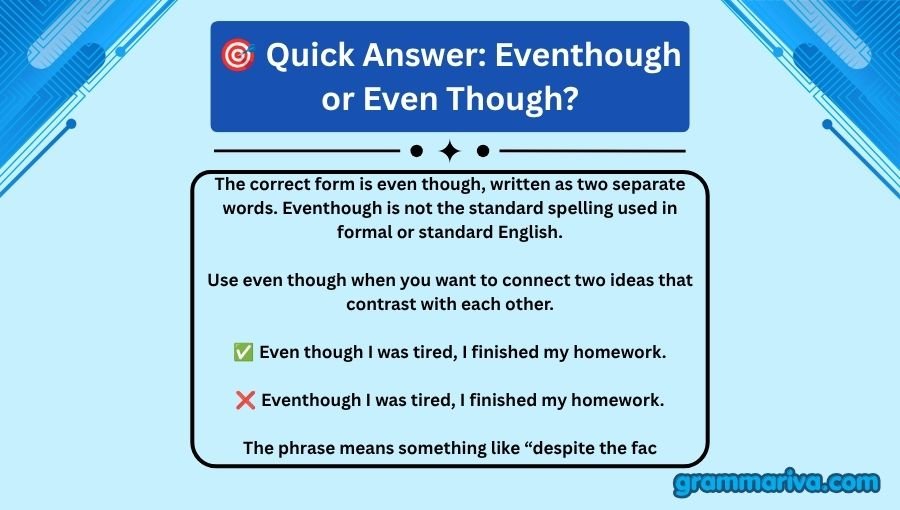
The correct form is even though, written as two separate words. Eventhough is not the standard spelling used in formal or standard English.
Use even though when you want to connect two ideas that contrast with each other.
- ✅ Even though I was tired, I finished my homework.
- ❌ Eventhough I was tired, I finished my homework.
The phrase means something like “despite the fact that” or “although.”
| Form | Correct? | Use |
|---|---|---|
| even though | ✅ Yes | Standard English conjunction |
| eventhough | ❌ No | Nonstandard spelling |
| even-thought | ❌ No | Incorrect form |
| even tho | ⚠️ Informal | Texting or casual online writing only |
The simple rule is easy: write “even though” as two words every time in standard English.
Is Eventhough a Word?
No, eventhough is not the standard written form of the phrase. The correct spelling is even though, with a space between even and though.
People often combine the two words because they are commonly pronounced together in normal speech. However, spoken language and written spelling do not always match.
For example:
- ✅ Even though she was nervous, she gave the speech.
- ❌ Eventhough she was nervous, she gave the speech.
The mistake does not usually come from misunderstanding the meaning. Most writers know what the phrase means. The problem is that the phrase can sound like one unit when spoken quickly.
I once edited a short school essay where a student had written eventhough several times. The student knew exactly how to use the phrase grammatically. The only problem was the missing space. Once we separated the words, every sentence looked correct.
Why Does the Mistake Happen?
There are several reasons people combine the words:
- They hear the phrase as one sound.
- They type quickly.
- They assume it works like a single-word conjunction.
- Autocorrect may not catch the mistake.
- They have seen the incorrect form online.
- They have never learned the spelling rule.
| Reason | What Happens | Better Habit |
|---|---|---|
| Fast typing | Words get joined | Slow down when proofreading |
| Speech influence | The phrase sounds connected | Remember the written form |
| Autocorrect | The mistake may remain | Proofread manually |
| Online writing | Incorrect forms spread | Check standard spelling |
| Lack of practice | The rule is forgotten | Memorize “even though” |
💡 Even Though vs Eventhough at a Glance
Even though is the correct two-word form. Eventhough is an incorrect combination in standard English.
| Form | Type | Meaning | Example | Correct/Incorrect |
|---|---|---|---|---|
| even though | Conjunction | Although; despite the fact that | Even though I was tired, I worked. | ✅ Correct |
| eventhough | Nonstandard spelling | Intended to mean “even though” | Eventhough I was tired, I worked. | ❌ Incorrect |
| although | Conjunction | In spite of the fact that | Although I was tired, I worked. | ✅ Correct |
| despite the fact that | Phrase | In spite of a fact | Despite the fact that I was tired, I worked. | ✅ Correct |
The key difference is spelling, not meaning. When you want this particular conjunction, use even though.
What Does Even Though Mean?
Even though introduces a fact that contrasts with another fact or action. It tells the reader that something happened despite an expected obstacle or opposing condition.
Consider this sentence:
Even though the store was crowded, we found a table.
The first part gives the condition:
the store was crowded
The second part gives the result:
we found a table
The crowd might have made finding a table difficult. The phrase shows that the expected problem did not prevent the result.
Even Though Shows Contrast
The phrase is especially useful when the first idea might make the second idea surprising.
- ✅ Even though it was cold, we went swimming.
- ❌ Eventhough it was cold, we went swimming.
The cold weather creates an expectation that we would stay out of the water. The second part shows that we did not.
| Meaning | Word Type | Example Sentence |
|---|---|---|
| Contrast | Conjunction | Even though it was late, we continued working. |
| Unexpected result | Conjunction | Even though he practiced, he felt nervous. |
| Unexpected action | Conjunction | Even though she was busy, she called me. |
How Do You Use Even Though in a Sentence?
Use even though before a clause that contains a subject and a verb. The phrase can appear at the beginning or in the middle of a sentence.
For example:
- ✅ Even though I was sick, I went to class.
- ✅ I went to class even though I was sick.
Both sentences have the same basic meaning.
When even though begins the sentence, a comma usually separates the introductory clause from the main clause.
Even though I was tired, I finished the report.
When the phrase comes after the main clause, a comma is often unnecessary.
I finished the report even though I was tired.
Sentence Pattern 1: Even Though + Clause, Main Clause
This is one of the most common patterns.
Even though + subject + verb, subject + verb.
Example:
- Even though the road was busy, we arrived on time.
The first clause gives the contrasting condition. The second gives the main result.
Sentence Pattern 2: Main Clause + Even Though + Clause
You can also place the phrase after the main clause.
Subject + verb + even though + subject + verb.
Example:
- We arrived on time even though the road was busy.
| Pattern | Example | Correct? |
|---|---|---|
| Even though + clause, main clause | Even though I was tired, I studied. | ✅ |
| Main clause + even though + clause | I studied even though I was tired. | ✅ |
| Eventhough + clause | Eventhough I was tired, I studied. | ❌ |
| Even though + noun only | Even though the rain | ❌ |
Can Even Though Start a Sentence?
Yes. Even though can begin a sentence when it introduces a dependent clause.
For example:
- ✅ Even though the test was difficult, Maya passed.
- ✅ Even though I had little time, I helped him.
The clause beginning with even though cannot normally stand alone as a complete sentence.
For example:
- ❌ Even though I was tired.
- ✅ Even though I was tired, I finished my work.
The first example leaves the reader waiting for the main idea.
Why Is a Complete Sentence Needed?
Even though introduces a dependent clause. A dependent clause has a subject and verb but does not express a complete thought by itself.
Compare these:
- Even though I was tired → incomplete idea
- I finished my work → complete idea
- Even though I was tired, I finished my work → complete sentence
This is one of the most useful grammar patterns to remember.
Can Even Though Come in the Middle of a Sentence?
Yes. In fact, this is very common in everyday and professional writing.
Examples include:
- I went for a walk even though it was raining.
- She accepted the job even though the commute was long.
- We enjoyed the movie even though it was nearly three hours long.
- He finished the project even though he had very little time.
The phrase connects the main statement to a contrasting condition.
| Sentence Position | Example | Correct? |
|---|---|---|
| Beginning | Even though it rained, we played. | ✅ |
| Middle | We played even though it rained. | ✅ |
| Beginning without main clause | Even though it rained. | ❌ |
| Combined spelling | Eventhough it rained, we played. | ❌ |
🎯 Even Though Grammar Rules Explained
The main grammar rule is simple: even though is a conjunction made up of two separate words.
The word even modifies or strengthens the contrast introduced by though. Together, the words introduce a dependent clause.
This means you should not normally treat the phrase as a single word.
Standard English references and major dictionaries use the two-word form even though. The important point for writers is the same across formal, academic, business, and general writing: keep the words separate.
Rule 1: Keep the Space
Always write:
even though
Not:
eventhough
Rule 2: Use It With a Clause
A clause normally includes a subject and a verb.
- ✅ Even though she was tired, she worked.
- ❌ Even though her tiredness, she worked.
The second example needs a different construction.
Rule 3: Use a Comma When the Phrase Opens the Sentence
- ✅ Even though I was late, the meeting had not started.
- ❌ Even though I was late the meeting had not started.
When the dependent clause comes first, the comma makes the sentence easier to read.
Rule 4: Do Not Confuse It With “Even If”
These expressions are related but not identical.
Even though usually introduces a real or accepted fact.
Even if introduces a condition that may or may not happen.
- Even though it is raining, we are leaving.
The rain is happening. - Even if it rains, we are leaving.
Rain is possible.
| Expression | Main Idea | Example |
|---|---|---|
| even though | A known or accepted fact | Even though it was late, I called. |
| even if | A possible condition | Even if it is late, I will call. |
| although | Contrast | Although it was late, I called. |
| despite | Contrast before a noun or gerund | Despite the rain, we left. |
Correct vs Incorrect at a Glance
The quickest way to master this spelling is to compare real sentences.
| Sentence | Correct/Incorrect | Why |
|---|---|---|
| Even though I was tired, I kept working. | ✅ Correct | The phrase is written as two words. |
| Eventhough I was tired, I kept working. | ❌ Incorrect | The two words have been incorrectly joined. |
| We went outside even though it was cold. | ✅ Correct | Correct placement and spelling. |
| We went outside eventhough it was cold. | ❌ Incorrect | “Eventhough” is not standard spelling. |
| Even though she was nervous, she spoke clearly. | ✅ Correct | Correct conjunction and sentence structure. |
📝 Case Study: A Simple Workplace Example
Imagine that you are writing an email to your manager.
You want to explain why you completed a report despite having limited time.
You might write:
Even though I had a short deadline, I completed the report before lunch.
That sentence is clear and professional.
Now imagine writing:
Eventhough I had a short deadline, I completed the report before lunch.
The meaning is still easy to understand, but the spelling mistake makes the sentence look less polished.
I once caught myself typing eventhough while editing a fast email. I knew the correct form, but my fingers followed the way the phrase sounded. I stopped, added the space, and moved on. That small pause is often enough to prevent this mistake.
| Workplace Situation | Better Sentence |
|---|---|
| Explaining a delay | Even though traffic was heavy, I arrived on time. |
| Explaining success | Even though the deadline was tight, we finished. |
| Explaining a choice | Even though the price was high, the client approved it. |
| Explaining an action | Even though I was busy, I replied. |
⚠️ Common Mistakes With Even Though
People make this mistake because even though sounds like one connected unit when spoken quickly.
Fast typing is another major reason. When two common words frequently appear together, the fingers may automatically join them.
Autocorrect can also play a role. Not every writing tool catches every nonstandard word.
A third reason is simple lack of knowledge. If someone has never seen the phrase written correctly, eventhough can look completely natural.
Common Grammar Confusions
| Confusion | Correct Form | Common Error |
|---|---|---|
| its / it’s | its, it’s | Mixing possession and contraction |
| your / you’re | your, you’re | Mixing possession and “you are” |
| their / there / they’re | their, there, they’re | Choosing the wrong form |
| then / than | then, than | Confusing time and comparison |
| even though / eventhough | even though | Joining two words |
| a lot / alot | a lot | Joining separate words |
Specific Spelling Mistakes
| Wrong Form | What’s Wrong | Correct Form |
|---|---|---|
| eventhough | Two words incorrectly joined | even though |
| even-thought | Wrong word and hyphen | even though |
| event though | Incorrect combination | even though |
| eventhough | Missing space | even though |
| even tho | Informal shortening | even though |
| Eventhough | Capitalization does not fix the spelling | Even though |
The last point matters. Writing Eventhough with a capital letter does not make it correct. The problem is the missing space.
Why Do People Confuse Eventhough and Even Though?
The biggest reason is pronunciation. In normal speech, people often say the phrase smoothly without a strong pause between the words.
Another reason is visual familiarity. Once you have seen an incorrect form many times, it can start to look normal.
A student once asked me why eventhough could not be treated like although. That was a good question. The answer is that English does not always build words in perfectly logical ways. Some expressions remain separate words even when they work closely together.
This is why memorizing the correct written form is useful.
| Cause | Effect |
|---|---|
| Fast speech | Words sound connected |
| Fast typing | Space may be skipped |
| Repeated online errors | Wrong form looks familiar |
| Autocorrect | Mistake may go unnoticed |
| Limited proofreading | Small errors remain |
| Weak spelling memory | Writer repeats the same mistake |
How To Remember the Difference
A simple memory trick can make this rule much easier.
Think of even though as two small building blocks:
EVEN + THOUGH
Do not let them merge.
You can also connect the phrase with although. When you think:
Even though = although
remember that the correct phrase contains a space.
A Quick Memory Test
Ask yourself:
“Would I write ‘even’ and ‘though’ as separate words if I slowed down?”
The answer is yes.
Then write:
even though
Another useful trick is to replace the phrase with although.
- Even though I was tired, I worked.
- Although I was tired, I worked.
If the sentence still makes sense, you are probably using the phrase correctly.
| Memory Method | Example |
|---|---|
| Split the words | even + though |
| Replace with “although” | Even though = although |
| Look for a clause | even though + subject + verb |
| Check the space | even [space] though |
| Read slowly | Even. Though. |
Even Though in Different Writing Contexts
The phrase works well in almost every type of English writing.
It can appear in casual conversation, business emails, academic work, creative writing, and social media.
| Context | Which Term to Use | Example |
|---|---|---|
| Everyday conversation | even though | Even though I’m tired, I’ll come. |
| Professional writing | even though | Even though the deadline was short, we finished. |
| Creative writing | even though | Even though the night was dark, she kept walking. |
| Social media | even though | Even though it rained, we had fun! |
| Academic writing | even though | Even though the sample was small, the result was useful. |
The spelling does not change based on the context.
You may see informal forms such as even tho in texting or social media, but that is a shortened casual form. It should not replace even though in formal writing.
Is Even Though Formal or Informal?
The eventhough or even though spelling question does not change based on formality: even though is the standard form in both casual and formal writing. Even though is standard and acceptable in both everyday and formal writing. It is not limited to casual conversation.
For example, it works naturally in:
- school assignments
- business emails
- reports
- articles
- essays
- professional documents
- conversations
- social posts
You do not need to replace it simply because you are writing formally.
| Setting | “Even Though” Appropriate? |
|---|---|
| Text message | ✅ Yes |
| ✅ Yes | |
| School essay | ✅ Yes |
| Business report | ✅ Yes |
| Academic writing | ✅ Yes |
| Social media | ✅ Yes |
| Formal letter | ✅ Yes |
Common Phrases With Even Though
Unlike some words that form fixed idioms, even though is mainly used as a flexible conjunction. Still, it appears in many useful sentence patterns.
| Phrase Pattern | Meaning |
|---|---|
| even though it is | Contrast with a current fact |
| even though I was | Contrast with a past condition |
| even though she had | Contrast with something she possessed |
| even though they were | Contrast with a state or condition |
| even though we knew | Contrast with known information |
| even though he could | Contrast with an ability or possibility |
Examples:
- Even though it is expensive, I like it.
- Even though I was nervous, I answered.
- Even though she had little time, she helped.
- Even though they were tired, they continued.
- Even though we knew the answer, we checked again.
- Even though he could leave, he stayed.
Can You Replace Even Though With Although?
Yes. Although can often replace even though without changing the basic meaning.
Compare:
- Even though the movie was long, I enjoyed it.
- Although the movie was long, I enjoyed it.
Both are grammatical.
However, even though can place a little more emphasis on the contrast.
| Alternative | Meaning | Example |
|---|---|---|
| although | Contrast | Although it was late, I called. |
| even though | Stronger contrast | Even though it was very late, I called. |
| despite the fact that | Formal contrast | Despite the fact that it was late, I called. |
| in spite of the fact that | Formal contrast | In spite of the fact that it was late, I called. |
Be careful with despite and in spite of. Their grammar pattern is different.
- ✅ Despite the rain, we left.
- ❌ Despite it was raining, we left.
- ✅ Even though it was raining, we left.
Synonyms and Alternatives to Even Though
Several expressions can sometimes replace even though, but they do not all follow the same grammar pattern.
| Alternative | Works When | Does Not Work When |
|---|---|---|
| although | You need a contrasting clause | You need a noun-only structure |
| though | You want a shorter contrast | You need a very formal tone in some contexts |
| despite | You want contrast before a noun or gerund | You place a full clause directly after it |
| in spite of | You want a noun or gerund after it | You want the same clause pattern as “even though” |
| nevertheless | You want to connect contrasting ideas | You need to introduce a dependent clause |
Examples:
- ✅ Although I was tired, I worked.
- ✅ Despite being tired, I worked.
- ✅ In spite of being tired, I worked.
- ✅ I was tired. Nevertheless, I worked.
- ❌ Despite I was tired, I worked.
Can Even Though and Though Be Used the Same Way?
They are closely related, but they are not always interchangeable in every position.
Even though normally introduces a dependent clause.
Though can also introduce a contrast, and it has some more flexible uses.
Compare:
- Even though I was tired, I went out.
- Though I was tired, I went out.
Both are correct.
You can also place though at the end of a sentence in informal English:
I liked the movie, though.
That does not work in the same way with even though.
| Form | Example | Natural? |
|---|---|---|
| even though | Even though I was tired, I worked. | ✅ |
| though | Though I was tired, I worked. | ✅ |
| though at end | I was tired, though. | ✅ |
| even though at end | I was tired, even though. | ❌ |
Why Getting the Spelling Right Matters
A one-space mistake may seem tiny, but correct spelling helps readers trust your writing.
In professional communication, small errors can distract readers. In published content, repeated errors can make the writer appear careless. In school writing, spelling mistakes can also affect how polished an assignment looks.
I once reviewed a short client message that had only one spelling error. The mistake itself was minor, but the client had to send the message to several senior managers. Fixing the small error took seconds and made the message much cleaner.
A useful principle is:
Small writing choices can make a big difference in how clear your message feels.
| Situation | Why Getting It Right Matters |
|---|---|
| Resume | Shows attention to detail |
| Client email | Creates a professional impression |
| Published article | Builds reader confidence |
| Social post | Makes the message easier to read |
Is “Even Tho” Correct?
Even tho is understandable, but it is an informal shortened form of even though. It is best reserved for casual texting, chats, or social media when a relaxed style is intended.
For standard writing, use even though.
Compare:
- ✅ Even though it was late, we talked.
- ⚠️ Even tho it was late, we talked.
The second version may be fine in a casual text, but it is not the best choice for an essay, report, formal email, or professional article.
Can You Use Even Though in an Essay?
Yes. Even though is perfectly acceptable in an essay when it accurately expresses contrast.
For example:
Even though the first experiment failed, the researchers learned useful information from the results.
The phrase makes the relationship between the two ideas clear.
You can also use although if you want a similar structure.
Although the first experiment failed, the researchers learned useful information from the results.
Both are standard.
How To Check Your Sentence Quickly
When proofreading, use this three-step test:
- Find the phrase.
- Check for the space between “even” and “though.”
- Check that the phrase introduces a complete clause.
For example:
Even though the weather was bad, we traveled.
Step one: Find even though.
Step two: Confirm there is a space.
Step three: Check the clause the weather was bad.
Everything works.
| Check | Question | Example |
|---|---|---|
| Spelling | Is there a space? | even though |
| Grammar | Does it introduce a clause? | even though I was tired |
| Meaning | Is there a contrast? | tired but still working |
| Punctuation | Is the opening clause followed by a comma? | Even though I was tired, I worked. |
🎯 Quick Recap Checklist
The most important rule is simple: use even though, not eventhough, in standard English.
| Question | If Yes → Use |
|---|---|
| Do you mean “although”? | even though |
| Are you introducing a contrasting clause? | even though |
| Are you writing formal English? | even though |
| Are you writing a professional email? | even though |
| Are you writing an essay? | even though |
| Are you deliberately using casual texting language? | even tho may work |
Practice Examples
1. ___ I was hungry, I waited for dinner.
✅ Even though I was hungry, I waited for dinner.
2. We went hiking ___ the weather was cloudy.
✅ We went hiking even though the weather was cloudy.
3. ___ she had little experience, she did an excellent job.
✅ Even though she had little experience, she did an excellent job.
If you see eventhough, simply separate the two words.
FAQs About Eventhough vs Even Though
Is eventhough one word?
No. Eventhough is not the standard spelling. The correct form is even though, written as two separate words.
Is even though correct?
Yes. Even though is the correct standard form. It is a conjunction used to introduce a contrasting fact or condition.
What is the difference between eventhough and even though?
The main difference is that even though is correct standard English, while eventhough is a nonstandard spelling created by joining the two words.
Is even though the same as although?
They are very similar. Both can introduce a contrasting clause. Even though can sometimes place slightly more emphasis on the contrast.
Can even though start a sentence?
Yes. For example: Even though I was tired, I finished the assignment. When the phrase begins the sentence, a comma normally separates the dependent clause from the main clause.
Can I use even though in formal writing?
Yes. Even though is suitable for formal and informal writing, including essays, reports, business emails, and professional articles.
Is “even tho” grammatically correct?
Even tho is an informal shortened spelling. It may be acceptable in casual texts or social media, but even though is the better choice for standard writing.
Should I use a comma before even though?
If even though introduces a clause at the beginning of the sentence, use a comma after that clause. If the clause comes at the end, a comma is usually not needed.
- ✅ Even though I was tired, I worked.
- ✅ I worked even though I was tired.
What can I use instead of even though?
Depending on the sentence, you can use although, though, despite, in spite of, or nevertheless. Be careful because these alternatives do not all use the same grammar pattern.
How can I remember the spelling of even though?
Remember that it contains two separate words: even + though. If you are writing standard English, always leave a space between them.
Conclusion
Eventhough or even though is a simple choice once you remember that even though is always written as two words in standard English. The phrase introduces a contrast and is commonly used to show that one fact did not stop another action or result. 😊
For example, you can write, “Even though I was tired, I finished the work.” You should not write, “Eventhough I was tired, I finished the work.”
The phrase works in casual conversation, professional emails, school essays, articles, reports, and creative writing. You can often replace it with although, but remember that alternatives such as despite follow different grammar patterns.
When proofreading, focus on three things: spelling, sentence structure, and meaning. Make sure even and though remain separate, and make sure the phrase introduces a clause that creates a clear contrast.
Once you train yourself to see the space, this mistake becomes easy to catch.
Remember: even though has a space, and your writing should too. ✍️

Hi, I’m Olivia Carter. I’m an English language editor at Grammariva, and I work on making grammar lessons clear, accurate, and easy to follow. I especially enjoy writing about common grammar mistakes and everyday English.
[…] messages. The good news is that the rule is much easier once you think about the timeline. Eventhough or Even Though | Afflict vs Inflict | Behaviour or […]