If you have ever stopped while writing a sentence and wondered about has ran or has run, you are not alone. These two forms look similar, but only one works after has in standard English grammar. The problem usually comes from the fact that ran and run are both forms of the verb run, but they do different jobs in a sentence.
The simple rule is easy once you see the pattern. Ran is the simple past form. Run is the past participle. After has, have, or had, English normally uses the past participle.
I teach grammar by looking at the helper verb first. That small habit makes this rule much easier. Once you know which verb form follows has, you can avoid this common error in emails, schoolwork, reports, social posts, and everyday writing. ✍️
Let’s break the rule down with clear examples, quick tests, tables, and real-life situations. By the end, you will know exactly when to use has run and when ran belongs in your sentence. 😊 Paid vs Payed | Coach vs Couch | Have Fun or Enjoy
Quick Answer: Has Ran or Has Run? 🎯
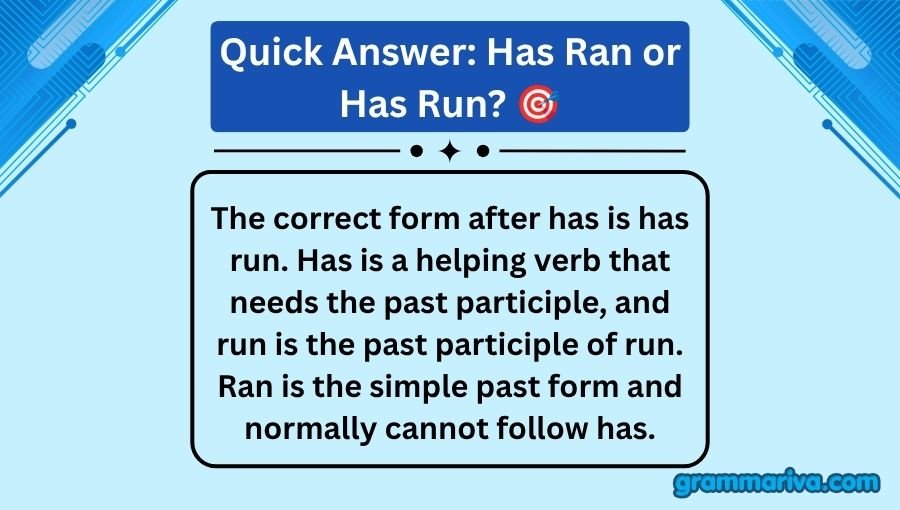
The correct form after has is has run. Has is a helping verb that needs the past participle, and run is the past participle of run. Ran is the simple past form and normally cannot follow has.
- ✅ She has run five miles today.
- ❌ She has ran five miles today.
The easiest rule to remember is:
Has + past participle = has run
So, when choosing between has ran or has run, choose has run when the sentence contains has.
What Are the Forms of “Run”? 📝
The verb run is irregular. Its main forms do not follow the usual pattern of adding -ed.
| Form | Type | Example |
|---|---|---|
| run | Base form | I run every morning. |
| runs | Present form for he/she/it | She runs every morning. |
| ran | Simple past | She ran yesterday. |
| run | Past participle | She has run today. |
| running | Present participle | She is running now. |
This is why the pair can feel confusing. The past form is ran, but the past participle goes back to run.
Why Is “Ran” Different From “Run”?
Ran tells us that an action happened in the past. It can stand as the main verb in a simple past sentence.
Run is used as the past participle after helping verbs such as has, have, and had.
Compare these:
- ✅ Marcus ran to the store yesterday.
- ❌ Marcus has ran to the store yesterday.
The first sentence uses simple past. The second sentence tries to use ran after has, which is not the standard form.
Has Ran or Has Run at a Glance 📊
The key difference is grammatical form. Ran is simple past, while run is the past participle used with has, have, or had.
| Form | Type | Meaning | Example | Correct/Incorrect |
|---|---|---|---|---|
| ran | Simple past | Action happened in the past | She ran yesterday. | ✅ Correct |
| run | Past participle | Used with a helping verb | She has run today. | ✅ Correct |
| has ran | Has + simple past | Incorrect verb combination | She has ran today. | ❌ Incorrect |
| has run | Has + past participle | Present perfect | She has run today. | ✅ Correct |
| is running | Present progressive | Action happening now | She is running now. | ✅ Correct |
A useful way to think about it is that has creates a job for the next verb. That next verb needs to be the past participle.
Why Is “Has Run” Correct? 💡
Has run is correct because run is the past participle of the verb run. The word has is a helping verb used to form the present perfect tense.
The structure is:
Subject + has + past participle
For example:
She + has + run.
The sentence means that she completed or experienced the action at a time connected to the present.
Present Perfect With “Run”
The present perfect often describes an action that happened before now without focusing on a finished past time.
Examples:
- ✅ He has run three races this year.
- ✅ My dog has run away again.
- ✅ The machine has run for six hours.
- ✅ She has run this route many times.
Notice the pattern in each sentence:
has + run
That pattern is the main reason has run is correct.
Why “Has Ran” Does Not Work
Has ran combines has with the simple past form ran. Standard English does not use that combination.
Think of these forms as separate jobs:
- ran = simple past
- run = past participle
So:
- ✅ He ran yesterday.
- ✅ He has run today.
- ❌ He has ran today.
Test Tip 💡
When you are unsure, remove has and check the tense.
Ask yourself:
Am I describing a finished past action with no helping verb?
If yes, ran may be right.
Am I using has, have, or had before the verb?
If yes, use run.
| Meaning | Word Type | Example Sentence |
|---|---|---|
| Finished past action | Simple past | Tom ran home. |
| Past action linked to now | Past participle | Tom has run home. |
| Past action before another past action | Past participle | Tom had run home. |
When Should You Use “Ran”? ⏰
Use ran when you need the simple past form of run. It usually describes an action that happened at a specific finished time in the past.
Examples:
- ✅ I ran five miles yesterday.
- ✅ She ran to catch the bus this morning.
- ✅ We ran around the park last Saturday.
- ❌ I has ran five miles yesterday.
- ❌ She has ran to catch the bus yesterday.
Words such as yesterday, last night, last week, and two days ago often point toward simple past.
That does not mean every sentence with a past-time idea uses ran, but these time words are strong clues.
When Should You Use “Run” After “Has”? ⏳
Use run after has when you are forming the present perfect tense.
The basic pattern is:
has + run
Examples:
- ✅ He has run every morning this week.
- ✅ The engine has run all day.
- ✅ She has run three successful races this season.
- ❌ He has ran every morning this week.
- ❌ The engine has ran all day.
The difference is not about the meaning of run itself. It is about the verb form required by the grammar.
Why Do People Confuse Ran and Run? 🤔
People often confuse ran and run because they are both forms of the same irregular verb. The forms are also different from regular verbs such as walk, which becomes walked in both the simple past and past participle.
For example:
- walk → walked → walked
- play → played → played
- run → ran → run
That unusual pattern makes run harder to remember.
I once caught myself typing a sentence with the wrong form while editing quickly. I had written the sentence by sound instead of checking the helper verb. The fix took one second: I saw has, changed ran to run, and moved on.
| Similar Confusion | Common Error | Correct Pattern |
|---|---|---|
| it’s / its | Mixing possession and contraction | its = possession |
| your / you’re | Mixing possession and contraction | you’re = you are |
| their / they’re | Mixing possession and contraction | they’re = they are |
| was / were | Choosing the wrong past form | Depends on subject |
| ran / run | Mixing simple past and past participle | has run / ran |
The best solution is not to memorize random sentences. Learn the verb forms and the job each form does.
Has Run in Everyday Grammar 🗣️
In everyday speech, has run can describe exercise, machines, events, businesses, animals, and many other actions.
Consider these examples:
- My brother has run five miles today.
- The washing machine has run twice.
- The dog has run into the yard.
- The store has run out of milk.
- The program has run without errors.
In each example, has is followed by run.
This rule stays the same even when the subject or meaning changes.
Has Run in Professional Writing 💼
Professional writing often requires careful grammar because small mistakes can make a message look rushed.
Imagine an employee writing:
❌ The report has ran through three reviews.
A better version is:
✅ The report has run through three reviews.
Here is another example:
❌ The system has ran for eight hours without a problem.
Correct:
✅ The system has run for eight hours without a problem.
I once edited a short workplace note where the writer had used has ran several times. The meaning was clear, but the repeated error made the note look less polished. We corrected the verb forms, and the message immediately looked cleaner.
Case Study: A Real-World Email Example 📧
Imagine a manager sends this email:
The new software has ran successfully since Monday.
The reader can understand the meaning, but the verb form is wrong.
A corrected version is:
The new software has run successfully since Monday.
Why?
The sentence uses has, so the next verb needs its past participle form.
has + run
Now imagine a different email:
The new software ran successfully during yesterday’s test.
This sentence is also correct because it uses the simple past form ran without has.
| Situation | Original | Better Version |
|---|---|---|
| Present perfect | The system has ran well. | The system has run well. |
| Simple past | The system ran well yesterday. | The system ran well yesterday. |
| Present progressive | The system is ran now. | The system is running now. |
| Past perfect | The system had ran well. | The system had run well. |
The key is to look at the helping verb before choosing the form.
Grammar Rules Explanation 📚
The grammar rule is simple: has is followed by a past participle when forming the present perfect tense. For run, the past participle is run, not ran.
The main forms are:
run → ran → run
The first run is the base form.
The second form, ran, is the simple past.
The third form, run, is the past participle.
The present perfect uses:
has/have + past participle
So we get:
- has run
- have run
The past perfect uses:
had + past participle
So we get:
- had run
The simple past does not need has, have, or had.
So we get:
- ran
Most standard English reference sources agree on this basic verb pattern. The rule is not a matter of style. In standard grammar, has run is the correct form.
Correct vs Incorrect at a Glance
| Sentence | Correct/Incorrect | Why |
|---|---|---|
| She has run five miles. | ✅ Correct | Has is followed by the past participle. |
| She has ran five miles. | ❌ Incorrect | Ran is the simple past form. |
| She ran five miles yesterday. | ✅ Correct | Ran is the simple past. |
| She had run five miles before lunch. | ✅ Correct | Had is followed by the past participle. |
| She had ran five miles before lunch. | ❌ Incorrect | Had needs the past participle, run. |
How Do Has, Have, and Had Work With Run? 🔎
The same basic rule applies to has, have, and had. Each can be followed by run when the sentence needs the past participle.
Examples:
- ✅ She has run the race.
- ✅ They have run the race.
- ✅ She had run the race before noon.
The subject changes the helping verb, but the participle stays run.
| Helping Verb | Correct Form | Example |
|---|---|---|
| has | has run | She has run today. |
| have | have run | They have run today. |
| had | had run | They had run before noon. |
| did | did run | She did run yesterday. |
| is | is running | She is running now. |
This table also shows why ran has a more limited role. It works as the simple past form, but it does not replace the past participle.
Common Mistakes With Has Ran and Has Run ⚠️
Most errors happen for a few simple reasons.
Fast Typing
When people type quickly, they often choose the form that sounds natural. This can lead to has ran.
Autocorrect
Autocorrect may not always catch grammar errors. Both ran and run are real English words, so spelling software may accept either one.
Lack of Knowledge
Some writers know that ran means past but have never learned that run is also the past participle.
Sound-Based Grammar
People sometimes write what sounds right in casual speech. Grammar, however, depends on the structure of the sentence.
| Mistake | Why It Happens | Better Habit |
|---|---|---|
| has ran | Fast typing | Check the word after has |
| have ran | Copying the same pattern | Use have run |
| had ran | Treating ran as every past form | Use had run |
| ran after has | Confusing past and participle | Learn the three main forms |
| running after has | Mixing progressive and perfect forms | Check the tense structure |
Specific Wrong Forms to Avoid
| Wrong Form | What’s Wrong | Correct Form |
|---|---|---|
| has ran | Simple past follows has | has run |
| have ran | Simple past follows have | have run |
| had ran | Simple past follows had | had run |
| has runned | Incorrect regular-style form | has run |
| have runned | Incorrect past participle | have run |
| had runned | Incorrect past participle | had run |
The form runned is especially easy to reject once you remember that run is an irregular verb.
Does “Run” Always Follow “Has”? 🧠
No. Run follows has when the sentence uses the past participle form of run. But has can also be followed by other types of words.
For example:
- She has finished.
- He has eaten.
- The team has won.
- The dog has run away.
The key point is not that has always means run comes next. The point is that when run is the main verb after has, the correct form is run.
How Is “Has Run” Used in Different Contexts? 🌎
The form has run works in many kinds of writing. The grammar does not change based on the setting.
| Context | Which Term to Use | Example |
|---|---|---|
| Everyday conversation | has run | My dog has run outside. |
| Professional writing | has run | The test has run successfully. |
| Creative writing | has run | The fox has run into the woods. |
| Social media/texting | has run | She has run her first marathon! |
Casual writing may ignore some grammar rules, but has run remains the standard form when the writer wants correct English.
Common Phrases With Run 🏃
The verb run appears in many common phrases. Some use the base form, some use ran, and some use run as a participle.
| Phrase | Meaning |
|---|---|
| run out of | Have no more of something |
| run away | Leave or escape |
| run into | Meet unexpectedly or move into something |
| run late | Be behind schedule |
| run a business | Manage a business |
| run a test | Perform a test |
Notice that the form changes depending on the grammar:
- She ran out of time.
- She has run out of time.
- The company has run several tests.
The phrase may stay recognizable while the verb form changes.
Can “Has Run” Mean Something Is Still Happening? ⏱️
Sometimes, yes. The present perfect does not always mean the action is completely finished in the sense that it can no longer continue. The exact meaning depends on the sentence.
For example:
The machine has run for six hours.
This tells us about the amount of time the machine has operated up to now.
Compare it with:
The machine ran for six hours yesterday.
The second sentence places the action in a finished past period.
| Sentence | Main Focus |
|---|---|
| The machine has run for six hours. | Time connected to now |
| The machine ran for six hours yesterday. | Finished past time |
| The machine is running now. | Action happening now |
| The machine had run for six hours before noon. | Earlier past action |
Has Ran or Has Run in Questions? ❓
The rule stays the same in questions. If has is used with run, the correct participle is still run.
Examples:
- ✅ Has she run today?
- ❌ Has she ran today?
- ✅ Has the machine run long enough?
- ❌ Has the machine ran long enough?
The question structure may move has to the beginning, but that does not change the form of the main verb.
The same applies to short answers:
- Yes, she has run today.
- No, she has not run today.
Has Ran or Has Run in Negative Sentences? 🚫
Negative sentences follow the same rule.
Examples:
- ✅ She has not run today.
- ❌ She has not ran today.
- ✅ The system has not run correctly.
- ❌ The system has not ran correctly.
The word not does not change the verb form.
The structure is:
has + not + past participle
So:
has + not + run
This is another useful test. If you see has not, you should still expect run, not ran.
What About “Had Run” and “Had Ran”? 🔄
The correct form is had run.
This is because had also needs the past participle when forming the past perfect.
- ✅ She had run home before the rain started.
- ❌ She had ran home before the rain started.
The same three-form pattern works again:
run → ran → run
That makes this rule easier to remember. If you see has, have, or had, think run.
If there is no such helping verb and you need simple past, think ran.
How Can You Remember the Difference? 🧩
Use this short memory trick:
Yesterday = ran. Has or had = run.
Examples:
- She ran yesterday.
- She has run today.
- She had run before lunch.
Another trick is to memorize the three forms together:
Run, ran, run.
Say it out loud a few times. The repeated first and third forms are unusual, so they are worth memorizing.
I teach irregular verbs by grouping them into patterns. Run, ran, run is a small pattern that becomes easy once you see it often.
Synonyms and Alternatives for Run ✨
Sometimes you can replace run with another verb. However, the replacement depends on the intended meaning.
| Alternative | Works When | Does Not Work When |
|---|---|---|
| jog | Someone runs slowly for exercise | The meaning is operating a machine |
| sprint | Someone runs very fast | The action is a long steady run |
| operate | A machine or system is working | A person is physically running |
| manage | Someone controls a business | The meaning is physical movement |
| travel | Someone moves from one place to another | The exact meaning is running |
For example:
The machine has run for three hours.
You might say:
The machine has operated for three hours.
But you cannot always replace run with jog or sprint because the meaning changes.
Why Does Getting the Form Right Matter? 🎯
Correct verb forms make your writing clear and professional. A single error may not block understanding, but repeated errors can distract readers.
| Situation | Why Getting It Right Matters |
|---|---|
| Resume | Shows careful writing |
| Client email | Builds a professional impression |
| Published content | Improves grammar and trust |
| Social post | Keeps the message polished |
A useful rule is:
Clear grammar makes your meaning easier to trust.
You do not need complicated grammar to write well. You need the right form in the right place.
Quick Recap Checklist ✅
Use this checklist whenever you are unsure.
| Question | If Yes → Use |
|---|---|
| Does the sentence use has before the verb? | run |
| Does it use have before the verb? | run |
| Does it use had before the verb? | run |
| Is it a simple past action with no perfect helper? | ran |
| Is the action happening right now? | running |
Practice Examples
- She ___ five miles yesterday.
- Answer: ran
- ✅ She ran five miles yesterday.
- She has ___ five miles today.
- Answer: run
- ✅ She has run five miles today.
- She had ___ five miles before lunch.
- Answer: run
- ✅ She had run five miles before lunch.
The pattern is now clear:
ran = simple past
run = past participle
FAQs About Ran vs Run ❓
Is “has ran” grammatically correct?
No. In standard English, has ran is incorrect. The correct form is has run because has is followed by the past participle.
Is “has run” correct?
Yes. Has run is the correct present perfect form of the verb run.
Example:
She has run three miles today.
Should I say “she ran” or “she has run”?
Use she ran for simple past actions. Use she has run when using the present perfect.
- She ran yesterday.
- She has run today.
Why is “ran” wrong after “has”?
Ran is the simple past form. After has, the present perfect requires the past participle. The past participle of run is run.
Is “had ran” correct?
No. The standard form is had run.
Example:
- ❌ He had ran home.
- ✅ He had run home.
Is “have ran” correct?
No. The correct form is have run.
Example:
- ❌ They have ran five miles.
- ✅ They have run five miles.
What are the three forms of run?
The main forms are:
run → ran → run
The first is the base form. The second is the simple past. The third is the past participle.
Is “runned” a word?
Runned is not the standard past form or past participle of run. Use ran for simple past and run after has, have, or had.
Which is correct: “has ran out” or “has run out”?
The correct phrase is has run out.
Example:
The store has run out of milk.
How can I remember “has run” quickly?
Remember this simple pattern:
Has, have, or had → run.
For simple past without those helping verbs:
ran.
Conclusion: Has Ran or Has Run? 🌟
Has ran or has run becomes easy once you remember one simple rule: has + past participle = has run. The word ran is the simple past form, so it belongs in sentences such as She ran yesterday. The word run is the past participle, so it belongs after has, have, and had.
When I check my own writing, I look for the helping verb first. If I see has, have, or had, I immediately check whether the next verb needs its past participle. For run, that form is run.
Keep the three forms together in your mind:
run → ran → run
That tiny pattern can prevent a very common grammar mistake. Whether you are writing an email, school assignment, article, report, or social post, choosing the right verb form makes your writing cleaner and easier to trust. ✍️
Remember: yesterday means ran, but has, have, and had mean run. Get that pattern right, and you will never have to guess again. 🚀

Hi, I’m Madison Hayes. I’m an English learning writer at Grammariva, where I work on simple lessons and examples for people who want to improve their grammar and writing. I love turning confusing rules into easy-to-follow explanations.



[…] examples, memory tricks, and FAQs. By the end, you should know exactly when to use each word. 😊 Has Ran or Has Run | Paid vs Payed | Coach vs […]
[…] how to remember the difference, and how to avoid the most common mistakes. Affirm vs Confirm | Has Ran or Has Run | Paid vs […]