Have you ever paused while writing an email and wondered whether you should say affirm vs confirm? You are not alone. These two verbs can look very similar because both can show that something is true, accepted, or agreed upon. Yet they do not always mean the same thing. The key is to look at what you are doing with the information. When you affirm something, you usually state or support that it is true, valid, or accepted. When you confirm something, you usually verify that it is true, correct, or settled.
I teach grammar and editing, and I often see these words mixed up in workplace emails. The mistake is easy to make because both words can sound natural in the same sentence. ✍️
This guide explains the difference in plain US English. You will see clear definitions, examples, grammar rules, common mistakes, workplace examples, memory tricks, and FAQs. By the end, you should know exactly when to use each word. 😊 Has Ran or Has Run | Paid vs Payed | Coach vs Couch
Quick Answer: Affirm vs Confirm 🎯
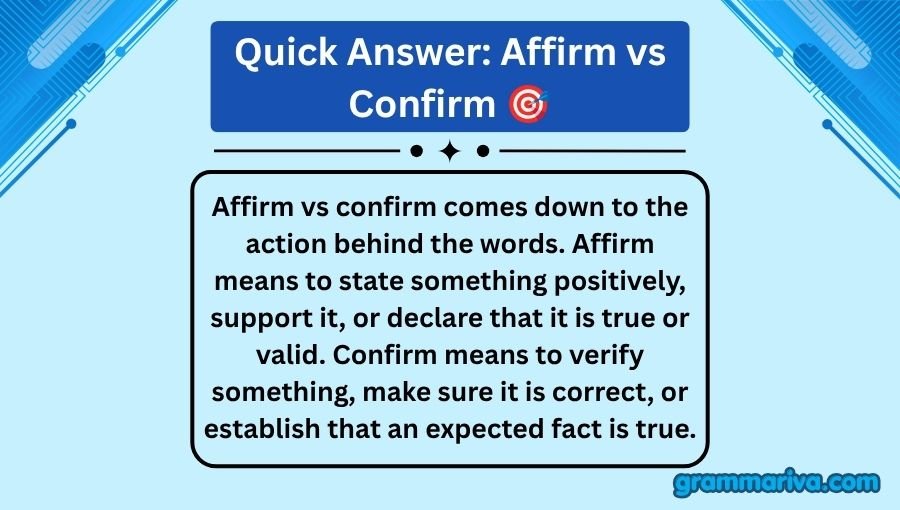
Affirm vs confirm comes down to the action behind the words. Affirm means to state something positively, support it, or declare that it is true or valid. Confirm means to verify something, make sure it is correct, or establish that an expected fact is true.
A simple memory trick is:
Affirm = state or support.
Confirm = verify or make certain.
For example:
- “She affirmed her commitment to the project.”
- “She confirmed the meeting time.”
The first sentence focuses on her positive statement or commitment. The second focuses on checking or establishing a fact.
Related Word Forms for Affirm and Confirm 🧩
Both words have several useful forms. Knowing these forms can make the difference easier to understand because the same basic idea appears in nouns, adjectives, and participles.
| Form | Type | Example |
|---|---|---|
| affirm | Verb | I affirm that the statement is true. |
| affirmed | Past-tense verb | He affirmed his decision. |
| affirming | Present participle | She is affirming her support. |
| affirmation | Noun | Her affirmation gave the team confidence. |
| confirm | Verb | Please confirm your appointment. |
| confirmed | Past-tense verb | They confirmed the booking. |
| confirming | Present participle | We are confirming the details. |
| confirmation | Noun | I received a confirmation email. |
The noun forms are especially common in professional writing. You may see affirmation when someone expresses support or validation. You may see confirmation when someone verifies or finalizes information.
Understanding Affirm vs Confirm at a Glance 📊
The basic difference is simple: affirm focuses on a positive statement, support, or declaration, while confirm focuses on verification or certainty.
| Form | Type | Meaning | Example | Correct/Incorrect |
|---|---|---|---|---|
| affirm | Verb | State or support as true or valid | She affirmed her support. | ✅ Correct |
| confirm | Verb | Verify or establish as true | Please confirm the date. | ✅ Correct |
| affirm | Verb | Verify a booking | Please affirm my reservation. | ❌ Usually incorrect |
| confirm | Verb | State personal support | He confirmed his loyalty. | ⚠️ Possible, but less natural |
| affirmation | Noun | Positive statement or support | Her affirmation helped me. | ✅ Correct |
The words can overlap, but they are not interchangeable in every sentence.
If you are checking information, choose confirm.
If you are making a positive statement or showing support, choose affirm.
Is Affirm the Same as Confirm? 🤔
No. Affirm and confirm are related, but they describe different actions.
To affirm something is to state it positively or support its truth, validity, or importance. To confirm something is to check it, verify it, or establish that it is correct.
Consider these examples:
“The witness affirmed his statement.”
The witness stood by what he had said.
“The witness confirmed his statement.”
The witness verified that the statement was accurate.
Both sentences can work, but the focus changes. Affirm highlights the act of standing by or declaring something. Confirm highlights verification.
Here is another pair:
- “I affirm that I support the plan.” ✅
- “I confirm that I support the plan.” ✅
Both are grammatically possible. The first sounds more like a formal declaration. The second sounds more like a verification of information.
Why Do People Confuse Affirm and Confirm? 💡
People confuse these words because both can be connected with truth, agreement, and certainty. They also appear in formal settings, such as meetings, legal documents, emails, forms, and official statements.
There is another reason. In casual speech, we often use simple words like yes, agree, verify, or check. When we switch to formal English, affirm and confirm can seem interchangeable.
I once edited a short business email that said, “Please affirm your attendance by Friday.” The writer wanted the reader to tell the organizer whether they would attend. Confirm was the more natural choice because the email was asking the reader to verify attendance.
A useful question can help:
Am I supporting or declaring something, or am I checking whether something is true?
If you are supporting or declaring, affirm may fit.
If you are checking or verifying, confirm usually fits.
| Situation | Better Word | Why |
|---|---|---|
| Showing support | affirm | It emphasizes support or agreement. |
| Verifying a date | confirm | It emphasizes checking information. |
| Declaring that something is true | affirm | It can express a firm statement. |
| Checking an appointment | confirm | It establishes the appointment details. |
| Verifying a reservation | confirm | It makes sure the reservation exists. |
Affirm: Meaning and Correct Use 📝
Understanding affirm vs confirm starts with knowing that affirm focuses on stating, supporting, or declaring something clearly. Affirm means to state something firmly, support something, or declare that something is true or valid.
It is often used when a person stands behind an idea, belief, decision, statement, or commitment.
Affirm as a Positive Statement
When you affirm something, you make a clear and positive statement about it.
- “She affirmed that she was ready.” ✅
- “She affirmed her commitment to the team.” ✅
In the first example, she clearly stated that she was ready.
In the second, she expressed firm support for her commitment.
Affirm as Support
Affirm can also mean to support or reinforce an idea.
- “The results affirmed our concerns.” ✅
- “His actions affirmed his belief in the project.” ✅
Here, the word does not simply mean “check.” It means that something provided support for an existing belief or position.
Affirm in Formal Settings
You may see affirm in formal, legal, religious, academic, or professional language.
For example:
- “The court affirmed the lower court’s decision.” ✅
- “The employee affirmed that the information was accurate.” ✅
This use is more formal than everyday expressions such as “agree” or “say yes.”
Affirm Meaning Summary
| Meaning | Word Type | Example Sentence |
|---|---|---|
| State positively | Verb | She affirmed the statement. |
| Support | Verb | The evidence affirmed his view. |
| Declare as true | Verb | He affirmed that the report was accurate. |
| Reinforce a belief | Verb | The result affirmed our decision. |
Test Tip 💡
Ask yourself:
“Am I standing behind a statement, belief, decision, or position?”
If yes, affirm may be the right choice.
For example:
“I ___ my support for the proposal.”
The natural answer is affirm because the sentence focuses on support.
Confirm: Meaning and Correct Use 🔎
n affirm vs confirm, confirm is the better choice when your main goal is to verify information or make sure something is correct. Confirm means to verify something, establish that something is true, or make sure that an arrangement or detail is correct.
It is very common in everyday and professional English.
Confirm Information
Use confirm when you want to verify a fact.
- “Please confirm your address.” ✅
- “Can you confirm the delivery date?” ✅
The goal is to make sure the information is correct.
Confirm Plans
You can also confirm plans, appointments, reservations, and arrangements.
- “Please confirm your appointment.” ✅
- “I called to confirm the meeting.” ✅
This is one of the most common uses of confirm.
Confirm a Fact
Confirm can mean to establish that something expected or suspected is true.
- “The test confirmed the diagnosis.” ✅
- “The investigation confirmed the report.” ✅
The focus is on verification.
Confirm Meaning Summary
| Meaning | Word Type | Example Sentence |
|---|---|---|
| Verify information | Verb | Please confirm the address. |
| Verify a plan | Verb | We confirmed the meeting. |
| Establish truth | Verb | The evidence confirmed the claim. |
| Make certain | Verb | Please confirm your attendance. |
Test Tip 💡
Ask:
“Am I checking to make sure something is correct?”
If yes, confirm is usually the better choice.
For example:
“Please ___ your flight details.”
The natural answer is confirm because you are asking someone to verify information.
When Should You Use Affirm Instead of Confirm? 🎯
Use affirm when the main idea is a positive declaration, support, or firm statement. Use confirm when the main idea is verification or certainty.
The easiest contrast is:
Affirm: “I stand by this.”
Confirm: “I checked this, and it is correct.”
Here are several examples:
- “The manager affirmed her support for the new policy.” ✅
- “The manager confirmed the meeting time.” ✅
- “The witness affirmed his statement.” ✅
- “The witness confirmed the details.” ✅
A useful rule is to focus on the speaker’s purpose rather than the subject of the sentence.
Someone can affirm a decision.
Someone can confirm a decision.
But the meaning is slightly different.
Affirm a decision suggests publicly or firmly supporting the decision.
Confirm a decision suggests verifying or establishing what the decision is.
| Purpose | Natural Choice | Example |
|---|---|---|
| Express support | Affirm | She affirmed her support. |
| Declare a position | Affirm | He affirmed his position. |
| Verify a detail | Confirm | She confirmed the date. |
| Verify an arrangement | Confirm | He confirmed the booking. |
| Establish a fact | Confirm | The evidence confirmed the claim. |
Can You Use Affirm and Confirm in the Same Sentence? 🔄
Yes. In some sentences, both words can appear because they describe different actions.
For example:
“The director affirmed her support and confirmed the final schedule.” ✅
Here, affirmed describes support, while confirmed describes the schedule.
Another example:
“He affirmed that he would attend and confirmed the meeting time.” ✅
The first verb focuses on his statement. The second focuses on verified information.
This is a good way to see why the words are related but not identical.
A Workplace Case Study: Affirm vs Confirm 📧
Imagine that a manager sends this email:
“Please confirm your attendance at Friday’s training session.”
The manager wants employees to verify whether they will attend. Confirm is the natural choice.
Now imagine the manager writes:
“The team leader affirmed her support for the training program.”
Here, the sentence describes a clear expression of support. Affirm works well.
I once caught myself typing “affirm” in a message about a scheduled call. I stopped and asked what I actually wanted the reader to do. I wanted the person to verify the time, so I changed it to “confirm.” That small edit made the request much clearer.
| Workplace Situation | Best Word | Example |
|---|---|---|
| Asking about attendance | Confirm | Please confirm your attendance. |
| Asking about a meeting time | Confirm | Please confirm the meeting time. |
| Showing support for a plan | Affirm | She affirmed her support. |
| Declaring a commitment | Affirm | He affirmed his commitment. |
| Checking a document detail | Confirm | Please confirm the details. |
Grammar Rules Explanation 📚
The main grammar rule is based on meaning, not spelling. Both affirm and confirm are verbs, and both can take an object or a clause depending on the sentence.
Affirm commonly takes a noun phrase or a clause:
- “She affirmed her commitment.”
- “He affirmed that the statement was true.”
Confirm can also take a noun phrase or a clause:
- “She confirmed the appointment.”
- “He confirmed that the information was correct.”
The difference is semantic. Affirm presents or supports something as true, valid, or worthy of support. Confirm verifies or establishes something as true, correct, or settled.
Standard English references treat the words as separate verbs with overlapping but distinct uses. The safest approach is to select the word based on the action you mean.
Correct vs Incorrect at a Glance
| Sentence | Correct/Incorrect | Why |
|---|---|---|
| Please confirm the appointment. | ✅ Correct | The appointment needs verification. |
| She affirmed her support. | ✅ Correct | The sentence expresses support. |
| Please affirm the appointment time. | ❌ Usually incorrect | “Confirm” is more natural for checking a time. |
| He confirmed his commitment to the cause. | ⚠️ Possible | It can mean he verified or stated the commitment, but “affirmed” may better stress support. |
| The evidence confirmed the report. | ✅ Correct | The evidence verified the report. |
The important point is that not every alternative is strictly ungrammatical. Sometimes both verbs can be grammatically possible while one is more natural for the intended meaning.
Common Mistakes With Affirm and Confirm ⚠️
Most mistakes happen because writers focus on the idea of “yes” instead of the purpose of the sentence.
If someone says yes to a meeting invitation, you might confirm the meeting.
If someone says yes to a belief or position, they might affirm it.
I once reviewed a student’s essay where “affirm” appeared several times whenever the writer meant “verify.” The sentences were understandable, but they sounded too formal and slightly off. We replaced several uses with “confirm,” and the essay became much more natural.
Similar Grammar Confusions
| Confusion | Correct Difference |
|---|---|
| it’s / its | “It’s” means “it is”; “its” shows possession. |
| your / you’re | “Your” shows possession; “you’re” means “you are.” |
| accept / except | “Accept” means receive or agree; “except” means excluding. |
| affect / effect | “Affect” is usually a verb; “effect” is usually a noun. |
| affirm / confirm | “Affirm” emphasizes support or declaration; “confirm” emphasizes verification. |
Common causes include:
- Fast typing: You may choose the first similar word that comes to mind.
- Autocorrect: Software may suggest a word that looks close but changes the meaning.
- Lack of knowledge: Learners may know both words but not the difference in purpose.
- Formal writing pressure: Writers sometimes choose a more formal word when a simple word would be clearer.
Specific Wrong Forms and Uses
| Wrong Form | What’s Wrong | Correct Form |
|---|---|---|
| Please affirm my appointment. | Verification is intended. | Please confirm my appointment. |
| Confirm your support for the cause. | Possible, but it may not stress support clearly. | Affirm your support for the cause. |
| She confirmation the date. | “Confirmation” is a noun. | She confirmed the date. |
| He affirmation his decision. | “Affirmation” is a noun. | He affirmed his decision. |
| Please affirm the booking details. | “Confirm” is more natural for checking details. | Please confirm the booking details. |
| She confirmed her support. | Grammatically possible, but context may favor “affirmed.” | She affirmed her support. |
How Do Affirm and Confirm Work in Different Contexts? 🌎
The best word can depend on the situation. Affirm vs confirm can change depending on the context. Confirm is especially common when information needs to be checked. Affirm is more common when someone expresses support, agreement, or a firm position.
| Context | Which Term to Use | Example |
|---|---|---|
| Everyday conversation | Usually confirm for facts or plans | Can you confirm the time? |
| Professional writing | Confirm for details; affirm for formal support | The director affirmed her support. |
| Creative writing | Either, depending on meaning | He affirmed his belief. |
| Social media/texting | Confirm for plans; affirm for support | Confirm you’re coming! |
In casual messages, confirm is usually more common because people often use it for plans and details.
In formal writing, affirm may appear when a person is making a strong declaration or expressing support.
Common Phrases With Affirm and Confirm 💬
Both words appear in several common combinations. Learning these phrases can make your writing sound more natural.
| Phrase | Meaning |
|---|---|
| affirm your commitment | State or show strong commitment |
| affirm your support | Clearly express support |
| affirm a decision | Stand firmly behind a decision |
| confirm your attendance | Verify that you will attend |
| confirm the details | Check that information is correct |
| confirm an appointment | Verify a scheduled appointment |
Notice the difference between affirm your support and confirm your attendance. The first is about expressing a position. The second is about verifying an arrangement.
Synonyms and Alternatives 🔤
You do not always need either word. Sometimes a simpler alternative communicates your meaning better.
| Alternative | Works When | Does Not Work When |
|---|---|---|
| verify | You need to check facts or details | You want to express personal support |
| state | You want to clearly say something | You specifically mean verification |
| support | You want to show agreement or backing | You need to check whether information is true |
| agree | You want to express agreement | You need to verify an appointment |
| validate | You want to show that something is accepted or supported | You simply need to confirm a time or date |
For example, instead of “I affirm my support,” you could say “I support the plan.” That is often simpler.
Instead of “Please affirm the appointment,” say “Please confirm the appointment.”
Clear writing is usually better than overly formal writing.
How To Remember the Difference 🧠
Remembering affirm vs confirm is easy when you connect each word with its main purpose. Use this simple two-word memory trick:
AFFIRM = ASSERT or SUPPORT
CONFIRM = CHECK or VERIFY
Think about a meeting.
You confirm the meeting time.
You affirm your support for the meeting plan.
Think about a personal belief.
You affirm your belief.
Think about a reservation.
You confirm your reservation.
| Question to Ask | If Yes → Use |
|---|---|
| Am I expressing support? | Affirm |
| Am I making a firm declaration? | Affirm |
| Am I checking information? | Confirm |
| Am I verifying a plan? | Confirm |
| Am I establishing that something is true? | Confirm |
Practice Examples ✏️
- “Please ___ your email address.”
Answer: confirm ✅ - “The board ___ its support for the proposal.”
Answer: affirmed ✅ - “Can you ___ the appointment time?”
Answer: confirm ✅
These examples work because the purpose of each sentence is different.
Why It Matters: Affirm vs Confirm in Clear Writing 🎯
Using the right verb helps your reader understand what action you mean. A small word choice can change whether a sentence sounds like a request for verification or a statement of support.
“Clear words make clear ideas easier to act on.”
That principle is especially useful in professional communication.
| Situation | Why Getting It Right Matters |
|---|---|
| Resume | Precise wording makes your writing sound polished. |
| Client email | Clear requests reduce confusion. |
| Published content | Accurate word choice improves trust. |
| Social post | Natural wording makes the message easier to understand. |
Imagine receiving an email that says, “Please affirm your reservation.” You may understand it, but “Please confirm your reservation” is much more natural.
Good writing is not always about using the most formal word. It is about choosing the word that gives the reader the clearest meaning.
Are Affirm and Confirm Interchangeable? 🔍
Affirm vs confirm is not simply a choice between two interchangeable verbs. They can overlap in some contexts, but they usually emphasize different actions. Affirm is best when the idea involves declaring, supporting, or standing behind something. Confirm is best when the idea involves checking, verifying, or establishing something.
For example:
- “The manager affirmed her support for the plan.” ✅
- “The manager confirmed the meeting date.” ✅
Changing the verbs can change the focus:
- “The manager confirmed her support.”
- “The manager affirmed the meeting date.”
These are not impossible sentences, but they may not express the intended idea as naturally.
What Is the Difference Between Affirmation and Confirmation? 📝
Affirmation is the noun related to affirm. It usually refers to a positive statement, declaration, or expression of support.
Confirmation is the noun related to confirm. It usually refers to verification or proof that something is correct, true, or arranged.
Compare:
“Her affirmation gave me confidence.”
This focuses on her positive statement or support.
“I received confirmation of my appointment.”
This focuses on verification of the appointment.
| Noun | Main Idea | Example |
|---|---|---|
| affirmation | Positive statement or support | His affirmation encouraged us. |
| confirmation | Verification or proof | We received confirmation. |
| affirmation | Expression of belief or commitment | Her affirmation was clear. |
| confirmation | Establishment of a fact or arrangement | The email was a confirmation. |
When Does Confirm Sound More Natural? 📩
Confirm sounds more natural when the sentence involves dates, times, bookings, addresses, appointments, attendance, reservations, or other details.
Examples include:
- “Please confirm your address.” ✅
- “Please confirm the meeting time.” ✅
- “Can you confirm your attendance?” ✅
- “I called to confirm the reservation.” ✅
- “The company confirmed the order.” ✅
These examples all involve checking or establishing information.
If your reader needs to take an action that verifies a detail, confirm is usually the safest choice.
When Does Affirm Sound More Natural? 🗣️
Affirm sounds more natural when the sentence involves support, commitment, belief, a position, or a firm declaration.
Examples include:
- “She affirmed her commitment.” ✅
- “He affirmed his support for the team.” ✅
- “The leader affirmed the value of the project.” ✅
- “The statement affirmed their position.” ✅
- “She affirmed that the decision was final.” ✅
These sentences focus on a person or thing expressing, supporting, or reinforcing a position.
Quick Recap Checklist ✅
The fastest way to choose between these verbs is to ask what the sentence is doing.
| Question | If Yes → Use |
|---|---|
| Am I checking a fact? | Confirm |
| Am I verifying a date or time? | Confirm |
| Am I checking a reservation? | Confirm |
| Am I expressing support? | Affirm |
| Am I standing behind a position? | Affirm |
| Am I making a firm declaration? | Affirm |
Remember:
Check it → confirm it.
Support it → affirm it.
FAQs About Affirm vs Confirm ❓
What is the main difference between affirm and confirm?
Affirm means to state something positively, support it, or declare that it is true or valid. Confirm means to verify something, make sure it is correct, or establish that it is true. The words can overlap, but they emphasize different actions.
Is it correct to say “please affirm your attendance”?
It is understandable, but “please confirm your attendance” is usually more natural. Attendance is normally something a person verifies. Affirm would sound more formal and would emphasize a declaration rather than a simple confirmation.
Should I say “affirm or confirm the date”?
Use confirm when you mean checking or verifying the date. For example, “Please confirm the date of the meeting.” This tells the reader to make sure the date is correct.
Can you affirm a statement?
Yes. You can affirm a statement when you mean that someone states it firmly, supports it, or stands behind it. For example, “The witness affirmed his statement.”
Can you confirm a statement?
Yes. Confirm a statement can mean verify that the statement is accurate or true. The focus is on verification rather than simply expressing support.
Is “affirmation” the same as “confirmation”?
No. An affirmation is generally a positive statement, declaration, or expression of support. A confirmation is generally verification that something is true, correct, or arranged.
Is “confirm your support” correct?
Yes, it can be correct depending on the context. However, “affirm your support” often gives a stronger sense of openly expressing or declaring support. Confirm can suggest that the support is being verified.
Which word is better in a business email?
It depends on your purpose. Use confirm for meetings, dates, appointments, reservations, attendance, and details. Use affirm when someone is formally expressing support, commitment, or a position.
Is affirm more formal than confirm?
Often, affirm can sound more formal, especially when it is used for declarations, commitments, or positions. Confirm is common in both casual and professional English and is often the natural choice for checking information.
What is an easy way to remember affirm vs confirm?
Remember this pair: affirm = support or declare, while confirm = check or verify. If you are checking whether something is correct, choose confirm. If you are firmly supporting or stating something, choose affirm.
Conclusion 🌟
Affirm vs confirm becomes much easier when you focus on the purpose of the verb. Use affirm when you want to state something firmly, support an idea, or stand behind a belief, decision, commitment, or position. Use confirm when you want to verify information, check an arrangement, or establish that something is true or correct.
The easiest memory trick is simple: affirm means support or declare, while confirm means check or verify. ✨
When I edit a sentence, I ask one quick question: “Is the writer supporting something, or checking something?” That question usually makes the correct choice clear.
Use confirm for appointments, dates, reservations, details, and plans. Use affirm for support, commitments, positions, and firm statements.
Once you learn that small difference, your emails, essays, workplace messages, and everyday writing will sound more natural and precise. Keep the rule in mind, and these two verbs will no longer feel confusing. 📝
Check it, confirm it. Support it, affirm it.

Hi, I’m Nathan Reed. I’m a grammar and writing specialist at Grammariva. I work on practical grammar content that helps readers understand sentence structure, punctuation, vocabulary, and better writing habits.

[…] when to use each word, how to remember the difference, and how to avoid the most common mistakes. Affirm vs Confirm | Has Ran or Has Run | Paid vs […]
[…] each word works, and gives you simple rules for choosing the right form. Acception vs Exception | Affirm vs Confirm |Has Ran or Has […]
[…] In this guide, I will explain too vs to with simple rules, clear examples, useful tests, common mistakes, tables, and real-life situations. You will also learn how to avoid the error when writing quickly. By the end, you should be able to choose the correct word with confidence. ✨ Momma or Mama | Acception vs Exception | Affirm vs Confirm […]