Understanding fewer vs less is a common challenge in English grammar because both words describe a smaller number or amount, but they follow different rules. Even experienced writers sometimes mix up these two words. For example, should you say “fewer mistakes” or “less mistakes”? What about “less water” or “fewer water”? The answer depends on the type of noun you are talking about.
Understanding fewer vs less can make your everyday conversations, school assignments, emails, and professional writing much clearer. Although both words describe a smaller amount or number, they do not work in exactly the same way. Each has its own job in English grammar.
As an editor, I often see this small mistake in otherwise excellent writing. The good news is that the rule is easy to learn. Once you understand the difference between countable and uncountable nouns, choosing the right word becomes much easier. 😊
In this guide, I will explain the rules in simple US English. You will find clear examples, comparison tables, common mistakes, practical writing tips, and short exercises to help you use both words with confidence. Let’s make this grammar rule easy to remember! ✨Farther vs Further | Affect vs Effect | Performed vs Preformed
🎯 Quick Answer: Fewer vs Less
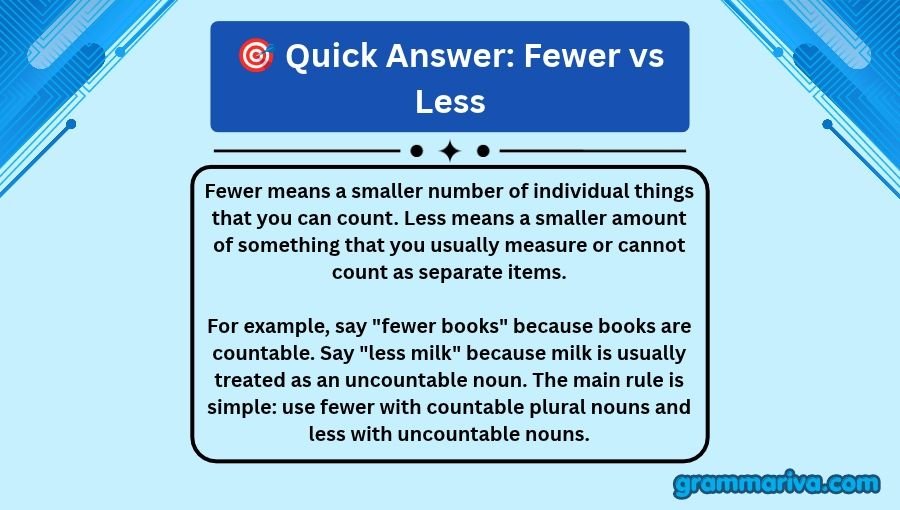
Fewer means a smaller number of individual things that you can count. Less means a smaller amount of something that you usually measure or cannot count as separate items.
For example, say “fewer books” because books are countable. Say “less milk” because milk is usually treated as an uncountable noun. The main rule is simple: use fewer with countable plural nouns and less with uncountable nouns.
Fewer vs Less: Understanding the Basics
The main difference between these words is the kind of noun that follows them. Fewer works with things that you can count one by one. Less works with things that you measure, weigh, or think oa whole amount.
Consider these examples:
- I have fewer pencils than you.
- I have less money than you.
In the first sentence, pencils are separate objects. You can count them: one pencil, two pencils, or three pencils.
In the second sentence, money is usually treated as a total amount. You can measure it in dollars, but you do not normally count the word money itself as individual items.
Fewer: Meaning and Correct Use
Fewer means a smaller number of people, objects, events, or other countable things. It is most often used before plural countable nouns.
Examples include:
- Fewer students attended the class.
- We need fewer chairs for the meeting.
- She made fewer spelling mistakes this time.
- There are fewer cars on the road today.
- I bought fewer apples than last week.
In each sentence, the noun refers to separate things that can be counted.
Sentence breakdown:
“Fewer students attended the class.”
- Fewer: Shows a smaller number.
- Students: A plural countable noun.
- Attended: Describes what the students did.
The sentence tells us that the number of students was smaller than before or smaller than expected.
Less: Meaning and Correct Use
Less means a smaller amount, degree, or quantity of something. It usually appears before uncountable nouns, measurements, and certain expressions.
Examples include:
- I need less sugar in my coffee.
- We have less time than yesterday.
- She drinks less milk now.
- This project requires less effort.
- He spent less money on groceries.
You cannot normally count sugar, time, milk, or effort as individual items. Instead, you measure or describe their amounts.
Sentence breakdown:
“I need less sugar in my coffee.”
- Less: Shows a smaller amount.
- Sugar: An uncountable noun.
- In my coffee: Explains where the sugar is used.
The sentence means that the speaker wants a smaller quantity of sugar.
Fewer vs Less Comparison Table
| Form | Type | Meaning | Example | Correct/Incorrect |
|---|---|---|---|---|
| Fewer | Determiner | Smaller number | Fewer people came. | ✅ Correct |
| Less | Determiner | Smaller amount | Less water is needed. | ✅ Correct |
| Fewer | Determiner | Used with countable nouns | Fewer books are available. | ✅ Correct |
| Less | Determiner | Used with uncountable nouns | Less rice is needed. | ✅ Correct |
| Less | Determiner | Used with ordinary plural countable nouns | Less books are available. | ❌ Incorrect in standard usage |
Why Do People Confuse Fewer and Less?
People confuse these words because both communicate the idea of having a smaller quantity. They can also appear in similar sentence patterns, which makes the difference less obvious.
For example:
- We have fewer customers today.
- We have less business today.
Both sentences describe a decrease, but customers are individual people, while business describes an overall amount of activity.
I once reviewed a student’s short essay about saving money. The student wrote, “I want to make less mistakes when I spend less money.” The second use was correct, but the first needed to be “fewer mistakes.” The student understood the general meaning but had not learned the countable noun rule.
This is why looking at the noun is more helpful than simply thinking about whether something is increasing or decreasing.
The Countable and Uncountable Noun Test
Ask yourself whether you can count the noun as separate items.
Countable nouns:
- Books
- Phones
- Children
- Questions
- Tickets
- Employees
- Mistakes
- Coins
Uncountable nouns:
- Water
- Air
- Information
- Advice
- Money
- Furniture
- Traffic
- Equipment
| Noun | Countable or Uncountable? | Correct Choice | Example |
|---|---|---|---|
| Apples | Countable | Fewer | Fewer apples |
| Water | Uncountable | Less | Less water |
| Students | Countable | Fewer | Fewer students |
| Information | Uncountable | Less | Less information |
| Cars | Countable | Fewer | Fewer cars |
| Furniture | Uncountable | Less | Less furniture |
💡 Test Tip: The Simple Counting Method
Here is an easy trick I recommend to students and new writers:
Try placing a number before the noun.
- One book, two books, three books. Use fewer books.
- One chair, two chairs, three chairs. Use fewer chairs.
- One liter of water, two liters of water. Use less water.
- One piece of advice, two pieces of advice. Use less advice.
If the noun can naturally be counted as separate items, fewer is usually the right choice. If it describes an amount or a whole substance, less is usually the better choice.
Correct Meanings and Uses of Fewer and Less
Both words have several common uses. Learning these patterns will help you understand sentences that go beyond basic examples.
Using Fewer With Plural Countable Nouns
Use fewer when you are talking about a smaller number of separate objects or people.
Examples:
- Our team has fewer players this season.
- I received fewer emails this morning.
- There are fewer seats in this room.
- We need fewer workers for this task.
The noun after fewer is usually plural because it refers to more than one countable item.
Using Less With Uncountable Nouns
Use less when the noun represents a quantity that is not normally counted as individual objects.
Examples:
- There is less noise outside today.
- I have less patience when I am tired.
- This recipe needs less flour.
- We need less information to complete the form.
These nouns describe amounts, conditions, or general concepts rather than separate countable items.
Using Less With Time, Money, Distance, and Measurement
Less is also common with measurements and amounts of time, money, distance, and weight.
Examples:
- The journey takes less than two hours.
- This bag weighs less than five pounds.
- The store is less than a mile away.
- I paid less than fifty dollars.
- She completed the task in less than ten minutes.
Notice that the numbers do not automatically require fewer. The complete expression matters.
For example, you can count dollars as individual units, but in “less than fifty dollars,” the phrase describes a total monetary amount.
Using Fewer and Less in Negative Comparisons
Both words can help compare two situations.
Examples:
- This year, fewer people visited the park.
- This year, we received less rain.
- My new job requires fewer meetings.
- My new job involves less stress.
The first and third sentences compare numbers. The second and fourth compare amounts or degrees.
Summary of Their Main Uses
| Meaning | Word Type | Example Sentence |
|---|---|---|
| Smaller number of objects | Fewer | We bought fewer toys. |
| Smaller number of people | Fewer | Fewer guests arrived. |
| Smaller amount of liquid | Less | Add less water. |
| Smaller amount of money | Less | I spent less money. |
| Shorter amount of time | Less | We have less time. |
| Lower degree of something | Less | She feels less stress. |
📝 Case Study: Fewer vs Less in a Workplace Email
Imagine that a manager is preparing an email for the team. The company wants to reduce waste, save money, and improve its daily work process.
Here is an incorrect version:
“Starting next month, we want less printed documents, less unnecessary meetings, and fewer paper waste. Please try to use less supplies and make less mistakes when completing reports.”
Although the message is understandable, several word choices are incorrect.
Here is the improved version:
“Starting next month, we want fewer printed documents, fewer unnecessary meetings, and less paper waste. Please try to use fewer supplies and make fewer mistakes when completing reports.”
Let’s examine the changes.
| Original Phrase | Correct Phrase | Reason |
|---|---|---|
| Less printed documents | Fewer printed documents | Documents are countable. |
| Less unnecessary meetings | Fewer unnecessary meetings | Meetings are countable. |
| Fewer paper waste | Less paper waste | Waste is uncountable here. |
| Less supplies | Fewer supplies | Supplies are countable. |
| Less mistakes | Fewer mistakes | Mistakes are countable. |
I once edited a workplace report that had a similar problem. The writer had used less before almost every plural noun. Instead of rewriting the entire report, I checked each noun and corrected the words one by one. The message became much clearer without changing its meaning.
The lesson is simple: good grammar does not always require complicated sentences. Sometimes, one small word makes a big difference.
Grammar Rules Explanation: Why One Word Is Correct
The grammar rule behind these words is based on countable and uncountable nouns.
A countable noun names something that can be counted as an individual unit. It can usually have a singular and plural form.
Examples include:
- One apple and two apples.
- One student and five students.
- One book and several books.
Fewer is used with plural countable nouns because it describes a smaller number of separate items.
An uncountable noun names a substance, quality, idea, or general quantity that is not usually counted as individual units.
Examples include:
- Water
- Happiness
- Knowledge
- Furniture
- Traffic
Less is used with these nouns because it describes a smaller amount or degree.
There is also an important point about the word that follows the comparison. Sometimes a noun can be countable in one sentence and uncountable in another, depending on its meaning.
For example:
- We ordered fewer coffees. (Individual cups of coffee.)
- We drank less coffee. (The overall amount of coffee.)
Both sentences are correct because the nouns are being used in different ways.
Standard English grammar references generally support the countable-versus-uncountable distinction. However, context and common expressions also affect how these words are used.
Correct vs Incorrect at a Glance
| Sentence | Correct/Incorrect | Why |
|---|---|---|
| I have fewer assignments today. | ✅ Correct | Assignments are countable. |
| She needs less help. | ✅ Correct | Help is uncountable. |
| There are less children here. | ❌ Incorrect | Use fewer with children. |
| We need fewer milk. | ❌ Incorrect | Milk is uncountable. |
| He has less experience now. | ✅ Correct | Experience is used as an uncountable noun. |
⚠️ Common Mistakes When Using Fewer and Less
Even people who understand the basic rule can make mistakes when writing quickly. These errors often happen because the words have similar meanings and appear in similar sentence patterns.
Here are some common reasons:
- Fast typing: People choose the first word that comes to mind without checking the noun.
- Autocorrect: A writing tool may not recognize a grammar mistake because both words are spelled correctly.
- Lack of knowledge: Some writers have never learned the difference between countable and uncountable nouns.
- Speaking habits: Everyday speech sometimes uses less with plural countable nouns, which can affect formal writing.
- Confusing sentence structure: A sentence may contain several nouns, making it easy to choose the wrong one.
Common Grammar Confusions
| Confused Words | Main Difference | Correct Example |
|---|---|---|
| It’s / Its | It’s means it is; its shows ownership. | It’s a beautiful day. |
| Your / You’re | Your shows ownership; you’re means you are. | You’re doing well. |
| There / Their | There shows a place; their shows ownership. | Their house is over there. |
| Then / Than | Then relates to time; than makes comparisons. | She is taller than me. |
| Fewer / Less | Fewer counts; less measures an amount. | Fewer bags, less luggage. |
Specific Wrong Uses and Their Corrections
| Wrong Form | What’s Wrong | Correct Form |
|---|---|---|
| Less books | Books are countable. | Fewer books |
| Fewer water | Water is uncountable. | Less water |
| Less students | Students are countable. | Fewer students |
| Fewer money | Money is uncountable in this use. | Less money |
| Less mistakes | Mistakes are countable. | Fewer mistakes |
| Fewer furniture | Furniture is uncountable. | Less furniture |
How to Avoid These Mistakes
Use these simple habits to improve your writing:
- Read the noun before choosing fewer or less.
- Check whether the noun refers to separate items or a total amount.
- Review your sentences before sending important emails.
- Do not depend completely on spelling and grammar tools.
- Practice with common countable and uncountable nouns.
I once caught myself typing “less customers” in a quick work message. The sentence looked fine at first because I was focused on the message rather than the grammar. A quick review helped me change it to “fewer customers.” Even experienced writers benefit from checking their work.
How to Use Fewer and Less in Different Contexts
The same grammar rule applies in conversations, professional documents, creative writing, and online messages. However, the level of formality may change.
Everyday Conversation
Use fewer and less naturally when talking with friends, family, or coworkers.
Examples:
- We have fewer guests this evening.
- I want less salt in my food.
- There are fewer buses on Sundays.
- I need less sleep when I am on vacation.
Professional Writing
In professional writing, correct word choice helps make your message clear and polished.
Examples:
- Our department received fewer applications this month.
- The new system requires less maintenance.
- We need fewer printed copies.
- This process takes less time.
Creative Writing
Writers can use these words to describe changes, emotions, and settings.
Examples:
- Fewer stars appeared in the cloudy sky.
- There was less hope in his voice.
- Fewer people remembered the old town.
- She carried less fear after hearing the truth.
Social Media and Texting
Short online messages still benefit from correct grammar. Using the right word can make captions, comments, and posts easier to read.
Examples:
- Fewer worries, more happy moments.
- Less stress, more smiles.
- Fewer excuses, more action.
- Less drama, more peace.
Usage Comparison Table
| Context | Which Term to Use | Example |
|---|---|---|
| Everyday conversation | Both, depending on the noun | Fewer guests, less food. |
| Professional writing | Both, depending on the noun | Fewer errors, less work. |
| Creative writing | Both, depending on the noun | Fewer stars, less light. |
| Social media/texting | Both, depending on the noun | Fewer worries, less stress. |
Common Phrases With Fewer and Less
Some expressions use these words so often that they are worth learning as complete phrases. Understanding them can make your writing sound more natural.
Here are several useful examples.
| Phrase | Meaning |
|---|---|
| Fewer and fewer | A number that keeps getting smaller. |
| Fewer and farther between | Events or things become less common. |
| Less is more | A simple approach can be better than an excessive one. |
| More or less | Approximately or almost. |
| No less than | At least a stated amount, often with emphasis. |
| Less than | A smaller amount or degree than something else. |
Examples in Sentences
- There are fewer and fewer places to park downtown.
- Good job opportunities have become fewer and farther between.
- When decorating a small room, remember that less is more.
- The trip will take more or less three hours.
- No less than fifty people attended the event.
- The package weighs less than ten pounds.
One useful detail is that “fewer and farther between” describes countable events or things that occur less often. It is a common expression that helps show a decrease in frequency.
Fewer vs Less: Synonyms and Alternatives
Sometimes, you may want to avoid repeating the same words. Several alternatives can express a smaller number or amount, but they do not always work in every sentence.
Choose a replacement based on the meaning you want to communicate.
| Alternative | Works When | Does Not Work When |
|---|---|---|
| A smaller number of | Talking about countable things. | Describing an uncountable amount. |
| A smaller amount of | Talking about substances or quantities. | Counting separate people or objects. |
| Not as many | Making an informal comparison between countable items. | Describing uncountable nouns. |
| Not as much | Making an informal comparison between amounts. | Describing separate countable items. |
| Reduced | Describing something that has been made smaller. | You need to specify a count or amount clearly. |
Examples of Alternative Words
A smaller number of:
- A smaller number of students joined the club.
- A smaller number of tickets are available.
A smaller amount of:
- Use a smaller amount of sugar.
- We need a smaller amount of water.
Not as many:
- We have not as many options as before.
A more natural version is: “We do not have as many options as before.”
Not as much:
- I do not have as much free time as you.
Reduced:
- The company reduced its monthly expenses.
Remember that alternatives may change the tone or structure of a sentence. Always check whether the replacement keeps your original meaning.
🎯 Why Getting Fewer and Less Right Matters
Grammar is not only about following rules. It is also about helping people understand your message without confusion.
Choosing the correct word improves communication in several ways.
Clarity in Communication
Correct word choice helps readers understand whether you mean a smaller number of items or a smaller amount of something.
For example, “fewer products” and “less inventory” can describe similar business changes, but they focus on different things.
Professionalism
Correct grammar makes emails, reports, applications, and other professional documents look more polished.
A small grammar mistake may not change the main message, but several mistakes can make writing seem rushed.
Better Digital Communication
Online communication happens quickly. People write emails, captions, product descriptions, and comments every day.
Using the right words helps your content look more careful and trustworthy.
A useful writing reminder:
“Clear words make clear messages.”
| Situation | Why Getting It Right Matters |
|---|---|
| Resume | Shows attention to detail and writing skills. |
| Client email | Helps communicate information professionally. |
| Published content | Makes articles easier to read and understand. |
| Social post | Helps your message sound clear and natural. |
How to Remember the Difference Between Fewer and Less
If you often forget which word to choose, use a simple memory trick.
Fewer = Count. Less = Amount.
Think about the following examples:
- Fewer cookies: You can count the cookies.
- Less sugar: You measure the sugar.
- Fewer people: You can count the people.
- Less traffic: You describe the amount of traffic.
Another helpful trick is to remember that fewer usually works with plural countable nouns, while less usually works with uncountable nouns.
You can also create your own example pairs.
| Fewer Example | Less Example |
|---|---|
| Fewer books | Less paper |
| Fewer bottles | Less water |
| Fewer employees | Less work |
| Fewer questions | Less information |
| Fewer mistakes | Less confusion |
Practice these pairs until the difference becomes natural.
Important Exceptions and Special Cases
Although the basic rule is useful, English has a few special patterns that are worth understanding.
Less With Time and Money Expressions
Less is correct when describing a total amount of time or money.
Examples:
- I have less than ten minutes.
- The repair costs less than one hundred dollars.
- She finished the task in less than an hour.
These expressions describe an amount or measurement rather than a count of separate objects.
Less Than One
Less is also used when talking about a quantity below one.
Examples:
- The bottle contains less than one liter of water.
- The trip takes less than one hour.
- The package weighs less than one kilogram.
Less With Plural Nouns in Certain Expressions
In everyday English, you may hear less used with plural countable nouns. This happens especially with fixed expressions, numbers, distances, and amounts.
For example:
- The restaurant has less than ten tables.
- The journey takes less than three miles.
In formal writing, fewer is generally preferred when the meaning clearly refers to a count of separate objects:
“The restaurant has fewer than ten tables.”
However, less than is widely used in expressions involving numerical limits and measurements. It is useful to understand both patterns rather than assuming every sentence with a plural noun follows the same rule.
Less With Money and Time on Signs
You may also see phrases such as:
- 10 items or less.
- Five minutes or less.
- $20 or less.
The phrase “10 items or less” is a familiar expression on store signs. In formal edited writing, “10 items or fewer” follows the traditional countable noun rule more closely.
This distinction helps explain why everyday usage does not always match the strict grammar rule taught in school.
Quick Recap Checklist: Fewer vs Less
Before finishing a sentence, ask yourself what kind of noun you are describing.
| Question | If Yes → Use |
|---|---|
| Can I count the items separately? | Fewer |
| Is the noun a plural countable noun? | Fewer |
| Am I describing a liquid or substance? | Less |
| Am I describing an amount of money? | Less |
| Am I describing time or distance? | Less |
| Am I describing a general amount or degree? | Less |
Practice Examples
Try these three short questions to test your understanding.
Example 1: We need _____ chairs for the event.
Answer: Fewer.
Reason: Chairs are separate countable objects.
Example 2: Please add _____ salt to the soup.
Answer: Less.
Reason: Salt is an uncountable noun in this sentence.
Example 3: She has _____ responsibilities than before.
Answer: Fewer.
Reason: Responsibilities are countable.
Quick Self-Test
Choose the correct word for each sentence.
- There are (fewer / less) people at the station today.
- I want (fewer / less) coffee in my cup.
- We made (fewer / less) errors this time.
- He has (fewer / less) patience than his sister.
- The shop sold (fewer / less) products this month.
Answer Key:
- Fewer
- Less
- Fewer
- Less
- Fewer
If you answered all five correctly, you understand the main rule. If not, review the noun in each sentence and decide whether it can be counted as separate items.
FAQs About Fewer vs Less
Here are answers to common questions about these two words. These explanations will help you understand their correct use in everyday and professional English.
1. What Is the Main Difference Between Fewer and Less?
Fewer refers to a smaller number of countable things, while less refers to a smaller amount of something. For example, use “fewer books” and “less water.” The noun determines which word is correct.
2. Should I Use Fewer or Less With Money?
Use less with money when describing a total amount.
Correct examples:
- I spent less money this week.
- We have less cash than before.
- The product costs less than fifty dollars.
Money is generally treated as an uncountable noun.
3. Is It Fewer People or Less People?
The correct choice in standard English is “fewer people” because people are countable. You can count one person, two people, or several people. Therefore, fewer is the better choice.
4. Is It Less Time or Fewer Time?
Use “less time” because time is generally an uncountable noun. For example, “I need less time to finish this task.” You are describing a smaller amount of time, not counting separate units.
5. Can Less Ever Be Used With Countable Nouns?
Yes. Less appears in certain fixed expressions, measurements, and everyday phrases. For example, “less than ten miles” and “less than five minutes” are natural. However, fewer is generally preferred when directly describing a smaller number of separate items.
6. Is It Fewer or Less Water?
Use less water because water is an uncountable noun. You can measure water in liters, cups, or gallons, but the word water itself usually describes an overall amount.
7. Is It Fewer or Less Than 10?
Both can be correct, depending on the noun and meaning.
- Fewer than 10 students attended.
- Less than 10 minutes remain.
Use fewer for countable things and less for measurements or amounts.
8. Why Do Stores Say 10 Items or Less?
“10 items or less” is a common expression used on store signs. Traditional formal grammar recommends “10 items or fewer” because items are countable. However, the less version is widely recognized in everyday English.
9. Is Fewer More Formal Than Less?
Neither word is automatically more formal. Both are correct in professional and everyday writing when used with the right noun. Fewer is used for countable plural nouns, while less is generally used for uncountable nouns and amounts.
10. How Can I Quickly Remember When to Use Fewer and Less?
Remember this simple rule: fewer means a smaller number, and less means a smaller amount. If you can count the things separately, use fewer. If you are measuring or describing a general quantity, use less.
Conclusion: Master Fewer vs Less With One Simple Rule
Understanding fewer vs less does not have to be difficult. The most useful rule is to check the noun before choosing your word. Use fewer when talking about a smaller number of separate, countable things. Use less when describing a smaller amount, degree, or quantity of something that is usually uncountable.
For example, say “fewer mistakes” because mistakes can be counted. Say “less stress” because stress is usually treated as an uncountable noun. Remember that certain expressions involving time, money, distance, and numbers may use less as well.
I recommend practicing with everyday examples rather than memorizing long grammar rules. Pay attention to the nouns in your emails, conversations, and online posts. Soon, the correct choice will feel natural.
Good grammar is built through small habits. Keep this simple rule in mind: count it with fewer, measure it with less. Keep practicing, and your writing will become clearer, smoother, and more confident! ✨

Hi, I’m Madison Hayes. I’m an English learning writer at Grammariva, where I work on simple lessons and examples for people who want to improve their grammar and writing. I love turning confusing rules into easy-to-follow explanations.


[…] in conversations, emails, and professional writing. Let’s make this grammar rule simple! 😊 Fewer vs Less | Farther vs Further | Affect vs […]
[…] you will know exactly when to use each word. Let’s make this grammar rule easy! Lay vs Lie | Fewer vs Less | Farther vs […]