
Have you ever paused while writing because you were unsure whether to use farther or further? Understanding Farther vs Further is easier than it seems.
These two words look and sound similar, but they have slightly different meanings. Farther usually describes physical distance, while further refers to additional information, progress, or a greater degree.
Both words appear in everyday conversations, emails, school assignments, and professional writing. Learning their differences will help you avoid common grammar mistakes and make your sentences clearer.
In this guide, you’ll discover simple rules, practical examples, common mistakes, and easy tricks to remember when to use each word. 😊 Affect vs Effect | Performed vs Preformed | Fairing or Faring
🎯 Quick Answer: Farther vs Further
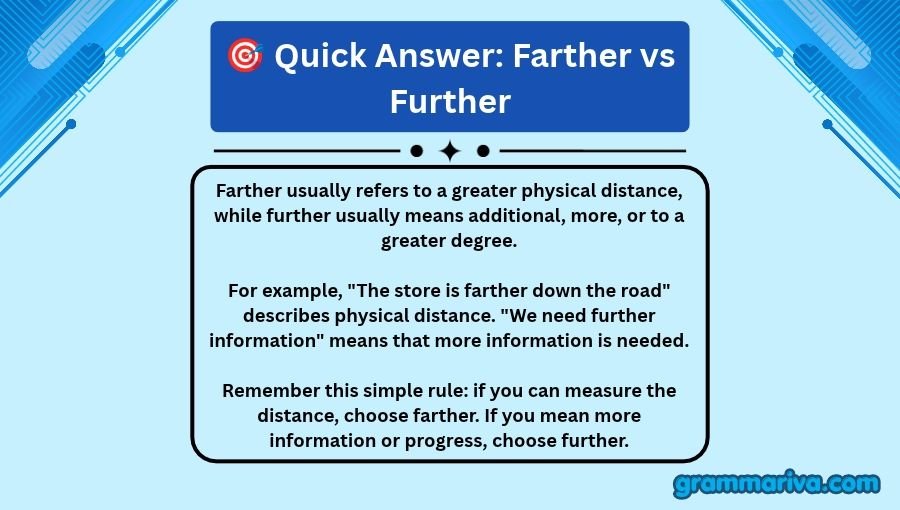
Farther usually refers to a greater physical distance, while further usually means additional, more, or to a greater degree.
For example, “The store is farther down the road” describes physical distance. “We need further information” means that more information is needed.
Remember this simple rule: if you can measure the distance, choose farther. If you mean more information or progress, choose further.
Understanding the Basics of Farther vs Further
The main difference between these words is the type of distance or amount they describe. Farther is mainly used for measurable physical space. Further is commonly used for abstract distance, extra details, or additional progress.
Although both words can sometimes describe distance, they have different preferred uses in standard American English.
Farther: Meaning and Correct Use
Farther is an adverb or adjective that describes a greater physical distance. It helps explain how far away something is or how much additional distance someone must travel.
Use it when discussing places, roads, walking, driving, running, or other measurable distances.
Examples:
- My school is farther from home than yours.
- We walked farther than we planned.
- The next gas station is farther down the highway.
- She threw the ball farther than her brother.
- Their new house is farther away from the city.
Sentence breakdown:
Consider this sentence:
“The airport is farther from my house.”
- Subject: The airport
- Verb: Is
- Comparison: Farther from my house
- Meaning: The airport is located at a greater physical distance from the house.
The word farther works because the sentence compares actual locations.
Further: Meaning and Correct Use
Further means additional, more, or to a greater degree. It often describes ideas, knowledge, discussion, progress, and actions rather than physical space.
It can work as an adverb or adjective. It is also used as a verb meaning to help something develop or move forward.
Examples:
- We need further details before making a choice.
- She wants to further her education.
- Let’s discuss this matter further.
- The company plans to further improve its services.
- I have no further questions.
Sentence breakdown:
Consider this sentence:
“We need further information.”
- Subject: We
- Verb: Need
- Object: Information
- Description: Further
- Meaning: We need additional information.
The word further is correct because the sentence refers to extra details, not physical distance.
Farther vs Further Comparison Table
| Form | Type | Meaning | Example | Correct/Incorrect |
|---|---|---|---|---|
| Farther | Adverb | Greater physical distance | We walked farther today. | ✅ Correct |
| Further | Adjective | Additional | I need further help. | ✅ Correct |
| Farther | Adverb | More physical distance | The lake is farther away. | ✅ Correct |
| Further | Adverb | To a greater degree | Let’s look further into this. | ✅ Correct |
| Farther | Adjective | Greater physical distance | The farther road leads to town. | ✅ Correct |
| Further | Verb | Help something develop | Education can further your career. | ✅ Correct |
Why Do People Confuse Farther and Further?
People often confuse farther and further because both words have similar meanings and can describe distance. Understanding the difference between farther vs further helps writers choose the correct word based on context. While farther usually refers to physical distance, further often means additional information, progress, or a greater degree.
There are three common reasons for this confusion.
- Similar meanings: Both words can suggest something greater or beyond what already exists.
- Similar pronunciation: In everyday American speech, they sound very much alike.
- Overlapping usage: Both words can sometimes describe physical distance.
I once edited a student’s school essay that used farther every time the writer wanted to say “more.” The sentences were easy to understand, but several sounded unnatural. After explaining the difference between physical distance and additional information, the student corrected the mistakes quickly.
The easiest way to avoid this problem is to focus on the meaning of the sentence instead of how the words sound.
Farther vs Further: Key Differences at a Glance
The main difference between farther vs further is how each word describes distance or additional meaning. Farther is generally preferred for measurable physical distance, while further is commonly used for extra information, discussion, and progress. Knowing these differences makes English writing clearer and more accurate. However, understanding their roles in sentences makes the difference even clearer.
| Feature | Farther | Further |
|---|---|---|
| Main meaning | Greater physical distance | Additional or more |
| Common use | Places and travel | Information and progress |
| Physical distance | Preferred | Also acceptable in some cases |
| Abstract meaning | Generally avoided | Preferred |
| Adjective use | Greater physical distance | Additional |
| Adverb use | Greater physical distance | To a greater degree |
| Verb use | No | Yes |
| Example | Walk farther | Discuss further |
The Simple Distance Rule
Use farther when you are comparing measurable physical distances.
Examples:
- The park is farther from our house. ✅
- We drove farther than expected. ✅
- Can you move a little farther away? ✅
The Additional Information Rule
Use further when you mean extra details, more discussion, or additional work.
Examples:
- Please send further instructions. ✅
- We need further research. ✅
- The manager requested further changes. ✅
When Both Words Can Describe Distance
In modern English, further can also refer to physical distance. For example, “We walked further than yesterday” is acceptable.
However, farther remains the clearer traditional choice when the sentence specifically refers to measurable physical distance.
This distinction is especially helpful in formal writing because it makes your meaning clear.
💡 Correct Meanings and Uses of Farther and Further
Both words have several uses. Learning their different meanings will help you choose the correct one in more situations.
Farther for Physical Distance
Use farther when describing how much physical space separates two places or objects.
Examples:
- The library is farther from here than the supermarket. ✅
- We need to drive farther to reach the beach. ✅
- My brother lives farther away than my sister. ✅
- The finish line is farther than it looks. ✅
Why are these correct?
Each sentence describes a real distance that can be measured in miles, kilometers, meters, or other units.
Further for Additional Information
Use further when asking for or providing more details about a subject.
Examples:
- Could you provide further information about the course? ✅
- I would like further details about your offer. ✅
- The teacher gave us further instructions. ✅
- We need further evidence before reaching a decision. ✅
Why are these correct?
The word further describes something extra. It does not refer to a physical location.
Further for Progress and Development
Further can also describe moving a plan, goal, or idea forward. It often appears in business, education, and personal development.
Examples:
- Reading can further your understanding of the subject. ✅
- She wants to further her career. ✅
- The new plan will further our goals. ✅
- The team worked hard to further the project. ✅
Here, further can be a verb. It means to help something grow, improve, or develop.
Further for Degree or Extent
Use further when describing a greater degree or extent of something.
Examples:
- The problem requires further attention. ✅
- We should investigate the issue further. ✅
- His behavior raised further concerns. ✅
- The discussion continued further into the evening. ✅
These examples show how the word can describe an action or situation going beyond its current level.
Summary of the Different Meanings
| Meaning | Word Type | Example Sentence |
|---|---|---|
| Greater physical distance | Adverb | We traveled farther today. |
| Greater physical distance | Adjective | The farther town is beautiful. |
| Additional information | Adjective | I need further details. |
| Additional discussion | Adverb | Let’s discuss this further. |
| Help something develop | Verb | Training can further your skills. |
| Greater degree | Adverb | We need to investigate further. |
🎯 Test Tip: How to Choose the Right Word
Here is an easy test I recommend to students and writers.
Ask yourself whether the sentence is about physical distance or something extra.
- If you mean a greater physical distance, try using farther.
- If you mean additional information, progress, or a greater degree, use further.
- If you are describing abstract ideas, further is usually the better choice.
Try this example:
“We need to walk ______ before reaching the village.”
The correct answer is farther because the sentence describes physical travel.
Now try this one:
“We need ______ information about the project.”
The correct answer is further because the sentence asks for additional information.
📝 Real-Life Case Study: Farther and Further in the Workplace
Imagine that you work for a company that is planning a new office. Your manager asks you to compare two possible locations.
You write the following email:
Subject: Office Location Comparison
Hello Team,
I visited both locations yesterday. The second office is farther from our current building, but it offers more parking space.
We also need further information about the rental cost, available rooms, and internet services before making our final decision.
Please let me know if you have any further questions.
Best regards,
Alex
Why Is This Email Correct?
Notice how both words appear naturally in the same message.
| Sentence | Word Used | Reason |
|---|---|---|
| The second office is farther away. | Farther | Describes physical distance. |
| We need further information. | Further | Means additional details. |
| Any further questions? | Further | Means any more questions. |
The email is clear because each word has a different job.
I once reviewed a workplace report in which an employee wrote, “We need farther information before approving the project.” The intended meaning was clear, but further information was the natural choice. A small correction made the report sound more professional.
This example shows why understanding the difference matters beyond grammar lessons. It can improve everyday communication, too.
Grammar Rules Explanation
The difference between farther and further comes from how each word is used in a sentence. Both are comparative forms related to the idea of going beyond a point. However, standard American English generally favors farther for physical distance and further for additional or abstract meaning.
Rule 1: Use Farther for Measurable Distance
When comparing the physical distance between two places, use farther.
Correct: The hotel is farther from the airport.
Incorrect: The hotel is further from the airport.
The second sentence is not necessarily grammatically wrong. Further is also accepted for physical distance. However, farther is the more precise choice when you want to emphasize measurable space.
Rule 2: Use Further for Additional Things
When you mean extra information, details, help, or time, choose further.
Correct: We need further explanation.
Incorrect: We need farther explanation.
The first sentence is correct because the writer wants more explanation. The second sentence uses a physical-distance word for an abstract idea.
Rule 3: Use Further as a Verb
Further can also function as a verb. It means to help something progress or develop.
Correct: This course will further my career.
Incorrect: This course will farther my career.
The first sentence is correct because the course may help the person’s career move forward.
Rule 4: Do Not Treat Them as Completely Interchangeable
Although the meanings sometimes overlap, replacing one word with the other can change how natural or clear a sentence sounds.
For example:
- We walked farther into the forest. ✅
- We need further discussion. ✅
The first sentence refers to physical movement. The second refers to additional discussion.
Correct vs Incorrect at a Glance
| Sentence | Correct/Incorrect | Why |
|---|---|---|
| We drove farther than yesterday. | ✅ Correct | Describes physical distance. |
| I need farther details. | ❌ Incorrect | Use further for additional details. |
| Let’s discuss this further. | ✅ Correct | Means more discussion. |
| She wants to farther her education. | ❌ Incorrect | Further is the verb form. |
| The school is farther away. | ✅ Correct | Describes physical location. |
⚠️ Common Mistakes When Using Farther and Further
One common mistake when using farther vs further is choosing the wrong word for the intended meaning. Although these words sometimes overlap, farther is generally better for physical distance, while further is the natural choice for additional details, research, and discussion. Since both words can refer to distance, writers sometimes use them without thinking about their main differences.
Here are some reasons these mistakes happen:
- Fast typing: People often choose the first word that comes to mind.
- Autocorrect: A keyboard may suggest a different word than the one the writer intended.
- Lack of knowledge: Some people learn the words separately without understanding their different uses.
- Similar meanings: Their overlapping meanings make the choice less obvious.
- Limited proofreading: Writers may overlook small word-choice mistakes when checking their work.
Similar Grammar Confusions
Farther and further are not the only English words that people mix up. Several other word pairs can cause similar problems.
| Word Pair | Difference | Correct Example |
|---|---|---|
| It’s / Its | It’s means it is; its shows ownership. | It’s a lovely day. |
| Your / You’re | Your shows ownership; you’re means you are. | You’re doing well. |
| Their / There | Their shows ownership; there refers to a place. | Their house is over there. |
| Then / Than | Then refers to time; than makes comparisons. | She is taller than me. |
| Affect / Effect | Affect is usually a verb; effect is usually a noun. | The change had an effect. |
| Lose / Loose | Lose means fail to keep; loose means not tight. | Don’t lose your keys. |
Common Wrong Forms of Farther and Further
Some mistakes involve using the correct word in the wrong situation. Others involve creating phrases that do not fit standard grammar.
| Wrong Form | What’s Wrong | Correct Form |
|---|---|---|
| Farther information | Uses physical distance for extra details. | Further information |
| Further details | Not wrong, but sometimes confused with distance. | Further details |
| Farther discussion | Uses the less suitable word for additional discussion. | Further discussion |
| To farther your career | Incorrect verb form. | To further your career |
| Farther questions | Incorrect for the meaning of more questions. | Further questions |
| Further away by five miles | Not necessarily wrong, but less precise for measurable distance. | Farther away by five miles |
How to Avoid These Mistakes
You can improve your writing with a few simple habits:
- Read the full sentence before choosing a word.
- Identify whether the sentence describes physical space or an abstract idea.
- Use farther for measurable physical distance.
- Use further for extra information, progress, and extent.
- Check your work before sending an important email or publishing an article.
How to Remember the Difference Between Farther and Further
Remembering the difference between farther vs further becomes easier with a simple trick. Connect farther with the word “far” to remember physical distance. Think of further as meaning “more” or “additional” when discussing information, progress, or ideas.
Think of the word far inside farther. Both are connected to distance.
For further, think of the phrase further information. This phrase means additional information.
Here are some easy memory tricks:
- Farther = Far: Think about how far you need to travel.
- Further = More: Think about getting more details or making more progress.
- Farther = Physical: Picture a road, a park, or a distant building.
- Further = Additional: Picture more questions, more work, or more knowledge.
Easy Memory Examples
| Situation | Memory Question | Correct Word |
|---|---|---|
| Walking to a store | How much more distance? | Farther |
| Asking for details | Do I need more information? | Further |
| Driving to another city | Is the place physically distant? | Farther |
| Improving a career | Am I helping something progress? | Further |
| Continuing a discussion | Do I mean more discussion? | Further |
The trick is to focus on the meaning rather than memorizing long definitions.
Is There a Difference Between Farther and Further in American English?
Yes. In American English, farther is traditionally preferred for physical distance, while further is preferred for additional or abstract meanings.
However, both words can be used to describe physical distance. This is why you may see sentences such as “We traveled further than expected” in books, newspapers, and everyday writing.
For clear and polished American English, follow these guidelines:
- Choose farther when comparing measurable distances.
- Choose further when referring to extra details.
- Choose further when describing progress or development.
- Choose further when talking about a greater degree or extent.
| Example | Preferred Choice | Explanation |
|---|---|---|
| The next town is farther away. | Farther | Physical distance |
| Please provide further details. | Further | Additional information |
| We need to travel farther. | Farther | Measurable travel |
| Let’s explore the issue further. | Further | More investigation |
Usage of Farther and Further in Different Contexts
The correct use of farther vs further depends on the context of your sentence. Both words appear in everyday conversations, professional emails, creative writing, and social media. Farther usually describes physical distance, while further commonly refers to additional information or progress. Both words appear in daily conversations, professional documents, creative writing, and online messages.
Everyday Conversation
In everyday conversations, farther usually describes places and travel. Further is often used when someone wants additional information or wants to continue a discussion.
Examples:
- Is the shopping mall farther from here?
- Can you explain this further?
- We need to walk farther to reach the station.
- I don’t have any further questions.
Professional Writing
In professional writing, the distinction is especially useful. Use farther when discussing physical locations and further when talking about extra details, research, or business development.
Examples:
- Our new warehouse is farther from the main office.
- Please send further details about the agreement.
- We need further research before approving the plan.
- The company wants to further its business goals.
Creative Writing
Writers can use both words to make descriptions more natural.
Farther works well when describing movement through a physical setting. Further can describe deeper thoughts, emotional development, or additional exploration.
Examples:
- The traveler walked farther into the woods.
- She wanted to explore the mystery further.
- He moved farther away from the crowd.
- The story takes the reader further into the character’s mind.
Social Media and Texting
In casual messages, people may not think much about these rules. However, choosing the right word still makes your message easier to understand.
Examples:
- We walked farther than we planned today!
- I need further details about the event.
- Let’s talk further tomorrow.
- The beach is farther away than I thought.
Context Comparison Table
| Context | Which Term to Use | Example |
|---|---|---|
| Everyday conversation | Both, depending on meaning | We walked farther. |
| Professional writing | Both, depending on meaning | Further research is needed. |
| Creative writing | Both, depending on meaning | She traveled farther. |
| Social media/texting | Both, depending on meaning | Tell me further details. |
Common Phrases and Expressions With Farther and Further
Both words appear in common English phrases. Learning these expressions can help you understand their meanings and use them naturally.
Common Phrases With Farther
- Farther away: At a greater physical distance.
- Farther down the road: At a point located at a greater distance along a road.
- Go farther: Travel a greater physical distance.
- Farther apart: Separated by a greater physical distance.
Common Phrases With Further
- Further information: Additional details about something.
- Further details: More specific information.
- Further discussion: More conversation about a subject.
- Until further notice: Until another announcement or instruction is given.
- Further research: Additional study or investigation.
- Nothing further: Nothing more to add.
Common Expression Comparison
| Phrase | Meaning |
|---|---|
| Farther away | At a greater physical distance |
| Farther down the road | At a more distant point along a road |
| Go farther | Travel a greater distance |
| Further information | Additional details |
| Further discussion | More conversation |
| Until further notice | Until another announcement is made |
One expression worth remembering is until further notice. You may see it on office signs, websites, public announcements, and business emails.
For example:
“The swimming pool will remain closed until further notice.”
Here, further means another announcement or update.
Synonyms and Alternatives for Farther and Further
Sometimes, you can replace these words with other expressions. The best alternative depends on the meaning of your sentence.
For example, more can replace further when you mean additional information. However, it cannot always replace farther when describing a physical distance.
Alternatives for Farther
- More distant: Describes something located at a greater physical distance.
- Beyond: Refers to a place or point past another location.
- At a greater distance: Clearly describes physical separation.
Alternatives for Further
- Additional: Means extra or more.
- More: Works when asking for extra details or discussion.
- Extra: Describes something added to what already exists.
- Further ahead: Can describe a later point in a process or a greater distance, depending on context.
Synonyms Comparison Table
| Alternative | Works When | Does Not Work When |
|---|---|---|
| More distant | Comparing physical locations | Asking for additional details |
| Beyond | Describing a point past something | Replacing every use of further |
| Additional | Referring to extra information | Describing measurable travel |
| More | Asking for extra items or details | Describing a specific physical distance |
| Extra | Describing something added | Comparing two locations |
Example:
Original: We need further information.
Alternative: We need additional information.
Both sentences are correct because they express the same idea.
However:
Original: The airport is farther away.
Alternative: The airport is more distant.
Both sentences work because they describe physical distance.
Why Does Using Farther and Further Correctly Matter?
Choosing the correct word helps readers understand your message without confusion. Even though these words have similar meanings, using them properly makes your writing clearer and more polished.
Here are three reasons why this small grammar rule matters.
Clarity in Communication
Correct word choice helps readers understand exactly what you mean.
For example, “We need further information” clearly asks for more details. It does not suggest that the information is physically far away.
Professionalism
Correct grammar makes emails, reports, applications, and business documents look more polished.
A small word-choice mistake may not change the entire message, but it can make your writing appear less carefully edited.
Better Digital Communication
People read and write thousands of short messages online. Social posts, website articles, product descriptions, and emails all benefit from clear language.
Using the correct word helps your content feel natural and trustworthy.
Clear writing is not about using difficult words. It is about choosing the right words.
Why Correct Word Choice Matters in Different Situations
| Situation | Why Getting It Right Matters |
|---|---|
| Resume | Makes professional writing more polished. |
| Client email | Helps communicate requests clearly. |
| Published content | Improves grammar and reader experience. |
| Social post | Makes short messages easier to understand. |
Can Farther and Further Ever Be Used Interchangeably?
Yes. In some sentences, both words can describe physical distance. Their meanings overlap, especially in modern English.
For example:
- We walked farther than expected. ✅
- We walked further than expected. ✅
Both sentences are acceptable. They describe traveling beyond an expected physical distance.
However, they are not interchangeable in every situation.
Compare these examples:
- We need further information. ✅
- We need farther information. ❌
The first sentence is correct because it means additional information.
Another example:
- She wants to further her education. ✅
- She wants to farther her education. ❌
The first sentence is correct because further acts as a verb meaning to advance or develop something.
My advice: When writing in American English, use farther for physical distance and further for additional or abstract meanings. This simple approach will keep most of your sentences clear and natural.
Farther vs Further: Quick Recap Checklist
Before choosing either word, ask yourself what the sentence is trying to describe. A quick check can help you avoid common mistakes.
| Question | If Yes → Use |
|---|---|
| Am I describing a greater physical distance? | Farther |
| Am I talking about extra information? | Further |
| Am I asking for more details? | Further |
| Am I describing additional discussion? | Further |
| Am I talking about helping something develop? | Further |
| Am I describing how much farther someone must travel? | Farther |
| Am I describing a greater degree or extent? | Further |
Practice Examples
Test your understanding with these three sentences. Choose the correct word before checking the answers.
Practice 1: The grocery store is ______ from my house than the bakery.
- A. Farther
- B. Further
Correct answer: A. Farther ✅
The sentence compares two physical distances.
Practice 2: Please send me ______ details about the meeting.
- A. Farther
- B. Further
Correct answer: B. Further ✅
The sentence asks for additional information.
Practice 3: She wants to ______ her knowledge of English grammar.
- A. Farther
- B. Further
Correct answer: B. Further ✅
Here, further means to develop or improve her knowledge.
If you answered all three correctly, you understand the basic difference. If not, review the physical-distance and additional-information rules once more.
FAQs About Farther vs Further
1. What is the main difference between farther and further?
These frequently asked questions about farther vs further explain the main grammar rules, differences, and common uses. Explore the answers to understand which word fits different sentences and how to avoid common English grammar mistakes. For example, “We walked farther” describes travel, while “We need further details” asks for more information.
2. Is farther or further correct for physical distance?
Both can describe physical distance. However, farther is traditionally preferred when referring to measurable physical space. For example, “The airport is farther away” is a clear and natural choice.
3. Should I use farther or further in American English?
In American English, use farther for physical distance and further for additional information, progress, and abstract meanings. Both can describe physical distance, but following this distinction makes your writing clearer.
4. Is further a real word for additional information?
Yes. Further commonly means additional or more. For example, “Please provide further information” means that the speaker wants more details about a subject.
5. Can further be used as a verb?
Yes. Further can be a verb meaning to help something progress or develop. For example, “She wants to further her education” means she wants to advance her learning.
6. Is it farther down the road or further down the road?
Both expressions can be correct. Use farther down the road when you want to emphasize physical distance. Further down the road can also describe a more distant point or a later stage in a process.
7. Is it further discussion or farther discussion?
The correct expression is further discussion. It means additional conversation about a subject. Farther discussion is not the natural choice because the sentence does not describe physical distance.
8. What does until further notice mean?
“Until further notice” means that something will continue until another announcement, instruction, or update is given. For example, “The office will remain closed until further notice.”
9. Is further more or farther more correct?
Neither further more nor farther more is the standard expression. If you mean additional information, use furthermore as one word. It is a transition word that means “in addition” or “also.”
10. How can I remember when to use farther and further?
Remember that farther contains the word far, which can help you connect it with physical distance. Think of further as meaning more or additional. This simple memory trick works in most everyday writing situations.
Conclusion: Master the Difference Between Farther and Further
Understanding farther vs further does not have to be difficult. Once you know what each word means, choosing the correct one becomes much easier. Remember the simple rule: farther is generally used for physical distance, while further refers to additional information, progress, or a greater degree.
For example, you can travel farther down a road, ask for further details, or further your education. These examples show how each word has its own purpose in everyday English.
As a writing tip, always think about the meaning of your sentence before choosing between these two words. If you are describing a measurable distance, farther is usually the best choice. If you mean something extra or want to describe progress, choose further.
You do not need complicated grammar rules to get this right. A little practice and careful proofreading can make a big difference. Keep these examples in mind, and your writing will become clearer, more natural, and more confident. ✨
Remember: Farther takes you places, while further takes your ideas forward! 🚀

Hi, I’m Lucas Bennett. I’m a grammar content specialist at Grammariva. I work on articles covering everyday grammar questions, sentence usage, and writing tips that readers can apply with confidence.


[…] to help you use both words with confidence. Let’s make this grammar rule easy to remember! ✨Farther vs Further | Affect vs Effect | Performed vs […]
[…] emails, and professional writing. Let’s make this grammar rule simple! 😊 Fewer vs Less | Farther vs Further | Affect vs […]