Have you ever typed a word that sounded right but had a completely different meaning from what you intended? This happens often with words that sound alike but have different spellings and uses. Elicit vs illicit is a common grammar confusion because both words sound almost the same. However, their meanings are very different.
The word elicit is a verb. It means to draw out a response, answer, feeling, or piece of information. On the other hand, illicit is an adjective. It describes something that is illegal, forbidden, or against accepted rules.
As an English writer and editor, I have seen these two words mixed up in school assignments, business emails, and online articles. A small spelling mistake can change the meaning of an entire sentence. Don’t worry, though! 😊 In this guide, I’ll explain their meanings, grammar rules, examples, and common mistakes in simple English. By the end, you’ll know exactly when to use each word. 🎯 Discreet vs Discrete | Complement vs Compliment | Stationary vs Stationery
🎯 Quick Answer: Elicit vs Illicit
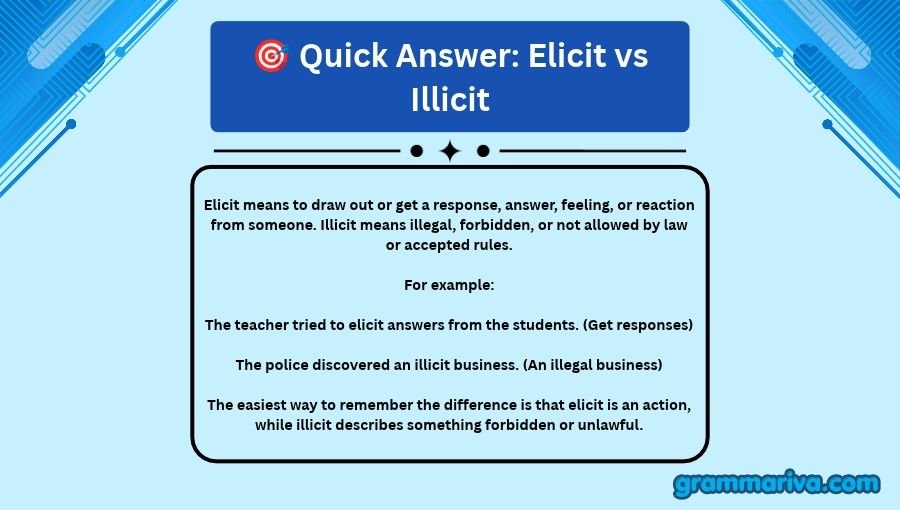
Elicit means to draw out or get a response, answer, feeling, or reaction from someone. Illicit means illegal, forbidden, or not allowed by law or accepted rules.
For example:
- The teacher tried to elicit answers from the students. (Get responses)
- The police discovered an illicit business. (An illegal business)
The easiest way to remember the difference is that elicit is an action, while illicit describes something forbidden or unlawful.
Understanding the Basics of Elicit vs Illicit
The main difference between these words is their meaning and grammatical role. Although they sound alike, they cannot replace each other.
Elicit is a verb. It tells us what someone does. A person can elicit a reply, reaction, answer, memory, or feeling.
Illicit is an adjective. It describes a person, activity, product, or action that is illegal or forbidden.
Comparison Table
| Form | Type | Meaning | Example |
|---|---|---|---|
| Elicit | Verb | To draw out a response | Her question may elicit an answer. |
| Illicit | Adjective | Illegal or forbidden | They investigated illicit sales. |
| Elicits | Verb | Draws out a response | The story elicits strong emotions. |
| Elicited | Verb | Drew out a response | His question elicited laughter. |
| Illicitly | Adverb | In an illegal or forbidden way | The goods were sold illicitly. |
The Main Difference in Simple Words
Think of elicit whenever someone tries to get something from another person.
Think of illicit whenever you describe an activity that is against the law or rules.
Examples:
- The manager asked questions to elicit useful feedback. ✅
- The manager asked questions to illicit useful feedback. ❌
- The company investigated illicit payments. ✅
- The company investigated elicit payments. ❌
The first pair is about getting feedback. The second pair is about payments that may be unlawful.
💡 Why Do People Confuse Elicit and Illicit?
People confuse these words because they sound nearly identical in common English pronunciation. Their spellings are also similar, with only a small difference at the beginning.
However, sound alone cannot tell you which word belongs in a sentence. You must look at the meaning and grammar.
I once edited a short business report in which the writer described a manager’s questions as “illicit questions” when the intended meaning was that the questions would encourage honest feedback. The writer had chosen the wrong word because it sounded correct.
Here are some common reasons for this confusion:
- Both words sound alike.
- Their spellings differ by only one letter.
- People may remember the sound but forget the meaning.
- Autocorrect may not identify the intended word.
- Writers sometimes focus on spelling instead of sentence meaning.
Quick Examples
| Sentence | Correct Word | Reason |
|---|---|---|
| The question should ___ a useful answer. | Elicit | It means to draw out an answer. |
| The store sold ___ products. | Illicit | It describes forbidden products. |
| Her speech may ___ strong feelings. | Elicit | It means to bring out emotions. |
| The group was involved in ___ trade. | Illicit | It describes illegal trade. |
A Simple Memory Trick
Try this easy trick:
- Elicit = Extract a response.
- Illicit = Illegal or forbidden.
Both words begin with the letter “E” or “I,” but their jobs are completely different.
Elicit: Meaning and Correct Use
Elicit is a verb that means to bring out, draw out, or obtain a response, reaction, feeling, answer, or information from someone or something.
It usually involves an action that causes another person to respond.
Elicit a Response
Use this phrase when someone does or says something that causes another person to reply.
Examples:
- The teacher used a fun question to elicit a response from the class. ✅
- The teacher used a fun question to illicit a response from the class. ❌
The teacher wants students to answer. Therefore, elicit is correct.
Elicit Information
This expression means to get information from someone through questions, discussion, or careful conversation.
Examples:
- The interviewer tried to elicit information about the project. ✅
- The interviewer tried to illicit information about the project. ❌
The interviewer wants to obtain details, so the verb elicit fits.
Elicit an Emotional Reaction
Use this expression when something causes another person to feel or show an emotion.
Examples:
- The movie was able to elicit tears from the audience. ✅
- The movie was able to illicit tears from the audience. ❌
The movie brings out an emotional response. That is why elicit is the right choice.
Elicit an Answer
This phrase is common in schools, interviews, meetings, and discussions.
Examples:
- The teacher asked a simple question to elicit the correct answer. ✅
- The teacher asked a simple question to illicit the correct answer. ❌
The question is designed to get an answer from the student.
Summary of Elicit’s Uses
| Meaning | Word Type | Example Sentence |
|---|---|---|
| Get a response | Verb | Her comment elicited a reply. |
| Obtain information | Verb | The officer elicited important details. |
| Bring out feelings | Verb | The song elicited sadness. |
| Get an answer | Verb | The question elicited a correct answer. |
| Cause a reaction | Verb | His joke elicited laughter. |
💡 Test Tip for Elicit
Ask yourself:
Am I talking about getting or bringing out something?
If the answer is yes, you probably need elicit.
You can also replace it with “draw out” or “bring out” to check the sentence.
For example:
“Her question elicited a response.”
You can rewrite it as:
“Her question drew out a response.”
The meaning remains almost the same. This is a strong sign that elicit is correct.
Illicit: Meaning and Correct Use
Illicit is an adjective that describes something illegal, forbidden, or against accepted rules. It is often used when discussing unlawful activities, secret dealings, or prohibited behavior.
Unlike elicit, illicit does not describe the act of getting a response. It describes the nature of something.
Illicit Activities
Use illicit to describe activities that break the law or involve forbidden behavior.
Examples:
- The authorities investigated an illicit operation. ✅
- The authorities investigated an elicit operation. ❌
The operation is described as unlawful. Therefore, illicit is correct.
Illicit Trade
This phrase describes the illegal buying, selling, or movement of goods.
Examples:
- The government introduced new steps to stop illicit trade. ✅
- The government introduced new steps to stop elicit trade. ❌
The sentence discusses unlawful trade, so the adjective illicit is needed.
Illicit Payments
Use this expression for payments that are illegal or prohibited by applicable laws or rules.
Examples:
- The company was accused of making illicit payments. ✅
- The company was accused of making elicit payments. ❌
The sentence describes payments that may involve unlawful activity.
Illicit Drugs
This phrase commonly refers to drugs that are illegal to produce, sell, or possess under applicable law.
Examples:
- The report discussed the dangers of illicit drugs. ✅
- The report discussed the dangers of elicit drugs. ❌
The word describes the legal status of the drugs, not an action.
Summary of Illicit’s Uses
| Meaning | Word Type | Example Sentence |
|---|---|---|
| Illegal activity | Adjective | They investigated illicit activities. |
| Forbidden trade | Adjective | Illicit trade harms communities. |
| Unlawful payments | Adjective | The company denied illicit payments. |
| Prohibited drugs | Adjective | Police found illicit drugs. |
| Unauthorized dealings | Adjective | The report described illicit dealings. |
💡 Test Tip for Illicit
Ask yourself:
Am I describing something illegal, forbidden, or against the rules?
If yes, illicit is likely the correct word.
You can often replace it with “illegal” or “unlawful” to test the sentence.
For example:
“The company investigated illicit payments.”
You can rewrite it as:
“The company investigated illegal payments.”
The basic meaning stays the same.
Is Elicit a Verb or an Adjective?
Elicit is a verb. It describes an action in which someone or something brings out a response, feeling, answer, or information.
It can change its form depending on the tense.
Examples:
- The question will elicit a response.
- Her question elicits a response.
- Her question elicited a response.
- The question is eliciting strong reactions.
Related Forms of Elicit
| Form | Type | Example |
|---|---|---|
| Elicit | Base verb | I want to elicit an answer. |
| Elicits | Present-tense verb | This question elicits interest. |
| Elicited | Past-tense verb | His comment elicited laughter. |
| Eliciting | Present participle | She is eliciting useful feedback. |
| Elicitation | Noun | The elicitation of answers took time. |
These forms all relate to the act of drawing out a response or information.
Is Illicit a Verb or an Adjective?
Illicit is an adjective. It describes something that is illegal, forbidden, or not allowed.
It does not work as a verb in standard English.
Examples:
- They discovered an illicit business.
- The report described illicit activity.
- The police investigated illicit sales.
Related Forms of Illicit
| Form | Type | Example |
|---|---|---|
| Illicit | Adjective | The company investigated illicit trade. |
| Illicitly | Adverb | The goods were sold illicitly. |
| Illicitness | Noun | The report discussed the illicitness of the activity. |
These forms describe the quality or manner of something forbidden or unlawful.
⚖️ Grammar Rules Explanation
The grammar rule behind these words is simple. Elicit functions as a verb, while illicit functions as an adjective. Their different grammatical roles explain why they cannot be used interchangeably.
Rule 1: Use Elicit for an Action
A verb tells us what someone or something does.
The word elicit describes the action of bringing out a response or obtaining information.
Example:
“The speaker’s question elicited several answers.”
Here:
- Subject: The speaker’s question
- Verb: Elicited
- Object: Several answers
The verb explains what the question did.
Rule 2: Use Illicit to Describe a Noun
An adjective gives more information about a noun.
The word illicit describes an activity, payment, trade, product, or other thing that is illegal or forbidden.
Example:
“The investigators discovered an illicit business.”
Here:
- Subject: The investigators
- Verb: Discovered
- Adjective: Illicit
- Noun: Business
The adjective describes the type of business.
Rule 3: Check the Meaning Before Choosing
Even when a sentence sounds natural, its meaning may be wrong.
Compare:
- The question elicited a strong reaction.
- The question involved an illicit activity.
The first sentence describes an action. The second describes something forbidden.
Standard English grammar references and dictionaries maintain this distinction between the verb and adjective. Remembering their word types is one of the easiest ways to avoid mistakes.
✅ Correct vs Incorrect at a Glance
| Sentence | Correct/Incorrect | Why |
|---|---|---|
| Her question elicited an honest answer. | ✅ Correct | Elicited describes getting an answer. |
| Her question illicit an honest answer. | ❌ Incorrect | Illicit is not the required verb. |
| Police investigated illicit sales. | ✅ Correct | Illicit describes unlawful sales. |
| Police investigated elicit sales. | ❌ Incorrect | Elicit is a verb, not an adjective. |
| His story elicited laughter. | ✅ Correct | Elicited means brought out laughter. |
📝 Case Study: Elicit vs Illicit in a Workplace Email
Imagine a company manager preparing an email after a team meeting.
The manager wants employees to share honest feedback about a new work plan. At the same time, the company is reviewing a separate report about illegal payments made by an outside business.
The manager writes:
“We want to elicit honest feedback from employees. We are also reviewing claims about illicit payments made by the outside business.”
Both words are correct because they have different jobs.
Understanding the Email
First sentence:
“We want to elicit honest feedback from employees.”
The manager wants to receive opinions and suggestions. The verb elicit explains this action.
Second sentence:
“We are also reviewing claims about illicit payments.”
The word illicit describes the payments as potentially unlawful.
What Happens If You Switch the Words?
| Original Meaning | Wrong Sentence | Problem |
|---|---|---|
| Get honest feedback | We want to illicit feedback. | Illicit is not a verb. |
| Unlawful payments | We are reviewing elicit payments. | Elicit does not describe payments. |
Why This Example Matters
A workplace email needs clear language. Using the wrong word may confuse readers or make a serious report sound unprofessional.
When I review business writing, I encourage writers to check the job each word performs before checking its spelling. This small habit can prevent many errors.
⚠️ Common Mistakes With Elicit and Illicit
Writers often make mistakes with these words because they sound alike. However, the solution is not difficult. You only need to understand the sentence before selecting the spelling.
Common Reasons for Mistakes
Fast typing
People often type quickly and choose the first spelling that comes to mind. They may not stop to check the meaning.
Autocorrect
A spelling checker may accept both words because both are correctly spelled English words. It may not understand which meaning the writer intended.
Lack of knowledge
Some writers know the words sound alike but do not understand the difference between a verb and an adjective.
Reading without context
If someone learns a word without seeing it in a sentence, it can be harder to remember its correct use.
Similar Grammar Confusions
| Word Pair | First Word | Second Word |
|---|---|---|
| Its / It’s | Possessive form | It is or it has |
| Your / You’re | Shows ownership | You are |
| There / Their | Refers to a place | Shows ownership |
| Affect / Effect | Usually a verb | Usually a noun |
| Elicit / Illicit | Draw out a response | Illegal or forbidden |
Specific Wrong Spellings and Uses
| Wrong Form | What’s Wrong | Correct Form |
|---|---|---|
| Illicit a response | Illicit is not a verb. | Elicit a response |
| Elicit activity | Elicit does not describe an activity. | Illicit activity |
| Illicit information | Wrong when the intended meaning is obtaining information. | Elicit information |
| Elicit payments | Elicit does not describe payments. | Illicit payments |
| Illicit an answer | Wrong verb choice. | Elicit an answer |
| Elicit trade | Wrong adjective choice. | Illicit trade |
How to Avoid These Mistakes
Follow these simple steps:
- Read the full sentence before choosing a word.
- Identify whether you need a verb or adjective.
- Replace elicit with “draw out” to test its meaning.
- Replace illicit with “illegal” to test its meaning.
- Read your sentence again after correcting it.
- Do not rely on autocorrect alone.
A little attention can make your writing much clearer.
How to Remember the Difference Between Elicit and Illicit
A good memory trick makes confusing words easier to use.
Here are a few simple methods.
Remember Elicit Through Extraction
Think of elicit as getting something out of someone.
Examples:
- Elicit an answer.
- Elicit a response.
- Elicit information.
- Elicit a reaction.
Whenever you see the word “draw out,” think about elicit.
Remember Illicit Through Illegal
Think of illicit as something illegal or forbidden.
Examples:
- Illicit trade.
- Illicit payments.
- Illicit activities.
- Illicit drugs.
Whenever you see the word “illegal,” think about illicit.
Use This Easy Comparison
| Memory Clue | Word | Example |
|---|---|---|
| Get a response | Elicit | Elicit feedback |
| Draw out information | Elicit | Elicit details |
| Illegal activity | Illicit | Illicit business |
| Forbidden trade | Illicit | Illicit trade |
The One-Second Test
Before using either word, ask:
- Am I trying to get something? Use elicit.
- Am I describing something forbidden? Use illicit.
This quick test works in most everyday and professional writing situations.
Elicit vs Illicit in Different Contexts
Both words appear in different types of writing. Their meanings stay the same, but the situations in which people use them can change.
Everyday Conversation
In everyday conversation, elicit is useful when discussing reactions or answers.
Example:
“That question will probably elicit a funny response.”
Illicit is useful when discussing something unlawful.
Example:
“The news report was about an illicit business.”
Professional Writing
In professional writing, elicit often appears in reports, surveys, interviews, and meetings.
Example:
“The survey was designed to elicit customer feedback.”
Illicit often appears in legal, financial, and compliance reports.
Example:
“The audit revealed concerns about illicit transactions.”
Creative Writing
Writers can use elicit to describe emotions and reactions.
Example:
“Her final words elicited tears from the crowd.”
They can use illicit when describing forbidden activities in a story.
Example:
“The detective uncovered an illicit agreement.”
Social Media and Texting
On social media, elicit may describe a post that gets a reaction.
Example:
“That video always elicits a laugh.”
Illicit may appear in posts about illegal activities or prohibited goods.
Example:
“The documentary explains the effects of illicit trade.”
Context Comparison Table
| Context | Which Term to Use | Example |
|---|---|---|
| Everyday conversation | Elicit | His joke elicited laughter. |
| Everyday conversation | Illicit | The report covered illicit activity. |
| Professional writing | Elicit | The survey elicited feedback. |
| Professional writing | Illicit | The audit examined illicit payments. |
| Creative writing | Elicit | Her words elicited sadness. |
| Creative writing | Illicit | The story involved illicit dealings. |
| Social media/texting | Elicit | The post elicited many replies. |
| Social media/texting | Illicit | The article discussed illicit sales. |
Common Phrases With Elicit and Illicit
Both words appear in common English expressions. Learning these phrases can help you remember their meanings and use them naturally.
Common Phrases With Elicit
| Phrase | Meaning |
|---|---|
| Elicit a response | Get someone to respond |
| Elicit information | Obtain details |
| Elicit an answer | Get an answer |
| Elicit a reaction | Cause someone to react |
| Elicit sympathy | Bring out feelings of sympathy |
| Elicit feedback | Get opinions or suggestions |
Common Phrases With Illicit
| Phrase | Meaning |
|---|---|
| Illicit trade | Illegal buying or selling |
| Illicit drugs | Drugs that are illegal under applicable law |
| Illicit payments | Unlawful or prohibited payments |
| Illicit activities | Illegal or forbidden actions |
| Illicit dealings | Unlawful business arrangements |
| Illicit substances | Substances that are prohibited or illegal in a particular context |
Examples in Sentences
- The survey helped elicit useful feedback from customers.
- The teacher asked questions to elicit thoughtful answers.
- The police investigated an illicit trade network.
- The report discussed the risks of illicit payments.
Notice how the first two phrases describe getting something, while the last two describe unlawful activities.
Synonyms and Alternatives for Elicit and Illicit
Synonyms can help you avoid repeating the same word. However, you should choose an alternative that fits the sentence.
Alternatives for Elicit
| Alternative | Works When | Does Not Work When |
|---|---|---|
| Draw out | Getting a response or feeling | Describing something illegal |
| Obtain | Getting information or details | Describing a reaction caused by something |
| Bring out | Causing a feeling or quality to appear | Describing unlawful trade |
| Evoke | Causing a feeling, memory, or image | Simply collecting facts |
| Prompt | Encouraging a response or action | Describing forbidden activities |
Alternatives for Illicit
| Alternative | Works When | Does Not Work When |
|---|---|---|
| Illegal | Something breaks the law | Describing a response |
| Unlawful | An action violates the law | Describing a feeling |
| Forbidden | Something is not allowed | Describing the act of getting information |
| Prohibited | Something is officially not permitted | Describing a question that gets an answer |
| Unauthorized | Something lacks proper permission | Every situation involving a legal violation |
Important Note About Synonyms
Not every alternative has exactly the same meaning.
For example, “unauthorized” means something has not been approved or permitted. It does not always mean the action is illegal.
Similarly, “obtain” means to get something. It does not always carry the same sense as elicit, which often involves drawing out a response or reaction.
Always check the sentence before replacing a word.
🌟 Why Getting Elicit and Illicit Right Matters
Using the correct word makes your writing clear, accurate, and professional. A single spelling choice can change the message you want to share.
Clarity in Communication
Readers should understand your meaning without guessing. Using elicit when you mean to get a response makes your sentence clear.
Using illicit when you describe illegal activity also gives readers the right information.
Professionalism
Correct word choice matters in emails, reports, resumes, and workplace documents.
A simple grammar mistake may distract readers from your main message. Correct spelling helps your writing look polished.
Digital Communication
Online articles, social media posts, and business messages reach many people. A wrong word can make your content confusing.
Grammar accuracy also helps readers trust the information you share.
A Short Writing Reminder
“Clear words create clear messages.”
Why Accuracy Matters in Different Situations
| Situation | Why Getting It Right Matters |
|---|---|
| Resume | Shows attention to detail and writing skills. |
| Client email | Keeps professional communication clear. |
| Published content | Helps readers understand your message. |
| Social media post | Prevents confusion among readers. |
The goal is not to use difficult words to sound smart. The goal is to choose the right words to express your ideas.
Elicit vs Illicit: Quick Recap Checklist
Before finishing a sentence, use this checklist to confirm your word choice.
| Question | If Yes → Use |
|---|---|
| Am I trying to get a response? | Elicit |
| Am I trying to obtain information? | Elicit |
| Am I describing something illegal? | Illicit |
| Am I talking about forbidden trade? | Illicit |
| Am I describing unlawful payments? | Illicit |
| Am I talking about bringing out emotions? | Elicit |
Remember These Three Rules
- Elicit is a verb. It describes getting or drawing out something.
- Illicit is an adjective. It describes something illegal or forbidden.
- Both words sound alike, but their meanings are different.
📝 Practice Examples
Try choosing the correct word in each sentence.
Example A:
“The teacher tried to ______ an answer from the class.”
Correct answer: Elicit
The teacher wants students to give an answer.
Example B:
“The investigation focused on ______ payments.”
Correct answer: Illicit
The payments are described as unlawful.
Example C:
“Her kind words ______ a smile from the child.”
Correct answer: Elicited
The words brought out a smile.
If you got all three right, you understand the main difference!
FAQs About Elicit vs Illicit
1. What is the difference between elicit and illicit?
Elicit is a verb meaning to draw out a response, answer, feeling, or information. Illicit is an adjective meaning illegal, forbidden, or against accepted rules.
Example: A question can elicit an answer, while an illicit activity involves unlawful behavior.
2. Is elicit a verb or an adjective?
Elicit is a verb. It describes the action of getting or bringing out a response, reaction, feeling, or information.
Example: “The question elicited a thoughtful answer.”
3. Is illicit a verb or an adjective?
Illicit is an adjective. It describes something illegal, forbidden, or prohibited.
Example: “The company investigated illicit payments.”
4. Can elicit and illicit be used interchangeably?
No. These words have different meanings and grammatical roles. Elicit describes an action, while illicit describes something unlawful or forbidden.
Using one in place of the other can change the meaning of your sentence or make it grammatically incorrect.
5. What is an example of elicit in a sentence?
“The teacher asked a question to elicit a response from the students.”
In this sentence, elicit means to draw out or encourage an answer.
6. What is an example of illicit in a sentence?
“The authorities investigated an illicit business.”
Here, illicit describes a business involved in illegal or forbidden activities.
7. Why do elicit and illicit sound the same?
They have very similar pronunciations in common English speech. Their similar sounds make them easy to confuse, but their spellings, meanings, and grammatical roles are different.
8. What is another word for elicit?
Depending on the sentence, possible alternatives include draw out, evoke, obtain, bring out, and prompt.
For example, “The question elicited a response” can be rewritten as “The question drew out a response.”
9. What is another word for illicit?
Possible alternatives include illegal, unlawful, forbidden, prohibited, and unauthorized.
However, these words are not always exact replacements. Choose one that matches the meaning of your sentence.
10. How can I remember the difference between elicit and illicit?
Remember this simple rule:
- Elicit = Extract a response.
- Illicit = Illegal or forbidden.
If you are talking about getting an answer or reaction, use elicit. If you are describing something unlawful, use illicit.
Conclusion
Understanding elicit vs illicit becomes easy when you remember their different meanings and grammatical roles. Elicit is a verb that means to draw out a response, answer, feeling, or information. Illicit is an adjective that describes something illegal, forbidden, or against accepted rules.
Use elicit when talking about questions, answers, feedback, emotions, and reactions. Use illicit when describing unlawful activities, illegal trade, prohibited products, or forbidden dealings.
I recommend using the simple memory trick from this guide: elicit means extract a response, while illicit means illegal. You can also replace elicit with “draw out” and illicit with “illegal” to check your sentence before publishing it.
Remember, both words may sound alike, but they do not share the same meaning. 😊 A little attention to spelling and grammar can make a big difference in your writing.
Choose the right word, express your meaning clearly, and let your writing speak with confidence!

Hi, I’m Nathan Reed. I’m a grammar and writing specialist at Grammariva. I work on practical grammar content that helps readers understand sentence structure, punctuation, vocabulary, and better writing habits.


[…] know exactly when to use each word. Let’s make this grammar lesson simple and enjoyable! 📚 Elicit vs Illicit | Discreet vs Discrete | Complement vs […]
[…] examples. Let’s make this confusing word pair easy to remember! 😊 Allusion vs Illusion | Elicit vs Illicit | Discreet vs […]