Have you ever wondered about the difference between adverse vs averse? These two words look and sound quite similar, but they have different meanings. Choosing the wrong one can change the message of your sentence. Understanding when to use each word can make your English writing clearer and more accurate. Adverse describes something harmful or unfavorable, while averse describes a person who strongly dislikes or opposes something. For example, you might face adverse weather during a trip, but you might be averse to traveling in bad weather.
Understanding adverse vs averse is easier than you might think. Both words are common in English, especially in conversations, schoolwork, business emails, and professional writing. The main difference is simple: adverse describes something harmful or unfavorable, while averse describes a person who strongly dislikes or does not want something.
For example, you might face adverse weather during a trip. However, you might be averse to traveling in bad weather.
As an English grammar writer, I believe that learning words through simple examples is one of the best ways to improve your writing. In this guide, I’ll explain both words, show you their correct uses, and share easy memory tricks. You’ll also find comparison tables, common mistakes, practice questions, and helpful examples. Let’s make this confusing word pair easy to remember! 😊 Allusion vs Illusion | Elicit vs Illicit | Discreet vs Discrete
🎯 Quick Answer: Adverse vs Averse
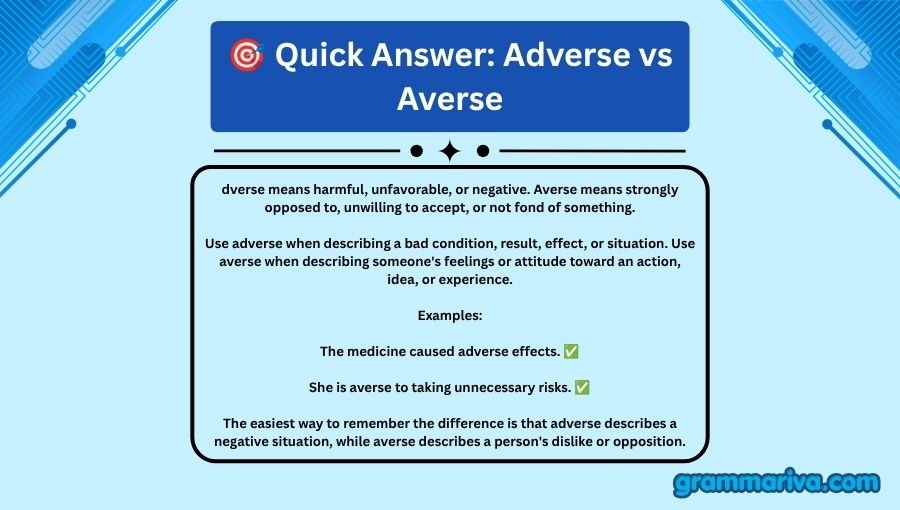
Adverse means harmful, unfavorable, or negative. Averse means strongly opposed to, unwilling to accept, or not fond of something.
Use adverse when describing a bad condition, result, effect, or situation. Use averse when describing someone’s feelings or attitude toward an action, idea, or experience.
Examples:
- The medicine caused adverse effects. ✅
- She is averse to taking unnecessary risks. ✅
The easiest way to remember the difference is that adverse describes a negative situation, while averse describes a person’s dislike or opposition.
Understanding the Basics of Adverse vs Averse
The words adverse and averse are adjectives. They both describe something, but they do not describe the same kind of thing.
Adverse usually describes an unfavorable condition or effect. Averse usually describes a person’s attitude toward something.
Think about these two sentences:
- The team faced adverse weather during the match.
- The coach was averse to changing the team’s strategy.
In the first sentence, adverse describes the weather. In the second sentence, averse describes the coach’s attitude.
Comparison Table
| Form | Type | Meaning | Example |
|---|---|---|---|
| Adverse | Adjective | Harmful or unfavorable | The company faced adverse conditions. |
| Averse | Adjective | Strongly opposed or unwilling | He is averse to change. |
Key Differences at a Glance
| Feature | Adverse | Averse |
|---|---|---|
| Main meaning | Harmful or unfavorable | Opposed or unwilling |
| Describes | Conditions, effects, results | Feelings, attitudes, preferences |
| Common use | Adverse effects | Risk-averse |
| Common pattern | Adverse to conditions | Averse to something |
| Opposite idea | Favorable or beneficial | Willing or receptive |
| Example | Adverse weather | Averse to travel |
Both words can appear in formal and informal English. However, their meanings are not interchangeable.
What Does Adverse Mean?
Adverse means harmful, unfavorable, negative, or likely to cause problems. It describes something that creates difficulty or produces an unwanted result.
You will often see this word in health reports, business documents, weather updates, news stories, and academic writing.
Adverse as Harmful
Use adverse when something causes harm or has a negative effect.
Examples:
- The new treatment caused adverse effects in some patients.
- Smoking can have adverse effects on health.
- The chemical had an adverse impact on the environment.
Sentence breakdown:
In the sentence “The new treatment caused adverse effects,” the word adverse describes the effects. It tells readers that those effects were unwanted or harmful.
Adverse as Unfavorable
Adverse can also describe conditions that make a task or situation difficult.
Examples:
- The hikers continued walking despite adverse weather.
- The business struggled under adverse market conditions.
- Poor road conditions created an adverse situation for drivers.
Here, the word describes conditions that make success harder.
Adverse as Negative or Unwanted
You can also use adverse when talking about negative results, reactions, or changes.
Examples:
- The company received an adverse review.
- The policy had an adverse effect on small businesses.
- The project faced adverse results after the budget was reduced.
Common Meanings of Adverse
| Meaning | Word Type | Example Sentence |
|---|---|---|
| Harmful | Adjective | The drug caused adverse reactions. |
| Unfavorable | Adjective | We faced adverse weather. |
| Negative | Adjective | The decision had an adverse effect. |
| Difficult | Adjective | The team worked in adverse conditions. |
Common Phrases With Adverse
Some word combinations are especially common in everyday and professional English.
| Phrase | Meaning |
|---|---|
| Adverse effects | Harmful or unwanted results |
| Adverse reaction | A negative response to something |
| Adverse weather | Bad or unfavorable weather |
| Adverse conditions | Difficult or unfavorable circumstances |
| Adverse impact | A negative influence |
| Adverse outcome | An unwanted or unfavorable result |
These phrases are useful in reports, workplace communication, health discussions, and news writing.
What Does Averse Mean?
Averse means strongly opposed to, unwilling to do, or not fond of something. It describes a person’s feelings, attitude, or preference.
For example, someone who dislikes public speaking may be averse to giving presentations.
Unlike adverse, this word does not usually describe a harmful condition. It tells readers how someone feels about an activity, choice, or idea.
Averse as Unwilling
Use averse when someone does not want to do something.
Examples:
- She is averse to working late.
- My brother is averse to trying new foods.
- The manager is averse to making sudden changes.
Sentence breakdown:
In “She is averse to working late,” the word averse describes her attitude toward working late. It means she does not like or want to do it.
Averse as Opposed to Something
You can also use averse when someone strongly disagrees with an idea or choice.
Examples:
- The owner is averse to unnecessary spending.
- They are averse to changing the original plan.
- He is averse to taking financial risks.
Averse as Having a Strong Dislike
Averse can describe a personal dislike or reluctance.
Examples:
- I am not averse to trying something new.
- She is averse to crowded places.
- My father is averse to using social media.
Notice that not averse to means someone is not strongly opposed to something. It can suggest that the person is open to the idea.
Common Meanings of Averse
| Meaning | Word Type | Example Sentence |
|---|---|---|
| Unwilling | Adjective | He is averse to traveling alone. |
| Opposed | Adjective | She is averse to the proposal. |
| Not fond of | Adjective | I am averse to spicy food. |
| Reluctant | Adjective | They are averse to making changes. |
⚠️ Why Do People Confuse Adverse and Averse?
People confuse these words because they look similar and have nearly identical pronunciation in many varieties of English. Both are adjectives, and both can appear in sentences about negative situations.
However, their meanings are different.
I once reviewed a sample business report in which the writer used “averse weather conditions” instead of “adverse weather conditions.” The writer wanted to describe bad weather, not someone’s dislike of it. Replacing one letter changed the meaning and made the phrase incorrect.
Here are the main reasons this mistake happens:
- Similar spelling: Both words begin with “a” and end with “erse.”
- Similar pronunciation: Their sounds are close enough to cause confusion.
- Limited vocabulary knowledge: Some writers learn the words without learning their separate meanings.
- Fast writing: People may choose the first word that looks familiar.
- Autocorrect: Spell-check tools may not detect a mistake when the wrong word is spelled correctly.
How to Remember the Difference
Try these simple memory tricks:
- Adverse = Against good results: Think of harmful effects or bad conditions.
- Averse = A person against something: Think of someone who dislikes or avoids an activity.
For example:
- Adverse weather can delay a flight.
- Averse passengers may dislike flying.
The first sentence describes a condition. The second describes a person’s attitude.
Is Adverse the Same as Averse?
No, adverse and averse are not the same. Adverse describes something unfavorable or harmful, while averse describes someone’s opposition or dislike.
Although they look alike, they have different jobs in a sentence.
Consider these examples:
Adverse:
- The storm created adverse conditions for farmers.
- The new rule had an adverse effect on workers.
Averse:
- Farmers are averse to unnecessary financial risks.
- Some workers are averse to changing their schedules.
A simple way to check your sentence is to ask what you are describing.
If you are describing a harmful situation, use adverse. If you are describing someone’s attitude, use averse.
How to Use Adverse and Averse in a Sentence
The correct choice depends on the meaning of your sentence. Both words are adjectives, but they usually appear with different types of nouns and sentence patterns.
Using Adverse Correctly
Common patterns include:
- Adverse effects
- Adverse conditions
- Adverse reactions
- Adverse consequences
- Adverse weather
- Adverse impact
Examples:
- The storm had an adverse impact on the crops.
- The patient experienced adverse reactions.
- The company faced adverse financial conditions.
Using Averse Correctly
A common sentence pattern is:
Person + be + averse + to + noun or gerund.
Examples:
- She is averse to driving at night.
- He is averse to taking unnecessary risks.
- They are averse to spending too much money.
Remember that the word to is a preposition in this structure. Therefore, a verb that follows it should normally take the -ing form.
Correct: She is averse to working late. ✅
Incorrect: She is averse to work late. ❌
Correct and Incorrect Usage Table
| Sentence | Correct/Incorrect | Explanation |
|---|---|---|
| The medicine caused adverse effects. | Correct ✅ | Adverse describes harmful effects. |
| She is adverse to public speaking. | Incorrect ❌ | Averse describes her dislike. |
| He is averse to taking risks. | Correct ✅ | Averse describes his attitude. |
| We faced averse weather. | Incorrect ❌ | Adverse describes bad weather. |
| The decision had an adverse impact. | Correct ✅ | Adverse describes a negative impact. |
💡 Test Tip
Ask yourself one simple question:
Am I describing something bad, or someone who dislikes something?
- Something bad or unfavorable = Adverse.
- Someone who dislikes or opposes something = Averse.
This quick test can help you choose the right word in most situations.
A Real-Life Case Study: Adverse vs Averse at Work
Imagine that a company is preparing to launch a new product. The marketing team has limited time and a small budget.
During the launch, the company faces adverse market conditions. Sales are lower than expected, and shipping delays create more problems.
The marketing manager is also averse to spending extra money on advertising because the company needs to control its costs.
Notice how both words work in this example:
- Adverse market conditions describe unfavorable business circumstances.
- Averse to spending describes the manager’s unwillingness to spend more money.
Now imagine an employee writes this sentence in a report:
“The manager is adverse to increasing the advertising budget.”
The intended meaning is that the manager does not want to increase spending. The correct sentence is:
“The manager is averse to increasing the advertising budget.”
This small change makes the report clearer and more professional.
Grammar Rules Explanation: When to Use Each Word
The grammar rule is simple. Adverse describes unfavorable things, while averse describes an attitude of opposition or dislike.
Both words function as adjectives. However, their meanings and common sentence patterns are different.
Rule for Adverse
Use adverse before a noun when you want to describe a harmful or unfavorable condition.
Examples:
- Adverse effects
- Adverse weather
- Adverse consequences
- Adverse conditions
You can also use it with words such as “to” when describing an unfavorable effect or influence.
Example:
“The changes were adverse to the company’s interests.”
Here, adverse to means harmful or unfavorable to something.
Rule for Averse
Use averse to describe a person or group that does not like or support something.
Its most common pattern is:
Be + averse + to + noun or -ing verb.
Examples:
- She is averse to criticism.
- He is averse to spending money.
- They are averse to taking risks.
The preposition to must be followed by a noun, pronoun, or gerund in this pattern.
Correct vs Incorrect at a Glance
| Sentence | Correct/Incorrect | Why |
|---|---|---|
| The workers faced adverse conditions. | Correct ✅ | Adverse describes unfavorable conditions. |
| He is adverse to taking risks. | Incorrect ❌ | Averse is the correct word for his attitude. |
| The policy had adverse consequences. | Correct ✅ | Adverse describes negative consequences. |
| She is averse to unnecessary changes. | Correct ✅ | Averse describes her opposition. |
| The company experienced averse effects. | Incorrect ❌ | Adverse is needed to describe harmful effects. |
Standard English dictionaries and grammar references distinguish these words by their meanings and uses. The difference is not simply a matter of style. Choosing the correct word helps communicate the intended message.
Common Mistakes With Adverse and Averse
Many writers choose the wrong word because they focus on spelling instead of meaning. Since both words are valid English words, a basic spell-check tool may not catch the error.
I once noticed a similar issue while checking an example paragraph for an English lesson. The sentence said, “The school was averse to poor weather.” The writer meant that the school experienced unfavorable weather. The correct phrase was “adverse weather.”
Similar Grammar Confusions
Adverse and averse are not the only words that people mix up. English has several word pairs that look or sound similar.
| Word Pair | Main Difference | Example |
|---|---|---|
| It’s / Its | It’s means it is; its shows possession. | It’s raining. |
| Your / You’re | Your shows possession; you’re means you are. | You’re holding your book. |
| Affect / Effect | Affect is usually a verb; effect is usually a noun. | The change had an effect. |
| Accept / Except | Accept means receive; except means excluding. | Everyone came except Tom. |
| Advice / Advise | Advice is a noun; advise is a verb. | I need your advice. |
Common Wrong Spellings and Uses
Here are some mistakes to avoid when using this word pair.
| Wrong Form | What’s Wrong | Correct Form |
|---|---|---|
| Averse weather | Averse describes dislike, not bad weather. | Adverse weather |
| Adverse to taking risks | Averse describes unwillingness. | Averse to taking risks |
| Averse effects | Averse does not mean harmful. | Adverse effects |
| Adverse attitude toward change | When describing reluctance, use averse. | Averse attitude toward change |
| Adverse reactions | No mistake if referring to harmful reactions. | Adverse reactions |
| Averse consequences | Averse does not describe negative results. | Adverse consequences |
Three Reasons These Mistakes Happen
Fast typing
When people write quickly, they may select the wrong word without thinking about its meaning. This often happens in emails, messages, and reports.
Autocorrect
Autocorrect may replace a word with another correctly spelled word. Since both words are valid, the software may not recognize the meaning problem.
Lack of knowledge
Some learners memorize spellings without understanding how each word works. Learning examples and sentence patterns can help solve this problem.
Word Origin and History of Adverse and Averse
The two words have different histories, even though their modern spellings are similar.
Adverse is connected to the idea of turning against something. Its meaning developed around opposition, unfavorable conditions, and harmful results.
Averse is connected to the idea of turning away from something. Its modern meaning focuses on dislike, reluctance, or opposition.
Understanding these general ideas can help explain why the words have different meanings today.
The key point is that their modern meanings should guide your writing. You do not need to memorize their history to use them correctly.
Adverse vs Averse in Different Contexts
Both words appear in different types of writing. Knowing where each one belongs can help you write more clearly.
Everyday Conversation
In everyday conversation, people often use adverse to describe bad conditions and averse to explain personal preferences.
Examples:
- We had to cancel our trip because of adverse weather.
- I’m averse to eating food that is too spicy.
Professional Writing
In business and professional writing, adverse often describes risks, effects, results, and conditions.
Examples:
- The new policy may have adverse effects on employees.
- The manager is averse to making major financial changes.
Creative Writing
Writers can use adverse to describe difficult situations and averse to explain a character’s feelings.
Examples:
- The hero survived several adverse conditions.
- The main character was averse to trusting strangers.
Social Media and Texting
Both words can appear in online posts and messages.
Examples:
- “Adverse weather ruined our weekend plans.”
- “I’m averse to waking up early on Sundays.”
Usage Comparison Table
| Context | Which Term to Use | Example |
|---|---|---|
| Everyday conversation | Both | I’m averse to driving in adverse weather. |
| Professional writing | Both | The company faced adverse conditions, but its manager was averse to taking risks. |
| Creative writing | Both | She remained hopeful despite adverse circumstances and was averse to giving up. |
| Social media/texting | Both | I’m averse to going out in adverse weather. |
How to Remember the Difference Between Adverse and Averse
Remembering the difference becomes easier when you connect each word with a simple idea.
Remember Adverse With Bad Conditions
Think of adverse as a word for something negative.
Examples:
- Adverse weather
- Adverse effects
- Adverse results
- Adverse conditions
If the sentence describes a harmful or unfavorable situation, adverse is usually the correct choice.
Remember Averse With Personal Feelings
Think of averse as a word for someone’s dislike or opposition.
Examples:
- Averse to exercise
- Averse to change
- Averse to risk
- Averse to spending
If the sentence explains what someone does not like or want, choose averse.
The One-Line Memory Trick
Adverse means bad for a situation; averse means against something by choice.
Try repeating this rule a few times. It can help you remember the difference when writing.
Synonyms and Alternatives for Adverse and Averse
Synonyms can help make your writing more varied. However, not every similar word works in every sentence.
Alternatives for Adverse
| Alternative | Works When | Does Not Work When |
|---|---|---|
| Harmful | Something causes damage. | Describing a simple dislike. |
| Unfavorable | Conditions or results are negative. | Describing a person’s unwillingness. |
| Negative | A result or effect is bad. | Describing a personal preference. |
| Damaging | Something causes harm. | Describing opposition without harm. |
| Detrimental | Something has a harmful effect. | Describing a person’s reluctance. |
Alternatives for Averse
| Alternative | Works When | Does Not Work When |
|---|---|---|
| Opposed | Someone disagrees with an idea. | Describing harmful weather. |
| Reluctant | Someone is unwilling to act. | Describing negative results. |
| Unwilling | Someone does not want to do something. | Describing an unfavorable condition. |
| Resistant | Someone does not accept or support change. | Describing a harmful effect. |
| Disinclined | Someone has little desire to do something. | Describing bad circumstances. |
Always check the full sentence before replacing either word with a synonym.
Why Getting Adverse and Averse Right Matters
Using the correct word makes your writing clear and easy to understand. A small spelling difference can change the message you want to share.
Clarity in Communication
Readers should understand what you mean without having to guess. Using adverse and averse correctly helps separate negative situations from personal attitudes.
Professionalism
Correct word choice matters in business reports, resumes, emails, and other professional documents. A simple vocabulary mistake can make otherwise good writing look less polished.
Accuracy in Digital Communication
Online writing moves quickly. People send emails, publish blog posts, and share updates every day. Choosing the right word helps prevent misunderstandings.
A useful writing principle is:
“Clear words create clear messages.”
Why Correct Usage Matters
| Situation | Why Getting It Right Matters |
|---|---|
| Resume | Shows strong vocabulary and writing skills. |
| Client email | Makes your message sound professional. |
| Published content | Helps readers understand your meaning. |
| Social media post | Prevents confusion among readers. |
Quick Recap Checklist: Adverse or Averse?
Use this checklist whenever you are unsure which word belongs in your sentence.
| Question | If Yes → Use |
|---|---|
| Am I describing harmful effects? | Adverse |
| Am I describing bad weather? | Adverse |
| Am I talking about unfavorable conditions? | Adverse |
| Am I describing someone’s dislike? | Averse |
| Am I explaining that someone does not want something? | Averse |
| Am I describing opposition to an idea? | Averse |
Practice Examples
Test your knowledge with these short examples.
Example A: The storm created ______ conditions for the farmers.
Answer: Adverse. The sentence describes unfavorable conditions.
Example B: My sister is ______ to spending money on expensive clothes.
Answer: Averse. The sentence describes her attitude toward spending.
Example C: The new medicine caused ______ reactions.
Answer: Adverse. The sentence describes unwanted or harmful reactions.
Quick Memory Review
- Adverse = Harmful, unfavorable, or negative.
- Averse = Opposed, unwilling, or not fond of something.
- Adverse effects = Correct.
- Averse to taking risks = Correct.
FAQs About Adverse vs Averse
What Is the Main Difference Between Adverse and Averse?
Adverse means harmful or unfavorable. Averse means opposed to or unwilling to do something. Adverse describes situations and effects, while averse describes feelings and attitudes.
Is It Adverse Weather or Averse Weather?
The correct phrase is adverse weather. It describes bad or unfavorable weather that makes an activity difficult or unsafe.
Example: The flight was delayed because of adverse weather.
Is It Adverse to Change or Averse to Change?
The correct phrase for someone who dislikes or opposes change is averse to change.
Example: The manager is averse to changing the company’s current policy.
What Does Adverse Mean in Simple Words?
Adverse means bad, harmful, or unfavorable. It describes something that creates problems or produces negative results.
Example: The team faced adverse conditions during the competition.
What Does Averse Mean in Simple Words?
Averse means strongly against something or unwilling to do it. It describes a person’s feelings or attitude.
Example: He is averse to eating spicy food.
Can Adverse and Averse Be Used in the Same Sentence?
Yes. You can use both words in one sentence when they describe different things.
Example: She is averse to traveling in adverse weather.
Here, averse describes her dislike, while adverse describes the weather.
Is Averse Always Followed by To?
In common sentence patterns, averse is usually followed by to. The word after to can be a noun, pronoun, or verb ending in -ing.
Examples:
- He is averse to risk.
- She is averse to it.
- They are averse to working late.
What Is the Opposite of Adverse?
Common opposites of adverse include favorable, beneficial, positive, and helpful. The best choice depends on the sentence.
Example: The company moved from adverse conditions to a more favorable business environment.
What Is the Opposite of Averse?
Common opposites of averse include willing, receptive, open, and agreeable.
Example: She is receptive to new ideas rather than averse to change.
What Does Risk-Averse Mean?
Risk-averse describes someone who prefers to avoid risks or choose safer options. The term is common in business, investing, and personal decision-making.
Example: A risk-averse investor may prefer safer investments over highly uncertain ones.
Conclusion
Understanding adverse vs averse does not have to be difficult. The main rule is simple: use adverse when describing something harmful, unfavorable, or negative. Use averse when describing someone’s dislike, reluctance, or opposition to something.
Remember these examples: adverse weather, adverse effects, and adverse conditions. For the other word, remember averse to change, averse to risk, and averse to spending money.
As an English writer, I recommend checking the meaning of a word before choosing it. Similar spelling does not always mean similar meaning. A few seconds of careful reading can prevent common grammar mistakes and make your writing stronger.
You can also use the simple memory trick from this guide: adverse describes a bad situation, while averse describes a person’s attitude. Keep practicing with everyday sentences, workplace examples, and short writing exercises.
Good grammar is not about using difficult words. It is about choosing the right words at the right time. Master this difference, and you’ll never have to guess between these two words again! 🎯

Hi, I’m Ethan Brooks. I’m an English grammar writer at Grammariva, where I work on clear explanations, practical examples, and useful writing tips. I enjoy making difficult grammar topics easier to understand.
[…] make these two words easy to understand and use with confidence! Adverse vs Averse | Allusion vs Illusion | Elicit vs […]
[…] Let’s make this common grammar confusion easy to understand! 😊 Compose vs Comprise | Adverse vs Averse | Allusion vs […]