Have you ever stopped while writing because you were unsure whether to use compose or comprise? These two words are common in American English, especially in school assignments, business reports, articles, and professional emails. However, they do not mean exactly the same thing. Using the wrong word can make an otherwise clear sentence confusing.The difference between compose vs comprise becomes much easier when you understand how each word describes a whole and its parts.
Both words relate to how something is made up, but they express that relationship from different directions.
For example, you can say that five players compose a team. You can also say that a team comprises five players. Both sentences describe the same group, but their sentence structures are different.
As an English grammar guide, I’ll explain the meanings, rules, examples, and common mistakes in simple language. You’ll also find practical writing tips, comparison tables, and practice questions to help you remember the difference. 😊
Let’s make these two words easy to understand and use with confidence! Adverse vs Averse | Allusion vs Illusion | Elicit vs Illicit
🎯 Quick Answer: Compose vs Comprise
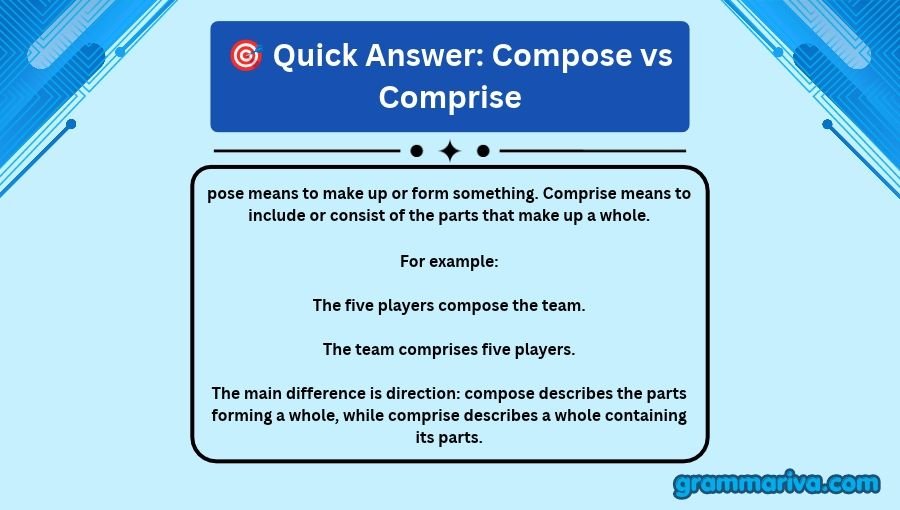
Compose means to make up or form something. Comprise means to include or consist of the parts that make up a whole.
For example:
- The five players compose the team.
- The team comprises five players.
The main difference is direction: compose describes the parts forming a whole, while comprise describes a whole containing its parts.
Understanding the Basics of Compose vs Comprise
The easiest way to understand these words is to think about the relationship between a whole and its smaller parts.
Imagine a pizza cut into eight slices. The slices compose the pizza because they come together to form the whole. The pizza comprises eight slices because the whole includes those individual pieces.
Both sentences describe the same situation. However, the subject changes depending on the word you choose.
Compose: Meaning and Correct Use
Compose is a verb that means to form, make up, or create something by bringing different parts together.
The word focuses on the smaller elements that build a complete thing.
Examples:
- Several musicians compose the orchestra.
- Water is composed of hydrogen and oxygen.
- Three chapters compose the first section of the book.
- Different colors compose the final design.
In these sentences, the subjects are the parts that form something larger.
Comprise: Meaning and Correct Use
Comprise is a verb that means to include, contain, or consist of different parts.
The word focuses on the complete thing and the elements it contains.
Examples:
- The orchestra comprises several musicians.
- Water comprises hydrogen and oxygen.
- The first section comprises three chapters.
- The final design comprises different colors.
Here, the subjects are the complete things that contain the smaller elements.
Compose vs Comprise Comparison Table
| Form | Type | Meaning | Example | Correct/Incorrect |
|---|---|---|---|---|
| Compose | Verb | To form a whole | Five members compose the group. | Correct |
| Comprise | Verb | To include parts | The group comprises five members. | Correct |
| Composed of | Verb phrase | Formed from parts | The group is composed of five members. | Correct |
| Comprised of | Verb phrase | Commonly used to mean made up of | The group is comprised of five members. | Traditional usage guides often discourage this construction |
| Composing | Present participle | Forming something | The students are composing a team. | Correct |
| Comprising | Present participle | Including parts | The team is comprising five members. | Grammatically possible in limited contexts, but usually unnatural here |
🔍 What Is the Main Difference Between Compose and Comprise?
The main difference is the direction in which you describe the parts and the whole.
Use compose when the parts are the subject. Use comprise when the complete thing is the subject.
Consider this example:
- Ten players compose the football team.
- The football team comprises ten players.
The meaning is almost identical, but the grammatical focus changes.
Think of it this way:
- Compose = Parts form the whole.
- Comprise = The whole includes the parts.
This simple rule works in most everyday and professional writing situations.
Understanding the Direction of Each Word
Let’s use a school classroom as an example.
Suppose a classroom has twenty students.
With compose, the sentence begins with the students:
“Twenty students compose the class.”
With comprise, the sentence begins with the class:
“The class comprises twenty students.”
The number of students stays the same. Only the sentence structure changes.
Compose vs Comprise at a Glance
| Word | Sentence Subject | Focus | Example |
|---|---|---|---|
| Compose | Parts | Forming a whole | Five ingredients compose the dish. |
| Comprise | Whole | Including parts | The dish comprises five ingredients. |
| Be composed of | Whole | Being formed from parts | The dish is composed of five ingredients. |
| Consist of | Whole | Including all parts | The dish consists of five ingredients. |
💡 Test Tip: How to Choose the Right Word
Use this simple test before choosing either word:
- If your sentence starts with the parts, consider compose.
- If your sentence starts with the whole, consider comprise.
- If you want to describe what something is made from, be composed of is a useful option.
For example:
“Four wheels, an engine, and a frame compose the vehicle.”
“The vehicle comprises four wheels, an engine, and a frame.”
Both sentences are correct and communicate the same basic relationship.
Correct Meanings and Uses of Compose
The word compose has several common uses. It can describe forming something from parts, creating written or musical work, and becoming calm.
Compose Means to Form or Make Up
This is the meaning most directly compared with comprise.
Examples:
- Several departments compose the organization.
- Different ingredients compose the recipe.
- Five sections compose the report.
- Many small details compose the complete picture.
Sentence breakdown:
“Several departments compose the organization.”
- Subject: Several departments
- Verb: Compose
- Object: The organization
The departments are the individual parts. Together, they form the organization.
Compose Means to Create Written or Musical Work
Compose can also mean to create something through writing or music.
Examples:
- She composed a beautiful song.
- The writer composed a short poem.
- He composed an email to his manager.
- The musician composed a new melody.
In these sentences, the word describes the act of creating something.
It does not mean that the subject is made up of smaller parts. Instead, it describes producing a piece of work.
Compose Means to Calm Yourself
Another meaning of compose is to become calm or control your emotions.
Examples:
- She took a moment to compose herself.
- He tried to compose himself before speaking.
- I needed a few minutes to compose my thoughts.
This use is common in everyday conversation and professional situations.
The phrase compose yourself usually means to regain control of your emotions.
Summary of Compose Meanings
| Meaning | Word Type | Example Sentence |
|---|---|---|
| To form a whole | Verb | Several parts compose the machine. |
| To create music | Verb | She composed a song. |
| To create writing | Verb | He composed a letter. |
| To calm yourself | Verb | She composed herself before the meeting. |
Correct Meanings and Uses of Comprise
The word comprise mainly describes what a complete thing includes. It is especially useful when discussing groups, organizations, systems, and collections.
Comprise Means to Include
This is the main meaning used when comparing the word with compose.
Examples:
- The committee comprises seven members.
- The course comprises twelve lessons.
- The collection comprises rare books.
- The team comprises experienced players.
Sentence breakdown:
“The committee comprises seven members.”
- Subject: The committee
- Verb: Comprises
- Object: Seven members
The committee is the whole. The seven members are its parts.
Comprise Means to Consist of
Comprise can also be used to explain what makes up a complete thing.
Examples:
- The package comprises three separate items.
- The program comprises several learning activities.
- The report comprises five major sections.
- The meal comprises a starter, a main course, and dessert.
These examples explain the contents of a complete group or item.
Comprise in Formal and Professional Writing
The word is especially useful in formal writing because it can express the relationship between a whole and its parts in a direct way.
Examples:
- The research team comprises experts from four departments.
- The annual report comprises financial and operational information.
- The training program comprises six individual modules.
- The organization comprises several regional offices.
These sentences are clear, direct, and suitable for business communication.
Summary of Comprise Meanings
| Meaning | Word Type | Example Sentence |
|---|---|---|
| To include | Verb | The group comprises ten people. |
| To consist of | Verb | The course comprises eight lessons. |
| To contain as parts | Verb | The collection comprises old paintings. |
📝 Real-Life Case Study: Compose vs Comprise in a Workplace
Imagine that a company manager is preparing a report about a new marketing department.
The department has three teams:
- Content team
- Design team
- Advertising team
The manager writes:
“The marketing department composes three teams.”
This sentence is incorrect for the intended meaning because the whole department is the subject. The manager should write:
“The marketing department comprises three teams.”
Alternatively, the sentence can be rewritten using compose:
“Three teams compose the marketing department.”
Both revised sentences are correct.
A Workplace Email Example
Consider this email:
Subject: Marketing Department Structure
Hello Team,
Our marketing department comprises three main teams: content, design, and advertising. These three teams compose the department and work together to support our business goals.
Best regards,
Marketing Manager
Notice how both words work together naturally.
The first sentence uses comprise because the department is the whole. The second uses compose because the three teams are the parts.
This example shows why choosing the right subject is just as important as choosing the right verb.
Grammar Rules Explanation: How Compose and Comprise Work
Understanding the grammar rules makes these words easier to use correctly.
Rule: Use Compose With the Parts as the Subject
When the individual elements form something larger, use compose.
Correct:
“Six chapters compose the book.”
Incorrect:
“The book composes six chapters.”
The second sentence reverses the relationship. For the intended meaning, the book includes the chapters rather than forming them.
Rule: Use Comprise With the Whole as the Subject
When the complete thing includes its smaller elements, use comprise.
Correct:
“The book comprises six chapters.”
Incorrect:
“Six chapters comprise the book.”
The second sentence is not the traditional preferred construction when the intended meaning is that the chapters form the book. Use compose instead.
Rule: Use Be Composed Of for a Whole Made From Parts
The expression be composed of is another correct way to describe the parts of something.
Examples:
- The team is composed of eight players.
- The mixture is composed of several ingredients.
- The committee is composed of experienced professionals.
This structure is especially useful when you want to keep the whole as the subject.
Rule: Understand the Debate Around Comprised Of
You may see sentences such as:
“The team is comprised of eight players.”
This construction is widespread in modern English. However, traditional grammar guidance often recommends avoiding it.
The preferred formal alternatives are:
- The team comprises eight players.
- The team is composed of eight players.
- The team consists of eight players.
For school assignments, formal reports, and careful editing, these alternatives are safer choices.
Correct vs Incorrect at a Glance
| Sentence | Correct/Incorrect | Why |
|---|---|---|
| Five chapters compose the book. | Correct | The parts form the whole. |
| The book comprises five chapters. | Correct | The whole includes its parts. |
| The book composes five chapters. | Incorrect for the intended meaning | The subject and relationship are reversed. |
| Five chapters comprise the book. | Traditionally discouraged for this meaning | Use compose to describe parts forming a whole. |
| The book is composed of five chapters. | Correct | The phrase describes the whole and its parts. |
⚠️ Why Do People Confuse Compose and Comprise?
People confuse these words because both describe how different elements relate to a complete thing.
They are also often used in similar sentences. This makes it easy to think they can replace each other.
However, their grammatical direction is different.
Similar Meanings Create Confusion
Consider these sentences:
- Three parts compose the machine.
- The machine comprises three parts.
Both sentences describe the same machine. This similarity can make writers forget which word belongs with which subject.
Fast Typing
People often write quickly without checking the relationship between the subject and the object.
For example, someone may type:
“The company composes four divisions.”
They may mean that the company comprises four divisions.
Autocorrect
Autocorrect may suggest a different word based on spelling or sentence patterns. It does not always understand the meaning of a sentence.
Always review the complete sentence instead of trusting an automatic suggestion.
Lack of Knowledge
Some writers learn that both words relate to parts and wholes but never learn the difference in direction.
Once this basic rule is clear, choosing the correct word becomes much easier.
An Editing Example
Imagine reviewing a school essay that says:
“The human body composes several major systems.”
The writer likely intends to say that the body comprises several systems.
Changing the verb fixes the relationship without changing the main idea.
Similar Grammar Confusions
| Confusing Words | Main Difference | Example |
|---|---|---|
| Its / It’s | Possession vs contraction | The dog wagged its tail. |
| Your / You’re | Possession vs you are | You’re doing well. |
| Affect / Effect | Usually verb vs noun | The change affected the result. |
| Then / Than | Time or sequence vs comparison | She is taller than me. |
| Compose / Comprise | Parts form a whole vs whole includes parts | Parts compose a whole. |
Common Wrong Forms and Better Alternatives
| Wrong Form | What’s Wrong | Correct Form |
|---|---|---|
| The team composes ten players. | Reverses the intended relationship. | The team comprises ten players. |
| Five players comprise the team. | Traditionally discouraged for this meaning. | Five players compose the team. |
| The book comprises of chapters. | Adds an unnecessary preposition. | The book comprises chapters. |
| The group is comprise of ten people. | Uses the wrong verb form. | The group is composed of ten people. |
| The company is compose of departments. | Uses the base verb incorrectly. | The company is composed of departments. |
| The committee comprise five people. | Subject-verb agreement is missing. | The committee comprises five people. |
Usage of Compose and Comprise in Different Contexts
Both words are useful in several types of communication. The best choice depends on what you want to describe.
Everyday Conversation
In everyday conversation, compose and comprise can describe groups, teams, and collections.
Examples:
- Five friends compose our group.
- Our group comprises five friends.
However, people may prefer simpler expressions such as make up and consist of in casual speech.
Professional Writing
Professional writing often uses these words to explain organizational structures, reports, teams, and projects.
Examples:
- The board comprises nine directors.
- Four departments compose the organization.
- The training package comprises five courses.
Clear word choice makes business documents easier to understand.
Creative Writing
Writers can use compose to describe the elements of a scene, character, or story.
Examples:
- Several small details compose the scene.
- The story comprises three connected parts.
- Music and dialogue compose the final performance.
These words can help writers explain how different elements work together.
Social Media and Texting
In social media posts and text messages, shorter alternatives are often more natural.
For example:
- “These five photos make up my collection.”
- “My collection comprises five photos.”
Both communicate the same idea, but the first sounds more casual.
Context Comparison Table
| Context | Which Term to Use | Example |
|---|---|---|
| Everyday conversation | Either, depending on direction | The team comprises five friends. |
| Professional writing | Either, depending on direction | The report comprises six sections. |
| Creative writing | Either, depending on direction | Several details compose the scene. |
| Social media/texting | Either, or simpler alternatives | Three photos make up the post. |
How to Remember the Difference Between Compose and Comprise
Remembering these words does not require complicated grammar rules. You only need to remember which direction each word describes.
Use the Parts-to-Whole Trick
Think of compose as building something.
Several smaller pieces come together to form one complete thing.
For example:
“Four ingredients compose the recipe.”
Use the Whole-to-Parts Trick
Think of comprise as looking inside something.
You begin with the complete thing and identify what it contains.
For example:
“The recipe comprises four ingredients.”
Remember These Two Simple Questions
Before writing, ask yourself:
- Am I describing the parts that form something? Use compose.
- Am I describing a whole that includes several parts? Use comprise.
A Simple Memory Table
| Word | Memory Trick | Example |
|---|---|---|
| Compose | Parts come together | Five rooms compose the house. |
| Comprise | The whole includes parts | The house comprises five rooms. |
| Composed of | The whole is formed from parts | The house is composed of five rooms. |
Synonyms and Alternatives for Compose and Comprise
Sometimes, another word can make your sentence easier to understand.
However, not every synonym works in every situation. Choose an alternative that preserves the meaning of your sentence.
Alternatives for Compose
- Form: Use when parts come together to create something.
- Make up: Use in everyday speech to describe the parts of a whole.
- Create: Use when describing the act of producing something.
- Build: Use when something develops from separate elements.
Alternatives for Comprise
- Include: Use when describing what something contains.
- Consist of: Use when listing the parts of a whole.
- Contain: Use when describing what is inside something.
- Be made up of: Use in both formal and casual writing.
Synonyms Comparison Table
| Alternative | Works When | Does Not Work When |
|---|---|---|
| Form | Parts create a whole. | You simply want to list what a whole includes. |
| Make up | Explaining the parts of something. | Describing the act of writing a song. |
| Include | Listing elements contained in something. | Describing smaller parts as the subject forming a whole. |
| Consist of | Describing the contents of a whole. | Describing the act of creating music. |
| Create | Explaining the production of something. | Simply listing the existing parts of a group. |
Common Phrases With Compose and Comprise
These words appear in several common expressions.
Understanding these phrases helps you recognize their meanings in different sentences.
Common Expressions With Compose
- Compose a song: Create a piece of music.
- Compose a letter: Write a letter.
- Compose yourself: Become calm.
- Compose a message: Write a message.
- Be composed of: Be formed from different parts.
Common Expressions With Comprise
- Comprise several parts: Include different elements.
- Comprise a group: Include the members of a group.
- Comprise several sections: Include different sections.
- Comprise a collection: Include the items in a collection.
Common Phrases Table
| Phrase | Meaning |
|---|---|
| Compose a song | Create a musical work. |
| Compose a letter | Write a letter. |
| Compose yourself | Calm your emotions. |
| Be composed of | Be formed from different parts. |
| Comprise several parts | Include several elements. |
| Comprise a collection | Include the items that form a collection. |
Why Using Compose and Comprise Correctly Matters
Choosing the right word helps readers understand the relationship between different parts of a sentence.
Although the difference may seem small, it can affect the clarity and quality of your writing.
Clarity in Communication
Correct word choice makes your meaning clear.
For example:
“The department comprises four teams.”
This sentence clearly explains what the department includes.
Professionalism
Correct grammar shows that you have taken care with your writing.
This matters in:
- Business reports
- School assignments
- Professional emails
- Research papers
- Published articles
Accuracy in Digital Communication
Online articles, websites, and social media posts reach many readers.
Using the right words helps prevent confusion and makes content easier to understand.
A useful writing reminder is:
“Clear writing begins with choosing words that express the right relationship.”
Why Correct Usage Matters
| Situation | Why Getting It Right Matters |
|---|---|
| Resume | Shows strong writing skills. |
| Client email | Communicates information clearly. |
| Published content | Improves accuracy and readability. |
| Social media post | Helps readers understand your message. |
Quick Recap Checklist: Compose vs Comprise
Use this checklist whenever you are unsure which word belongs in your sentence.
| Question | If Yes → Use |
|---|---|
| Are separate parts forming a complete thing? | Compose |
| Is a complete thing including smaller parts? | Comprise |
| Are you describing what something is made from? | Be composed of |
| Are you describing the creation of music or writing? | Compose |
| Are you describing what a group contains? | Comprise |
Practice Examples
Choose the correct word in each sentence.
Practice A: Five players ______ the basketball team.
Answer: Compose.
Explanation: The five players are the parts that form the team.
Practice B: The basketball team ______ five players.
Answer: Comprises.
Explanation: The team is the whole that includes the players.
Practice C: She ______ a beautiful song for her school performance.
Answer: Composed.
Explanation: Here, compose means to create music.
Quick Memory Trick
- Parts compose a whole.
- A whole comprises parts.
- Something can be composed of smaller elements.
Remember these three ideas, and you will avoid most mistakes involving these words.
FAQs About Compose vs Comprise
What is the difference between compose and comprise?
Compose means to form something from smaller parts. Comprise means to include those parts within a complete whole. For example, five players compose a team, while a team comprises five players.
Is compose the opposite of comprise?
They describe opposite directions of the same relationship, but they are not exact opposites in every use. Compose focuses on parts forming a whole, while comprise focuses on a whole containing its parts.
How do you use compose in a sentence?
Use compose when something forms or creates another thing. For example, “Several chapters compose the book.” You can also use it for writing music, creating messages, or calming yourself.
How do you use comprise in a sentence?
Use comprise when the subject is a complete thing that includes smaller elements. For example, “The book comprises ten chapters.” The book is the whole, and the chapters are its parts.
Is comprised of grammatically correct?
Comprised of is widely used in modern English, but traditional grammar guides often discourage it. In formal writing, prefer comprises, is composed of, or consists of.
Can compose and comprise be used in the same sentence?
Yes. You can use both words in one sentence when describing the same whole from different directions. For example, “Four teams compose the league, and the league comprises four teams.”
Is composed of or comprises better?
Both are correct when used properly. “The group is composed of six members” and “The group comprises six members” are both acceptable. The second is more direct because it uses fewer words.
What is another word for comprise?
Common alternatives include include, contain, consist of, and be made up of. The best choice depends on the sentence and the relationship you want to describe.
What is another word for compose?
Depending on the meaning, alternatives include form, make up, create, and build. For example, “Five sections form the report” can replace “Five sections compose the report.”
How can I remember when to use compose or comprise?
Remember that parts compose a whole, while a whole comprises its parts. Think about whether your sentence starts with the smaller elements or the complete thing. This simple trick will help you choose correctly.
Conclusion
Understanding compose vs comprise is easier when you remember the relationship between a whole and its parts. Compose describes the smaller elements that come together to form something. Comprise describes the complete thing that includes those elements.
For example, “Five chapters compose the book” and “The book comprises five chapters” are both correct. The difference is the direction of the sentence, not the basic information it communicates.
You can also use composed of when describing what something is made from. In formal writing, it is generally safer to avoid comprised of and choose a clearer alternative.
As you practice, pay attention to the subject of each sentence. Ask yourself whether you are describing the parts or the whole. That small step can prevent many common grammar mistakes.
Good grammar does not have to be complicated. With a little practice, you’ll know exactly when to use each word. Keep this simple rule in mind: Parts compose the whole, and the whole comprises the parts. 🎯

Hi, I’m Lucas Bennett. I’m a grammar content specialist at Grammariva. I work on articles covering everyday grammar questions, sentence usage, and writing tips that readers can apply with confidence.


[…] belongs in each sentence. Let’s make this common grammar confusion easy to understand! 😊 Compose vs Comprise | Adverse vs Averse | Allusion vs […]
[…] memory tips. Let’s make these two words easy to understand! 😊 Literally vs Figuratively | Compose vs Comprise | Adverse vs […]