Have you ever felt sick to your stomach and wondered whether to say, “I feel nauseous” or “I feel nauseated”? Both expressions are common in American English. However, they have slightly different meanings, which can make them confusing for students, writers, and everyday speakers.Understanding nauseous vs nauseated can help you choose the right word in conversations, emails, school assignments, and professional writing.
Traditionally, nauseous describes something that causes nausea, while nauseated describes someone who experiences that sick feeling. However, modern American English also accepts nauseous to describe a person who feels sick.
As an English grammar writer, I recommend learning both meanings instead of relying on one old rule. The difference is simple once you understand how each word works in a sentence. You will also learn common mistakes, useful examples, and easy memory tips. Let’s make these two words easy to understand! 😊 Literally vs Figuratively | Compose vs Comprise | Adverse vs Averse
🎯 Quick Answer: Nauseous vs Nauseated
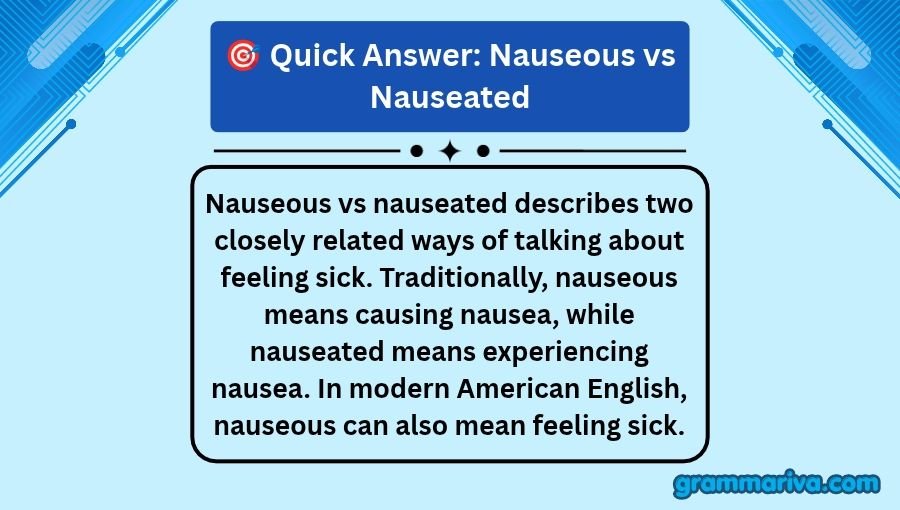
Nauseous vs nauseated describes two closely related ways of talking about feeling sick. Traditionally, nauseous means causing nausea, while nauseated means experiencing nausea. In modern American English, nauseous can also mean feeling sick.
For example:
- The smell of spoiled milk is nauseous. (It causes nausea.)
- I feel nauseated after the long car ride. (I feel sick.)
- I feel nauseous after eating too much. (Also correct in modern English.)
Easy rule: Use nauseated when you want to clearly describe your own sick feeling. Use nauseous for something that causes nausea or when following common modern American usage.
📚 Understanding the Basics of Nauseous vs Nauseated
The main difference between these words is their traditional meaning. One describes something that causes a sick feeling. The other describes someone who experiences that feeling.
Both words are adjectives. They describe people, things, conditions, or experiences.
Nauseous: Meaning and Correct Use
Nauseous traditionally means causing nausea or making someone feel sick.
It often describes:
- A strong or unpleasant smell.
- Spoiled food.
- A disturbing sight.
- A rough or uncomfortable ride.
- Something that causes an upset stomach.
Examples:
- The nauseous smell came from the garbage.
- The boat ride made several passengers feel sick.
- I noticed a nauseous odor near the kitchen.
- The sight of the spoiled meat was nauseous.
In these examples, the word describes something that causes discomfort.
However, modern American English commonly uses nauseous to describe a person who feels sick.
For example:
“I feel nauseous after eating that pizza.”
This sentence is widely accepted and natural in everyday conversation.
Nauseated: Meaning and Correct Use
Nauseated means experiencing nausea or feeling like you might vomit.
It describes the physical condition of a person who feels sick.
Examples:
- I felt nauseated during the flight.
- She became nauseated after taking the medicine.
- The child looked nauseated after the car ride.
- He felt nauseated when he smelled the spoiled food.
In each sentence, the person experiences the unpleasant feeling.
Nauseous vs Nauseated Comparison Table
| Form | Type | Meaning | Example | Correct/Incorrect |
|---|---|---|---|---|
| Nauseous | Adjective | Causing nausea | The odor was nauseous. | Correct |
| Nauseated | Adjective | Experiencing nausea | I feel nauseated. | Correct |
| Nauseous | Adjective | Feeling sick in modern usage | I feel nauseous. | Correct |
| Nauseated | Adjective | Describing a person feeling sick | She became nauseated. | Correct |
| Nauseously | Adverb | In a way that causes or relates to nausea | The odor spread nauseously. | Grammatically possible, but uncommon |
| Nauseation | Noun | The state or process of becoming nauseated | The term is rarely used in everyday speech. | Correct but uncommon |
💡 Why Do People Confuse Nauseous and Nauseated?
People confuse these words because they are closely related and both connect to the same physical feeling.
The confusion also comes from how people use language in daily life. Many speakers say “I feel nauseous” when they experience an upset stomach. This usage is accepted in modern English, even though some older grammar advice recommends nauseated.
Consider these reasons:
- Similar meanings: Both words relate to nausea.
- Common speech: People often use nauseous when describing their own symptoms.
- Traditional grammar rules: Older guidance teaches a narrower meaning for nauseous.
- Word endings: The endings can make the words seem like they describe the same thing.
- Dictionary usage: Modern references recognize that nauseous can describe someone who feels sick.
Imagine a student writing a sentence about a long bus trip. The student writes, “I felt nauseous during the journey.” A teacher following the traditional rule might suggest “I felt nauseated.” However, the original sentence is also acceptable in modern American English.
The important point is to understand the difference without treating every modern use of nauseous as a mistake.
🔍 Key Differences Between Nauseous and Nauseated
Although the words are closely connected, their traditional uses are not exactly the same.
Here are the main differences:
| Feature | Nauseous | Nauseated |
|---|---|---|
| Part of speech | Adjective | Adjective |
| Traditional meaning | Causing nausea | Experiencing nausea |
| Common subject | Smell, food, sight, or experience | Person or animal |
| Modern meaning | Can also mean feeling sick | Feeling sick |
| Everyday usage | Very common | Common |
| Best use for clear formal writing | Depends on meaning | When describing a sick person |
Difference in Simple Sentences
Nauseous:
“The nauseous smell made me leave the room.”
The smell caused the unpleasant feeling.
Nauseated:
“I felt nauseated after smelling the food.”
The person experienced the unpleasant feeling.
Both sentences are grammatically correct.
📝 Correct Meanings and Uses of Nauseous
Understanding the different ways to use nauseous makes it easier to write natural sentences.
Describing Something That Causes Nausea
This is the traditional meaning of nauseous.
Examples:
- The nauseous odor filled the kitchen.
- The garbage produced a nauseous smell.
- The unpleasant sight made everyone uncomfortable.
- The nauseous fumes spread through the room.
Sentence breakdown:
“The nauseous odor filled the kitchen.”
- Nauseous: Adjective.
- Odor: Noun being described.
- Filled: Verb.
- The kitchen: Place affected by the odor.
The adjective describes the odor because it causes nausea.
Describing a Person Who Feels Sick
In modern American English, nauseous can describe a person experiencing nausea.
Examples:
- I feel nauseous after lunch.
- My brother became nauseous during the trip.
- She feels nauseous whenever she reads in a moving car.
- The passenger looked nauseous after the flight.
This usage is common in everyday speech and accepted in modern dictionaries.
Describing an Unpleasant Experience
Nauseous can also describe experiences that make someone feel sick.
Examples:
- The boat ride was nauseous for some passengers.
- The smell made the entire experience nauseous.
- That unpleasant scene made me feel nauseous.
For greater clarity, you can also say “The boat ride made me nauseated.”
🩺 Correct Meanings and Uses of Nauseated
Nauseated directly describes the feeling of nausea.
Describing Physical Discomfort
Examples:
- I became nauseated after dinner.
- She felt nauseated during the morning commute.
- The patient felt nauseated after taking the medicine.
- He was nauseated by the strong smell.
The adjective describes the person’s physical condition.
Describing Motion Sickness
Motion sickness is another common situation where nauseated works naturally.
Examples:
- I feel nauseated when I travel by bus.
- She became nauseated during the boat trip.
- The child felt nauseated on the winding road.
- He was nauseated after riding the roller coaster.
Describing a Reaction to Food
Nauseated is also useful when talking about food-related discomfort.
Examples:
- I felt nauseated after eating spoiled food.
- The strong flavor made her feel nauseated.
- He became nauseated after eating too quickly.
- They felt nauseated after the heavy meal.
Quick Meaning Summary
| Meaning | Word Type | Example Sentence |
|---|---|---|
| Causing nausea | Adjective | The nauseous smell was unpleasant. |
| Experiencing nausea | Adjective | I felt nauseated after lunch. |
| Feeling sick in modern usage | Adjective | She feels nauseous today. |
| Describing physical discomfort | Adjective | He looked nauseated. |
💡 Test Tip: How to Choose the Right Word
A simple test can help you remember the traditional difference.
Ask yourself: Is the subject causing nausea, or is the subject experiencing nausea?
- If something causes nausea, traditionally use nauseous.
- If someone experiences nausea, use nauseated.
- If someone says they feel nauseous, remember that modern American English accepts this usage.
Memory trick:
Think of nauseous as something that can make you sick and nauseated as someone who feels sick.
However, do not forget that everyday English allows both words to describe a person’s sick feeling.
📝 Case Study: Using Nauseous and Nauseated at Work
Imagine an employee named Sarah who needs to send a message to her manager after feeling sick during her morning commute.
Here is an example of a professional message:
Subject: Request to Work From Home
Hi,
I started feeling nauseated during my morning commute. I am still experiencing some discomfort, so I would like to work from home today if possible.
I will remain available by email and complete my assigned tasks.
Thank you for understanding.
Sarah
This message uses nauseated because Sarah is describing her physical condition.
Now consider another example:
“The office had a nauseous smell after the cleaning chemicals were used.”
Here, nauseous describes the smell that caused discomfort.
These examples show how context helps readers understand the intended meaning.
📖 Grammar Rules Explanation: Nauseous vs Nauseated
Both words are adjectives. They can appear before nouns or after linking verbs.
Rule: Use Nauseous for Something That Causes Nausea
Traditional grammar uses nauseous to describe something that produces nausea.
Examples:
- The nauseous odor bothered everyone.
- The nauseous fumes spread across the room.
- The nauseous sight made him uncomfortable.
Rule: Use Nauseated for Someone Experiencing Nausea
Use nauseated when you want to describe someone who feels sick.
Examples:
- I felt nauseated after breakfast.
- She became nauseated during the flight.
- The patient looked nauseated.
Rule: Modern English Accepts Nauseous for Feeling Sick
Many modern speakers use nauseous to describe their own physical discomfort.
Examples:
- I feel nauseous.
- He became nauseous after the ride.
- She looks nauseous today.
These sentences are acceptable in contemporary American English.
Rule: Use Context to Make Your Meaning Clear
The subject and the rest of the sentence help readers understand the intended meaning.
For example:
“The smell was nauseous.”
This means the smell caused nausea.
“I was nauseated.”
This means the person experienced nausea.
Correct vs Incorrect at a Glance
| Sentence | Correct/Incorrect | Why |
|---|---|---|
| I felt nauseated after lunch. | ✅ Correct | Describes a person experiencing nausea. |
| The nauseous smell filled the room. | ✅ Correct | Describes something causing nausea. |
| I feel nauseous after eating too much. | ✅ Correct | Modern English accepts this meaning. |
| She became nauseated during the trip. | ✅ Correct | Describes physical discomfort. |
| The nauseated smell was terrible. | ❌ Incorrect in the intended traditional meaning | Use nauseous to describe a smell that causes nausea. |
⚠️ Common Mistakes With Nauseous and Nauseated
Even good writers sometimes mix up these words. The problem often comes from similar meanings, quick typing, and old grammar rules.
Why These Mistakes Happen
Fast typing
People often write the first word that comes to mind. They may not stop to check whether the sentence describes a cause or a feeling.
Autocorrect
Some spelling and grammar tools may suggest changes without fully understanding the intended meaning.
Lack of knowledge
Writers who learned only the traditional rule may believe that nauseous can never describe a person who feels sick.
Confusing word endings
Both words look similar. Their endings can make it harder for beginners to remember their different traditional uses.
Common Grammar Confusions
| Confusing Words | Main Difference | Example |
|---|---|---|
| Its / It’s | Possession vs contraction | The dog wagged its tail. |
| Your / You’re | Possession vs you are | You’re doing well. |
| There / Their | Place vs possession | Their house is over there. |
| Affect / Effect | Usually verb vs noun | The change affected the result. |
| Nauseous / Nauseated | Causing nausea vs experiencing nausea | I felt nauseated. |
Specific Wrong Forms and Better Alternatives
| Wrong Form | What’s Wrong | Correct Form |
|---|---|---|
| The nauseated smell was awful. | Uses the feeling word for a smell that causes nausea. | The nauseous smell was awful. |
| I was nauseated by the ride. | Nothing is wrong with this sentence. | I was nauseated by the ride. |
| I feel nauseaous. | Incorrect spelling. | I feel nauseous. |
| She feels nauseating. | Changes the meaning to something that causes nausea. | She feels nauseated. |
| The food made me nauseous. | This is acceptable modern English. | The food made me nauseous. |
A Practical Editing Example
Imagine reviewing a short article about travel sickness. One sentence reads:
“The passenger felt nauseous after the rough boat ride.”
An editor who follows the traditional distinction may change it to:
“The passenger felt nauseated after the rough boat ride.”
Both versions communicate the intended feeling. The second simply follows the traditional distinction more closely.
🌎 Nauseous and Nauseated in Different Contexts
The best word can depend on the audience and writing style.
Everyday Conversation
Both words are common in everyday American English.
Examples:
- I feel nauseous.
- I feel nauseated.
- That smell makes me nauseous.
Professional Writing
Nauseated is a clear choice when describing someone’s physical condition.
Example:
“The employee reported feeling nauseated during the afternoon shift.”
For something causing nausea, use nauseous.
Creative Writing
Writers can use both words to create clear descriptions.
Examples:
- The nauseous smell drifted through the old building.
- He felt nauseated as the boat rocked from side to side.
Social Media and Texting
Nauseous is very common in casual messages.
Examples:
- Feeling nauseous after that long drive.
- I got so nauseated on the roller coaster!
- That smell is making me nauseous.
Context Comparison Table
| Context | Which Term to Use | Example |
|---|---|---|
| Everyday conversation | Both | I feel nauseous today. |
| Professional writing | Nauseated for a person’s symptoms | I felt nauseated during the meeting. |
| Creative writing | Both | The nauseous odor filled the room. |
| Social media/texting | Both | Feeling nauseous after lunch. |
💬 Common Phrases With Nauseous and Nauseated
These words appear in several common expressions.
| Phrase | Meaning |
|---|---|
| Feel nauseous | Experience a sick feeling |
| Feel nauseated | Experience nausea |
| Become nauseated | Start feeling sick |
| Look nauseated | Appear to feel sick |
| Nauseous smell | A smell that causes nausea |
| Nauseating odor | An unpleasant smell that causes nausea |
Notice that nauseating is another related adjective. It generally describes something that causes nausea.
For example:
“The nauseating odor came from the trash can.”
This sentence is also correct.
✍️ Synonyms and Alternatives for Nauseous and Nauseated
Sometimes, another word can make your sentence easier to understand.
Here are useful alternatives.
| Alternative | Works When | Does Not Work When |
|---|---|---|
| Sick | Describing general illness or discomfort | You need to describe a specific cause of nausea |
| Queasy | Describing a mild upset stomach | You need formal medical wording |
| Unwell | Describing general discomfort | You want to identify nausea specifically |
| Nauseating | Describing something that causes nausea | Describing someone who experiences nausea |
| Ill | Describing sickness in general | You need to explain a specific stomach feeling |
Examples of Alternative Words
- I feel queasy after the ride.
- She feels sick after eating too much.
- He became unwell during the trip.
- The nauseating odor made everyone leave.
These alternatives can improve your writing by reducing repetition.
🎯 How to Remember the Difference Between Nauseous and Nauseated
The easiest way to remember these words is to focus on their traditional meanings.
Nauseous = Causing nausea
Think about a smell, sight, or experience that makes someone feel sick.
Nauseated = Experiencing nausea
Think about a person who already has that sick feeling.
Try these memory examples:
- The garbage smells nauseous.
- I feel nauseated.
- The spoiled food has a nauseous odor.
- She became nauseated during the trip.
Remember that modern English also accepts “I feel nauseous.”
The goal is not to avoid a correct modern expression. It is to understand the traditional distinction and choose words that fit your audience.
⭐ Why Getting Nauseous and Nauseated Right Matters
Choosing the right word makes communication clearer. It also helps readers understand whether you are describing a cause of discomfort or a person experiencing it.
Clarity in Communication
A clear sentence helps readers understand what is happening.
For example:
“The smell was nauseous.”
This tells readers that the smell caused nausea.
“I felt nauseated.”
This tells readers that someone experienced nausea.
Professionalism
Correct word choice makes reports, emails, and other documents easier to read.
Digital Communication
Social media posts, online articles, and text messages benefit from clear wording. Even small word choices can affect how a message sounds.
A useful writing reminder:
“Clear words make clear messages.”
Why Accuracy Matters in Different Situations
| Situation | Why Getting It Right Matters |
|---|---|
| Resume or professional profile | Shows attention to language and detail |
| Client email | Helps communicate physical discomfort clearly |
| Published content | Improves grammar and reader understanding |
| Social media post | Makes casual messages easier to understand |
✅ Quick Recap Checklist
Use this checklist whenever you are unsure which word to choose.
| Question | If Yes → Use |
|---|---|
| Does something cause nausea? | Nauseous |
| Is a person experiencing nausea? | Nauseated |
| Are you describing a smell that causes sickness? | Nauseous |
| Are you describing your own sick feeling? | Nauseated or nauseous |
| Are you following the traditional grammar distinction? | Nauseated for a person |
Practice Examples
Choose the correct word in each sentence.
Example A: The ______ smell made me leave the room.
Answer: Nauseous.
Example B: I felt ______ after riding the roller coaster.
Answer: Nauseated or nauseous.
Example C: She became ______ during the flight.
Answer: Nauseated or nauseous.
The key is to recognize the traditional distinction while understanding modern usage.
FAQs About Nauseous vs Nauseated
What Is the Difference Between Nauseous and Nauseated?
Traditionally, nauseous means causing nausea, while nauseated means experiencing nausea. However, modern American English accepts nauseous to describe someone who feels sick.
Is It Correct to Say I Feel Nauseous?
Yes. “I feel nauseous” is correct in modern American English. Although older grammar advice prefers “I feel nauseated,” both expressions are widely accepted.
Should I Say Nauseous or Nauseated When I Feel Sick?
You can use either word. Nauseated is the traditional choice when describing your own sick feeling. Nauseous is also correct in everyday modern English.
Does Nauseous Mean Sick or Causing Sickness?
Traditionally, nauseous means causing sickness or nausea. Today, it can also mean feeling sick. Context helps readers understand the intended meaning.
Is Nauseating the Same as Nauseous?
They have closely related meanings. Both can describe something that causes nausea. For example, “The nauseating smell filled the room” and “The nauseous smell filled the room” are both understandable.
Can a Person Be Nauseous?
Yes. A person can be described as nauseous in modern English. For example, “She feels nauseous after eating.” This is a common and accepted expression.
Is Nauseated More Formal Than Nauseous?
Nauseated can sound more precise in formal writing when describing a person’s physical symptoms. However, nauseous is also a correct word and is widely used in professional and everyday communication.
Which Word Should I Use in a Medical Report?
Nauseated is a clear choice when describing a person’s experience of nausea. For example, “The patient reported feeling nauseated after taking the medicine.”
Can I Use Nauseous to Describe a Smell?
Yes. This is the traditional use of nauseous. For example, “The nauseous smell came from the garbage.” It describes a smell that causes nausea.
What Is an Easy Trick to Remember Nauseous vs Nauseated?
Remember the traditional rule: nauseous describes something that causes nausea, while nauseated describes someone experiencing nausea. Also remember that modern English accepts nauseous for a person’s sick feeling.
Conclusion
Understanding nauseous vs nauseated is easier when you remember their traditional meanings. Nauseous describes something that causes nausea, such as an unpleasant smell or sight. Nauseated describes someone who experiences that sick feeling.
However, modern American English accepts both “I feel nauseous” and “I feel nauseated.” You do not need to treat the first expression as grammatically wrong.
As a practical writing rule, choose nauseated when you want to describe a person’s physical symptoms clearly. Choose nauseous when describing something that causes nausea. In everyday conversation, either word can describe feeling sick.
The most important lesson is to understand the meaning behind each word. Good grammar is not just about memorizing rules. It is about choosing words that help readers understand your message.
Keep practicing with simple examples, and these two words will soon become easy to use. Remember: Know the meaning, choose the right word, and make every sentence clear! ✨

Hi, I’m Nathan Reed. I’m a grammar and writing specialist at Grammariva. I work on practical grammar content that helps readers understand sentence structure, punctuation, vocabulary, and better writing habits.



[…] will know how to use them with confidence. Let’s make this common grammar problem easy! 😊 Nauseous vs Nauseated | Literally vs Figuratively | Compose vs […]
[…] word. Let’s make this grammar rule easy to remember! 🎯 Disinterested vs Uninterested | Nauseous vs Nauseated | Literally vs […]