Have you ever written a sentence and wondered whether you should use complement or compliment? You’re not alone. These two words look almost identical, but they have different meanings. Mixing them up can change the message you want to share. Understanding complement vs compliment is easier than you might think once you learn what each word means and how to use it.
As an English writer and editor, I often see these words confused in emails, school assignments, business messages, and everyday conversations. The good news is that a simple memory trick can help you choose the right spelling every time. 😊
In this guide, I’ll explain their meanings, grammar rules, examples, common mistakes, and practical uses. You’ll also find comparison tables, practice questions, and helpful tips to improve your writing. By the end, you’ll know exactly when to use each word. Let’s get started! 🎯 Stationary vs Stationery | Principal vs Principle | License vs Licence
🎯 Quick Answer: Complement vs Compliment
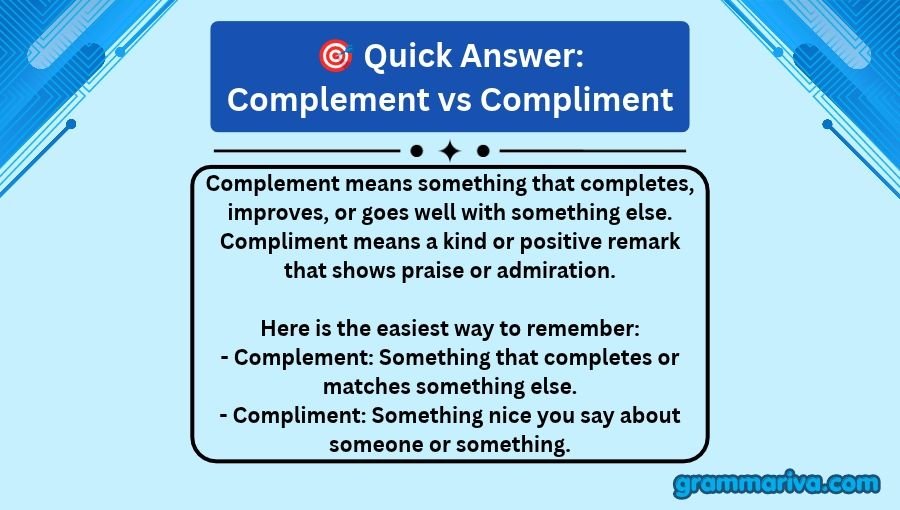
Complement means something that completes, improves, or goes well with something else. Compliment means a kind or positive remark that shows praise or admiration.
Here is the easiest way to remember:
- Complement: Something that completes or matches something else.
- Compliment: Something nice you say about someone or something.
For example:
- The blue shoes complement her dress. (They match it well.)
- She gave me a lovely compliment. (She said something nice.)
Both words are correct English words. However, they cannot always replace each other because their meanings are different.
Understanding the Basics of Complement vs Compliment
The main difference between these words is their purpose. One describes something that completes or improves another thing. The other describes praise or appreciation.
Although they sound alike, their spelling gives you a clue about their meaning.
Complement: Meaning and Correct Use
A complement is something that completes, balances, or improves another thing. It can make something feel more complete or work better.
It can also describe something that matches another item in a pleasing way.
Examples:
- The red curtains complement the white walls.
- Her skills are a perfect complement to the team.
- Fresh fruit is a healthy complement to breakfast.
In each example, the word describes something that adds value, balance, or completeness.
Compliment: Meaning and Correct Use
A compliment is a kind or positive statement about someone or something. People give compliments to show respect, admiration, or appreciation.
Examples:
- My teacher gave me a nice compliment.
- He received a compliment about his new haircut.
- Your presentation was excellent. Thank you for the compliment!
In these sentences, the word refers to praise rather than something that completes another thing.
Complement vs Compliment Comparison Table
| Form | Type | Meaning | Example |
|---|---|---|---|
| Complement | Noun | Something that completes another thing | The sauce is a perfect complement to the meal. |
| Complement | Verb | To complete or improve something | These shoes complement your outfit. |
| Compliment | Noun | An expression of praise | She received a compliment. |
| Compliment | Verb | To praise someone | I complimented her work. |
Key Differences Between Complement and Compliment
The words differ in meaning, spelling, and use. Learning these differences will help you avoid spelling mistakes in both formal and casual writing.
| Feature | Complement | Compliment |
|---|---|---|
| Main meaning | Completes or improves | Praises or admires |
| Noun use | An addition that makes something better | A positive remark |
| Verb use | To match or complete | To praise |
| Common situation | Food, colors, skills, design | Conversations, work, appearance |
| Memory clue | Complete | Praise |
Consider these examples:
- The necklace complements her dress. ✅
- The necklace compliments her dress. ❌
The first sentence means the necklace looks good with the dress. The second suggests that the necklace is praising the dress, which is not the intended meaning.
Another pair:
- Your teacher complimented your essay. ✅
- Your teacher complemented your essay. ❌
The first sentence means the teacher praised the essay. The second would mean the teacher completed or improved it.
Why Do People Confuse Complement and Compliment?
People confuse these words because they have similar spellings and sounds. Both contain almost the same letters, so it is easy to choose the wrong one while writing.
There are several reasons behind this confusion.
Similar pronunciation: In everyday American English, the words sound very similar. This makes it hard to identify the correct spelling by listening alone.
Similar appearance: Both words begin with almost the same letters and have similar endings.
Different meanings: Their meanings are not closely related in everyday use. Remembering which spelling belongs to which meaning takes practice.
Fast typing: People often type quickly without checking their word choices.
I once reviewed a student’s school assignment in which the sentence said, “My mother gave me a beautiful complement.” The student wanted to describe a kind comment from their mother. Changing the spelling to compliment made the sentence correct.
The best solution is to connect each spelling with its meaning instead of relying only on how it sounds.
Different Meanings and Uses of Complement
The word complement has two common grammatical uses. It can work as a noun or a verb.
Complement as a Noun
As a noun, complement refers to something that completes, balances, or improves another thing.
Examples:
- This painting is a lovely complement to the room.
- Her experience is a valuable complement to our project.
- Rice is a common complement to spicy dishes.
Sentence breakdown:
In “Rice is a common complement to spicy dishes,” rice adds something useful to the meal. It balances or improves the overall food experience.
Complement as a Verb
As a verb, complement means to complete, match, or improve something.
Examples:
- Your jacket complements your shoes.
- The new software complements our existing system.
- Her calm nature complements his energetic personality.
Sentence breakdown:
In “Your jacket complements your shoes,” the jacket matches the shoes and makes the overall outfit look better.
Summary of Complement Uses
| Meaning | Word Type | Example Sentence |
|---|---|---|
| Something that completes | Noun | This final chapter is a useful complement. |
| Something that improves | Noun | The salad is a complement to the meal. |
| To match something | Verb | The curtains complement the sofa. |
| To improve something | Verb | Her ideas complement the project. |
Different Meanings and Uses of Compliment
The word compliment also works as both a noun and a verb. However, its meaning always relates to praise, admiration, or appreciation.
Compliment as a Noun
As a noun, compliment means a positive statement about someone or something.
Examples:
- She gave me a wonderful compliment.
- His kind words were the best compliment I received.
- Your feedback is a great compliment to our team.
Sentence breakdown:
In “She gave me a wonderful compliment,” the word describes the positive words she said.
Compliment as a Verb
As a verb, compliment means to say something positive about someone or something.
Examples:
- I complimented my friend on her new dress.
- The manager complimented the employee’s hard work.
- We complimented the chef on the delicious meal.
Sentence breakdown:
In “The manager complimented the employee’s hard work,” the manager praised the employee for doing a good job.
Summary of Compliment Uses
| Meaning | Word Type | Example Sentence |
|---|---|---|
| An expression of praise | Noun | She received a compliment. |
| A kind remark | Noun | His compliment made me smile. |
| To praise someone | Verb | I complimented my sister. |
| To express admiration | Verb | They complimented his performance. |
💡 Test Tip: How to Remember the Difference
A simple memory trick can help you remember which word to use.
Connect complement with complete.
Both words begin with the same letters, and something that complements another thing helps complete or improve it.
Connect compliment with praise.
When someone says something nice about you, they are giving you a compliment.
Try these quick questions:
- Does the sentence describe something that completes or matches something? Use complement.
- Does the sentence describe praise or a kind remark? Use compliment.
Easy Memory Examples
| Sentence | Correct Word | Reason |
|---|---|---|
| Her earrings match her dress. | Complement | They complete the outfit. |
| He praised my cooking. | Compliment | He said something nice. |
| The sauce improves the dish. | Complement | It adds to the meal. |
| She praised my new haircut. | Compliment | She expressed admiration. |
My favorite trick: If you can replace the word with complete, use complement. If you can replace it with praise, use compliment.
📝 Case Study: Complement vs Compliment in the Workplace
Imagine that Sarah works at a marketing company. She has recently completed a project with her colleague, Daniel.
During a meeting, their manager says:
“Daniel, your creative ideas complement Sarah’s research.”
This sentence is correct because the manager means Daniel’s ideas work well with Sarah’s research.
Later, the manager says:
“Sarah, I want to compliment you on your excellent research.”
This sentence is also correct because the manager is praising Sarah.
Now imagine that Sarah writes the following email:
“Thank you for the complement on my research.”
The intended meaning is praise, so the sentence should be:
“Thank you for the compliment on my research.”
This small spelling difference matters in professional communication.
Grammar Rules Explanation: When to Use Each Word
The correct choice depends on the meaning you want to express. Both words are accepted English spellings, but their grammar and meanings are different.
Rules for Using Complement
Use complement when discussing something that completes, balances, or improves another thing.
Common patterns include:
- Complement + noun: The colors complement the design.
- A complement to + noun: This book is a useful complement to the course.
- Complement each other: Their skills complement each other.
Examples:
- The flowers complement the room’s decoration. ✅
- The flowers compliment the room’s decoration. ❌
The first sentence describes how the flowers improve the room’s appearance.
Rules for Using Compliment
Use compliment when discussing praise or admiration.
Common patterns include:
- Give someone a compliment.
- Receive a compliment.
- Compliment someone on something.
- Pay someone a compliment.
Examples:
- I complimented him on his performance. ✅
- I complemented him on his performance. ❌
The first sentence correctly describes praising his performance.
Correct vs Incorrect at a Glance
| Sentence | Correct/Incorrect | Why |
|---|---|---|
| Your shoes complement your outfit. | ✅ Correct | The shoes match the outfit. |
| Your shoes compliment your outfit. | ❌ Incorrect | The intended meaning is matching. |
| She gave me a compliment. | ✅ Correct | She praised me. |
| She gave me a complement. | ❌ Incorrect | The intended meaning is praise. |
| Their skills complement each other. | ✅ Correct | Their skills work well together. |
Most standard English dictionaries and grammar references maintain this distinction between the two words.
⚠️ Common Mistakes With Complement and Compliment
Even experienced writers sometimes mix up these spellings. The main reason is that the words look and sound alike.
Here are some common mistakes and ways to avoid them.
Commonly Confused English Words
| Word Pair | Difference |
|---|---|
| Complement / Compliment | Complete or improve / Praise |
| It’s / Its | It is or it has / Belonging to it |
| Your / You’re | Belonging to you / You are |
| Their / There | Belonging to them / A place or position |
| Principal / Principle | Main or school leader / A rule or belief |
| Stationary / Stationery | Not moving / Writing materials |
Why These Mistakes Happen
Fast typing: When people write quickly, they may choose the first spelling that looks familiar.
Autocorrect: Some devices may replace a word with another correctly spelled word that does not fit the sentence.
Lack of knowledge: Writers who have not learned the meaning difference may use the words interchangeably.
I once caught myself typing “a nice complement” in a thank-you email when I meant to thank someone for their kind words. The spelling was correct, but the meaning was wrong. Reading the sentence again helped me catch the mistake.
Common Wrong Spellings and Uses
| Wrong Form | What’s Wrong | Correct Form |
|---|---|---|
| Thank you for the complement. | Wrong word for praise | Thank you for the compliment. |
| She complimented my outfit by matching it. | Wrong word for matching | She complemented my outfit. |
| His advice was a nice compliment to the plan. | Wrong word for an addition | His advice was a nice complement to the plan. |
| The colors compliment each other. | Wrong word for matching | The colors complement each other. |
| He gave me a great complement. | Wrong word for praise | He gave me a great compliment. |
| Her skills compliment his skills. | Wrong word for working well together | Her skills complement his skills. |
How to Use Complement and Compliment in Different Contexts
Both words appear in everyday conversations, business writing, creative content, and social media. The correct choice depends on what you want to say.
Everyday Conversation
Use complement when talking about things that work well together.
Use compliment when talking about praise.
Examples:
- That scarf complements your coat.
- Your hairstyle looks great. That’s a lovely compliment!
Professional Writing
In business communication, complement often describes skills, services, ideas, or products that work well together.
Compliment is useful when praising a colleague, employee, or business partner.
Examples:
- Your experience complements the team’s current skills.
- I would like to compliment you on your excellent presentation.
Creative Writing
Writers use complement to describe how characters, colors, sounds, and ideas fit together.
They use compliment when one character praises another.
Examples:
- The soft music complemented the peaceful setting.
- He complimented her courage before the journey began.
Social Media and Texting
Both words are common in online communication.
Examples:
- “Your new profile picture looks amazing!” is a compliment.
- “These colors complement each other perfectly” describes a good match.
Usage Comparison Table
| Context | Which Term to Use | Example |
|---|---|---|
| Everyday conversation | Both | Your shoes complement your dress. |
| Professional writing | Both | I complimented my colleague. |
| Creative writing | Both | Their personalities complement each other. |
| Social media/texting | Both | Thanks for the compliment! |
Common Phrases With Complement
Several common expressions use complement to describe things that complete or improve each other.
| Phrase | Meaning |
|---|---|
| A perfect complement | Something that fits or improves another thing perfectly |
| Complement each other | To work well together |
| A complement to something | An addition that improves something |
| The perfect complement | An ideal matching addition |
| Complementary colors | Colors that work well together in a color scheme |
Examples:
- Their personalities complement each other.
- This dessert is the perfect complement to dinner.
- The blue and orange shades are complementary colors.
Common Phrases With Compliment
The word compliment appears in several common expressions related to praise and appreciation.
| Phrase | Meaning |
|---|---|
| Pay someone a compliment | Say something nice to someone |
| Give a compliment | Express praise |
| Receive a compliment | Get praise from someone |
| Take it as a compliment | Accept something as praise |
| Backhanded compliment | A remark that sounds positive but contains an insult |
| Compliments of the chef | A dish or item provided by the chef as a courtesy |
Examples:
- She paid me a lovely compliment.
- I received a compliment from my manager.
- He took her kind words as a compliment.
Synonyms and Alternatives for Complement and Compliment
Sometimes you can replace these words with other terms. However, the best alternative depends on the meaning and sentence structure.
Alternatives for Complement
| Alternative | Works When | Does Not Work When |
|---|---|---|
| Complete | Something needs finishing | You mean praise |
| Enhance | Something improves another thing | You mean a kind remark |
| Match | Two things look good together | You mean finishing a task |
| Balance | Something creates harmony | You mean admiration |
Alternatives for Compliment
| Alternative | Works When | Does Not Work When |
|---|---|---|
| Praise | Someone receives positive words | Something completes another thing |
| Admire | Showing respect or appreciation | Describing a matching item |
| Appreciate | Expressing gratitude or value | Describing physical completeness |
| Commend | Formally praising someone’s actions | Describing colors or designs |
Remember that synonyms are not always exact replacements. Check the full sentence before changing a word.
Why Getting Complement and Compliment Right Matters
Using the correct word helps readers understand your message without confusion. Although the spelling difference is small, the meaning can change completely.
Clarity in Communication
Correct spelling helps people understand whether you are describing a good match or expressing praise.
Professionalism
In emails, reports, and business messages, correct word choice shows attention to detail.
Writing Accuracy
Accurate spelling makes your articles, assignments, and online content easier to read and trust.
As a simple writing rule, I believe every word should express the meaning you actually intend.
Clear writing begins with choosing the right words.
Why It Matters in Different Situations
| Situation | Why Getting It Right Matters |
|---|---|
| Resume | Shows strong writing skills and attention to detail |
| Client email | Keeps your message clear and professional |
| Published content | Improves accuracy and reader trust |
| Social post | Helps readers understand your intended message |
Quick Recap Checklist: Complement vs Compliment
Use this checklist whenever you are unsure which spelling belongs in your sentence.
| Question | If Yes → Use |
|---|---|
| Does the word mean complete something? | Complement |
| Does it describe something that matches another thing? | Complement |
| Does it mean praise or admiration? | Compliment |
| Does it describe a kind remark? | Compliment |
| Are you saying something positive about a person? | Compliment |
Practice Examples
Test your understanding with these sentences.
Example A: The blue tie ______ his black suit.
Answer: complements
Why? The tie matches the suit.
Example B: My boss gave me a nice ______ after the presentation.
Answer: compliment
Why? The boss praised the presentation.
Example C: I want to ______ you on your excellent work.
Answer: compliment
Why? The speaker wants to praise someone.
FAQs About Complement vs Compliment
What is the main difference between complement and compliment?
Complement means something that completes, improves, or matches another thing. Compliment means a kind statement or expression of praise.
Is it a compliment or a complement?
It depends on what you mean. Use compliment for praise and complement for something that completes or improves another thing.
For example, “She gave me a compliment” is correct when describing praise.
How do you remember complement vs compliment?
Connect complement with complete. Both begin with the same letters. Connect compliment with praise to remember that it describes kind words.
Can complement be used as a verb?
Yes. As a verb, complement means to complete, improve, or match something.
Example: The curtains complement the furniture.
Can compliment be used as a verb?
Yes. As a verb, compliment means to praise someone or something.
Example: I complimented her on her excellent work.
What does it mean when two things complement each other?
It means two things work well together or improve each other. They may create a better result when combined.
Example: Their different skills complement each other.
What does a backhanded compliment mean?
A backhanded compliment is a statement that sounds like praise but also contains criticism or an insult.
Example: “You look good today, much better than usual.”
Is complementary the same as complimentary?
No. Complementary means completing, matching, or improving something.
Complimentary usually means free of charge or expressing praise.
Examples:
- The colors are complementary.
- The hotel offers complimentary breakfast.
What is the plural of compliment?
The plural is compliments. It refers to more than one positive remark.
Example: She received several compliments about her presentation.
What does compliments of the chef mean?
“Compliments of the chef” means the chef is providing something as a courtesy, usually without charging the customer for it.
Conclusion
Understanding complement vs compliment becomes simple when you connect each spelling with its meaning. Remember that complement means to complete, improve, or match something. On the other hand, compliment means to praise someone or express admiration.
You can use complement when discussing outfits, colors, food, skills, and ideas that work well together. Use compliment when giving someone kind words or recognizing their achievements.
My best advice is to remember two simple words: complete and praise. If your sentence is about completing or matching something, choose complement. If it is about saying something nice, choose compliment.
Keep practicing with short sentences and check your word choice before publishing important writing. With time, the difference will become natural. 😊

Hi, I’m Lucas Bennett. I’m a grammar content specialist at Grammariva. I work on articles covering everyday grammar questions, sentence usage, and writing tips that readers can apply with confidence.


[…] grammar rules, examples, and common mistakes so you can use both words with confidence. ✍️ Complement vs Compliment | Stationary vs Stationery | Principal vs […]
[…] English. By the end, you’ll know exactly when to use each word. 🎯 Discreet vs Discrete | Complement vs Compliment | Stationary vs […]