Principal vs principle is a common grammar confusion because both words sound exactly alike but have different meanings. Have you ever stopped while writing an email because you were unsure which spelling to use?
You’re not alone. One word refers to a school leader, a person in charge, or something most important. The other describes a belief, value, or basic rule that guides behavior. Choosing the wrong word can change the meaning of your sentence.
As an English writing guide, I recommend learning these words through simple examples instead of memorizing long definitions. In this article, I’ll explain their meanings, show you how to use them correctly, and share easy memory tricks. By the end, you’ll know exactly which spelling fits your sentence. 🎯 License vs Licence | Practice vs Practise | Advice vs Advise
🎯 Quick Answer: Principal vs Principle
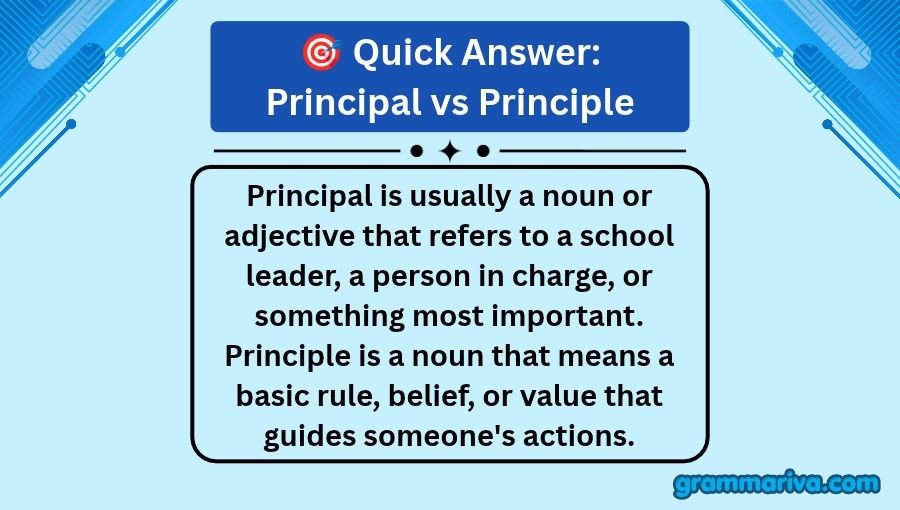
Principal is usually a noun or adjective that refers to a school leader, a person in charge, or something most important. Principle is a noun that means a basic rule, belief, or value that guides someone’s actions.
Remember this simple trick:
- Principal = Person or Primary thing.
- Principle = Rule or Belief.
Examples:
- The principal welcomed the new students.
- Honesty is an important principle in our family.
Both words sound the same, but their meanings are different.
Understanding the Basics of Principal vs Principle
The main difference between these words is their meaning and purpose. Although they share the same pronunciation, they cannot be used in place of each other.
| Form | Type | Meaning | Example |
|---|---|---|---|
| Principal | Noun | A school leader or person in charge | The principal spoke to the parents. |
| Principal | Adjective | Main or most important | Safety is our principal concern. |
| Principle | Noun | A basic rule or belief | Trust is a key principle of friendship. |
| Principles | Plural noun | More than one rule or belief | She follows strong moral principles. |
What Does Principal Mean?
The word principal can work as both a noun and an adjective.
As a noun, it often describes the head of a school or someone who manages an organization.
Examples:
- Our school principal announced a new schedule.
- The principal called the student’s parents.
- She wants to become a school principal.
As an adjective, it describes something that is most important or has the highest level of importance.
Examples:
- The principal reason for the delay was bad weather.
- Our principal goal is to help students succeed.
- The principal character appears in every chapter.
In simple words, think of principal as a person in charge or something that comes first in importance.
What Does Principle Mean?
A principle is a basic belief, rule, or idea that guides how someone thinks or behaves.
It is commonly used when discussing honesty, fairness, respect, justice, and personal values.
Examples:
- Honesty is a strong principle of good leadership.
- She refused to break her principles.
- Every team should follow the principle of fairness.
Principles can guide people at home, at school, and in the workplace.
For example, a teacher may believe that every student deserves equal treatment. This belief is a professional principle.
Principal vs Principle: Key Differences
| Feature | Principal | Principle |
|---|---|---|
| Word type | Noun and adjective | Noun |
| Main meaning | Leader or most important | Rule or belief |
| Refers to a person | Yes | No |
| Describes importance | Yes | No |
| Refers to values | No, not normally | Yes |
| Common use | Schools, business, finance | Ethics, beliefs, rules |
| Example | The principal is helpful. | Honesty is a principle. |
Why Do People Confuse Principal and Principle?
People confuse these words because they sound exactly alike. This type of word pair is called a homophone. Homophones have the same pronunciation but different spellings and meanings.
When speaking, listeners cannot see which spelling someone means. The confusion usually appears in writing.
For example:
- The school principle welcomed everyone. ❌
- The school principal welcomed everyone. ✅
The second sentence is correct because it refers to the head of a school.
I once reviewed a student’s school essay where the writer used “school principle” several times. The meaning was clear from the sentences, but the spelling needed correction. The student remembered the difference after learning that a principal is a person.
Three common reasons explain this confusion:
- Similar pronunciation: Both words sound the same.
- Similar spelling: They share almost all their letters.
- Limited practice: Writers may understand the meanings but forget which spelling matches each one.
The easiest solution is to focus on the meaning before choosing the spelling.
Principal: Meaning and Correct Uses
The word principal has several common uses. It can describe a school leader, a person with authority, or the most important part of something.
Principal as a School Leader
This is one of the most familiar uses of the word.
Examples:
- The principal visited every classroom.
- Our principal organized a school event.
- Parents requested a meeting with the principal.
In these sentences, principal refers to the person who leads or manages a school.
Principal as the Main or Most Important Thing
Principal can also describe something that has the greatest importance.
Examples:
- My principal concern is student safety.
- The principal reason for moving was a new job.
- Her principal responsibility is managing the team.
Here, principal works as an adjective.
Principal in Finance
In banking and finance, principal refers to the original amount of money borrowed or invested, not including interest.
Examples:
- I paid part of the loan principal this month.
- The principal amount was $10,000.
- Your monthly payment includes principal and interest.
This meaning is common in loans, mortgages, and investment discussions.
Principal as a Person With Authority
Outside schools, principal can describe someone who has the highest authority in a particular role or business setting.
Examples:
- The company principal approved the agreement.
- The principal owner attended the meeting.
- Each principal partner signed the contract.
The exact meaning depends on the situation.
| Meaning | Word Type | Example Sentence |
|---|---|---|
| School leader | Noun | The principal greeted the children. |
| Main or primary | Adjective | Our principal goal is success. |
| Original loan amount | Noun | She reduced the loan principal. |
| Person with authority | Noun | The principal approved the deal. |
💡 Test Tip for Principal
Try replacing principal with main, primary, or school leader.
If the replacement makes sense, principal is probably the correct choice.
For example:
- The main reason was poor planning.
- The principal reason was poor planning.
Both sentences have the same meaning. Therefore, principal is correct.
Principle: Meaning and Correct Uses
The word principle refers to a basic truth, belief, rule, or value. It is used when discussing the ideas that guide people’s actions and decisions.
Principle as a Personal Belief
People have personal principles that help them decide what is right and wrong.
Examples:
- Honesty is one of my strongest principles.
- He follows his principles even under pressure.
- Respect is an important principle in our home.
These sentences describe personal values.
Principle as a Moral Rule
A moral principle is an idea about how people should behave.
Examples:
- Treating others fairly is a good principle.
- She believes in the principle of equal rights.
- Kindness is a valuable principle of friendship.
Principle as a Basic Rule or Idea
Principle is also used in education, science, business, and other fields.
Examples:
- Students learned the basic principles of physics.
- The company follows the principle of customer satisfaction.
- This design works on a simple principle.
In these examples, the word describes a basic idea or rule.
Principles in Everyday Life
People follow different principles in their daily routines.
Some common examples include:
- Telling the truth.
- Respecting other people.
- Keeping promises.
- Treating everyone fairly.
- Taking responsibility for mistakes.
These values can influence personal and professional decisions.
| Meaning | Word Type | Example Sentence |
|---|---|---|
| Personal belief | Noun | Honesty is my guiding principle. |
| Moral rule | Noun | Fairness is a basic principle. |
| Basic idea | Noun | The principle of gravity explains the concept. |
| Guiding value | Noun | Respect is an important principle. |
💡 Test Tip for Principle
Try replacing principle with rule, belief, or value.
Example:
- Fairness is an important value.
- Fairness is an important principle.
Both sentences make sense. This tells you that principle is correct.
Is Principal an Adjective or a Noun?
Yes, principal can be both a noun and an adjective. Its meaning changes depending on how it is used in a sentence.
As a noun, it often identifies a school leader or a person with authority.
As an adjective, it describes the main or most important thing.
Examples:
- The principal welcomed the visitors. (Noun)
- Education is our principal goal. (Adjective)
- The principal of the school announced the results. (Noun)
- Her principal concern was student safety. (Adjective)
Remember: Principle is a noun. It does not work as an adjective in standard English.
Can Principle Be Used as a Plural Word?
Yes. The plural form of principle is principles. It refers to two or more beliefs, rules, or basic ideas.
Examples:
- She follows strong personal principles.
- The students studied the principles of mathematics.
- Good leaders follow ethical principles.
The word principal also has a plural form: principals.
Examples:
- Several school principals attended the meeting.
- The principals discussed the new education policy.
| Singular | Plural | Meaning |
|---|---|---|
| Principal | Principals | School leaders or main people |
| Principle | Principles | Rules, beliefs, or values |
Both words can become plural, but their meanings remain different.
Case Study: Principal vs Principle in a Workplace Email
Imagine that a company manager sends an email to employees about a new workplace policy.
The manager wants to explain that honesty and fairness are important values. The manager also needs approval from the company’s principal.
Here is an example:
Incorrect email:
“Our company believes in the principal of honesty. The company principle will review the new policy tomorrow.”
Both words are used incorrectly.
Correct email:
“Our company believes in the principle of honesty. The company principal will review the new policy tomorrow.”
Why are these choices correct?
- Principle of honesty: This refers to a value that guides company behavior.
- Company principal: This refers to a person with authority.
I once caught a similar spelling mix-up while reviewing a business document. The writer had used principal when describing an ethical value. Changing one letter made the sentence accurate and more professional.
This example shows why checking meaning is more useful than relying on sound alone.
Grammar Rules Explanation: When to Use Each Word
The correct choice depends on the role and meaning of the word in your sentence.
Rule for Principal
Use principal when referring to:
- A school leader.
- A person with authority.
- Something that is main or most important.
- The original amount of a loan or investment.
Examples:
- The principal addressed the students.
- Our principal objective is to improve quality.
- I paid the remaining loan principal.
Rule for Principle
Use principle when referring to:
- A belief.
- A moral value.
- A basic rule.
- A fundamental idea.
Examples:
- Honesty is a valuable principle.
- The principle of fairness matters.
- Students studied the basic principles of science.
Correct vs Incorrect at a Glance
| Sentence | Correct/Incorrect | Why |
|---|---|---|
| The school principal is friendly. | ✅ Correct | Principal means school leader. |
| Honesty is a strong principal. | ❌ Incorrect | Principle means a guiding belief. |
| Fairness is an important principle. | ✅ Correct | Principle means a value or rule. |
| The principle announced the results. | ❌ Incorrect | Principal is the school leader. |
| The principal reason was the cost. | ✅ Correct | Principal means most important. |
A Simple Grammar Rule to Remember
Use principal for a person or something primary. Use principle for a belief or rule.
This rule covers most everyday writing situations.
⚠️ Common Mistakes With Principal and Principle
Even experienced writers can mix up these words. Their identical pronunciation makes it easy to select the wrong spelling.
Here are some common reasons:
- Fast typing: People often type the first spelling that comes to mind.
- Autocorrect: A spelling tool may not recognize a wrong word if it is correctly spelled but incorrectly used.
- Lack of knowledge: Some writers have not learned the difference between the two meanings.
- Speaking habits: Since both words sound alike, speaking does not help identify the correct spelling.
Similar Grammar Confusions
Principal and principle are not the only words that cause problems. English has several pairs that sound or look similar.
| Word Pair | Difference | Example |
|---|---|---|
| Its / It’s | Possession / It is | The dog wagged its tail. |
| Your / You’re | Possession / You are | You’re very helpful. |
| There / Their | Place / Possession | Their house is over there. |
| Affect / Effect | Usually verb / Usually noun | Sleep can affect your mood. |
| Then / Than | Time / Comparison | She is taller than me. |
| Principal / Principle | Leader or main / Rule or belief | The principal values honesty. |
Common Wrong Spellings and Uses
| Wrong Form | What’s Wrong | Correct Form |
|---|---|---|
| School principle | Uses the word for a belief | School principal |
| Moral principal | Uses the word for a leader | Moral principle |
| Main principle reason | Uses the wrong word for importance | Main principal reason |
| Basic principals of science | Uses the leader-related spelling | Basic principles of science |
| Principal of honesty | Uses the wrong spelling for a value | Principle of honesty |
| Loan principle | Uses the wrong spelling for the original amount | Loan principal |
How to Avoid These Mistakes
Follow these simple steps before publishing or sending your writing:
- Read the full sentence.
- Identify what the word describes.
- Replace principal with “main” or “school leader.”
- Replace principle with “rule” or “belief.”
- Check the sentence again.
This short habit can prevent many spelling mistakes.
How to Remember the Difference Between Principal and Principle
A memory trick can help you choose the right spelling without checking a dictionary every time.
Remember Principal as a Person
The word principal contains the letters “pal” at the end.
Think of a school principal as a person who works with students and teachers.
Principal = Your school pal or a person in charge.
This is a simple memory trick, not the word’s formal definition.
Remember Principle as a Rule
Think of principle as a personal rule or belief.
For example:
- Honesty is my principle.
- Fairness is our principle.
- Respect is an important principle.
Use the Main vs Rule Test
Ask yourself one question:
Am I talking about a person or something important?
- If yes, use principal.
- If you are talking about a belief or rule, use principle.
| Memory Trick | Word | Example |
|---|---|---|
| Person in charge | Principal | Our principal is helpful. |
| Main thing | Principal | The principal reason is clear. |
| Personal belief | Principle | Honesty is my principle. |
| Basic rule | Principle | Follow the principle of fairness. |
Principal vs Principle in Different Contexts
Both words appear in many areas of everyday life. However, the correct spelling depends on the context.
Everyday Conversation
People use principal when talking about schools, leaders, and important things.
Principle is used when discussing values and beliefs.
Examples:
- Our principal is very kind.
- I never compromise my principles.
Professional Writing
In professional documents, principal may refer to a manager, leader, or main business concern.
Principle is often used to describe company values and ethical standards.
Examples:
- The principal approved the project.
- Transparency is a key business principle.
Creative Writing
Writers use principal when describing an important character, person, or event.
They use principle when discussing a character’s beliefs or moral choices.
Examples:
- The principal character faced a difficult decision.
- The hero refused to abandon his principles.
Social Media and Texting
People may use both words in posts, captions, and messages.
Examples:
- Our school principal deserves appreciation.
- Never give up your principles for attention.
| Context | Which Term to Use | Example |
|---|---|---|
| Everyday conversation | Both | The principal is kind. Honesty is a principle. |
| Professional writing | Both | The principal approved it. Fairness is a principle. |
| Creative writing | Both | The principal character follows strong principles. |
| Social media/texting | Both | Respect your principles. |
Common Phrases With Principal and Principle
Both words appear in common expressions. Learning these phrases can make your writing more natural.
Common Phrases With Principal
- School principal: The person who leads a school.
- Principal reason: The main reason for something.
- Principal concern: The most important concern.
- Principal amount: The original amount of money borrowed or invested.
- Principal character: The main character in a story.
Common Phrases With Principle
- Basic principle: A fundamental rule or idea.
- Moral principle: A belief about right and wrong.
- Guiding principle: A value that helps someone make decisions.
- Principle of fairness: The belief that people should be treated fairly.
- Matter of principle: Something done because of a personal belief.
| Phrase | Meaning |
|---|---|
| School principal | Head of a school |
| Principal reason | Main reason |
| Principal amount | Original loan or investment amount |
| Basic principle | Fundamental rule or idea |
| Guiding principle | Belief that guides decisions |
| Matter of principle | Action based on personal values |
Synonyms and Alternatives for Principal and Principle
Synonyms can help make your writing more varied. However, not every alternative works in every sentence.
Alternatives for Principal
- Main: Use when describing the most important thing.
- Primary: Use when discussing the first or leading concern.
- Chief: Use when describing the highest-ranking person or most important factor.
- Head: Use when referring to someone who leads an organization.
Alternatives for Principle
- Rule: Use when describing an instruction or standard.
- Belief: Use when discussing a personal idea.
- Value: Use when describing something important to a person.
- Guideline: Use when explaining a recommended way to act.
| Alternative | Works When | Does Not Work When |
|---|---|---|
| Main | Describing importance | Referring specifically to a school leader |
| Primary | Describing a leading concern | Referring to an ethical belief |
| Chief | Describing a leader or major factor | Referring to every basic rule |
| Rule | Describing a standard | Describing a school principal |
| Belief | Describing personal values | Describing the original loan amount |
Always check the meaning before replacing one word with another.
Why Getting Principal and Principle Right Matters
Correct spelling helps readers understand your message. Even when two words sound alike, their meanings can be very different.
Clarity in Communication
Using the right word prevents confusion.
For example, “school principal” identifies a person. “School principle” suggests a rule or belief connected to a school.
Professionalism
Correct spelling makes emails, reports, resumes, and business documents look polished.
Accuracy in Digital Communication
Search engines, online readers, and editing tools all benefit from clear and accurate writing. Choosing the correct word also helps your content match what readers are trying to understand.
A useful reminder is:
“Clear words make clear ideas easier to understand.”
| Situation | Why Getting It Right Matters |
|---|---|
| Resume | Shows strong writing skills. |
| Client email | Makes your message professional. |
| Published content | Helps readers understand the topic. |
| Social media post | Prevents spelling confusion. |
Practice Examples: Test Your Knowledge
Now that you understand the difference, try these examples. Choose the correct word for each sentence.
Practice Example A
The school ______ welcomed the new students.
- Principal
- Principle
Correct answer: Principal
The sentence refers to the person who leads the school.
Practice Example B
Honesty is an important ______ in our family.
- Principal
- Principle
Correct answer: Principle
The sentence refers to a personal value.
Practice Example C
The ______ reason for the meeting was to discuss safety.
- Principal
- Principle
Correct answer: Principal
The word describes the main reason.
✅ Quick Recap Checklist
Use this checklist whenever you are unsure which spelling belongs in your sentence.
| Question | If Yes → Use |
|---|---|
| Are you talking about a school leader? | Principal |
| Do you mean the main or most important thing? | Principal |
| Are you talking about an original loan amount? | Principal |
| Are you describing a personal belief? | Principle |
| Are you discussing a moral rule? | Principle |
| Are you explaining a basic idea? | Principle |
Final Practice
Choose the correct word in each sentence:
- The school (principal/principle) gave a speech.
- Respect is a basic (principal/principle).
- The (principal/principle) reason for leaving was the weather.
Answers:
- Principal
- Principle
- Principal
If you can answer these correctly, you understand the main difference.
FAQs About Principal vs Principle
What Is the Main Difference Between Principal and Principle?
Principal refers to a school leader, person in charge, or something most important. Principle refers to a basic rule, belief, or value that guides behavior.
Is Principal or Principle Used for a School Head?
Principal is the correct word for a school head. For example, “The principal welcomed the new students.”
Is Principle a Rule or a Belief?
Principle can mean both. It describes a basic rule, belief, or value that guides someone’s actions and decisions.
Is Principal an Adjective?
Yes. Principal can be an adjective meaning main or most important. For example, “Our principal concern is safety.”
Can Principle Be Used as an Adjective?
No. In standard English, principle is a noun. It refers to a rule, belief, or basic idea.
What Is the Plural of Principal?
The plural of principal is principals. It can refer to two or more school leaders or people in charge.
What Is the Plural of Principle?
The plural of principle is principles. It refers to multiple beliefs, rules, or basic ideas.
How Do You Remember Principal vs Principle?
Remember that principal can refer to a person in charge or something primary. Principle refers to a personal belief or basic rule. You can also remember the “principal is your school pal” trick.
Is It Principal Amount or Principle Amount?
Principal amount is correct in finance. It refers to the original amount of money borrowed or invested before interest.
Is It a Matter of Principal or Principle?
A matter of principle is the correct expression. It describes an action or decision based on someone’s values or beliefs.
Conclusion
Understanding principal vs principle becomes easy when you focus on what each word means. Use principal when talking about a school leader, someone in charge, the main reason, or the original amount of a loan.
Use principle when discussing a personal belief, moral value, basic rule, or guiding idea. Both words sound the same, but their spelling and meaning are different. My best advice is to pause for a moment before choosing either word.
Ask yourself whether you mean a person or something important, or whether you mean a rule or belief. This small habit can improve your emails, school assignments, professional documents, and online content. You do not need to memorize complicated grammar rules to get it right.
Just remember the simple trick: Principal = Person or Primary. Principle = Rule or Belief. Keep practicing with real sentences, and choosing the correct spelling will soon become second nature. ✨

Hi, I’m Olivia Carter. I’m an English language editor at Grammariva, and I work on making grammar lessons clear, accurate, and easy to follow. I especially enjoy writing about common grammar mistakes and everyday English.


[…] how to use each word correctly. Let’s make this common spelling confusion easy to solve! 😊 Principal vs Principle | License vs Licence | Practice vs […]
[…] know exactly when to use each word. Let’s get started! 🎯 Stationary vs Stationery | Principal vs Principle | License vs […]