Have you ever stopped while writing a message because you were unsure about your vs you’re? These two words sound exactly the same, but they have different meanings and grammatical uses.
Understanding your vs you’re is easier than you might think. One word shows ownership, while the other is a shorter way to say two words. Once you learn this simple rule, you can use both forms correctly in emails, schoolwork, social media posts, and everyday conversations. 😊
As an English writing guide, I recommend learning the meaning of each word instead of trying to remember spelling alone. A quick sentence test can help you make the right choice every time.
In this guide, I will explain the rules, share simple examples, point out common mistakes, and give you practice questions. By the end, you will know exactly which word belongs in your sentence. Its vs It’s | Who vs Whom | Lay vs Lie
🎯 Quick Answer: Your vs You’re
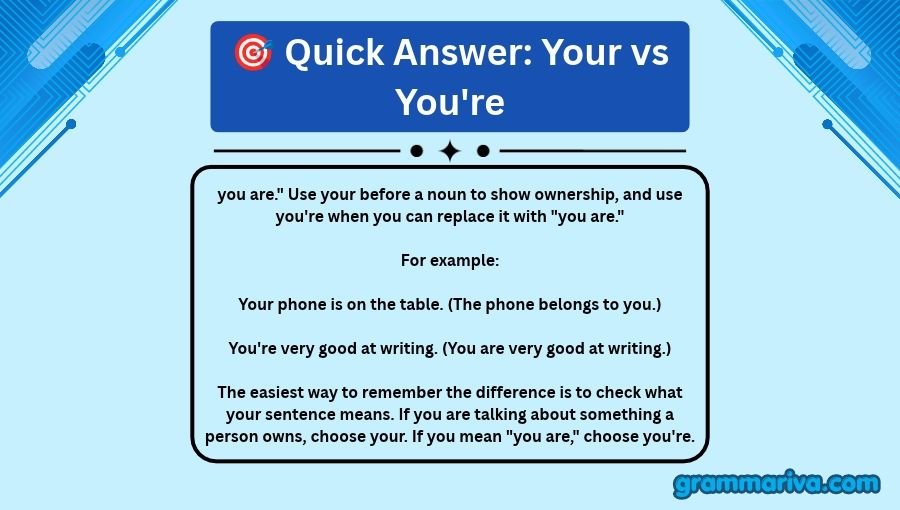
Your is a possessive word that shows something belongs to someone. You’re is a contraction of “you are.” Use your before a noun to show ownership, and use you’re when you can replace it with “you are.”
For example:
- Your phone is on the table. (The phone belongs to you.)
- You’re very good at writing. (You are very good at writing.)
The easiest way to remember the difference is to check what your sentence means. If you are talking about something a person owns, choose your. If you mean “you are,” choose you’re.
📚 Understanding the Basics of Your and You’re
The main difference between these words is their grammatical purpose. Although they sound alike, they cannot replace each other in standard English.
Your describes ownership. You’re joins the pronoun “you” with the verb “are.” Both forms are common in American English, but each follows a different rule.
Your: Meaning and Correct Use
Your is a possessive determiner. It tells readers that something belongs to the person being addressed.
It usually appears before a noun. The noun can describe a person, place, object, feeling, or idea.
Examples:
- Your house looks beautiful.
- I like your new haircut.
- Please bring your notebook tomorrow.
- Your answer is correct.
- Where did you park your car?
In each sentence, your connects the person being addressed with something related to them.
Let’s break down one example:
Your jacket is beautiful.
- Your = shows ownership.
- Jacket = the item being discussed.
- Is beautiful = describes the jacket.
The sentence tells someone that the jacket belongs to them.
You’re: Meaning and Correct Use
You’re is a contraction made from two words: “you” and “are.”
A contraction combines two words into a shorter form. The apostrophe replaces the missing letter in the original phrase.
Examples:
- You’re my best friend.
- You’re doing a great job.
- I think you’re ready.
- You’re welcome to join us.
- You’re always kind to others.
Let’s break down one example:
You’re a wonderful teacher.
- You = the person being discussed.
- ‘re = the shortened form of “are.”
- A wonderful teacher = describes that person.
The full sentence is “You are a wonderful teacher.”
Your vs You’re Comparison Table
| Form | Type | Meaning | Example | Correct/Incorrect |
|---|---|---|---|---|
| Your | Possessive determiner | Shows ownership | Your book is here. | ✅ Correct |
| You’re | Contraction | You are | You’re kind. | ✅ Correct |
| Your | Possessive determiner | Shows ownership | I like your idea. | ✅ Correct |
| You’re | Contraction | You are | You’re very helpful. | ✅ Correct |
| Your | Possessive determiner | Used instead of you are | Your very nice. | ❌ Incorrect |
| You’re | Contraction | Used instead of ownership | You’re phone is new. | ❌ Incorrect |
💡 What Are the Main Meanings of Your and You’re?
These words have different grammatical meanings. Your shows possession, while you’re expresses a subject together with the verb “are.”
There are several ways to understand how they work in everyday sentences.
Your Shows Ownership or Connection
Your identifies something connected to the person you are speaking to. That connection does not always mean legal ownership.
Examples:
- Your mother called this morning.
- Your favorite song is playing.
- I enjoyed your presentation.
- Your team won the match.
- Your dreams deserve attention.
In these examples, the word connects the listener to a person, song, presentation, team, or dream.
It can also show relationships or personal qualities:
- Your smile makes people happy.
- Your family is very supportive.
- Your opinion matters.
You’re Describes a Person or Action
You’re can introduce a description, an identity, a feeling, or an action happening in the present.
Examples:
- You’re happy today.
- You’re a great friend.
- You’re learning English.
- You’re getting better every day.
- You’re working too hard.
Remember that every sentence containing you’re must make sense when expanded to “you are.”
Summary of the Main Meanings
| Meaning | Word Type | Example Sentence |
|---|---|---|
| Ownership | Possessive determiner | Your room is clean. |
| Personal connection | Possessive determiner | Your brother is here. |
| Description | Contraction | You’re funny. |
| Identity | Contraction | You’re a good student. |
| Present action | Contraction | You’re reading a book. |
🔍 How Can You Remember the Difference?
You can remember the correct spelling with one simple trick: replace you’re with “you are” whenever you are unsure.
If the sentence still makes sense, you’re is correct. If it does not, you probably need your.
Try these examples:
- You’re looking great. → You are looking great. ✅
- Your shoes look great. → You are shoes look great. ❌
- I like your cooking. → I like you are cooking. ❌
- You’re an excellent cook. → You are an excellent cook. ✅
This replacement method is one of the easiest ways to check your writing.
💡 The Simple Test Tip
Whenever you hesitate between the two words, follow these steps:
- Read the complete sentence.
- Replace you’re with “you are.”
- Check whether the sentence sounds correct.
- If it does, use you’re.
- If it does not, check whether you are showing ownership. If so, use your.
Remember: Your goes with a noun. You’re means “you are.”
However, your can also appear before words that describe a noun.
For example, “Your beautiful garden looks amazing” is correct because beautiful describes the noun garden.
📝 A Real-Life Case Study: Your and You’re at Work
Imagine that a team leader is sending a message to a new employee about an upcoming project.
Here is the original message:
“You’re presentation looks excellent. Your ready to share it with the team tomorrow.”
Although the message is easy to understand, it contains two spelling mistakes.
The corrected version is:
“Your presentation looks excellent. You’re ready to share it with the team tomorrow.”
Why are these corrections necessary?
- Your presentation: The presentation belongs to or was prepared by the employee.
- You’re ready: This means “You are ready.”
I use examples like this when explaining grammar because they show how one small spelling change can affect the meaning of a sentence.
Here is another workplace example:
| Incorrect Sentence | Correct Sentence | Explanation |
|---|---|---|
| You’re report is ready. | Your report is ready. | The report is connected to the employee. |
| Your doing great work. | You’re doing great work. | You are doing great work. |
| Please check you’re email. | Please check your email. | The email belongs to the reader. |
| Your welcome to attend. | You’re welcome to attend. | You are welcome to attend. |
The lesson is simple: always check whether you are showing ownership or describing the person you are addressing.
📖 Grammar Rules Explanation for Your and You’re
The rules behind these words are straightforward. Your functions as a possessive determiner, while you’re functions as a contraction of a pronoun and a verb.
Understanding their grammatical roles helps you avoid mistakes in longer and more complex sentences.
The Grammar Rule for Your
Use your when you want to show that something belongs to or is connected with the person you are addressing.
Your normally comes before a noun or a phrase that describes a noun.
Correct examples:
- Your dog is sleeping.
- Your new shoes look expensive.
- I appreciate your honest opinion.
- Your hard work paid off.
Incorrect examples:
- You’re dog is sleeping. ❌
- You’re new shoes look expensive. ❌
Why are these incorrect?
In both sentences, the writer needs a word that shows ownership. The contraction you’re cannot perform that job.
The Grammar Rule for You’re
Use you’re when you mean “you are.”
The contraction can appear before an adjective, a noun phrase, or a verb ending in -ing.
Correct examples:
- You’re beautiful.
- You’re a smart person.
- You’re making progress.
- You’re becoming more confident.
Incorrect examples:
- Your beautiful. ❌
- Your a smart person. ❌
- Your making progress. ❌
These sentences need the verb “are.” Therefore, you’re is the correct form.
Correct vs Incorrect at a Glance
| Sentence | Correct/Incorrect | Why |
|---|---|---|
| Your birthday is tomorrow. | ✅ Correct | Shows ownership or personal connection. |
| You’re going to love this movie. | ✅ Correct | Means “You are going to love this movie.” |
| Your very talented. | ❌ Incorrect | Needs “You are.” |
| You’re favorite color is blue. | ❌ Incorrect | Needs the possessive form. |
| I hope you’re having fun. | ✅ Correct | Means “I hope you are having fun.” |
A useful way to avoid errors is to understand the role of each word rather than relying only on how it sounds.
⚠️ Why Do People Confuse Your and You’re?
People often confuse these words because they sound the same when spoken. Their spelling is also very similar, so it is easy to choose the wrong one when typing quickly.
There are several common reasons behind this confusion.
They Have the Same Sound
In normal speech, both words are pronounced the same way by most English speakers.
This means you cannot depend on sound alone to choose the correct spelling.
For example:
- Your friend is waiting.
- You’re a good friend.
Both words sound alike, but their meanings are different.
Fast Typing Causes Mistakes
People often write messages without checking every word. When they type quickly, they may choose the wrong form even if they know the rule.
I once noticed this problem in a sample of informal workplace messages. A writer used “your” in a sentence that clearly needed “you are.” The writer understood the difference but had rushed through the message.
A quick review would have fixed the problem.
Autocorrect Does Not Always Help
Spell-check tools may accept both words because both are correctly spelled English words.
For example, a grammar checker may not flag “Your doing great” because your is a valid word.
The issue is not the spelling of the individual word. It is how the word is used in the sentence.
Lack of Grammar Knowledge
Some learners memorize the spellings without learning their meanings.
As a result, they may choose a word based on appearance instead of grammar.
The best solution is to practice complete sentences and learn the replacement test.
Similar Grammar Confusions
Other English words create similar problems because they sound alike or look almost identical.
| Word Pair | Main Difference | Example |
|---|---|---|
| Your / You’re | Ownership / You are | Your bag / You’re ready |
| Its / It’s | Possession / It is | Its color / It’s blue |
| Their / They’re | Ownership / They are | Their house / They’re home |
| There / Their | Place / Ownership | Over there / Their car |
| To / Too | Direction / Also or excessive | Go to school / Too much |
| Then / Than | Time or order / Comparison | Then we left / Taller than me |
Learning these differences can improve your writing accuracy.
Common Wrong Forms of Your and You’re
Here are some incorrect uses to avoid.
| Wrong Form | What’s Wrong | Correct Form |
|---|---|---|
| You’re car is nice. | Uses a contraction to show ownership. | Your car is nice. |
| Your going home. | Missing the verb “are.” | You’re going home. |
| Your welcome. | Does not mean “You are welcome.” | You’re welcome. |
| You’re name is beautiful. | Uses the wrong possessive form. | Your name is beautiful. |
| Your a winner. | Needs “You are.” | You’re a winner. |
| I like you’re style. | Uses a contraction before a possessive noun. | I like your style. |
🧠 How to Use Your and You’re in Different Contexts
Both forms appear in everyday conversations, professional writing, creative work, and online communication.
The basic grammar rule stays the same in every situation. The tone and purpose of your sentence may change, but the meaning of each word does not.
Everyday Conversation
People use both words when speaking to friends, family members, and other people.
Examples:
- Your food smells delicious.
- You’re looking happy today.
- Is this your jacket?
- You’re always welcome here.
In casual conversations, these words help people describe relationships, possessions, and feelings.
Professional Writing
Correct grammar matters in workplace emails, reports, presentations, and business messages.
Examples:
- Please send your updated resume.
- You’re invited to the meeting.
- Your feedback is valuable.
- You’re responsible for the final report.
A small spelling error can distract readers from your main message. Checking your word choices helps your writing look polished.
Creative Writing
Writers use these words to build dialogue, describe characters, and create natural conversations.
Examples:
- “Your courage inspires me,” she said.
- “You’re the person I’ve been waiting for,” he replied.
- Your eyes reflected the morning light.
- You’re stronger than you think.
Using the correct form keeps dialogue clear and easy to follow.
Social Media and Texting
Social media users often write short messages, comments, and captions. These messages may be informal, but correct word choice still matters.
Examples:
- Your outfit is amazing!
- You’re absolutely hilarious.
- Your pictures look beautiful.
- You’re my favorite person.
Context Comparison Table
| Context | Which Term to Use | Example |
|---|---|---|
| Everyday conversation | Both | Your coffee is ready. You’re welcome. |
| Professional writing | Both | Your report is complete. You’re invited. |
| Creative writing | Both | Your dreams matter. You’re brave. |
| Social media and texting | Both | Your style is amazing. You’re glowing. |
✍️ Common Phrases With Your and You’re
Some phrases appear frequently in everyday English. Learning these expressions can help you remember the correct form without stopping to think about every sentence.
Common Phrases With Your
These expressions show ownership, connection, or a personal relationship.
| Phrase | Meaning |
|---|---|
| Your own way | A way that belongs to or suits you |
| Your best effort | The greatest effort you can give |
| Your point of view | Your personal opinion or perspective |
| Your place | A location connected to you |
| Your turn | The time when you are expected to act |
| Your fault | Responsibility for something you did wrong |
Common Phrases With You’re
These expressions use the shortened form of “you are.”
| Phrase | Meaning |
|---|---|
| You’re welcome | A polite response to thanks |
| You’re right | You are correct |
| You’re welcome to join | You are invited to participate |
| You’re on your own | You must handle something yourself |
| You’re not alone | You have support or company |
| You’re doing great | You are performing well |
These phrases are useful in daily conversations, messages, and professional communication.
🔄 What Words Can Replace Your and You’re?
There are some alternatives that can help you rewrite sentences, but no single replacement works in every situation.
The best choice depends on the meaning of the original sentence.
Alternatives for Your
Your is a possessive determiner, so you can sometimes replace it by changing the sentence structure.
Examples include:
- Belonging to you
- Owned by you
- Associated with you
- Connected to you
For example:
“Your book is on the desk.”
Can become:
“The book belonging to you is on the desk.”
The second version is longer, but it keeps the basic meaning.
Alternatives for You’re
You’re can often be replaced with its full form, “you are.”
Examples:
- You’re ready. → You are ready.
- You’re funny. → You are funny.
- You’re learning. → You are learning.
You can also rewrite a sentence with a different structure.
For example:
“You’re a talented artist.”
Can become:
“You have great artistic talent.”
Alternatives Comparison Table
| Alternative | Works When | Does Not Work When |
|---|---|---|
| You are | Expanding you’re | Showing ownership |
| Belonging to you | Explaining possession | Replacing every use of your naturally |
| Owned by you | Describing ownership | Describing feelings or relationships |
| Associated with you | Describing a connection | Expressing “you are” |
| You have | Rewriting some descriptions | Replacing every use of you’re |
Always check the full sentence before making a replacement.
⭐ Why Getting Your and You’re Right Matters
Correct word choice makes your writing easier to understand. It also shows that you care about clear communication.
Even though these mistakes rarely prevent readers from understanding the main message, they can make your writing look less polished.
Clarity in Communication
The right word helps readers understand your message without stopping to guess what you mean.
For example:
- Your work is excellent.
- You’re excellent at your work.
Both sentences are correct, but they communicate slightly different ideas.
Professionalism
In a job application, business email, or formal report, grammar mistakes can distract from your skills and ideas.
Correct spelling helps create a positive impression.
Digital Communication
Online messages move quickly. People often write comments and captions without reviewing them.
Taking a few seconds to check your words can make your communication clearer and more professional.
A simple writing principle is worth remembering:
“Clear words create clear messages.”
Situations Where Accuracy Matters
| Situation | Why Getting It Right Matters |
|---|---|
| Resume | Shows attention to detail and writing skills. |
| Client email | Creates a polished and professional impression. |
| Published content | Improves readability and content quality. |
| Social media post | Helps readers understand your message clearly. |
🧩 Quick Recap Checklist
You do not need to memorize a long list of grammar rules to use these words correctly. Just remember their main purpose.
Use this checklist whenever you are unsure.
| Question | If Yes → Use |
|---|---|
| Does the sentence show ownership? | Your |
| Does the sentence mean “you are”? | You’re |
| Does the word come before a noun to show a connection? | Your |
| Can you replace the word with “you are”? | You’re |
| Are you talking about something belonging to the reader? | Your |
Practice Examples
Try choosing the correct word in each sentence before looking at the answers.
Example A: I like _____ new hairstyle.
Answer: Your ✅
Why? The hairstyle belongs to or is associated with the person being addressed.
Example B: _____ going to enjoy this trip.
Answer: You’re ✅
Why? The sentence means “You are going to enjoy this trip.”
Example C: _____ the best person for this job.
Answer: You’re ✅
Why? The full sentence is “You are the best person for this job.”
Example D: Where is _____ phone?
Answer: Your ✅
Why? The phone is connected to the person being addressed.
❓ FAQs About Your vs You’re
What is the main difference between your and you’re?
Your shows ownership or a personal connection. You’re is a contraction of “you are.” For example, “Your car is new” shows ownership, while “You’re very kind” means “You are very kind.”
When should I use your in a sentence?
Use your when you want to show that something belongs to or is connected with the person you are speaking to. For example, “Your bag is near the door.”
When should I use you’re in a sentence?
Use you’re whenever you mean “you are.” It can describe a person, an action, or a condition. For example, “You’re doing an excellent job.”
Is your or you’re correct in the phrase “_____ welcome”?
You’re is correct because the phrase means “You are welcome.” Writing “Your welcome” is incorrect in this expression.
Is it your or you’re doing great?
You’re is correct because the sentence means “You are doing great.” Your cannot replace the subject and verb in this sentence.
Can your and you’re be used in the same sentence?
Yes. Both forms can appear in one sentence when they have different grammatical purposes.
Example: “Your friends think you’re funny.”
Here, your shows a connection to the friends, while you’re means “you are.”
Why do your and you’re sound the same?
Both words are pronounced alike in most standard English speech. This makes them homophones. Their meanings and grammatical roles are different, even though their sounds are the same.
Is you’re a proper word in English?
Yes. You’re is a standard English contraction of “you are.” It is common in conversations, informal writing, emails, and many other forms of communication.
Can I use you’re in formal writing?
Yes, but the choice depends on the writing style. Contractions are common in modern business writing and friendly professional communication. In very formal or academic writing, using “you are” may be more suitable.
What is the easiest trick to remember your vs you’re?
Replace you’re with “you are.” If the sentence still makes sense, you’re is correct. If the sentence shows ownership, use your instead.
🎉 Conclusion
Understanding your vs you’re is simple once you remember the main grammar rule. Your shows ownership or a connection to the person you are speaking to. You’re is the shorter form of “you are.” These words may sound the same, but they have different meanings and cannot be used interchangeably.
Whenever you are unsure, try replacing you’re with “you are.” If the sentence makes sense, you have found the correct form. If you are talking about someone’s belongings, relationships, or personal connections, choose your instead.
I recommend practicing with short sentences before moving on to longer paragraphs. Pay attention to these words when writing emails, social media captions, school assignments, and professional documents. A quick spelling check can prevent many common grammar mistakes. ✨
Remember this simple rule: Your shows what belongs to you, while you’re tells what you are. Master this small difference, and you will make your everyday English writing clearer, stronger, and more confident.

Hi, I’m Lucas Bennett. I’m a grammar content specialist at Grammariva. I work on articles covering everyday grammar questions, sentence usage, and writing tips that readers can apply with confidence.


[…] end, you will know exactly when to use each word and feel more confident about your writing. ✍️ Your vs You’re | Its vs […]
[…] tables, common mistakes, and short practice questions. 😊 Their vs There vs They’re | Your vs You’re | Its vs […]