Confused about its vs it’s? You are not alone. These two words look almost the same, but they have very different meanings. A small apostrophe can change the meaning of a sentence and make your writing look incorrect.
Understanding its vs it’s is easier than it seems. The main rule is simple: its shows ownership, while it’s is a short form of it is or it has. Once you learn this difference, you can avoid one of the most common grammar mistakes in English. Whether you are writing an email, completing schoolwork, creating a blog post, or sending a quick text, choosing the right form matters. 😊
In this guide, I will explain both words with simple rules, clear examples, comparison tables, and practical writing tips. You will also learn how to remember the difference without checking a grammar website every time. By the end, you should feel confident using both forms in everyday and professional writing. ✍️ Who vs Whom | Lay vs Lie | Fewer vs Less
🎯 Quick Answer: Its vs It’s
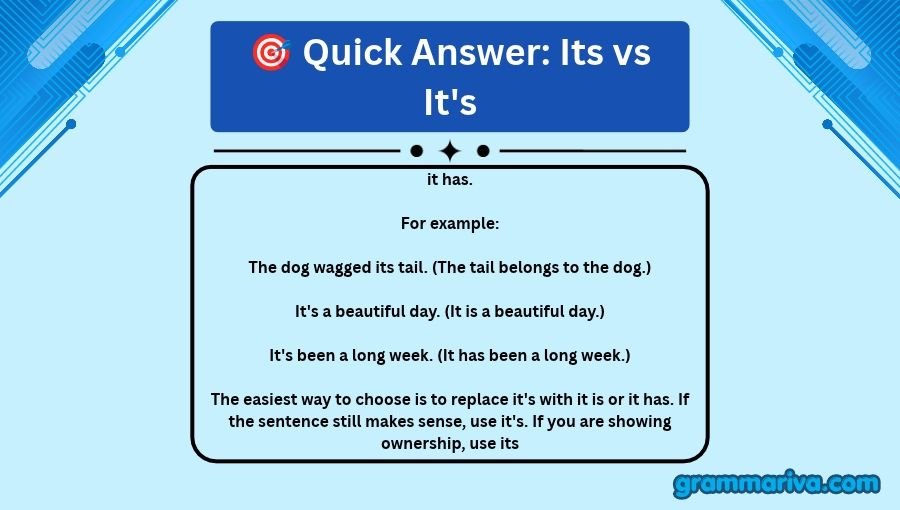
Its shows that something belongs to or is connected to something. It’s is a contraction that means it is or it has.
For example:
- The dog wagged its tail. (The tail belongs to the dog.)
- It’s a beautiful day. (It is a beautiful day.)
- It’s been a long week. (It has been a long week.)
The easiest way to choose is to replace it’s with it is or it has. If the sentence still makes sense, use it’s. If you are showing ownership, use its.
Related Word Forms and Their Meanings
Both forms are closely related to the pronoun it, but they serve different grammar roles. Understanding their related forms makes it easier to avoid spelling and punctuation mistakes.
| Form | Type | Example |
|---|---|---|
| It | Personal pronoun | It looks beautiful. |
| Its | Possessive determiner | The bird spread its wings. |
| It’s | Contraction | It’s getting late. |
| It is | Pronoun + verb | It is very cold. |
| It has | Pronoun + helping verb | It has stopped raining. |
| Itself | Reflexive pronoun | The door closed by itself. |
The most important difference is between its and it’s. The other forms help explain how each word works in a sentence.
Understanding the Basics of Its vs It’s
The main difference is ownership versus contraction. Its tells readers that something belongs to an animal, object, place, or other thing. It’s combines the pronoun it with is or has.
Think of these words as two separate tools. One shows possession. The other makes a sentence shorter.
Comparison Table
| Form | Type | Meaning | Example | Correct/Incorrect |
|---|---|---|---|---|
| Its | Possessive determiner | Belonging to it | The cat cleaned its paws. | ✅ Correct |
| It’s | Contraction | It is | It’s a cute cat. | ✅ Correct |
| It’s | Contraction | It has | It’s been raining. | ✅ Correct |
| Its | Possessive determiner | Belonging to it | The company changed its name. | ✅ Correct |
| It’s | Incorrect possessive use | Intended to show ownership | The company changed it’s name. | ❌ Incorrect |
Its: Meaning and Correct Use
Its is a possessive determiner. It shows that something belongs to or is connected with a thing, animal, organization, or idea.
It answers the question, “Whose?”
For example:
- The house lost its roof during the storm.
- The school updated its website.
- The tree dropped its leaves in autumn.
- The phone needs its battery replaced.
In each example, its connects an object or thing with something related to it.
Showing Ownership
The most common use of its is to show ownership.
Examples:
- The dog found its toy.
- The baby held its bottle.
- The car lost its mirror.
- The computer needs its charger.
Sentence breakdown:
The dog found its toy.
- The dog = the subject.
- Found = the action.
- Its = shows ownership.
- Toy = the thing that belongs to the dog.
The word its tells readers who the toy belongs to.
Describing Parts of Something
You can also use its when talking about a part or feature of something.
Examples:
- The flower opened its petals.
- The building changed its design.
- The river reached its highest level.
- The phone lost its signal.
Here, the word connects the subject with one of its parts or features.
Talking About Animals
English often uses its when the animal’s sex is unknown, irrelevant, or not being emphasized.
Examples:
- The bird built its nest.
- The puppy moved its ears.
- The horse lifted its head.
- The snake changed its skin.
However, when an animal is a known pet and its sex matters to the speaker, his or her may also be used.
It’s: Meaning and Correct Use
It’s is a contraction. It combines it with either is or has. The apostrophe shows that some letters have been left out.
There are two main uses.
It’s Means It Is
Use it’s when you mean it is.
Examples:
- It’s cold outside.
- It’s a lovely morning.
- It’s difficult to understand this rule.
- It’s time to go home.
Sentence breakdown:
It’s cold outside.
- It = the subject.
- Is = the linking verb.
- Cold = describes the subject.
- Outside = tells where.
The contraction makes the sentence shorter without changing its meaning.
It’s Means It Has
You can also use it’s when you mean it has.
This usually happens when has works as a helping verb.
Examples:
- It’s been a busy day.
- It’s already started.
- It’s become much easier.
- It’s taken longer than expected.
Sentence breakdown:
It’s been a busy day.
- It = the subject.
- Has = the helping verb.
- Been = the past participle.
- A busy day = describes the experience.
The complete sentence is “It has been a busy day.”
Small Table Summarizing Each Meaning
| Meaning | Word Type | Example Sentence |
|---|---|---|
| Ownership | Possessive determiner | The bird spread its wings. |
| Belonging or connection | Possessive determiner | The business changed its logo. |
| It is | Contraction | It’s very sunny today. |
| It has | Contraction | It’s been a great experience. |
💡 Test Tip: Replace It’s With It Is or It Has
Here is a simple trick I recommend when checking grammar.
Whenever you write it’s, replace it with it is or it has.
- It’s raining. → It is raining. ✅
- It’s been fun. → It has been fun. ✅
- The dog hurt it’s leg. → The dog hurt it is leg. ❌
The third sentence does not make sense. Therefore, you need its.
Remember that this replacement trick works for it’s. It does not mean you should replace every occurrence of its with another phrase.
Why Do People Confuse Its and It’s?
People confuse these words because they look almost identical and sound the same in normal speech. The apostrophe creates a small visual difference, but that difference changes the grammar.
The confusion also comes from a common English spelling pattern.
Most possessive nouns use an apostrophe:
- The boy’s book.
- The teacher’s desk.
- The dog’s collar.
Because of this pattern, writers sometimes assume that its needs an apostrophe too.
However, English has a special rule for possessive pronouns and determiners. Words such as his, hers, ours, yours, and its do not use apostrophes to show ownership.
Consider this example:
A student writes, “The school changed it’s schedule.” The student knows the schedule belongs to the school but follows the usual apostrophe pattern for ownership. The correct sentence is “The school changed its schedule.”
This is a useful reminder that possessive pronouns follow their own spelling rules.
The Apostrophe Confusion
The apostrophe in it’s does not show ownership. It shows that letters have been removed from it is or it has.
| Word | Full Form | Purpose |
|---|---|---|
| It’s | It is | Describes something |
| It’s | It has | Shows an action or state |
| Its | No contraction | Shows ownership |
| His | No contraction | Shows ownership |
| Hers | No contraction | Shows ownership |
| Yours | No contraction | Shows ownership |
A Simple Way to Remember the Difference
Use this short memory trick:
- Its = ownership.
- It’s = it is or it has.
You can also remember the apostrophe as a sign of missing letters.
When you see it’s, ask yourself what the apostrophe replaces. If the answer is is or has, the form is correct.
📝 Case Study: Its vs It’s in a Workplace Email
Imagine an employee is writing an email about a company website.
The employee types:
“Hello Team,
The company has updated it’s website. It’s new design is easier to use, and it’s already helping visitors find information faster.”
There are two incorrect uses of it’s in this message.
Here is the corrected version:
“Hello Team,
The company has updated its website. Its new design is easier to use, and it’s already helping visitors find information faster.”
Now let’s understand the changes.
| Original Sentence | Correct Sentence | Reason |
|---|---|---|
| Updated it’s website | Updated its website | Shows website ownership |
| It’s new design | Its new design | Shows which design belongs to the website |
| It’s already helping | It’s already helping | Means it is already helping |
The third example is correct because it’s means it is.
Imagine reviewing this email before sending it. The simple replacement test quickly identifies the two mistakes.
This example also shows why grammar matters in the workplace. A small apostrophe error can make a polished message look less professional.
Grammar Rules Explanation
The grammar rule behind these words is simple: its is a possessive determiner, while it’s is a contraction.
The two forms are not interchangeable. Their spelling depends on their job in the sentence.
Rule: Use Its Without an Apostrophe for Ownership
When something belongs to or is connected with an object, animal, organization, or other thing, use its.
Examples:
- The company changed its policy.
- The bird protected its eggs.
- The phone lost its connection.
- The country celebrated its independence.
In these sentences, its identifies something related to the subject.
Rule: Use It’s for It Is
When the full phrase is it is, you can shorten it to it’s.
Examples:
- It is a good idea. → It’s a good idea.
- It is getting dark. → It’s getting dark.
- It is my favorite book. → It’s my favorite book.
Both versions are grammatically correct.
Rule: Use It’s for It Has
When has acts as a helping verb, you can shorten it has to it’s.
Examples:
- It has been a great day. → It’s been a great day.
- It has changed. → It’s changed.
- It has become popular. → It’s become popular.
Rule: Do Not Use It’s Before a Noun to Show Ownership
This is one of the most important rules.
Incorrect: The dog wagged it’s tail.
Correct: The dog wagged its tail.
The tail belongs to the dog. Therefore, you need the possessive form without an apostrophe.
Correct vs Incorrect at a Glance
| Sentence | Correct/Incorrect | Why |
|---|---|---|
| The cat cleaned its paws. | ✅ Correct | Shows ownership |
| The cat cleaned it’s paws. | ❌ Incorrect | The apostrophe is unnecessary |
| It’s a sunny day. | ✅ Correct | Means it is |
| Its a sunny day. | ❌ Incorrect | Needs the contraction |
| The company changed its name. | ✅ Correct | Shows ownership |
These examples cover the main rules. When you understand the purpose of the apostrophe, choosing the correct form becomes much easier.
⚠️ Common Mistakes With Its and It’s
Learning the difference between its vs it’s can help you avoid apostrophe mistakes in everyday writing, professional emails, and online content. Most mistakes happen because writers focus on how a word looks instead of what it means. The missing apostrophe rule can feel unusual because possessive nouns often use apostrophes.
There are also practical reasons for these errors:
- Fast typing: People often type without checking each sentence.
- Autocorrect: Some writing tools replace one form with the other.
- Lack of knowledge: Writers may not know that possessive pronouns do not use apostrophes.
- Reading quickly: People may miss a small punctuation mark when reviewing text.
While editing a sample blog post, consider this sentence: “The app is popular because it’s simple design attracts users.” A writer may read it quickly and miss the error. The correct version is “The app is popular because its simple design attracts users.”
Similar Grammar Confusions
The same type of confusion appears in other English word pairs.
| Word Pair | Difference | Correct Example |
|---|---|---|
| Its / It’s | Ownership vs contraction | Its color is bright. |
| Your / You’re | Ownership vs you are | You’re holding your bag. |
| Their / They’re | Ownership vs they are | They’re bringing their books. |
| Whose / Who’s | Ownership vs who is or who has | Who’s using whose phone? |
| There / Their | Place or existence vs ownership | Their house is over there. |
These pairs may look or sound similar, but their grammar roles are different.
Common Wrong Spellings and Uses
| Wrong Form | What’s Wrong | Correct Form |
|---|---|---|
| It’s tail is long. | Uses a contraction for ownership | Its tail is long. |
| Its raining. | Missing apostrophe in the contraction | It’s raining. |
| Its a nice day. | Should mean it is | It’s a nice day. |
| The dog hurt it’s paw. | Incorrect possessive form | The dog hurt its paw. |
| The company lost it’s money. | Incorrect ownership form | The company lost its money. |
| Its been a while. | Missing contraction apostrophe | It’s been a while. |
Why Spell-Check Does Not Always Help
A spelling checker may not catch this mistake because both its and it’s are valid English words.
For example:
“The dog lost it’s toy.”
Every word is spelled correctly on its own. However, the sentence uses the wrong form.
This is why grammar checks need more than spelling checks. You must understand what the sentence means.
Usage in Different Writing Contexts
Both forms appear in everyday and professional English. The correct choice depends on the meaning, not the writing style.
Everyday Conversation
In everyday conversation, it’s is common because people often use contractions when speaking.
Examples:
- It’s getting late.
- The dog loves its new bed.
- It’s time for lunch.
- The phone has lost its signal.
Professional Writing
Professional writing requires careful use of both forms. Use its when showing ownership and it’s when a contraction fits the tone.
Examples:
- The company updated its privacy policy.
- It’s important to review the final report.
- The product has improved its performance.
- It’s ready for approval.
Creative Writing
Writers use both forms in stories, novels, poems, and descriptions.
Examples:
- The old house had lost its charm.
- It’s been years since anyone visited.
- The forest showed its beauty in spring.
- It’s a strange feeling to return home.
Social Media and Texting
Social media posts and text messages often use short forms. However, that does not change the grammar rules.
Examples:
- It’s finally Friday!
- My phone lost its case.
- It’s such a cute picture.
- The puppy loves its new toy.
Context Comparison Table
| Context | Which Term to Use | Example |
|---|---|---|
| Everyday conversation | Both | It’s cold, and the car has lost its mirror. |
| Professional writing | Both | It’s ready, and the company has updated its policy. |
| Creative writing | Both | It’s quiet, and the house has lost its charm. |
| Social media/texting | Both | It’s my favorite photo because of its colors. |
The best approach is to focus on the sentence’s meaning. Formality does not change the difference between these forms.
Common Phrases With Its and It’s
There are several common expressions that use one of these forms. Learning them can help you recognize the correct spelling more quickly.
| Phrase | Meaning |
|---|---|
| It’s up to you | You can make the decision. |
| It’s all right | Something is acceptable or fine. |
| It’s about time | Something should happen now. |
| At its best | In the best possible condition. |
| In its own way | In a special or individual manner. |
| For its own good | For the benefit of something. |
Notice that phrases with it’s use the contraction it is. Phrases with its show a relationship or ownership.
Synonyms and Alternatives
You cannot replace its or it’s with one synonym in every sentence. However, some words and phrases can express a similar meaning in certain situations.
The best alternative depends on the sentence.
| Alternative | Works When | Does Not Work When |
|---|---|---|
| It is | Expanding it’s when it means it is | It’s means it has |
| It has | Expanding it’s when it means it has | It’s means it is |
| Belonging to it | Explaining ownership | You need a natural possessive determiner |
| The object’s | Identifying the owner clearly | The subject is not an object |
| Its own | Emphasizing something belongs to or is individual to it | The sentence requires a contraction |
For example:
- It’s a good idea. → It is a good idea.
- It’s been a long day. → It has been a long day.
- The dog moved its bed. → The bed belonging to the dog was moved.
These alternatives can help explain meaning, but they do not always create equally natural sentences.
Why Correct Usage Matters
Using the correct form helps readers understand your message without stopping to work out what you mean. It also shows that you pay attention to small details.
Clarity in Communication
A correct sentence is easier to read. The right form tells readers whether you are describing something or showing ownership.
Compare:
- It’s beautiful. (It is beautiful.)
- Its beauty is clear. (The beauty belongs to or is a feature of it.)
Both sentences are correct, but they communicate different ideas.
Professionalism
Grammar mistakes can affect how readers view your work. This matters when writing business emails, reports, resumes, and website content.
A carefully edited sentence makes your message look more polished.
Accuracy in Digital Communication
Online writing moves quickly. People publish blog posts, social updates, product descriptions, and messages every day.
A simple proofreading habit can prevent many common mistakes.
A Short Reminder
“Small details make clear writing stronger.”
This simple idea applies to punctuation, spelling, and grammar. A single apostrophe may look small, but it can change the meaning of a sentence.
| Situation | Why Getting It Right Matters |
|---|---|
| Resume | Shows attention to detail |
| Client email | Makes communication look professional |
| Published content | Improves writing quality |
| Social post | Helps readers understand the message |
How to Remember the Difference Between Its and It’s
The easiest way to remember the difference is to focus on the apostrophe.
Think of the apostrophe in it’s as a small sign that letters are missing. It replaces letters from it is or it has.
The word its has no missing letters. It shows ownership.
Use the Replacement Method
Follow these steps:
- Write your sentence with it’s.
- Replace it with it is.
- If that does not work, try it has.
- If neither version makes sense, check whether you need its.
Examples:
Example A: It’s a beautiful flower.
Replace it: It is a beautiful flower.
<badge color=”success”>Correct</badge>
Example B: The flower lost it’s petals.
Replace it: The flower lost it is petals.
<badge color=”danger”>Incorrect</badge>
Correct version: The flower lost its petals.
Use the Ownership Question
Ask yourself, “Does something belong to it?”
If the answer is yes, use its.
- The bird spread its wings.
- The car lost its wheel.
- The school changed its rules.
Remember Other Possessive Words
Think about these words:
- His
- Hers
- Yours
- Ours
- Theirs
- Its
None of these words needs an apostrophe to show ownership.
This pattern makes its easier to remember.
Quick Recap Checklist
Before choosing between the two forms, ask yourself what the word is doing in the sentence.
| Question | If Yes → Use |
|---|---|
| Does the sentence mean it is? | It’s |
| Does the sentence mean it has? | It’s |
| Does the word show ownership? | Its |
| Does it describe something belonging to an animal or object? | Its |
| Can you replace the word with it is or it has? | It’s |
Practice Examples
Choose the correct form in each sentence.
Example A: The cat is playing with (its / it’s) ball.
Correct answer: its ✅
The ball belongs to the cat.
Example B: (Its / It’s) going to rain tomorrow.
Correct answer: It’s ✅
The sentence means “It is going to rain tomorrow.”
Example C: The company announced (its / it’s) new product.
Correct answer: its ✅
The product belongs to or is associated with the company.
Final Practice
Try these three sentences without looking at the answers.
- The baby opened ___ eyes.
- ___ been a wonderful day.
- The computer needs ___ software updated.
Answers:
- Its
- It’s
- Its
If you answered all three correctly, you understand the main rule. The easiest way to master its vs it’s is to remember that its shows ownership, while it’s means it is or it has.
FAQs About Its vs It’s
Here are answers to common questions about these two words. Each answer explains the rule in simple language.
What Is the Main Difference Between Its and It’s?
Its shows ownership, while it’s means it is or it has. Use its when something belongs to or is connected with an object, animal, or organization. Use it’s when you can replace it with it is or it has.
When Should I Use Its Without an Apostrophe?
Use its when showing ownership or a connection. For example, “The dog wagged its tail.” The tail belongs to the dog, so the possessive form without an apostrophe is correct.
Does It’s Mean It Is or It Has?
It can mean both. The correct meaning depends on the sentence. For example, “It’s cold” means “It is cold,” while “It’s been fun” means “It has been fun.”
Why Does Its Not Have an Apostrophe?
Its is a possessive determiner, and possessive pronouns and determiners do not use apostrophes to show ownership. This is different from possessive nouns such as the dog’s toy.
Is It’s Ever Correct for Showing Ownership?
No. Standard English does not use it’s to show ownership. Use its instead. For example, “The company changed its name” is correct.
Can I Replace It’s With It Is in Every Sentence?
No. You can replace it’s with it is only when it means it is. Sometimes it means it has. For example, “It’s been a long day” means “It has been a long day.”
Which Is Correct: The Dog Lost Its Tail or It’s Tail?
“The dog lost its tail” is correct. The word its shows that the tail belongs to the dog. The form it’s would mean it is or it has, which does not fit the sentence.
Is Its a Possessive Pronoun?
In everyday grammar explanations, its is commonly described as a possessive form of the pronoun it. More precisely, it functions as a possessive determiner before a noun, as in “its color” or “its name.”
Why Do People Write Its and It’s Incorrectly?
People often confuse them because they sound the same and look almost identical. Fast typing, autocorrect, and confusion about apostrophe rules also cause mistakes. Learning the replacement test can help prevent these errors.
How Can I Check Whether Its or It’s Is Correct?
Try replacing it’s with it is or it has. If the sentence makes sense, use it’s. If you are showing ownership, use its. Reading the complete sentence again can also help you catch errors.
Conclusion
Understanding its vs it’s does not have to be difficult. The main rule is simple: its shows ownership, while it’s is a contraction of it is or it has. Once you understand these two meanings, you can choose the correct form with confidence.
Remember the replacement trick whenever you feel unsure. If it is or it has fits your sentence, use it’s. If you are talking about something that belongs to an animal, object, place, or organization, use its.
I recommend making this a habit whenever you proofread your writing. Check apostrophes carefully, especially in emails, school assignments, blog posts, and social media captions. A quick review can save you from a common grammar mistake.
You do not need to memorize a long list of complicated rules. Just remember that an apostrophe in it’s shows missing letters, not ownership. Keep practicing, read your sentences aloud, and pay attention to the meaning of each word.
One small apostrophe can change a sentence, but one simple rule can help you get it right every time. 😊

Hi, I’m Ethan Brooks. I’m an English grammar writer at Grammariva, where I work on clear explanations, practical examples, and useful writing tips. I enjoy making difficult grammar topics easier to understand.


[…] give you practice questions. By the end, you will know exactly which word belongs in your sentence. Its vs It’s | Who vs Whom | Lay vs […]