Have you ever stopped while writing a sentence because you could not decide between lay vs lie? You are not alone. These two words confuse students, writers, editors, and even people who use English every day.
They look similar and have related meanings, but they follow different grammar rules. Knowing when to use each word can make your writing clearer and more accurate. For example, you might say, “I lie on the couch every afternoon,” but “Yesterday, I lay on the couch.” That small change can make grammar feel harder than it really is.
The confusion often happens because the past tense of one word is the present tense of the other. For example, you might say, “I lie on the couch every afternoon,” but “Yesterday, I lay on the couch.” That small change can make grammar feel harder than it really is.
In this guide, I will explain lay vs lie with simple rules, everyday examples, helpful tables, and easy memory tricks. You will also learn their different verb forms, common mistakes, and how to choose the correct word in conversations, emails, and professional writing. Let’s make this grammar rule simple! 😊 Fewer vs Less | Farther vs Further | Affect vs Effect
🎯 Quick Answer: Lay vs Lie
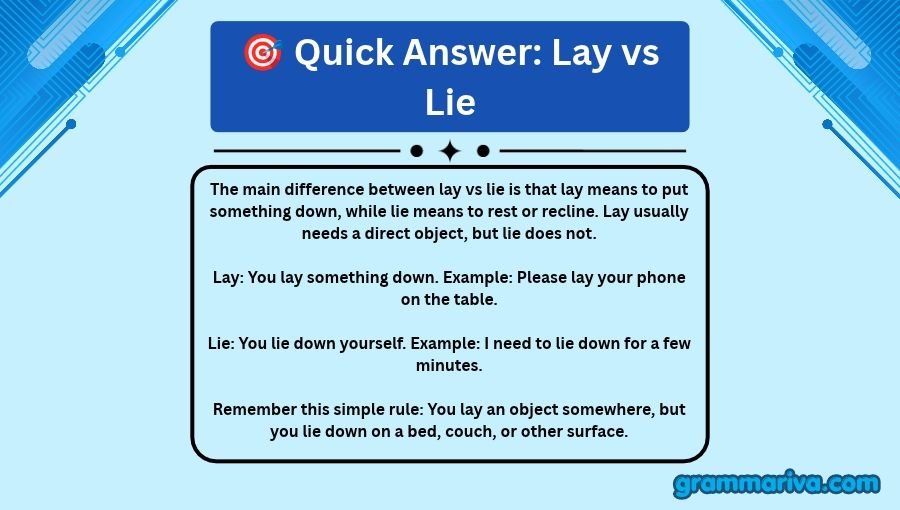
The main difference between lay vs lie is that lay means to put something down, while lie means to rest or recline. Lay usually needs a direct object, but lie does not.
- Lay: You lay something down. Example: Please lay your phone on the table.
- Lie: You lie down yourself. Example: I need to lie down for a few minutes.
Remember this simple rule: You lay an object somewhere, but you lie down on a bed, couch, or other surface.
Understanding the Basics of Lay vs Lie
The easiest way to understand these words is to look at what is happening in a sentence. Ask yourself whether someone is placing an object somewhere or resting their own body.
Lay is a verb that describes placing something in a particular position. The thing being placed receives the action.
Lie is a verb that describes a person, animal, or object resting in a position. It does not need a direct object.
Here is a basic comparison:
| Form | Type | Meaning | Example | Correct/Incorrect |
|---|---|---|---|---|
| Lay | Verb | Put something down | Lay the book here. | ✅ Correct |
| Lie | Verb | Rest or recline | I lie on the sofa. | ✅ Correct |
| Lay | Verb | Rest in the past | Yesterday, I lay down. | ✅ Correct |
| Lie | Verb | Put something down | Lie the book here. | ❌ Incorrect |
| Lay | Verb | Rest or recline in the present | I lay down every day. | ❌ Incorrect in standard present-tense usage |
| Lie | Verb | Rest in the past | Yesterday, I lied down. | ❌ Incorrect |
The last two examples need extra attention. The past tense of lie is lay. Also, lied is the past tense of a different verb meaning to tell something untrue.
What Does Lay Mean?
Lay means to put or place something down carefully or in a particular position. It is a transitive verb, which means it normally takes a direct object.
In simple words, something must receive the action of laying.
For example:
- Please lay the keys beside the door.
- She lays her clothes on the chair.
- I laid the papers on the desk.
- They are laying new tiles in the kitchen.
In each sentence, an object receives the action.
Lay in the Present Tense
Use lay when someone places an object somewhere in the present.
Examples:
- I lay my notebook on the desk before class.
- She lays the baby gently in the crib.
- Please lay the blanket over the chair.
- He lays his tools beside the garage door.
Sentence breakdown:
Sentence: I lay my jacket on the bed.
- Subject: I
- Verb: lay
- Direct object: my jacket
- Location: on the bed
The jacket is receiving the action. That is why lay is correct.
Lay in the Past Tense
The past tense of lay is laid. Use it when someone placed an object somewhere in the past.
Examples:
- I laid my wallet on the kitchen counter.
- She laid the baby in the crib.
- He laid his jacket on the sofa.
- We laid the books on the classroom table.
Sentence breakdown:
Sentence: She laid the flowers on the table.
The flowers are the objects being placed. The action happened in the past, so laid is correct.
Lay in the Future Tense
Use will lay when the action of placing something will happen later.
Examples:
- I will lay the documents on your desk.
- She will lay the baby in the crib.
- We will lay the carpet tomorrow.
- He will lay the tools near the workshop.
The verb after will stays in its base form. Therefore, use lay, not laid.
What Does Lie Mean?
Lie means to rest, recline, or remain in a horizontal position. It is an intransitive verb, which means it does not need a direct object.
A person, animal, or object can lie somewhere without placing another object.
Examples:
- I lie on my bed after work.
- The dog lies beside the fireplace.
- She likes to lie in the sun.
- The book lies on the table.
Notice that nobody is putting another object down in these sentences. The subject is simply resting or remaining in a position.
Lie in the Present Tense
Use lie when describing someone or something resting in the present.
Examples:
- I lie on the couch when I feel tired.
- My cat lies near the window.
- The children lie on the grass.
- He likes to lie in bed on Sunday mornings.
Remember that the verb changes to lies with he, she, or it.
Lie in the Past Tense
This is where many people become confused.
The past tense of lie is lay, not lied.
Examples:
- I lay on the couch yesterday.
- She lay in bed all morning.
- The dog lay beside its owner.
- We lay on the beach and watched the clouds.
Sentence breakdown:
Sentence: I lay on the sofa last night.
- Subject: I
- Verb: lay
- Time: last night
- Meaning: I rested on the sofa.
Here, lay describes resting in the past. It does not mean placing an object somewhere.
Lie in the Future Tense
Use will lie when someone or something will rest in the future.
Examples:
- I will lie down after dinner.
- She will lie on the beach tomorrow.
- The dog will lie beside the fireplace.
- We will lie under the stars tonight.
The word will is followed by the base form lie.
Lay vs Lie Verb Forms Explained
One of the biggest reasons people confuse these words is their changing forms. The present tense of lie is lie, but its past tense is lay. Meanwhile, lay changes to laid in the past.
Study this table to understand the difference.
| Verb Form | Lay (Put Something Down) | Lie (Rest or Recline) |
|---|---|---|
| Present | Lay | Lie |
| Third-person present | Lays | Lies |
| Past | Laid | Lay |
| Past participle | Laid | Lain |
| Present participle | Laying | Lying |
| Future | Will lay | Will lie |
Examples:
- Present: I lay the book down.
- Present: I lie on the bed.
- Past: I laid the book down.
- Past: I lay on the bed.
- Past participle: I have laid the book down.
- Past participle: I have lain on the bed.
- Present participle: I am laying the book down.
- Present participle: I am lying on the bed.
The Difference Between Laid and Lain
These two words may look similar, but they belong to different verbs.
Laid is the past tense and past participle of lay. It means that someone placed something somewhere.
Lain is the past participle of lie. It describes someone or something that has rested in a position.
Examples:
- ✅ I have laid the keys on the table.
- ❌ I have lain the keys on the table.
- ✅ She has lain in bed all morning.
- ❌ She has laid in bed all morning.
The key is to check whether there is a direct object receiving the action.
Why Do People Confuse Lay and Lie?
People confuse these words because their meanings are related and their verb forms overlap. The word lay can describe placing an object in the present or resting in the past.
That overlap makes it difficult to choose the right form without checking the sentence.
There are several common reasons for this confusion.
Their Past Tenses Overlap
The past tense of lie is lay. However, lay is also the present tense of the verb meaning to place something.
Compare these examples:
- ✅ I lay the book on the table every morning.
- ✅ I lay on the couch yesterday.
- ❌ I laid on the couch yesterday.
The first sentence describes a present action. The second describes a past action.
Everyday Speech Makes the Difference Less Clear
People often use informal grammar when speaking quickly. Some incorrect forms become common in casual conversation.
For example:
- ❌ I am going to lay down.
- ✅ I am going to lie down.
The first sentence is common in casual speech, but the second is correct in standard written English when the speaker means resting.
A Classroom Example
Imagine a student writing a short story about a tired dog. The student writes, “The dog laid beside the fireplace.” The sentence sounds natural because laid is familiar. However, the dog is not placing anything down. It is resting. The correct sentence is “The dog lay beside the fireplace.”
This small example shows why checking the action is more useful than relying on how a sentence sounds.
How Can You Remember the Difference Between Lay and Lie?
You can remember the difference by asking one simple question: Is someone putting something down, or is someone resting? Learning these simple rules makes lay vs lie much easier to understand and remember.
If someone is putting an object somewhere, choose lay. If someone is resting, choose lie.
Here are some easy memory tricks.
Use the Object Test
Try adding the question “What?” after the verb.
- I lay what? My phone.
- She lays what? The blanket.
- He laid what? The book.
If a direct object answers the question, lay is usually the correct choice.
With lie, there is no direct object.
- I lie. What? No direct object is needed.
- She lies on the bed. What? No direct object is needed.
Remember the Furniture Trick
Think about what you do with everyday objects.
- You lay a pillow on the bed.
- You lie on the bed.
- You lay a towel on the floor.
- You lie on the floor.
The object receives the action when you use lay. Your body rests when you use lie.
Learn the Verb Forms Together
Do not memorize each word separately. Learn the forms as two groups:
- Lay, laid, laid, laying.
- Lie, lay, lain, lying.
This makes the past-tense difference easier to remember.
💡 Test Tip
When you are unsure, replace the verb with put or rest.
If put makes sense, use a form of lay. If rest makes sense, use a form of lie.
For example:
- I need to ___ my bag here.
- Replace the blank with “put”: I need to put my bag here.
- Correct answer: lay.
Now try:
- I need to ___ down.
- Replace the blank with “rest”: I need to rest down.
- The intended action is resting, so the correct sentence is “I need to lie down.”
A Real-Life Case Study: Lay vs Lie at Work
Imagine an employee sending instructions to a coworker before leaving the office.
The original message says:
“Please lie the printed reports on my desk. I will check them tomorrow.”
The message is understandable, but the verb is incorrect. The employee wants the coworker to place the reports on the desk.
A corrected version would be:
“Please lay the printed reports on my desk. I will check them tomorrow.”
Now imagine the coworker replies:
“I will lie down for a few minutes after I finish.”
That sentence is also correct because the coworker is describing a personal action rather than placing an object.
Comparing Both Actions
| Situation | Original Sentence | Correct Sentence |
|---|---|---|
| Placing reports | ❌ Lie the reports here. | ✅ Lay the reports here. |
| Resting after work | ❌ I will lay down. | ✅ I will lie down. |
| Placing a folder | ❌ I have lain the folder there. | ✅ I have laid the folder there. |
| Resting yesterday | ❌ I laid down yesterday. | ✅ I lay down yesterday. |
This example shows how the correct word changes with the action. In workplace writing, small grammar choices can make instructions clearer and more professional.
Grammar Rules Explanation: When to Use Each Verb
The main grammar rule depends on whether the verb takes a direct object.
Lay is a transitive verb. It describes an action performed on something. That something is the direct object.
Lie is an intransitive verb when it means to rest or recline. It describes the position or action of the subject without requiring a direct object.
These rules explain why the two verbs cannot always replace each other.
Rule 1: Use Lay With a Direct Object
When you place something somewhere, use lay or one of its correct forms.
Examples:
- ✅ Please lay the newspaper on the table.
- ❌ Please lie the newspaper on the table.
- ✅ He laid the jacket on the chair.
- ❌ He lay the jacket on the chair yesterday.
Rule 2: Use Lie When Resting
When the subject rests or reclines, use lie or its correct form.
Examples:
- ✅ I lie in bed every morning.
- ❌ I lay in bed every morning.
- ✅ She lay on the grass yesterday.
- ❌ She laid on the grass yesterday.
Rule 3: Use Laid for the Past of Lay
If someone placed an object somewhere in the past, use laid.
Examples:
- ✅ They laid the books on the shelf.
- ❌ They lay the books on the shelf yesterday.
Rule 4: Use Lain After Have, Has, or Had
When describing a completed resting action, use lain with the correct helping verb.
Examples:
- ✅ I have lain here for an hour.
- ❌ I have laid here for an hour.
- ✅ She had lain in bed all day.
- ❌ She had laid in bed all day.
Rule 5: Use Laying and Lying Correctly
The present participles also follow different patterns.
- Laying describes placing something.
- Lying describes resting or reclining.
Examples:
- ✅ He is laying the clothes on the bed.
- ❌ He is lying the clothes on the bed.
- ✅ He is lying on the bed.
- ❌ He is laying on the bed.
Correct vs Incorrect at a Glance
| Sentence | Correct/Incorrect | Why |
|---|---|---|
| I lay my phone on the desk. | ✅ Correct | The phone receives the action. |
| I lie down after lunch. | ✅ Correct | The subject is resting. |
| She laid the baby in the crib. | ✅ Correct | Laid is the past of lay. |
| He laid on the sofa yesterday. | ❌ Incorrect | The past tense of lie is lay. |
| I have lain here for hours. | ✅ Correct | Lain is the past participle of lie. |
Common Mistakes With Lay and Lie ⚠️
The most common mistakes happen when writers forget the different verb forms. Fast typing, autocorrect, and a lack of grammar knowledge can also lead to errors.
I once saw a typical editing problem in which a sentence used laid several times to describe people resting. The writer knew that the word was connected to resting but had not learned that lay was the correct past-tense form. Reviewing the full verb pattern fixed every sentence.
Here are some other grammar mix-ups that create similar problems.
Similar Grammar Confusions
| Confusing Words | Correct Difference | Example |
|---|---|---|
| Its / It’s | Possession / It is | The dog wagged its tail. |
| Your / You’re | Possession / You are | You’re doing well. |
| Their / There | Possession / Place | Their house is over there. |
| Then / Than | Time / Comparison | I am taller than him. |
| Affect / Effect | Usually a verb / Usually a noun | Sleep can affect mood. |
| Lay / Lie | Place / Rest | Lay the bag down. |
Common Reasons for These Errors
Fast typing: People often type what sounds right without checking the verb form.
Autocorrect: A phone or computer may suggest a familiar word that does not fit the sentence.
Lack of knowledge: Some writers have never learned that the past tense of lie is lay.
Confusing speech with formal writing: A phrase may sound natural in casual conversation but still be incorrect in standard grammar.
Common Wrong Forms and Their Corrections
| Wrong Form | What’s Wrong | Correct Form |
|---|---|---|
| I laid down yesterday. | Uses the past of lay for resting. | I lay down yesterday. |
| Lie the book here. | Uses the resting verb for placing. | Lay the book here. |
| I have laid in bed. | Uses the wrong past participle. | I have lain in bed. |
| I am laying on the couch. | Uses the wrong present participle. | I am lying on the couch. |
| She lied the baby down. | Uses the wrong verb form. | She laid the baby down. |
| I am going to laid it there. | Uses a past form after going to. | I am going to lay it there. |
Is Lie Ever Used to Mean Something Other Than Resting?
Yes. The verb lie has another meaning: to say something that is not true.
This is a separate use of the word. Its forms are different from the forms used for resting.
When lie means to tell an untruth, its forms are:
- Present: lie
- Third-person present: lies
- Past: lied
- Past participle: lied
- Present participle: lying
Examples:
- He lies about his age.
- She lied about the missing money.
- They have lied before.
- Stop lying to your parents.
Compare the two meanings:
| Meaning | Present | Past | Past Participle |
|---|---|---|---|
| Rest or recline | Lie | Lay | Lain |
| Tell something untrue | Lie | Lied | Lied |
| Put something down | Lay | Laid | Laid |
This is a useful distinction because lied is correct when someone tells an untruth. It is not correct when someone describes resting.
Lay vs Lie in Different Contexts
The same grammar rules apply whether you are speaking with friends, writing an email, creating a story, or posting on social media.
However, the situation can change which verb form you need.
Everyday Conversation
In everyday conversation, you might talk about resting, putting away objects, or helping someone.
Examples:
- I need to lie down for a while.
- Can you lay the groceries on the counter?
- The baby lay quietly in the crib.
- I laid my phone beside the television.
Professional Writing
Professional writing needs clear and accurate sentences. Choose the correct verb when writing instructions, reports, or emails.
Examples:
- Please lay the signed forms on my desk.
- The equipment was laid in the storage area.
- The employee has lain in the recovery room.
- I will lie down after the meeting.
Creative Writing
Writers can use both verbs to describe movement, position, and action.
Examples:
- The knight lay beneath the old tree.
- She laid the letter beside the candle.
- The cat was lying near the fireplace.
- He carefully laid the flowers on the grave.
Social Media and Texting
Even short captions and messages benefit from correct grammar.
Examples:
- Just going to lie down and relax. 😴
- Laid everything out for tomorrow.
- My dog lies in the sun all afternoon.
- I lay on the beach and enjoyed the view.
Context Comparison Table
| Context | Which Term to Use | Example |
|---|---|---|
| Everyday conversation | Lay for placing; lie for resting | I need to lie down. |
| Professional writing | Correct form based on the action | Lay the documents on my desk. |
| Creative writing | Both, depending on meaning | The old dog lay by the fire. |
| Social media/texting | Both, depending on meaning | I am lying on the couch. |
Common Phrases With Lay and Lie
Some familiar expressions use these verbs in ways that are easy to remember. Learning them can help you understand how each word works in natural English.
Common Expressions With Lay
| Phrase | Meaning |
|---|---|
| Lay the groundwork | Prepare for something important. |
| Lay down the law | Set strict rules or expectations. |
| Lay something on the table | Present an idea or offer openly. |
| Lay a foundation | Create a strong starting point. |
| Lay your cards on the table | Be honest and open about your plans. |
Common Expressions With Lie
| Phrase | Meaning |
|---|---|
| Lie low | Stay quiet or avoid attention. |
| Lie in wait | Wait secretly for an opportunity. |
| Let sleeping dogs lie | Avoid bringing up an old problem. |
| Lie through your teeth | Tell a very obvious lie. |
| Lie ahead | Be in the future or still to come. |
These expressions are useful because they show that both verbs appear in everyday English beyond their basic meanings.
Synonyms and Alternatives for Lay and Lie
Sometimes, another word can replace lay or lie. However, the replacement must match the meaning of the original sentence.
For example, place can replace lay in many situations. Similarly, rest can sometimes replace lie.
Here are some useful alternatives.
| Alternative | Works When | Does Not Work When |
|---|---|---|
| Place | You are putting something somewhere. | You are describing someone resting. |
| Put | You are moving an object into position. | You need to describe a resting position. |
| Set | You are placing something on a surface. | You are describing someone reclining. |
| Rest | Someone is taking a break or relaxing. | You are placing an object somewhere. |
| Recline | Someone is leaning or lying back. | You are describing placing an item down. |
Examples:
- Lay the book on the desk. → Place the book on the desk.
- I need to lie down. → I need to rest.
- She lay on the couch. → She reclined on the couch.
These alternatives can make writing more varied. However, they do not always fit every sentence.
Why Does Correct Grammar Matter? ✍️
Using the right word helps readers understand your message without stopping to work out what you mean. Although lay and lie are small words, using them correctly can improve the quality of your writing.
Here are three main reasons to learn the difference.
Clarity in Communication
Correct grammar makes your meaning clear. If you write “Lay down,” a reader may wonder whether you mean placing an object or resting. The sentence “Lie down” clearly describes resting.
Professionalism
Emails, reports, applications, and business documents should use standard grammar. Correct word choices show attention to detail and help readers focus on your message.
Better Digital Communication
Social media posts, website articles, and online messages are easier to read when the grammar is correct. Clear writing also helps build trust with your audience.
A useful reminder is:
“Clear words make clear messages.”
Why Getting It Right Matters
| Situation | Why Getting It Right Matters |
|---|---|
| Resume | Shows care and attention to detail. |
| Client email | Makes instructions clear and professional. |
| Published content | Improves readability and trust. |
| Social media post | Helps communicate your message clearly. |
Quick Recap Checklist: How to Choose the Right Word
Before choosing lay or lie, ask yourself what action the subject is performing.
Use this checklist to make the decision easier.
| Question | If Yes → Use |
|---|---|
| Am I putting an object somewhere? | Lay |
| Am I describing someone resting now? | Lie |
| Did someone place an object somewhere in the past? | Laid |
| Did someone rest somewhere in the past? | Lay |
| Has someone placed an object somewhere? | Laid |
| Has someone rested in a position? | Lain |
| Is someone placing something right now? | Laying |
| Is someone resting right now? | Lying |
Practice Examples
Try choosing the correct word in each sentence before checking the answers.
Example 1: Please ___ the newspaper on the table.
Answer: Lay
Why: The newspaper is the object being placed.
Example 2: I need to ___ down before dinner.
Answer: Lie
Why: The speaker wants to rest.
Example 3: She ___ on the sofa yesterday.
Answer: Lay
Why: This describes resting in the past.
More Practice: Test Your Knowledge
Fill in the blanks with the correct forms.
- The teacher asked me to ___ my notebook on the desk.
- My dog likes to ___ near the window.
- I have ___ in bed for two hours.
- He ___ the jacket on the chair yesterday.
- She is ___ on the grass.
Answers:
- Lay
- Lie
- Lain
- Laid
- Lying
If you answered all five correctly, you understand the main rule and its most common verb forms.
FAQs About Lay vs Lie
What Is the Main Difference Between Lay and Lie?
Lay means to put something down, while lie means to rest or recline. Lay usually needs a direct object, but lie does not.
For example, you lay a book on a desk, but you lie on a bed.
Is It Correct to Say Lay Down or Lie Down?
Use lie down when you are talking about resting yourself.
For example, “I need to lie down because I feel tired” is correct.
Use lay down when you are placing an object somewhere, such as “Lay the blanket down.”
Is Lay the Past Tense of Lie?
Yes. Lay is the simple past tense of lie when it means to rest or recline.
For example, “I lie on the couch every evening” becomes “I lay on the couch yesterday.”
Is Laid the Past Tense of Lie?
No. Laid is the past tense of lay, which means to put or place something down.
The past tense of lie, meaning to rest, is lay.
Should I Use Laid or Lain?
Use laid when someone has placed an object somewhere. Use lain when someone has rested in a position.
Examples:
- I have laid the papers on the desk.
- I have lain in bed all morning.
Is It Lying Down or Laying Down?
Use lying down when someone is resting.
For example, “The baby is lying down in the crib.”
Use laying down when someone is placing something down. For example, “She is laying the blanket on the bed.”
Why Do People Say Laid Down Instead of Lay Down?
People often confuse the past forms of the two verbs. In informal speech, you may hear “I laid down yesterday,” but standard grammar requires “I lay down yesterday” when describing rest.
Can Lay and Lie Be Used in the Same Sentence?
Yes. Both words can appear in one sentence when they describe different actions.
For example: “I lay the blanket on the bed before I lie down.”
The first verb describes placing the blanket. The second describes resting.
Is Lied Ever Correct When Talking About Lie?
Yes, but only when lie means to tell something untrue.
For example, “He lied about his homework” is correct.
However, “I lied down yesterday” is incorrect when you mean that you rested. The correct sentence is “I lay down yesterday.”
What Is the Difference Between Lying and Laying?
Lying can mean resting or telling something untrue. Laying means placing something down.
Examples:
- I am lying on the couch.
- He is lying about what happened.
- She is laying the books on the table.
Conclusion: Master Lay vs Lie With Simple Grammar Rules
Understanding lay vs lie becomes much easier when you focus on the action in the sentence. Use lay when you put something down. Use lie when you rest or recline. Remember that the past tense of lay is laid, while the past tense of lie is lay. Their past participles are also different: laid and lain.With regular practice, you will become more confident about using lay vs lie correctly in your writing.
The easiest way to check your sentence is to ask whether there is an object receiving the action. If there is, you probably need a form of lay. If someone is simply resting, you need a form of lie.
Keep the verb forms close by when writing, and practice with everyday examples. You do not need to memorize complicated grammar terms to use these words correctly. A little practice will help you recognize the right form naturally.
So, the next time you write about placing a book or resting on a couch, stop for a second and check the action. Small grammar choices make a big difference! ✅

Hi, I’m Nathan Reed. I’m a grammar and writing specialist at Grammariva. I work on practical grammar content that helps readers understand sentence structure, punctuation, vocabulary, and better writing habits.


[…] By the end, you will know exactly when to use each word. Let’s make this grammar rule easy! Lay vs Lie | Fewer vs Less | Farther vs […]
[…] should feel confident using both forms in everyday and professional writing. ✍️ Who vs Whom | Lay vs Lie | Fewer vs […]