Have you ever wondered about the difference between affect vs effect? These two English words look and sound similar, but they have different meanings. Choosing the wrong one can change the meaning of your sentence. Even experienced writers sometimes confuse them!
Understanding affect vs effect is easier than you might think. The main difference is simple: affect is usually a verb that means to influence something, while effect is usually a noun that means a result or outcome.
For example, you might say, “Lack of sleep can affect your mood.” However, you would say, “Lack of sleep can have an effect on your mood.”
Both sentences are correct, but the words serve different purposes.
In this guide, I will explain the meanings, grammar rules, common mistakes, and practical examples of both words. You will also learn simple memory tricks to help you choose the correct word every time.
By the end, you will understand how to use these commonly confused words with confidence. Let’s make English grammar easier! 😊 Backyard or Back-Yard | Performed vs Preformed | Fairing or Faring
🎯 Quick Answer: Affect vs Effect
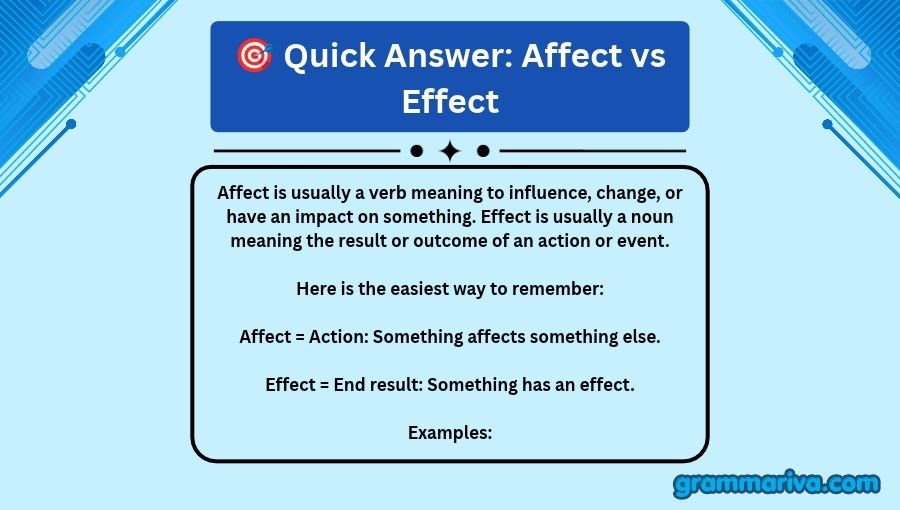
Affect is usually a verb meaning to influence, change, or have an impact on something. Effect is usually a noun meaning the result or outcome of an action or event.
Here is the easiest way to remember:
- Affect = Action: Something affects something else.
- Effect = End result: Something has an effect.
Examples:
- ✅ Heavy rain can affect traffic.
- ❌ Heavy rain can effect traffic. (Incorrect in ordinary usage.)
- ✅ Heavy rain can have an effect on traffic.
- ❌ Heavy rain can have an affect on traffic. (Incorrect in ordinary usage.)
Think about it this way: an action affects something, and the effect is the result.
This simple rule will help you choose the correct word in most everyday conversations, school assignments, emails, and professional documents.
📚 Related Word Forms
Both words have related forms that appear in everyday English. Understanding these forms will help you recognize their meanings in different sentences.
| Form | Type | Example |
|---|---|---|
| Affect | Verb | Noise can affect concentration. |
| Affects | Present-tense verb | Stress affects sleep. |
| Affected | Past-tense verb | The storm affected several towns. |
| Affecting | Present participle | The news is affecting everyone. |
| Effect | Noun | The medicine had a positive effect. |
| Effects | Plural noun | The effects of pollution are serious. |
| Effective | Adjective | This is an effective solution. |
| Effectively | Adverb | She communicated effectively. |
| Effectiveness | Noun | We measured the effectiveness of the plan. |
Understanding These Related Forms
Affects: Use this form when talking about something that influences another thing in the present tense.
Example: Poor lighting affects my ability to read.
Affected: Use this form when describing something that experienced an influence in the past.
Example: The power outage affected the entire neighborhood.
Affecting: Use this form when describing an ongoing action.
Example: The film is affecting viewers emotionally.
Effects: This is the plural form of the noun effect. It refers to multiple results or outcomes.
Example: Scientists studied the effects of climate change.
Effective: This adjective describes something that produces the desired result.
Example: Regular practice is an effective way to improve writing.
Effectively: This adverb describes how something is done.
Example: The manager handled the problem effectively.
Learning these forms makes it easier to understand the difference between the two main words.
🔍 Understanding the Basics of Affect vs Effect
The easiest way to understand these words is to look at their grammatical roles.
Affect generally describes an action. It tells us that something influences or changes something else.
Effect generally names a result. It tells us what happens because of an action, event, or situation.
Consider this example:
“Cold weather affects plants. One effect is slower growth.”
The first sentence uses affects because cold weather influences plants. The second uses effect because slower growth is a result.
Affect vs Effect Comparison Table
| Form | Type | Meaning | Example | Correct/Incorrect |
|---|---|---|---|---|
| Affect | Verb | To influence | Noise can affect sleep. | ✅ Correct |
| Effect | Noun | A result | Noise has an effect on sleep. | ✅ Correct |
| Affect | Noun | An emotional state or expression | The patient showed a flat affect. | ✅ Correct |
| Effect | Verb | To bring about or accomplish | The team will effect change. | ✅ Correct |
| Affect | Noun in ordinary result-based usage | Incorrect substitute for effect | The affect was serious. | ❌ Incorrect |
| Effect | Noun in ordinary influence-based usage | Incorrect substitute for affect | Rain can effect traffic. | ❌ Incorrect |
Notice that the words have special uses beyond the basic rule. These exceptions are discussed later.
💡 What Does Affect Mean?
Affect is most commonly used as a verb. It means to influence, change, or produce an impact on someone or something.
When you use this word, you are describing an action that influences another person, object, situation, or condition.
1. Affect Means to Influence
This is the most common meaning of affect.
Examples:
- Lack of exercise can affect your health.
- Your attitude can affect your performance.
- Weather conditions affect road safety.
- A noisy environment affects concentration.
Sentence breakdown:
“Stress affects your sleep.”
- Subject: Stress
- Verb: Affects
- Object: Your sleep
Stress is the thing doing the influencing. Sleep is the thing being influenced.
2. Affect Means to Change Something
Sometimes, affect describes a change in the condition or behavior of something.
Examples:
- The new rules affected our daily routine.
- Rising prices affect family budgets.
- The accident affected his ability to work.
- Poor communication can affect team performance.
In each sentence, something causes a change or influence.
3. Affect Can Describe Emotional Expression
In psychology and medical writing, affect can also be a noun.
It refers to the outward expression of someone’s emotions.
For example:
“The patient displayed a calm affect during the interview.”
In this sentence, affect does not mean influence. It describes the person’s visible emotional expression.
This is a specialized use. Most everyday writers will mainly encounter affect as a verb.
Affect: Meaning Summary
| Meaning | Word Type | Example Sentence |
|---|---|---|
| To influence | Verb | Exercise affects physical health. |
| To change | Verb | The decision affected our plans. |
| Emotional expression | Noun | The patient displayed a flat affect. |
📝 What Does Effect Mean?
Effect is most commonly used as a noun. It refers to the result, outcome, or consequence of an action or event.
Whenever you want to describe what happened because of something else, effect is usually the right choice.
1. Effect Means a Result
This is the most common meaning of effect.
Examples:
- The new schedule had a positive effect.
- The medicine had an immediate effect.
- The storm had a serious effect on the town.
- Regular exercise has many health effects.
Sentence breakdown:
“Exercise has a positive effect on health.”
- Subject: Exercise
- Verb: Has
- Noun: Effect
- Description: Positive
- Object of the preposition: Health
Here, effect identifies the result of exercise.
2. Effect Means an Outcome or Consequence
You can also use effect to describe the consequences of a decision, event, or action.
Examples:
- The effect of the decision was unexpected.
- Pollution has harmful effects on wildlife.
- The policy had a lasting effect on education.
- The power failure had a major effect on business operations.
3. Effect Can Be Used as a Verb
Although effect is usually a noun, it can also work as a verb.
As a verb, effect means to bring about, accomplish, or make something happen.
Examples:
- The new manager hopes to effect positive changes.
- The government plans to effect reforms.
- The organization wants to effect meaningful improvements.
This use is more formal than the everyday noun use.
Remember the difference:
- Affect change = Influence change or have an impact on it.
- Effect change = Bring change about or make it happen.
Both expressions are correct, but their meanings are different.
Effect: Meaning Summary
| Meaning | Word Type | Example Sentence |
|---|---|---|
| A result | Noun | The effect was surprising. |
| A consequence | Noun | The storm had serious effects. |
| To bring about | Verb | Leaders hope to effect reform. |
🧠 How to Remember the Difference Between Affect and Effect
Remembering the difference does not require complicated grammar rules. A simple memory trick can help you choose the right word.
The A-to-A and E-to-E Trick
Think of these two connections:
- Affect = Action
- Effect = End result
Both words start with a different letter. Use that letter as a reminder.
For example:
“Too much screen time can affect sleep.”
Here, screen time is doing something. It is influencing sleep.
“Too much screen time can have an effect on sleep.”
Here, the sentence focuses on the result.
The Noun and Verb Test
Try asking yourself two questions before choosing a word:
- Am I describing an action or influence? Use affect.
- Am I naming a result or outcome? Use effect.
Examples:
- Lack of water can affect crops.
- Lack of water can have an effect on crops.
Both sentences are correct because they use different sentence structures.
💡 Test Tip
If you are unsure, replace the word with a simpler expression.
Try replacing affect with “influence.”
If the sentence still makes sense, affect is probably correct.
Example:
“Noise can influence concentration.”
Therefore:
“Noise can affect concentration.”
Now try replacing effect with “result.”
Example:
“The result of the storm was serious.”
Therefore:
“The effect of the storm was serious.”
This replacement test works well in most everyday situations.
🏢 Case Study: Affect vs Effect in a Workplace Email
Imagine a manager writing an email to employees about a change in office working hours.
The manager wants to explain how the new schedule will influence employees and what results the company expects.
Here is an example of an incorrect email:
Subject: Changes to Office Hours
“Dear Team,
The new office schedule will have a positive affect on productivity. It may also effect our daily routines. We hope these changes will improve teamwork.”
There are two word-choice mistakes.
Let’s correct them.
Corrected email:
“Dear Team,
The new office schedule will have a positive effect on productivity. It may also affect our daily routines. We hope these changes will improve teamwork.
Thank you for your cooperation.”
Why are these changes correct?
- “Positive effect” is correct because the sentence describes a result.
- “Affect our daily routines” is correct because the schedule influences daily routines.
This example shows why choosing the right word matters in professional communication.
A small spelling difference can make a sentence less accurate, even when the overall message is easy to understand.
📖 Grammar Rules Explanation
The difference between affect and effect is mainly based on their grammatical roles.
Standard English usage treats affect primarily as a verb and effect primarily as a noun. However, both words have additional meanings and grammatical uses.
Rule 1: Use Affect as a Verb
Use affect when describing an influence or change.
Examples:
- The weather affects my mood.
- Lack of sleep affects memory.
- The new law affected local businesses.
In these examples, the word describes what one thing does to another.
Rule 2: Use Effect as a Noun
Use effect when naming a result or consequence.
Examples:
- The weather had an effect on my mood.
- Lack of sleep has an effect on memory.
- The new law had a major effect on local businesses.
In these examples, effect names the outcome.
Rule 3: Remember That Effect Can Be a Verb
Use effect as a verb when you mean to bring about or accomplish something.
Examples:
- The company plans to effect major changes.
- The committee hopes to effect a new policy.
- The leaders worked together to effect reform.
This use is more formal and less common in casual conversation.
Rule 4: Remember That Affect Can Be a Noun
In psychology and related fields, affect can describe an emotional state or outward emotional expression.
Example:
“The report described the patient’s affect as calm.”
This is a specialized grammatical use. It does not follow the usual action-versus-result memory trick.
Rule 5: Pay Attention to Sentence Structure
Sometimes, the words around the blank will help you make the right choice.
Compare:
- The decision may affect our plans.
- The decision may have an effect on our plans.
The first sentence uses affect after the helping verb “may.” The second uses the noun effect after “have an.”
Both are grammatically correct.
Correct vs Incorrect at a Glance
| Sentence | Correct/Incorrect | Why |
|---|---|---|
| The weather can affect your health. | ✅ Correct | Affect means influence. |
| The weather can effect your health. | ❌ Incorrect | Effect is not the usual verb here. |
| The medicine had a positive effect. | ✅ Correct | Effect means result. |
| The medicine had a positive affect. | ❌ Incorrect | Affect is not the correct noun here. |
| The new rules will effect change. | ✅ Correct | Effect means bring about. |
These examples demonstrate why you should consider both meaning and sentence structure.
⚠️ Common Mistakes With Affect and Effect
People often confuse these words because they look similar and have related meanings.
Both words describe connections between actions and results. However, they do not usually perform the same grammatical job.
Here are some common reasons for mistakes.
1. Fast Typing
People sometimes choose the first word that comes to mind when writing quickly.
For example, someone might type:
“The new policy had a positive affect.”
The correct sentence is:
“The new policy had a positive effect.”
Taking a few seconds to review your writing can prevent this mistake.
2. Autocorrect
Autocorrect can sometimes replace the word you intended to use.
For example, you might write “affect” when you need “effect.” A spelling checker may not identify the mistake because both words are correctly spelled.
This is why proofreading should include checking meaning, not just spelling.
3. Lack of Grammar Knowledge
Some writers learn that one word is a verb and the other is a noun. However, they may not understand the special exceptions.
For example, they might assume that effect can never be a verb.
That is not correct.
Understanding the main rule and its exceptions makes your writing more accurate.
4. Confusing Similar English Words
English has many words that look or sound alike but have different meanings.
| Confusing Words | Correct Difference | Example |
|---|---|---|
| Its / It’s | Possession / It is | The dog wagged its tail. |
| Your / You’re | Possession / You are | You’re doing well. |
| Their / There | Possession / Place | Their house is over there. |
| Then / Than | Time / Comparison | I am taller than him. |
| Lose / Loose | Misplace / Not tight | Do not lose your keys. |
| Affect / Effect | Influence / Result | Sleep affects mood. |
Learning these differences can improve your grammar and writing skills.
5. Using the Wrong Form After a Verb
Some writers forget that the sentence structure determines which word is needed.
Incorrect:
“Exercise has a positive affect on health.”
Correct:
“Exercise has a positive effect on health.”
The phrase “has a positive” is followed by a noun in this construction. Therefore, effect is correct.
Common Wrong Spellings and Uses
| Wrong Form | What’s Wrong | Correct Form |
|---|---|---|
| Have an affect | Incorrect noun in ordinary usage | Have an effect |
| Effect your mood | Wrong verb for influence | Affect your mood |
| A positive affect | Wrong noun for a result | A positive effect |
| Affected by the effect | Not necessarily wrong, but often confusing | Affected by the outcome |
| Effects your health | Wrong verb for influence | Affects your health |
| The affect was harmful | Wrong noun for a result | The effect was harmful |
One useful editing habit is to read your sentence slowly. Ask whether you are describing an influence or naming a result.
🌍 Usage of Affect and Effect in Different Contexts
Both words appear in everyday speech, professional writing, creative work, and online communication.
Their basic meanings stay the same across these settings. However, the way people use them may change depending on the situation.
1. Everyday Conversation
In everyday conversations, affect usually describes how something influences a person or situation.
Examples:
- Does the weather affect your plans?
- Lack of sleep affects my mood.
- The news had a strange effect on him.
2. Professional Writing
Professional writing often uses both words to explain changes, results, and business decisions.
Examples:
- The new policy may affect employee performance.
- The training program had a positive effect on productivity.
- Management plans to effect organizational changes.
Correct word choice makes professional documents clearer.
3. Creative Writing
Writers use affect and effect to describe emotional changes and consequences.
Examples:
- The sudden news affected her deeply.
- His words had a lasting effect on her life.
- The storm affected the quiet village.
These words can help explain how characters respond to events.
4. Social Media and Texting
Online communication often uses short sentences. However, the grammar rules do not change.
Examples:
- “Does this update affect my account?”
- “The new feature has a great effect on performance.”
- “Bad weather affected our travel plans.”
Even short social media posts benefit from correct grammar.
Usage Comparison Table
| Context | Which Term to Use | Example |
|---|---|---|
| Everyday conversation | Both | Stress affects sleep. |
| Professional writing | Both | The change had a positive effect. |
| Creative writing | Both | Her words affected him deeply. |
| Social media/texting | Both | Does this update affect you? |
💬 Common Phrases With Affect and Effect
Some phrases make it easier to understand how these words work in real sentences.
Learning common expressions can also help you recognize correct usage more quickly.
Common Phrases With Affect
- Affect someone’s mood
- Affect daily life
- Affect performance
- Affect the outcome
- Affect public opinion
Examples:
“Poor communication can affect team performance.”
“Your decisions can affect your future.”
Common Phrases With Effect
- Have an effect on
- Take effect
- In effect
- Side effect
- Cause and effect
- Personal effects
Examples:
“The new rules will take effect next month.”
“The medicine may have a side effect.”
Phrase Comparison Table
| Phrase | Meaning |
|---|---|
| Affect someone’s mood | Influence how someone feels |
| Affect performance | Influence how well someone performs |
| Have an effect on | Produce an impact or result |
| Take effect | Begin to work or become active |
| In effect | Operating or essentially true |
| Side effect | An additional result, often unintended |
These expressions appear frequently in conversations, news reports, workplace documents, and educational materials.
✍️ Synonyms and Alternatives
Sometimes, replacing affect or effect with another word can make your writing clearer.
However, not every alternative works in every sentence. The meaning and grammar must still match.
Alternatives for Affect
Influence: Use this when describing how something changes someone’s thoughts, actions, or decisions.
Example: Friends can influence your choices.
Impact: Use this when describing a strong influence.
Example: The decision can impact the whole team.
Change: Use this when something makes a difference to a condition or situation.
Example: New rules can change our routine.
Alternatives for Effect
Result: Use this when describing what happens after an action.
Example: The result was unexpected.
Outcome: Use this when discussing the final result of an event or decision.
Example: The outcome of the meeting was positive.
Consequence: Use this when describing something that happens because of an action.
Example: Every decision has a consequence.
Synonyms and Alternatives Table
| Alternative | Works When | Does Not Work When |
|---|---|---|
| Influence | Describing an impact | Naming a specific final result |
| Impact | Describing a strong effect | A different grammatical structure is required |
| Change | Describing a difference | Naming a consequence without further context |
| Result | Naming an outcome | Describing an ongoing action |
| Outcome | Discussing a final result | Describing how something influences another thing |
| Consequence | Describing an outcome of an action | Describing a general influence |
Remember that synonyms are not always perfect replacements. Always check the meaning of your full sentence.
⭐ Why Getting Affect and Effect Right Matters
Correct grammar is more than following classroom rules. It helps readers understand your ideas without confusion.
Using the right word can make your writing clearer, more professional, and easier to read.
1. Clarity in Communication
The wrong word can change the meaning of a sentence.
Compare:
- “The new rules affect employees.”
- “The new rules have an effect on employees.”
Both are correct, but the sentence structures are different.
Using the correct word helps readers understand exactly what you mean.
2. Professionalism
Grammar mistakes can distract readers from your message.
Imagine sending a business proposal that says:
“The new marketing strategy will have a positive affect on sales.”
Although the meaning is understandable, the incorrect word may make the document look less polished.
A correct version is:
“The new marketing strategy will have a positive effect on sales.”
3. Accuracy in Digital Communication
Online writing moves quickly. People send messages, publish posts, and share information every day.
However, short messages still need correct grammar.
A simple proofreading habit can help you avoid mistakes in emails, social media posts, website content, and other digital communication.
A Simple Thought to Remember
“Clear words create clear messages.”
Choosing the correct word helps your readers focus on your ideas instead of your grammar mistakes.
Why Correct Usage Matters
| Situation | Why Getting It Right Matters |
|---|---|
| Resume | Makes professional writing look polished |
| Client email | Communicates ideas clearly |
| Published content | Builds reader confidence |
| Social media post | Improves readability and accuracy |
🎯 Quick Recap Checklist
Before choosing between these two words, ask yourself what you are trying to express.
The following checklist will help you remember the main rule.
| Question | If Yes → Use |
|---|---|
| Am I describing an influence? | Affect |
| Am I describing something that changes another thing? | Affect |
| Am I naming a result? | Effect |
| Am I describing a consequence? | Effect |
| Am I talking about bringing something about? | Effect |
| Am I describing emotional expression in a psychological context? | Affect |
Practice Examples
Test your understanding with these three sentences.
Example 1:
“Too much sugar can ______ your health.”
Correct answer: Affect
Why? Sugar can influence or change your health.
Example 2:
“The new rules had a positive ______ on the company.”
Correct answer: Effect
Why? The sentence describes a result.
Example 3:
“The organization hopes to ______ meaningful change.”
Correct answer: Effect
Why? Here, effect is a verb meaning to bring about or accomplish.
Quick Memory Reminder
- Affect = Influence.
- Effect = Result.
- Effect as a verb = Bring about.
- Affect as a noun = Emotional expression.
Keep these four points in mind whenever you write.
❓ FAQs About Affect vs Effect
Here are answers to common questions about these two confusing English words.
1. What Is the Main Difference Between Affect and Effect?
Affect is usually a verb meaning to influence something. Effect is usually a noun meaning a result or outcome.
Example:
- Lack of sleep can affect your health.
- Lack of sleep can have an effect on your health.
The first describes an action. The second describes a result.
2. Is Affect a Verb or a Noun?
Affect is most commonly a verb. It means to influence, change, or have an impact on something.
Example:
“Stress can affect your performance.”
However, affect can also be a noun in psychology. It describes someone’s emotional expression or state.
3. Is Effect a Verb or a Noun?
Effect is most commonly a noun. It means a result, outcome, or consequence.
Example:
“The decision had a positive effect.”
It can also be a verb meaning to bring about or accomplish something.
Example:
“The leaders hope to effect change.”
4. Should I Write Affect or Effect on My Mood?
Use affect when describing something that influences your mood.
Correct: “Bad weather can affect my mood.”
You can also use effect in a different sentence structure.
Correct: “Bad weather can have an effect on my mood.”
Both sentences are grammatically correct.
5. Is It Affect or Effect on Someone?
The correct choice depends on the sentence structure.
Use affect someone when you mean to influence that person.
Example: “Your words can affect someone deeply.”
Use an effect on someone when describing the result.
Example: “Your words can have a lasting effect on someone.”
6. Is It Side Affect or Side Effect?
The correct phrase is side effect.
A side effect is an additional result of something. It often refers to an unwanted reaction to medicine.
Example:
“Headaches can be a side effect of certain medications.”
Writing “side affect” is incorrect in this expression.
7. Can Effect Be Used as a Verb?
Yes. Effect can be a verb meaning to bring about, accomplish, or make something happen.
Example:
“The new manager hopes to effect positive changes.”
This usage is more formal than using effect as a noun.
8. Can Affect Be Used as a Noun?
Yes. In psychology and medical contexts, affect can be a noun describing a person’s emotional expression.
Example:
“The patient displayed a flat affect.”
This meaning is different from the common verb meaning of affect.
9. What Is the Easiest Way to Remember Affect vs Effect?
Use this simple memory trick:
- Affect = Action.
- Effect = End result.
When you mean influence, choose affect. When you mean a result, choose effect.
Remember that both words have special uses, but this trick works for most everyday sentences.
10. Is It Affect or Effect Change?
Both expressions are correct, but they mean different things.
Affect change means to influence or have an impact on change.
Example: “The new policy may affect change in the workplace.”
Effect change means to bring about or accomplish change.
Example: “The organization hopes to effect change in the community.”
The second expression is especially common in formal writing.
🏁 Conclusion: Master Affect vs Effect With One Simple Rule
Understanding affect vs effect becomes much easier when you remember their main grammatical roles. Affect is usually a verb that means to influence or change something. Effect is usually a noun that means a result or outcome.
For example, “Lack of sleep can affect your concentration” describes an influence. On the other hand, “Lack of sleep can have an effect on your concentration” describes a result.
Remember that there are exceptions. Effect can also mean to bring about something, while affect can describe emotional expression in psychology. However, these uses are less common in everyday writing.
My best advice is to pause before choosing either word. Ask yourself whether you are describing an action or naming a result. This small habit can prevent many common grammar mistakes.
Keep practicing with everyday sentences. Read your work carefully, check the meaning of each word, and do not depend on spelling tools alone.
Affect describes the influence. Effect describes the result. Master this simple difference, and you will write with greater confidence! 🎉

Hi, I’m Ethan Brooks. I’m an English grammar writer at Grammariva, where I work on clear explanations, practical examples, and useful writing tips. I enjoy making difficult grammar topics easier to understand.


[…] rules, practical examples, common mistakes, and easy tricks to remember when to use each word. 😊 Affect vs Effect | Performed vs Preformed | Fairing or […]
[…] words with confidence. Let’s make this grammar rule easy to remember! ✨Farther vs Further | Affect vs Effect | Performed vs […]