Have you ever wondered whether reply me vs reply to me is the correct way to ask someone for a response? You are not alone. This small grammar difference can be confusing because answer and reply have similar meanings but follow different sentence patterns. 😊
In standard English, “reply to me” is the correct form when you want someone to respond to you. The phrase “reply me” is generally not used in standard English for this meaning.
When I explain this difference to students and writers, I focus on one small word: to. It connects the verb reply with the person receiving the response. Once you understand that pattern, the difference becomes much easier to remember.
In this guide, I’ll show you when to use reply to me, why reply me is incorrect in standard English, and how to avoid this common mistake in emails, conversations, and everyday writing. Curious of or Curious About | Postfix vs Suffix | Awaiting vs Waiting
🎯 Quick Answer: Reply Me vs Reply to Me
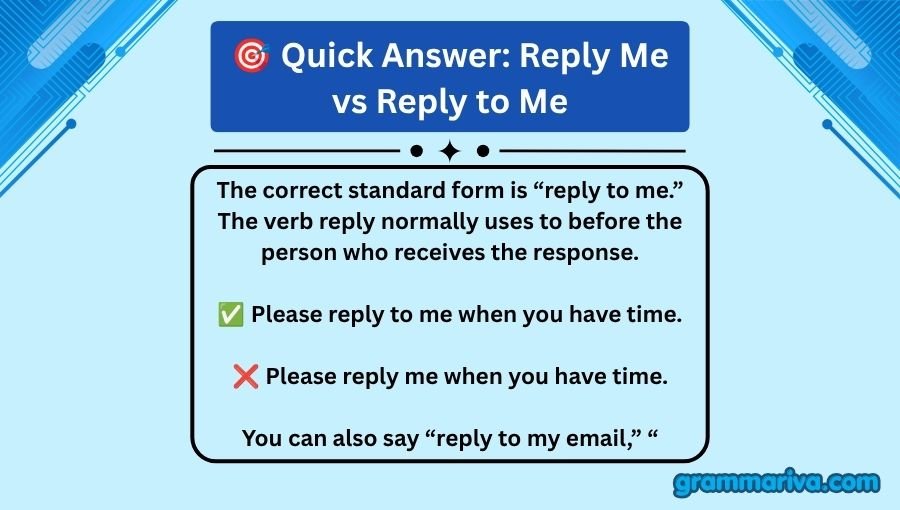
The correct standard form is “reply to me.” The verb reply normally uses to before the person who receives the response.
- ✅ Please reply to me when you have time.
- ❌ Please reply me when you have time.
You can also say “reply to my email,” “reply to the message,” or simply “reply.” In standard English, do not normally place a person directly after reply without to.
Is “Reply Me” Grammatically Correct?
No, “reply me” is not the standard form when you mean “respond to me.” Standard English normally requires the preposition to before the person receiving the reply.
For example:
- ✅ Please reply to me soon.
- ❌ Please reply me soon.
This is different from verbs such as answer.
We can say:
- Please answer me.
- Please reply to me.
Notice the difference. Answer can take the person directly. Reply normally needs to.
A Simple Comparison
| Form | Type | Meaning | Example | Correct/Incorrect |
|---|---|---|---|---|
| reply to me | Verb phrase | Respond to me | Please reply to me. | ✅ Correct |
| reply me | Verb phrase | Intended to mean respond to me | Please reply me. | ❌ Incorrect in standard English |
| answer me | Verb phrase | Give me an answer | Please answer me. | ✅ Correct |
| reply to my email | Verb phrase | Respond to my email | Please reply to my email. | ✅ Correct |
The key is not the meaning. Both forms are usually intended to communicate the same idea. The issue is grammar and verb pattern.
Why Do People Confuse “Reply Me” and “Reply to Me”?
People often confuse these forms because answer and reply have similar meanings but different grammar patterns.
I once reviewed a short work message that said, “Please reply me before Friday.” The writer clearly understood the meaning. The problem was simply the missing to. I changed it to “Please reply to me before Friday,” and the sentence immediately sounded natural.
Here is the basic contrast:
Answer + person
Please answer me.
Reply + to + person
Please reply to me.
Both verbs can describe a response, but they do not always follow the same sentence pattern.
The Pattern to Remember
| Verb | Common Pattern | Example |
|---|---|---|
| answer | answer + person | Answer me. |
| reply | reply + to + person | Reply to me. |
| respond | respond + to + person | Respond to me. |
| respond | respond + to + thing | Respond to the request. |
| reply | reply + to + thing | Reply to the email. |
This pattern explains most cases of reply me vs reply to me.
Reply Me vs Reply to Me at a Glance
The main difference is simple: reply to me follows the standard verb pattern, while reply me leaves out the required preposition in standard English.
| Sentence | Correct/Incorrect | Reason |
|---|---|---|
| Please reply to me. | ✅ Correct | Reply is followed by to before a person. |
| Please reply me. | ❌ Incorrect | The normal preposition to is missing. |
| She replied to me yesterday. | ✅ Correct | The person is introduced with to. |
| He did not reply to my question. | ✅ Correct | Reply to can introduce the thing being answered. |
| I will reply to you later. | ✅ Correct | To connects the response with the person. |
The fastest lesson is this:
Answer me, but reply to me.
That one sentence can help you remember the difference.
What Does “Reply to Me” Mean?
“Reply to me” means “give me a response.” It asks another person to respond directly to the speaker or writer.
For example:
Please reply to me by Monday.
The speaker wants the other person to send a response before Monday.
Another example is:
Did Sarah reply to you?
Here, reply to you means that Sarah responded to you.
Breaking Down the Sentence
Consider:
Please reply to me.
- Please = polite request
- reply = verb
- to = preposition
- me = person receiving the response
The sentence is short, but every part has a job.
Common Uses of “Reply to Me”
You can use the phrase in many situations:
- Please reply to me when you are free.
- Could you reply to me today?
- She finally replied to me.
- Why did he not reply to me?
- I asked him to reply to me.
All of these follow the same basic structure.
Can You Say “Reply to Me” in Professional English?
Yes. “Reply to me” is grammatically correct in professional English, although the best wording can depend on the situation.
For a workplace email, you might write:
Please reply to me by Thursday.
That is clear and correct.
However, if you are referring to an email, document, or request, a more specific sentence can sometimes sound smoother:
Please reply to the email by Thursday.
Or:
Please respond to the request by Thursday.
The choice depends on what you want the reader to focus on.
| Situation | Natural Expression | Example |
|---|---|---|
| Asking someone to respond | reply to me | Please reply to me today. |
| Referring to an email | reply to the email | Please reply to the email. |
| Referring to a message | reply to the message | Please reply to the message. |
| Formal request | respond to me | Please respond to me by Friday. |
| Casual request | reply | Please reply when you can. |
💡 Test Tip: Use the “Answer Me” Test
A useful way to remember reply me vs reply to me is to compare reply with answer.
Ask yourself:
Would I normally say “answer me” or “answer to me”?
The natural sentence is:
Answer me.
But with reply, the normal structure is:
Reply to me.
So remember:
Answer me.
Reply to me.
Respond to me.
This is not because reply and answer have completely different meanings. It is because English verbs can require different patterns.
Quick Test Table
| If You Want to Say… | Use This |
|---|---|
| Give me an answer | answer me |
| Give me a reply | reply to me |
| Give me a response | respond to me |
| Respond to my email | reply to my email |
| Respond to my question | reply to my question |
📝 Case Study: A Workplace Email
Imagine that Maya sends an email to a coworker:
Hi James,
Could you check the attached file and reply to me by 3 p.m.?
Thanks,
Maya
This is grammatically correct.
Now imagine the same email says:
Could you check the attached file and reply me by 3 p.m.?
The meaning is easy to understand, but the sentence does not follow the standard English pattern for reply.
A better version is:
Could you check the attached file and reply to me by 3 p.m.?
Or, if the email itself is the focus:
Could you check the attached file and reply to this email by 3 p.m.?
Both versions are clear.
| Original Idea | Better Version | Why |
|---|---|---|
| Reply me by 3 p.m. | Reply to me by 3 p.m. | Standard grammar |
| Reply me soon. | Reply to me soon. | Uses the normal verb pattern |
| Reply my email. | Reply to my email. | To is needed |
| Reply the message. | Reply to the message. | Reply to introduces the thing |
📚 Grammar Rules Explanation
The grammar rule behind reply me vs reply to me is based on how the verb reply normally connects to its object.
In standard English, reply is commonly followed by to when we identify the person or thing receiving the response.
For example:
She replied to me.
The phrase to me tells us who received the reply.
We can also say:
She replied to my email.
Here, to my email identifies what she responded to.
By contrast, answer can normally take a direct object:
She answered me.
This difference is a normal part of English verb patterns. Two verbs can have similar meanings but still require different structures.
Standard dictionaries and English usage references generally show reply to someone and reply to something as standard constructions.
Correct vs Incorrect at a Glance
| Sentence | Correct/Incorrect | Why |
|---|---|---|
| Please reply to me. | ✅ Correct | Standard reply to + person structure. |
| Please reply me. | ❌ Incorrect | Missing to. |
| I replied to her yesterday. | ✅ Correct | Correct preposition before the person. |
| He replied to my email. | ✅ Correct | Correct structure before a thing. |
| She replied me yesterday. | ❌ Incorrect | Reply does not normally take the person directly. |
The same rule applies to you, him, her, us, and them:
- reply to you
- reply to him
- reply to her
- reply to us
- reply to them
⚠️ Common Mistakes With Reply
Mistakes happen for several reasons. Fast typing is one reason. Autocorrect and texting habits can also make unusual patterns feel normal.
Another reason is that learners transfer a pattern from another verb.
For example, someone knows:
Answer me.
Then they create:
Reply me.
The meaning makes sense, but the grammar pattern has been copied from a different verb.
I once caught myself typing a short message too quickly and leaving out a small preposition. The sentence looked fine at first because I knew exactly what I meant. Reading it once more made the missing word obvious. Small words can make a big difference.
Similar Grammar Confusions
| Common Confusion | Correct Form | Main Difference |
|---|---|---|
| it’s / its | It’s raining. / Its color is blue. | Contraction vs possessive |
| your / you’re | Your phone / You’re ready | Possessive vs contraction |
| their / they’re | Their house / They’re here | Possessive vs contraction |
| affect / effect | It affected me. / The effect was clear. | Verb vs noun in common uses |
| answer me / reply to me | Answer me. / Reply to me. | Different verb patterns |
Specific Wrong Forms
| Wrong Form | What’s Wrong | Correct Form |
|---|---|---|
| Reply me. | Missing to | Reply to me. |
| Reply him. | Missing to | Reply to him. |
| Reply her. | Missing to | Reply to her. |
| Reply my email. | Missing to | Reply to my email. |
| Reply the message. | Missing to | Reply to the message. |
| Reply us soon. | Missing to | Reply to us soon. |
How Does “Reply” Work With Other Words?
The verb reply can appear in several useful patterns.
You can use it by itself:
I will reply later.
You can use reply to + person:
I will reply to you later.
You can use reply to + thing:
I will reply to your email later.
You can also use reply + adverb:
She replied quickly.
Notice that the preposition is needed when you name the person or thing receiving the response.
| Pattern | Example | Correct |
|---|---|---|
| reply | I will reply later. | ✅ |
| reply to + person | I will reply to you. | ✅ |
| reply to + thing | I will reply to the email. | ✅ |
| reply + person | I will reply you. | ❌ in standard English |
| reply + thing | I will reply the email. | ❌ in standard English |
Why Is “Reply to Me” More Natural?
“Reply to me” is more natural because it follows the standard grammatical pattern used with the verb reply.
English has many verb combinations that must simply be learned as patterns.
For example:
- listen to me
- speak to me
- talk to me
- respond to me
- reply to me
The word to connects the action with the person being addressed or receiving the response.
That does not mean every communication verb works this way. Answer is a useful exception to remember:
Answer me.
Not:
Answer to me.
So the best approach is not to translate the sentence word for word. Instead, learn the natural pattern used with each verb.
How To Use “Reply to Me” in Everyday Conversation
In casual conversation, reply to me is completely normal.
You might say:
Reply to me when you get home.
Or:
Why didn’t you reply to me?
Or:
Please reply to me when you see this.
In very casual texting, people sometimes shorten messages:
Reply when free.
That is perfectly understandable because the person is left unstated.
You can also simply write:
Please reply.
There is no need to add to me if the context already makes the recipient clear.
| Style | Example | Notes |
|---|---|---|
| Full | Please reply to me. | Clear and standard |
| Short | Please reply. | Natural when the recipient is obvious |
| Casual | Reply when you can. | Friendly and concise |
| Professional | Please reply to me by Friday. | Clear workplace wording |
Professional Writing and Email Examples
Professional writing benefits from simple and direct wording. If you need someone to respond, reply to me is correct. Understanding reply me vs reply to me helps you choose the correct form in professional emails.
Here are several examples:
Please reply to me by the end of the day.
Could you reply to me when you have reviewed the document?
Please reply to this email with your confirmation.
I would appreciate it if you could reply to me by Friday.
Sometimes respond to me may sound more formal:
Please respond to me at your earliest convenience.
However, formal writing does not require complicated words. A short sentence can be more effective.
| Professional Situation | Recommended Sentence |
|---|---|
| Deadline | Please reply to me by Friday. |
| Document review | Please reply to me after reviewing the document. |
| Confirmation | Please reply to this email with your confirmation. |
| Request | Please reply to my request when possible. |
“Reply to Me” in Texting and Social Media
Text messages often leave out words because people type quickly. That is why you may see forms such as: The same rule applies to reply me vs reply to me in digital communication, even when the message is short and informal. The same rule applies to reply me vs reply to me in texts and social media messages.
Reply me.
Even when readers understand the intended meaning, standard written English still favors:
Reply to me.
On social media, short phrases may be informal. In comments or chats, people may use nonstandard grammar because speed matters more than formal correctness.
Still, if you are writing a professional post, public announcement, business message, or polished caption, reply to me is the safer standard form.
| Context | Which Term to Use | Example |
|---|---|---|
| Everyday conversation | reply to me | Reply to me later. |
| Professional writing | reply to me | Please reply to me by noon. |
| Creative writing | reply to me | He begged her to reply to him. |
| Social media/texting | reply to me or reply | Reply to me when you see this. |
Common Phrases With “Reply”
There are several common phrases built around reply. These can help you become comfortable with the correct pattern.
| Phrase | Meaning |
|---|---|
| reply to me | Respond to me |
| reply to someone | Respond to a person |
| reply to an email | Respond to an email |
| reply to a message | Respond to a message |
| reply to a question | Give a response to a question |
| reply as soon as possible | Respond quickly |
Examples:
Please reply to my question.
I will reply to your message tonight.
She replied to him immediately.
He did not reply to the email.
These examples all show the same basic pattern.
Synonyms and Alternatives to “Reply to Me”
You do not always need to use the exact phrase reply to me. Several alternatives can work, depending on the situation. Knowing the difference between reply me vs reply to me also makes it easier to choose the right alternative for each situation.
| Alternative | Works When | Does Not Work When |
|---|---|---|
| respond to me | You want a neutral or slightly formal tone | You specifically need the word reply |
| answer me | You are asking for an answer | You are simply referring to an email reply |
| get back to me | You want a natural business or casual expression | Very formal writing may need clearer wording |
| write back to me | Someone is expected to send a written response | The response may be spoken |
| reply | The recipient is already obvious | The recipient needs to be clearly identified |
For example:
Please get back to me tomorrow.
This is natural English.
You could also say:
Please respond to me tomorrow.
Or:
Please reply to me tomorrow.
All three can work, but their tone can differ slightly.
Why Correct Usage Matters
Correct grammar makes your message easier to understand and helps your writing sound polished. This is especially useful when your message is going to a client, teacher, manager, customer, or large audience. That is why understanding reply me vs reply to me can help you keep your communication clear and grammatically correct.
A small word such as to can determine whether a sentence follows the standard pattern of the verb.
Clear writing removes unnecessary distractions.
That principle applies to emails, articles, school assignments, and online communication.
| Situation | Why Getting It Right Matters |
|---|---|
| Resume or application | Shows careful written communication |
| Client email | Makes the request clear and professional |
| Published content | Keeps grammar consistent |
| Social post | Helps polished writing look natural |
The goal is not to make every casual message formal. The goal is to know the standard form so you can choose the style you want.
Is There Any Exception to “Reply Me”?
There is no common standard-English exception that makes “reply me” the normal equivalent of “reply to me.”
You may encounter reply me in informal online writing, learner English, regional usage, or messages influenced by other languages. The fact that people understand it does not make it the standard form for polished English.
For standard American English, use:
Reply to me.
If you want an even shorter sentence, use:
Reply.
The second version works when the recipient is already clear.
How To Remember the Difference
The easiest memory trick is: This simple comparison is the easiest way to remember the rule behind reply me vs reply to me.
Answer me, but reply to me.
You can also group reply with verbs that commonly use to:
- reply to me
- respond to me
- speak to me
- listen to me
- talk to me
Then compare them with answer:
- answer me
- answer the question
- answer the phone
This gives you a practical mental pattern instead of forcing you to memorize a long grammar rule.
Memory Table
| Verb | Example |
|---|---|
| answer | Answer me. |
| reply | Reply to me. |
| respond | Respond to me. |
| listen | Listen to me. |
| speak | Speak to me. |
| talk | Talk to me. |
Quick Recap Checklist
Use this checklist whenever you are unsure.
| Question | If Yes → Use |
|---|---|
| Am I asking someone to respond to me? | reply to me |
| Am I asking someone to respond to my email? | reply to my email |
| Am I asking someone to answer a question directly? | answer me |
| Is the recipient already obvious? | reply can work |
| Am I writing standard English? | Avoid reply me |
Practice Examples
- Please ___ me after lunch.
Answer: reply to - Please ___ when you arrive.
Answer: reply - Please ___ before you leave.
Answer: answer me
The more you notice these patterns, the easier they become.
FAQs About Reply Me vs Reply To Me
Is “reply me” correct in English?
In standard English, “reply me” is generally incorrect when you mean “respond to me.” Use “reply to me” instead.
Is it “reply me” or “reply to me”?
The standard form is “reply to me.” The verb reply normally takes to before the person receiving the response.
Can I say “please reply me”?
No, not in standard English. Write “Please reply to me” instead.
Why do we say “answer me” but “reply to me”?
Because answer and reply follow different grammar patterns. Answer can take a person directly, while reply normally uses to before the person.
Is “reply to me” grammatically correct?
Yes. “Reply to me” is grammatically correct and standard English.
Can I say “reply to my email”?
Yes. “Reply to my email” is correct when you want someone to respond to your email.
Can I use “respond to me” instead?
Yes. “Respond to me” is also grammatically correct. It can sound neutral or slightly more formal than “reply to me.”
Is “reply to you” correct?
Yes. You can say “reply to you,” “reply to him,” “reply to her,” “reply to us,” and “reply to them.”
Can I simply say “reply”?
Yes. If the person receiving the response is obvious from context, you can simply say “Please reply.”
Is “reply me” acceptable in texting?
You may see it in informal messages, but it is not the standard form for polished English. If you want grammatically standard writing, use “reply to me.”
Conclusion
Reply me vs reply to me becomes easy once you remember that standard English uses reply to + person. 😊 So write “Please reply to me,” not “Please reply me.” The same pattern works with other people and things: “reply to him,” “reply to her,” “reply to the email,” and “reply to the message.”
The most useful comparison is answer me versus reply to me. Answer can take a person directly, but reply normally needs to before the person receiving the response.
When the recipient is already obvious, you can also shorten the sentence to “Please reply.” That keeps your writing natural without creating a grammar problem.
If you remember just one line from this guide, make it this:
Answer me, but reply to me.
That simple pattern will help you write clearer emails, messages, assignments, and everyday English with confidence. ✨

Hi, I’m Lucas Bennett. I’m a grammar content specialist at Grammariva. I work on articles covering everyday grammar questions, sentence usage, and writing tips that readers can apply with confidence.
[…] examples, regional usage, common mistakes, writing contexts, and easy ways to remember the rule. Reply Me vs Reply to Me | Curious of or Curious About | Postfix vs […]