Have you ever typed a word, looked at it for a second, and wondered, “Wait, is that really how you spell it?” 😅 The choice between crumby or crummy is a good example. Both forms look believable, but they do not have the same status or meaning in standard English.
The confusion often comes from the word crumb, which refers to a small piece of bread, cake, cookie, or another baked food. When people want to describe something that contains crumbs, the spelling crumby may seem perfectly logical. At the same time, crummy is a familiar English word that means poor, unpleasant, cheap, or of low quality.
That small spelling difference creates a big difference in meaning. One form can describe something related to crumbs, while the other is normally used to describe something bad or disappointing.
In this guide, I’ll explain crumby or crummy step by step. You’ll learn which spelling fits which meaning, how each word works in a sentence, and how to avoid common mistakes. By the end, you should be able to choose the right form without stopping to second-guess yourself. 👍 Wait or Weight | Sizable or Sizeable | Lite vs Light
🎯 Quick Answer: Crumby or Crummy?
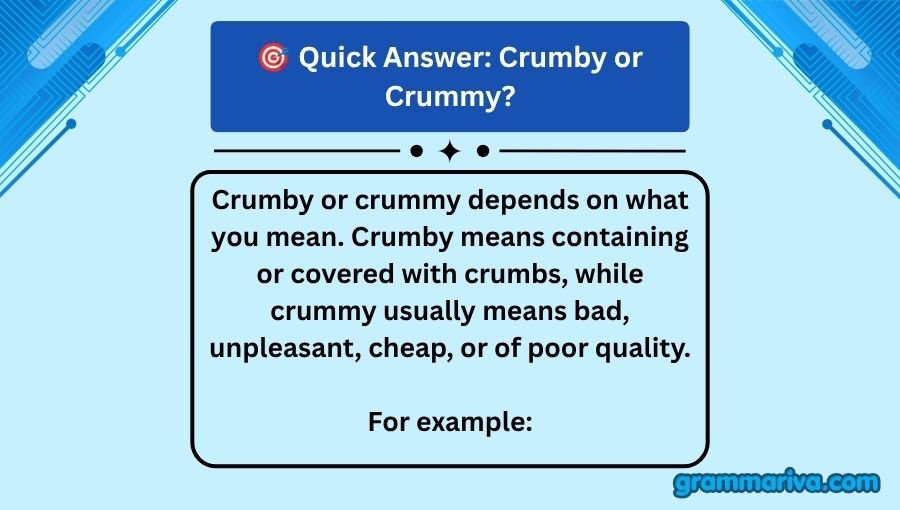
Crumby or crummy depends on what you mean. Crumby means containing or covered with crumbs, while crummy usually means bad, unpleasant, cheap, or of poor quality.
For example:
- The kitchen counter is crumby after breakfast. ✅
- The hotel room was crummy. ✅
If you mean “full of crumbs,” choose crumby. If you mean “bad” or “low-quality,” choose crummy.
| Word | Meaning | Example |
|---|---|---|
| crumby | Containing or covered with crumbs | The table is crumby. |
| crummy | Bad, unpleasant, or poor in quality | We had a crummy day. |
The key is simple: crumbs → crumby; poor quality → crummy.
Is Crumby a Correct Word?
Yes, crumby is a valid word when you want to describe something that has crumbs or is related to crumbs. It is formed from the noun crumb with the adjective ending -y.
For example:
The sofa is crumby because the kids ate cookies on it.
Here, “crumby” tells us that the sofa has crumbs on it.
The word is especially useful in casual conversation. You might use it when talking about food, kitchens, tables, couches, clothes, cars, or other surfaces.
Examples of Crumby
- The kitchen floor is crumby. ✅
- My shirt got crumby while I was eating the muffin. ✅
- The picnic table was covered in crumbs and looked crumby. ✅
- Please clean the crumby counter. ✅
The meaning is easy to connect to crumb.
| Form | Type | Meaning | Example | Correct/Incorrect |
|---|---|---|---|---|
| crumb | Noun | Small piece of food | There is a crumb on the plate. | Correct |
| crumby | Adjective | Containing crumbs | The table is crumby. | Correct |
| crummy | Adjective | Bad or poor quality | It was a crummy table. | Correct |
| crumby | Adjective | Bad or poor quality | The movie was crumby. | Usually incorrect for this meaning |
| crummy | Adjective | Containing crumbs | The counter is crummy. | Usually incorrect for this meaning |
This distinction matters because the two spellings can lead readers toward completely different meanings.
Is Crummy a Correct Word?
Yes. Crummy is a common adjective in informal English. It usually describes something that is bad, unpleasant, disappointing, uncomfortable, or low in quality.
For example:
We stayed in a crummy hotel.
The speaker is not saying the hotel had crumbs. The speaker means the hotel was poor or unpleasant.
You can use crummy for things such as:
- a bad experience
- a poor-quality product
- an unpleasant day
- an uncomfortable place
- a disappointing situation
- something cheap or poorly made
Examples of Crummy
- I had a crummy day at work. ✅
- That old computer is pretty crummy. ✅
- We were given a crummy room. ✅
- The weather was crummy all weekend. ✅
- He felt crummy after losing the game. ✅
Because crummy is informal, it is usually better suited to conversation and casual writing than highly formal documents.
🧠 Crumby vs Crummy at a Glance
The main difference between crumby or crummy is meaning, not simply spelling.
Crumby connects to crumbs.
Crummy usually connects to something bad or unpleasant.
| Word | Main Idea | Common Use | Example |
|---|---|---|---|
| crumby | Full of or covered with crumbs | Food and surfaces | The couch is crumby. |
| crummy | Bad or unpleasant | Experiences and things | It was a crummy couch. |
Notice the difference in these two sentences:
The couch is crumby.
This means the couch has crumbs on it.
The couch is crummy.
This means the couch is poor, unpleasant, or low-quality.
That one letter changes the message.
Why Do People Confuse Crumby and Crummy?
People confuse these words because they look and sound very similar. Both begin with crum-, and both are adjectives ending in -y.
There is also a natural spelling trap. If someone knows that crumb becomes an adjective, crumby seems obvious. But crummy is already an established word with a different meaning.
I once edited a casual food blog where the writer described a cookie as “crummy” when they meant that crumbs were falling everywhere. The sentence sounded funny because readers could understand “crummy” as “bad.” Changing it to “crumby” made the intended meaning clear.
Three reasons the confusion happens
- The words look almost identical.
- Both can describe things.
- Fast typing makes one-letter differences easy to miss.
| Confusion | What the Writer May Mean | Better Choice |
|---|---|---|
| crumby/crummy table | Covered with crumbs | crumby |
| crumby/crummy service | Poor service | crummy |
| crumby/crummy sandwich | Full of crumbs | crumby |
| crumby/crummy experience | Bad experience | crummy |
| crumby/crummy room | Poor-quality room | crummy |
What Does Crumby Mean?
Crumby means containing, covered with, or characterized by crumbs. It is an adjective that comes from crumb.
Imagine eating toast over a clean table. Small pieces fall onto the surface. Afterward, you might say:
The table is crumby.
The word describes the physical condition of the table.
Common things that can be Crumby
You might describe these as crumby:
- a table
- a kitchen counter
- a couch
- a car seat
- a floor
- a shirt
- a backpack
- a desk
The exact meaning depends on context, but the connection is always with crumbs.
Sentence Breakdown
The couch is crumby.
- The couch = subject
- is = linking verb
- crumby = adjective describing the couch
The sentence tells us about the couch’s condition.
| Meaning | Word Type | Example Sentence |
|---|---|---|
| Covered with crumbs | Adjective | The couch is crumby. |
| Containing crumbs | Adjective | The floor became crumby. |
| Related to crumbs | Adjective | We cleaned the crumby surface. |
💡 Test Tip
Ask yourself:
“Am I talking about actual crumbs?”
If the answer is yes, crumby is usually the word you want.
What Does Crummy Mean?
Crummy usually means bad, poor, unpleasant, disappointing, or low-quality. It is informal and often carries a negative feeling.
For example:
That was a crummy movie.
The speaker is saying the movie was bad.
Another example:
I had a crummy morning.
This means the morning was unpleasant or disappointing.
The word can also describe a person’s physical or emotional condition in informal speech:
I feel crummy today.
Here, the speaker means they feel unwell or generally bad.
Common Uses of Crummy
Crummy service
Means poor service.
Crummy weather
Means unpleasant weather.
Crummy apartment
Means a poor or unpleasant apartment.
Crummy excuse
Means a weak or poor excuse.
Crummy feeling
Means an unpleasant feeling.
| Expression | Meaning | Example |
|---|---|---|
| crummy day | Bad day | I had a crummy day. |
| crummy job | Poor or unpleasant job | He found a crummy job. |
| crummy service | Poor service | The restaurant had crummy service. |
| crummy weather | Bad weather | We had crummy weather. |
| crummy excuse | Weak excuse | That is a crummy excuse. |
Can Crumby Mean Bad?
Generally, crumby should not be your normal choice when you mean “bad,” “poor,” or “unpleasant.”
For that meaning, use crummy.
- It was a crummy movie. ✅
- It was a crumby movie. ❌
The second sentence can confuse readers because “crumby” points toward crumbs.
However, English is flexible, and informal writing sometimes produces unusual spellings. That does not mean every unusual spelling is the best standard choice.
If you mean bad, choose crummy.
Can Crummy Mean Full of Crumbs?
In standard modern usage, crummy is normally understood as “bad,” “poor,” or “unpleasant,” not as the ordinary adjective for something covered in crumbs.
So if your kitchen counter has cookie crumbs all over it, write:
The counter is crumby. ✅
Not:
The counter is crummy. ❌
The second sentence is likely to suggest that the counter is poor-quality or unpleasant rather than literally covered with crumbs.
✍️ Correct Meanings and Uses
The safest way to remember the difference is to connect each spelling with its main meaning.
Crumby = Related to Crumbs
Use crumby when the physical presence of crumbs matters.
My keyboard is crumby after lunch. ✅
The speaker is describing crumbs around the keyboard.
Crummy = Bad or Poor
Use crummy when you are criticizing something.
My keyboard is crummy. ✅
Now the speaker is saying the keyboard itself is poor or unpleasant.
Crummy = Feeling Bad
You can also use crummy to describe how someone feels in informal English.
I feel crummy today. ✅
This does not mean the person is covered with crumbs. It describes an unpleasant physical or emotional state.
| Word | Meaning | Typical Example |
|---|---|---|
| crumby | Has crumbs | The table is crumby. |
| crummy | Bad quality | The table is crummy. |
| crummy | Unpleasant experience | We had a crummy trip. |
| crummy | Feeling unwell | I feel crummy today. |
📝 Case Study: A Small Spelling Difference in a Workplace Email
Imagine an employee sends this message to a coworker:
“The conference room table is crummy after the meeting.”
The coworker may think the table is old, damaged, cheap, or unpleasant.
But the employee actually means that people left cookie crumbs on the table.
The better message would be:
“The conference room table is crumby after the meeting.”
Now the meaning is clear.
I once caught myself making a similar kind of mistake while proofreading a short note. The sentence was technically understandable, but one spelling choice made the reader pause. That is often the real problem with close word pairs. They may not completely destroy communication, but they can slow the reader down.
| Original Idea | Better Sentence | Intended Meaning |
|---|---|---|
| The table is crummy. | The table is crumby. | It has crumbs. |
| The service was crumby. | The service was crummy. | The service was bad. |
| I feel crumby. | I feel crummy. | I feel bad. |
| The couch is crumby. | The couch is crumby. | It has crumbs. |
📚 Grammar Rules Explanation
The difference between these words comes from their established meanings and spelling patterns.
Crumby is linked directly to crumb. It functions as an adjective describing something that has crumbs or is associated with crumbs.
Crummy is an established adjective with a negative meaning. It commonly describes something bad, unpleasant, disappointing, or low-quality.
The words therefore should not normally be treated as interchangeable.
A useful grammar principle is simple: choose the adjective that expresses the meaning you intend. Spelling is not just decoration. It can signal meaning.
Most standard English reference sources distinguish the two forms by meaning and usage.
Correct vs Incorrect at a Glance
| Sentence | Correct/Incorrect | Why |
|---|---|---|
| The counter is crumby. | ✅ Correct | It has crumbs on it. |
| The counter is crummy. | ❌ Usually incorrect for this meaning | “Crummy” normally means bad or poor. |
| We had a crummy experience. | ✅ Correct | The experience was unpleasant. |
| We had a crumby experience. | ❌ Usually incorrect | “Crumby” suggests crumbs. |
| I feel crummy today. | ✅ Correct | It means feeling bad or unwell. |
The important point is that crumby or crummy is not simply a matter of choosing the spelling you like better. The intended meaning decides the word.
⚠️ Common Mistakes With Crumby and Crummy
These mistakes happen because the words are visually close.
Mistake 1: Using Crummy for Crumbs
The table is crummy because everyone ate cookies. ❌
If the table has crumbs, use:
The table is crumby because everyone ate cookies. ✅
Mistake 2: Using Crumby for Bad Quality
We stayed at a crumby hotel. ❌
If the hotel was poor or unpleasant:
We stayed at a crummy hotel. ✅
Mistake 3: Treating Them as Exact Synonyms
They are not normally exact synonyms.
| Similar Confusion | Correct Choice | Main Reason |
|---|---|---|
| its / it’s | Depends on meaning | Possession vs contraction |
| your / you’re | Depends on meaning | Possession vs “you are” |
| there / their / they’re | Depends on meaning | Place, possession, contraction |
| affect / effect | Depends on grammar | Verb vs noun and related uses |
| crumby / crummy | Depends on meaning | Crumbs vs poor quality |
Why These Mistakes Happen
Fast typing: When people type quickly, one letter can easily replace another.
Autocorrect: Automatic corrections do not always understand the intended meaning.
Lack of knowledge: Someone who has never noticed the difference may assume the forms are interchangeable.
Sound similarity: In casual speech, the words can feel very close.
I once saw a student write “crummy” while describing a picnic blanket covered in cookie crumbs. When I asked what the student meant, the answer was simply, “I mean it has crumbs.” That made the correction easy: crumby.
Common Wrong Spellings and Uses
| Wrong Form | What’s Wrong | Correct Form |
|---|---|---|
| crumie | Misspelling | crummy |
| crummie | Nonstandard spelling | crummy |
| crumbby | Extra letter | crumby |
| crumby = bad | Wrong meaning in standard use | crummy |
| crummy = full of crumbs | Usually the wrong word for this meaning | crumby |
| crumee | Misspelling | crumby or crummy, depending on meaning |
Why the Extra M Matters
The spelling difference is small, but it helps separate the meanings.
Compare:
crumby → connected to crumb
crummy → means bad, poor, or unpleasant
This is not a rule that every English word follows. It is simply a useful memory connection for these particular words.
If you are talking about a surface after eating cookies, think:
crumb → crumby
If you are complaining about a bad experience, think:
crummy → bad
| Situation | Best Word |
|---|---|
| A table covered in crumbs | crumby |
| A poor-quality table | crummy |
| A floor with cookie crumbs | crumby |
| A terrible hotel | crummy |
| An unpleasant day | crummy |
| A desk covered with food crumbs | crumby |
🌎 Usage in Different Contexts
The best choice can become easier when you consider the context.
Everyday Conversation
Crumby works well when describing food crumbs.
The kids left the couch crumby.
Crummy works well when complaining.
This is a crummy chair.
Professional Writing
Be more careful with crummy because it is informal.
Instead of:
The company provided a crummy service.
A professional report might say:
The company provided poor service.
For a physical description, crumby may still be useful if crumbs are relevant.
Creative Writing
Both words can work well because creative writing often uses conversational language.
She brushed the crumby table with her sleeve.
He spent another crummy afternoon waiting for the bus.
Social Media and Texting
Both can work naturally.
My couch is officially crumby after movie night. 😂
What a crummy Monday.
| Context | Which Term to Use | Example |
|---|---|---|
| Everyday conversation | Either, depending on meaning | The table is crumby. |
| Professional writing | crumby when literal; alternatives for crummy | The surface was crumby. |
| Creative writing | Either, depending on meaning | It was a crummy afternoon. |
| Social media/texting | Either, depending on meaning | What a crummy day! |
💬 Common Phrases With Crummy
Crummy appears naturally in several informal expressions.
| Phrase | Meaning |
|---|---|
| crummy day | A bad or unpleasant day |
| crummy weather | Poor or unpleasant weather |
| crummy job | A poor or unpleasant job |
| crummy service | Poor service |
| crummy excuse | A weak or poor excuse |
| feel crummy | Feel bad or unwell |
There are fewer fixed expressions with crumby because it is mainly a descriptive adjective.
Instead, it usually appears in ordinary descriptions:
- a crumby table
- a crumby floor
- a crumby couch
- a crumby seat
- a crumby shirt
🔄 Synonyms and Alternatives
Sometimes you can avoid the spelling problem entirely by choosing another word.
If you mean crumby, alternatives include:
- covered in crumbs
- full of crumbs
- crumb-covered
- messy with crumbs
If you mean crummy, alternatives include:
- bad
- poor
- unpleasant
- disappointing
- low-quality
The best alternative depends on the exact sentence.
| Alternative | Works When | Does Not Work When |
|---|---|---|
| covered in crumbs | You want a very clear literal description | You mean poor quality |
| full of crumbs | You want to emphasize many crumbs | You mean a bad experience |
| bad | You mean poor quality | You specifically mean crumbs |
| poor | You need a more neutral or formal word | You mean physical crumbs |
| unpleasant | You want to describe a negative experience | You mean a surface with crumbs |
❓ Is Crumby or Crummy More Formal?
Neither word is especially formal, but crummy is particularly informal because it is often used as a casual way to say “bad” or “poor.”
In formal writing, alternatives such as poor, unsatisfactory, or unpleasant may be better.
Crumby can be useful in ordinary descriptive writing, but in a formal report you might prefer:
The surface was covered with crumbs.
That version is clearer and more direct.
| Writing Style | Preferred Choice |
|---|---|
| Casual conversation | crumby or crummy |
| Text message | crumby or crummy |
| Blog post | Either, depending on meaning |
| Formal report | Clearer alternatives may be better |
| Academic writing | Usually use more precise formal wording |
✨ How To Remember the Difference
Here is my favorite memory trick:
Crumby has a B for Breadcrumbs
Think:
B = breadcrumbs → crumby
If you can see crumbs, choose crumby.
Crummy Has Two Ms for “Miserable”
Think:
crummy = miserable, bad, or unpleasant
This is not a formal grammar rule. It is simply a memory trick.
| Memory Clue | Word | Meaning |
|---|---|---|
| B → breadcrumbs | crumby | Covered with crumbs |
| “Bad” feeling | crummy | Poor or unpleasant |
Try making two mental pictures.
Picture a cookie-covered couch:
crumby couch
Now picture an uncomfortable, broken couch:
crummy couch
Same noun. Different adjective. Different meaning.
🎯 When Should You Use Crumby?
Use crumby when crumbs are the main idea.
Ask yourself:
“Does this thing have crumbs on or in it?”
If yes, crumby is a good choice.
Examples:
- The bed is crumby after breakfast. ✅
- The car seat is crumby. ✅
- My backpack is crumby because I carry crackers in it. ✅
- The kitchen floor is crumby. ✅
The word is especially natural in informal descriptions.
🎯 When Should You Use Crummy?
Use crummy when you mean bad, poor, unpleasant, disappointing, or low-quality.
Ask yourself:
“Am I complaining about the quality or experience?”
If yes, crummy is usually the right choice.
Examples:
- The service was crummy. ✅
- I had a crummy weekend. ✅
- That is a crummy excuse. ✅
- This old chair is crummy. ✅
- I feel crummy today. ✅
Remember that crummy is informal. In formal writing, a more precise alternative may be better.
Why Getting Crumby or Crummy Right Matters
Choosing the correct spelling makes your writing easier to understand.
A reader who sees crumby expects a connection to crumbs. A reader who sees crummy usually expects a negative judgment.
That difference can affect tone as well as meaning.
Imagine writing a food review:
“The restaurant gave us a crummy table.”
Readers may think the table was uncomfortable or poor-quality.
But:
“The restaurant gave us a crumby table.”
Readers may picture a table covered in crumbs.
A single letter changes the image in the reader’s mind.
“Good writing helps the reader understand your meaning without stopping to decode it.”
| Situation | Why Getting It Right Matters |
|---|---|
| Resume | Informal word choices can affect professionalism |
| Client email | Clear wording prevents misunderstandings |
| Published content | Correct spelling builds reader trust |
| Social post | Correct word choice keeps the intended joke or message clear |
Is Crumby or Crummy Used More Often?
The two forms serve different purposes, so frequency alone should not decide which one you use.
Crummy is a familiar informal word for something bad or unpleasant. Crumby is more specific because it describes something involving crumbs.
For example, you would not replace crummy with crumby simply because both are adjectives.
Likewise, you would not normally use crummy when you literally mean that a surface has crumbs.
The right word depends on meaning rather than popularity.
| Intended Meaning | Correct Word |
|---|---|
| Has crumbs | crumby |
| Bad | crummy |
| Poor quality | crummy |
| Unpleasant | crummy |
| Covered with food crumbs | crumby |
| Feeling bad | crummy |
📝 Practice Examples
Test yourself before looking at the answers.
Example 1
The kitchen table was covered with cookie crumbs.
Answer: crumby ✅
The kitchen table was crumby.
Example 2
The hotel room was dirty, uncomfortable, and poorly maintained.
Answer: crummy ✅
The hotel room was crummy.
Example 3
I ate a muffin in the car, and now the seat has crumbs everywhere.
Answer: crumby ✅
The car seat is crumby.
Example 4
The weather ruined our plans.
Answer: crummy ✅
We had crummy weather.
Example 5
The children ate cookies on the sofa.
Answer: crumby ✅
The sofa is crumby.
✅ Quick Recap Checklist
Use this checklist whenever you are unsure.
| Question | If Yes → Use |
|---|---|
| Are you talking about crumbs? | crumby |
| Is something covered with crumbs? | crumby |
| Does something contain crumbs? | crumby |
| Are you saying something is bad? | crummy |
| Are you describing poor quality? | crummy |
| Are you describing an unpleasant experience? | crummy |
| Are you saying you feel bad? | crummy |
Three Final Practice Sentences
- The kitchen counter is crumby after breakfast. ✅
- We had a crummy experience at the hotel. ✅
- I feel crummy after staying up all night. ✅
The fastest test is:
Crumbs? → crumby.
Bad? → crummy.
FAQs About Crumby vs Crummy
What is the difference between crumby and crummy?
Crumby means containing or covered with crumbs. Crummy usually means bad, unpleasant, disappointing, or low-quality.
Is crumby a real word?
Yes. Crumby is used as an adjective for something that has crumbs or is covered with crumbs.
Is crummy a real word?
Yes. Crummy is a standard informal adjective meaning bad, poor, unpleasant, or low-quality.
Is crumby or crummy correct for food crumbs?
Use crumby when you mean something has food crumbs on it or in it.
The table is crumby. ✅
Is crumby or crummy correct for something bad?
Use crummy when you mean bad, poor, unpleasant, or disappointing.
That was a crummy movie. ✅
Can I say “I feel crumby”?
If you mean that you feel bad or unwell, I feel crummy is the usual choice.
I feel crummy today. ✅
Can crummy mean covered in crumbs?
That is not the normal meaning of crummy. If you mean that something is covered in crumbs, crumby is clearer.
Is crummy formal English?
Crummy is informal. It is natural in conversation, casual writing, texts, and creative writing. More formal writing may use words such as poor, unsatisfactory, or unpleasant.
How can I remember crumby vs crummy?
Think crumb → crumby when you mean actual crumbs. Think crummy → bad when you are describing something negative or unpleasant.
Which spelling should I use in professional writing?
Choose the word based on meaning. If you mean crumbs, crumby can work. If you mean bad quality, consider a more formal word such as poor or unsatisfactory instead of informal crummy.
🏁 Conclusion
Crumby or crummy becomes easy to choose once you connect each spelling to its meaning. Use crumby when something has crumbs or is covered with crumbs. Use crummy when something is bad, unpleasant, disappointing, or low-quality.
Think of a kitchen table after someone eats cookies. The table is crumby because it has crumbs. Now think of a terrible hotel room. The room is crummy because it is poor or unpleasant.
The difference is only one letter, but that letter helps your reader understand exactly what you mean. ✨ When you are unsure, stop and ask one simple question: Am I talking about crumbs, or am I saying something is bad?
If the answer is crumbs, choose crumby. If the answer is bad, choose crummy.
That tiny memory trick can save you from a surprisingly common spelling mistake. And once you learn the difference, you will probably never hesitate over these two words again. 👍

Hi, I’m Olivia Carter. I’m an English language editor at Grammariva, and I work on making grammar lessons clear, accurate, and easy to follow. I especially enjoy writing about common grammar mistakes and everyday English.
[…] and professional writing. Once you understand the difference, the choice becomes much easier. 🎯 Crumby or Crummy | Wait or Weight | Sizable or […]