Choosing between independent from or independent of can feel confusing because both phrases appear in English. You may see both in books, emails, articles, and everyday speech. So which one should you use?
The short answer is that independent of is usually the standard and safest choice when you mean that something is not controlled by, connected to, or dependent on something else. Independent from can also be used, especially when the idea is separation from a person, group, system, or influence. The difference is often small, but the choice can affect how natural and polished your sentence sounds.
I have seen this issue many times when editing essays and professional writing. Writers often know exactly what they want to say, but they pause over one small preposition. That tiny choice can make a sentence sound either natural or awkward. 😊
In this guide, I will explain independent from or independent of in simple US English. You will learn when to use each form, which one is more common in different situations, how to avoid common mistakes, and how to remember the difference. By the end, you should be able to choose confidently. 👍 Leave It as It Is or Leave It as Is | Ahead vs A Head | Concurrent vs Simultaneous
🎯 Quick Answer: Independent From or Independent Of
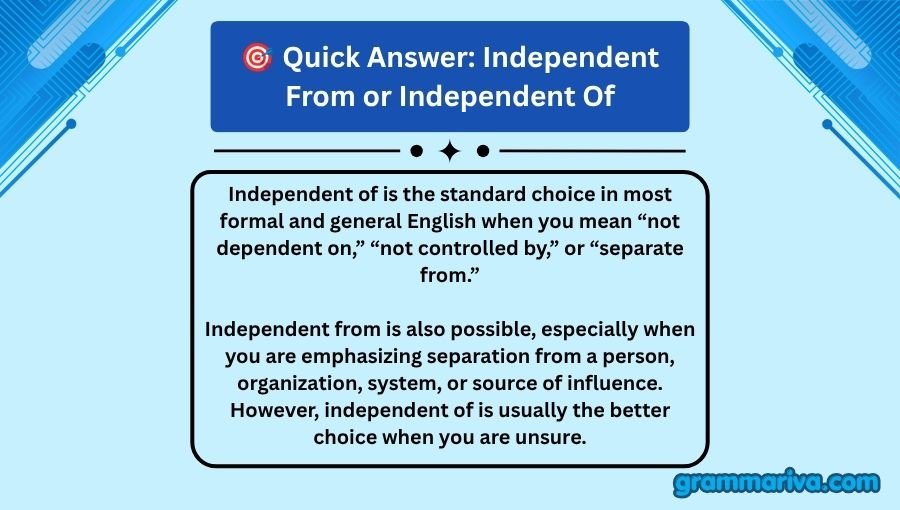
Independent of is the standard choice in most formal and general English when you mean “not dependent on,” “not controlled by,” or “separate from.”
Independent from is also possible, especially when you are emphasizing separation from a person, organization, system, or source of influence. However, independent of is usually the better choice when you are unsure.
Quick comparison
| Phrase | Main Use | Example |
|---|---|---|
| independent of | Not dependent on or controlled by something | The company is independent of the government. |
| independent from | Separate from a person, group, or system | The group became independent from the larger organization. |
A simple rule is:
When in doubt, use “independent of.”
That choice works naturally in most formal writing.
Is Independent Of More Common Than Independent From?
Yes. Independent of is generally the more established and flexible construction. It is especially common when describing freedom from control, influence, dependence, or connection.
For example:
- The committee must remain independent of political pressure. ✅
- Her income is independent of her parents. ✅
- The results are independent of the original estimate. ✅
Independent from can be grammatical too, but it often highlights separation rather than simple lack of dependence.
| Expression | Natural Meaning | Typical Emphasis |
|---|---|---|
| independent of | Not dependent on or controlled by | Freedom or lack of dependence |
| independent from | Separated from | Distance or separation |
| independent of outside influence | Free from influence | Formal writing |
| independent from the parent company | Separate from a company | Organizational separation |
In professional writing, I usually recommend independent of unless the sentence clearly focuses on separation.
🔎 Independent From or Independent Of at a Glance
The main difference is one of emphasis. Independent of usually describes a state of freedom from dependence or control. Independent from can describe separation from a person, organization, or system.
| Form | Type | Meaning | Example | Correct/Incorrect |
|---|---|---|---|---|
| independent of | Adjective phrase | Not dependent on | The project is independent of funding from the city. | ✅ Correct |
| independent from | Adjective phrase | Separate from | The department became independent from the main office. | ✅ Correct |
| independently of | Adverb phrase | Without relying on | She worked independently of the team. | ✅ Correct |
| independence from | Noun phrase | State of being separate or free | The country gained independence from colonial rule. | ✅ Correct |
| independence of | Noun phrase | Freedom or lack of control | The independence of the court is essential. | ✅ Correct |
The important point is that these expressions are not always interchangeable in tone.
What Does Independent Mean in These Phrases?
Independent is an adjective that describes someone or something that is free from control, dependence, or support from another person or thing.
The exact meaning depends on context.
A person can be independent because they make their own decisions. A company can be independent because another company does not control it. A research result can be independent because it does not depend on another variable.
Common meanings of independent
| Meaning | Word Type | Example Sentence |
|---|---|---|
| Free from control | Adjective | The agency is independent of political control. |
| Not relying on someone | Adjective | She is financially independent of her family. |
| Separate from another organization | Adjective | The studio is independent from the larger network. |
| Able to act alone | Adjective | He is independent enough to manage the project himself. |
The preposition that follows independent helps explain the relationship.
💡 Understanding the Basics of Independent Of
Independent of usually means that one person or thing does not rely on, depend on, or remain under the control of another.
This is why it works so well in formal English.
Consider:
The research team is independent of the company.
This means the research team is not controlled by the company.
Another example:
The final decision is independent of personal opinions.
This means personal opinions do not control the final decision.
More examples
- The committee is independent of the board. ✅
- The student’s grade is independent of her attendance. ✅
- The system operates independent of the main network. ❌
- The system operates independently of the main network. ✅
That last example is worth noticing. When independent modifies a verb rather than a noun, independently may be needed.
Why Is Independent Of Usually the Safer Choice?
Independent of is safer because it covers several related ideas: freedom from control, freedom from influence, lack of dependence, and lack of connection.
It fits naturally in academic, business, legal, scientific, and everyday writing.
| Situation | Preferred Form | Example |
|---|---|---|
| Financial dependence | independent of | He is financially independent of his parents. |
| Political influence | independent of | The agency must remain independent of political pressure. |
| Research | independent of | The result is independent of the sample size. |
| Business control | independent of | The company operates independently of its parent firm. |
| Personal decisions | independent of | She made the choice independent of her friends’ opinions. |
A useful editing trick is to ask:
“Does this mean not dependent on or not controlled by?”
If yes, independent of is usually the right answer.
Can You Use Independent From?
Yes. Independent from is not automatically wrong.
It can sound natural when the sentence describes separation from a person, organization, group, system, or previous state.
For example:
The new department became independent from the parent organization.
Here, the focus is on separation.
Another example:
She wanted to become independent from her family’s business.
The phrase emphasizes moving away from an existing connection.
Compare the two
| Sentence | Meaning | Naturalness |
|---|---|---|
| The agency is independent of the government. | The government does not control it. | Very natural |
| The agency is independent from the government. | The agency is separate from the government. | Possible |
| The company is independent of outside investors. | It does not depend on them. | Very natural |
| The company became independent from its former owner. | It separated from its former owner. | Natural |
The distinction is not absolute. Context matters.
❓ Is Independent From Grammatically Correct?
Yes, independent from can be grammatically correct. It is not necessary to mark every use as wrong.
The problem is that writers sometimes use it where independent of would sound more natural.
For example:
The decision was independent from political influence.
This is understandable, but many editors would prefer:
The decision was independent of political influence. ✅
Why? Because political influence is something the decision is free from, not something it has physically separated from.
A practical test
Replace the phrase with “not dependent on.”
If the replacement works well, use independent of.
Example:
The result is independent of temperature.
Try:
The result is not dependent on temperature.
The meaning stays clear. Therefore, independent of is a strong choice.
🧠 How To Remember Independent From vs Independent Of
I use a simple memory trick when teaching this distinction:
OF = freedom from dependence or influence.
FROM = separation from something.
This is not a perfect rule for every sentence, but it works in many everyday cases.
| If You Mean… | Choose | Example |
|---|---|---|
| Not dependent on | of | independent of funding |
| Not controlled by | of | independent of the government |
| Not influenced by | of | independent of public opinion |
| Separated from an organization | from | independent from the parent group |
| Moved away from a former connection | from | independent from his former employer |
💡 Test Tip
Ask yourself:
“Am I talking about freedom from dependence, or separation from a source?”
- Freedom from dependence → independent of
- Separation → independent from
If the answer is unclear, independent of is usually the safer formal option.
📝 Case Study: A Workplace Example
Imagine that I am editing a company report.
The writer says:
“Our audit team is independent from the company’s management.”
The meaning is clear. The team is separate from management.
But the report is discussing whether management controls the auditors. In that context, I would revise it to:
“Our audit team is independent of the company’s management.” ✅
The second version makes the idea of freedom from control clearer.
I once edited a short business report where a writer used independent from several times. The writer was not making a serious grammar mistake. The bigger issue was consistency. Once we changed the sentences that described freedom from influence to independent of, the report sounded much more polished.
Workplace comparison
| Original Idea | Better Formal Version | Reason |
|---|---|---|
| The review is independent from management. | The review is independent of management. | Freedom from control |
| The new unit became independent from the company. | The new unit became independent from the company. | Separation |
| The findings are independent from political views. | The findings are independent of political views. | Lack of influence |
| The division became independent from the parent company. | The division became independent from the parent company. | Organizational separation |
📚 Grammar Rules Explanation
The word independent describes a state in which someone or something is not controlled by, dependent on, or subject to another person or thing.
The preposition of commonly follows independent when the noun after it identifies the thing from which the subject is free.
For example:
The organization is independent of the government.
The organization is not controlled by the government.
The phrase independent from can also occur when the speaker wants to stress separation. It is especially useful when the idea involves becoming separate from a former group, organization, or relationship.
The key is not to treat from as an automatic error. Instead, consider the intended relationship.
Correct vs Incorrect at a Glance
| Sentence | Correct/Incorrect | Why |
|---|---|---|
| The agency is independent of political pressure. | ✅ Correct | It is free from political influence. |
| The agency is independent from political pressure. | ⚠️ Less natural | “Of” is more standard for freedom from influence. |
| The department became independent from the parent company. | ✅ Correct | The focus is separation. |
| The result is independent of temperature. | ✅ Correct | The result does not depend on temperature. |
| The result is independent from temperature. | ⚠️ Less natural | “Independent of” is the usual choice for dependence. |
Most standard English references support the broad pattern that independent of is a common and established construction. That does not mean every use of independent from is incorrect.
❓ Why Do People Confuse Independent From and Independent Of?
People confuse these phrases because from and of can both appear after adjectives that describe relationships.
English also has many adjective-preposition combinations that cannot be predicted from simple rules.
For example:
- different from
- afraid of
- interested in
- responsible for
- independent of
A learner may reason that because something is “free from” something, independent from must always be the best choice. That logic is understandable, but English does not always work that way.
I once caught myself typing independent from in a quick email. I reread the sentence and realized I was talking about freedom from financial dependence. I changed it to independent of, and the sentence immediately sounded cleaner.
Why the mistake happens
| Cause | What Happens |
|---|---|
| Fast typing | Writers choose the first preposition that comes to mind. |
| Autocorrect | Software may reinforce a familiar phrase. |
| Lack of knowledge | Writers may not know the common adjective-preposition pairing. |
| Translation habits | Another language may use a structure that maps poorly into English. |
| Similar meanings | “From” naturally suggests freedom or separation, creating confusion. |
⚠️ Common Mistakes With These Expressions
The most common problem is not that independent from is always wrong. The problem is choosing it when independent of is the more natural construction.
Similar grammar confusions
| Common Confusion | Correct Form | Example |
|---|---|---|
| its / it’s | its = possessive; it’s = it is | The company changed its policy. |
| your / you’re | your = possessive; you’re = you are | You’re ready for your test. |
| affect / effect | affect = usually verb; effect = usually noun | The change affected sales. |
| advice / advise | advice = noun; advise = verb | She gave me good advice. |
| then / than | then = time; than = comparison | Better than before. |
| independent of / independent from | depends on context | The result is independent of cost. |
Specific mistakes with independent
| Wrong Form or Use | What’s Wrong | Correct Form |
|---|---|---|
| independent of from the company | Two prepositions are combined unnecessarily | independent of the company |
| independent on the government | Wrong preposition | independent of the government |
| independent from political influence | Understandable but less standard | independent of political influence |
| independently of the team, she worked | Correct but different structure | independently of the team, she worked |
| independent from funding | Often less natural when dependence is meant | independent of funding |
| independent of the parent company after separation | Can be correct, but may not stress the separation event | independent from the parent company |
Do not assume that every sentence containing independent from needs correction. First determine what the writer means.
❓ When Should You Use Independent Of?
Use independent of when you mean that something does not depend on another thing or is free from its control or influence.
This is especially common in:
- academic writing
- business writing
- research
- formal reports
- professional communication
- discussions of money or dependence
- discussions of influence or control
Examples
The result is independent of the method used. ✅
The organization must remain independent of political parties. ✅
Her decision was independent of public opinion. ✅
The student’s success was independent of financial support. ✅
The phrase is strong because it directly expresses a lack of dependence.
❓ When Should You Use Independent From?
Use independent from when the sentence naturally focuses on becoming or remaining separate from another person, group, organization, or system.
It often works particularly well with verbs such as:
- become
- remain
- separate
- break away
- operate
Examples
The division became independent from the parent company. ✅
The organization remained independent from the larger political group. ✅
The new team operates independent from the main office. ⚠️
The final example is often better as:
The new team operates independently of the main office. ✅
That is because independently modifies the verb operates.
🔄 Independent, Independently, and Independence
These related forms are easy to mix up.
Independent is an adjective.
Independently is an adverb.
Independence is a noun.
| Form | Type | Example |
|---|---|---|
| independent | Adjective | The organization is independent of the company. |
| independently | Adverb | The organization operates independently of the company. |
| independence | Noun | The organization values its independence. |
| independent of | Adjective phrase | She is independent of her parents financially. |
| independently of | Adverb phrase | She worked independently of the larger team. |
| independence from | Noun phrase | The group sought independence from the parent organization. |
This distinction is important because changing independent to independently can change the grammar of the sentence.
✍️ Independent Of in Professional Writing
Professional writing often favors independent of because it sounds clear and precise when describing control, dependence, or influence.
For example:
The review committee must remain independent of senior management.
This tells the reader that senior management should not control the committee.
Another example:
The employee’s bonus is independent of the department’s annual budget.
This means the bonus does not depend on that budget.
Professional examples
| Professional Situation | Recommended Sentence |
|---|---|
| Audit | The auditors must remain independent of management. |
| Research | The findings are independent of the original hypothesis. |
| Finance | The payment is independent of the company’s annual revenue. |
| Education | The grade is independent of the student’s age. |
| Management | The decision was independent of personal preferences. |
🌎 Usage in Different Contexts
Both expressions can appear in different types of writing, but the preferred choice changes with meaning.
| Context | Which Term to Use | Example |
|---|---|---|
| Everyday conversation | Usually independent of | She wants to be independent of her parents. |
| Professional writing | Usually independent of | The review is independent of management. |
| Creative writing | Either, depending on meaning | He wanted to be independent from his old life. |
| Social media/texting | Either, depending on context | I’m independent of everyone’s opinions. |
In casual writing, readers are unlikely to misunderstand either expression when the context is clear.
Formal writing deserves more care because the difference between dependence and separation can matter.
💬 Common Phrases With Independent
There are several useful combinations that appear often in natural English.
| Phrase | Meaning |
|---|---|
| independent of government | Not controlled by the government |
| independent of outside influence | Not affected by outside pressure |
| independent of cost | Not dependent on cost |
| financially independent of | Not relying financially on someone |
| independent from the parent company | Separate from the parent company |
| politically independent of | Not controlled by a political group |
These phrases can help you recognize which preposition sounds natural.
❓ Is Independent Of Better for Academic Writing?
Yes. Independent of is generally the safer choice in academic writing when you are describing a lack of dependence, influence, or control.
For example:
The outcome is independent of the participant’s age.
This is clear and formal.
Another example:
The variable remains independent of external factors.
Again, of clearly expresses a relationship of non-dependence.
Academic examples
| Sentence | Recommended? | Explanation |
|---|---|---|
| The result is independent of age. | ✅ | No dependence on age |
| The result is independent from age. | ⚠️ | Understandable but less standard |
| The study is independent of commercial interests. | ✅ | Free from outside influence |
| The study is independent from commercial interests. | ⚠️ | Possible but less natural |
| The organization became independent from the university. | ✅ | Separation is emphasized |
❓ Does Independent From Ever Sound More Natural?
Yes. It can sound more natural when the sentence describes a clear break or separation.
Compare:
The company is independent of its former owner.
This focuses on the company’s current lack of control or dependence.
Now compare:
The company became independent from its former owner.
This focuses on the process of separating.
| Focus | Better Choice |
|---|---|
| Current lack of dependence | independent of |
| Freedom from influence | independent of |
| Lack of control | independent of |
| Separation from an organization | independent from |
| Becoming separate | independent from |
| Breaking away | independent from |
This is why context matters more than memorizing “one is correct and one is wrong.”
🧩 Synonyms and Alternatives
Sometimes you can avoid the preposition problem completely by choosing another phrase.
Possible alternatives include separate from, free from, not dependent on, self-sufficient, and autonomous.
However, these words are not always exact replacements.
| Alternative | Works When | Does Not Work When |
|---|---|---|
| separate from | You mean physical or organizational separation | You mean financial dependence |
| free from | You mean freedom from control or influence | You need to describe organizational status |
| not dependent on | You want a very clear explanation | You need a concise formal phrase |
| autonomous | An organization can govern itself | You only mean financial independence |
| self-sufficient | Someone or something does not need outside support | You mean legal or organizational separation |
For example:
The agency is free from political influence.
This works well.
But:
The agency is self-sufficient of political influence.
That does not work.
❓ How Can You Choose the Right Preposition Quickly?
Use a three-step test.
Step 1: Find the relationship
Ask what the second noun represents.
Is it:
- a source of control?
- a source of influence?
- a source of financial support?
- a former organization?
- a group from which something separated?
Step 2: Test “not dependent on”
If that meaning works, choose independent of.
The project is independent of government funding.
= The project is not dependent on government funding.
Step 3: Test “separate from”
If the main idea is separation, independent from may fit.
The department became independent from the main organization.
= The department became separate from the main organization.
This quick test can solve most cases.
❓ Why Does Getting Independent Of or Independent From Right Matter?
Correct preposition choice improves clarity. It also helps your writing sound natural and professional.
A reader may understand a sentence even when the preposition is less natural. But polished writing should communicate the exact relationship without making the reader pause.
“Clear writing makes the relationship clear before the reader has to guess.”
That principle is especially useful in professional communication.
Why accuracy matters
| Situation | Why Getting It Right Matters |
|---|---|
| Resume | Shows strong command of professional English |
| Client email | Makes your meaning clear and confident |
| Published content | Creates a polished reading experience |
| Social post | Prevents unnecessary confusion |
The goal is not to obsess over tiny grammar points. The goal is to choose the wording that best matches your meaning.
📝 Independent From or Independent Of in Real Sentences
Let’s compare several pairs.
Pair 1: Political influence
The committee is independent of political influence. ✅
The committee is independent from political influence. ⚠️
The first sentence is more natural because the meaning is freedom from influence.
Pair 2: Company separation
The new business became independent from its parent company. ✅
The new business became independent of its parent company. ✅
Both can work, but from strongly emphasizes the separation.
Pair 3: Financial dependence
She is financially independent of her parents. ✅
She is financially independent from her parents. ⚠️
The first is the natural choice because the issue is financial dependence.
Pair 4: Research
The findings are independent of the original data. ✅
The findings are independent from the original data. ⚠️
Again, of is preferred for a dependence relationship.
🚫 Common Incorrect Patterns to Avoid
Some errors involve more than simply choosing between of and from.
1. Using “independent on”
The decision is independent on cost. ❌
Better:
The decision is independent of cost. ✅
2. Adding both prepositions
The company is independent from of the government. ❌
Better:
The company is independent of the government. ✅
3. Using independent when independently is needed
The team operates independent of management. ⚠️
Better:
The team operates independently of management. ✅
In some informal usage, the first sentence may be heard, but independently of is the safer formal construction.
🧪 Practice Examples
Try choosing of or from before looking at the answers.
Example 1
The result is independent ___ the size of the sample.
Answer: of ✅
The result is independent of the size of the sample.
The result does not depend on sample size.
Example 2
The new organization became independent ___ the original group.
Answer: from ✅
The new organization became independent from the original group.
The focus is separation.
Example 3
Her decision was independent ___ her friends’ opinions.
Answer: of ✅
Her decision was independent of her friends’ opinions.
The decision was not influenced by them.
Practice table
| Sentence | Best Answer |
|---|---|
| The result is independent ___ cost. | of |
| The group became independent ___ the parent organization. | from |
| The committee is independent ___ political pressure. | of |
| She is financially independent ___ her family. | of |
| The new unit separated and became independent ___ the main office. | from |
❓ Is Independent Of Always Correct?
No. Independent of is the safest general choice, but context can make independent from more appropriate.
For example:
The country became independent from the empire.
The sentence emphasizes separation and the process of becoming separate.
Using independent of is also possible in many contexts:
The country is independent of the former empire.
Now the sentence emphasizes its present status.
This shows why grammar cannot always be reduced to a single “right word.” Meaning controls the best choice.
❓ Can Independent From and Independent Of Be Interchanged?
Sometimes, yes. They can overlap in meaning, especially when describing organizational or personal separation.
However, they are not equally natural in every context.
Use independent of for:
- dependence
- control
- influence
- financial support
- research relationships
Use independent from more readily for:
- separation
- becoming separate
- breaking away
- moving away from an organization or group
| Meaning | Preferred Expression |
|---|---|
| Not dependent on money | independent of |
| Not controlled by management | independent of |
| Not affected by opinion | independent of |
| Became separate from a company | independent from |
| Broke away from a group | independent from |
🧠 How To Remember the Difference
Here is the simplest memory rule I recommend:
Independent OF = free from dependence.
Independent FROM = separate from something.
Imagine two questions:
“Does it depend on it?”
→ independent of
“Did it separate from it?”
→ independent from
For example:
The result is independent of cost.
It does not depend on cost.
The company became independent from its parent organization.
It separated from the parent organization.
This small distinction can make your writing much easier.
📋 Quick Recap Checklist
| Question | If Yes → Use |
|---|---|
| Does the sentence mean “not dependent on”? | independent of |
| Does it mean “not controlled by”? | independent of |
| Does it mean “not influenced by”? | independent of |
| Does it describe separation from an organization? | independent from |
| Does it describe becoming separate? | independent from |
| Are you unsure in formal writing? | independent of |
Three final practice examples
- The research is independent of commercial interests. ✅
- The department became independent from the parent company. ✅
- She is financially independent of her parents. ✅
FAQs About Independent From vs Independent Of
Is “independent of” correct?
Yes. Independent of is correct and is usually the preferred construction when you mean “not dependent on,” “not controlled by,” or “not influenced by” something.
Is “independent from” correct?
Yes. Independent from can be correct, especially when the sentence emphasizes separation from a person, group, organization, or system.
Which is more common: independent of or independent from?
Independent of is generally the safer and more common choice in formal English, especially when discussing dependence, control, or influence.
Should I say “independent of the government” or “independent from the government”?
Independent of the government is usually the better choice when you mean that the organization is not controlled or influenced by the government.
Should I say “financially independent of” or “financially independent from”?
Use financially independent of. For example: “She is financially independent of her parents.”
Is “independent on” correct?
Usually, no. When you mean that something does not depend on another thing, use independent of, not independent on.
What is the difference between “independent of” and “independent from”?
Independent of usually focuses on freedom from dependence, control, or influence. Independent from can focus more strongly on separation from a person, organization, or group.
Is “independently of” correct?
Yes. Independently of is the adverb form and can modify a verb. For example: “The team worked independently of the main office.”
Is “independence from” correct?
Yes. Independence from is natural when the noun independence describes separation or freedom from another person, group, or power. For example: “The group sought independence from the larger organization.”
Which should I use if I am unsure?
Use independent of in most formal situations. It is the safest choice when you mean that something does not depend on, rely on, or remain controlled by something else.
❓ What Is the Final Rule for Independent From or Independent Of?
The final rule is simple: choose the preposition based on the relationship you want to describe.
Use independent of when something is free from dependence, control, support, or influence.
Use independent from when the sentence focuses on separation from a person, group, organization, or system.
When both seem possible, independent of is usually the safer choice for formal and professional English.
Final comparison
| Phrase | Best Meaning | Example |
|---|---|---|
| independent of | Not dependent on | The result is independent of cost. |
| independent of | Not controlled by | The agency is independent of government influence. |
| independent of | Not influenced by | Her choice was independent of public opinion. |
| independent from | Separate from | The division became independent from the parent company. |
| independently of | Acting without dependence | The team worked independently of management. |
| independence from | Freedom or separation | The organization sought independence from the larger group. |
✅ Conclusion
Independent from or independent of can both be correct, but they do not always carry the same emphasis. In most cases, independent of is the better and safer choice when you mean “not dependent on,” “not controlled by,” or “not influenced by.”
Use independent from when the main idea is separation, especially when someone or something becomes separate from an organization, group, or previous connection.
My easiest rule is this: if you can replace the phrase with “not dependent on,” choose independent of. If the sentence clearly describes separation, independent from may be the better fit. 😊
For formal writing, academic work, business emails, resumes, and published content, choosing the more natural construction helps your message sound confident and polished. You do not need to memorize dozens of complicated rules. Just focus on the relationship between the two ideas.
When you are unsure, remember the simple test:
Dependence or influence → independent of.
Separation → independent from.
Choose the preposition that matches the meaning, and your sentence will be clear, natural, and accurate. ✨

Hi, I’m Ethan Brooks. I’m an English grammar writer at Grammariva, where I work on clear explanations, practical examples, and useful writing tips. I enjoy making difficult grammar topics easier to understand.
[…] us look at the difference step by step so you can choose the right word with confidence. Independent From or Independent Of | Leave It as It Is or Leave It as Is | Ahead vs A […]
[…] you when to use each form, and give you easy ways to remember the correct spelling. Lite vs Light | Independent From or Independent Of | Leave It as It Is or Leave It as […]